13 Beautiful Craft Room Ideas for Creative Spaces
Craft room ideas refer to the design strategies, storage systems, furniture arrangements, and aesthetic decisions that transform a dedicated creative workspace — whether a full spare room, a converted closet, or a shared studio corner — into a space that actively supports making, inspires creativity, and keeps every supply organized, accessible, and ready to use. This article gives you 13 beautiful craft room ideas that balance genuine function with considered design, working across every room size, every creative discipline, and every budget from minimal to fully built-out.
Picture a room where sitting down at your worktable feels like permission — permission to make a mess, to experiment, to leave a half-finished project out without apology. Where the light is right, the supplies are where you expect them, and the walls themselves seem to encourage the next idea. A craft room at its best is not just organized storage — it is a space with a point of view, a room that reflects the creative identity of the person who works in it and makes that person more creative simply by being what it is. Here are 13 ideas worth saving — and stealing.
Why Beautiful Craft Room Design Works So Well
A well-designed craft room operates at the intersection of two design disciplines that rarely appear together — the organizational precision of a professional workshop and the aesthetic warmth of a personally expressive living space. The design philosophy draws from the traditions of the artist’s atelier and the designer’s studio, where workspace design is understood as a direct contributor to the quality and quantity of creative output: the right light, the right surface height, the right material organization, and the right visual environment are not luxuries but functional requirements for sustained creative practice.
The materials that define a beautiful craft room are those that serve double duty as both functional infrastructure and visual composition: white painted pegboard that organizes tools while contributing to the room’s graphic character, open pine shelving that holds supply bins while displaying the maker’s aesthetic sensibility through collected objects and reference materials, natural linen window treatments that control light while adding textile warmth, wide-plank wood work surfaces that provide functional cutting and assembly area while reading as warm, generous furniture rather than utilitarian tables. Colors in a craft room follow the creative personality of its occupant — from the calm white and natural wood of a Scandinavian-influenced textile studio to the richly layered color of a paper crafter’s room lined with rainbow-sorted cardstock.
The craft room design movement has grown dramatically alongside the broader maker culture resurgence, with dedicated creative workspaces moving from the realm of professional artists and serious hobbyists into mainstream residential design aspiration. Pinterest boards for craft room ideas consistently rank among the platform’s most-saved home content categories, driven by the combination of the COVID-era return to home-based creative hobbies and the growing recognition that creative practice requires infrastructure — that the difference between a creative hobby maintained for decades and one abandoned within months is often simply whether the maker has a functional, inspiring space to return to.
Even a small dedicated corner — 6 feet of wall with a floating desk surface, a pegboard panel above, and a shelf of labeled bins below — constitutes a genuine craft room when it is designed with intention. The size of the space matters far less than the quality of the organization system, the adequacy of the lighting, and the degree to which the space reflects and encourages the specific creative practice it serves.
Style at a Glance
| Element | Trait 1 | Trait 2 |
|---|---|---|
| Philosophy | Functional beauty — every organizational system also contributes aesthetically | Creative infrastructure that makes practice sustainable, not occasional |
| Materials | Pegboard, pine shelving, wide-plank work surfaces, canvas bins | Natural linen, clear acrylic, wicker baskets, brass hardware |
| Color Palette | Warm white, natural pine, sage green, warm cream | Dusty rose, soft terracotta, matte black, natural linen |
1. Floor-to-Ceiling Pegboard Studio Wall
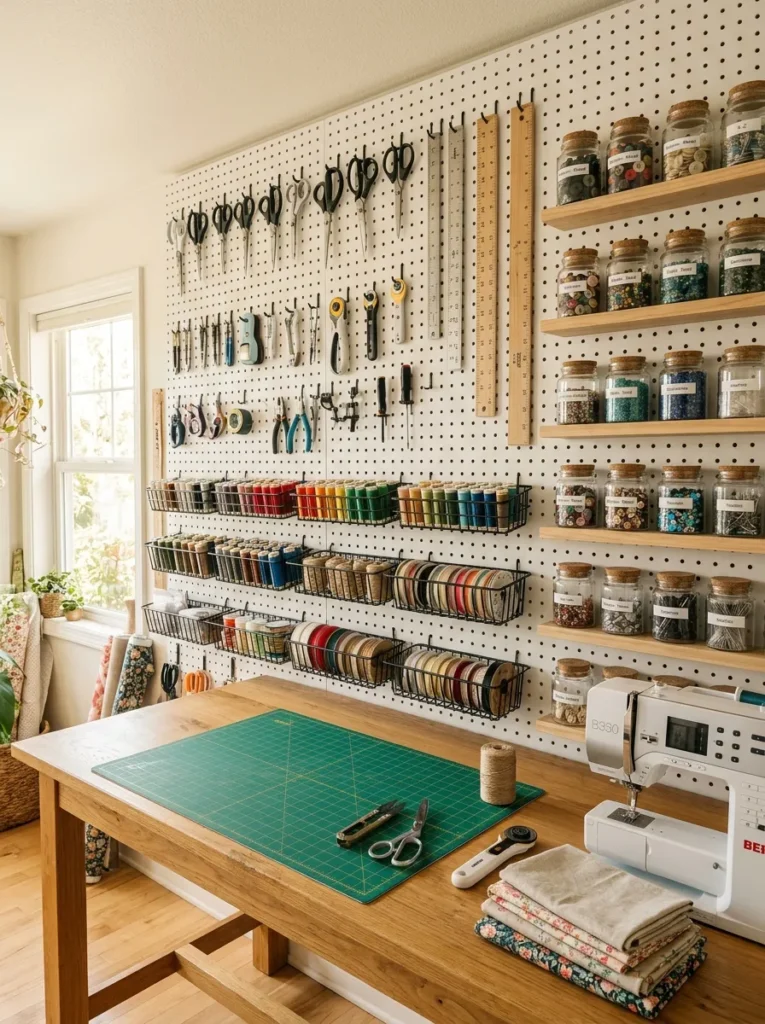
Vibe: Organized and energized — the wall that makes every tool feel like it is exactly where it belongs.
Why it works: A floor-to-ceiling pegboard studio wall applies the principle of maximum vertical surface activation — transforming the most prominent wall in the craft room from a passive background surface into the room’s primary organizational and visual system. The specific design advantage of full-height coverage over a partial pegboard panel is visual completeness: a pegboard that runs from baseboard to ceiling creates a unified graphic field that reads as intentional studio infrastructure rather than an accessory added to an ordinary wall. The combination of matte black hooks, wire baskets, wooden ledge shelves, and glass jars creates a layered visual texture across the white surface that functions simultaneously as organizational system and room decoration.
How to get it: Mount 4×8 foot pegboard panels using 1-inch furring strips between the board and wall — the gap is structurally necessary for hook insertion. Paint all panels with two coats of white semi-gloss latex before installation. Begin hook and basket placement by identifying the three most-reached-for tool categories and positioning them at the most accessible height zone (between shoulder and waist) before filling the upper and lower zones with less-frequently accessed items. Standardize to matte black hardware throughout — mixed metal finishes on a pegboard wall create visual noise that undermines the organizational clarity.
Quick Win: A single 4×4 foot pegboard section installed above the work surface costs under $20 in board and $15–$30 in initial hooks and baskets — this half-day project creates an immediately functional and visually complete tool organization zone before committing to a full wall installation.
| Product |
|---|
| White pegboard panel 4×8 ft standard hole |
| Matte black pegboard hook set assorted |
| Pegboard wire basket organizer set |
| Pegboard wooden ledge shelf small |
| Glass storage jar set with lids labels |
Also view: 15 Stylish Attic Bedroom Ideas for a Relaxing Retreat
2. Natural Light Studio with North-Facing Skylights
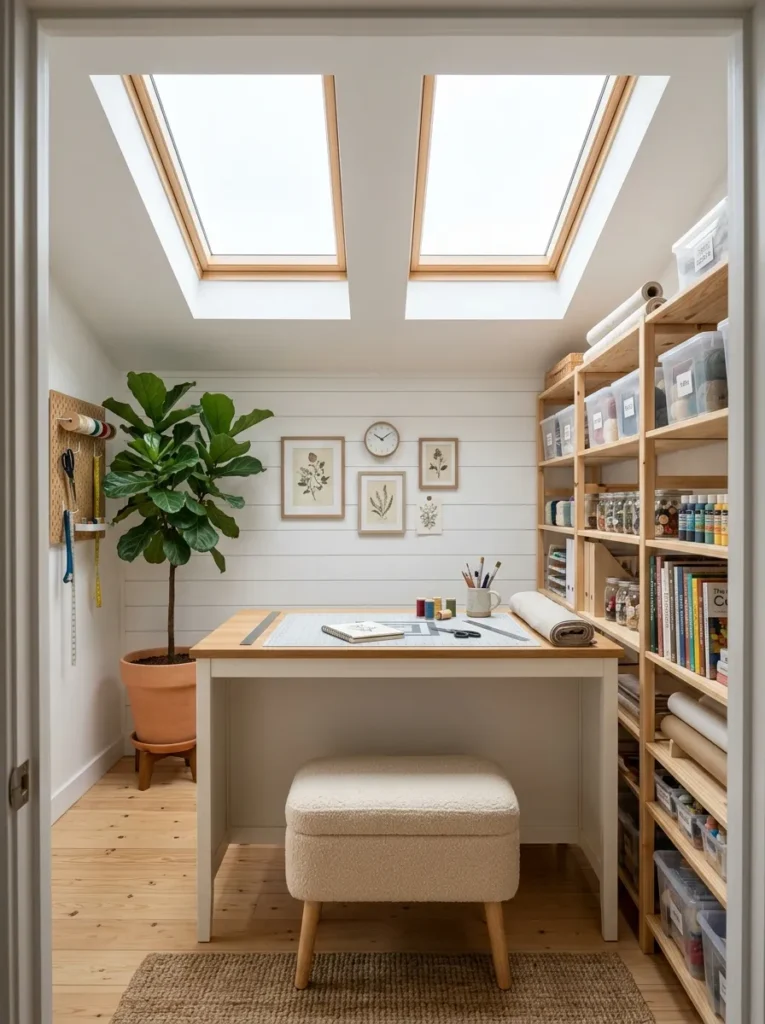
Vibe: Bright and creatively open — the studio that makes color look exactly as it should and shadow fall exactly where you need it.
Why it works: North-facing natural light is the most valued lighting condition in artist and craft studio design because it provides consistent, even illumination without direct sun — no harsh shadows crossing the work surface at different times of day, no color temperature shifts as the sun moves, and no glare that makes detailed handwork difficult. The design principle at play is light quality over light quantity: a north-facing skylight delivers less total light than a south-facing window, but the light it delivers is so consistent and diffuse that it serves fine craft work better than any artificial lighting alternative. Skylights over a work table provide this quality of light at the ideal angle — directly overhead, covering the full work surface without the wall obstruction that side windows create.
How to get it: For existing skylights, clean glazing panels annually and apply an anti-glare film to south-facing skylights that may admit direct sun during morning or evening hours. For new installations, specify north-facing roof orientation where possible — if north-facing installation is not possible due to roof geometry, specify glazing with a low solar heat gain coefficient (SHGC below 0.25) to reduce solar heat and glare while maintaining light transmission. Supplement with 5000K daylight-balanced LED task lighting for overcast days and evening work sessions.
| Product |
|---|
| VELUX skylight fixed deck-mounted |
| Daylight LED task lamp 5000K studio |
| White shiplap wall panel set |
| Natural pine open shelf unit adjustable |
| Cream upholstered adjustable craft stool |
Also view: 15 Yellow House Exterior Color Combinations
3. Pastel Color-Sorted Supply Display
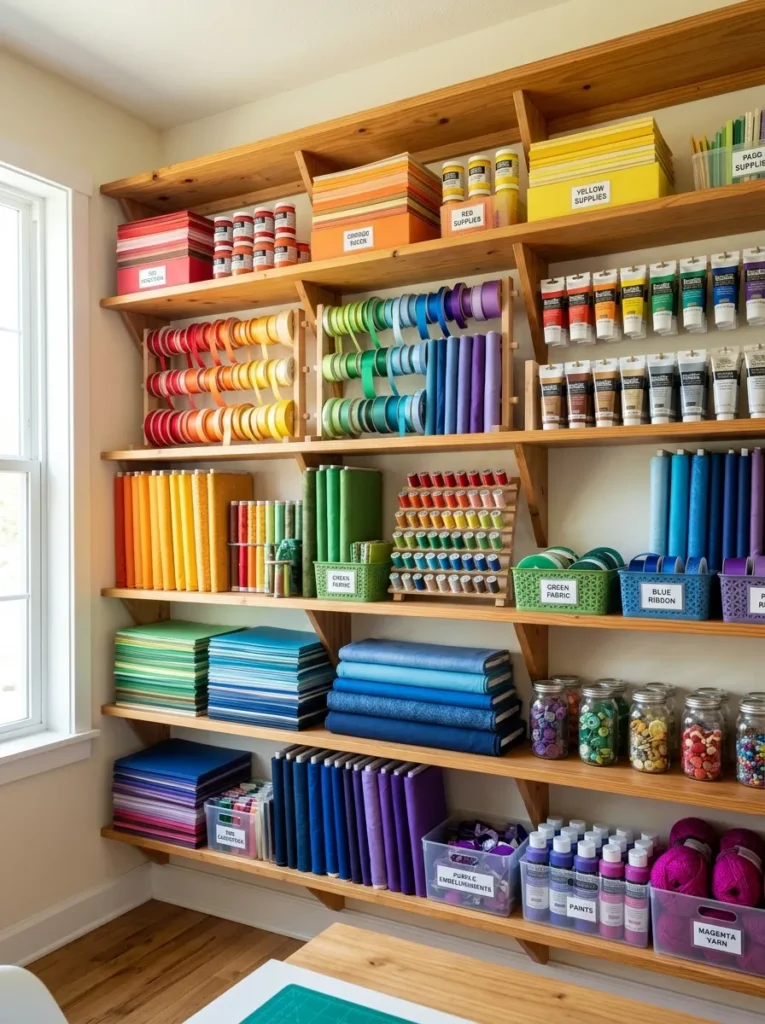
Vibe: Joyful and organized — the supply wall that makes color-matching feel effortless and makes the room itself a source of creative energy.
Why it works: Color-sorting supplies across open shelving applies the design principle of chromatic organization as visual display — the organized supplies become the room’s primary decoration while simultaneously being its most useful organizational system. A color-sorted supply wall does something that categorical organization by supply type cannot: it makes cross-category color relationships immediately visible, so a crafter can see in a single glance whether a paper color, a ribbon tone, and a fabric swatch all share the same warm coral register without pulling items from multiple storage locations. The full-spectrum display also functions as a constant color reference that stimulates creative thinking by keeping the full palette of available materials in peripheral vision during every work session.
How to get it: Begin color-sorting with the largest, most visually dominant supply category — typically cardstock or fabric — and use its sorted arrangement as the color reference for sorting all subsequent categories. Install adjustable-height pine shelving to allow shelf spacing to be customized to each category’s storage height requirements. Use 1-inch wooden dowel rods mounted between shelf uprights at the front of the shelf for ribbon spool storage — this is the technique that keeps ribbon visible, accessible, and color-sorted simultaneously without consuming shelf depth.
| Product |
|---|
| Adjustable pine shelf unit 72 inch tall |
| Wooden dowel rod 1 inch diameter pack |
| Cardstock paper rainbow assorted 65 lb |
| Small labeled storage bin set |
| Ribbon spool organizer dowel mount |
4. Farmhouse Craft Room with Shiplap and Wicker
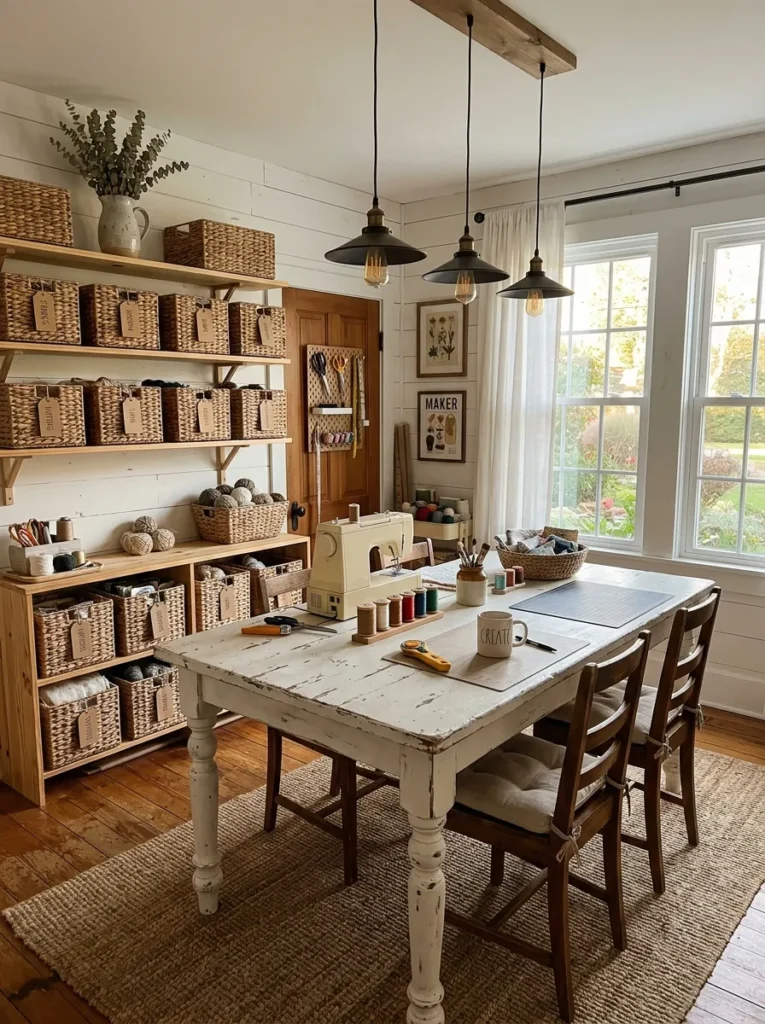
Vibe: Warm and settled — the craft room that feels like it has been accumulating the right things for years.
Why it works: A farmhouse craft room applies the aesthetic principle of functional rusticity — every organizational element (the wicker basket, the kraft label, the shiplap shelf backing, the distressed table surface) carries the warm, slightly imperfect character of traditional working farm spaces where storage was practical but the materials were inherently beautiful. Shiplap provides both a visually warm wall surface and a practical backdrop that is more forgiving of imperfect hanging than smooth drywall — the horizontal board lines provide natural visual reference for leveling shelves and hooks. Matching wicker baskets with handwritten kraft labels are the organizational element that most efficiently communicates the farmhouse aesthetic while maintaining functional storage clarity.
How to get it: Install white painted shiplap on the primary accent wall behind the main work table first — this single surface establishes the room’s farmhouse character and makes all subsequent decisions easier. Choose wicker baskets with straight sides in one consistent size for the primary open shelf storage — the uniformity of matching baskets creates visual order that allows the warmth of the wicker material to read as considered rather than collected randomly. Write labels on kraft tags using a fine-tip permanent black marker rather than a label maker — handwritten labels carry the warm human quality that makes a farmhouse space feel genuinely lived-in.
| Product |
|---|
| White shiplap wall panel set primed |
| Wicker storage basket set matching natural |
| Kraft paper label tag set with jute |
| Farmhouse pendant light vintage style |
| Natural jute area rug 5×8 |
5. Dedicated Cutting and Sewing Station
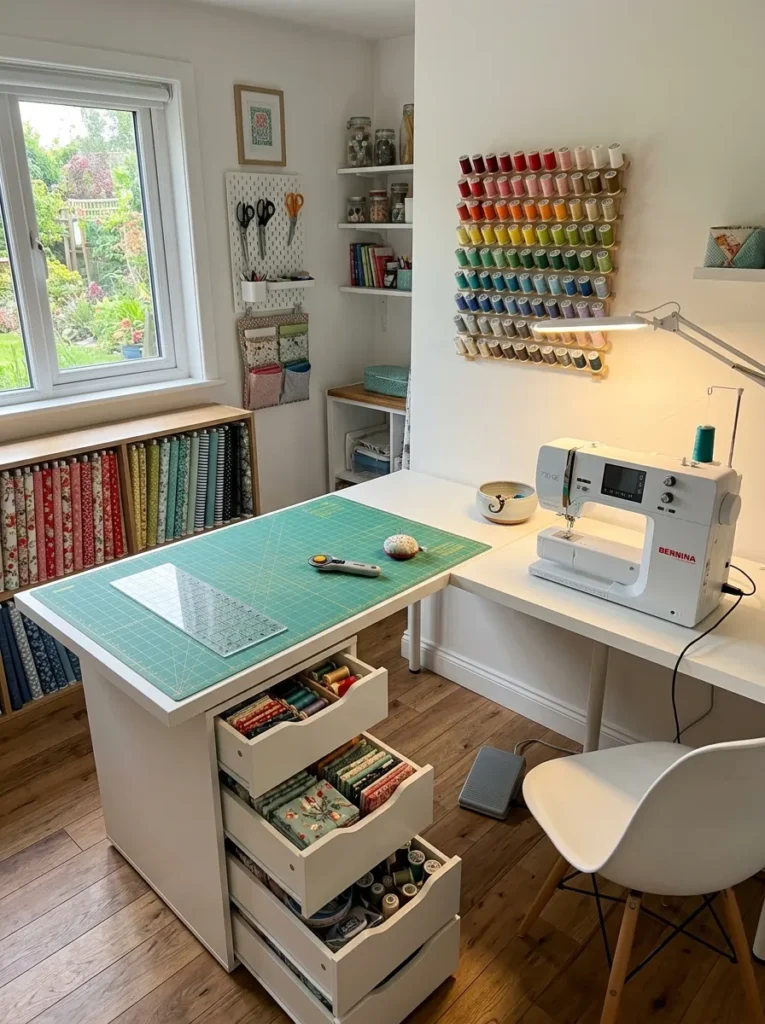
Vibe: Purposeful and organized — the station that makes a sewing project feel manageable from start to finish.
Why it works: A dedicated sewing and cutting station built at counter height (36 inches) rather than standard desk height (30 inches) applies the ergonomic principle of task-specific surface height — cutting fabric requires downward pressure from a standing position, which is ergonomically impossible at a seated desk height without back strain over extended sessions. The L-shaped configuration creates the functional separation that distinguishes a genuine sewing station from a sewing machine placed on a general desk: the cutting arm provides dedicated flat layout space that never needs to be cleared because it holds nothing else, while the sewing arm maintains the machine in its permanent, thread-loaded position. This separation of the two primary tasks reduces the setup and teardown time between sessions from 15–20 minutes to zero.
How to get it: Build the counter-height work surface from 3/4-inch plywood topped with a white laminate sheet — laminate provides a cleanable, slippery surface that fabric slides across easily during cutting and layout. Set the cutting arm surface at exactly 36 inches — the same height as a kitchen counter — and the sewing machine arm 2 inches lower at 34 inches to account for the machine’s height when seated at a stool. Install the thread rack on the wall directly above the sewing machine arm at arm’s reach height.
| Product |
|---|
| Self-healing cutting mat 24×36 with grid |
| Counter-height adjustable craft stool |
| Thread rack wall mount rotating |
| LED adjustable task lamp clamp-on |
| Under-desk drawer unit rolling white |
6. Boho Craft Room with Macramé and Plants
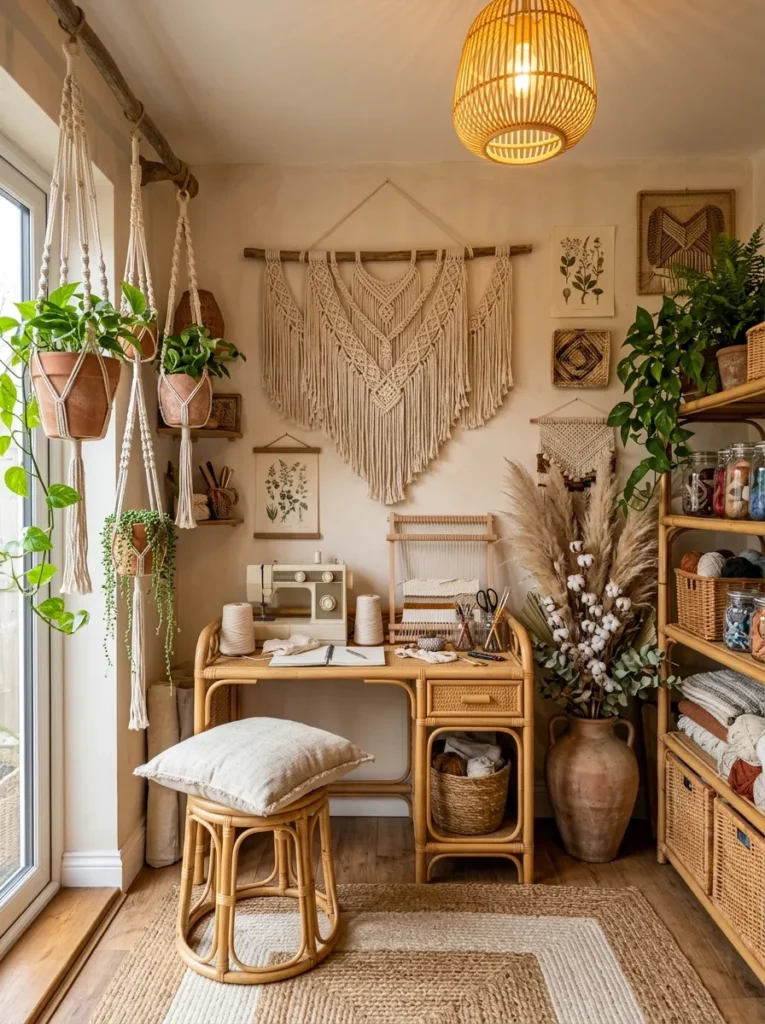
Vibe: Warm and layered — the creative space that makes every session feel like making in a garden.
Why it works: A boho craft room applies the design principle of organic material layering — natural materials in varied textures (macramé rope, rattan weave, terracotta clay, dried botanical) are stacked across multiple surfaces and heights, creating a room that reads as richly complex without any single expensive element. The macramé wall hanging above the work table serves three simultaneous functions: it provides the room’s primary decorative focal point, introduces the room’s foundational craft material (rope and knotting), and creates a visual backdrop for the work table that makes the space photograph well and feel personally expressive. Plant material — both living and dried — adds the dimension of temporal change to the room: the plants grow, the dried botanicals gradually shift in color, and the space never looks exactly the same twice.
How to get it: Anchor the boho aesthetic with the macramé wall hanging first — it should span at least two-thirds of the wall width above the work table to read as architectural rather than accessory. Source rattan furniture and shelving in natural honey rather than dark-stained rattan — dark rattan reads as heavy and dated while natural honey rattan reads as warm and contemporary. Cluster plants in the corner farthest from the work table for spatial balance, and use terracotta pots exclusively — the consistency of pot material creates visual cohesion across varied plant species and sizes.
| Product |
|---|
| Large macramé wall hanging natural cotton |
| Macramé plant hanger set of 3 natural |
| Rattan shelf unit adjustable natural |
| Terracotta pot set assorted sizes |
| Dried pampas grass bunch large natural |
7. Dark Academia Craft Room in Deep Navy
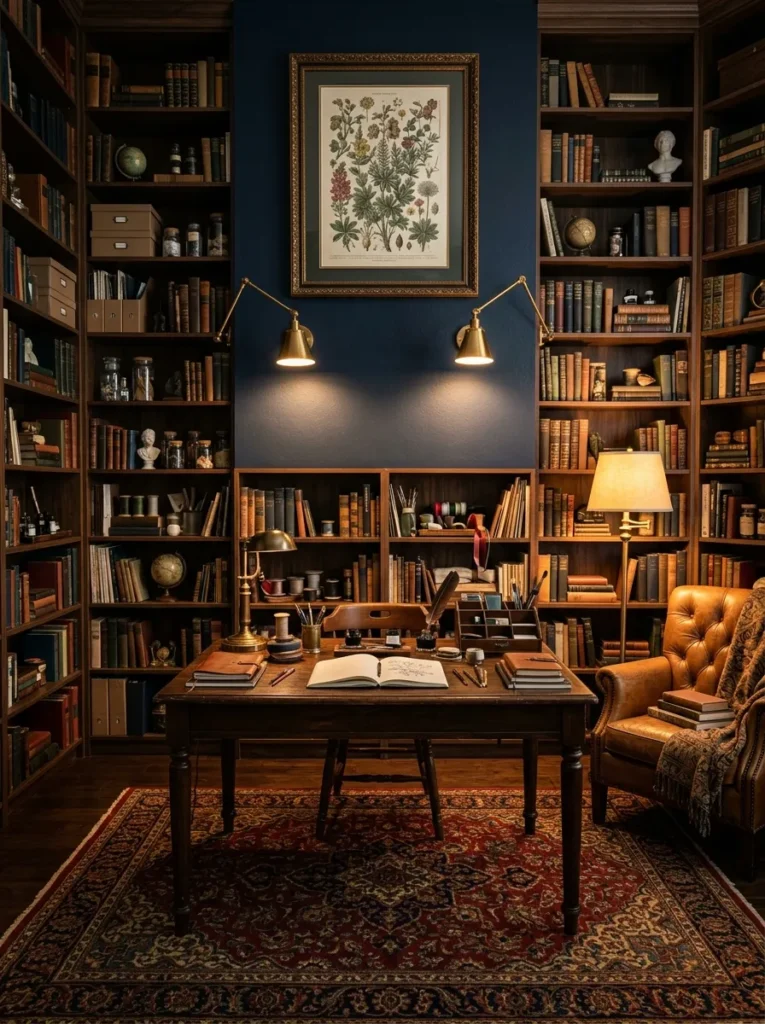
Vibe: Warm and intellectual — the craft room where making feels like a serious, pleasurable act of scholarship.
Why it works: A dark academia craft room applies the chromatic enclosure principle — deep navy walls surrounding a compressed room create intentional intimacy that amplifies focus and concentration rather than diminishing them. The specific appeal of the dark academia aesthetic in a craft room context is the elevation it provides to the act of making: surrounded by floor-to-ceiling books, warm brass light, and a serious writing table, the craft practice feels weightier and more significant — a legitimate intellectual and aesthetic pursuit rather than a casual hobby. Warm brass hardware against deep navy walls creates the room’s defining material tension — the warm metal reads as luminous against the dark wall, which makes the brass elements (sconces, drawer pulls, lamp) the room’s primary light sources even before they are switched on.
How to get it: Paint walls in Farrow and Ball Hague Blue (No. 30) or Benjamin Moore Naval (SW 6244) — both are deep navies with a slightly green undertone that prevents the color from reading as cold or flat in warm artificial light. Install floor-to-ceiling bookshelves in dark walnut or ebonized oak — the dark wood reads as cohesive with the navy wall rather than contrasting against it, creating a unified dark envelope that makes the warm brass and leather furniture elements pop by contrast.
| Product |
|---|
| Deep navy interior paint Farrow and Ball |
| Brass wall library sconce pair |
| Dark walnut bookshelf floor-to-ceiling |
| Antique writing table dark walnut |
| Vintage Persian rug deep red navy 5×8 |
8. Minimalist White Craft Room with Concealed Storage
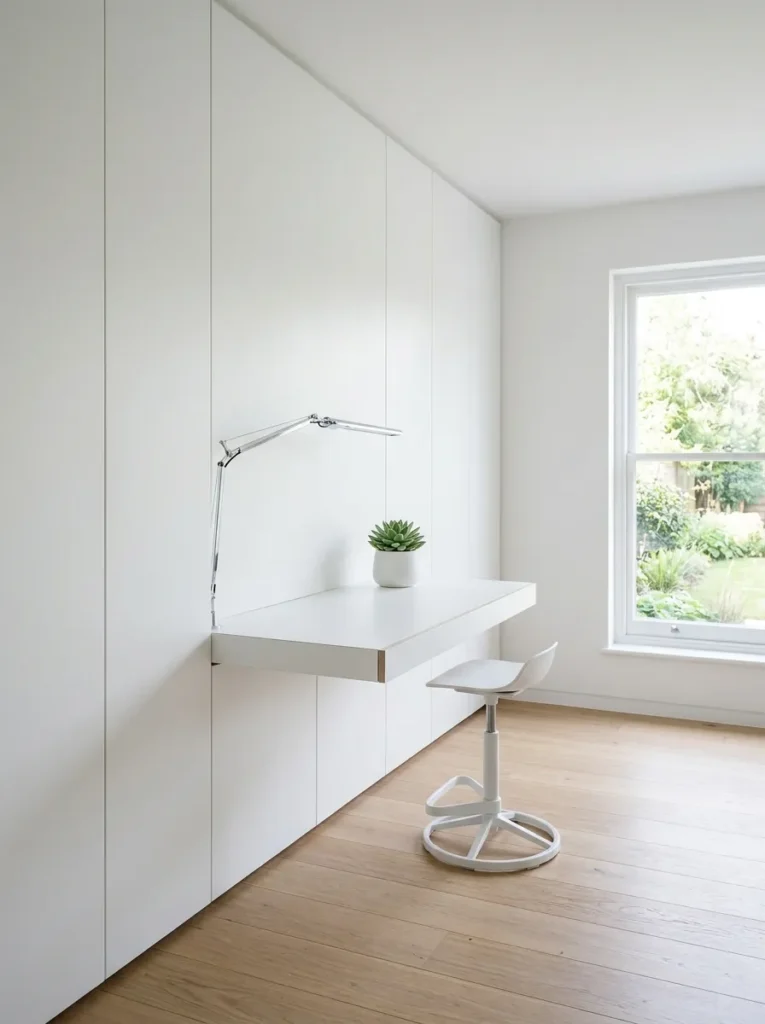
Vibe: Serene and clear-headed — the craft room that proves a creative space can be genuinely calm.
Why it works: A minimalist craft room with fully concealed storage applies the design principle of visual noise elimination — every supply, material, and tool is stored behind closed cabinet doors, leaving the work surface and room interior as a clean, distraction-free environment in which the current project is the only visual focus. This principle runs counter to the conventional craft room wisdom that supplies should be visible and accessible, but it reflects a genuine creative reality: for many makers, visual clutter in the peripheral field of vision competes with creative focus in the same way that background noise competes with concentration. A room where everything is hidden except the current work is a room where the current work receives the maker’s full attention.
How to get it: Specify full-height cabinets (floor-to-ceiling) in the same white as the wall paint — the ceiling-height cabinets and color matching create the seamless surface effect that makes the storage wall disappear rather than dominate. Install push-to-open hardware rather than handles on all cabinet doors — handles interrupt the seamless surface and add visual punctuation to a design that depends on visual silence. Organize cabinet interiors with pull-out drawers, lazy Susans, and adjustable shelving rather than fixed shelf positions — the interior organization flexibility compensates for the rigidity of the concealed exterior.
| Product |
|---|
| Full-height white cabinet set floor-to-ceiling |
| Push-to-open cabinet hardware set |
| White floating desk shelf wall mounted |
| Daylight LED task lamp adjustable |
| White ergonomic adjustable stool |
9. Craft Room with Dedicated Inspiration Board Wall
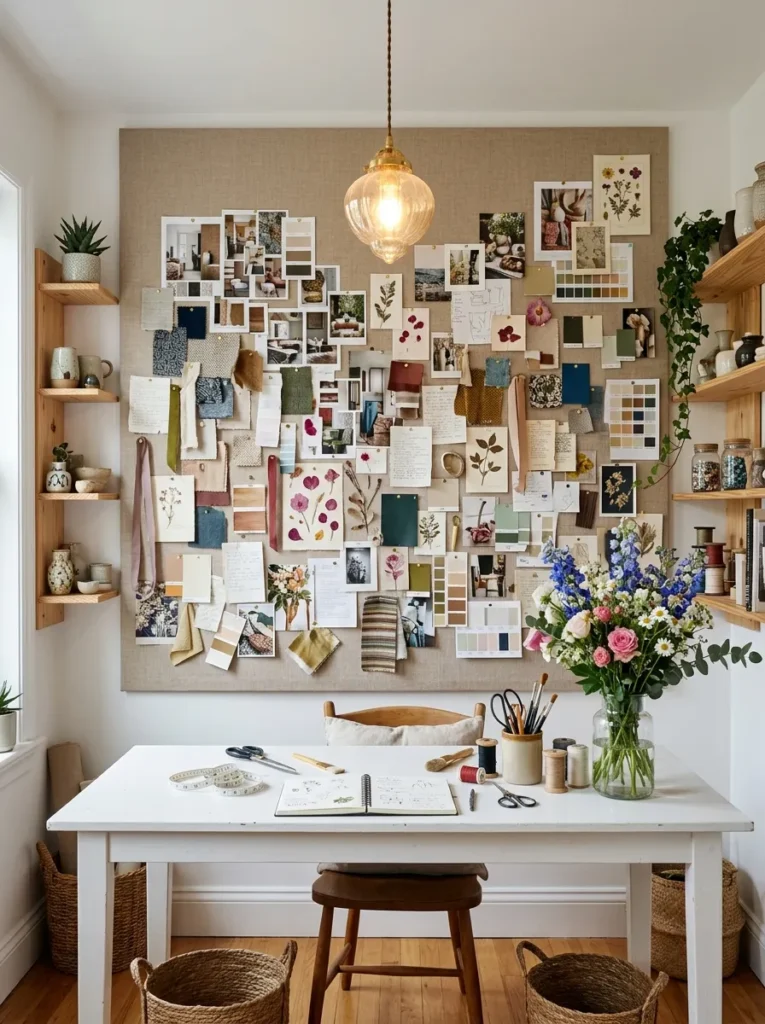
Vibe: Creative and alive — the wall that holds the visual thinking behind everything made at the table below it.
Why it works: A dedicated inspiration board wall serves a specific creative function that no organizational system can replicate — it externalizes the maker’s current aesthetic direction, making the intuitive color preferences, material affinities, and stylistic instincts that guide creative decisions visible and tangible rather than remaining as vague mental impressions. Working with an inspiration board visible in the peripheral field of vision during making sessions fundamentally changes the decision-making process: color choices become faster, material selections become more confident, and creative blocks occur less frequently because the aesthetic direction is continuously visible rather than having to be reconstructed from memory each session. A full wall of linen corkboard rather than a single pinboard allows the inspiration collection to expand to the scale that actually reflects a complex creative project.
How to get it: Cover a 4×8 foot corkboard sheet (available at home improvement stores for $20–$30) with natural linen fabric — stretch and staple the linen to the board back for a clean, professional surface that pins cleanly and reads as warm rather than institutional. Mount at eye level above the work table using heavy-duty picture mounting hardware. Refresh the board at the beginning of each new project, removing previous project content completely — a board that accumulates content from multiple projects without editing stops functioning as a focused creative reference and becomes visual clutter.
| Product |
|---|
| Large corkboard sheet 4×8 ft |
| Natural linen fabric yard for corkboard |
| Brass push pin set 100 count |
| Pine floating shelf small set of 2 |
| Clear glass vase bud set |
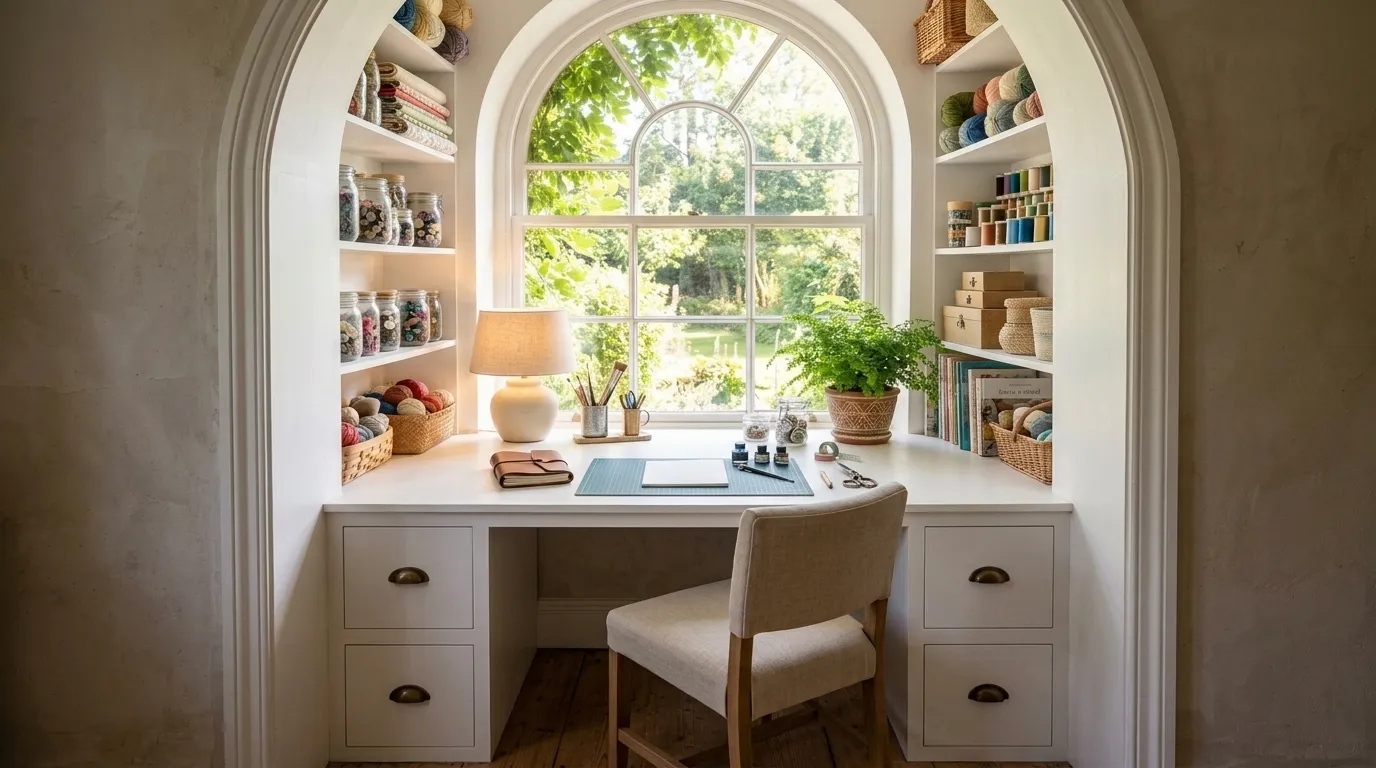
10. Craft Room with Arched Window Work Nook
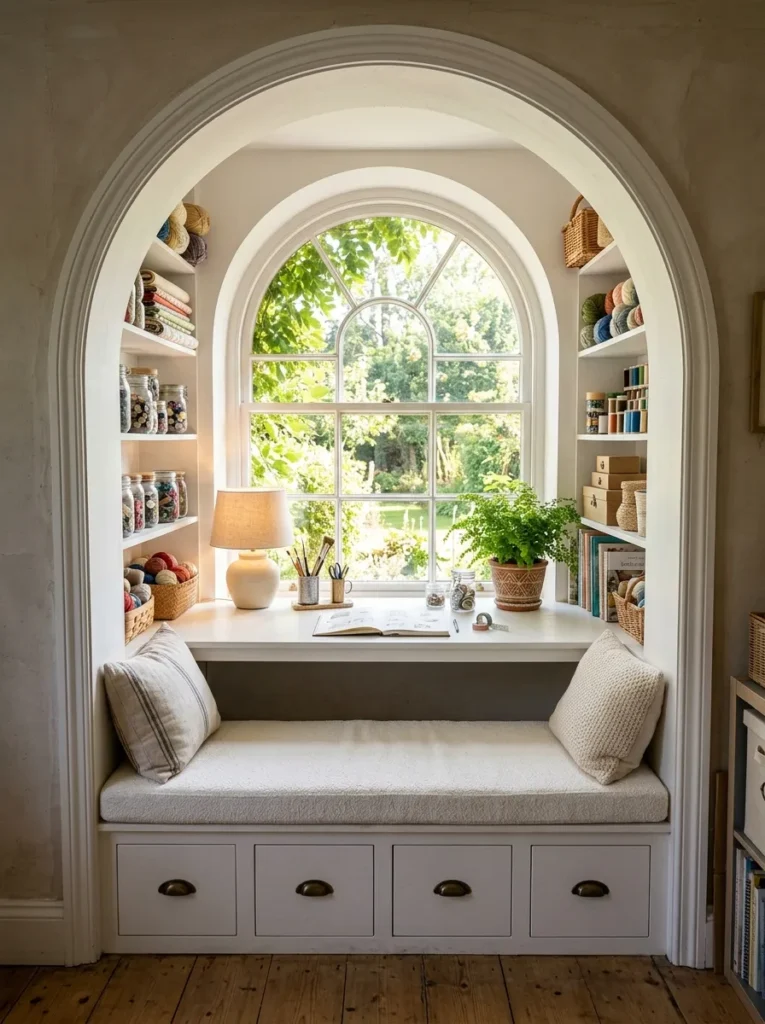
Vibe: Warm and sheltered — the work nook that makes a craft session feel like a private ritual.
Why it works: An arched window work nook applies the principle of architectural specificity — building the work surface and storage into the exact geometry of the window recess creates a space where the architectural feature and the functional workspace are unified into a single element. The arch overhead functions as a natural canopy that creates the zone-of-focus effect associated with the most productive work environments: the defined boundary of the arch separates the primary work zone from the broader room, helping the maker’s attention to remain within the creative task rather than distributing across the full room’s visual field. Morning light flooding directly onto the work surface from the window above provides ideal natural task lighting for detailed handwork during the primary creative hours.
How to get it: Build the work surface from 3/4-inch plywood faced with white laminate, fitted precisely to the arch opening width at standard desk height (30 inches). Install adjustable bookshelves on both inner arch side walls before fitting the work surface — the shelves become accessible from the seated working position without requiring the maker to leave the nook. Build the storage drawer unit below the work surface from the arch floor to the underside of the surface, using full-extension drawer slides for complete access to drawer depth.
| Product |
|---|
| White laminate work surface cut to size |
| Adjustable small bookshelf set built-in |
| Full-extension drawer slide set |
| White upholstered seat cushion custom |
| Small adjustable LED desk lamp |
11. Craft Room with Rainbow Thread and Yarn Wall
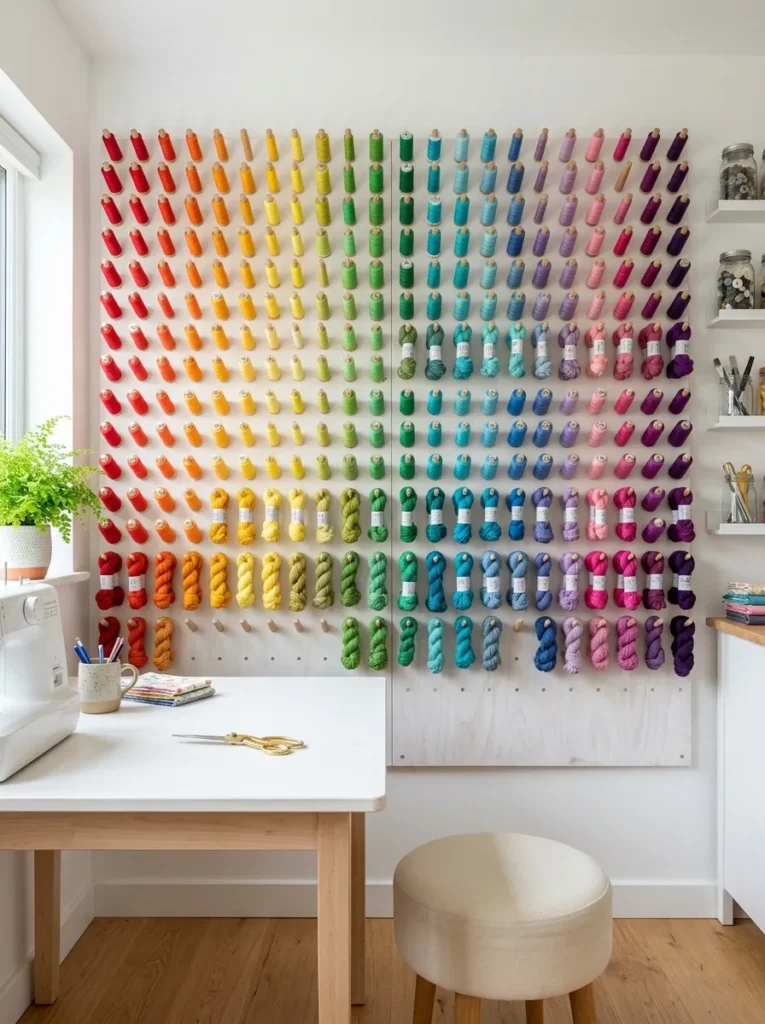
Vibe: Joyful and inspiring — the wall that makes every color decision feel like a gift rather than a problem.
Why it works: A rainbow-sorted thread and yarn wall applies the design principle of inventory display as color installation — the maker’s working materials are organized and displayed in a way that makes the room itself a creative resource independent of any specific project. Sorted into spectrum order, the thread and yarn wall makes color relationships immediately visible — a maker can see in seconds which shades of blue-green they have, which oranges read as warm versus cool, and what the full range of available neutrals looks like — without pulling a single item from storage. The two-material display (smooth thread spools and textured yarn skeins side by side) creates micro-texture variation across the color gradient that makes the wall as visually interesting as any gallery installation.
How to get it: Mount 1/4-inch wooden thread holder pegs (sold in packs of 50) on a 4×8 foot plywood panel painted white, spacing pegs 2 inches apart in a regular grid. Sort all thread and yarn into ROYGBIV order before mounting — this sorting session typically reveals purchasing duplicates and gaps in the color range, providing a shopping list for the next craft supply run. Hang the panel on the wall using heavy-duty French cleat hardware to allow the entire panel to be removed and replaced easily.
| Product |
|---|
| Wooden thread spool holder peg pack 50 |
| White plywood panel 4×4 craft backing |
| French cleat wall mount kit heavy duty |
| Thread spool set rainbow color pack |
| Yarn skein set mixed weight natural dye |
12. Cottage Craft Room with Painted Furniture
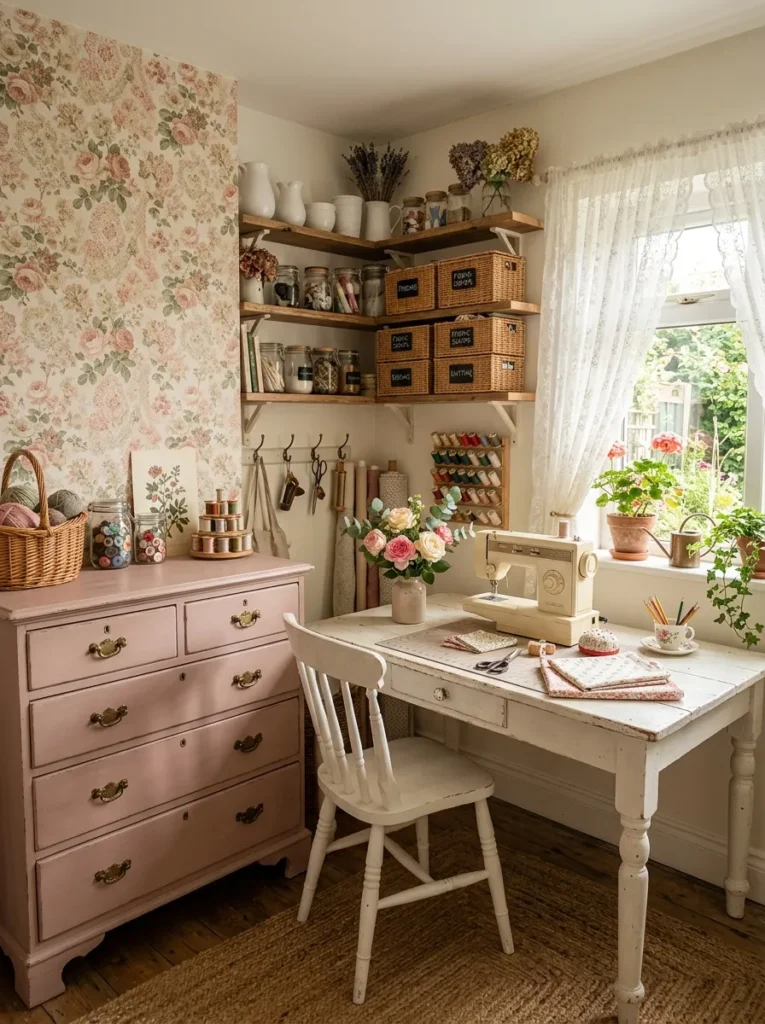
Vibe: Warm and charming — the craft room that makes making feel like the most natural thing in the world.
Why it works: A cottage craft room built around painted vintage furniture applies the design principle of character through transformation — a vintage dresser repainted in dusty rose and used as supply storage carries far more personality than a purpose-built craft storage unit at twice the price, because the original form of the furniture (its drawer pulls, its leg profile, its slightly irregular drawer faces) tells a material story that manufactured storage cannot replicate. The combination of painted furniture in the same soft palette, floral wallpaper on one accent wall, and fresh or dried botanical accents creates a room that reads as romantically personal — a space that reflects the specific aesthetic sensibility of its occupant rather than a generic creative workspace.
How to get it: Source vintage dressers, side tables, and bookcases from estate sales, thrift stores, or Facebook Marketplace — pieces with good bone structure (solid drawer construction, stable frame) but outdated finishes are ideal candidates for craft room transformation. Paint with chalk-finish furniture paint in dusty rose, sage green, or soft blue — chalk finish adheres without sanding in most cases and produces the soft matte finish most appropriate for cottage furniture. Distress edges lightly with fine sandpaper after the paint dries to reveal the wood beneath at the highest wear points.
| Product |
|---|
| Chalk finish furniture paint dusty rose |
| Vintage dresser knob set ceramic white |
| Floral accent wallpaper soft tone roll |
| White lace curtain panel set |
| Wicker box set with lid labeled |
13. Multipurpose Craft and Guest Room Design
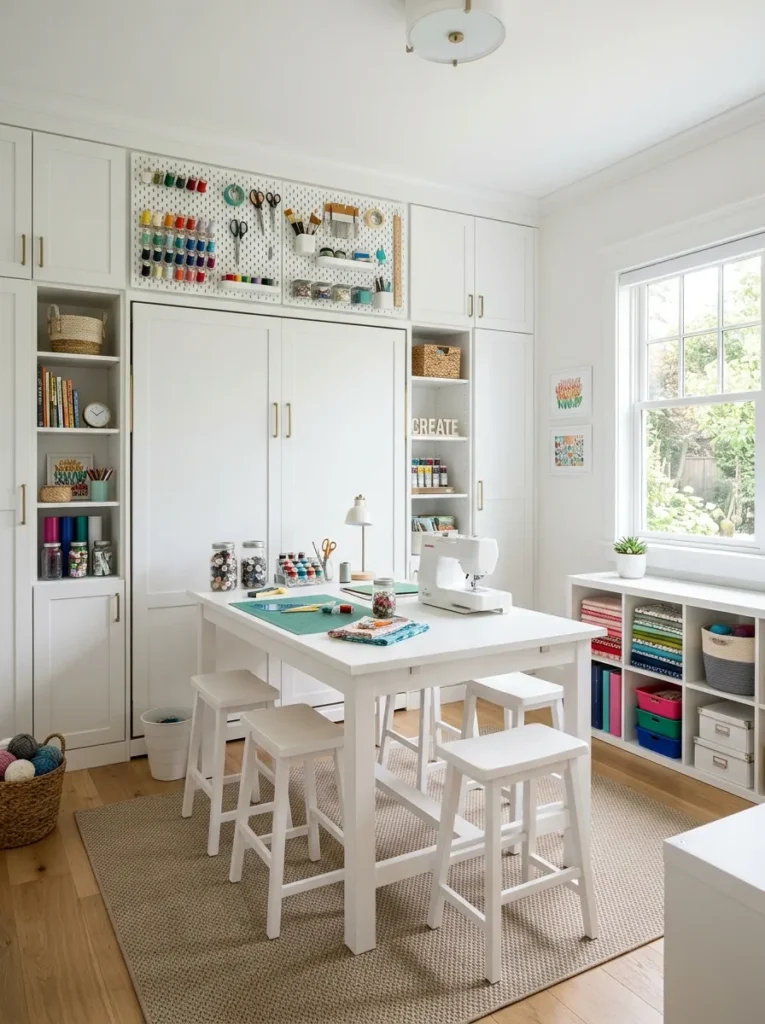
Vibe: Clever and clean — the room that proves you do not have to choose between a creative space and a guest room.
Why it works: A Murphy bed integrated into the craft room’s cabinet wall applies the principle of temporal space multiplicity — the room serves two completely different primary functions at different times without either function compromising the other, because the transition between them requires only the folding of a bed rather than the clearing and storing of one room’s worth of furniture. The key design requirement is that the Murphy bed cabinet reads as storage wall when closed — not as a folded-bed wall — which is achieved through flush cabinet doors in the same white as the room’s other storage, continuous base molding across the full wall width, and the integration of genuine supply storage (shelves, drawers) within the same cabinet unit that houses the bed mechanism.
How to get it: Specify a Murphy bed unit with integrated cabinet storage on both sides of the bed panel — most quality Murphy bed systems include this option, with shelf-and-drawer configurations available on each side of the central bed. Position the craft work table at the center of the room rather than against the Murphy bed wall — this ensures the table does not need to be moved when the bed is deployed, and the guest can use the room without the maker needing to clear their work surface. Install the pegboard organization system on the wall opposite the Murphy bed so it remains accessible and visible during both craft and guest room configurations.
| Product |
|---|
| Murphy wall bed cabinet white queen |
| Murphy bed mechanism hardware kit |
| Central work table white adjustable height |
| Pegboard panel set white 4×8 |
| Cube shelf organizer 9-cube white |
How to Start Your Craft Room Transformation
Start with the lighting. Before reorganizing a single supply, purchasing a single bin, or painting a single wall, address the lighting in your craft space — add a 5000K daylight-balanced LED task lamp directly over your primary work surface if you have one already, or identify the specific wall or corner where light quality is best and position your work surface there before any other furniture decision is made. The quality of light in a craft space determines the quality of every color decision, every detail judgment, and every extended work session the space supports. A craft room with inadequate lighting is a space that discourages use regardless of how well it is organized or how beautifully it is decorated — and this is the single most common reason craft rooms become storage rooms rather than working studios.
The most common mistake craft room designers make is organizing for display rather than for use — purchasing beautiful matching bins and baskets that look perfect on shelves but that require removing a lid, untying a tag, or opening a closure before accessing any supply. The organizational standard that makes a craft room genuinely functional rather than merely beautiful is zero-barrier access to frequently used supplies: the scissors are on a hook where the hand reaches without looking, the most-used thread colors are on pegs at arm’s reach from the sewing machine, and the current project’s materials are in an open tray on the work surface rather than stored away between sessions. Beautiful matching bins are appropriate for seasonal supplies and materials used monthly — daily and weekly supplies need open, immediate, zero-barrier access regardless of how it photographs.
Three items under $50 that make an immediate impact: A 5000K daylight LED task lamp ($18–$28) mounted directly above the primary work surface that immediately improves the accuracy of every color decision made in the space; a 4×4 foot white pegboard panel with a starter set of matte black hooks ($20–$35 total) installed above the work table that converts the most critical organizational zone from cluttered surface to clean wall in a single afternoon; and a set of six clear stackable bins with label holders ($14–$18) that converts any existing shelf from a stacking zone into a readable, navigable supply system with zero construction required.
Realistic expectations: A basic craft room refresh — task lighting upgrade, pegboard installation, labeled bins, and a color-sorted supply reorganization — takes one focused weekend and costs $60–$150 in materials. A mid-level craft room transformation adding a dedicated cutting station, a full inspiration board wall, and a complete storage system with built-in shelving typically takes two weekends and costs $200–$500 in materials. A full craft room build-out — Murphy bed integration, custom cabinetry, studio lighting, and complete fitted storage — typically costs $1,500–$5,000 DIY depending on size and specification, with professionally designed and installed craft studio conversions beginning at $8,000–$15,000 for equivalent quality and scope.
Frequently Asked Questions About Craft Room Ideas
What is the most important feature in a functional craft room?
Adequate task lighting at the correct color temperature is the single most important feature in a functional craft room — above storage, above workspace size, and above aesthetic design. A craft room with insufficient or incorrectly colored light produces inaccurate color decisions (fabric that looks salmon pink under warm light reveals itself as coral red in daylight), causes eye fatigue during detailed work (embroidery, fine cutting, detailed painting), and discourages extended creative sessions. Specify 5000K daylight-balanced LED lighting at a minimum of 50 foot-candles of illuminance at the work surface — most residential lighting provides 20–30 foot-candles, which is adequate for reading but insufficient for detailed craft work.
How do I organize a craft room when I have multiple creative hobbies?
Organize by activity zone rather than by supply type — designate a specific area of the room for each creative discipline (sewing zone, paper crafting zone, painting zone) and keep all supplies for each discipline contained within its zone. A maker who must assemble supplies from multiple locations across the room before beginning a creative session faces enough friction to make starting a project feel effortful rather than inviting. Zone organization means that beginning any creative activity requires only sitting down in the appropriate zone — every supply needed is already there, stored in the specific format appropriate to that discipline (upright paper in a wall file for paper crafting, thread on pegboard pegs beside the sewing machine for textile work, paints in a tilted palette organizer beside the easel for painting).
What size room do I need for a dedicated craft room?
A fully functional dedicated craft room can be achieved in as little as 80 square feet — approximately an 8×10 foot room — when the space is planned with vertical storage in mind. The minimum functional requirements are: a work surface of at least 24 inches deep and 48 inches wide for layout and assembly work, 8 linear feet of shelving for supply storage at accessible height, a dedicated pegboard or hook system for tool organization, and adequate task lighting above the work surface. Rooms smaller than 80 square feet function better as dedicated single-discipline studios (a sewing room, a painting corner) than as multi-discipline craft rooms, since the minimum equipment for multiple disciplines requires more floor area than a very small room can accommodate without creating organizational conflicts between disciplines.
How do I make a shared room work as both an office and a craft room?
The key to a successful office-craft room combination is the establishment of clear physical boundaries between the two functions — a dividing element (a bookshelf, a half-wall, or simply a consistent line of demarcation in the room’s floor plan) that prevents craft supplies from migrating into the office zone and office equipment from colonizing the craft surface. The office function requires a clean, professional background for video calls (position the office desk facing away from the craft storage wall), quiet focus conditions (position craft storage where tools are not visible from the seated office position to reduce distraction), and an organized visual environment (all craft supplies behind closed doors or in consistent opaque bins on the office-adjacent side). The craft function requires open supply access and a large flat work surface — both of which are incompatible with a clean office aesthetic unless they are separated by a physical or visual boundary.
What flooring is best for a craft room?
Vinyl plank flooring in a wood-look finish is the most practical craft room flooring choice for most makers — it is comfortable underfoot during extended standing sessions, resists spills, paint drips, and adhesive better than hardwood or laminate, and cleans completely with a damp mop. For makers whose primary discipline involves fabric (sewing, quilting, weaving), a floor that contrasts clearly with fabric color is preferable — a medium-tone wood-look vinyl rather than a light or white floor allows dropped pins, needles, and fabric pieces to remain visible. For painters, a floor that can withstand occasional paint spills without permanent staining eliminates the anxiety about working near the floor edge — sealed concrete or commercial-grade vinyl tile are both appropriate. Avoid carpet in any craft room where scissors, pins, needles, or small beads are used — these items disappear into carpet pile and create genuine safety hazards.
Ready to Create Your Dream Craft Room Creative Space?
These 13 ideas cover the full range of what a beautiful craft room can become — from the graphic precision of a floor-to-ceiling pegboard studio wall and the romantic warmth of a cottage craft room with painted furniture, to the focused calm of a minimalist concealed-storage studio and the multipurpose ingenuity of a Murphy bed craft-guest room combination. Every craft room transformation begins with a single decision that makes the space more functional or more personally expressive than it was the day before — and installing a daylight task lamp directly above your work surface this weekend is a complete, genuinely transformative first step that will change the quality of every creative session you have in that space from that day forward. Right now, sit at your existing work surface, look at the light falling on your hands, and ask whether it is accurate, adequate, and energizing — if it is not, that is where you begin, and everything else builds from there. Save the ideas that match your creative practice, your room’s architecture, and the making life you want to sustain for years — and start from that first lamp.