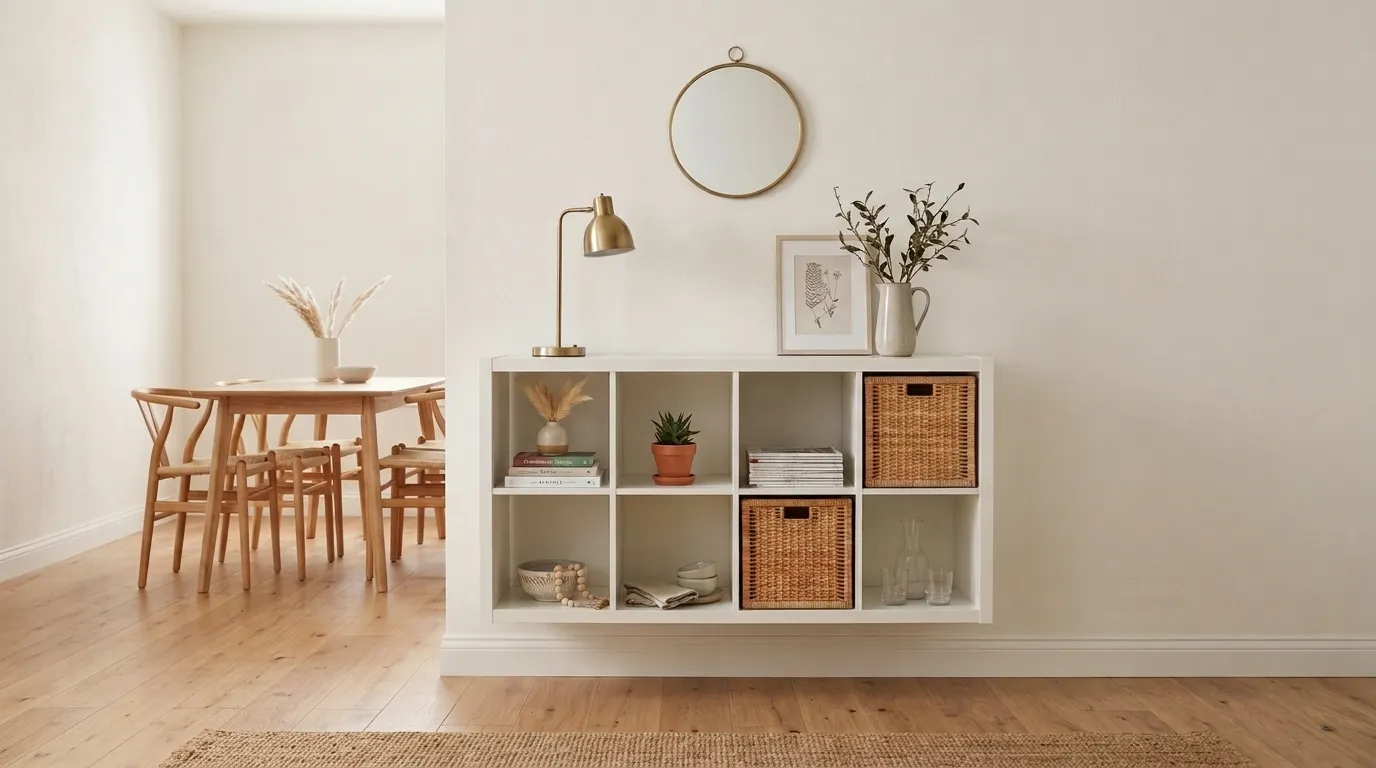
15 Modern KALLAX Sideboard Hacks for Stylish Homes
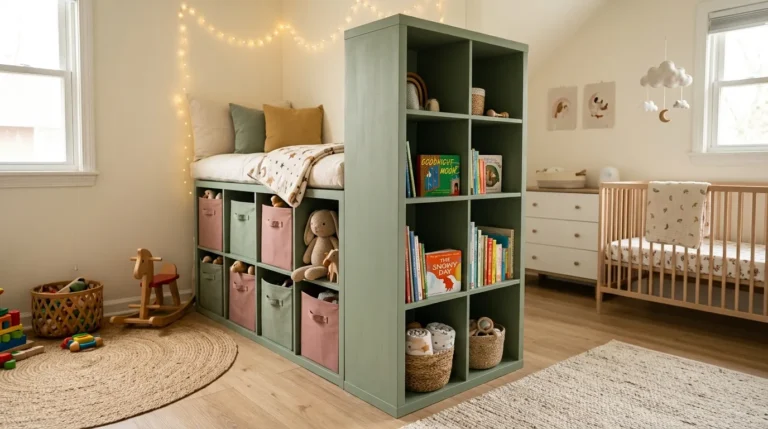
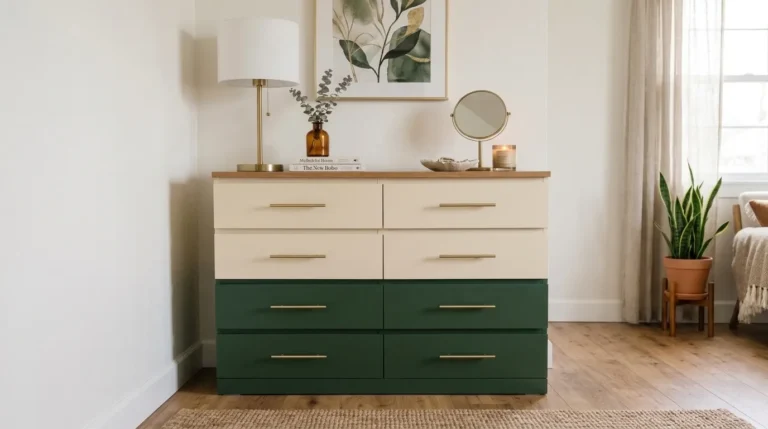
A KALLAX sideboard hack is the transformation of IKEA’s KALLAX shelving unit — a modular grid of 13×13-inch cube openings available in 1×2, 2×2, 4×2, and other configurations — from a functional storage piece into a finished, design-intentional sideboard, media console, or room divider through the addition of legs, doors, hardware, paint, facing material, or compositional styling that elevates it beyond its flat-pack origins into something that reads as custom furniture. This article gives you 15 KALLAX sideboard hack ideas across leg installations, door additions, facing materials, paint treatments, hardware upgrades, and styling approaches so your KALLAX unit becomes the most design-credible piece of furniture in the room it occupies.
The KALLAX is the most hackable piece of IKEA furniture because it starts from a position of genuine structural integrity — its cube grid is precisely dimensioned, perfectly square, and built from a particleboard composite that accepts paint, adhesive veneers, and face frames with equal reliability. The hack’s job is not to fix the KALLAX but to finish it — to add the material quality, the proportional refinement, and the design intention that IKEA deliberately leaves off to keep the price accessible and the customization possibilities open. Here are 15 ideas worth saving — and building.
Why KALLAX Sideboard Hacks Work So Well
The KALLAX sideboard hack draws from the long tradition of the modified ready-made — the design and craft practice of taking a manufactured object as a starting point and adding the material specificity, proportional refinement, and personal intention that elevates it from mass production to something genuinely individual. Ready-made modification has a distinguished history in both fine art (Duchamp’s assisted readymades, the Situationist détournement tradition) and in practical craft (the tradition of customizing flat-pack furniture that IKEA’s design philosophy essentially invented as a domestic craft category). The KALLAX specifically has generated one of the most extensive DIY and hack communities in furniture culture precisely because its dimensional precision makes it an ideal modification base.
The structural properties that make KALLAX an ideal sideboard hack base are specific and worth understanding. The KALLAX’s cube openings (13×13 inches interior dimension) are large enough to accept standard fabric insert boxes, wine bottle storage, and most standard filing systems — making the structure genuinely functional in its unmodified state. The panel thickness (approximately 1.25 inches on most models) provides enough material for screw installation of leg brackets, face frame attachment, and hardware mounting without structural compromise. And the KALLAX’s available configurations (the 2×2 for a small apartment sideboard, the 4×2 for a full living room or dining room credenza, the 1×4 vertical for a narrow hallway piece) cover the dimensional range that most residential sideboard applications require.
The contemporary design context for KALLAX hacks is specifically favorable. The warm minimalism aesthetic — the dominant residential design direction of the current decade — prioritizes honest material quality, warm wood tones, and restrained design language over the more elaborate furniture forms of previous decades. A KALLAX unit on solid walnut or white oak legs, with brass bar pulls and a veneer-faced surface in a warm natural tone, participates in this aesthetic with complete conviction and produces a finished piece that reads identically to a custom sideboard costing five to ten times as much.
Small homes and apartments benefit particularly from KALLAX sideboard hacks because the unit’s modular dimensional system allows precise customization to available wall space — a 4×2 KALLAX at 57 inches wide and 29.5 inches tall, elevated on 6-inch legs, produces a sideboard of exactly the proportions that most dining rooms and living rooms require, at a total finished cost of $150–$400 that compares favorably to any ready-made sideboard in the same category.
Style at a Glance
| Element | Detail |
|---|---|
| Philosophy | The ready-made as starting point — KALLAX provides the structure, the hack provides the material quality and design intention |
| Key Upgrades | Leg installation, door addition, face frame or veneer facing, hardware, paint treatment, interior lining |
| Key Materials | Solid walnut legs, white oak veneer, unlacquered brass hardware, matte black legs, concrete contact paper |
| Total Cost Range | $80–$500 depending on configuration and upgrade complexity |
15 Modern KALLAX Sideboard Hacks
1. KALLAX on Solid Walnut Hairpin Legs as a Dining Room Sideboard
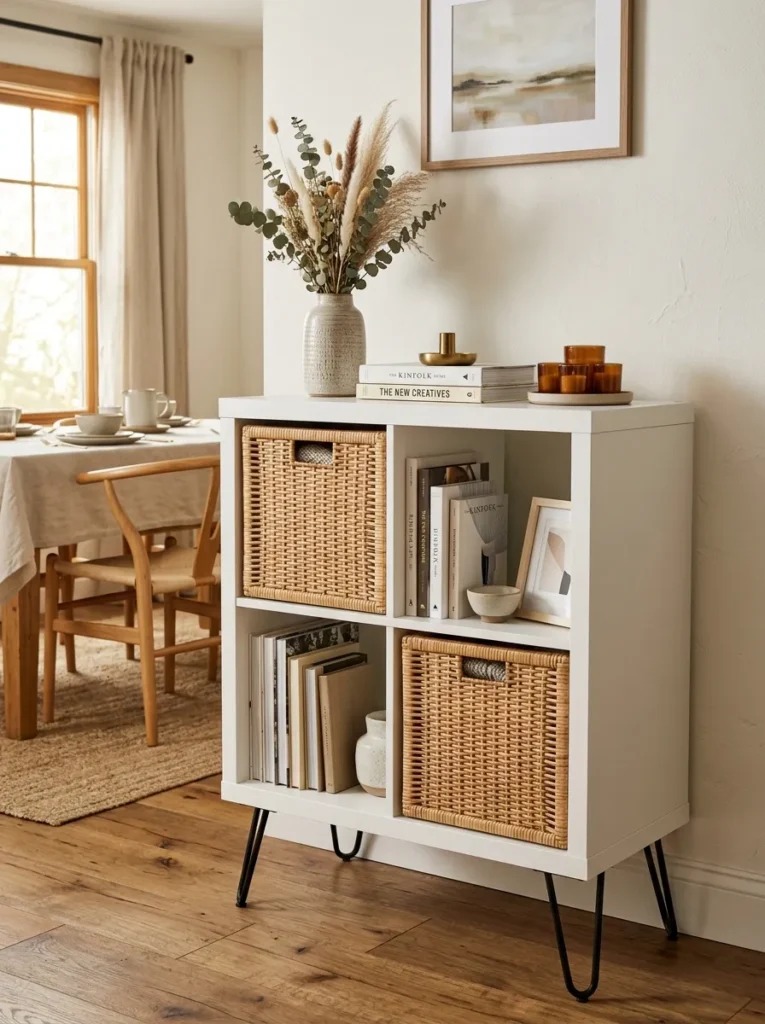
Vibe: The sideboard is designed — a white 4×2 KALLAX on matte black hairpin legs reads as a genuine dining room credenza at first glance, where the leg elevation and the combination of closed basket storage with open display cubes creates the functional and visual balance that defines the contemporary sideboard.
Why it works: Hairpin legs are the single most transformative KALLAX hack element because they address the unit’s most significant design limitation: its flat-on-the-floor proportions that make it read as a bookshelf laid on its side rather than as a piece of furniture with deliberate vertical presence. Elevating the KALLAX on 6–10-inch legs changes the piece’s relationship to the room fundamentally — it creates the floor clearance that allows the eye to move underneath the piece (making the room feel more open), positions the top surface at a functional height (typically 29–35 inches from floor to top surface depending on leg height), and gives the unit the proportional dignity of a sideboard rather than a storage box. Hairpin legs in matte black create strong material contrast with a white KALLAX; legs in solid walnut create warm material harmony.
How to get it: Purchase a 4×2 KALLAX in white or white-stain oak effect ($120–$165 from IKEA). Source a set of four hairpin legs in the desired height and finish ($40–$80 for a quality set in matte black or unlacquered steel from specialty hardware suppliers). Mount the leg brackets to the KALLAX base (the underside panel) using the provided screws and additional wood screws for extra security — pre-drill pilot holes to prevent the particleboard from splitting. Line two cube openings with natural wicker insert boxes ($6–$15 each from IKEA’s KALLAX insert range) and leave two open for styled display. Style the top surface with the three-object rule: one tall botanical element, one substantial book stack, one warm light source or candle.
Quick Win: Adding a set of matte black hairpin legs ($40–$60 for a set of four) to an existing KALLAX unit is the single most impactful KALLAX hack available — the installation takes 30 minutes and the visual transformation from floor-hugging storage unit to elevated sideboard is immediate and dramatic.
Shop The Look
- Hairpin legs set 4 matte black 8 inch
- IKEA KALLAX insert box wicker natural
- Ceramic vase large dried stems display
- Art book set display sideboard
- Brass taper candlestick set small
Also view: 13 Beautiful Craft Room Ideas for Creative Spaces
2. White Oak Veneer Facing on a Black-Brown KALLAX
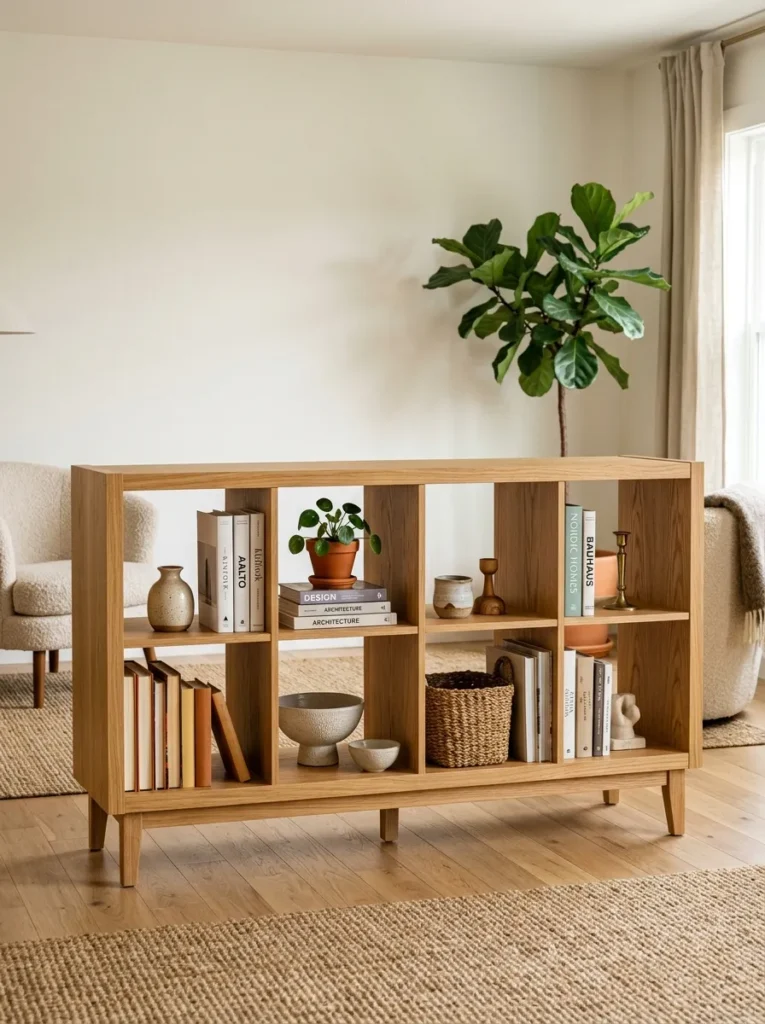
Vibe: The piece is architectural — a KALLAX surfaced in white oak peel-and-stick veneer with matching solid oak legs reads as custom furniture at a fraction of the cost, where the continuous warm grain across all visible surfaces creates the material consistency that makes a piece read as designed rather than assembled.
Why it works: Peel-and-stick wood veneer sheets (available in white oak, walnut, cherry, and birch from specialty suppliers including Oakworks, Real Wood Surfaces, and similar) are the KALLAX hack technique with the highest material-quality-to-effort ratio available — they transform the KALLAX’s laminated particleboard surface into something that reads as genuine wood at normal viewing distances, and they require only a utility knife, a straightedge, and a squeegee applicator to install. The key to a convincing veneer hack is grain direction consistency: all veneer sheets applied with the grain running in the same direction (horizontal on horizontal surfaces, vertical on vertical surfaces) read as a continuous material; misaligned grain directions break the material illusion. White oak is the most currently relevant veneer choice for the warm minimalism aesthetic — its open grain, warm honey tone, and contemporary design associations position it perfectly for the current residential design moment.
How to get it: Purchase a 4×2 or 2×4 KALLAX in the black-brown finish ($130–$170) — the darker starting surface is preferable for veneer application because any edge gaps in the veneer application read less prominently against dark than against white. Purchase white oak peel-and-stick veneer sheets ($25–$45 per roll, covering approximately 20 square feet) from a specialty wood veneer supplier. Cut sheets to size with a utility knife against a metal straightedge. Apply to the KALLAX exterior surfaces beginning with the top, then the sides, then any front face frames. Use a rubber squeegee or old credit card to eliminate air bubbles. Trim excess with the utility knife. Finish with solid wood tapered legs in matching white oak ($30–$60 for a set of four).
Shop The Look
- Peel and stick white oak veneer sheet roll
- KALLAX 4×2 black brown base unit
- Tapered furniture leg solid oak set 4
- Leg mounting plate bracket set
- Rubber squeegee veneer application
Also view: 15 Stylish Attic Bedroom Ideas for a Relaxing Retreat
3. KALLAX with Shaker Cabinet Doors for a Credenza Look
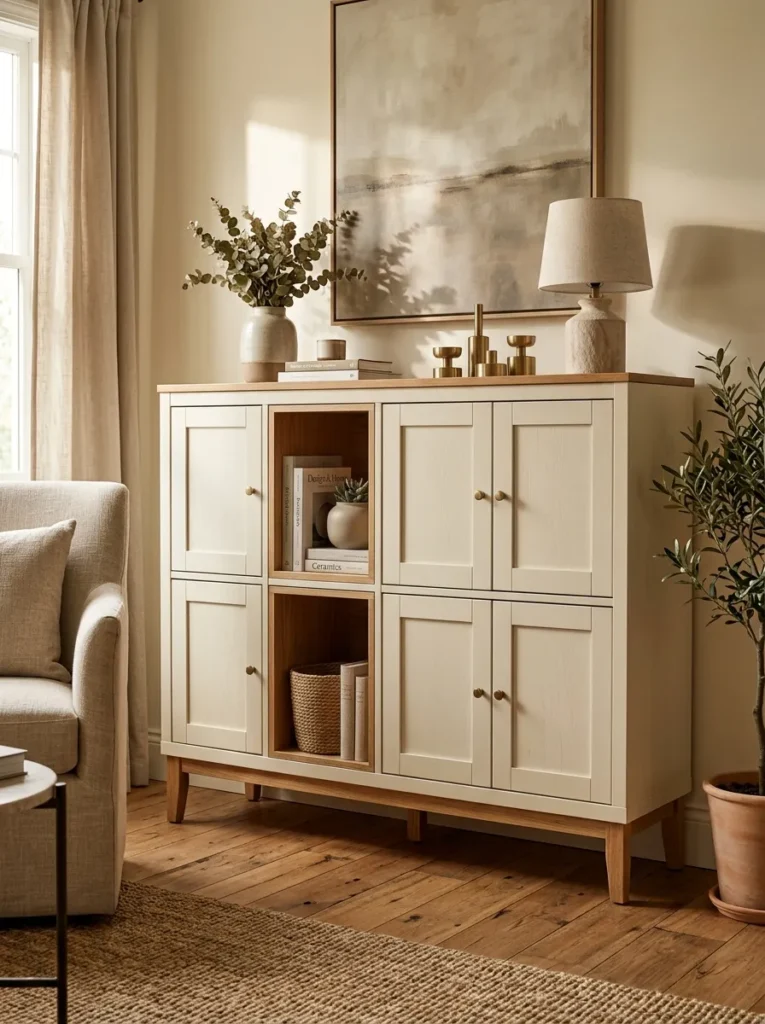
Vibe: The credenza is sophisticated — a KALLAX fitted with Shaker-profile cabinet doors in the correct four-closed-two-open ratio achieves the functional and visual composition of a traditional dining room credenza, where the flat-panel door’s simplicity and the leg elevation together make the piece read as custom furniture.
Why it works: The Shaker cabinet door is the design detail that most effectively civilizes a KALLAX into genuine room furniture because the door’s traditional profile (flat center panel in a simple frame) has the architectural vocabulary of furniture rather than shelving — a KALLAX with doors reads as a credenza; the same unit without doors reads as a storage shelf. The four-closed-two-open configuration (specifically, alternating door and open cube across the unit’s face) creates the functional and visual balance of a classic credenza: the closed sections provide concealed storage for everyday objects, the open sections provide display space for objects worth seeing. Aftermarket KALLAX-compatible doors are available from several specialty suppliers (Superfront, Prettypegs, Semihandmade, Lifehack Furniture) in Shaker and other door profiles, eliminating the need for custom woodworking.
How to get it: Purchase the aftermarket KALLAX-compatible Shaker doors in the desired configuration — Semihandmade (semihandmade.com) makes the most widely available high-quality aftermarket KALLAX doors at $50–$100 per door, available in paint-ready MDF or pre-finished in varied tones. Install using the supplied KALLAX-specific hinges (which are included with specialty aftermarket doors) — no drilling into the KALLAX’s interior panels required if using the correct door system. Add elongated bar pulls in unlacquered brass or matte black ($8–$20 per pull) centered on each door for the credenza hardware aesthetic. Elevate on warm wood tapered legs ($30–$60 for a set of four with mounting plates).
Shop The Look
- KALLAX compatible Shaker door aftermarket
- Elongated bar pull brass 3 inch set
- Tapered furniture leg walnut set 4
- KALLAX hinge soft close aftermarket
- Leg bracket mounting plate set
4. Concrete Contact Paper KALLAX for an Industrial Look
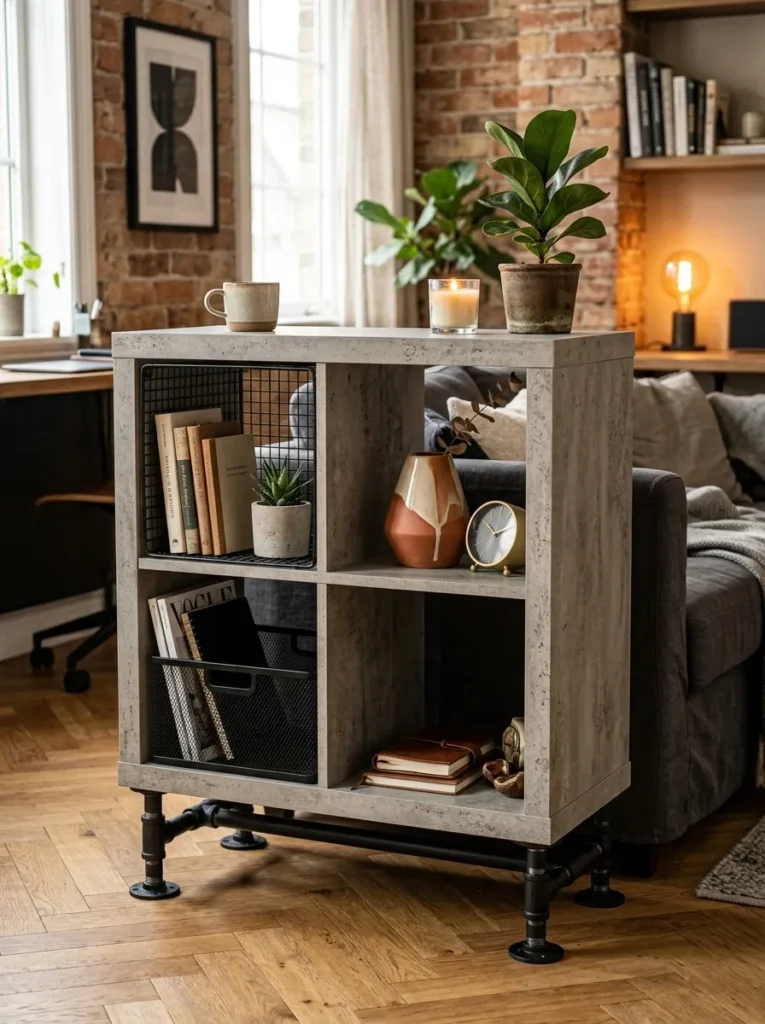
Vibe: The piece is industrial — a concrete-contact-paper KALLAX on matte black metal legs is the hack that most directly translates industrial aesthetic language into a compact, affordable side table or small sideboard, where the textured grey surface and the raw metal legs create a convincing industrial material pairing.
Why it works: Concrete-effect contact paper (available from Amazon, HomeBase, and specialty contact paper suppliers at $8–$20 per roll, with one roll typically covering a 2×2 KALLAX exterior) achieves a genuinely convincing concrete visual at arm’s length because the paper’s texture embossing replicates the micro-roughness of real concrete in a way that printed-flat vinyl cannot. The critical application technique is heat activation during installation — using a hair dryer on warm setting during application allows the contact paper to conform to corners and edges without the air bubbles and lifting that cold application produces. Matte black pipe legs (industrial plumbing pipe repurposed as furniture legs, or pre-made pipe-style legs from specialty furniture hardware suppliers) complete the industrial material pairing.
How to get it: Purchase a 2×2 KALLAX ($55–$70). Clean the exterior surfaces with rubbing alcohol to remove any oils or residue that would prevent adhesion. Apply concrete-effect contact paper ($12–$18 for a sufficient quantity), using a squeegee to eliminate bubbles and a heat gun or hair dryer to conform the paper to corners. Install matte black pipe-style legs ($30–$50 for a set of four, 4–6 inches height for a side table height, 8 inches for sideboard height) using the standard leg bracket system. The total hack investment: $100–$150 for a finished piece that reads as a deliberate industrial design object.
Shop The Look
- Concrete effect contact paper warm grey roll
- Matte black pipe leg set 4 furniture
- Rubber squeegee contact paper application
- Geometric ceramic display small
- Heat gun contact paper corner conform
5. KALLAX Face Frame Addition for Built-In Appearance
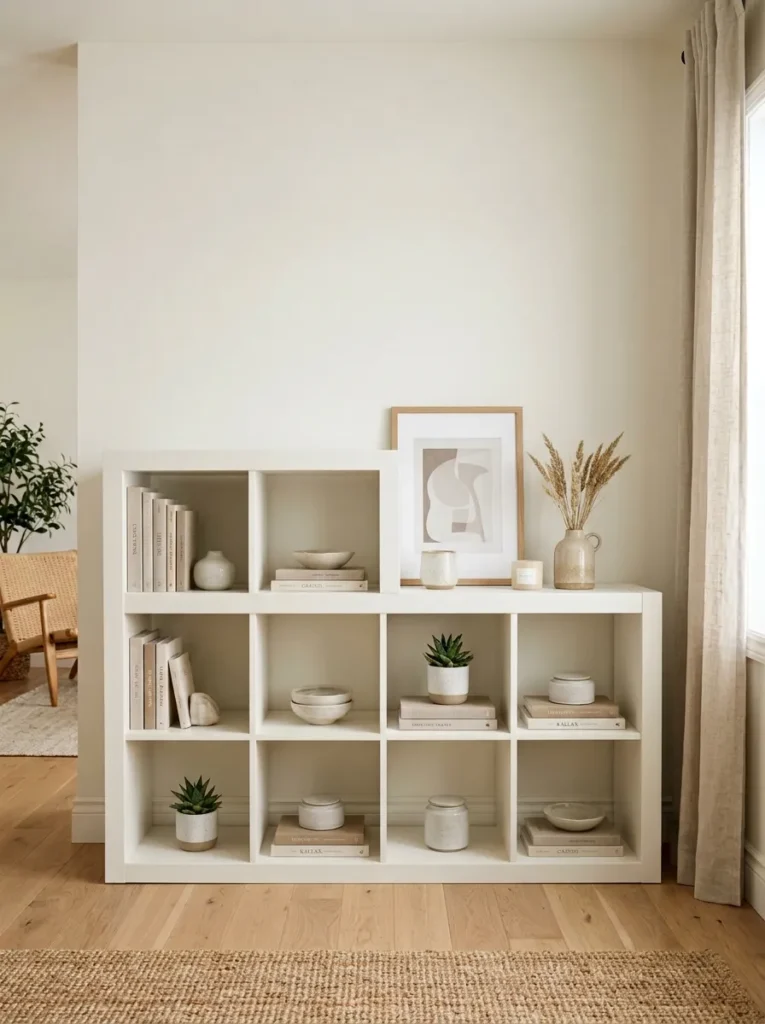
Vibe: The unit is built-in — a KALLAX with a paint-grade face frame applied around its perimeter and between its cube rows, painted to match the wall, creates the visual impression of a custom built-in shelving unit that has been part of the room’s architecture since the home was designed.
Why it works: The KALLAX’s most immediately identifiable design limitation is its rounded-edge plastic profile — the characteristic chamfered corner that reads as “IKEA” at a glance to any design-literate viewer. A face frame of 1×2-inch lumber applied around the unit’s exterior and between cube rows covers this profile entirely and replaces it with flat, sharp-edged paint-grade trim that reads as architectural millwork rather than flat-pack furniture. When the face frame is painted in the same color as the surrounding wall (specifically: same paint, same sheen), the KALLAX virtually disappears into the wall plane and reads as a designed architectural feature. Adding simple knob hardware to the face frame face (rather than to the KALLAX interior panel, which can damage the particleboard) completes the built-in aesthetic.
How to get it: Measure the KALLAX exterior dimensions and cut 1×2-inch pine or poplar lumber to the required lengths for the perimeter frame and the cross-members between cube rows. Attach with construction adhesive and brad nails (a brad nailer is the correct tool — screws create visible heads that are difficult to fill cleanly in paint-grade work). Fill all nail holes and joints with paintable caulk. Sand smooth when dry. Prime with a shellac-based primer (critical for painting over particleboard) and apply two coats of the wall paint in the same sheen used on the surrounding walls. Add hardware to face frame faces only. Total material cost for a 4×2 KALLAX face frame: $30–$60 in lumber, caulk, primer, and hardware.
Shop The Look
- Pine lumber 1×2 8ft face frame
- Brad nailer finish nail gun
- Paintable caulk white interior
- Shellac primer particleboard painting
- Square knob brass small cabinet set
6. KALLAX Sideboard with Washi Paper or Wallpaper Interior Lining
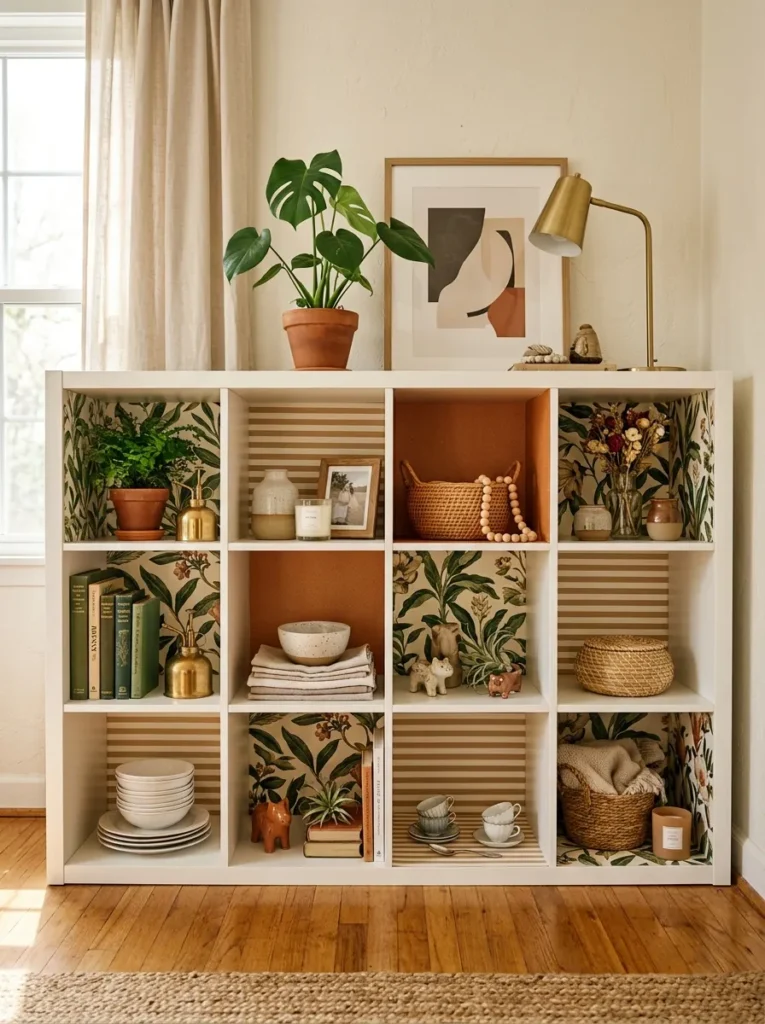
Vibe: The interior is curated — lining each KALLAX cube’s interior with a different coordinated pattern paper transforms open cube storage from neutral background space into a gallery of textile-reference patterns, where each object displayed against a patterned interior is framed rather than merely sitting on a shelf.
Why it works: The KALLAX cube’s 13×13-inch interior dimension, when lined with a decorative paper, creates a miniature room or display niche — the patterned or colored background immediately gives the interior depth and warmth that the raw particleboard interior cannot provide. Washi paper (Japanese decorative paper available in botanical, geometric, and abstract patterns at $5–$15 per sheet) is the most beautiful paper option for this application: its natural fiber translucency allows the interior’s depth to read through the paper rather than being flattened by an opaque vinyl covering. Peel-and-stick wallpaper offers a more durable and more precisely detailed alternative for interiors that will be frequently accessed. Selecting papers within a single warm color family (all warm terracotta-to-ochre tones, or all botanical-green-to-sage) creates visual cohesion across the varied patterns.
How to get it: Cut paper or peel-and-stick wallpaper to the precise interior dimensions of each KALLAX cube (13×13 inches for the back, 13 inches × the depth of the KALLAX for each side panel). Apply with wallpaper paste (for washi paper) or peel the adhesive backing (for peel-and-stick). Use a bone folder to press the paper firmly into the cube corners. Apply a thin coat of Mod Podge matte over washi paper applications to seal and protect the surface from moisture. Vary the pattern across cubes using papers that share a common color family. Total material cost: $20–$50 for a 4×2 KALLAX interior lining.
Shop The Look
- Washi paper botanical print sheet set
- Peel stick wallpaper pattern warm tones
- Mod Podge matte sealer craft
- Bone folder scoring craft tool
- Wallpaper paste small quantity adhesive
7. KALLAX with Rattan Cane Insert Doors
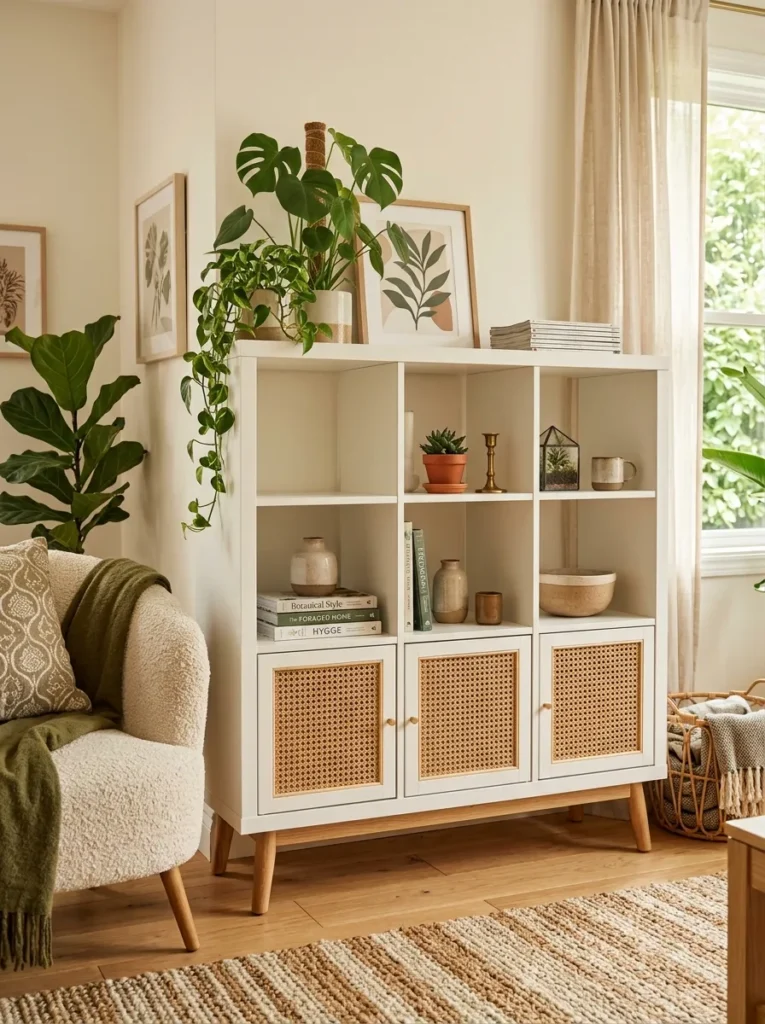
Vibe: The sideboard is organic — KALLAX with rattan cane-front doors is the hack that most directly connects the unit to the botanical, warm-natural-material aesthetic that defines contemporary home design, where the woven rattan introduces textile warmth to a furniture surface that would otherwise be uniformly hard.
Why it works: Rattan cane weave as a cabinet door insert material has experienced an extraordinary contemporary design revival — the material appears across furniture from every price point and design tradition as the primary botanical warmth element in contemporary cabinet design. For the KALLAX hack, rattan cane inserts (sheets of woven rattan available from specialty craft and upholstery suppliers) can be framed in simple painted MDF or pine frame structures that attach to the KALLAX using the standard aftermarket hinge system. The cane’s translucency (objects stored behind a rattan door are slightly visible as forms while being concealed from sharp view) adds a dimensional quality that solid door panels lack — the storage behind the door reads as present without being visible.
How to get it: Build simple door frames from 1×2 or 1×3-inch lumber (or MDF for a paint-grade option), dimensioned to the KALLAX cube opening size (approximately 13×13 inches). Cut a rectangular opening within the frame sized to accommodate the rattan panel. Cut rattan cane sheeting ($15–$25 per sheet, available from JoAnn Fabrics, Etsy specialty suppliers, or upholstery suppliers) to the opening size and attach to the back of the frame using a staple gun. Paint or stain the frame in the desired finish. Install to the KALLAX using KALLAX-compatible hinges from aftermarket door suppliers. Add simple round brass knobs ($5–$10 each) centered on each door.
Shop The Look
- Rattan cane sheet woven natural craft
- Simple pine frame 1×2 door construction
- KALLAX hinge compatible aftermarket
- Round brass knob small cabinet
- Upholstery staple gun furniture craft
8. Stained Dark Walnut KALLAX Transformation
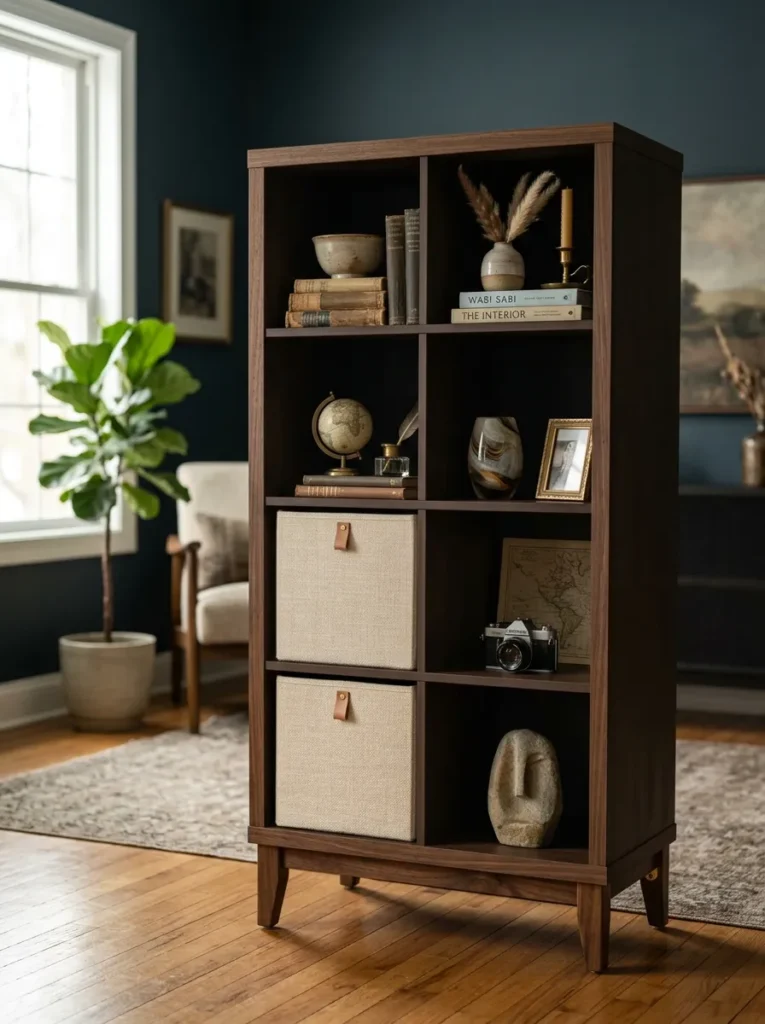
Vibe: The piece is moody — a KALLAX painted in a deep, warm dark walnut tone with brass hardware and matching solid walnut legs reads as a piece of deliberately dark furniture with the design authority that characterizes the current moody-interior trend.
Why it works: Chalk paint and mineral-based furniture paints bond chemically to the KALLAX’s laminated surface without requiring priming in most cases — this is the critical technical advantage of chalk paint (Annie Sloan, Rust-Oleum Chalked, and similar) over standard latex or acrylic paint for KALLAX hacks. Standard latex paint applied without shellac primer typically peels from the KALLAX’s laminate surface within weeks of use; chalk paint applied directly and sealed with a clear wax or topcoat provides a durable, furniture-quality finish that withstands the normal handling of a sideboard piece. The dark walnut tone (a deep, warm brown with red-brown undertone rather than a cool or grey-brown tone) is specifically the most flattering dark color for a KALLAX sideboard because it references genuine dark walnut furniture without reading as black.
How to get it: Lightly sand the KALLAX exterior surfaces with 220-grit sandpaper to create mechanical adhesion. Apply chalk paint in a deep walnut or dark brown tone ($18–$35 per quart, sufficient for a 4×2 KALLAX) using a quality brush or small foam roller. Apply two or three coats allowing full drying between coats. Seal with a clear matte furniture wax ($12–$20) or a water-based matte topcoat for durability. Install solid walnut tapered legs ($40–$80 for a set of four) and elongated brass bar pulls on a face frame or directly on cube faces ($10–$20 per pull).
Shop The Look
- Chalk paint dark walnut brown furniture
- Clear matte furniture wax sealer
- Walnut tapered leg solid set 4
- Elongated bar pull brass 5 inch
- Cream linen KALLAX insert basket
9. KALLAX Media Console with Cable Management
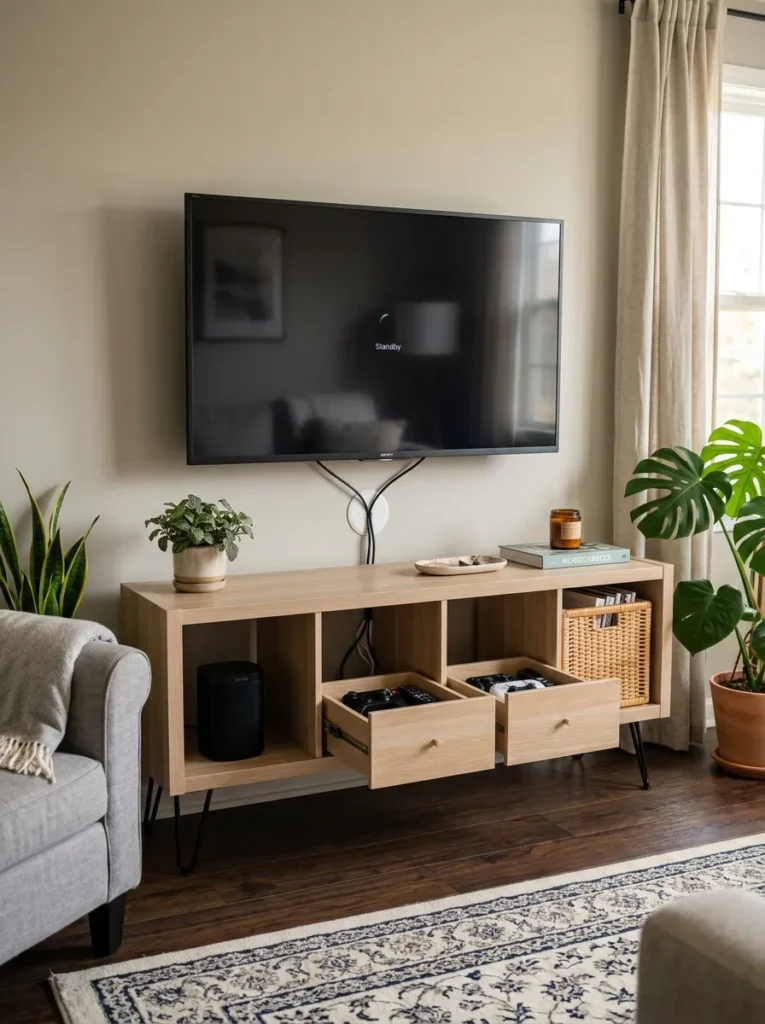
Vibe: The console is organized — a KALLAX configured as a media console with a cable management system, a pull-out drawer insert, and specific cube allocations for electronics, speaker, and display creates the most functionally resolved media console available at the KALLAX price point.
Why it works: The KALLAX media console hack is specifically effective because the 4×2 KALLAX’s dimensions (57 inches wide, 29.5 inches tall) match almost exactly the conventional media console proportions that the television industry and furniture market have established as standard for most living room configurations. The cube system’s flexibility allows each of the unit’s six cubes to be allocated to a specific electronics or storage function — gaming equipment in one, cable box and streaming devices in another, speaker in a third, general remote/controller storage in a fourth — creating a media console with more dedicated organizational capacity than most purpose-built media consoles in the same price range. Cable management through the back panel (drilling a 1.5-inch grommet hole aligned with the power outlet behind the unit) eliminates visible cable runs.
How to get it: Purchase a 4×2 KALLAX in white-stain oak effect ($165). Install 4-inch hairpin legs ($35–$55 for a set of four) — the lower profile keeps the console below the standard TV mounting height of 42–48 inches for the screen center. Drill a 1.5-inch cable management hole in the back panel (using a hole saw bit, $8–$15) aligned with the wall outlet position. Install a rubber grommet in the hole ($2–$4 per grommet). Add a KALLAX-compatible pull-out drawer insert ($20–$35 from IKEA) in the center cube for remote and controller storage. Route all power cables through the grommet to a surge protector inside the unit.
Shop The Look
- KALLAX 4×2 white oak effect media
- Low hairpin legs 4 inch set matte black
- Cable grommet rubber 1.5 inch set
- KALLAX drawer insert pull out
- Surge protector compact hidden unit
10. Pegboard Back Panel KALLAX for Utility Room
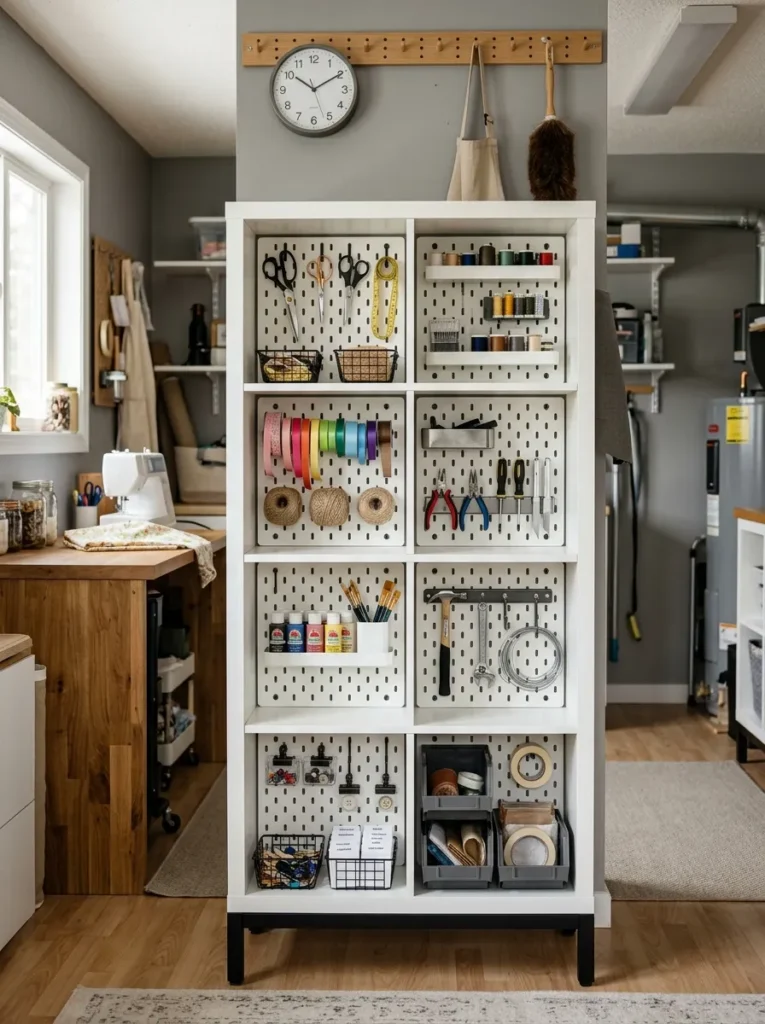
Vibe: The system is organized — a KALLAX with pegboard back panels in each cube creates the most adaptable organization system available for utility, craft, or home office contexts, where the pegboard’s infinite hook and shelf positioning allows the interior of each cube to be precisely configured for the specific tools, supplies, or accessories it holds.
Why it works: Pegboard is the organizational material specifically designed for the infinite reconfiguration of storage — any hook, shelf, or holder can be repositioned in any pegboard hole at any time without damage to the surface. Applied to the back wall of each KALLAX cube, a pegboard panel converts the cube from a passive storage compartment into an active organizational system where the back wall contributes as much storage capacity as the cube floor. The KALLAX’s 13-inch cube depth is sufficient for most pegboard accessories — standard pegboard hooks project 3–4 inches from the panel surface, leaving 9+ inches of usable depth in front of the hook. For craft rooms, home offices, and utility rooms, this combination of adjustable front-mounted shelving (the KALLAX grid itself) and adjustable back-panel storage (the pegboard within each cube) creates an organizational system of extraordinary density and adaptability.
How to get it: Cut 1/4-inch pegboard panels (standard 4×8-foot sheets, $12–$18 from any hardware store) to 12×12-inch squares (slightly smaller than the cube interior to allow insertion). Apply panel to the cube’s back wall using construction adhesive or small corner brackets — the panel need not be permanently attached for the hack to work, but adhesive installation creates a cleaner finish. Paint the pegboard panels the same white as the KALLAX interior for a unified appearance. Add standard 1/4-inch pegboard hooks ($8–$15 for an assorted set) in the configurations required for the specific organizational purpose.
Shop The Look
- Pegboard sheet 1/4 inch white 4×8
- Pegboard hook assortment set 1/4 inch
- Pegboard shelf small bracket
- Construction adhesive panel mount
- Pegboard bin small organization
11. Marble Contact Paper KALLAX for a Luxury Look
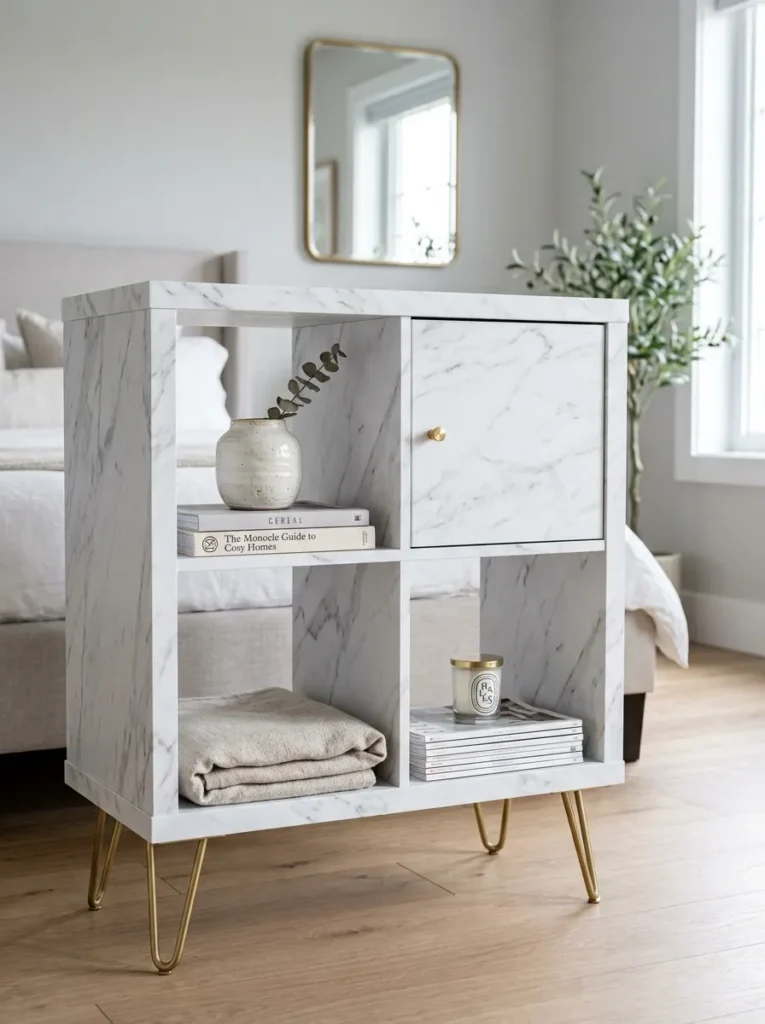
Vibe: The piece is luxurious — a marble-contact-paper KALLAX on brass hairpin legs reads as a genuine marble side table at normal viewing distance, where the combination of the convincing stone effect and the warm metallic legs creates the material pairing associated with luxury interior design at a fraction of the material cost.
Why it works: Marble-effect contact paper has improved dramatically in visual quality over the past decade — the best current options (Wallpaper from the 70s, d-c-fix, and similar quality brands) replicate the grey-on-white Carrara marble veining pattern with sufficient detail and three-dimensional shading to read convincingly as genuine stone at arm’s length. The key to a convincing marble contact paper application on a KALLAX is directional veining consistency — cutting and aligning all panels so the grey veining runs in the same diagonal direction across all surfaces creates the visual impression of a continuous stone slab, while misaligned veining on different surfaces immediately breaks the stone illusion. Brass hairpin or tapered legs complete the luxury material pairing: unlacquered brass and white marble is one of the most enduring material pairings in high-end interior design.
How to get it: Purchase high-quality Carrara marble-effect contact paper ($15–$30 for sufficient quantity for a 2×2 KALLAX) from a quality vinyl supplier. Plan the veining direction before cutting — all pieces should have the grey veining running in the same diagonal direction. Cut panels with a sharp utility knife against a metal straightedge. Apply to the KALLAX exterior surfaces using a squeegee to eliminate air bubbles and a heat gun to conform the paper to corners. Install unlacquered brass hairpin legs ($35–$65 for a set of four) at an 8-inch height for side table proportions.
Shop The Look
- Carrara marble effect contact paper roll
- Unlacquered brass hairpin leg set 4
- Utility knife precision cut application
- Squeegee contact paper application tool
- Small ceramic vessel white display
12. KALLAX Floating Sideboard with Wall-Mounted Configuration
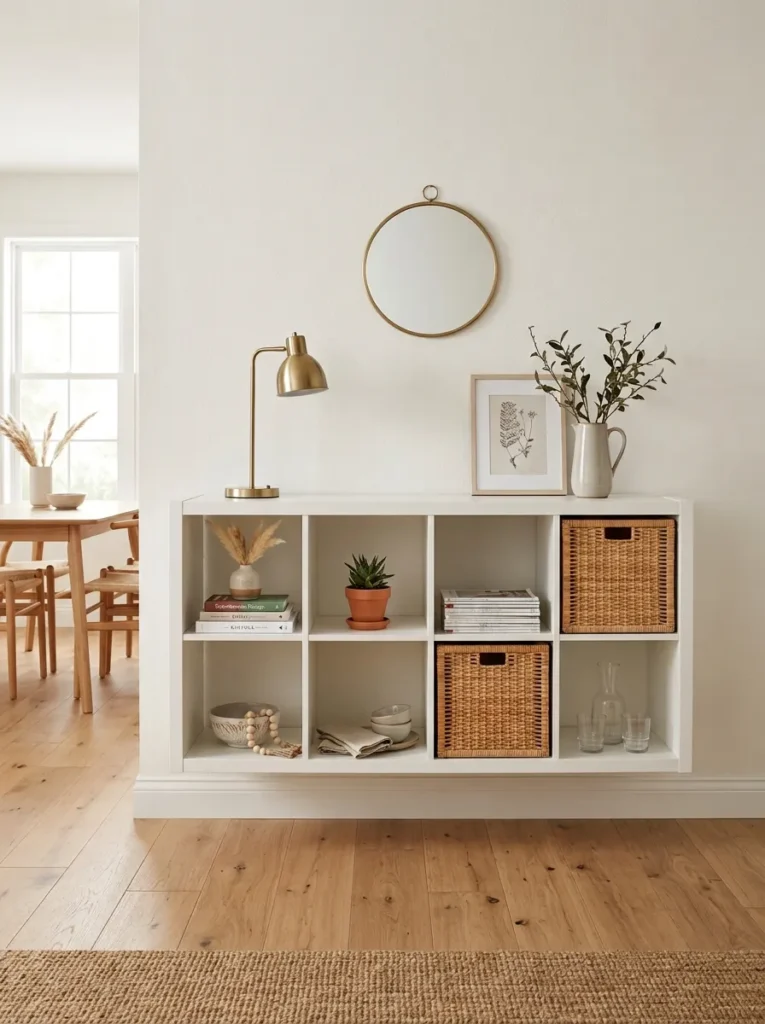
Vibe: The installation is spacious — a wall-mounted floating KALLAX sideboard that shows clear floor below transforms a storage unit into an architectural installation, where the visible floor beneath the piece makes the room feel significantly more open and the piece itself more deliberately designed.
Why it works: Floating furniture — wall-mounted pieces that show clear floor beneath them — creates a spatial openness that floor-contact furniture cannot approach, because the visible floor runs continuously under and beyond the piece, removing the visual boundary that floor-contact furniture creates. A floating KALLAX sideboard specifically addresses the 4×2 unit’s most significant spatial limitation: its relatively low height (29.5 inches) places it in a visual zone where floor-contact furniture reads as compressed and low, while the same unit elevated 6 inches from the floor on a wall bracket reads as deliberately proportioned and architecturally resolved. Wall mounting also creates the most stable possible KALLAX installation since the unit cannot tip forward regardless of the weight of its contents.
How to get it: Wall-mounting a KALLAX requires heavy-duty wall mounting brackets ($15–$30 per bracket, minimum two per unit) anchored into wall studs — the combined weight of a filled 4×2 KALLAX can exceed 80 pounds, which requires stud mounting rather than drywall anchor mounting. Install the brackets at the correct height (typically at 24–26 inches from the floor for the bracket, which positions the unit top surface at 30–32 inches). Mount the KALLAX to the brackets through pre-drilled holes in the unit’s back panel. Ensure the unit is level using a spirit level before tightening all fasteners. Add a thin strip of the wall paint color across the KALLAX’s bottom edge (or add a small trim piece) to minimize any visible gap between the unit and the wall.
Shop The Look
- Heavy duty shelf bracket wall stud mount
- Lag screw set 3 inch stud mount
- Spirit level magnetic small
- KALLAX 4×2 white horizontal
- Wicker cube insert KALLAX natural
13. Two-Tone KALLAX Hack with Contrasting Cube Liners
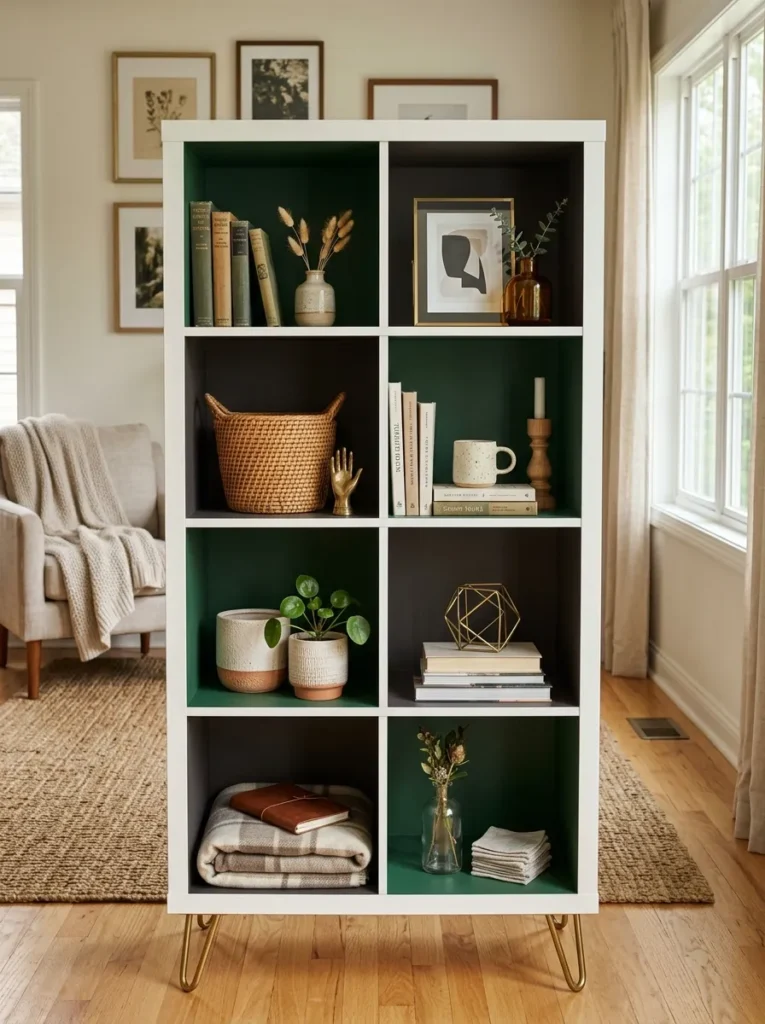
Vibe: The hack is graphic — alternating deep-colored cube interiors in a white KALLAX creates a graphic checkerboard pattern that transforms the unit from a storage grid into a designed composition, where the contrast between the white exterior and the deep interior tones frames each displayed object like a small gallery alcove.
Why it works: Painting the interior of KALLAX cubes in deep contrasting tones while leaving the exterior white creates a depth-of-field effect when viewed from the front — the white exterior advances visually and the dark interior recedes, creating the impression that the cubes have significantly more depth than their 15-inch physical dimension. Each object placed against a deep-colored interior is framed and displayed at gallery quality — the dark background provides maximum contrast for any warm-toned ceramic, natural object, or light-colored textile placed within the cube. The checkerboard alternation of two deep tones (forest green and warm charcoal, for example) creates the most graphic effect while maintaining tonal cohesion within the warm color register.
How to get it: Tape off the cube interiors within a white KALLAX, protecting the exterior surfaces with painter’s tape along the interior edge. Apply deep forest green chalk paint (one to two coats) to the interior of alternating cubes. Apply warm charcoal chalk paint to the remaining cube interiors. Seal all interior painted surfaces with a matte wax or water-based topcoat — the interior surfaces receive more direct handling than exteriors and require more durable sealing. Remove tape and clean the white exterior of any paint bleeds with a damp cloth before the chalk paint fully cures.
Shop The Look
- Chalk paint deep forest green interior
- Chalk paint warm charcoal interior
- Painter’s tape sharp line interior
- Matte wax furniture sealer interior
- Ceramic display object small set
14. KALLAX Raised on Solid Oak Block Legs for a Minimal Look
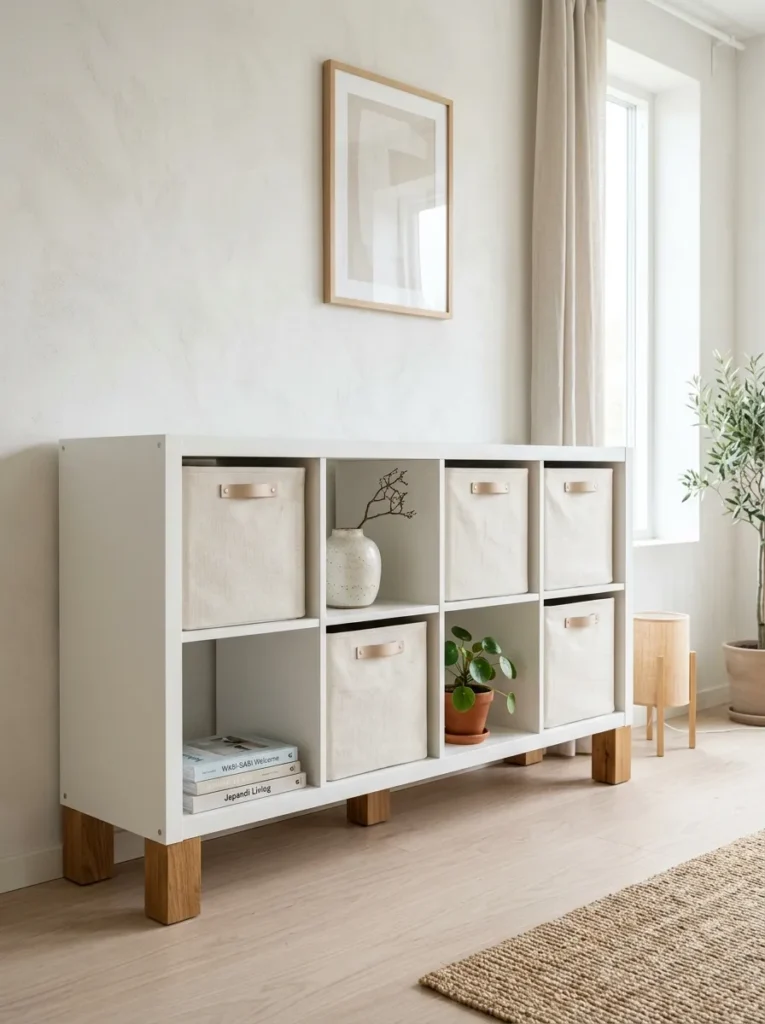
Vibe: The piece is minimal — a white KALLAX on short solid oak block legs with cream linen basket inserts and extremely restrained minimal styling is the KALLAX hack for the Japandi or Scandinavian minimalist interior, where the understatement of the leg height and the restraint of the styling communicate confident design intention.
Why it works: Short block legs (3–4 inches in solid wood, square or round profile) are the leg choice that gives the KALLAX the most subtle elevation — just enough to read as furniture rather than floor-storage, and just enough to allow the floor to be cleaned beneath the unit, without the more dramatic visual statement of taller hairpin or tapered legs. This restraint is specifically appropriate for minimalist interior directions (Japandi, Scandinavian, warm minimalism) where the design language actively resists dramatic gesture in favor of quiet material quality. Solid oak block legs (in the natural, warm-toned square profile) are the material choice that most directly references the Scandinavian furniture tradition of honest, unornamented solid wood at every leg.
How to get it: Source short square or round solid oak furniture legs (3–4 inch height, $5–$12 per leg from specialty furniture hardware suppliers or Etsy woodworkers). Mount using standard threaded leg plates ($3–$6 per plate) screwed to the KALLAX base — pre-drill pilot holes in the KALLAX base particleboard to prevent splitting. Style the unit with the minimal three-object rule on the top surface and cream linen KALLAX insert baskets (from IKEA’s own KALLAX insert range, $10–$20 each) in all but the most deliberately styled cubes.
Shop The Look
- Short solid oak block leg set 4 furniture
- Threaded leg plate mount set
- KALLAX insert linen basket cream
- Small ceramic vessel minimal display
- Small trailing plant shelf display
15. Full Custom KALLAX Sideboard with Plinth Base and Crown Molding
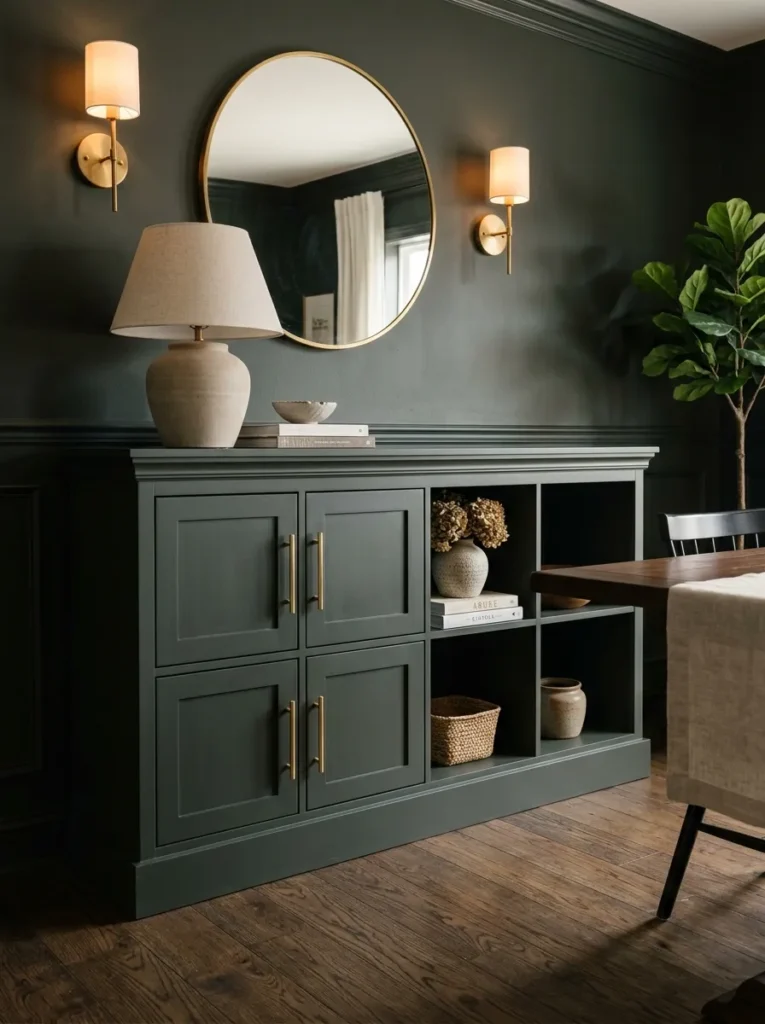
Vibe: The piece is custom — a KALLAX fitted with a plinth base, crown molding, face frame, Shaker doors, and painted in a deep room-matching tone is the most complete KALLAX sideboard hack available, where the accumulation of architectural detail elements produces a piece that reads as genuinely custom-built furniture from any viewing distance.
Why it works: The full custom KALLAX hack combines multiple individual hack techniques — the face frame (see Idea 5), the Shaker door addition (see Idea 3), and the paint treatment (see Idea 8) — with two additional architectural detail elements that push the finished piece into custom-furniture territory: the plinth base and the crown molding. The plinth base (a simple MDF box running the full unit length, 3–4 inches tall) replaces visible legs entirely with a solid furniture-base profile that reads as architectural millwork. The crown molding at the top edge (standard decorative molding profile from any hardware store) adds the detail associated with high-quality built-in cabinetry. Together, these elements eliminate every characteristic that reads as IKEA and replace them with details that read as custom furniture.
How to get it: This is a multi-stage hack that builds sequentially: first, construct and attach the MDF plinth base (three sides of 3/4-inch MDF, sized to the KALLAX base dimensions, assembled with wood glue and brad nails, then glued and screwed to the KALLAX underside). Second, install the face frame (1×2-inch lumber, as in Idea 5). Third, install Shaker doors (from aftermarket KALLAX door suppliers). Fourth, add crown molding to the top front edge (standard 2-inch or 3-inch crown profile, mitered at corners, attached with brad nails and construction adhesive). Fifth, apply chalk paint or furniture paint in the selected deep tone. Sixth, install elongated brass bar pulls. Total material cost for the full custom hack on a 4×2 KALLAX: $150–$300.
Shop The Look
- Crown molding 3 inch painted grade
- MDF sheet 3/4 inch plinth base
- Aftermarket KALLAX Shaker door set
- Elongated brass bar pull 5 inch set
- Chalk paint deep green charcoal custom
How to Start Your KALLAX Sideboard Hack
The single most important first decision in a KALLAX sideboard hack is the height at which the finished piece will sit — specifically, whether to use legs (and at what height) or a plinth base. This decision determines the piece’s proportional relationship to the room more than any other single variable: a 4×2 KALLAX at floor level reads as a storage shelf, the same unit on 4-inch legs reads as furniture with presence, and the same unit on 8-inch legs reads as a true sideboard or credenza. The specific leg height should be calibrated to the unit’s intended function and the room’s ceiling height — in rooms with 8-foot ceilings, 6–8-inch legs are the correct range for sideboard proportions; in rooms with 9-foot or higher ceilings, 10–12-inch legs create more appropriate proportions.
The most common KALLAX hack mistake is attempting the paint treatment without proper surface preparation and primer. The KALLAX’s laminated surface is specifically designed to resist moisture and adhesion — the same property that makes it easy to clean makes it resistant to paint adhesion without proper preparation. Standard latex paint applied directly to a KALLAX without primer will peel within weeks of normal use. The correct preparation sequence is: light sanding with 220-grit to create mechanical adhesion, followed by a shellac-based primer (Zinsser BIN is the most widely available option, $15–$20 per quart) that chemically bonds to the laminate surface, followed by the finish paint of choice. This three-step preparation eliminates peeling and produces a painted KALLAX surface that is as durable as factory furniture paint.
Three KALLAX hack upgrades under $50 that make an immediate, significant visual improvement: adding a set of four hairpin legs ($40–$60 for a quality set) that transforms the floor-level storage unit into elevated furniture in 30 minutes; replacing the standard IKEA KALLAX insert boxes with natural wicker or linen versions ($8–$15 each) that match the warm natural material aesthetic; and lining the interior back walls of all cube openings with a single coordinated patterned paper ($15–$25 for sufficient quantity for a 4×2 unit) that creates an immediate designer-quality visual effect in each display cube.
A complete KALLAX sideboard hack — legs, face frame, Shaker doors, paint treatment, hardware, and interior lining — is achievable over one weekend of focused work with basic tools (a drill, a brad nailer, a utility knife, and a saw or miter box for any lumber cuts) at a total cost of $200–$400 for a finished piece that represents $600–$1,500 in equivalent custom or retail furniture value. The return on investment in a KALLAX hack is among the highest of any home improvement or DIY project available — the base unit cost is low ($55–$165 depending on configuration), the material additions are modest, and the finished quality of a well-executed hack is genuinely competitive with purpose-built furniture at significantly higher price points.
Frequently Asked Questions About KALLAX Sideboard Hacks
Can I paint a KALLAX without it peeling?
Yes, but proper preparation is essential and non-negotiable. The KALLAX’s laminated surface resists paint adhesion — painting directly over the laminate with standard latex or acrylic paint will result in peeling within days to weeks of normal use, regardless of the paint quality. The correct technique: sand all surfaces to be painted lightly with 220-grit sandpaper (just enough to dull the sheen, not to remove the laminate), wipe clean with a tack cloth or slightly damp cloth, apply one coat of shellac-based primer (Zinsser BIN, available at any hardware store), allow to cure fully (1–2 hours minimum), then apply chalk paint or a quality furniture paint in two thin coats. Finish with a clear furniture wax or water-based topcoat for durability. This preparation sequence produces a painted surface that is as durable as factory-applied furniture finish and does not require any further special treatment.
What is the best leg height for a KALLAX sideboard?
The correct leg height depends on the KALLAX configuration being used and the desired finished height. A 4×2 KALLAX (29.5 inches tall, 57 inches wide) is the most common sideboard hack base — it requires a leg height of 6–10 inches to achieve the conventional sideboard height of 35–40 inches from floor to top surface. Within this range: 6-inch legs produce a finished height of approximately 35.5 inches, which is the lower end of conventional sideboard height and reads as slightly low; 8-inch legs produce approximately 37.5 inches, which is the most universally appropriate sideboard height; and 10-inch legs produce approximately 39.5 inches, which reads as a generous sideboard height and is the correct choice when the KALLAX will be used below a gallery wall or mirror that needs additional visual separation from the unit’s top surface.
How do I install doors on a KALLAX without custom woodworking skills?
Several aftermarket door systems are available specifically for KALLAX units that require no custom woodworking — they are designed to attach to the KALLAX using the unit’s existing hinge hole placements. Semihandmade (semihandmade.com) makes the most widely known KALLAX-compatible door system, available in Shaker and other profiles in paint-ready MDF and pre-finished options at $50–$100 per door. Superfront (superfront.com) and Prettypegs also offer KALLAX-compatible door and drawer insert systems. These aftermarket doors include KALLAX-specific hinges that use the KALLAX’s existing hinge mounting holes — no drilling into the interior panels is required, and installation typically takes 10–15 minutes per door with a standard Phillips screwdriver. The aftermarket systems are the most reliable option for non-woodworkers; building doors from scratch is also achievable but requires basic woodworking tools and skills.
How many KALLAX units can I combine to make a longer sideboard?
KALLAX units can be combined side by side (multiple units placed adjacent to each other) to create longer sideboard configurations. Two 4×2 KALLAX units placed side by side create a 114-inch (9.5-foot) sideboard — appropriate for large dining rooms and open-plan spaces. For multi-unit combinations, the most important structural consideration is connecting the units to each other (using cabinet connector screws, $3–$6 for a pack, inserted through the adjacent side panels) to prevent the units from separating or becoming misaligned over time. For multi-unit combinations with legs, the leg positioning is critical — legs at the outside corners and one or two legs at the join point of adjacent units prevent the joined units from sagging at the center. Apply a consistent face frame, paint treatment, and hardware across all units in a combination to ensure they read as a single piece rather than adjacent storage units.
Is it worth hacking a KALLAX or should I just buy a real sideboard?
The KALLAX hack represents genuinely superior value over most comparable ready-made sideboards at equivalent price points — a 4×2 KALLAX with legs, Shaker doors, brass hardware, and a chalk paint finish produces a finished piece of comparable quality to ready-made sideboards sold at $600–$1,000, at a total material cost of $200–$400. The KALLAX base unit’s quality (the cube grid’s dimensional precision and structural rigidity) is genuinely good at its price point, and the hacks described in this article add material quality and design refinement rather than compensating for structural deficiency. The hack’s additional advantages over a ready-made sideboard include precise dimensional customization (the available KALLAX configurations cover a wider range of widths and heights than most ready-made options), the ability to specify exactly the leg style, door profile, and hardware that matches the room’s specific aesthetic direction, and the making satisfaction of a genuinely transformed object. The hack makes less sense when a very specific ready-made sideboard in solid wood or genuine stone is available at a price point the budget can accommodate — in that case, the material quality of genuine solid wood exceeds what any KALLAX hack can achieve, and the investment in a quality piece is justified by its longevity and material improvement over time.
Ready to Hack Your KALLAX Into a Sideboard?
These 15 ideas cover the full spectrum of what a KALLAX sideboard hack can achieve — from the immediate visual transformation of adding matte black hairpin legs in an afternoon, to the material sophistication of a white oak veneer facing and matching solid leg installation, to the architectural ambition of a full custom treatment with plinth base, crown molding, Shaker doors, and deep-toned paint that produces a piece genuinely indistinguishable from custom furniture at normal viewing distances. You do not need to attempt the most complex hack as your first project — the most satisfying KALLAX sideboard hacks are built incrementally, beginning with the single upgrade that most directly addresses the current unit’s most significant visual limitation, assessing the result, and deciding what to add next. Start this weekend with the legs: measure your KALLAX, calculate the correct leg height for your room’s proportions, order a set of quality hairpin or tapered legs, and spend 30 minutes installing them. The transformation will tell you exactly what the piece needs next — and the answer will be obvious once the unit is off the floor. Pin the hacks that matched your aesthetic and your skill level — those are the ones worth building first.