17 Modern IKEA TARVA Hacks for Every Home
Modern IKEA TARVA hacks for every home use the TARVA range’s specific construction characteristics — solid unfinished pine in clean, minimal Scandinavian-proportioned forms, available as a chest of drawers, a bed frame, and a bedside table, all in raw pine that accepts any finish the maker chooses — as the starting point for furniture transformations that create specific, personalized, high-quality finished pieces at a fraction of the cost of equivalent bespoke or designer furniture. This article gives you exactly 17 ideas spanning paint finishes, stain treatments, hardware replacements, surface applications, structural modifications, and complete multi-piece styling systems, so every maker finds a TARVA hack that matches their skill level, their aesthetic direction, and their specific furniture need.
IKEA TARVA hacks done well are not simply painted flat-pack furniture — they are the result of applying the right preparation, the right finish, and the right hardware to a piece of furniture whose solid wood construction and clean proportions make it genuinely worth transforming. The TARVA’s competitive advantage over IKEA’s painted or lacquered furniture ranges is specifically its raw, unfinished pine surface: it can be painted in any color with any finish, stained in any tone, lime-washed, ebonized, waxed, or treated with any surface product that adheres to natural wood — providing the design flexibility that no manufactured-finish IKEA piece offers. Here are 17 ideas worth making.
Why Modern IKEA TARVA Hacks Work for Every Home
The design case for TARVA hacks specifically rests on the TARVA range’s unique combination of three properties that no other IKEA furniture range at comparable price provides simultaneously. First, solid wood construction: the TARVA is constructed from solid pine boards (not particleboard, not MDF, not pine veneer over particleboard) — a material that accepts real wood finishes (oil, wax, stain, paint over a genuine wood surface), that can be sanded back and refinished if the first finish is not the desired result, and that will not chip at edges or delaminate at drawer fronts in the way that manufactured-finish furniture consistently does over time. Second, clean Scandinavian proportions: the TARVA’s specific form — its low, clean lines, its absence of decorative molding, and its minimal hardware — makes it the IKEA piece most compatible with the widest range of design directions from Japandi through mid-century modern through contemporary coastal through maximalist botanical. Third, competitive price: the TARVA chest of drawers (six drawers) is one of the most affordable solid pine six-drawer chests available in the mass market, making it an exceptional value base for a furniture hack investment.
The furniture hack’s specific appeal is the specific combination of making satisfaction, material quality, and economic value it provides: the maker invests time and a modest material budget in transformation, and receives a finished piece that reads as a custom furniture item whose quality and character exceeds what the equivalent budget would purchase off the shelf, whose specific finish and hardware reflects the maker’s particular aesthetic sensibility rather than a manufacturer’s averaged market preference.
Style at a Glance
| Element | TARVA Construction | Hack Design Edge |
|---|---|---|
| Philosophy | The raw pine is the canvas, not the finished piece | The right preparation makes every finish beautiful |
| Key Products | TARVA chest of drawers, bed frame, bedside table | Chalk paint, wood stain, new hardware, contact paper |
| Essential Prep | Sand, clean, prime (for paint) — always prepare first |
17 Modern IKEA TARVA Hacks for Every Home
1. Warm White Chalk Paint — The Classic Clean Transformation
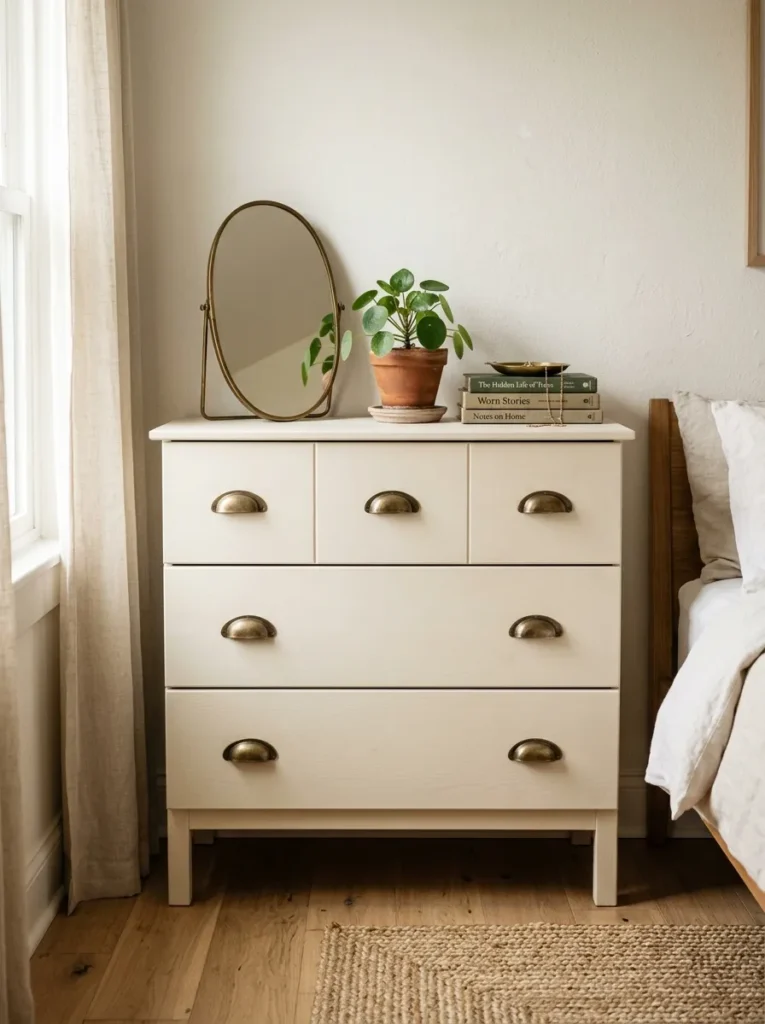
Vibe: The warm white chalk-painted TARVA feels like a piece of antique painted furniture that was found rather than made — the chalk paint’s specific matte depth creating a white surface of genuine warmth rather than the clinical brightness of gloss or commercial eggshell.
Why it works: Warm white chalk paint on the TARVA chest with aged brass cup pull hardware applies the classic painted furniture transformation principle — the TARVA’s clean, un-ornamented form in solid pine is specifically the right candidate for chalk paint: the solid wood surface accepts chalk paint without priming (chalk paint adheres to most solid wood surfaces without preparation beyond cleaning and light sanding), the wood’s grain provides a subtle texture beneath the paint that manufactured-finish furniture lacks, and the TARVA’s minimal form allows the paint color and the hardware to be the piece’s primary design elements without competing decorative structure.
Chalk paint preparation for TARVA: Sand the TARVA’s surfaces with 120-grit sandpaper, working with the grain, to remove any mill marks and open the wood grain for paint adhesion. Clean with a damp cloth and allow to dry completely. Apply two coats of chalk paint with a natural bristle brush, allowing each coat to dry for minimum two hours. Seal with a clear matte wax (applied with a clean cloth in circular motions, allowed to dry for 30 minutes, then buffed to a soft sheen) for durability. The chalk paint plus wax system on the TARVA requires no primer.
Budget: TARVA six-drawer chest: $100–130. Chalk paint (Annie Sloan, Rust-Oleum, or equivalent): $25–40. Aged brass cup pulls (six): $15–40. Clear matte wax: $15–25. Total: $155–235.
Making time: 4–6 hours including sanding, two paint coats, wax, and hardware replacement.
Quick Win: Replacing only the hardware (the original pine TARVA pulls with aged brass cup pulls) on an unpainted TARVA takes 20 minutes and immediately elevates the piece’s domestic quality — the hardware replacement alone is the single most impactful low-effort TARVA improvement.
Shop The Look
| Product |
|---|
| IKEA TARVA chest of drawers |
| Warm white chalk paint |
| Aged brass cup pull set six |
| Clear matte wax sealer |
| 120-grit sandpaper set |
Also view: 16 IKEA MALM Dresser Hacks with Gold Accents
2. Deep Navy Chalk Paint — The Bold Bedroom Statement
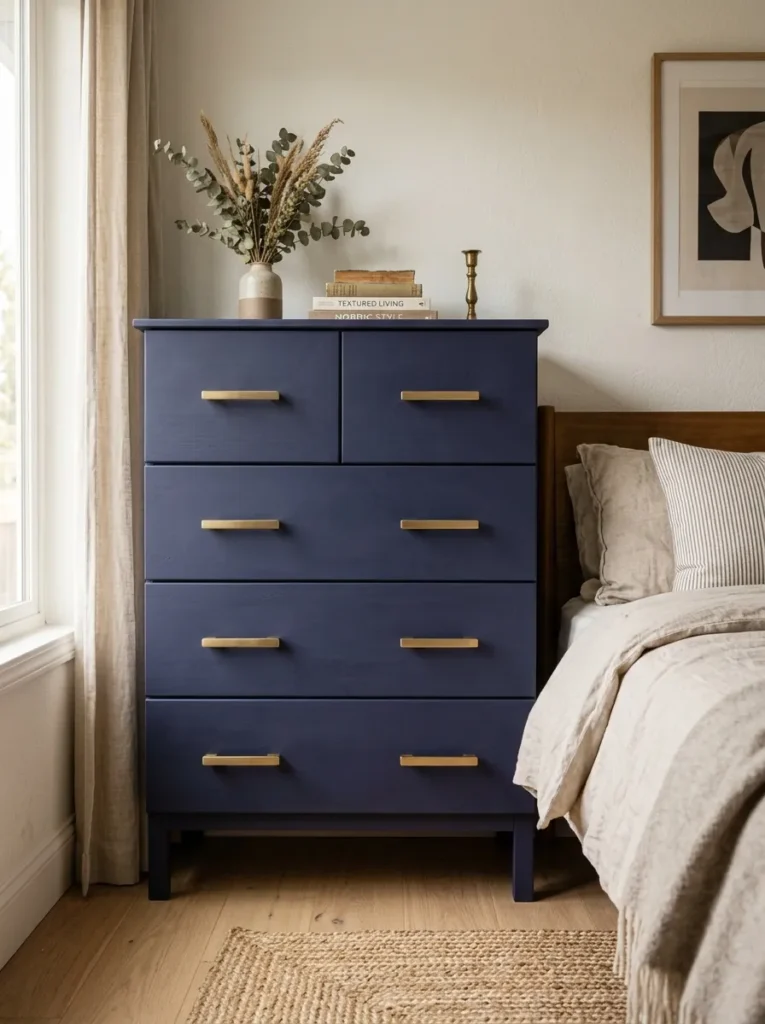
Vibe: The deep navy TARVA feels like a bedroom that made one bold furniture decision and let it define the room’s entire design language — the deep navy chalk paint and the brushed brass hardware creating a dresser of genuine chromatic authority.
Why it works: Deep warm navy chalk paint on the TARVA chest applies the furniture-as-color-anchor principle — as established in the navy bedroom article, painting the bedroom’s primary storage piece in deep navy provides the room’s entire chromatic depth without requiring wall painting, allowing the walls to remain light and spatially expansive while the furniture provides the color weight. The matte chalk paint finish is specifically important for navy: a shiny navy finish reads as commercial lacquer or automotive finish; a matte navy finish reads as the specific depth of a painted antique, creating the warm material quality that makes the navy furniture piece genuinely beautiful rather than merely dark.
Navy specification: The warm undertone navy (Annie Sloan Napoleonic Blue, Little Greene Hague Blue, Frenchic Navy Admiral, or equivalent chalk paint in warm navy) is the correct specification — cool navy with a green undertone reads as slightly gray and clinical in warm lamp light, while warm navy develops richness and depth in warm amber light.
Budget: TARVA chest: $100–130. Navy chalk paint: $25–40. Brass bar handles (six): $20–50. Total: $145–220.
Making time: 4–6 hours.
Shop The Look
| Product |
|---|
| IKEA TARVA chest navy paint |
| Deep warm navy chalk paint |
| Brushed brass bar handle set |
| Warm white wall paint bedroom |
| Natural linen bedding pair |
3. Warm Sage Green — The Botanical Dresser
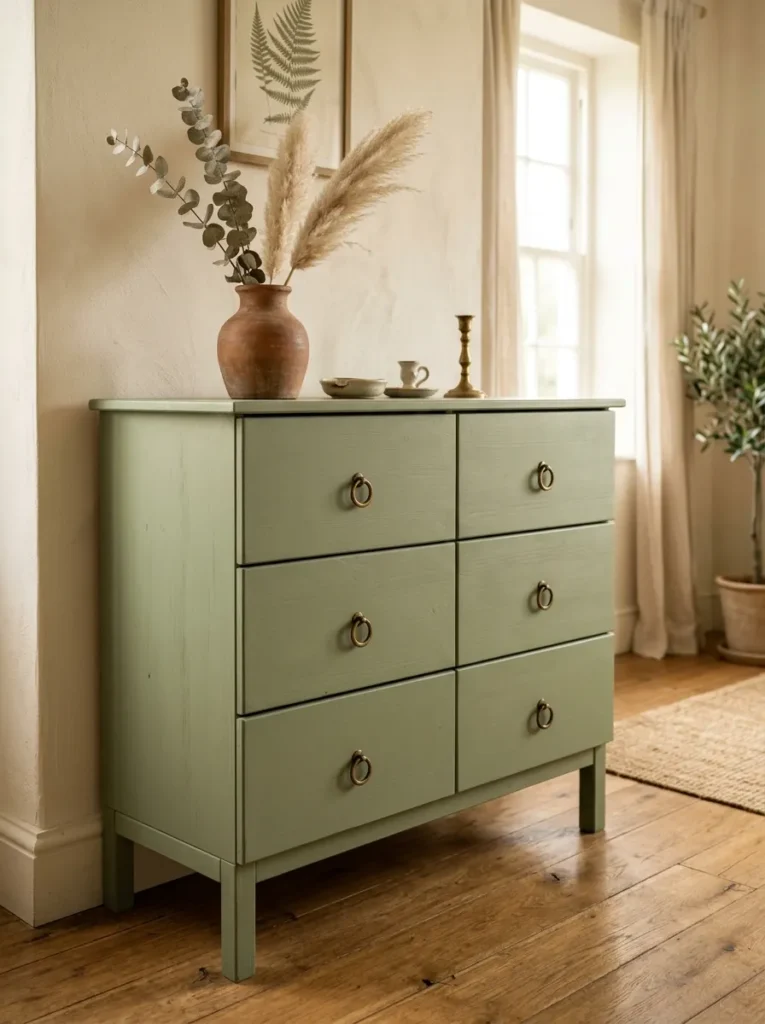
Vibe: The sage green TARVA feels like a piece of furniture that grew from the same botanical world as the plants around it — the warm herb-green chalk paint creating a dresser that reads as part of the room’s natural material palette rather than as furniture placed within it.
Why it works: Warm sage green chalk paint on the TARVA with aged brass ring pulls applies the botanical palette integration principle — sage green is specifically the paint color that most completely integrates furniture into a natural material, botanical, or Scandinavian interior palette because its warm yellow-green undertone references the actual color of sage herb (a botanically authentic natural tone) rather than a manufactured or trend-driven color choice. The brass ring pull (a small circular ring approximately 30mm diameter attached at the drawer face center) is specifically the hardware form that most authentically references antique painted furniture — the ring pull’s traditional association with painted country furniture makes it the natural hardware companion for the sage-painted TARVA.
Budget: TARVA chest: $100–130. Sage chalk paint: $25–40. Aged brass ring pulls (six): $15–30. Total: $140–200.
Making time: 4–6 hours.
Shop The Look
| Product |
|---|
| IKEA TARVA chest sage paint |
| Warm sage green chalk paint |
| Aged brass ring pull set six |
| Dried eucalyptus botanical |
| Terracotta vase small |
4. Dark Walnut Wood Stain — The Grown-Up Pine Transformation
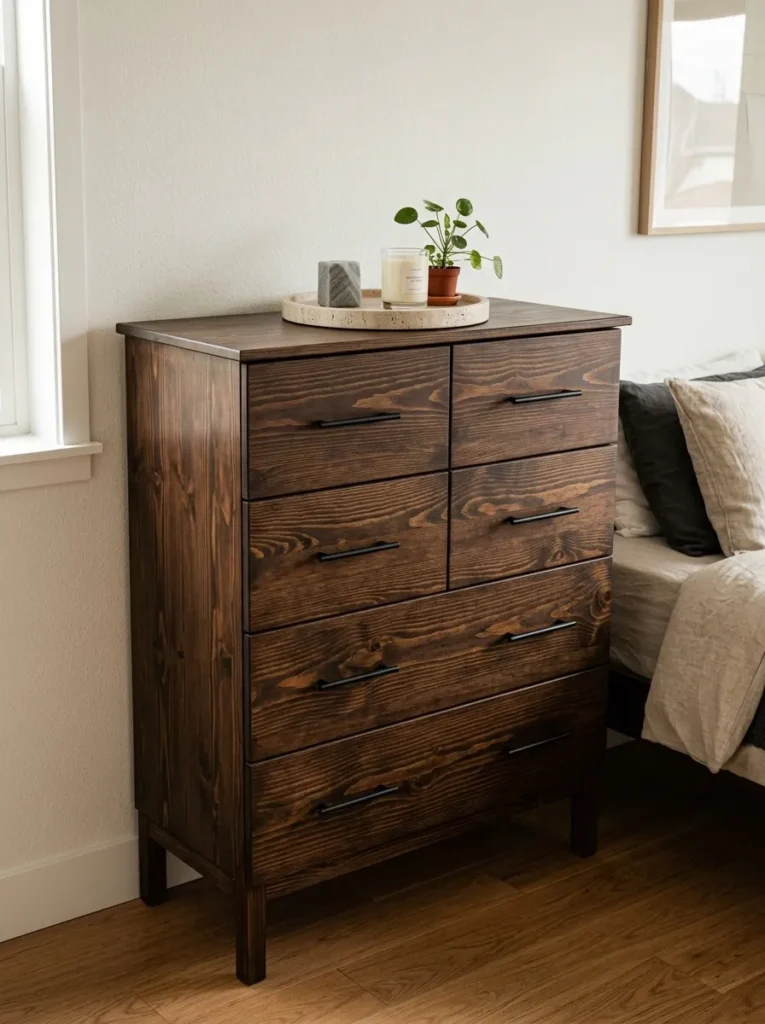
Vibe: The walnut-stained TARVA feels like solid walnut furniture at pine furniture cost — the dark stain’s depth in the pine grain creating the specific warm quality of genuine dark timber furniture without the premium material investment.
Why it works: Dark walnut oil stain on the TARVA pine chest with slim matte black hardware applies the wood species transformation principle — wood stain (oil-based or water-based pigmented stain) penetrates the wood’s fiber rather than sitting on the surface, creating a color that is within the wood rather than on it and that reveals the wood’s own grain pattern through the depth of the color. Dark walnut stain on pine creates the specific visual quality of genuine dark walnut furniture because it fills the pine’s open grain with the warm brown pigment that characterizes real walnut, while the pine’s own grain pattern (which is coarser than walnut’s but similarly directional) is visible within the stain depth. The result reads as dark timber furniture whose specific grain reveals, on close inspection, that it is a stained pine rather than genuine walnut — but at normal room viewing distance, the visual quality is persuasively similar.
Stain preparation: Sand the TARVA to 180-grit (finer than for chalk paint — stain raises the wood grain and must be applied over a smooth surface), working progressively from 80-grit through 120-grit to 180-grit. Apply the oil stain with a clean cloth using the wipe-on, wipe-off technique (apply generously, work into the grain, wipe off the excess before it dries). Allow complete cure (24–48 hours) before applying two coats of hard wax oil in a clear satin finish for durability and surface protection.
Budget: TARVA chest: $100–130. Dark walnut oil stain: $15–30. Matte black bar handles (six): $15–35. Hard wax oil: $20–35. Total: $150–230.
Making time: 6–10 hours including progressive sanding, stain, and wax coats.
Shop The Look
| Product |
|---|
| IKEA TARVA chest stain base |
| Dark walnut oil-based wood stain |
| Slim matte black bar handle six |
| Hard wax oil clear satin |
| Sandpaper set 80 120 180 grit |
5. Limewash Pine — The Aged Rustic Transformation
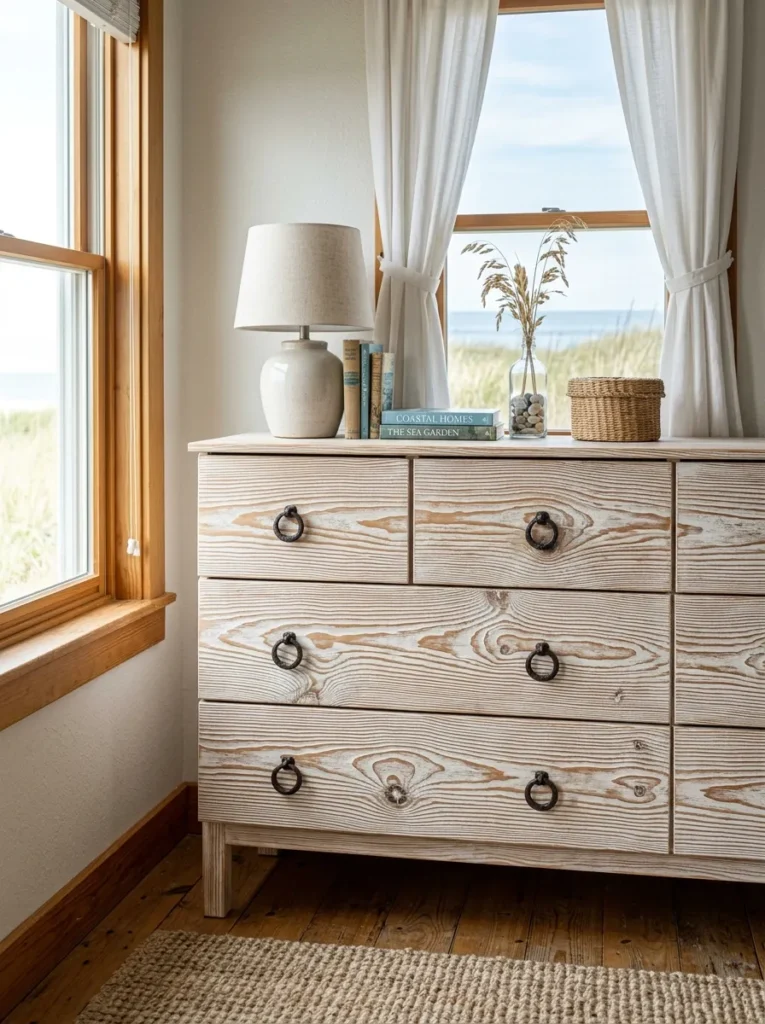
Vibe: The limewashed TARVA feels like a piece of coastal furniture that has been in a beach house for thirty years and improved with every season — the white pickling in the grain recesses creating the specific aged-and-bleached quality of genuinely weathered natural timber.
Why it works: A limewash or white pickling finish on the TARVA pine chest applies the grain emphasis natural aging principle — the limewash technique specifically exploits the pine’s open-grained structure: the white pigment wash settles into the pine’s grain recesses (the relatively softer early wood between the harder growth rings) while the raised surface grain (the dense late wood of the growth rings) resists the pigment. When the excess is wiped off while wet, the resulting surface shows white pigment in the valleys and natural pine honey on the ridges — a specifically aged, naturally bleached effect that no other finish technique creates. The forged iron hardware (which has the rough, imperfect quality of genuinely hand-worked metal rather than the smooth commercial finish of cast or machined handles) is the hardware family that most authentically coordinates with the limewash finish’s rustic quality.
Limewash technique: Dilute white chalk paint 1:3 with water (one part paint to three parts water) to create the pickling wash. Apply to the TARVA’s sanded surface (sanded to 80-grit with the grain — do not sand too finely as the grain texture must remain open for the pickling effect). Wipe off the excess while wet using a clean cloth, working with the grain. Allow to dry for four hours. Apply a clear matte wax for light protection (avoid oil finishes which will darken the white pigment in the grain).
Budget: TARVA chest: $100–130. Chalk paint for pickling wash: $15–25 (very small amount required). Iron or forged handles (six): $25–60. Clear matte wax: $15–20. Total: $155–235.
Making time: 3–5 hours.
Shop The Look
| Product |
|---|
| IKEA TARVA chest limewash |
| White chalk paint pickling wash |
| Forged iron ring pull set |
| Clear matte wax protection |
| 80-grit sandpaper grain opening |
6. Two-Tone Chalk Paint — Upper and Lower Color Blocks
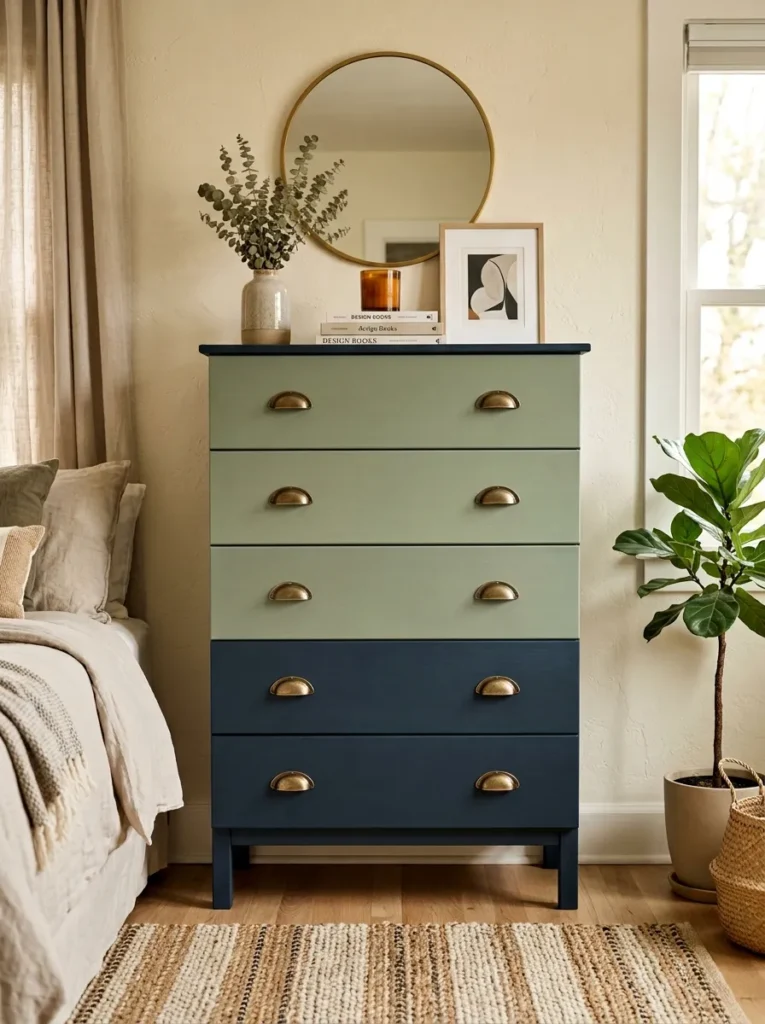
Vibe: The two-tone TARVA feels like a color theory lesson that became a piece of bedroom furniture — the sage top and navy bottom creating a composed color block that reads as designed rather than accidentally contrasted.
Why it works: Two-tone chalk paint on the TARVA using the drawer gap as a natural color division applies the KALLAX color-blocking principle in furniture form — the TARVA’s drawer structure (the visible gap between adjacent drawers) provides the same natural division line as the KALLAX’s internal shelf, allowing clean color transitions without masking tape or freehand painting edges. Dividing a six-drawer chest into equal three-drawer sections in two contrasting but related colors creates the specific visual composition of a designed color block rather than an accidentally mismatched piece of furniture. The sage-and-navy combination — with its shared warm undertone quality, its value contrast (mid-value sage above, deep-value navy below), and its botanical-and-maritime register — is specifically the two-color combination that most reads as intentional and resolved.
Budget: TARVA chest: $100–130. Two chalk paints: $30–50. Brass cup pulls (six): $15–40. Total: $145–220.
Making time: 4–6 hours (two colors requires more careful application at the color boundary).
Shop The Look
| Product |
|---|
| IKEA TARVA chest two-tone |
| Warm sage chalk paint top |
| Deep navy chalk paint bottom |
| Brushed brass cup pull set six |
| Clean masking tape drawer edge |
7. Contact Paper Drawer Fronts — The Renter-Friendly Transformation
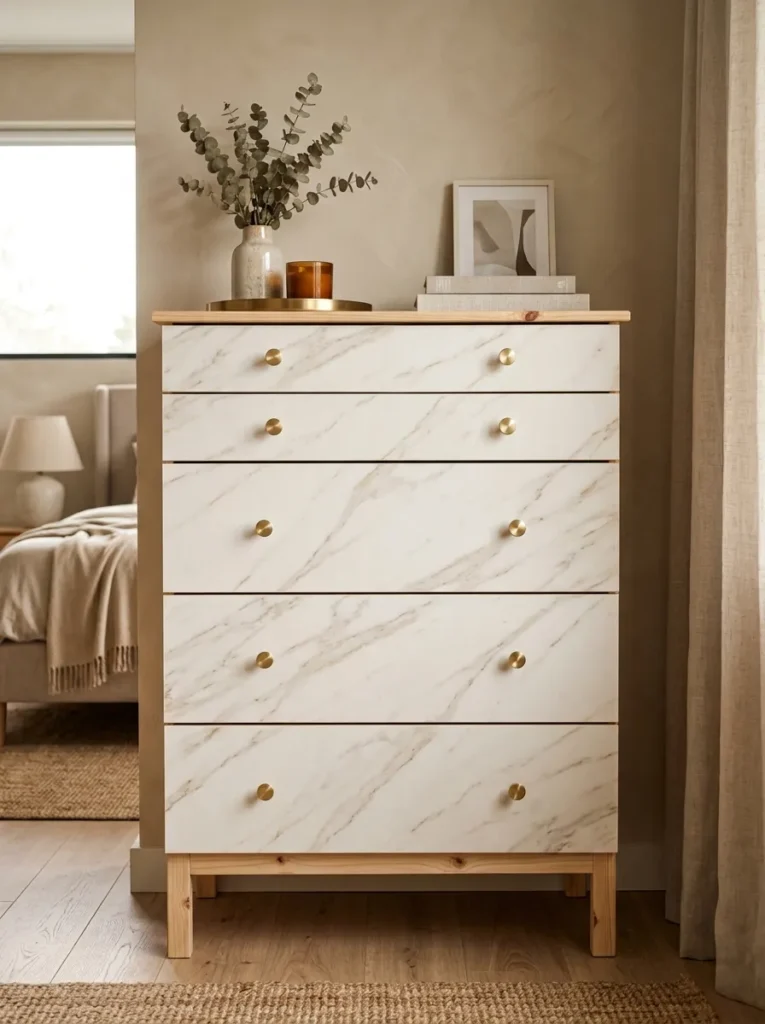
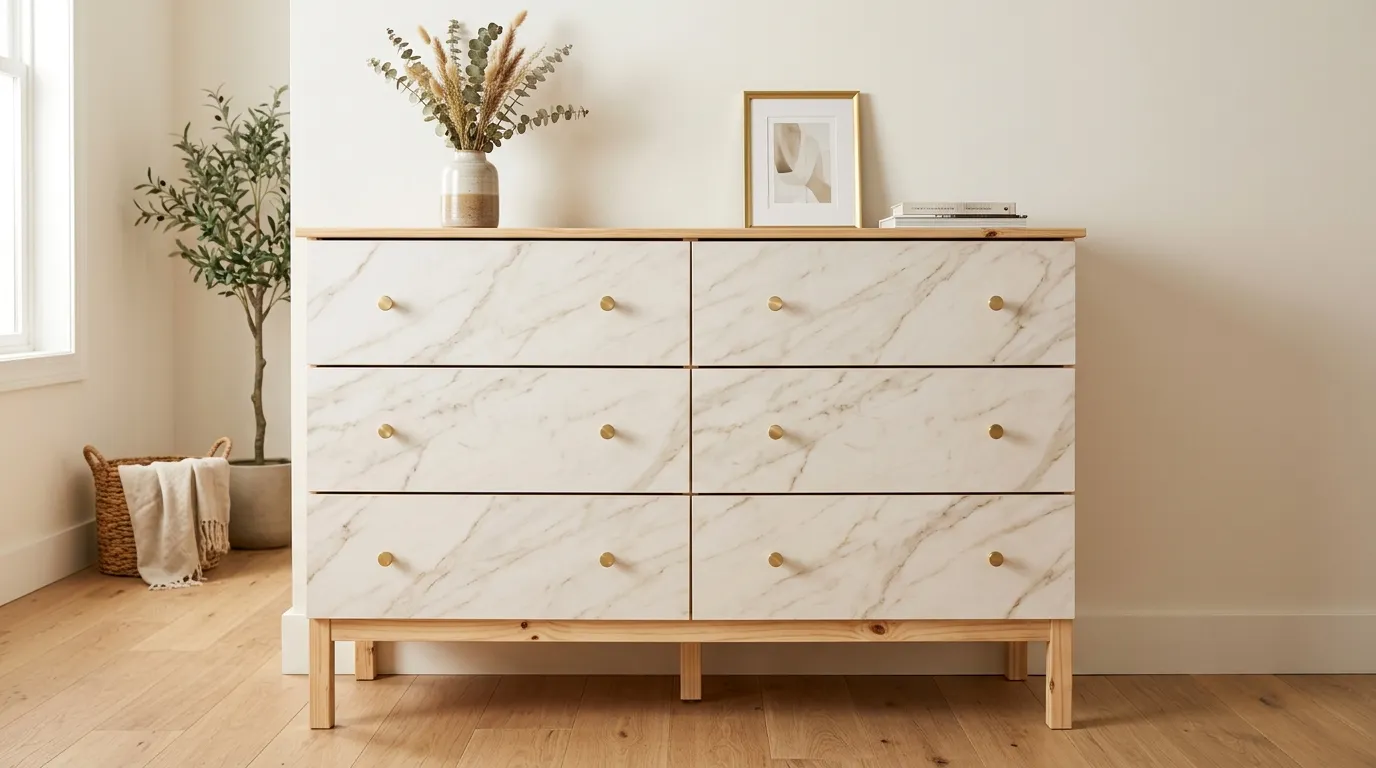
Vibe: The marble-effect contact paper TARVA feels like a chest of drawers that decided its drawer fronts should be a different material from its body — the clean marble-effect application and the small brass knobs creating a contemporary material contrast composition from a completely reversible technique.
Why it works: High-quality contact paper on the TARVA drawer fronts with the chest body left in natural pine applies the material contrast principle — the visual interest comes from the deliberate contrast between the warm marble-effect drawer fronts and the natural pine chest body, creating a two-material composition that reads as designed. The contact paper technique is specifically appropriate for rental properties (completely reversible — contact paper peels off without surface damage on removal) and for makers who want a material effect (marble, stone, wood grain, metallic) that paint cannot replicate. The small brass knob (rather than a bar or cup pull) is the hardware choice that provides the warmth of aged brass without competing visually with the marble-effect pattern on the drawer fronts.
Contact paper application: Clean the drawer fronts with isopropyl alcohol and allow to dry. Cut the contact paper slightly larger than each drawer front (2cm excess on all edges). Apply using the dry hinge method (peel the backing 5cm, align the top edge, smooth down progressively while peeling the backing in stages). Use a credit card or squeegee to smooth air bubbles toward the edges. Trim the excess with a sharp craft knife against a metal ruler.
Budget: TARVA chest: $100–130. Marble-effect contact paper (2m): $20–40. Small brass knobs (six): $12–25. Total: $132–195.
Making time: 1.5–3 hours.
Shop The Look
| Product |
|---|
| IKEA TARVA chest contact paper |
| Warm marble-effect contact paper |
| Small brass knob set six |
| Squeegee contact paper application |
| Craft knife contact paper trim |
8. Gold Leaf Accent Drawer Fronts — The Glamour Touch
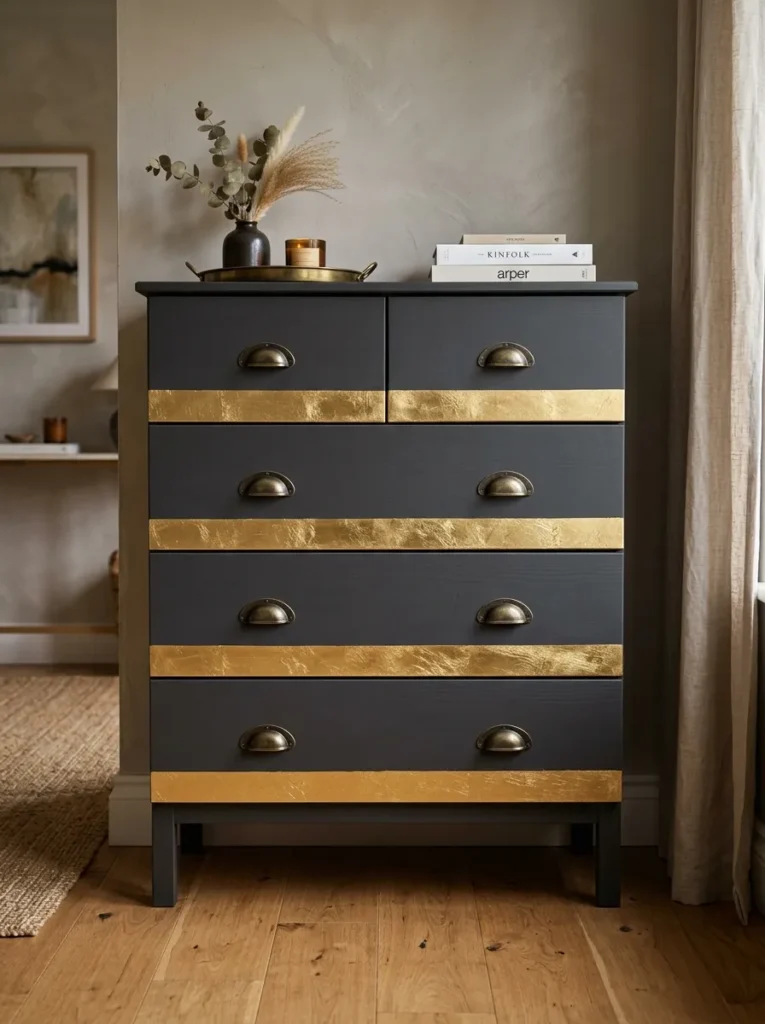
Vibe: The gold leaf accent TARVA feels like a theatrical flourish on a dramatically dark stage — the warm gold bands at the base of each charcoal drawer creating a glamorous detail that makes the chest of drawers genuinely extraordinary.
Why it works: Gold leaf accent bands on charcoal chalk-painted TARVA drawer fronts applies the precious metal accent principle — gold leaf (genuine or imitation, in 23.5K or composition gold) applied in a deliberate band pattern on a dark ground creates the specific visual quality of genuine luxury furniture decoration that no paint color can replicate. The band placement (at the base of each drawer front rather than random or central) creates the visual logic of a consistent detail repeated across all six drawers, making the gold leaf read as a designed element rather than a decorative accident. The aged brass cup pulls above the gold band coordinate with the gold leaf’s warm tone while providing the functional hardware element at the conventional position.
Gold leaf application: Apply gold leaf size (adhesive) to the intended gold leaf band area using a fine brush, allow to become tacky (15–30 minutes), then carefully lay the gold leaf sheet over the sized area and press gently with a soft brush. Remove the excess leaf with a soft dry brush. Seal the gold leaf with a clear varnish or wax to prevent tarnishing.
Budget: TARVA chest: $100–130. Charcoal chalk paint: $25–40. Imitation gold leaf sheets: $10–20. Aged brass cup pulls (six): $15–40. Gold leaf size: $8–15. Total: $158–245.
Making time: 6–8 hours (gold leaf application requires patience and cannot be rushed).
Shop The Look
| Product |
|---|
| IKEA TARVA chest gold leaf |
| Deep charcoal chalk paint |
| Imitation gold leaf sheet set |
| Gold leaf size adhesive |
| Aged brass cup pull six |
9. TARVA Bed Frame — The Painted Bedroom Centerpiece
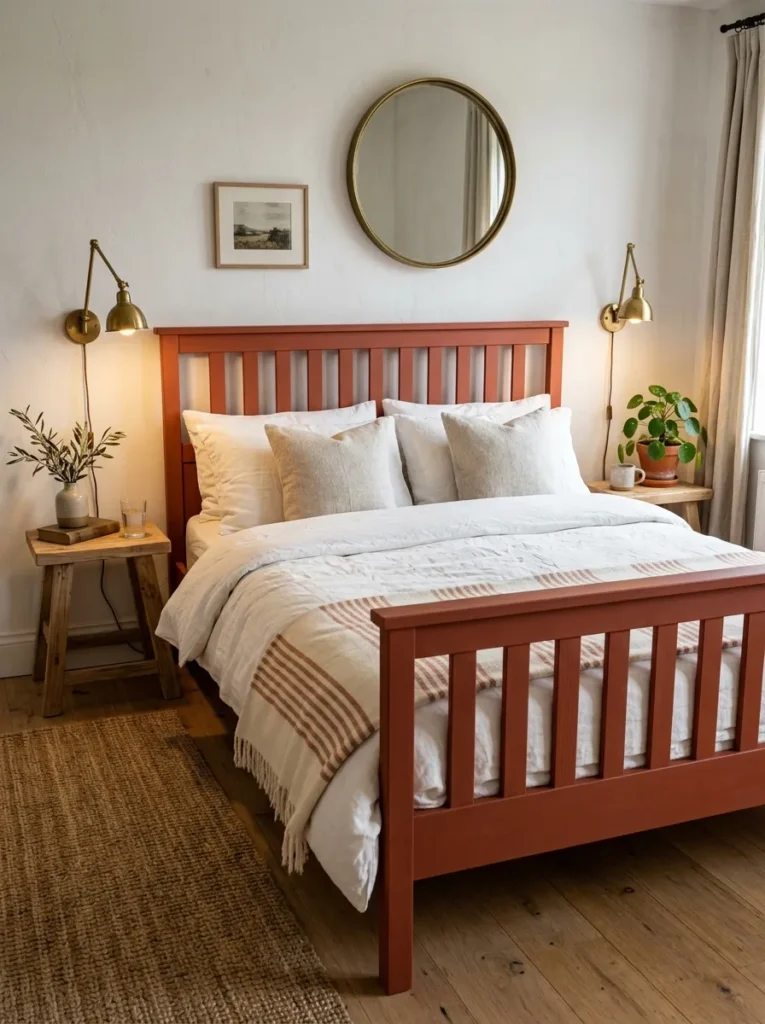
Vibe: The terracotta TARVA bed frame feels like a Mediterranean bedroom that chose the most important furniture piece to carry its entire color decision — the warm clay-red headboard and footboard creating a bedroom centerpiece of genuine chromatic presence.
Why it works: The TARVA bed frame painted in warm terracotta chalk paint applies the bed frame as bedroom color anchor principle — the bed frame is the bedroom’s largest furniture piece and its most visually dominant form, and painting the TARVA bed frame in a warm, saturated color converts it from a natural pine background element to the bedroom’s primary design statement. Terracotta specifically — the warm clay-red of Mediterranean tile and fired earth — is the bed frame color that most warmly coordinates with the white linen, natural timber, and aged brass combination that the bedroom’s companion elements provide.
TARVA bed frame assembly note: Assemble the TARVA bed frame completely before painting — sanding all surfaces after assembly (including the joints) and painting the assembled frame ensures that the paint covers the joints consistently and that no unpainted pine is revealed where parts connect.
Budget: TARVA bed frame: $130–180. Terracotta chalk paint: $25–40. Total: $155–220.
Making time: 5–8 hours for a complete bed frame.
Shop The Look
| Product |
|---|
| IKEA TARVA bed frame |
| Warm terracotta chalk paint |
| Clear matte wax bed frame |
| White linen bedding set |
| Aged brass wall reading light |
10. Ebonized Pine — The Dramatic Dark Transformation
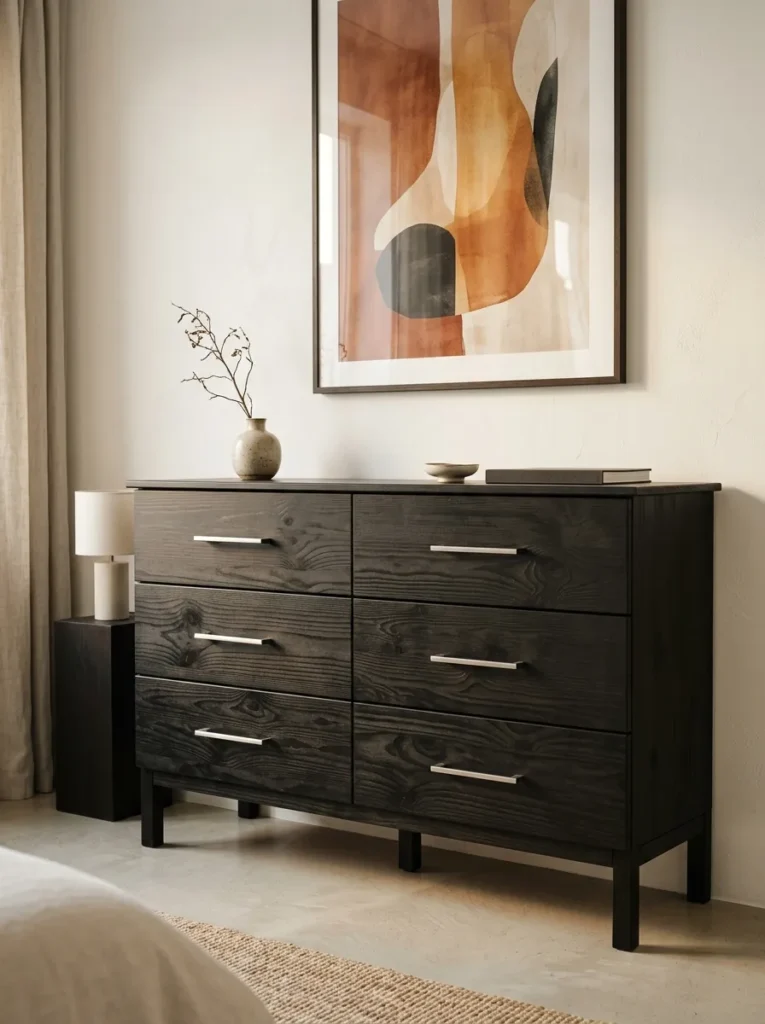
Vibe: The ebonized TARVA feels like a piece of Japanese tansu furniture reimagined in Scandinavian pine — the grain visible within the near-black depth creating a surface of genuine darkness and warmth that no black paint can replicate.
Why it works: An ebonizing treatment on the TARVA pine chest applies the chemical surface transformation principle — ebonizing (treating the wood with ferrous sulfate solution, black Japan, or a tea/iron mixture that reacts with the wood’s own tannins to create a dark surface chemical compound within the wood fiber rather than on it) creates a darkness that has the specific quality of the wood’s own grain structure made dark — the grain is still visible within the darkness because the chemical reaction is more intense in the softer early wood than in the denser late wood, creating a slightly lighter grain pattern within the near-black field. This is specifically different from black paint, which covers the grain uniformly and creates a flat opaque black surface.
Ebonizing technique: Apply several coats of strong black tea to the TARVA’s sanded surface (the tea adds tannins to the low-tannin pine). Allow to dry. Apply ferrous sulfate solution (available from garden suppliers as lawn iron supplement, diluted 1:10 with water). The iron in the solution reacts with the tea tannins to create a dark gray-black chemical compound within the wood surface. Apply multiple coats for deeper darkness. Seal with a clear matte wax.
Budget: TARVA chest: $100–130. Ferrous sulfate and black tea: $5–10. Brushed steel handles (six): $20–45. Clear matte wax: $15–20. Total: $140–205.
Making time: 6–10 hours including multiple treatment coats.
Shop The Look
| Product |
|---|
| IKEA TARVA chest ebonize |
| Ferrous sulfate ebonizing agent |
| Brushed steel bar handle set six |
| Clear matte wax ebonized seal |
| Natural bristle application brush |
11. TARVA Bedside Table — Complete Bedroom Matching Set
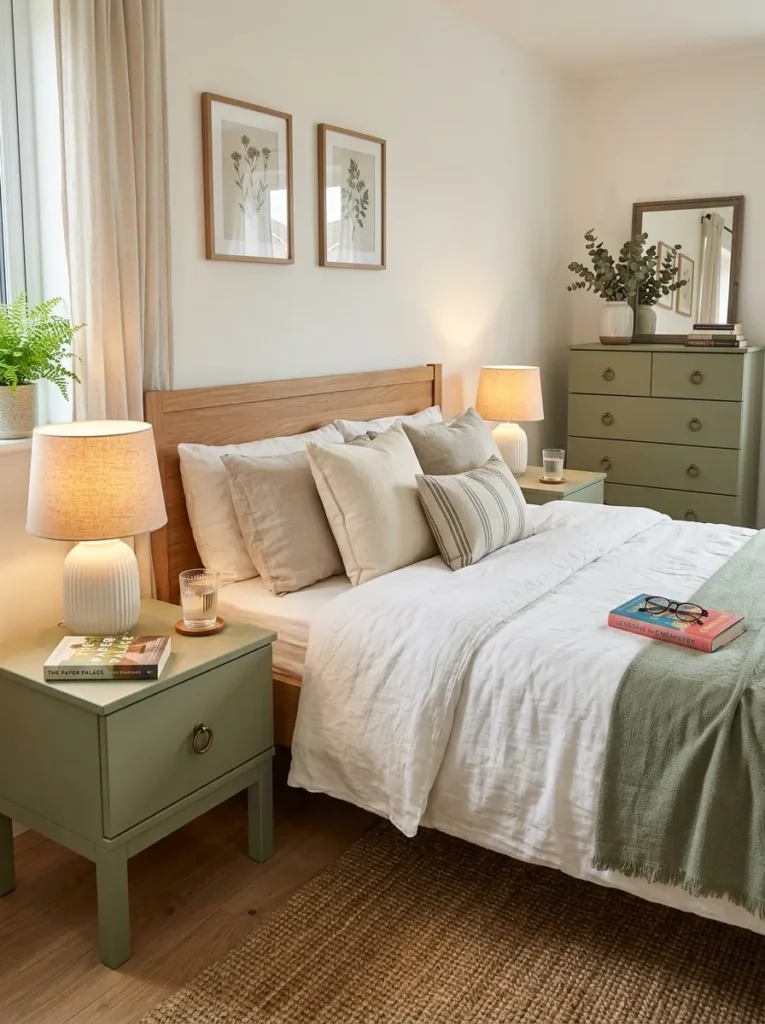
Vibe: The matching TARVA bedroom suite feels like a custom furniture collection designed specifically for this bedroom — the three TARVA pieces in consistent paint and hardware creating the specific quality of a designed furniture suite at flat-pack cost.
Why it works: Painting the TARVA bedside table pair in the same chalk paint and hardware as the TARVA chest applies the furniture suite composition principle — a composed bedroom furniture suite (chest, two bedside tables, and optionally the bed frame in consistent finish and hardware) creates the specific visual quality of a designed collection rather than an assembled accumulation of varied pieces. The TARVA’s availability as a chest, a bed frame, and a bedside table (all in the same solid unfinished pine) specifically enables this suite composition from a consistent material base, and the consistent chalk paint and hardware across all three pieces creates the visual unity that defines the suite as a designed collection rather than three coincidentally similar pieces.
Budget: Two TARVA bedside tables: $70–100. Sage chalk paint and ring pulls (for the pair): $20–35. Ceramic lamp pair: $40–80. Total bedside addition to existing chest hack: $130–215.
Making time: 2–3 hours per bedside table.
Shop The Look
| Product |
|---|
| IKEA TARVA bedside table pair |
| Sage chalk paint matching suite |
| Aged brass ring pull pair |
| Ceramic bedside lamp pair |
| Warm linen shade pair |
12. Stencil Pattern — Surface Decoration on Painted Base
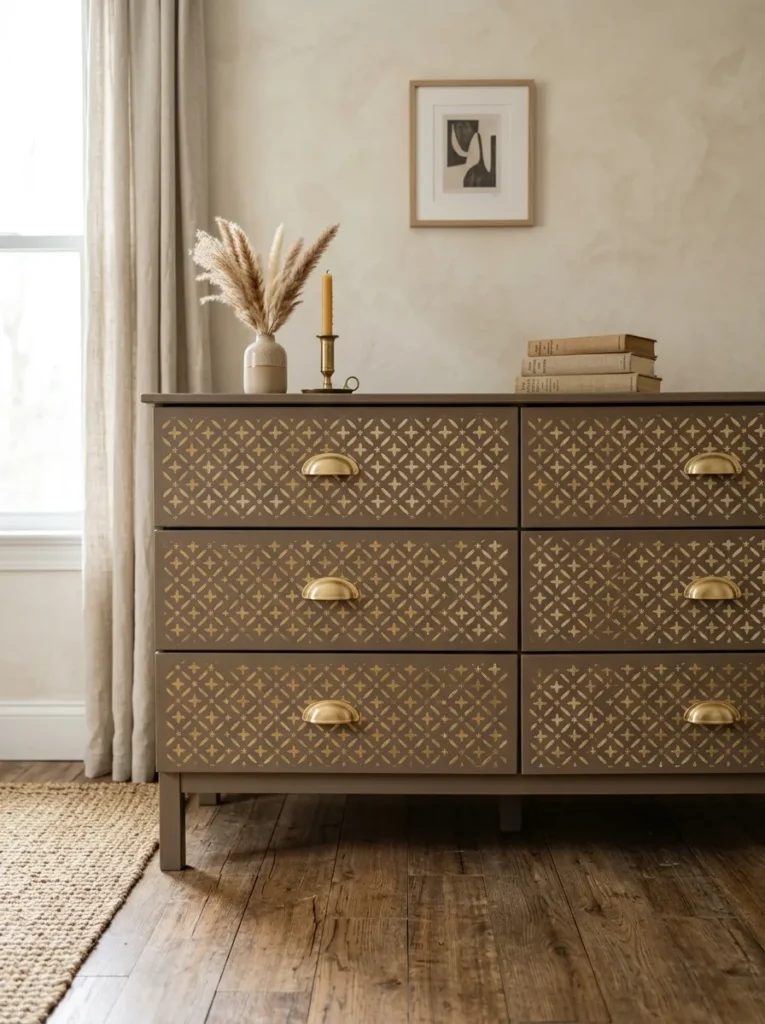
Vibe: The stenciled TARVA feels like a piece of folk art furniture that was made for someone specific — the repeating geometric pattern across all six drawer fronts creating a surface of genuine decorative craft quality from a technique achievable in an afternoon.
Why it works: A geometric stencil pattern in aged gold over a warm mushroom base coat on the TARVA applies the folk art furniture decoration principle — stenciling is the furniture decoration technique with the longest history in domestic craft (from American colonial painted furniture through Scandinavian folk art through Victorian painted cottage furniture), and a repeating geometric pattern in a warm metallic (aged gold or warm cream) over a warm mid-tone base creates the specific quality of deliberately decorated furniture that communicates making skill and aesthetic intention. The key to stenciling quality is the technique of dabbing (pouncing) the stencil paint rather than brushing — a stencil brush or a sponge pounced vertically through the stencil aperture creates a sharp, clean pattern edge; a brush pulled horizontally creates paint seeping under the stencil and blurred pattern edges.
Budget: TARVA chest: $100–130. Mushroom chalk paint: $25–40. Stencil (geometric): $8–20. Aged gold stencil paint: $10–15. Brushed gold cup pulls (six): $20–40. Total: $163–245.
Making time: 5–8 hours including base coat, stencil application across 18 drawer face applications, and hardware.
Shop The Look
| Product |
|---|
| IKEA TARVA chest stencil |
| Warm mushroom chalk paint base |
| Geometric stencil pattern |
| Aged gold stencil paint |
| Brushed gold cup pull set |
13. Cane Webbing Drawer Fronts — The Natural Material Upgrade
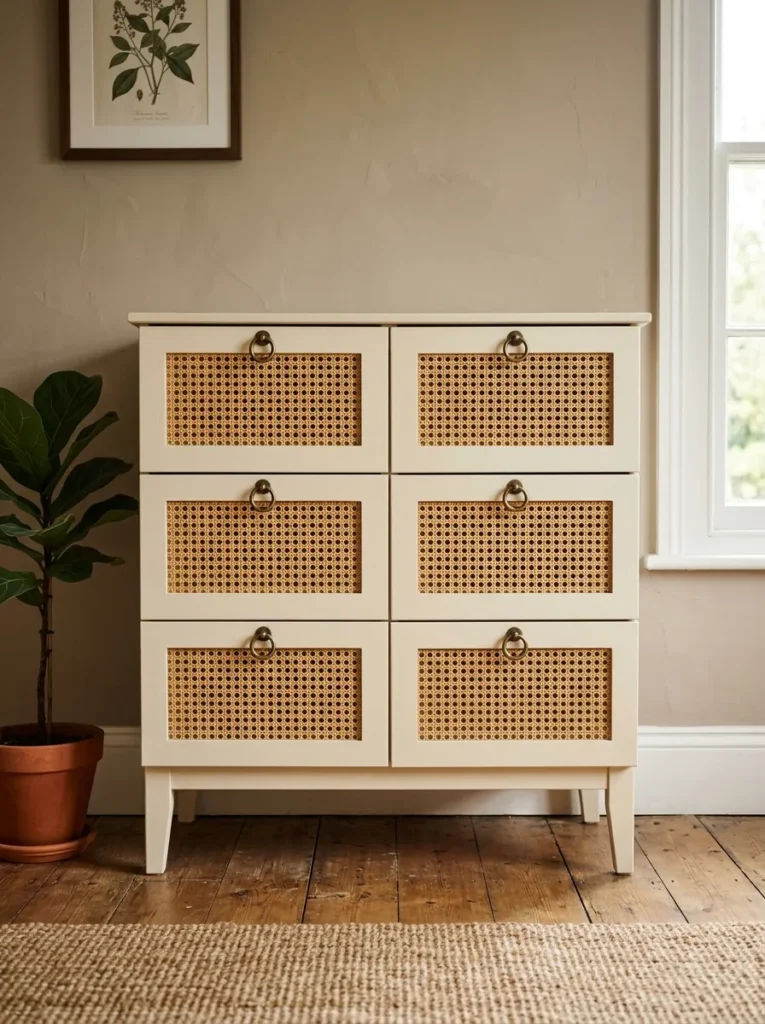
Vibe: The cane webbing TARVA feels like a Parisian mid-century cabinet that was built in a Scandinavian pine workshop — the warm honey cane webbing in each cut-out opening creating the specific natural material warmth of genuine rattan furniture from a modified flat-pack chest.
Why it works: Cane webbing inserts in cut-out drawer fronts on the TARVA chest applies the natural material insert technique — cane webbing (the woven rattan mesh used in traditional Parisian cafe chairs and mid-century furniture drawer and cabinet fronts) is one of the most consistently popular furniture material accents in contemporary interior design because of its specific combination of warmth (the honey color of natural rattan), texture (the woven open structure), and historical reference (rattan webbing furniture has a 200-year design tradition from Viennese bentwood through colonial plantation furniture through 1970s bohemian chic through contemporary Japandi). Applied as inserts to the TARVA’s drawer fronts, the cane webbing converts the drawer from a flat solid surface to an open-structured one that reveals (and partially conceals) the drawer’s contents.
Technical modification: Cut the drawer front openings using a router with a straight cutting bit (running the router around an MDF template to create consistent openings across all six drawers). Fix the cane webbing to the interior face of the cut drawer front using staples (staple gun) or thin timber battens glued and pinned around the opening perimeter. Pre-soak the cane webbing in warm water for 30 minutes before installation — it becomes pliable and, as it dries, contracts taut across the opening.
Budget: TARVA chest: $100–130. Cane webbing sheet: $30–60. Chalk paint and ring pulls: $30–50. Total: $160–240. Requires router tool.
Making time: 8–12 hours including router work, cane installation, paint, and hardware.
Shop The Look
| Product |
|---|
| IKEA TARVA chest cane webbing |
| Natural cane webbing sheet roll |
| Router tool drawer front cut |
| White or cream chalk paint frame |
| Aged brass ring pull cane |
14. Decoupage Drawer Fronts — The Paper Craft Transformation
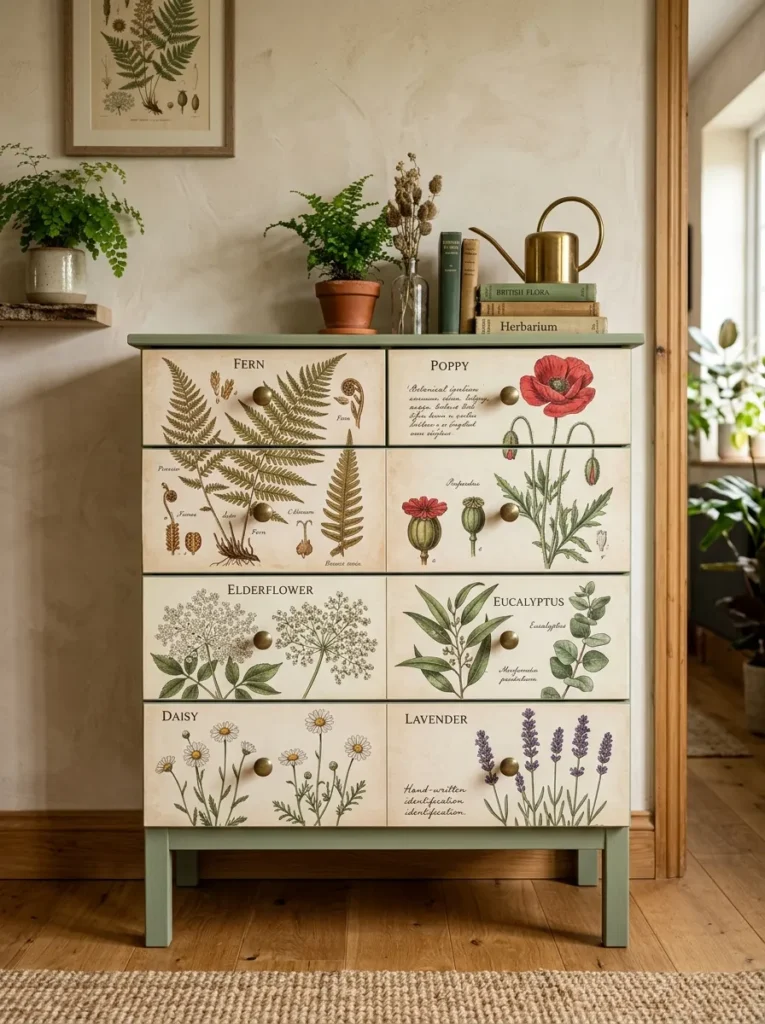
Vibe: The botanical decoupage TARVA feels like a cabinet made by a Victorian naturalist for a contemporary home — the herbarium botanical illustrations on each drawer converting the chest into a piece of botanical art furniture of genuine character.
Why it works: Botanical herbarium illustration decoupage on TARVA drawer fronts applies the paper craft art furniture principle — decoupage (the technique of applying paper images to a surface with decoupage medium, sealing the paper to the surface with multiple coats of the same medium) creates a smooth, permanently adhered image surface that reads as more integral to the furniture than a framed print placed above it. The choice of vintage herbarium botanical illustrations (available as copyright-free prints from botanical library archives, from vintage botanical illustration books, or from print-on-demand services specializing in antique botanical imagery) provides the specific combination of scientific precision, natural warmth, and historical character that makes the botanical illustration drawer fronts read as genuine art furniture rather than as decorated storage.
Budget: TARVA chest: $100–130. Sage chalk paint: $25–40. Botanical print set six: $15–30 (printed at home on high-quality matte paper). Decoupage medium: $10–15. Small brass knobs (six): $12–25. Total: $162–240.
Making time: 4–7 hours including paint, print application, and sealing coats.
Shop The Look
| Product |
|---|
| IKEA TARVA chest decoupage |
| Herbarium botanical print set |
| Decoupage medium Mod Podge |
| Warm sage chalk paint body |
| Small brass knob set six |
15. TARVA Chest as TV Unit — The Repurposed Application
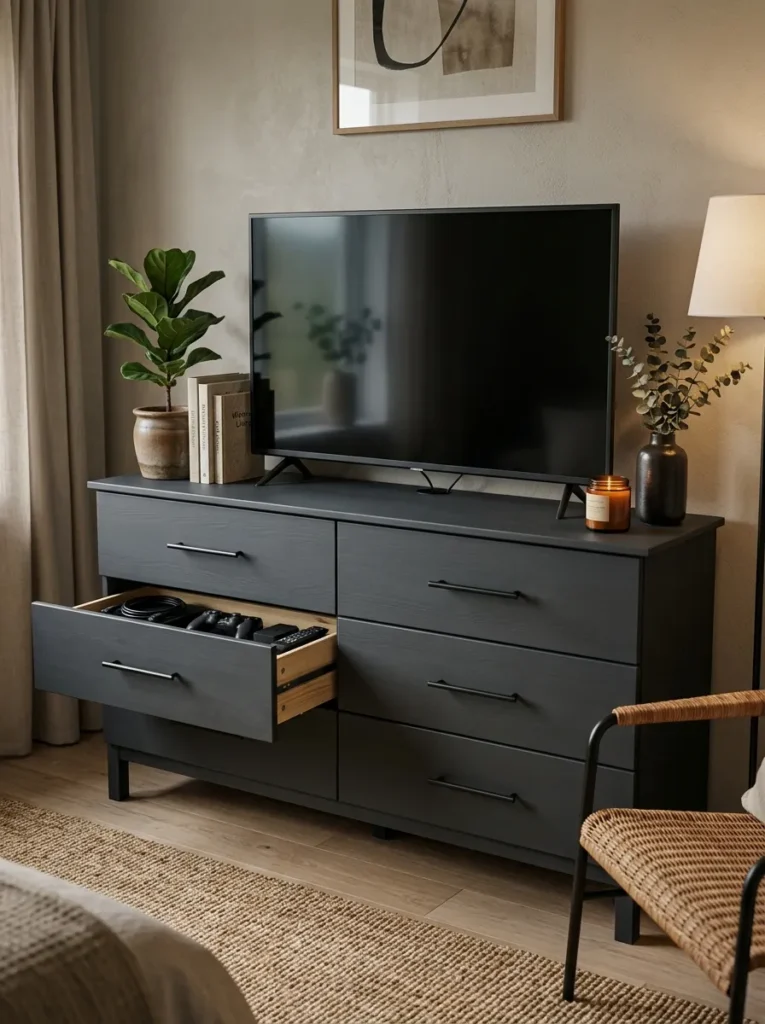
Vibe: The TARVA TV unit feels like a living room that decided its media storage should be as beautiful as its other furniture — the charcoal chalk paint and the matte black hardware converting the chest of drawers into a media console of genuine material quality.
Why it works: The TARVA six-drawer chest repurposed as a TV media unit applies the furniture function reassignment principle — the TARVA chest’s horizontal format (approximately 160cm wide in standard orientation) and its height (approximately 75cm) position the television at the correct viewing height for a standard sofa (screen center at approximately 100–110cm from the floor when a 65cm screen is placed on the 75cm chest top). The six drawers provide more organized media storage than most commercial TV units — each drawer can be assigned a specific media category (remotes, controllers, accessories, cables, games, spare devices) with complete concealment of the typical visual clutter of media equipment.
Cable management: Drill a 40mm cable management hole in the TARVA back panel behind the TV position using a drill and hole saw attachment — this allows the TV power cable and HDMI cables to run from the TV at the back of the chest top, through the hole in the back panel, and to the wall socket behind the unit without being visible from the front.
Budget: TARVA chest: $100–130. Charcoal chalk paint: $25–40. Matte black handles (six): $20–40. Total: $145–210.
Making time: 4–6 hours.
Shop The Look
| Product |
|---|
| IKEA TARVA chest TV unit |
| Deep charcoal chalk paint media |
| Slim matte black bar handle set |
| Cable management hole saw 40mm |
| Small plant TV flanking |
16. Mineral Paint Finish — The Depth Paint Alternative
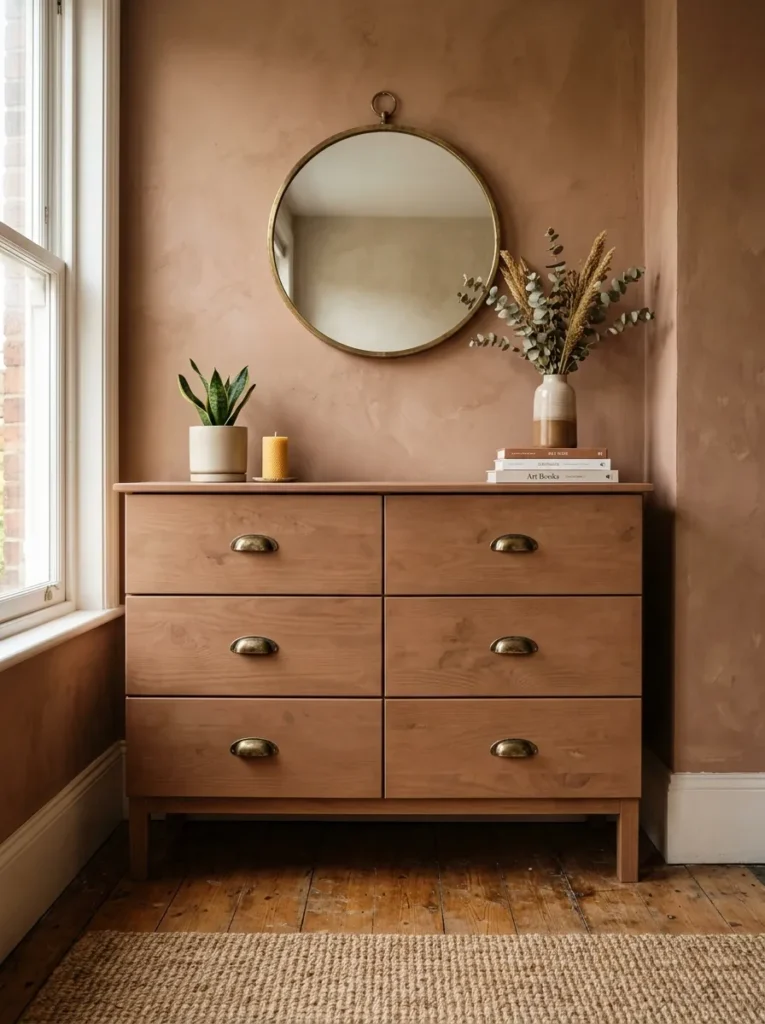
Vibe: The mineral-painted TARVA feels like the furniture was painted with the same material as the walls — the mineral paint’s specific tonal variation and light absorption creating a surface quality that reads as genuinely material rather than painted.
Why it works: Mineral paint (made from mineral pigments in a silicate or lime binder rather than acrylic or latex) on the TARVA pine chest applies the authentic pigment principle — mineral paint produces a surface quality that is specifically different from acrylic or chalk paint: the mineral pigments create a complex, slightly varied surface tone (the pigments distribute slightly unevenly, creating areas of marginally different density that read as material depth rather than flat color) and the mineral binder creates a specific matte quality that absorbs rather than reflects light without the powdery feel of chalk paint. The warm clay or plaster tones available in quality mineral paint ranges (Bauwerk Colour, KEIM Mineral Paint, Portola Paints) create a surface that reads as genuinely material rather than painted — as though the furniture has been made from a material of its own specific warmth rather than coated with a surface finish.
Budget: TARVA chest: $100–130. Mineral paint (half litre): $25–50. Aged brass pulls (six): $15–40. Total: $140–220.
Making time: 4–6 hours.
Shop The Look
| Product |
|---|
| IKEA TARVA chest mineral paint |
| Mineral paint warm clay tone |
| KEIM or Bauwerk mineral paint |
| Aged brass drawer pull set six |
| Natural bristle mineral paint brush |
17. Full Bedroom TARVA System — Complete Cohesive Suite
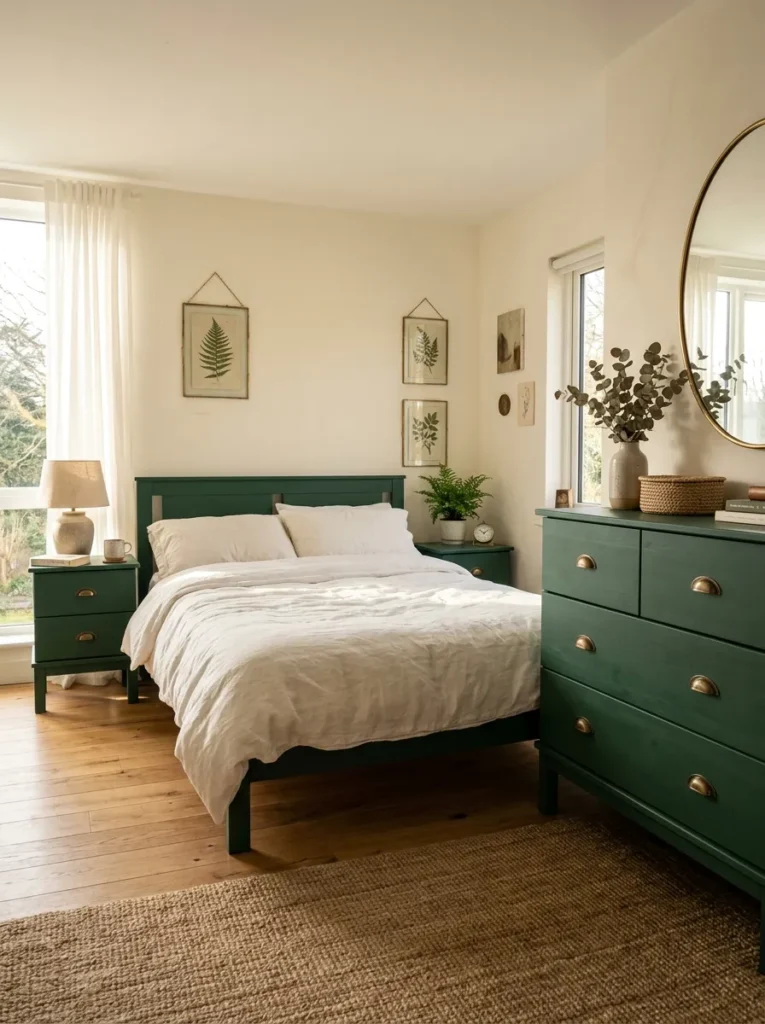
Vibe: The complete TARVA bedroom suite feels like a bedroom that was furnished by a designer working to a brief rather than assembled from separate purchases over time — the four pieces in consistent deep forest green and aged brass creating the specific quality of a designed furniture collection.
Why it works: A complete bedroom suite from all four TARVA pieces (bed frame, chest, two bedside tables) in consistent finish and hardware applies the suite cohesion maximum impact principle — as established in Idea 11, the visual quality of a composed furniture suite significantly exceeds the visual quality of the same pieces in varied finishes because the consistency reads as designed intention rather than accumulated coincidence. A complete TARVA suite in deep forest green with aged brass cups pulls creates a bedroom whose entire furniture layer speaks one design language, allowing the bedding, the art, the mirrors, and the lighting to provide all the variety and visual interest without the furniture layer contributing visual noise.
The forest green specification: Deep forest green (a green with sufficient blue depth to read as forest rather than sage, with a slight warm undertone rather than cool blue-green) is the chalk paint color that creates the most complete botanical immersion for the full bedroom suite — all four TARVA pieces in deep forest green create a bedroom where the furniture layer reads as an extension of the natural world rather than as manufactured furniture within it.
Budget: TARVA bed frame: $130–180. TARVA six-drawer chest: $100–130. Two TARVA bedside tables: $70–100. Forest green chalk paint (for all four): $40–60. Aged brass cup pulls (ten total — six for chest, two for bedside pair): $25–60. Total for complete suite: $365–530.
Making time: 15–25 hours across multiple days for the complete suite.
Shop The Look
| Product |
|---|
| IKEA TARVA bed frame suite |
| IKEA TARVA chest suite |
| IKEA TARVA bedside pair suite |
| Deep forest green chalk paint |
| Aged brass cup pull full set |
How to Start Your TARVA Hack Project
The single most important first move before beginning any TARVA hack is assessing the specific TARVA piece’s surface condition after assembly — inspecting each surface under raking light (a lamp held at a low angle to the surface, directing light across rather than onto it) to reveal any machine marks, sanding scratches, planer marks, or grain irregularities that need to be addressed before the finish coat. Raw pine from the TARVA manufacturing process typically has light planer marks on wide panel surfaces (visible as very fine parallel lines running with the grain) and varying degrees of surface roughness across the panel. These surface defects are invisible under a normal overhead light and are not visible in product photographs, but they become clearly visible (and permanently fixed in the surface) once a stain or paint coat is applied without adequate surface preparation. Assessing the surface before beginning and addressing every imperfection with appropriate sanding ensures that the finished piece has the smooth, consistent surface quality of professional furniture rather than the surface-mark-revealing quality of inadequately prepared raw pine.
The most common mistake in TARVA hacking is skipping or inadequately executing the surface preparation — specifically, applying chalk paint or stain over raw TARVA pine that has not been sanded smooth, cleaned of oil and handling contamination, and (for paint applications) lightly abraded with 120-grit sandpaper. The TARVA’s pine surface often carries handling oils and mineral deposits from the manufacturing process that prevent paint adhesion at contact points — visible as small areas where the first coat of paint beads slightly or fails to adhere fully. Cleaning with a clean cloth dampened with mineral spirits (white spirit) before any finish application removes these contamination points and is the preparation step most commonly omitted by first-time TARVA hackers.
Three specific investments under $50 that enable the widest range of TARVA hacks from this list: a set of sandpaper in 80, 120, and 180 grit ($8–12 for a multi-grit set — the preparation tool that enables every finishing technique in this list, from the smooth base for chalk paint through the grain-opening for limewash through the fine surface for stain); a small tin of chalk paint in a warm neutral (warm white or warm mushroom — $15–25 for a 250ml tin, sufficient for two coats on one chest of drawers and providing the test medium for any technique before committing to a full color); and a set of six replacement brass cup pulls in aged or brushed brass ($12–25 for a set of six from specialist hardware retailers — the hardware that immediately converts any TARVA from IKEA-reading to custom-reading regardless of whether the piece is painted or left in natural pine). These three investments combined for under $50 provide the preparation tools, the test medium, and the hardware upgrade that enable and improve every single idea in this list.
Frequently Asked Questions About IKEA TARVA Hacks
Do you need to prime TARVA pine before chalk painting?
For chalk paint specifically, priming is generally not required on the TARVA’s raw pine surface — chalk paint (made from calcium carbonate and acrylic binders) is formulated to adhere to most surfaces without primer, including raw wood. The key preparation steps for chalk painting TARVA pine without primer are: sand with 120-grit paper to remove any mill marks and open the grain surface, wipe clean with a dry cloth to remove sanding dust, and clean with a cloth dampened in mineral spirits to remove any oil or wax contamination from the manufacturing or handling process. If the chalk paint shows any adhesion problems (beading or failure to adhere on specific areas) after this preparation, spot-prime those areas with a shellac-based primer (such as Zinsser BIN) before applying the second chalk paint coat. For standard acrylic or latex paint (not chalk paint), the TARVA’s pine surface should be primed with a bonding primer formulated for wood — the smooth resin surface of some pine products resists standard paint without priming.
What is the best sealer for a chalk-painted TARVA chest of drawers?
The best sealer for a chalk-painted TARVA chest of drawers is a clear matte wax (Annie Sloan Clear Wax, Rust-Oleum Chalk Paint Wax, or equivalent) for bedroom and display pieces that receive light to moderate use. Apply the wax with a clean cloth in circular motions, allow to dry for 20–30 minutes (until the surface appears slightly hazy), then buff to a soft sheen with a clean cloth. Wax provides a soft, tactile finish that enhances the chalk paint’s matte depth without adding any sheen or plastic quality. For bathroom applications or pieces that will receive heavy daily use (kitchen dresser, entry console), a clear matte furniture varnish (water-based polyurethane or Polycrylic in matte sheen) provides greater durability than wax — it is harder and more moisture-resistant, though it adds a very slight plastic quality that wax does not.
How long does a TARVA hack take, and is it worth it?
A standard chalk paint TARVA chest hack (clean, sand, two coats of chalk paint, wax, and hardware replacement) takes 4–6 hours of active working time plus the drying time between coats — typically achievable in a weekend with one day of preparation and painting and one day of waxing and hardware installation. More complex hacks (ebonizing, cane webbing inserts, gold leaf, stencil pattern) take 8–15 hours and may require additional tool investment. The value proposition of a TARVA hack is assessed by comparing the total cost (TARVA plus materials plus hardware) with the cost of equivalent finished furniture in the desired style: a chalk-painted TARVA chest with aged brass hardware at $150–230 total compares with equivalent quality painted solid wood furniture at $400–1,200 — a saving of $250–1,000 for approximately 5 hours of skilled making time, or $50–200 per hour of making time saved. For makers who enjoy the making process, this represents genuine economic value in addition to the satisfaction of making; for makers who do not enjoy the process, the time investment may not represent value regardless of the economic saving.
Can TARVA hacks be undone if the finish is not successful?
Yes — the TARVA’s solid pine construction makes most finish decisions reversible. Chalk paint can be sanded back to raw pine using 80-grit sandpaper (aggressive sanding required to remove chalk paint fully, followed by 120-grit to smooth, followed by 180-grit to prepare for re-finishing). Water-based stains can be partially removed (lighter application) or overcoated with a darker stain or chalk paint. Oil-based stains (walnut, dark oak) are more permanently set in the wood fiber but can be overcoated with chalk paint or sanded aggressively and lightened with oxalic acid wood bleach. Contact paper peels off without surface damage. The TARVA’s solid wood construction allows this reversibility — manufactured-finish IKEA furniture in particleboard with foil or lacquer veneer cannot be sanded back or refinished in the same way, and mistakes on those surfaces are permanent.
What hardware fits the TARVA’s existing pilot holes?
The TARVA’s drawer fronts have single pilot holes for the included wooden knob hardware — 5mm diameter, positioned at the center of each drawer face. Standard M4 or M5 screw hardware (most European-standard furniture pulls and knobs use M4 bolts) fits the TARVA’s pilot holes with no modification when specified with screws in the correct length for the drawer front thickness. For bar handles (which require two holes), the existing single pilot hole must be filled (wood filler, sanded flush, re-drilled) and new holes drilled for the bar handle’s two-bolt pattern. Cup pulls use a single center bolt (same as the original TARVA knob) and fit without modification. When ordering new hardware, specify the screw length as the drawer front thickness plus 20mm (for the hardware boss behind the drawer front).
Ready to Hack Your TARVA?
These 17 ideas move through every dimension of what the TARVA can become — from the classic warmth of warm white chalk paint with aged brass hardware, through the bold chromatic authority of deep navy and forest green, to the natural material richness of walnut stain and limewash, to the glamorous drama of gold leaf and ebonized pine, to the technical craft of cane webbing inserts and botanical decoupage, to the complete design ambition of a four-piece cohesive bedroom suite. Starting with the surface assessment — raking light, clean cloth, 120-grit sandpaper ready, mineral spirits for cleaning — is the beginning that ensures every subsequent finish decision performs as well as it should on a properly prepared raw pine surface. Assess the surface first. Choose the finish direction. Prepare thoroughly. Apply carefully. Replace the hardware. And let the TARVA — the most hackable, most versatile, most finishable piece of affordable solid wood furniture available in the mass market — become exactly the piece of furniture that the specific home, the specific room, and the specific maker’s aesthetic requires it to be.