14 Cozy DIY Christmas Wreath Ideas for Your Door
A DIY Christmas wreath is a handmade seasonal door decoration assembled from natural or natural-reference materials — fresh and dried botanicals, fabric and ribbon, woven and structural elements, berry clusters, pine cones, and seasonal botanical forms — that creates the specific warmth and welcome of handmade craft at the home’s threshold, where the wreath communicates care for the dwelling and its visitors in a way that purchased alternatives cannot approach. This article gives you 14 DIY Christmas wreath ideas across fresh botanical, dried natural, fabric and textile, minimalist, maximalist, non-traditional material, and specialty theme approaches so every wreath you make reflects genuine craft quality and genuine seasonal character.
A DIY Christmas wreath made with genuine material and compositional intelligence is not simply a less expensive alternative to a purchased wreath — it is a categorically different object, because the handmade wreath carries the specific material warmth and visual authenticity of something assembled by specific hands with specific intentions for a specific door. The difference between a handmade wreath and a purchased one is visible at the front door in the way that the difference between a handmade gift and a purchased one is visible in the opening — genuine care communicates itself through the material choices and compositional decisions of someone who made something rather than bought it. Here are 14 ideas worth saving — and making.
Why DIY Christmas Wreaths Create Genuine Door Warmth
DIY Christmas wreath making draws from one of the longest unbroken craft traditions in domestic culture — the ancient practice of bringing the living natural world indoors and to the threshold at the darkest point of the year, a tradition that predates Christianity and runs through the Roman Saturnalia (evergreen boughs hung at doorways), the Norse midwinter celebrations (woven straw and grain decorations), and the Germanic Christmas traditions (the Advent wreath as a candlelit indoor centerpiece) that formed the template for the contemporary Christmas wreath. The handmade wreath participates in this entire tradition simultaneously — it is a contemporary craft object, a seasonal decoration, and a connection to thousands of years of human beings marking the winter solstice by bringing beauty to the threshold of their dwelling.
The material palette of a genuinely well-made DIY Christmas wreath is specific and broader than most beginners assume. Fresh cut evergreens — cedar, pine, fir, eucalyptus, and rosemary — provide the botanical freshness that only genuinely live plant material delivers. Dried materials — dried orange slices, dried cranberries, dried cotton bolls, dried pine cones, and dried seed heads — provide the preserved warmth of autumn and early winter botanical forms. Ribbon and fabric — woven plaid, velvet, linen, and burlap — provide the textile warmth that purely botanical wreaths lack. Structural elements — grapevine bases, wire frames, twig and branch armatures — provide the architectural foundation from which all other materials build. And accent elements — small bells, glass balls, cinnamon sticks, star anise, and beeswax ornaments — provide the finishing details that give a wreath its specific character.
The craft techniques required for genuinely beautiful DIY wreath making are accessible to beginners with first-attempt results that are immediately satisfying — wreath making has a lower technical barrier than most craft forms because the natural materials do much of the design work, and because the circular wreath form is inherently compositionally forgiving. Even a first-attempt DIY wreath made with quality natural materials on a good base reads as genuinely handmade and genuinely beautiful in a way that requires no prior craft experience to achieve.
Style at a Glance
| Element | Detail |
|---|---|
| Philosophy | Handmade seasonal beauty at the threshold — materials chosen for genuine warmth rather than commercial approximation |
| Key Materials | Fresh evergreens, dried botanicals, ribbon, pine cones, berries, grapevine base |
| Key Techniques | Wiring, hot glue, stem insertion, wrapping, and layering |
| Time Investment | 45 minutes to 3 hours depending on complexity and material preparation |
14 Cozy DIY Christmas Wreath Ideas for Your Door
1. Fresh Cedar and Pine Wreath with Warm Ribbon
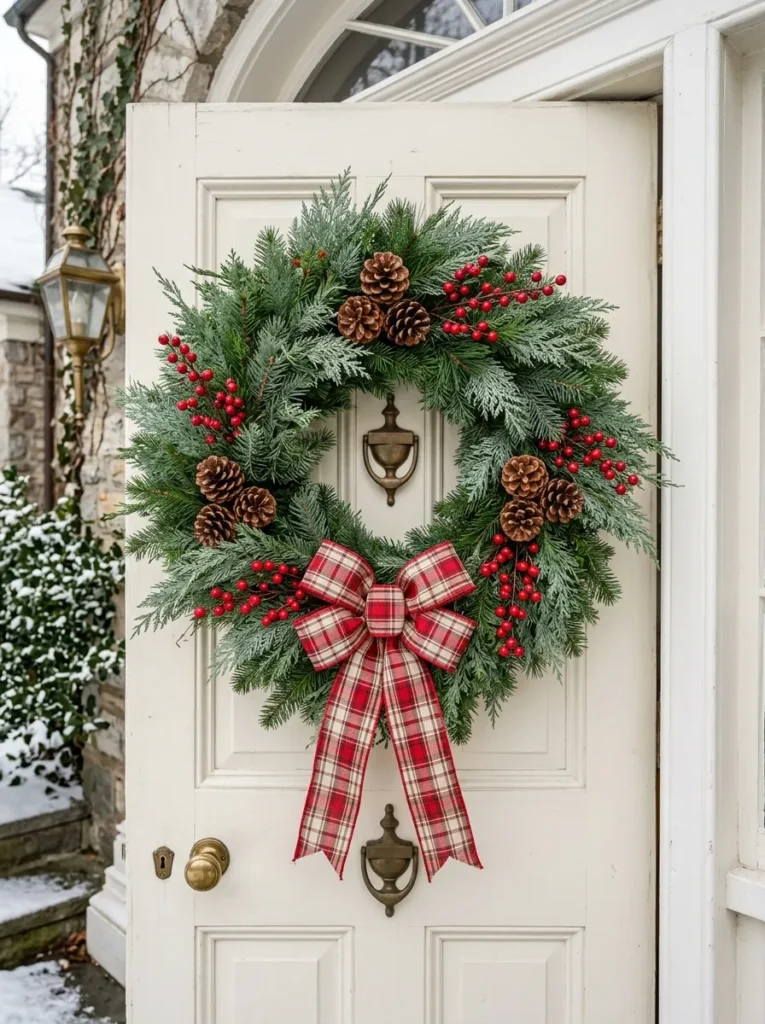
Vibe: The wreath is welcoming — a fresh cedar and pine wreath with plaid ribbon creates the most classically warm Christmas door decoration available, where the combination of silver-green cedar, deep pine, natural cones, and warm plaid ribbon communicates the specific seasonal hospitality of a genuinely traditional Christmas threshold.
Why it works: Fresh cedar and pine is the most fragrant and most visually authentic combination for a Christmas wreath because both materials are at their genuine best in December — freshly cut cedar has the specific clean, resinous fragrance that is among the most universally recognized Christmas scents, and its silver-green foliage creates a cooler, more varied tonal background than pine alone. The combination of cedar’s feathery texture and pine’s stiffer needle structure creates visual depth — the two distinct textures prevent the wreath from reading as a single uniform green mass. The plaid ribbon bow at the bottom is specifically the most compositionally appropriate bow placement for a front door wreath — it creates a visual base that grounds the circular form and provides the color accent that the botanical wreath needs without interrupting the full-circle silhouette of the botanical material.
How to get it: Source fresh cedar and pine from a Christmas tree lot, a garden center, or by purchasing a few additional branches when selecting a Christmas tree (most lots allow purchase of additional branches). Wind branches onto an 18-inch wire ring (available from craft stores, $2–$4) using floral wire, working in the same rotational direction around the ring. Wire pine cone clusters at three equally spaced positions around the wreath. Insert red berry stems (artificial or fresh holly) into the wire wrapping throughout the wreath. Tie a wide plaid ribbon bow ($4–$8 for 3 yards of 2.5-inch wide ribbon) and attach with wire at the bottom.
Quick Win: A single purchased grapevine wreath base ($4–$8 from craft stores) covered with fresh cedar stems tucked through the grapevine (no wiring required — the stems grip the vine naturally) creates a full, beautiful fresh cedar wreath in 20 minutes with no tools beyond scissors.
Shop The Look
- Wire ring wreath base 18 inch
- Floral wire paddle green 24 gauge
- Red berry stem bunch artificial
- Wide plaid ribbon red cream 2.5 inch
- Pine cone bag natural mixed sizes
Also view: 15 Beautiful Scandi Christmas Looks for Every Home
2. Dried Orange Slice and Cinnamon Stick Wreath
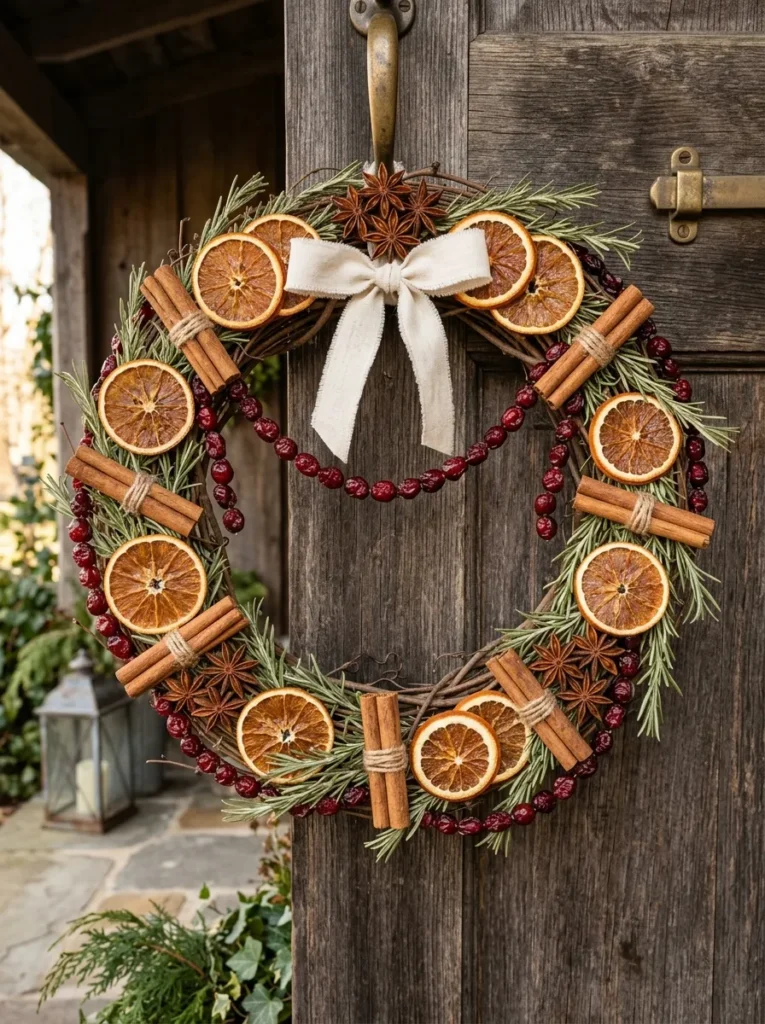
Vibe: The wreath is fragrant — a dried orange and cinnamon wreath creates the most sensory-complete Christmas door decoration available, where the fragrance of warming spices and citrus creates the olfactory dimension of Christmas welcome that purely visual wreaths lack.
Why it works: The spice and dried citrus wreath draws from the Victorian tradition of pomanders and spice balls — the clove-studded oranges and cinnamon-tied ribbons of 19th-century Christmas decoration — which gives this wreath aesthetic a genuinely historical quality that references the domestic craft tradition rather than contemporary commercial Christmas imagery. The combination of dried orange slices (which remain beautiful for months and continue releasing fragrance for weeks), cinnamon sticks (whose warm, spicy scent is among the most universally recognized Christmas olfactory cues), and star anise (whose geometric eight-pointed form creates a natural botanical star motif) creates a wreath that is as interesting at close inspection range (where the individual elements are beautiful) as at door-approaching distance (where the overall composition reads). The grapevine base specifically is the correct structural choice for this wreath because its natural, organic texture relates to the botanical spice materials in a way that wire or foam bases do not.
How to get it: Oven-dry fresh orange slices ($0.50–$1.00 per orange) by slicing at 1/4-inch thickness and baking at 200°F for 4–6 hours on a wire rack, or purchase pre-dried slices from craft stores ($8–$12 per bag). Attach dried orange slices with hot glue or floral wire pushed through the slice near the edge. Bundle cinnamon sticks in groups of three and tie with natural jute twine, then attach to the grapevine base with hot glue. String dried cranberries on 28-gauge wire to create garland arcs. Attach star anise clusters with hot glue. Fill remaining spaces with tucked rosemary sprigs.
Shop The Look
- Grapevine wreath base 16 inch natural
- Dried orange slice bag craft
- Cinnamon stick bundle natural
- Star anise whole bag natural
- Natural jute twine thin tie
3. Eucalyptus and White Berry Wreath for a Modern Look
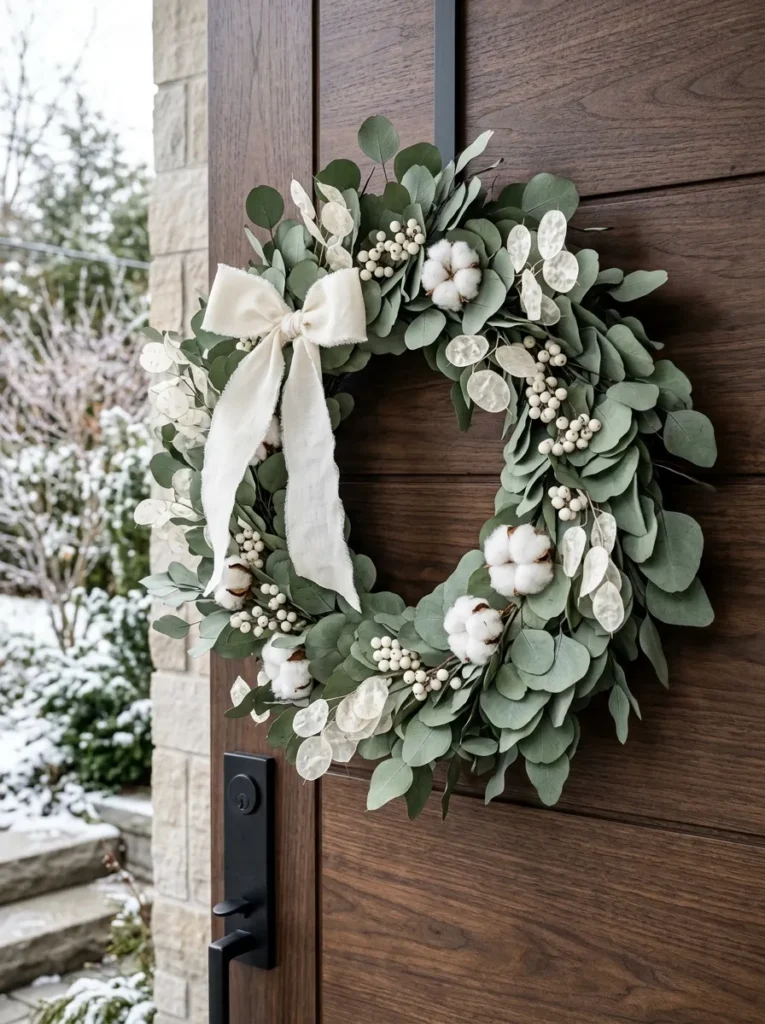
Vibe: The wreath is sophisticated — a eucalyptus and white berry wreath in silver-green and white communicates the contemporary Christmas aesthetic that has moved beyond traditional red-and-green toward a more restrained, monochromatic palette that reads as genuinely designed rather than commercially seasonal.
Why it works: The silver-green of preserved eucalyptus is specifically effective as the primary wreath botanical because preserved eucalyptus (treated with glycerin to maintain its flexibility and color) retains its silvery-green quality for 2–4 months, surviving the full Christmas season and beyond without drying to brown or dropping leaves — a significant practical advantage over fresh eucalyptus. The white-on-silver-green palette (white berries, white cotton bolls, white lunaria) creates the most sophisticated and most photographable Christmas wreath palette available because it references snow, winter light, and botanical precision rather than commercial Christmas color coding. The asymmetric ribbon placement (at one side of the wreath rather than centered at the bottom) is the compositional decision that most clearly signals contemporary design intention rather than conventional wreath styling.
How to get it: Purchase preserved silver-dollar eucalyptus ($15–$30 for a bundle sufficient for a 20-inch wreath) from floral supply wholesalers, Etsy floral suppliers, or specialty craft stores. Build the wreath on a wire ring by wiring eucalyptus stems in consistently overlapping layers around the ring. Add white artificial berry clusters ($5–$10 per bunch), white dried cotton stems ($8–$15 per bundle), and dried lunaria ($5–$10 per bunch) at irregular positions throughout the wreath. Attach a wide ivory satin or silk ribbon bow at the 3 o’clock or 9 o’clock position rather than the 6 o’clock (bottom) position for the contemporary asymmetric composition.
Shop The Look
- Preserved silver dollar eucalyptus bundle
- White artificial berry cluster bunch
- Dried cotton stem white boll bunch
- Dried lunaria silver dollar moon pod
- Wide ivory satin ribbon 3 inch
4. Plaid Fabric Bow Wreath with Pine and Red Berries
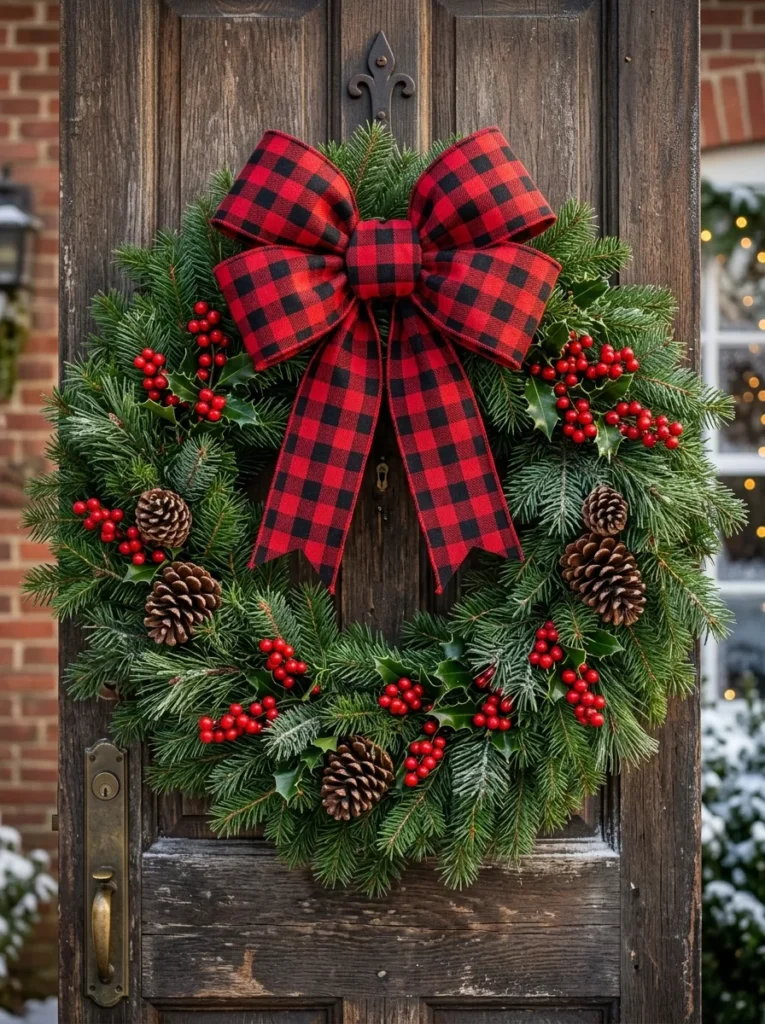
Vibe: The wreath is generous — a large pine wreath with an oversized buffalo check or tartan bow at the top creates the most generously festive Christmas door decoration available, where the bow’s scale and the full pine botanical composition communicate abundance and genuine seasonal celebration.
Why it works: The oversized fabric bow is the Christmas wreath element that most dramatically transforms the overall composition’s impact — a bow that is correctly proportioned to the wreath (loops of 8–10 inches for a 22-inch wreath, tails of 12–16 inches) reads as an intentional design feature that gives the wreath a definite personality, while an undersized bow (the common mistake of using a 4-inch bow on a 22-inch wreath) reads as a decorative addition that is too small to carry the visual weight of the botanical base beneath it. The top placement of the bow (at the 12 o’clock position rather than the conventional 6 o’clock position) is specifically interesting because it shifts the wreath’s compositional structure — instead of a base-weighted composition (heavy botanicals plus heavy bow at the bottom), the top-bowed wreath reads as a composition that is lifted and celebratory.
How to get it: Make the bow first, before attaching it to the wreath — a correctly made wreath bow requires approximately 3 yards of 2.5-inch wide ribbon. Create the bow with 5–7 loops of 8–10 inches each, pinched at the center and secured with a twist tie or wire before attaching tails of 12–16 inches each. Attach the completed bow to the pine wreath at the top (12 o’clock position) with 24-gauge floral wire threaded through the back of the bow. Build the pine wreath on a 22-inch wire ring using fresh or preserved pine boughs, wiring in the same rotational direction throughout.
Shop The Look
- Buffalo check ribbon red black 2.5 inch
- Tartan plaid ribbon red green wide
- Wire ring wreath form 22 inch
- Red berry cluster bunch wreath
- Pine bough fresh branches wreath
5. Dried Lavender and Rosemary Herb Wreath
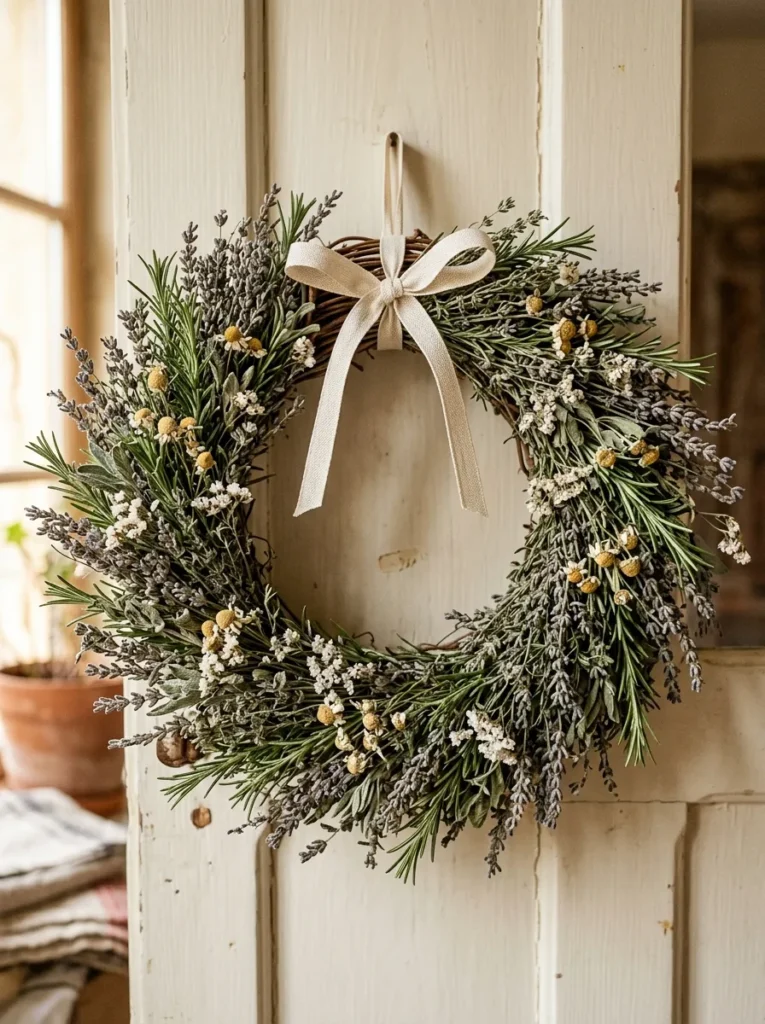
Vibe: The wreath is fragrant and delicate — a dried herb wreath in lavender, rosemary, and sage creates the most aromatherapeutically rich Christmas door decoration available, where the fragrance of dried culinary and medicinal herbs creates a sensory welcome that specifically references the herbal and botanical traditions of pre-commercial Christmas decoration.
Why it works: The dried herb wreath occupies a specific and beautiful design territory that neither fresh botanical wreaths nor heavily decorated commercial wreaths can access — it is simultaneously the most fragrant type of wreath (dried herbs release their essential oils continuously and consistently throughout the Christmas season), the most historically rooted (the use of aromatic herbs for seasonal threshold decoration predates commercial Christmas decoration by thousands of years), and the most restrained in its visual palette (the grey-green and purple-grey of the herb family creates the quietest and most sophisticated Christmas palette available). The herb wreath is specifically appropriate for interior door positions (between rooms, on the kitchen door, on a bedroom door) or on a sheltered exterior door where the delicate dried herbs will not be damaged by rain or wind.
How to get it: Harvest dried lavender ($8–$15 for a dried bunch from florists or farmers markets, or free from a summer garden harvest), dried rosemary ($0 from a kitchen herb garden, or $3–$6 from grocery produce sections — the woody stems dry beautifully), and dried sage ($0 from garden harvest or $3–$5 from grocery stores). Wire or hot-glue herb bundles to a small wire or grapevine ring, working in consistent rotational direction. The herb wreath is best made dry rather than fresh — fresh herbs shrink significantly as they dry, while pre-dried herbs maintain their size and shape throughout the Christmas season.
Shop The Look
- Dried lavender bunch large bundle
- Dried rosemary stem bunch craft
- Dried sage bundle culinary herb
- Small grapevine ring 14 inch
- Narrow linen ribbon cream natural
6. Pine Cone and Twig Natural Material Wreath
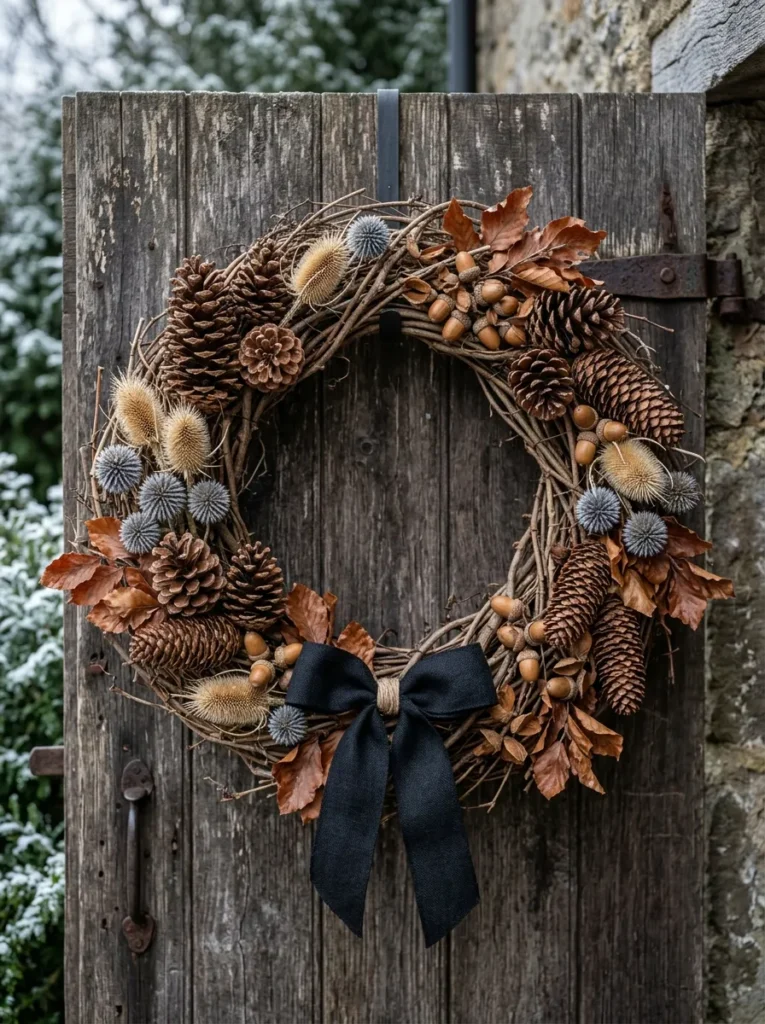
Vibe: The wreath is woodland — a pure natural material wreath assembled entirely from foraged or collected botanical materials creates the Christmas decoration that most directly connects the domestic threshold to the winter woodland landscape, where every element is genuinely from the natural world rather than manufactured to resemble it.
Why it works: The all-natural material wreath is the most material-honest Christmas wreath available because every element in it is exactly what it appears to be — no artificial berries that simulate holly, no plastic pine cones that reference but do not replicate the real form, no colored ribbon that references a tradition it is not participating in. The varied pine cone selection (using three distinct cone species with different sizes and shapes) creates visual complexity within a single natural material category — the long, elegant Scots pine cone, the smaller, rounder Norway spruce cone, and the mid-sized Douglas fir cone with its characteristic three-pointed bracts all read as related but distinct botanical forms. The matte black linen ribbon is the single design decision that situates this woodland collection in a contemporary aesthetic context rather than a purely rustic one — the black ribbon’s color provides graphic contrast to the natural brown palette without introducing any material that is not natural in origin.
How to get it: Collect pine cones ($0 from a woodland walk or garden, or $5–$15 per bag from craft stores) in as many species as locally available. Wire each cone by wrapping 24-gauge floral wire tightly around the cone’s lowest scale row and twisting to create a stem. Wire onto the grapevine or twig base at varied positions, ensuring each cone is securely attached. Add dried seed heads (teasel, echinops, or thistle), acorn clusters, and dried leaf stems with hot glue or additional wire. Attach a narrow matte black linen ribbon bow at the bottom.
Shop The Look
- Mixed pine cone bag three species
- Grapevine wreath base 18 inch natural
- Floral wire 24 gauge paddle
- Dried teasel stem seed head
- Matte black linen ribbon narrow
7. Velvet Ribbon and Magnolia Leaf Wreath
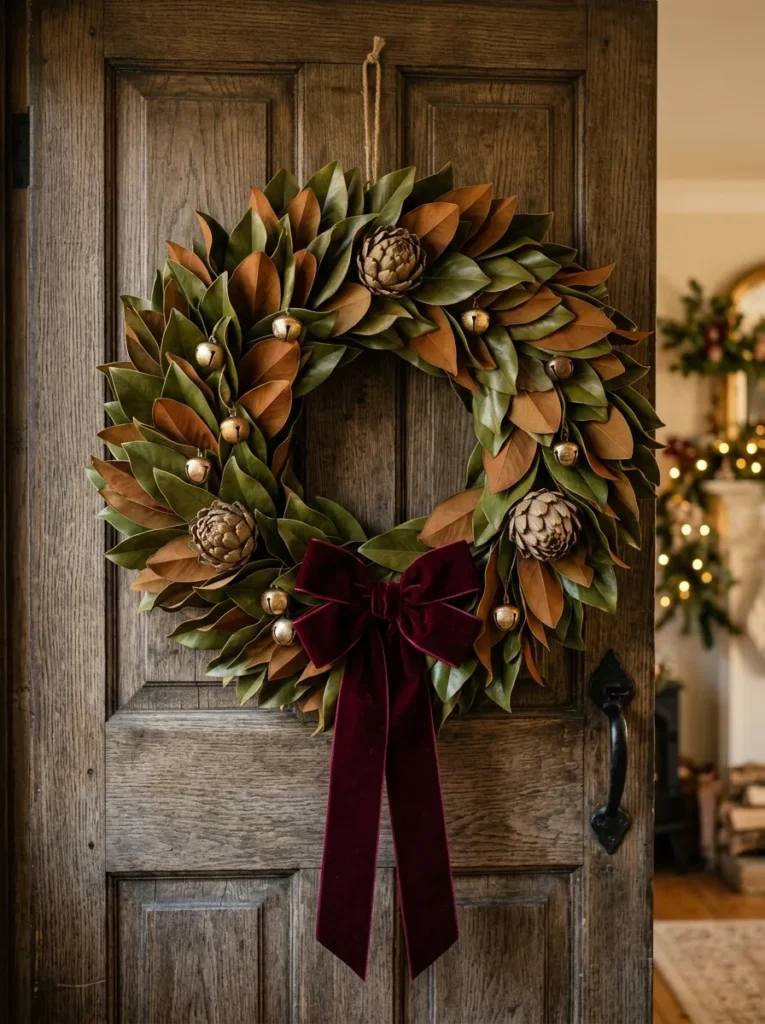
Vibe: The wreath is elegant — a magnolia leaf wreath with velvet ribbon and gold bells creates the most dramatically elegant Christmas door decoration available, where the magnolia’s distinctive two-tone leaf (deep olive-green on the upper surface, warm russet-brown on the underside) creates a wreath with unusual color depth and material sophistication.
Why it works: The magnolia leaf wreath is one of the most design-sophisticated DIY Christmas wreath formats because the magnolia leaf’s specific visual quality — its glossy dark green upper surface and its warm brown felt-like underside — creates a natural two-tone composition within a single botanical element, providing visual depth that single-surface botanical materials cannot approach. When multiple magnolia leaves are layered in overlapping patterns, the undersides of some leaves are inevitably visible, creating the warm russet accents that prevent the wreath from reading as a uniformly dark green mass. The velvet ribbon bow in deep burgundy or forest green is the textile element that makes the wreath read as materially luxurious — velvet’s cut pile creates the soft depth of light reflection that no other ribbon material achieves, and in deep jewel tones it creates a bow that reads as genuinely opulent rather than decorative.
How to get it: Source preserved magnolia leaves ($15–$30 for a bundle sufficient for an 18-inch wreath) from floral supply retailers or Etsy botanical suppliers — preserved leaves maintain their color and flexibility for months, while fresh magnolia leaves dry to a beautiful russet tone but cannot be used fresh without significant wilting. Attach leaves to the wire ring base by wiring each stem individually or by using a glue gun to attach in overlapping layers working clockwise around the ring. Wire small gold jingle bells ($5–$10 for a bag of 20) at intervals. Make a generous velvet bow ($5–$10 per yard of quality velvet ribbon in 2.5-inch width) and attach at the bottom.
Shop The Look
- Preserved magnolia leaf bundle wreath
- Deep burgundy velvet ribbon 2.5 inch
- Forest green velvet ribbon wide
- Gold jingle bells small wreath set
- Dried artichoke decorative stem
8. Burlap and Greenery Farmhouse Wreath
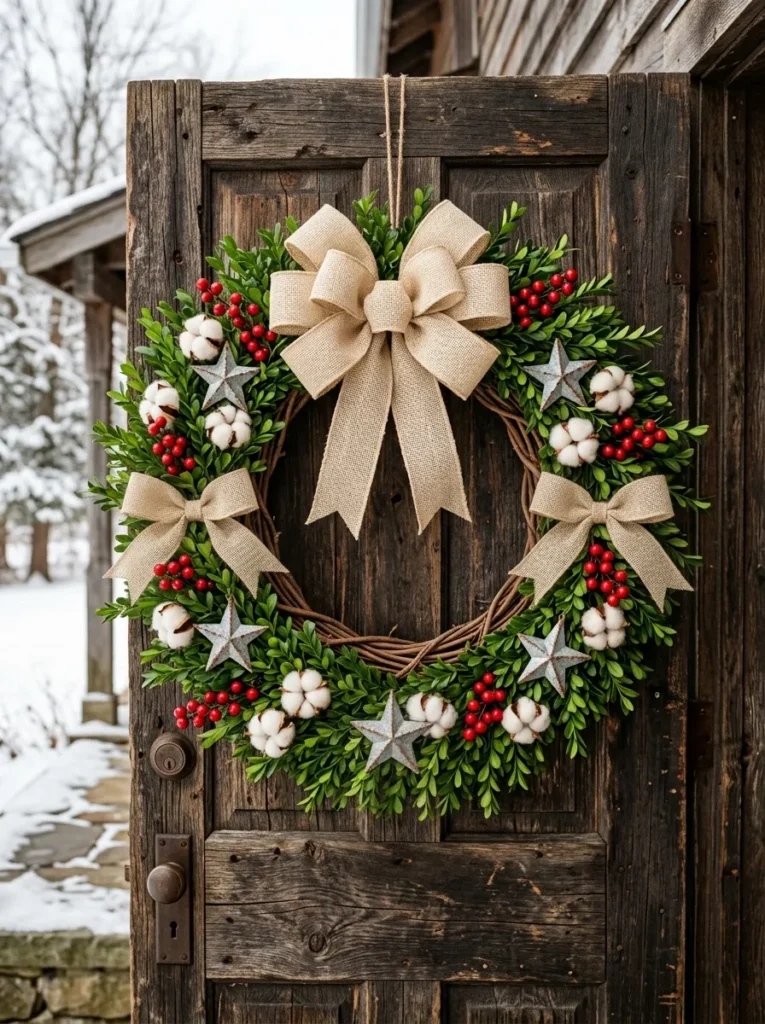
Vibe: The wreath is rustic — a burlap and boxwood farmhouse wreath creates the warmest and most texture-rich Christmas door decoration appropriate for a farmhouse, cottage, or casually styled home, where the rough natural fiber of burlap against the tight dense green of boxwood creates a material contrast that reads as genuinely rustic and genuinely warm.
Why it works: Burlap is specifically effective as a Christmas wreath material because its rough, open-weave texture provides maximum visual contrast to the tight, smooth surfaces of boxwood greenery and berry clusters — the woven burlap fibers catch light differently from any botanical element, creating a material variety that prevents the wreath from reading as texturally uniform. The multi-loop burlap bow (made with 5–6 loops rather than the conventional 2-loop bow) creates a voluminous, three-dimensional bow that reads as generous and handmade — the multiple loops create a full, round bow shape rather than the flat bow of conventional tied ribbon. The galvanized metal star ornaments (small pressed-metal stars in the galvanized silver-grey finish associated with farmhouse aesthetics) provide the metallic accent that completes the composition without introducing any material that conflicts with the farmhouse material palette.
How to get it: Purchase burlap ribbon ($3–$6 per roll in 2.5-inch or 4-inch width) from craft stores or online retailers. Make a multi-loop burlap bow by creating loops in alternating directions, pinching at the center after each loop pair, and securing the center with wire before pulling the bow open into its rounded form — this technique requires approximately 4 yards of burlap ribbon for a full, generous bow. Start with a 20-inch grapevine base and fill densely with boxwood stems (fresh boxwood from a garden center, or preserved boxwood from floral supply retailers), inserting stems into the vine structure and securing with wire where needed.
Shop The Look
- Burlap ribbon wide 4 inch craft
- Grapevine wreath base 20 inch
- Boxwood stem bunch preserved fresh
- Cotton boll stem white bunch
- Galvanized star ornament small set
9. Minimalist Twig and Single Botanical Wreath
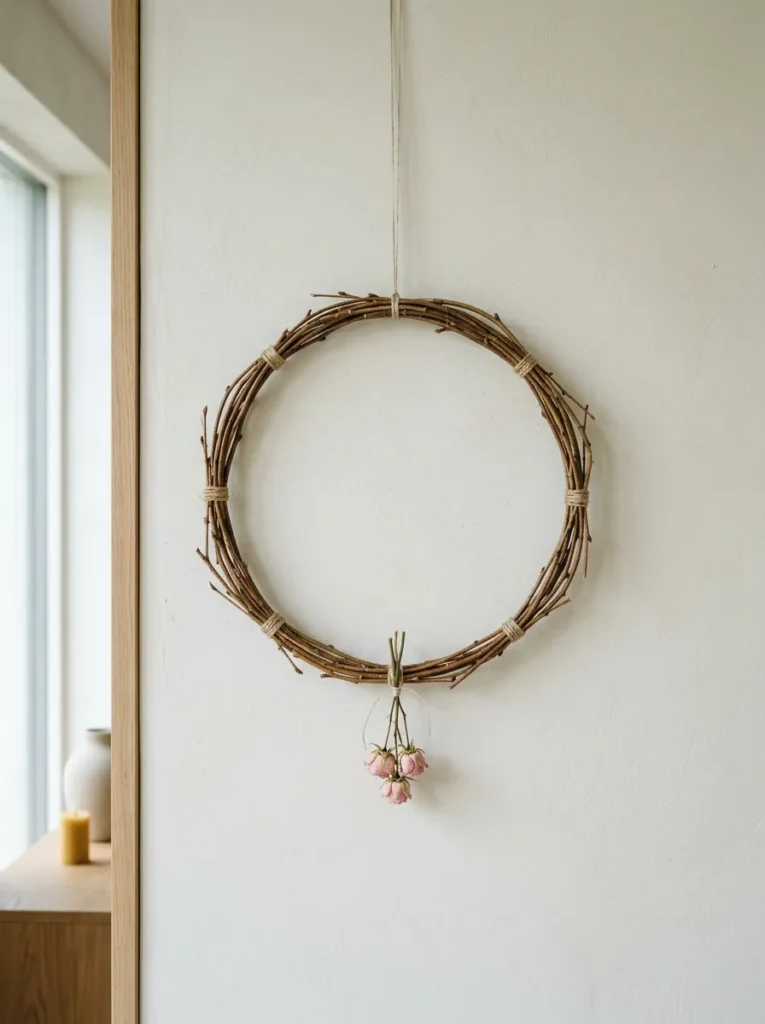
Vibe: The wreath is considered — a minimalist twig or single-botanical wreath communicates the design confidence of choosing one material and one accent and making them sufficient — the wreath’s beauty comes from the clarity of its concept rather than the accumulation of its materials.
Why it works: The minimalist Christmas wreath is the design direction that most directly applies the quiet luxury principle to seasonal decoration — the conviction that one thing done with complete commitment creates more impact than many things done with partial commitment. A wreath made entirely from a single botanical (all rosemary, creating a ring of fragrant grey-green herb, or all preserved eucalyptus, creating a silver-green botanical circle) has the visual authority of a concept clearly executed rather than a collection of materials assembled. The single accent element at the wreath’s base (a small sprig of mistletoe, a single gold ornament, three dried rosebuds) is the compositional choice that makes the minimalist wreath specifically Christmas rather than year-round botanical — it is enough seasonal reference to communicate the season without overwhelming the primary material’s quiet elegance.
How to get it: For a twig wreath: collect flexible thin branches (willow, birch, or any young shoot material) approximately 1/4-inch in diameter and 3–4 feet long. Bend the first branch into a ring of the desired diameter and secure with jute twine at the overlapping join. Wrap two or three additional branches around the ring to create a slightly irregular, organic circle. Add a single accent element at the bottom with a small wire or thread tie. For a single-botanical wreath: wire or hot-glue a single botanical material densely around a thin wire ring without any other materials.
Shop The Look
- Thin willow branch flexible wreath
- Natural jute twine fine binding
- Single dried rosebud bunch small
- Gold ring ornament small single
- Thin wire ring small 12 inch
10. Wreath with Bows, Bells, and Vintage Ornaments
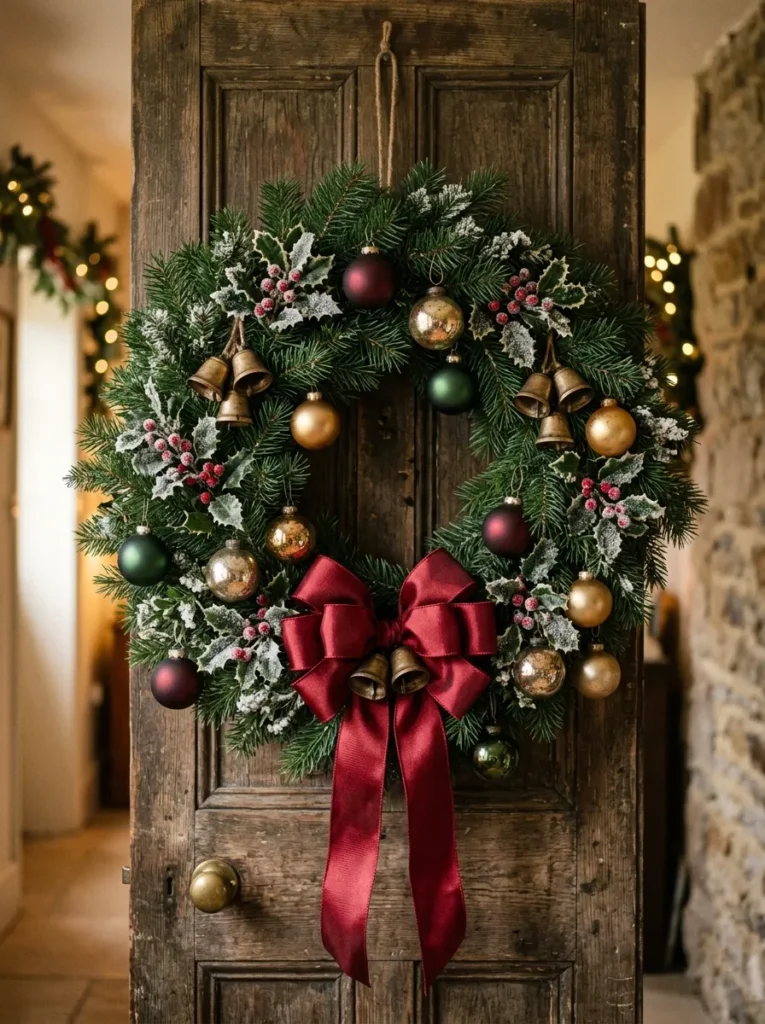
Vibe: The wreath is nostalgic — a vintage ornament and ribbon wreath with glass balls, brass bells, and a large satin bow creates the Christmas door decoration that most directly references the warmth of remembered childhood Christmas aesthetics — genuinely romantic in the sense of belonging to the remembered world of an idealized seasonal past.
Why it works: The vintage ornament wreath draws from the Christmas decoration tradition of the late 19th and early 20th centuries — the first era of mass-produced glass Christmas ornaments, when the hand-blown glass balls from Lauscha in Germany created the Christmas tree and wreath aesthetic that the mid-20th century American Christmas fully inherited. Genuine vintage glass ornaments (or high-quality reproductions in deep, saturated jewel tones rather than the pale colors of mass-market alternatives) have a different light quality than plastic alternatives — the thin glass creates a depth of reflection that plastic balls cannot achieve, and the slight irregularities of hand-blown glass read as material authenticity rather than manufacturing imperfection. The brass bells are the acoustic element that gives this wreath its specific quality — a wreath that makes a gentle sound when the door opens is more fully sensory than a purely visual decoration.
How to get it: Source vintage glass ball ornaments from thrift stores, estate sales, and antique markets ($1–$5 each for genuine vintage examples) or purchase high-quality reproduction vintage glass ornaments from specialty Christmas retailers ($2–$8 each for quality reproductions). Wire ornaments onto the pine wreath at varied depths — some pressed close to the greenery, some allowed to dangle 2–3 inches below the wreath surface — for the dimensional quality that a flat-mounted ornament arrangement cannot produce. Small brass bells ($4–$8 for a bag of mixed sizes) are wired in clusters of three at three equally spaced positions.
Shop The Look
- Vintage glass ball ornament set
- Reproduction vintage ornament deep jewel
- Small brass bell cluster Christmas
- Deep red satin ribbon bow 3 inch
- Ornament hanger hook thin gold
11. Succulent and Air Plant Winter Wreath
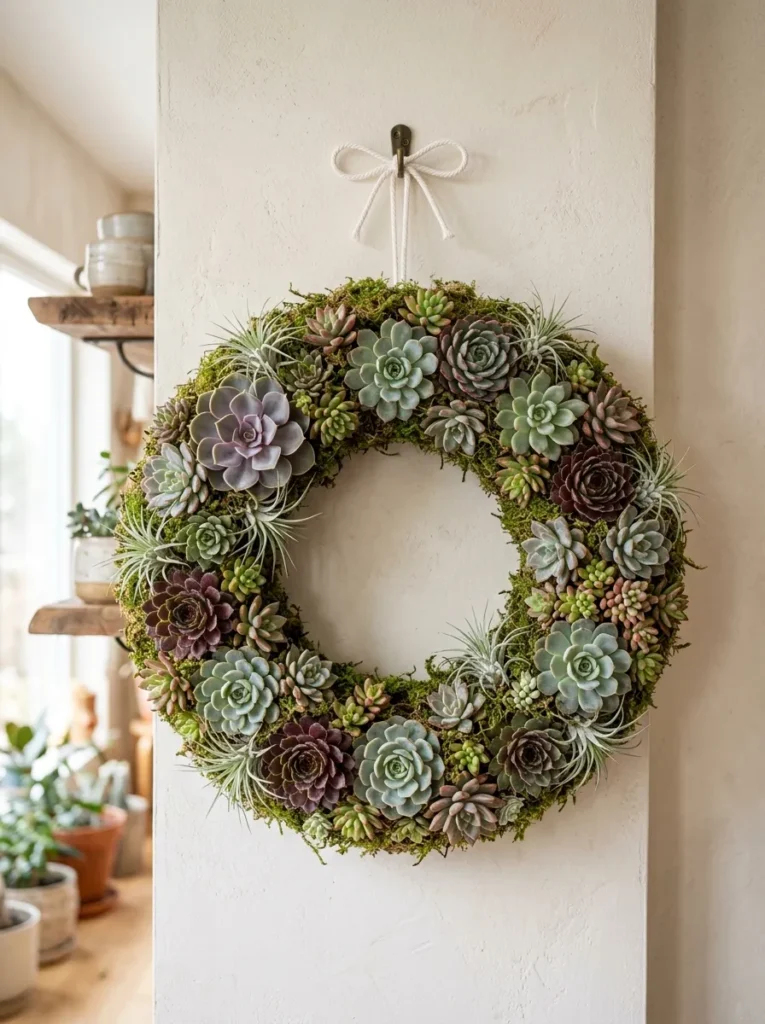
Vibe: The wreath is living — a succulent and air plant wreath planted on a moist moss base creates the most biophilically complete Christmas decoration available — a living, growing installation that continues to develop throughout the Christmas season and can be replanted and maintained as a decorative garden piece after Christmas.
Why it works: The living succulent wreath is the most genuinely sustainable Christmas wreath format because it is not a consumable seasonal decoration but a living plant installation that lasts indefinitely with appropriate care. Succulents and air plants are specifically the correct plant choices for a Christmas wreath because both groups are adapted to periodic drying (succulents through their water storage capacity, air plants through their atmospheric moisture absorption) and can survive the relatively dry, cool conditions of a December doorway or interior wall without daily watering. The wreath’s botanical color palette — the blue-green of Echeveria, the purple-tinged rosettes of Sempervivum, the silver of Tillandsia — is also specifically appropriate for a restrained contemporary Christmas palette.
How to get it: Pack a wire ring base ($3–$5) tightly with damp sphagnum moss, securing the moss to the wire with monofilament or floral wire wound around the outside. Using a chopstick or skewer, create planting holes in the moss and insert succulent rosettes (remove a few lower leaves and allow to callous for 24 hours before planting for best results). The succulent rosettes grip the moss naturally as they root. Tuck air plants into the gaps between succulent groupings — no planting required, as air plants simply rest in the moss. Mist weekly with clean water and allow to drain fully.
Shop The Look
- Small succulent assortment live rosette
- Air plant Tillandsia assortment set
- Sphagnum moss sheet wreath base
- Wire ring wreath base 16 inch
- Narrow cotton cord bow wreath
12. Cranberry and Holly Wreath for Traditional Color
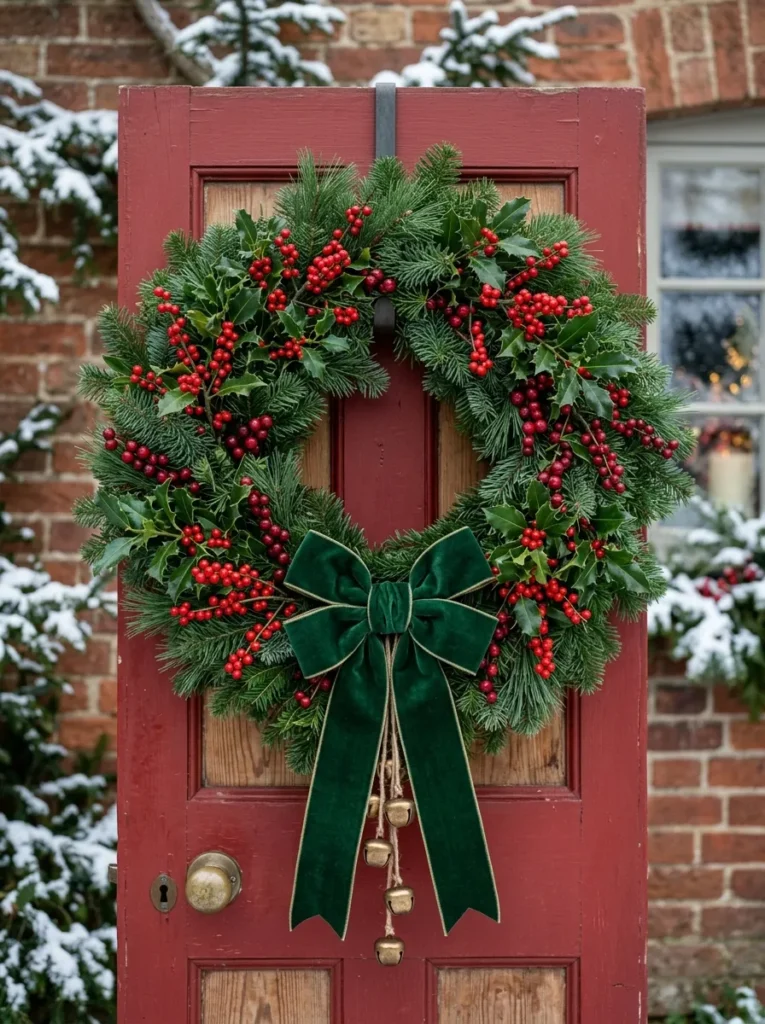
Vibe: The wreath is classic — a holly and cranberry wreath in the traditional red-and-green palette executed with fresh botanical materials creates the most genuinely festive Christmas door decoration available — the pure expression of the seasonal color story in its most authentic natural form.
Why it works: The red-and-green Christmas color palette is specifically derived from the red holly berry against the dark green holly leaf — the natural color relationship of this winter-fruiting plant that was specifically prized in pre-commercial Christmas tradition for its combination of genuine winter greenery and bright winter fruit in the darkest season. A wreath that uses genuine holly (or high-quality artificial holly) rather than commercially produced red-ribbon-and-green-tinsel references this natural origin of the Christmas color palette, giving the conventional red-and-green combination the naturalistic legitimacy of its botanical source. The forest green velvet bow specifically references the traditional Christmas green rather than the commercial chartreuse-green of most mass-market Christmas ribbon, which reads as fluorescent rather than botanical.
How to get it: Source fresh holly branches from garden centers, Christmas tree lots, or from holly bushes in your own or a neighbor’s garden (with permission) in late November or December when berries are at full color. Fresh holly lasts 2–4 weeks cut, significantly extending its usefulness through the Christmas season. Wire holly branches throughout a fresh pine base, ensuring berry clusters face outward. Add cranberry stems ($5–$10 for a bundle of preserved or artificial cranberry sprigs) for additional red berry scale variation. Attach a wide forest green velvet ribbon bow ($6–$12 for 3 yards of quality velvet ribbon).
Shop The Look
- Fresh holly branch bunch red berry
- Preserved cranberry stem bunch
- Forest green velvet ribbon 3 inch wide
- Pine wreath base fresh 18 inch
- Brass jingle bell bow accent
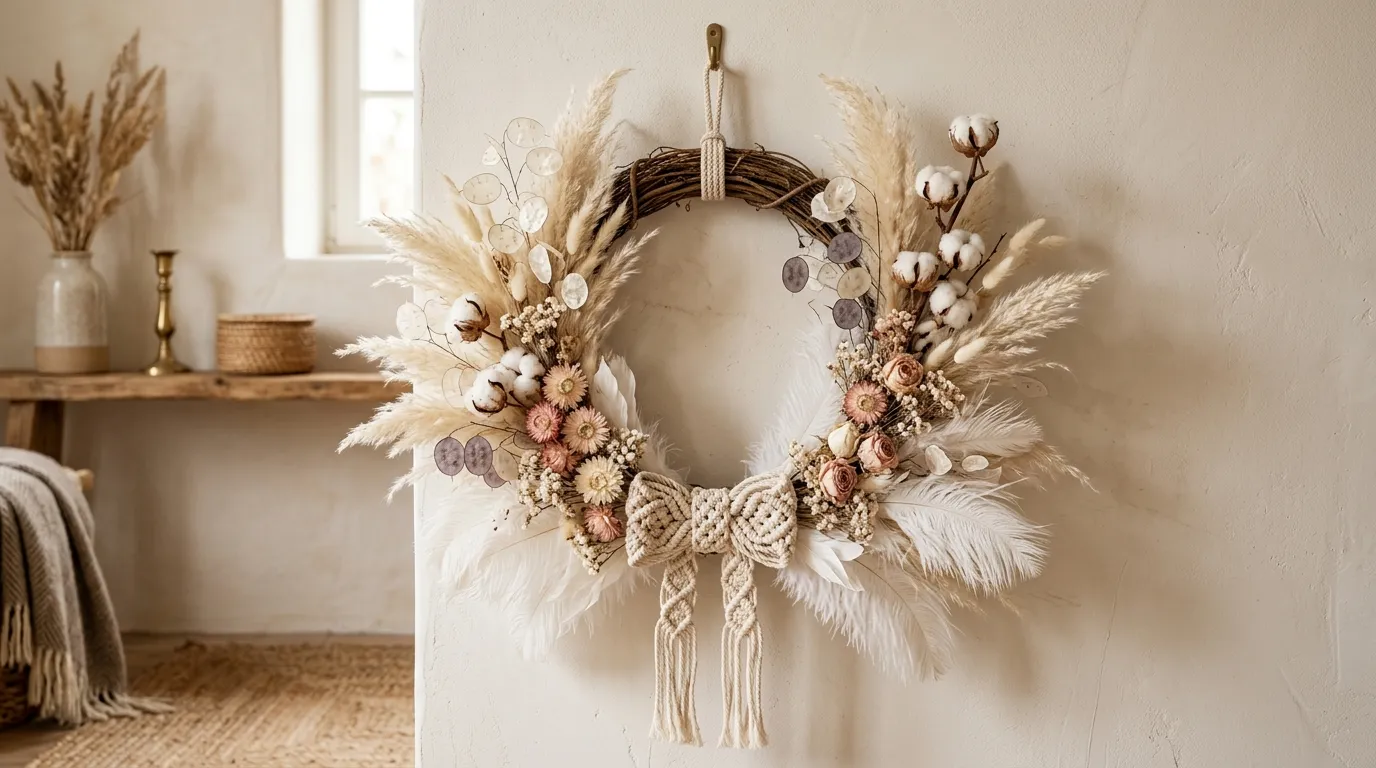
13. Feather and Dried Botanical Boho Wreath
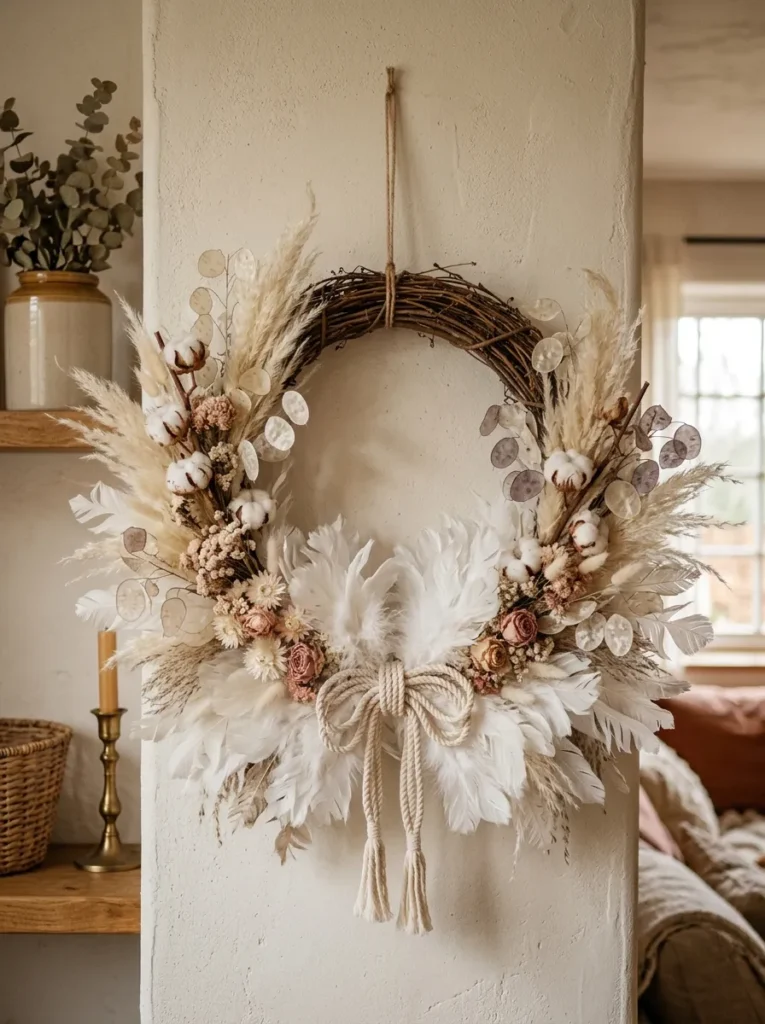
Vibe: The wreath is bohemian — a feather and dried botanical boho Christmas wreath creates the most contemporary and most design-current interpretation of Christmas door decoration, where the earthy natural materials and the feathers’ organic movement create a decoration that reads as thoughtfully original rather than conventionally seasonal.
Why it works: The feather and botanical boho wreath is specifically effective as a Christmas wreath for contemporary interiors because it uses the same material vocabulary (dried botanicals, natural fibers, organic forms) that is already present in warm minimalist and Japandi interior styling — it reads as a seasonal extension of the room’s existing material palette rather than as a seasonal departure from it. White feathers specifically carry a lightness and a delicate movement quality that no botanical material replicates — feathers sway gently in any air movement near the door, giving the wreath a subtle kinetic quality that makes it more visually alive than static botanical arrangements. The placement of feathers in the wreath’s lower quadrant (rather than distributed throughout) is the compositional decision that gives the boho wreath its characteristic silhouette — the botanicals above and the feathers below creating a wreath that reads as a specific form rather than as a uniform botanical circle.
How to get it: Purchase white turkey feathers ($5–$10 for a bag of 20–30 craft feathers) from craft retailers. Build the botanical body of the wreath on a grapevine ring using the dried botanical materials, leaving the lower quarter of the ring without botanicals for the feather zone. Insert feather stems into the grapevine structure and secure with a small dot of hot glue at each stem’s entry point into the vine. The feathers should be inserted at varied angles (some pointing downward, some angled outward) for the most organic, natural appearance. Attach a macramé-style or twisted cotton cord bow at the junction between the botanical upper section and the feather lower section.
Shop The Look
- White turkey feather bag craft set
- Dried pampas grass cream plume
- Dried lunaria seed pod white purple
- Macramé cord bow wreath natural
- Dried cotton stem white boll bunch
14. Personalized Name or Initial Wreath
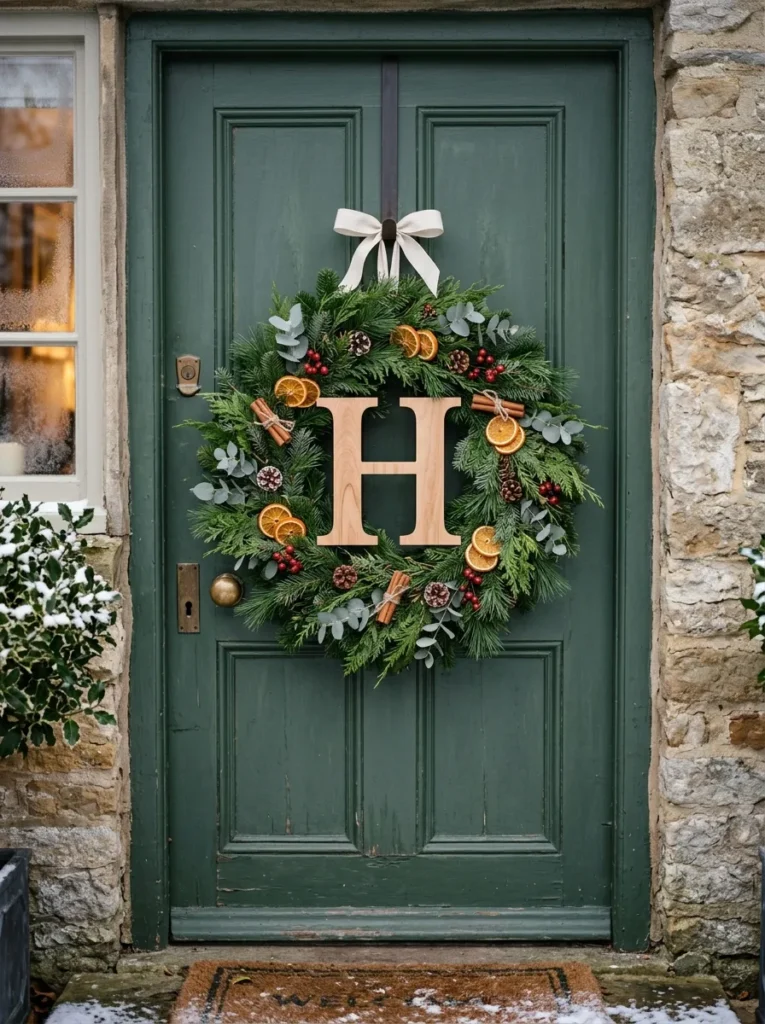
Vibe: The wreath is personal — a wreath with the family’s initial or house number at its center creates the most specifically personal Christmas door decoration available — a wreath that announces not just the season but the specific household that has made it, creating a welcome that is both seasonal and genuinely individual.
Why it works: The personalized initial or number wreath is the Christmas wreath format that most clearly communicates the design principle of the personal over the generic — a wreath with a specific initial or number can only belong to a specific household, which gives the decoration the quality of genuine ownership that anonymous commercial wreaths permanently lack. The natural wood letter at the wreath’s center (in unpainted or whitewashed birch or pine that is visible as a natural material rather than a manufactured graphic element) creates the design decision that makes this wreath read as considered and personal rather than novelty-personalized — the material quality of the wood letter is as important as its presence. The wreath’s botanical surroundings (fresh pine or preserved eucalyptus framing the letter on all sides) integrate the personalization into the seasonal decoration rather than treating the letter as a decoration applied to a botanical base.
How to get it: Source natural wood letters or numbers from craft stores (Hobby Lobby, Michael’s, and online retailers all carry unpainted birch and pine wood letters in 6–10-inch sizes, $3–$8 each). Whitewash the letter if desired (diluted white chalk paint applied with a dry brush and wiped off while wet creates a subtle whitewash that reads as natural material with light color rather than painted wood). Wire or hot-glue the letter to the completed botanical wreath at the center position — the letter should be centered horizontally and vertically within the wreath’s inner diameter. Tuck dried orange slices and cinnamon sticks around the letter’s base to ground it in the botanical context.
Shop The Look
- Natural wood letter birch craft large
- Unpainted wood initial craft store
- Whitewash chalk paint diluted wood
- Natural pine letter Christmas wreath
- Wood letter mounting wire hook
How to Start Making DIY Christmas Wreaths
The single most important first decision in any DIY Christmas wreath project is the base — the structural form from which all other materials build. The base determines the wreath’s final diameter, its structural approach (the wire ring and floral wire method for fresh botanical wreaths, the grapevine base for tucked and hot-glued natural material wreaths, the foam ring for pinned and secured wreaths), and the range of materials that can be effectively attached. The grapevine base is the most beginner-accessible because it accepts materials through three different attachment methods simultaneously — stems can be tucked into the vine, materials can be hot-glued to the vine surface, and wire can be wound around the vine for heavier elements — and it provides the most visually beautiful natural base when partially visible through the attached materials.
The most common DIY wreath mistake is working with too-small material quantities — purchasing one small bundle of evergreen, one small bunch of berries, and one small package of cones, and then discovering midway through the project that the wreath looks sparse because the materials are insufficient for full coverage. A 18-inch wreath requires more material than most beginners expect — approximately 20–30 individual stem insertions for full botanical coverage, which requires 3–5 generously sized branches of the primary botanical, 2–3 secondary botanical additions, and 1–2 accent materials. The wreath’s fullness is the quality that most distinguishes a beautiful handmade wreath from a sparse amateur one — when in doubt, purchase 30–50% more material than you think you need.
Three DIY Christmas wreath improvements that cost under $20 and immediately improve the finished result: purchasing quality floral wire ($3–$5 for a paddle of 24-gauge green floral wire) rather than using twist ties or household string, which creates more secure attachments and allows tighter material placement; buying the largest available version of the chosen base ($6–$10 for a quality 20-inch grapevine versus $3–$5 for a 14-inch version) because wreath diameter significantly affects the finished piece’s visual impact and door presence; and choosing ribbon in 2.5-inch or wider width ($4–$8 per roll) rather than narrow ribbon ($2–$3 per roll), because wreath bows require sufficient ribbon width to create the visual presence that a front door wreath demands.
A complete DIY wreath-making practice — owning a set of base sizes (12, 16, and 20-inch wire rings; 14 and 18-inch grapevine bases), a paddle of floral wire, a hot glue gun, and a collection of seasonal natural materials — is achievable for an initial investment of $40–$60 that produces materials sufficient for 5–8 wreaths in varied sizes and styles. The annual maintenance investment is $15–$30 in fresh botanical materials and $5–$15 in accent materials per wreath. A DIY Christmas wreath program that produces one new wreath each year — accumulating a collection of dried and preserved wreaths and making one fresh wreath annually — creates an increasingly personal and material-rich Christmas door tradition that purchased wreaths cannot replicate at any price.
Frequently Asked Questions About DIY Christmas Wreaths
How long do DIY Christmas wreaths last and how do I preserve them?
Fresh botanical wreaths (made from freshly cut pine, cedar, fir, or eucalyptus) last 3–6 weeks before the botanical material begins to dry and brown significantly — though many fresh botanical wreaths remain beautiful even as they dry, particularly cedar (which dries to a warm grey-brown while maintaining its structure) and eucalyptus (which dries to a soft grey-sage tone). To extend fresh wreath life: mist lightly with water every 2–3 days (do not soak — light misting is sufficient), keep in cool conditions (below 50°F is ideal — an unheated porch or garage maintains a fresh wreath longer than a heated interior), and keep out of direct sunlight. Dried botanical wreaths (made from already-dried materials — dried orange, dried herbs, pine cones, preserved eucalyptus) last indefinitely with proper storage between seasons — store in a large paper bag or cardboard box in a cool, dry location, and the wreath can be used for multiple Christmas seasons with minimal deterioration.
What is the best base for a DIY Christmas wreath?
The correct base depends on the wreath type. Wire ring bases (available in 12–24-inch diameters, $2–$5 each) are the best choice for fresh botanical wreaths — the open wire allows stem insertion from multiple angles and the wire provides anchor points for floral wire attachment throughout the construction process. Grapevine bases (available in 14–24-inch diameters, $4–$10 each) are the best choice for dried natural material wreaths and mixed wreaths using hot glue as the primary attachment method — the vine’s natural organic surface is visually beautiful when partially visible and accepts hot glue reliably. Foam ring bases are appropriate for pinned wreaths (ornaments pushed into foam with pins or picks) but less appropriate for botanical wreaths because they do not accept stem insertion as naturally as wire or grapevine. For beginners, the grapevine base is the most beginner-accessible choice across the widest range of wreath types.
How do I make a bow for my Christmas wreath?
A wreath bow requires 3–4 yards of ribbon in the correct width for the wreath size (2.5-inch ribbon for wreaths up to 18 inches, 4-inch ribbon for larger wreaths). The most widely used method for an impressive multi-loop bow: hold the ribbon at one end, create a loop of 6–8-inch length by folding the ribbon back on itself, pinch the fold at the center, create another loop of the same size on the opposite side, pinch at the same center point, and continue creating alternating loops (3–4 loops per side for a full bow) while consistently pinching at the center. Secure the pinched center with a twist of 24-gauge floral wire. Cut two tail lengths (12–16 inches each) and attach them to the center wire before opening all the loops out to create the full, dimensional bow shape. V-cut the tail ends for a decorative finish — hold the tail folded in half lengthwise and cut diagonally from the outside edge toward the fold for a clean V-notch.
Can I make a Christmas wreath without a hot glue gun?
Yes — all 14 wreath designs in this article can be made using floral wire as the primary attachment method rather than hot glue, and several (the grapevine wreaths where materials are tucked into the vine structure) require no attachment tool at all. Floral wire (24-gauge or 26-gauge green paddle wire, $3–$5 per paddle) is wound around stems and secured to the base ring at each attachment point. The wire attachment method is more time-consuming than hot glue but more secure for heavy materials (pine cones, ornaments) and more reversible (materials can be repositioned before the wire is tightened). The tucked grapevine method (stems inserted into the grapevine openings without any attachment tool) is the most beginner-accessible approach and produces naturally beautiful wreaths with no tools required beyond scissors.
What makes a DIY wreath look professional rather than handmade in an amateur sense?
Four specific decisions most consistently distinguish a professionally finished DIY wreath from an amateur result: sufficient material density (the wreath should be full enough that no base material is visible through the botanical coverage — thin, sparse wreaths read as unfinished regardless of the quality of individual materials); consistent working direction (all botanical stems inserted in the same rotational direction around the wreath — mixing directions creates a disordered, patchy appearance); intentional accent material placement (distributing accent elements such as pine cones, berries, and ornaments at equally spaced intervals rather than clustering them in one section or placing them randomly); and an appropriately sized, correctly made bow (the bow is the wreath’s most visible single element — a correctly proportioned, multi-loop bow in a quality ribbon material with properly notched tails transforms the finished impression more than any other single finishing decision).
Ready to Make Your Christmas Wreath?
These 14 ideas cover the full spectrum of what a handmade Christmas wreath can be — from the classically fragrant welcome of a fresh cedar and pine wreath with plaid ribbon and the apothecary warmth of a dried orange and cinnamon spice wreath, to the sophisticated restraint of a minimalist twig wreath and the botanical luxury of a magnolia leaf and velvet bow composition, from the living richness of a succulent and air plant installation and the traditional festivity of a holly and cranberry wreath in pure red and green, to the bohemian originality of a feather and pampas grass wreath and the personal specificity of a family-initial personalized door piece. You do not need to make all 14 to create a genuinely beautiful Christmas threshold — you need the one wreath that most directly reflects your home’s aesthetic direction, your door’s scale, and the specific material warmth that your household’s Christmas tradition values most. Start this December with the base that matches the wreath style you want to make, gather 30% more botanical material than you think you need, make the bow in the correct size before you attach it to the wreath, and let the natural materials do the design work they are perfectly equipped to do. Pin the wreaths that made you want to start immediately — those are the ones worth making first.