14 Mindful Crafts for Beginners to Relax and Create
Mindful crafts for beginners are simple, low-pressure creative activities that engage the hands and quiet the mind — no prior skill required, no perfectionism expected, just the steady rhythm of making something with your own two hands. This article gives you exactly 14 ideas spanning fiber arts, paper crafts, painting, clay work, and botanical projects so every personality finds a practice that genuinely fits.
There is something particular that happens when your hands are busy and your mind follows — a slowing down that arrives without being forced. Mindful crafts create that state reliably: the repetition of a stitch, the drag of a brush, the cool weight of clay between your palms. This isn’t about making something perfect. It’s about the twenty minutes in which nothing else needed your attention. Here are 14 ideas worth saving — and starting.
Why Mindful Crafts for Beginners Work So Well
The intersection of craft and mindfulness is not a contemporary wellness invention — it is a rediscovery of something humans have always understood intuitively. Indigenous weaving traditions, Japanese kintsugi, the medieval art of illuminated manuscript-making, and the domestic needlework of 18th-century Europe all used repetitive hand-making as a form of meditative practice long before the word “mindfulness” entered the cultural vocabulary. What contemporary research has added is scientific confirmation: a 2016 study published in the Journal of Positive Psychology found that engaging in creative activities on a daily basis was associated with higher positive affect, more energy, and greater flourishing the following day — and the effect was strongest for activities involving the hands.
The core materials that make beginner mindful crafts accessible span a deliberately wide range: natural cotton or wool fiber for knitting, weaving, and macramé; watercolor paint on cold-press paper; air-dry or oven-bake polymer clay; botanical materials including dried flowers, pressed leaves, and foraged stems; and basic paper in various weights for origami, journaling, and collage. The common thread is tactility — materials that engage the sense of touch and require a quality of physical presence that screen-based activities do not. Most beginner mindful craft materials cost under $30 to start, and many require nothing more than materials already present at home.
The mindful craft movement has grown substantially in the post-pandemic period, driven by a documented increase in anxiety and a corresponding cultural appetite for analog, offline activities. Pinterest searches for “beginner craft ideas for stress relief” increased by over 160% between 2020 and 2023. Craft supply retailers reported significant growth in beginner kit sales across watercolor painting, macramé, and embroidery categories specifically — categories characterized by repetitive, rhythmic motion rather than complex technical output. The appeal is not the finished object. It is the process.
Beginners specifically — people who have never made anything before, or who tried a craft and abandoned it — are the ideal audience for mindful crafts because the beginner’s relationship to the activity is inherently process-oriented rather than outcome-oriented. A beginner knitter cannot measure their session by the quality of their stitches; they measure it by how they feel during and after. This reorientation toward process over product is precisely what makes these crafts mindful rather than merely productive. No prior skill is required for any of the 14 ideas that follow.
Style at a Glance
| Element | Mindful Core | Creative Edge |
|---|---|---|
| Philosophy | Process over product | Making as meditation |
| Materials | Natural fiber, clay, botanicals | Watercolor, paper, wax |
| Pace | Slow, repetitive, rhythmic | Exploratory, intuitive, gentle |
1. Finger Knitting a Chunky Lap Blanket
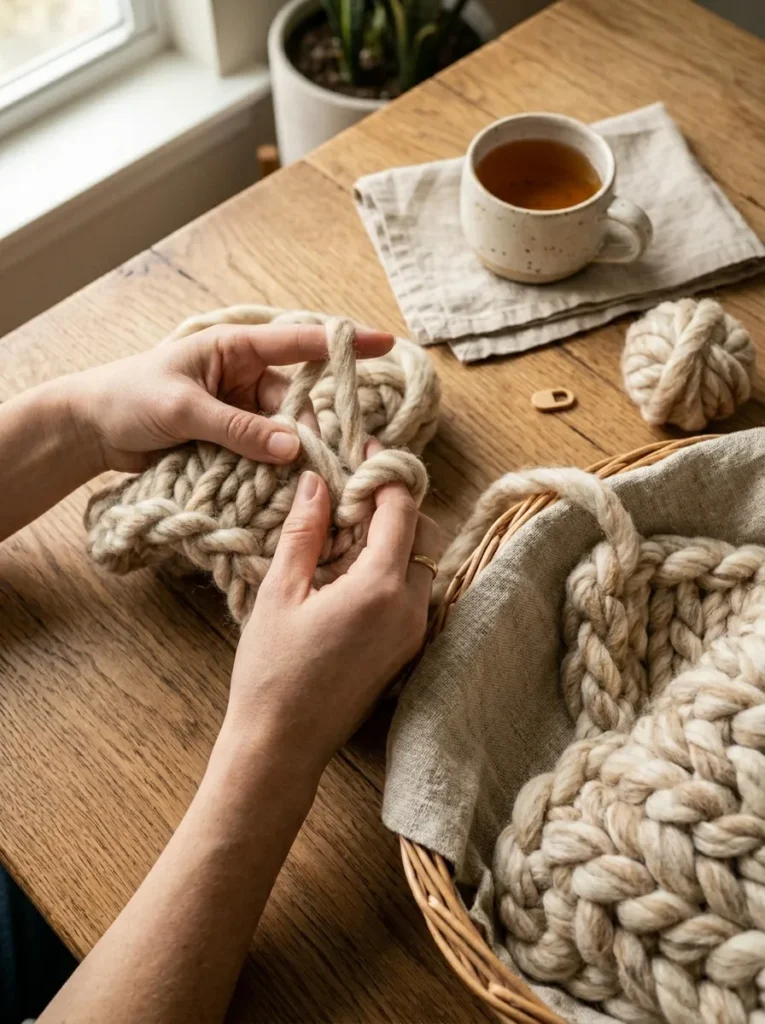
Vibe: The craft feels grounded — the weight of the wool and the rhythm of the loops arrive before any skill does.
Why it works: Finger knitting requires no needles, no pattern reading, and no prior experience — the technique involves looping yarn over and under the fingers in a repeating sequence that most beginners learn in under five minutes. The repetitive loop-over-loop motion engages the same neural mechanisms as other rhythmic meditative practices: the predictable sequence quiets the default mode network (the brain’s “worry circuit”) and occupies just enough cognitive attention to prevent intrusive thoughts without demanding problem-solving. Chunky merino roving amplifies the tactile satisfaction of each loop, making the sensory engagement immediate from the first stitch.
How to get it: Buy a 200-gram skein of super-chunky merino wool roving in a warm neutral — oat, cream, or dusty blush. Search “arm knitting roving” for the specific weight that produces large, satisfying loops. Watch one 3-minute YouTube tutorial on the four-finger knitting cast-on and begin. Aim for 15 minutes per session rather than a finished product as your initial goal.
Quick Win: A 200g skein of chunky merino roving ($18–25) produces a small lap blanket section in one sitting and requires zero tools — the most immediate mindful craft start available.
Shop The Look
| Product |
|---|
| Super chunky merino wool roving skein oat cream |
| Linen-lined wicker storage basket craft supplies |
| White ceramic mug simple handmade pottery |
| Natural linen craft storage bag project tote |
| Chunky knit blanket pattern card beginner printable |
Also view: 15 IKEA Nursery Storage Hacks Every Parent Needs
2. Watercolor Loose Botanical Painting
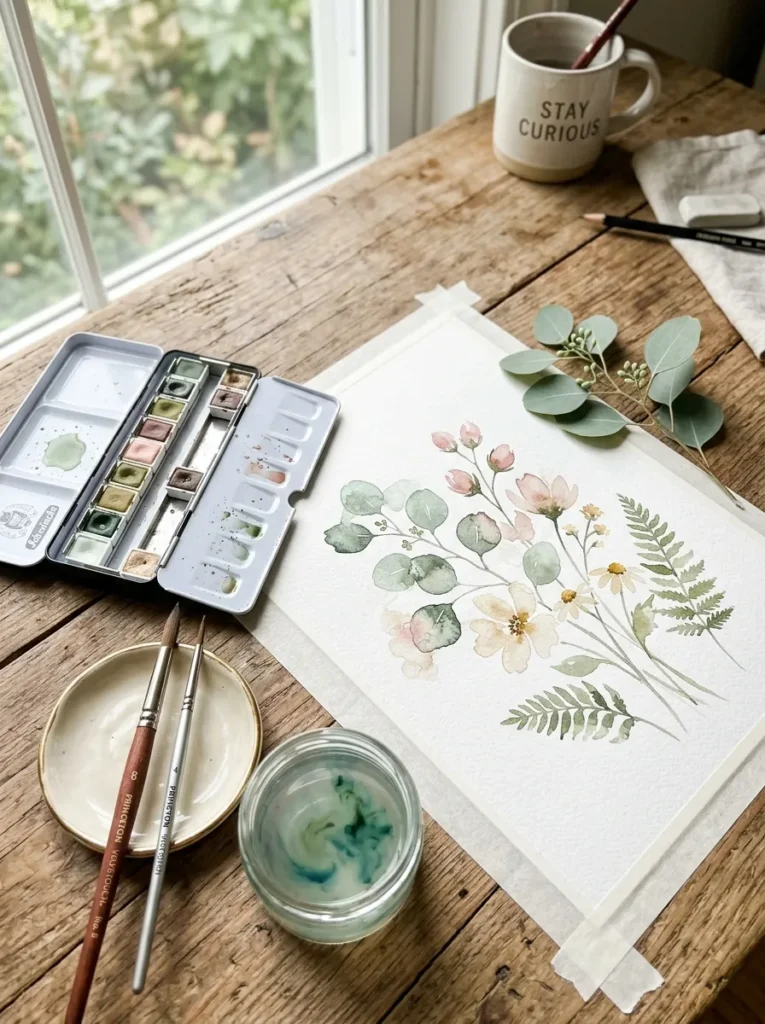
Vibe: The painting session feels luminous — the water does half the work and the brush does the rest.
Why it works: Loose watercolor botanical painting is specifically forgiving for beginners because the medium’s inherent unpredictability — paint blooming and bleeding into wet areas — produces organic effects that require no precise skill to achieve. The beginner cannot over-control watercolor the way they might over-control a pencil or pen, which makes the medium self-correcting in a way that suits process-oriented making. Botanical subjects (leaves, stems, simple flowers) offer recognizable reference shapes that are immediately achievable in loose form, producing results that read as intentional even when made with minimal technique.
How to get it: Buy a 24-pan watercolor set (Sakura Koi or a comparable student-grade pan set), a block of cold-press watercolor paper (90 lb minimum — lighter paper buckles when wet), and two round brushes in sizes 4 and 8. Begin with a single eucalyptus stem: wet the brush, pick up green, and let the paint find its own edges. Paint wet-into-wet for soft edges; let dry before adding detail lines for hard edges.
Shop The Look
| Product |
|---|
| 24-pan watercolor set beginner artist travel tin |
| Cold-press watercolor paper block 90lb 5×7 inch |
| Round watercolor brush set sizes 4 and 8 natural hair |
| Small clear glass water cup artist brush rinse |
| Ceramic brush holder round studio desk organizer |
3. Air-Dry Clay Pinch Pot Bowls
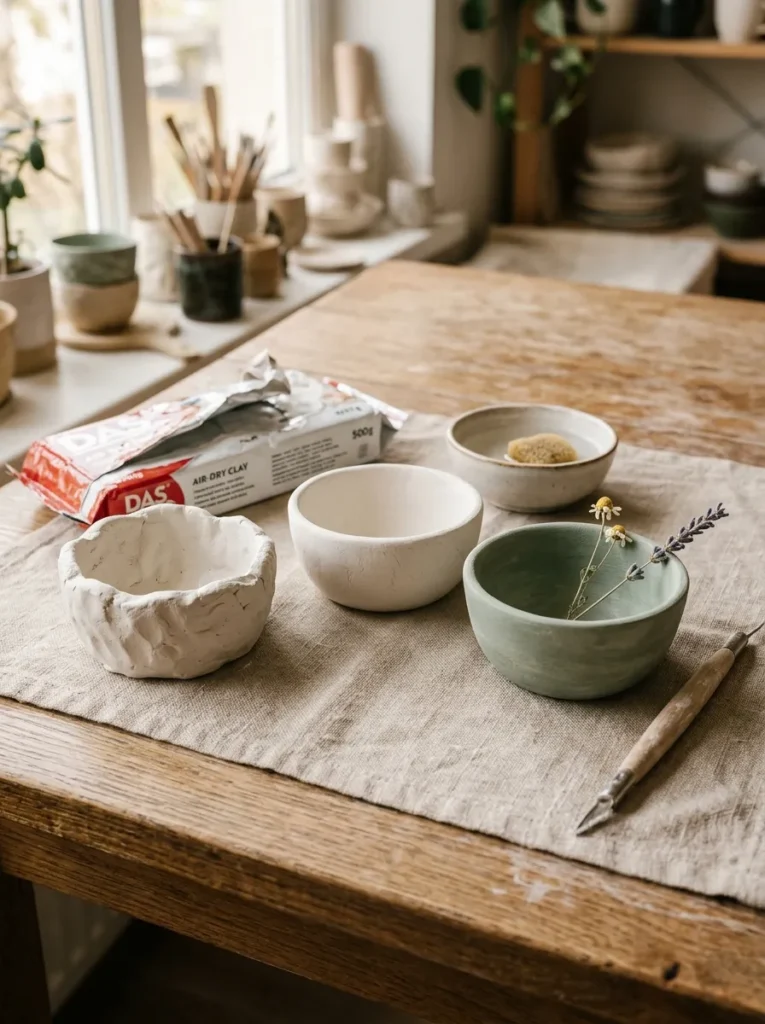
Vibe: The session feels raw and immediate — the clay responds to exactly as much pressure as you give it.
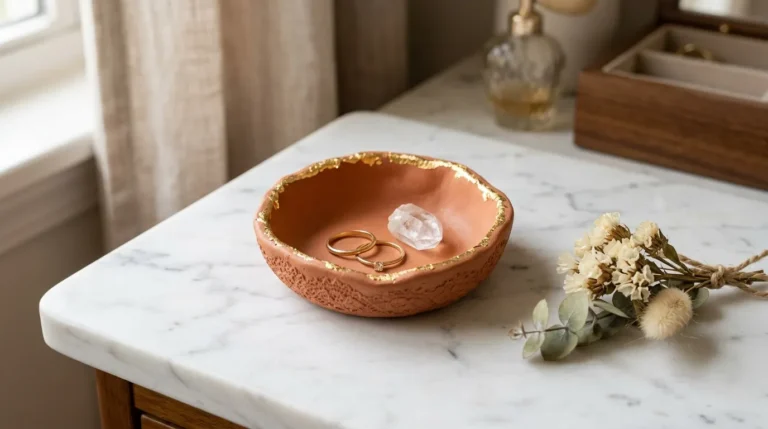
Why it works: Pinch pot making is the oldest ceramic technique in human history, practiced continuously across every culture with access to clay, and it remains the most sensory-rich beginner craft available. The process involves rolling a ball of clay and using thumbs and fingers to gradually thin and shape the walls — a direct, pressure-responsive technique that requires full physical presence and rewards slow attention. Air-dry clay eliminates the kiln requirement entirely, making the technique accessible on a kitchen table with no equipment beyond the clay itself and a small bowl of water.
How to get it: Buy a 2-pound package of white air-dry clay (DAS or a comparable brand), a wooden clay tool or old butter knife for smoothing, and a small bowl of water for keeping fingers moist. Roll a baseball-sized ball of clay, press your thumb into the center to one-third depth, and rotate the ball slowly while pinching the walls outward and upward. Aim for walls of approximately 5mm thickness for stability. Allow 24–48 hours to dry fully before painting with acrylic or watercolor wash.
Quick Win: A 2-pound block of white air-dry clay ($8–12) yields four to six pinch pot bowls — enough for a full afternoon session and several gifts. No tools, no oven, no kiln required.
Shop The Look
| Product |
|---|
| White air-dry clay 2 pound block DAS or similar |
| Wooden clay sculpting tool set beginner |
| Matte acrylic paint set small jars sage neutral tones |
| Small natural bristle paint brush set craft |
| Linen craft work mat table protection |
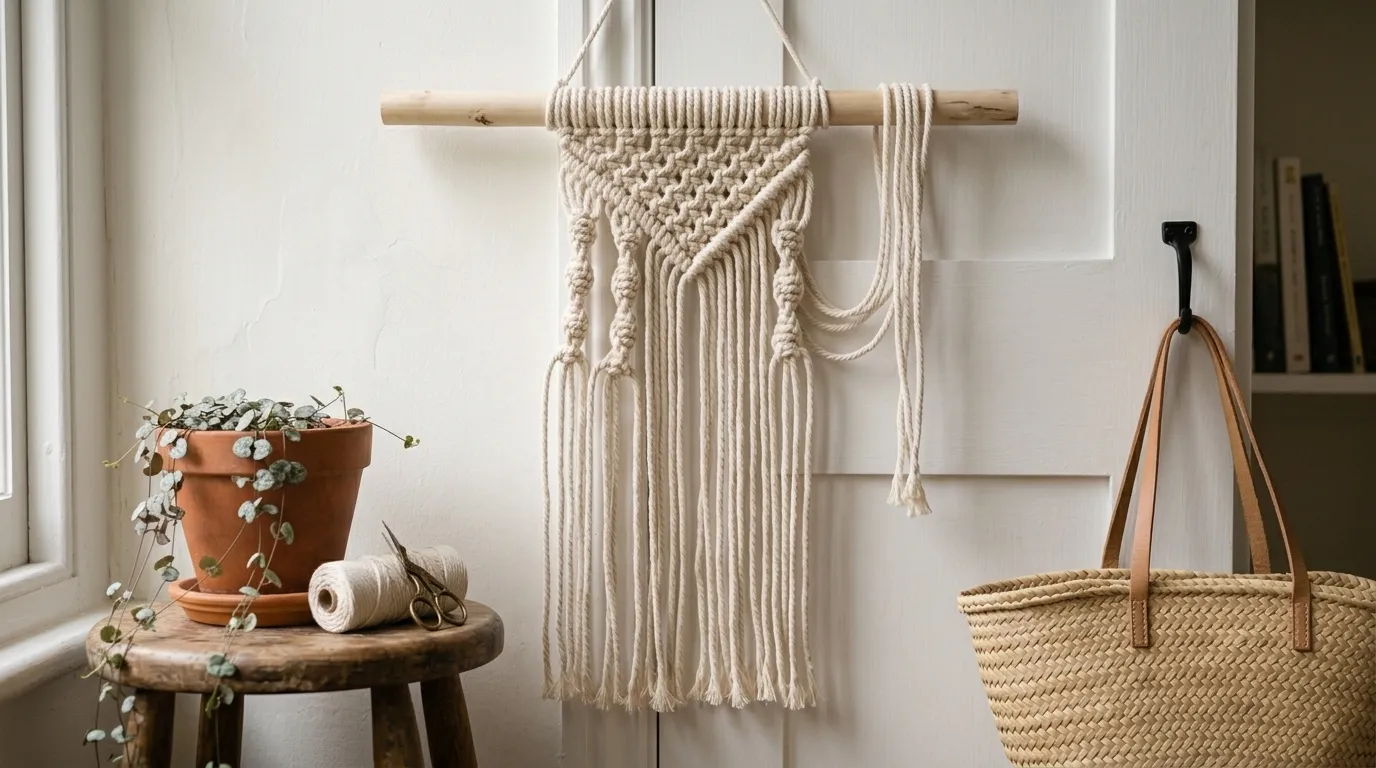
4. Simple Macramé Wall Hanging on a Wooden Dowel
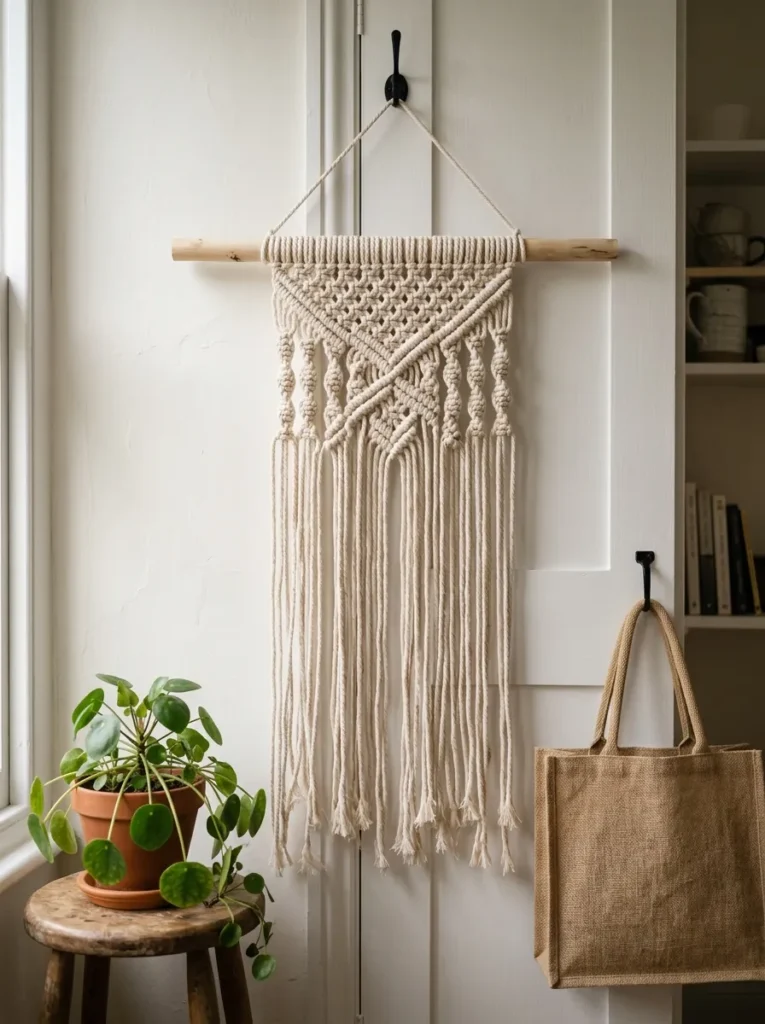
Vibe: The hanging feels textural and handmade in a way that arrives before you’ve tied more than ten knots.
Why it works: Macramé is the craft most precisely structured for beginners because it requires learning only two knots — the square knot and the half-hitch — to produce a result that reads as genuinely skilled. The repetitive knotting sequence engages the hands in a predictable, rhythmic pattern that occupies just enough cognitive attention to create a meditative state. Natural cotton cord is forgiving: knots can be untied and re-tied without damaging the fiber, which eliminates the anxiety of irreversible mistakes that other crafts can produce.
How to get it: Buy a 100-meter spool of 3mm single-strand natural cotton macramé cord and a 30 cm birch dowel. Cut 16 cords at 1 meter each, fold each in half, and lark’s head knot them onto the dowel — producing 32 working cords. Learn the square knot from a single YouTube tutorial and begin alternating rows. A beginner’s first wall hanging typically takes 2–3 hours across one or two sessions.
Shop The Look
| Product |
|---|
| Natural cotton macramé cord 3mm single strand 100m |
| Birch wood dowel rod set 12 inch craft |
| Macramé beginner kit with instructions natural |
| Small S-hook set brushed brass craft hanging |
| Macramé beginner pattern card set printable |
5. Pressed Flower Bookmarks and Cards
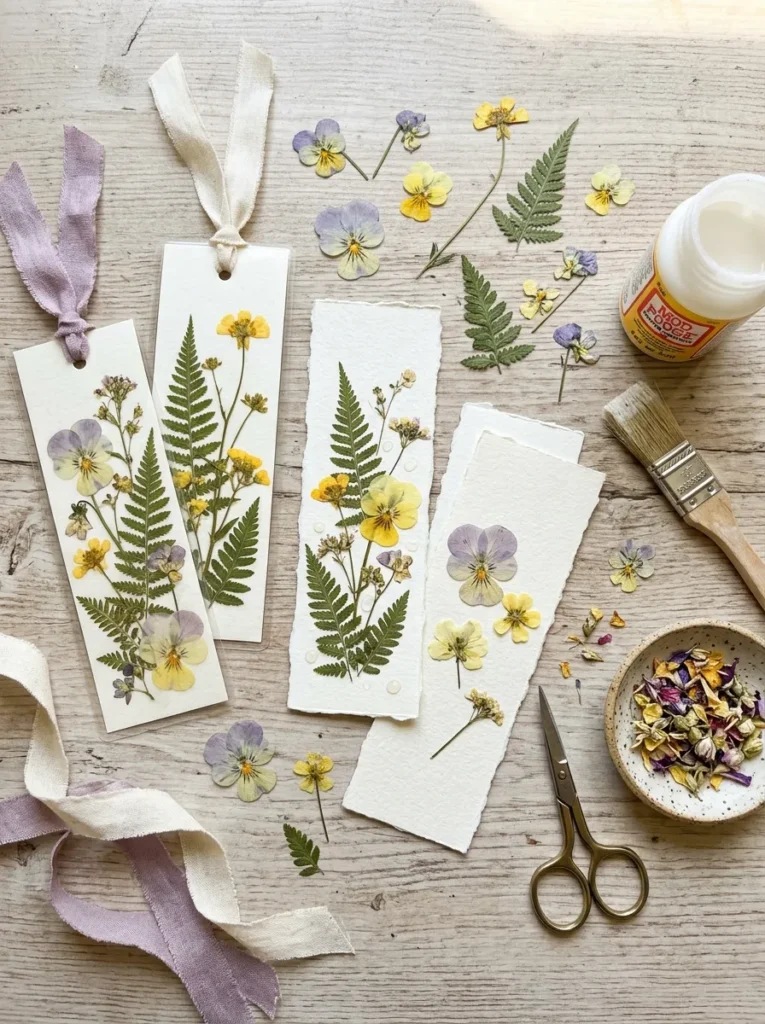
Vibe: The session feels delicate and slow — the kind of making that makes you notice the vein structure of a leaf.
Why it works: Pressed flower craft engages a quality of attention that few beginner crafts can replicate — the flowers are fragile, which demands a gentle, focused presence, and their natural variation (no two pressed pansies are identical) makes each composition uniquely unrepeatable. The pressing process itself (flowers placed between book pages for 1–2 weeks) introduces an element of anticipation and delayed gratification that modern making rarely includes. The arrangement stage, where dried botanicals are composed on paper, applies basic principles of balance and proportion in an entirely intuitive way — no design training required.
How to get it: Collect fresh flowers at their driest point in the day (mid-morning, after dew evaporates). Press between two sheets of parchment paper inside a heavy book, stacking additional books on top for pressure. After 1–2 weeks, arrange the dried flowers on watercolor paper strips (cut to 2×7 inches for bookmarks), affix with a thin layer of Mod Podge using a soft brush, and seal with a second coat once dry. Laminate at a local print shop for $0.50–1.00 per strip.
Quick Win: Wildflowers and garden flowers gathered from your own yard (or a neighbor’s, with permission) cost nothing to press — the only purchase required is a $5 bottle of Mod Podge and watercolor paper already in most craft drawers.
Shop The Look
| Product |
|---|
| Mod Podge matte finish craft sealer 8oz |
| Watercolor paper pad cold press 5×7 inch |
| Pressed flower craft kit dried botanical set |
| Small soft brush set craft decoupage |
| Natural linen ribbon roll craft thin |
6. Beginner Embroidery on Linen with Simple Stitches
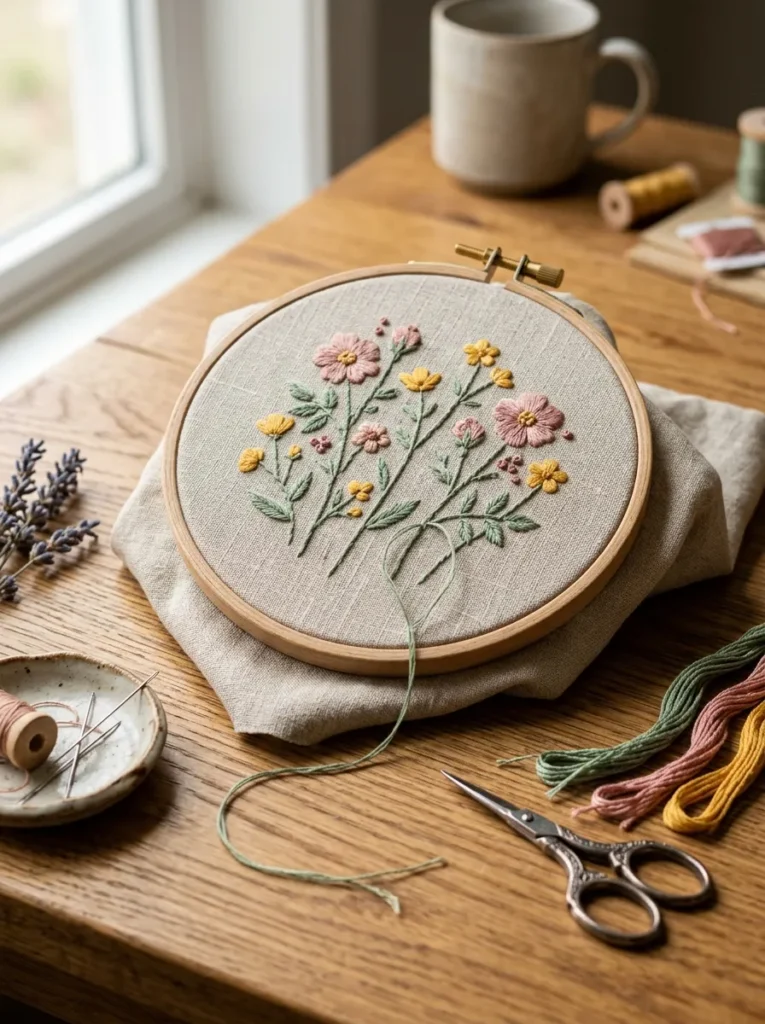
Vibe: The session feels focused — each stitch arriving with a small, satisfying resistance.
Why it works: Embroidery is one of the most studied craft-based mindfulness practices precisely because it requires simultaneous visual attention (following a pattern), fine motor engagement (needle placement and thread tension), and rhythmic repetition (stitch after stitch after stitch). The combination activates a focused-attention meditative state that researchers describe as similar to the effect of formal meditation practice. Beginner embroidery requires learning only three stitches — backstitch, satin stitch, and French knot — to complete most simple botanical patterns. The portability of a hoop-and-thread project makes it the mindful craft most compatible with existing daily routines.
How to get it: Buy a beginner embroidery kit that includes a pre-printed linen pattern, an assortment of six-strand embroidery floss in coordinating colors, a 6-inch wooden hoop, and a crewel needle. Avoid kits with complex patterns — look for simple botanicals or geometric designs with fewer than five stitch types listed. Separate the six-strand floss into two strands for fine detail work and use all six strands for filled areas.
Shop The Look
| Product |
|---|
| Beginner embroidery kit botanical floral linen pattern |
| Wooden embroidery hoop set 6 inch natural |
| Six-strand embroidery floss set assorted botanical colors |
| Crewel embroidery needle set assorted sizes |
| Small embroidery scissors sharp point craft |
7. Slow Collage Journaling with Found Paper
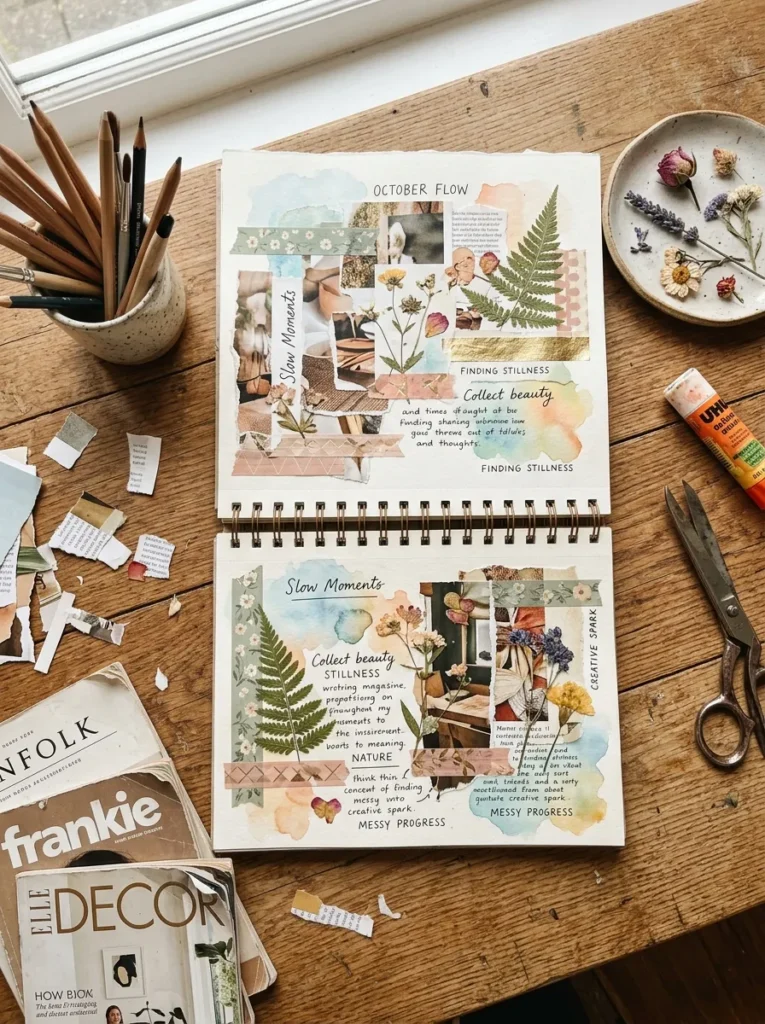
Vibe: The session feels layered — the pages accumulate slowly and nothing needs to be resolved.
Why it works: Slow collage journaling applies the design principle of assemblage — meaning is built from combination rather than creation from scratch, which significantly lowers the barrier to entry for beginners who feel they “can’t draw” or “aren’t creative.” Tearing paper by hand rather than cutting it produces organic edges that make the composition feel intentional regardless of skill level. The practice is explicitly open-ended: a collage journal page is never finished or unfinished, only paused. This absence of a completion state makes it one of the most genuinely process-oriented mindful crafts available.
How to get it: Gather a mixed journal (blank or dot-grid pages), a collection of old magazines and newspapers for tearing, a glue stick, washi tape in two or three coordinating tones, and a single watercolor paint pan for washes. Begin each session by tearing paper rather than selecting it — the act of tearing with intention, choosing what to keep and what to discard, is itself a mindful act.
Quick Win: Every item needed for a first slow collage session — a blank notebook, a glue stick, old magazines, washi tape — is either already at home or available for under $15 combined. The barrier to beginning is genuinely zero.
Shop The Look
| Product |
|---|
| Blank mixed media journal A5 thick pages |
| Washi tape set botanical sage blush neutral |
| Glue stick set craft non-toxic |
| Colored pencil set 24 colors artist quality |
| Dried flower head set craft collage botanical |
8. Beeswax Candle Rolling — No Heat Required
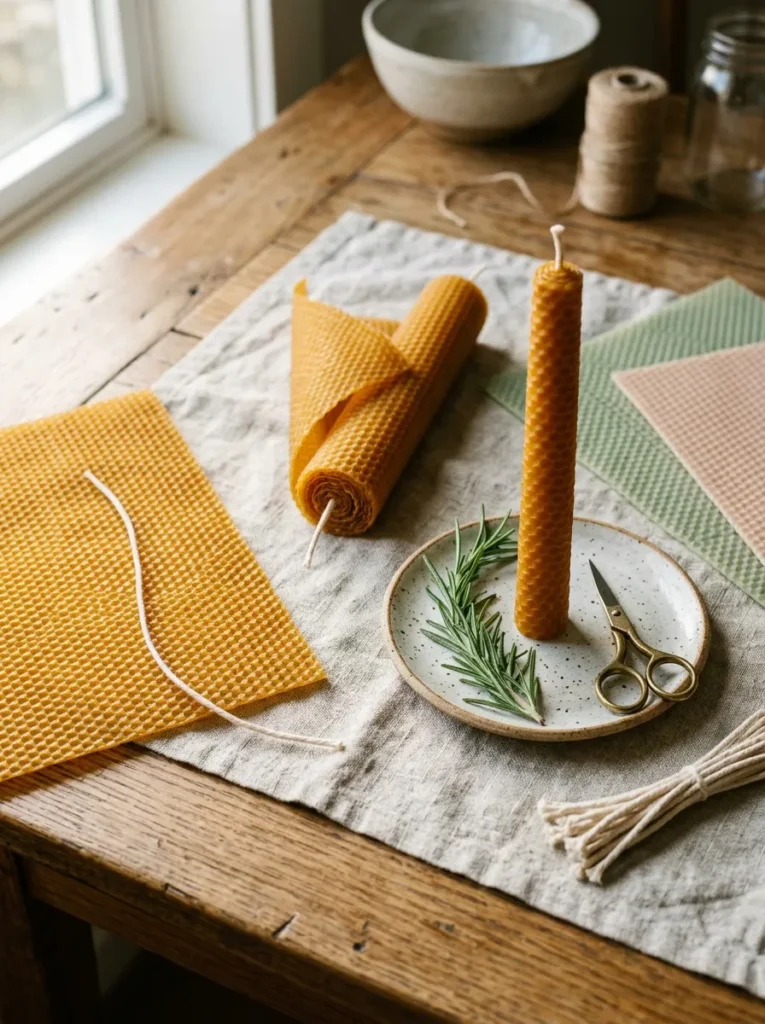
Vibe: The session feels sensory — warm beeswax softens just enough under your hands to make rolling effortless.
Why it works: Rolled beeswax candle-making is among the most immediately satisfying beginner crafts because the technique involves no melting, no pouring, no specialized equipment, and produces a finished, functional object in under ten minutes. The honeycomb-texture beeswax sheets soften slightly from hand warmth during rolling, creating a gentle tactile engagement that is simultaneously calming and rewarding. The natural honey scent of beeswax adds an olfactory dimension that most crafts lack — scent is the most direct sensory pathway to the relaxation response, making this one of the most multi-sensory mindful crafts for beginners.
How to get it: Buy a pack of natural beeswax honeycomb sheets (typically 8×16 inches) in natural amber or dyed colors, and pre-tabbed cotton wicks. Place a wick along the short edge of the sheet with a small overhang at the base. Gently warm the beeswax with a hair dryer on low for 15–20 seconds if the room is cool — cold beeswax cracks when rolled. Roll slowly and evenly from the wick edge, pressing gently to adhere each layer.
Shop The Look
| Product |
|---|
| Natural beeswax honeycomb sheet set candle making |
| Pre-tabbed cotton candle wick set medium thickness |
| Beeswax sheet candle making kit beginner complete |
| Small ceramic taper candle holder set natural white |
| Dried rosemary bunch natural herb decor |
9. Weaving a Simple Frame Loom Sampler
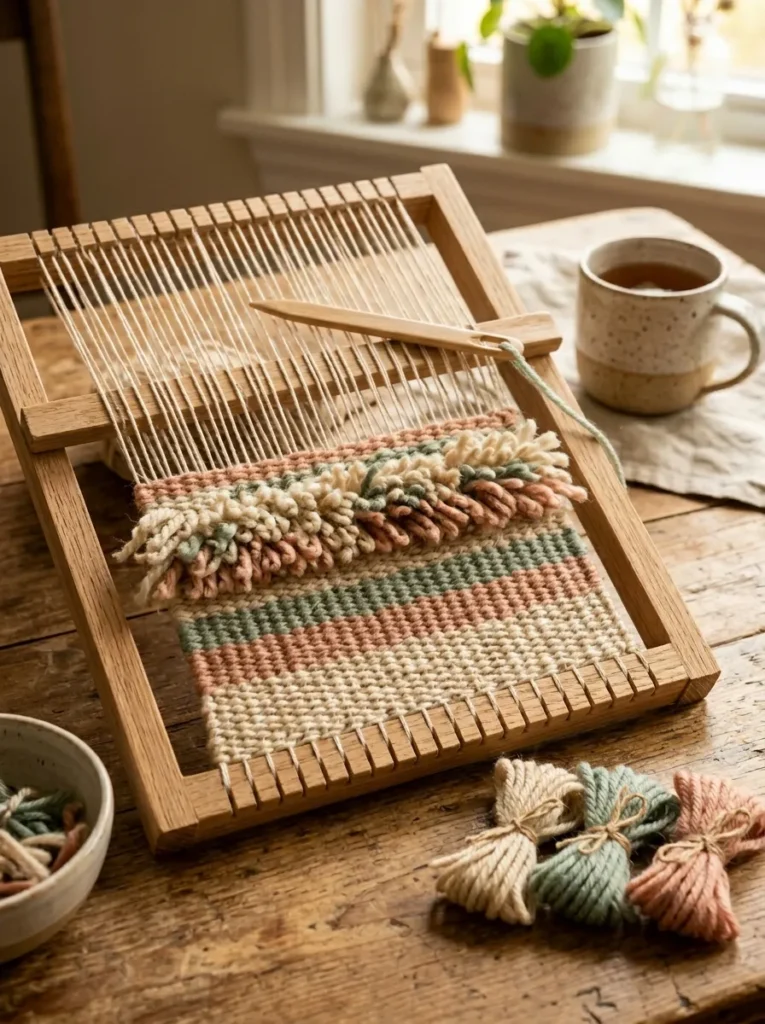
Vibe: The session feels textural and slow in the way that only over-under repetition can produce.
Why it works: Frame loom weaving is the most structurally straightforward textile craft — the over-under alternation of plain weave requires no pattern memorization beyond “the opposite of last row,” and the visual feedback of each weft row building the textile is immediate and satisfying. The physical motion of passing the needle over and under the warp threads is a bilateral movement (engaging both hands alternately) that mirrors the bilateral motion used in EMDR therapy for stress reduction. Weavers consistently describe the practice as the craft most effective at producing a genuine meditative state across their first session.
How to get it: Buy a small wooden frame loom kit (10×12 inches is ideal for a beginner sampler) that includes the loom, a warping guide, and a tapestry needle. Warp with natural cotton string at 8 threads per inch. Select three to four coordinating yarn weights for the weft — one thick, one thin, one textured — and begin plain weaving from the bottom, packing each row down gently with a fork or weaving comb before beginning the next.
Quick Win: A 10×12 inch frame loom kit ($18–28) includes everything needed for a first weaving session and produces a wall-hanging-sized sampler in two to three hours — one of the most complete beginner craft kits available at this price point.
Shop The Look
| Product |
|---|
| Small wooden frame loom kit beginner 10×12 inch |
| Natural cotton string warp thread craft weaving |
| Chunky yarn sampler bundle coordinating neutral tones |
| Wooden tapestry weaving needle set large eye |
| Weaving comb wooden tapestry tool beginner |
10. Nature Printing with Leaves and Acrylic Paint
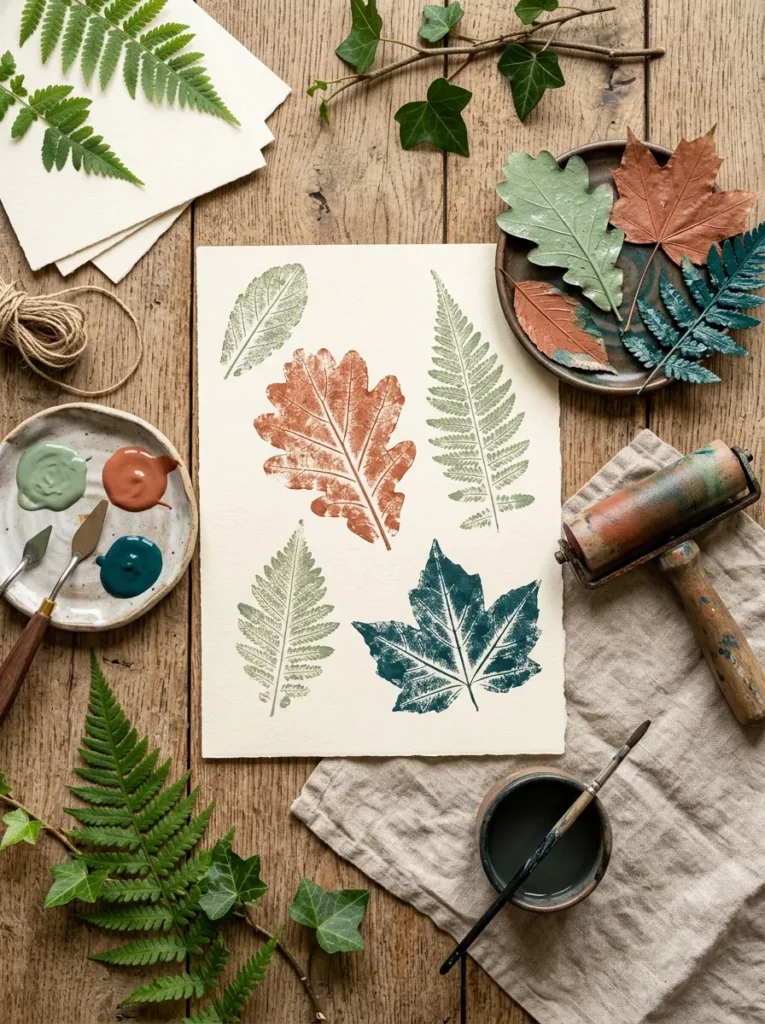
Vibe: The session feels fresh — each print a discovery you couldn’t have designed intentionally.
Why it works: Nature printing applies the principle of collaborative making with the natural world — the vein structure, shape, and texture of each leaf determines the print’s character, making the human role one of choice and placement rather than technical execution. This relinquishment of control is specifically beneficial for beginners who struggle with perfectionism: the leaf decides the outcome, and the outcome is always interesting. Each printing session begins with a foraging walk (even around a garden or sidewalk), which adds a preparatory mindfulness practice before the making itself begins.
How to get it: Collect leaves with pronounced vein structures — ferns, maple leaves, oak leaves, and herb leaves like sage and basil print most clearly. Apply a thin, even layer of acrylic paint to the underside of each leaf using a foam brayer or soft brush. Press the leaf paint-side-down onto watercolor paper and apply even pressure with your palm for 15–20 seconds. Peel back slowly from one corner to reveal the print. Rinse leaves immediately for reuse.
Shop The Look
| Product |
|---|
| Acrylic craft paint set small bottles terracotta sage teal |
| Foam brayer roller set small craft printing |
| Watercolor paper pad cream 8×10 inch |
| Small ceramic paint dish palette set |
| Craft apron waxed canvas adjustable |
11. Origami Paper Folding — Starting with Cranes and Stars
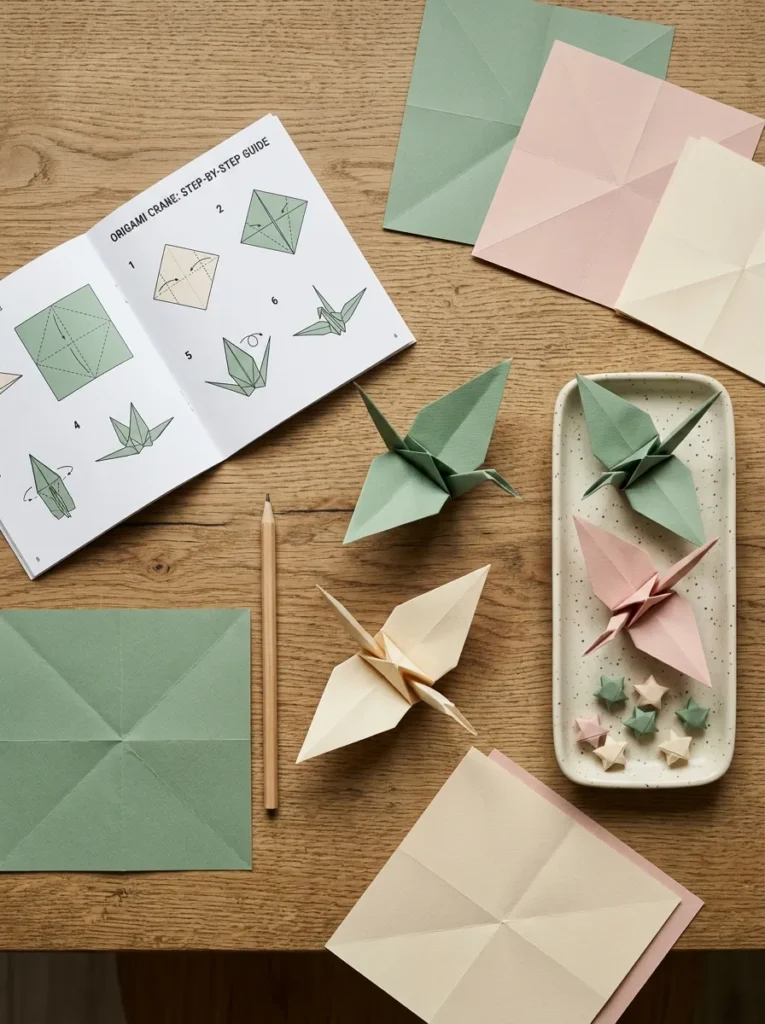
Vibe: The session feels precise and still — each crease demanding exactly the attention it’s owed.
Why it works: Origami is among the most cognitively well-documented mindful crafts — a 2020 study in the journal Frontiers in Psychology found that origami practice measurably reduced anxiety and improved focus in adult participants across a six-week protocol. The mechanism is the same as other attentional crafts: the folding sequence requires sustained, sequential attention that crowds out ruminative thinking. The crane is the optimal beginner project because its 26-step sequence is long enough to produce a genuine meditative session but short enough to complete in 15–20 minutes, delivering a satisfying finished object at the end of every practice session.
How to get it: Buy a 100-sheet pack of kami origami paper in 15cm squares — kami is specifically designed for origami and holds crisp creases better than standard printer paper. Learn the traditional crane fold from a step-illustrated card or short YouTube tutorial. Crease each fold against a hard surface (not in the air) and fold away from yourself when possible for maximum precision. Begin with solid-color paper before attempting patterned sheets, which can make fold lines harder to track.
Shop The Look
| Product |
|---|
| Origami paper pack 100 sheets assorted colors 15cm |
| Origami instruction card set beginner traditional folds |
| Small ceramic tray display origami finished pieces |
| Bone folder scoring tool craft paper folding |
| Glass display dome small origami paper art |
12. Eco-Dyeing Fabric with Leaves and Onion Skins
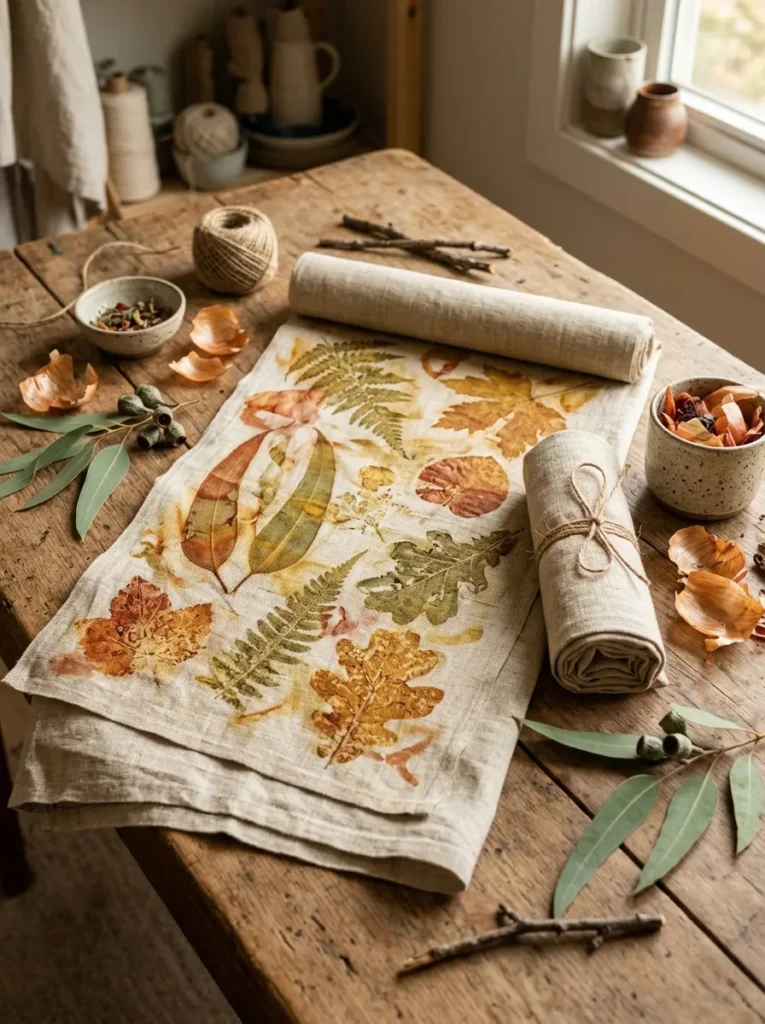
Vibe: The session feels earthy — the colors arrive like something found rather than made.
Why it works: Eco-dyeing is the most process-surrendered of all beginner mindful crafts — the dyer arranges the botanical material, bundles the fabric, simmers it in water, and then waits. The outcome cannot be controlled precisely, only influenced, which makes the unwrapping stage a genuine moment of discovery. Yellow onion skins produce rich amber-to-rust tones on natural linen with no mordant required, making them the most accessible and reliably satisfying eco-dye material for beginners. The connection to natural and foraged materials grounds the practice in the same material world as pressed flower and nature printing crafts.
How to get it: Collect yellow onion skins (save them over several weeks of cooking) and fresh or dried eucalyptus, oak, or maple leaves. Wet a piece of natural linen or cotton fabric, lay botanical materials across the surface, fold or roll the fabric around them, and tie with string. Simmer in a pot of water for 1–2 hours. Unwrap when cooled. No mordant is required for onion skin dyeing on natural fiber — the tannins in the skins bind directly to plant-based fabric.
Quick Win: Yellow onion skins saved from 6–8 onions over two weeks, combined with a $4 piece of natural cotton muslin, produce genuinely beautiful rust and amber eco-dye results with no additional purchases required.
Shop The Look
| Product |
|---|
| Natural cotton muslin fabric yard undyed |
| Cotton string bundle natural undyed tying |
| Stainless steel pot medium craft dyeing dedicated |
| Natural linen tea towel set undyed blank |
| Eco-dyeing beginner guide book botanical printing |
13. Candle Painting on Glass Jars with Translucent Paint
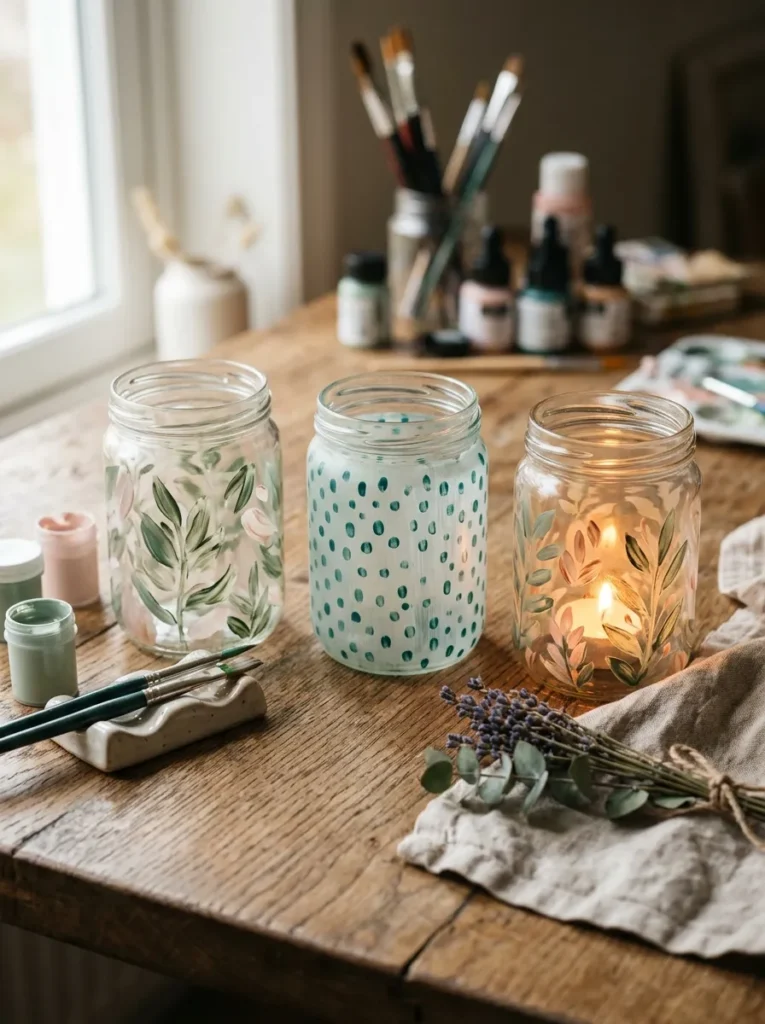
Vibe: The session feels luminous — the painting only fully reveals itself when a light goes on inside.
Why it works: Glass jar painting with translucent paint applies the design principle of light-activated color — the painted surface appears flat and opaque in natural light but becomes a glowing, stained-glass-like object when a tea light is placed inside. This transformation from flat to luminous provides a payoff that motivates beginners through the making process and creates genuine delight at the finished object’s first lighting. The translucent glass paint is water-based, wipes off with a damp cloth while wet (allowing correction), and requires no heat setting for decorative use — making the technique completely forgiving for beginners.
How to get it: Collect clean glass jars of varied shapes and sizes (jam jars, pasta sauce jars). Buy a set of translucent glass paint (Pebeo Vitrea 160 or a comparable translucent glass medium) in three to four coordinating colors. Apply with a soft round brush in loose, wet strokes — the paint flows and blends naturally on the glass surface, producing organic, painterly marks without requiring precise technique. Place an unscented tea light inside when the paint is fully dry.
Shop The Look
| Product |
|---|
| Translucent glass paint set small jars craft |
| Small round soft brush set glass painting craft |
| Clear glass jar set assorted sizes candle holder |
| Unscented tea light candles set of 50 |
| Small ceramic palette dish paint mixing craft |
14. Seed Paper Making from Recycled Paper Pulp
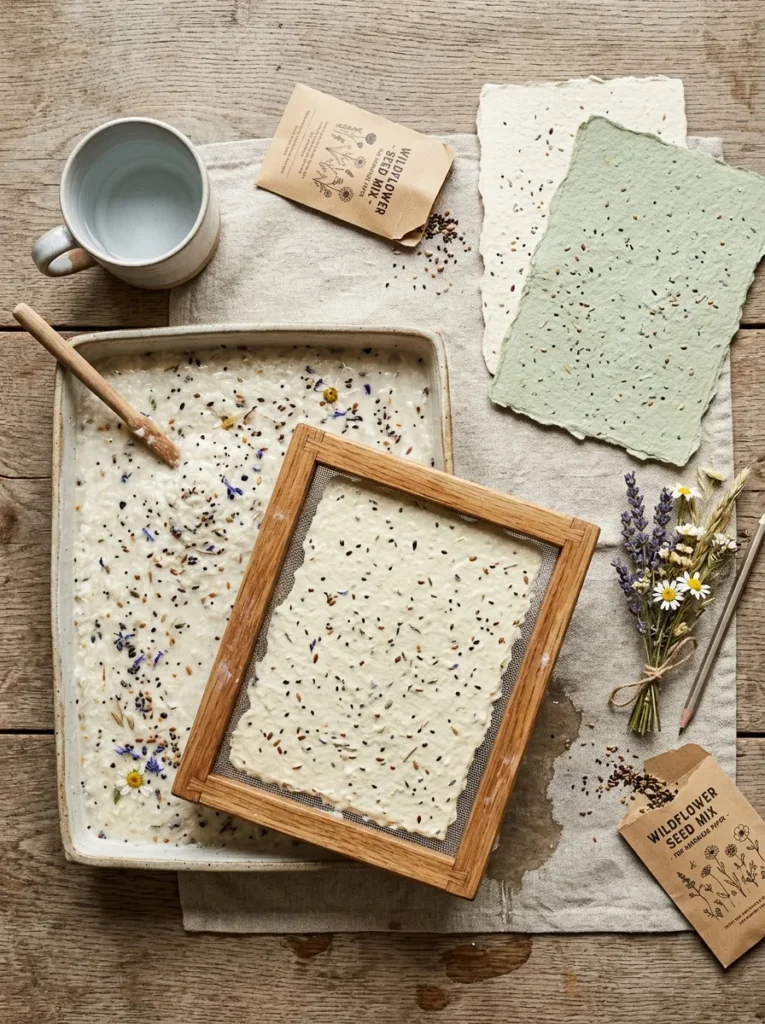
Vibe: The session feels elemental — the paper arriving slowly from water and fiber the way all paper originally did.
Why it works: Seed paper making closes a loop that most crafts leave open — the finished object is designed to be destroyed in the most life-giving way possible, planted in soil to grow wildflowers. This cradle-to-cradle quality gives the craft a philosophical dimension that purely decorative making lacks: you are making something that will eventually become something else entirely. The paper-making process itself — tearing, soaking, blending, and forming — involves every sensory modality (touch, sound, sight, smell) and a patient, multi-stage rhythm that distributes the mindful engagement across an entire afternoon rather than concentrating it in a single session.
How to get it: Tear used printer paper, newspaper, or cardboard into 1-inch pieces and soak in warm water for 30 minutes. Blend in a blender (use a dedicated craft blender, not your kitchen blender) with additional water until a smooth pulp forms. Pour into a shallow tray of water, add a tablespoon of wildflower seeds per sheet, and dip a mould-and-deckle frame to capture an even pulp layer. Press and dry on a flat surface for 24 hours. The dried sheets can be cut to size and planted directly in soil.
Quick Win: A mould-and-deckle frame set ($15–22) is the only specialized purchase required for seed paper making — everything else (paper scraps, a blender, a shallow tray, wildflower seeds from a garden center) is likely already available at home or costs under $5.
Shop The Look
| Product |
|---|
| Mould and deckle frame set papermaking beginner |
| Wildflower seed mix packet native species |
| Dedicated craft blender paper pulp making |
| Natural cotton mesh screen papermaking supply |
| Wildflower seed paper making kit complete beginner |
How to Start Your Mindful Crafting Practice
The single best first move is choosing one craft from this list based not on what you think you’d be good at, but on what material you most want to touch. The tactile pull is the mindfulness signal — if you keep thinking about the weight of wool or the smell of beeswax or the smoothness of clay, that is your nervous system indicating where the relaxation response will be strongest. Start there, and nowhere else.
The most common mistake beginners make is buying too much material before beginning. A full embroidery floss collection, an entire watercolor supply kit, a macramé cord library — all purchased before a single session — creates pressure to justify the investment with productivity. The fix is to buy only what a single session requires: one skein, one pan set, one block of clay. The craft earns more material after you’ve confirmed it’s the one that fits.
Three specific items under $50 that give you an immediate start across multiple crafts: a 24-pan student watercolor set ($12–18, covers watercolor painting and can add washes to pressed flower and collage projects); a 2-pound block of white air-dry clay ($8–12, requires zero additional tools for a first pinch pot session); and a 100-meter spool of 3mm natural cotton macramé cord ($10–15, covers a first macramé wall hanging and basic weaving warp).
Realistically, a single mindful craft session runs 20–45 minutes and requires no warm-up period — the mindfulness state arrives within the first five minutes of rhythmic making for most beginners. A starter supply kit for any single craft on this list costs $10–35. A more complete setup (proper tools, multiple materials, dedicated storage) runs $50–120 and can be assembled gradually over several weeks as the practice develops. No craft on this list requires a dedicated workspace — a kitchen table, a lap tray, or a corner of a desk is sufficient for every project here.
Frequently Asked Questions About Mindful Crafts for Beginners
What’s the difference between mindful crafts and regular crafts?
Mindful crafts prioritize the process of making over the quality or usefulness of the finished object — the goal is the state of focused, present attention that arises during making, not the thing itself. Regular crafts are often outcome-oriented: a finished garment, a functional object, a technically executed result. The distinction matters for beginners specifically because a mindful approach removes the performance anxiety that causes most people to abandon crafts early. Any craft can be practiced mindfully, but the 14 ideas in this list are specifically chosen because their techniques — repetitive, rhythmic, sensory, and low-stakes — naturally produce a meditative state without requiring conscious mindfulness practice.
Which mindful craft is best for anxiety relief specifically?
Research and practitioner consensus both point to rhythmic, repetitive crafts as the most effective for anxiety specifically — knitting, weaving, finger knitting, and embroidery all involve predictable, repeating physical sequences that activate the parasympathetic nervous system. A 2013 survey of over 3,500 knitters published in the British Journal of Occupational Therapy found that 81% reported feeling calmer after knitting, and those who knitted in groups reported the highest wellbeing scores. For someone new to craft and managing active anxiety, finger knitting with chunky merino wool is the most accessible starting point: it requires no tools, produces immediate tactile feedback, and can be learned in under five minutes.
How much do beginner mindful craft supplies cost?
Most beginner mindful crafts have a startup cost of $10–35 for a single session’s materials. Finger knitting requires only a $20–25 skein of chunky wool. A first pressed flower session costs nothing if flowers are gathered from a garden. Watercolor painting starter kits run $15–25. Air-dry clay for a pinch pot session costs $8–12. The most expensive beginner entry points are frame loom weaving ($25–40 for a kit) and eco-dyeing ($15–25 for fabric and materials). No craft on this list requires a startup investment over $45 for a complete first session, and several require no purchase at all.
Can mindful crafts genuinely help with stress and mental wellbeing?
Yes — the evidence base is substantive and growing. A 2016 study in the Journal of Positive Psychology found that engaging in creative activities daily was associated with meaningfully higher positive affect the following day. A 2021 review in the journal Arts in Psychotherapy synthesized 37 studies on craft-based interventions and found consistent evidence of reduced cortisol, reduced self-reported anxiety, and improved mood across a range of craft activities including knitting, clay work, collage, and drawing. The mechanism involves both attentional absorption (crowding out ruminative thinking) and the competence satisfaction produced by making something with one’s hands. The effect is strongest when the craft is practiced consistently — three to four times per week — rather than as a single-session intervention.
What mindful craft works best in a small space with no dedicated workspace?
Origami, slow collage journaling, pressed flower making, and beeswax candle rolling all work on a standard kitchen table or even a lap tray and require no mess management beyond a sheet of newspaper as a work surface. Origami requires only a flat surface and paper. Collage journaling contains itself within the journal. Pressed flower work produces no liquids or debris beyond dried petals. Beeswax candle rolling involves no melting and no mess. For anyone in a small apartment without a dedicated workspace, origami is the single most space-efficient mindful craft — requiring only a flat surface approximately 30×30 cm, producing no waste, and storing entirely in a single envelope of paper squares.
Ready to Begin Your Mindful Crafting Practice?
These 14 ideas span every dimension of what makes a craft genuinely mindful rather than merely productive — from the weight and warmth of chunky merino wool and the cool responsiveness of air-dry clay, to the patient rhythm of embroidery stitches and the surrendered discovery of eco-dyeing. Starting with one session of one craft is not a small beginning — it is the only beginning that works, because the mindful state arrives in the doing, not in the preparing. Today, identify the material on this list you most want to touch, buy only what a single session requires, and give yourself 20 minutes at the kitchen table with no other objective. When the hands are busy and the mind follows, the rest of the day lands differently — quieter, more settled, more yours. Save the ideas that made you slow down while reading them — those are the ones your nervous system already knows it needs.