15 Indoor Plant Ideas Worth Saving for Every Home
Indoor plant ideas worth saving for every home use living botanical specimens — from trailing vines and sculptural floor plants through compact desk specimens and window-sill collections to bathroom botanicals and kitchen herb installations — to bring the specific quality of living green into domestic interiors in ways that improve both the atmosphere of the spaces they inhabit and the wellbeing of the people who share those spaces with them. This article gives you exactly 15 ideas spanning every room, every light condition, every budget, and every level of plant care experience so every home finds a botanical approach that is genuinely achievable and genuinely transformative.
A well-chosen indoor plant does something that no purchased decoration can replicate — it changes. It grows, it responds to the light, it moves in an air current, it opens and closes with the day. This quality of being alive and dynamic in an environment of static manufactured surfaces is the specific value that indoor plants bring to domestic interiors, and it is available from a $3 succulent cutting as much as from a $150 specimen tree. Here are 15 ideas worth keeping.
Why Indoor Plant Ideas Work for Every Home
The evidence base for indoor plants’ positive effects on domestic environments extends across several research domains simultaneously. The NASA Clean Air Study (1989, updated in subsequent meta-analyses) documented that a range of common houseplants reduce volatile organic compound concentrations in sealed environments — though subsequent research has noted that the plant density required to produce measurable air quality improvement in a ventilated domestic space is higher than typically assumed, and that the air quality benefit of the average houseplant in an average ventilated room is less significant than initially reported. The psychological benefits, however, are more robustly supported: research published in the Journal of Physiological Anthropology documents that passive contact with indoor plants (looking at, touching, or being in proximity to living plants) reduces physiological stress markers including cortisol, blood pressure, and heart rate. This finding is replicated across dozens of studies and robust to the variety of plant species used — the stress reduction appears to be a response to living plant presence generally rather than to specific species. The attention restoration theory (Kaplan and Kaplan, 1989) further explains why indoor plant contact supports cognitive recovery: natural elements including plants provide the “fascination without effort” that allows directed attention to restore itself, reducing mental fatigue.
The practical indoor plant selection challenge is matching plant species to the specific light and humidity conditions available in the intended position — the most common cause of indoor plant failure is not a lack of care skill but a species-environment mismatch. A fiddle-leaf fig placed in a low-light corner will decline regardless of the quality of care it receives because it requires bright indirect light; a peace lily in a sunny south-facing window will scorch because it requires shade. The fifteen ideas in this list specifically address light conditions for each recommendation, using the practical categories that most homes can assess without specialized equipment: bright direct light (within 60cm of a south or west-facing window with unobstructed sun), bright indirect light (within 90cm of a window with indirect or filtered sun), medium light (90–180cm from a window, or near a north-facing window), and low light (more than 180cm from a window, or in a room with no natural light).
Style at a Glance
| Element | Plant Function | Design Edge |
|---|---|---|
| Philosophy | Living green changes what static decoration cannot | Match species to light, not to aesthetic alone |
| Light Categories | Bright direct, bright indirect, medium, low | Each room has a light category that determines plant choice |
| Budget Range | $3 succulent cutting to $150 specimen tree |
15 Indoor Plant Ideas Worth Saving for Every Home
1. The Statement Floor Plant — Fiddle-Leaf Fig or Monstera
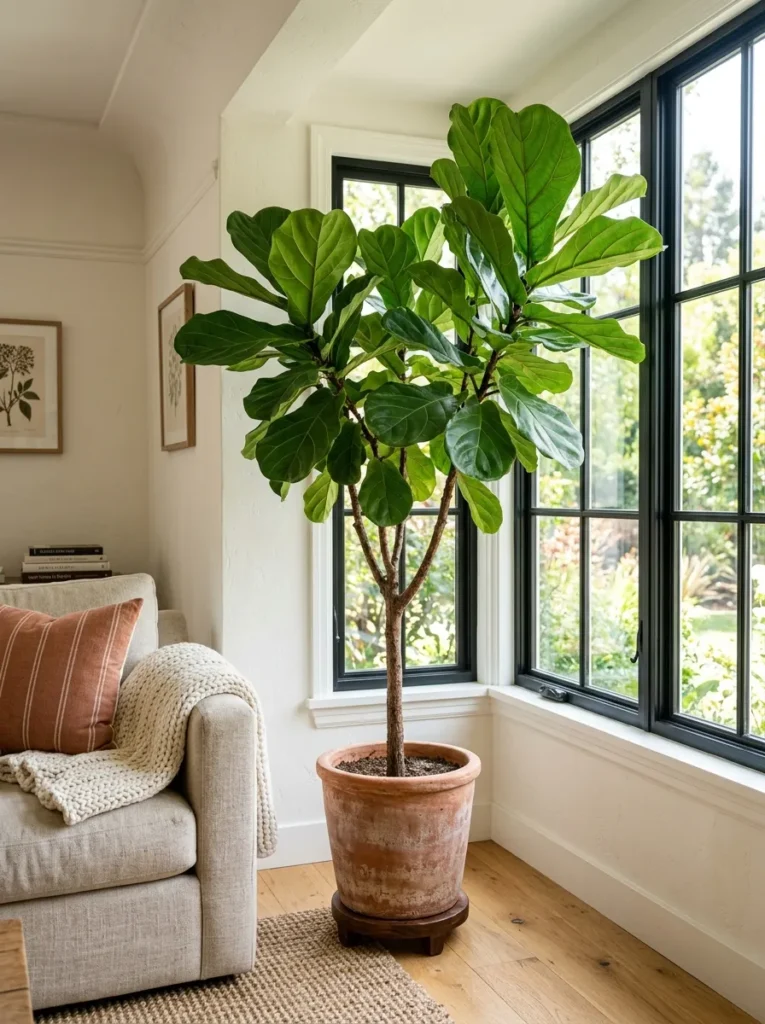
Vibe: The statement floor plant feels like a living architectural element — the fiddle-leaf fig’s sculptural branching form and large leaves doing the work of a room divider, a ceiling anchor, and a natural sculpture simultaneously.
Why it works: A large statement floor plant in a living room applies the vertical botanical presence principle — the room’s floor plane is typically the only surface where a significant vertical plant form can exist without wall mounting or shelf installation. A specimen plant of 120–180cm height at the correct window-adjacent position creates a botanical presence that reads at the room’s full scale, anchoring a corner, filling a vertical void beside a window, or creating a soft visual boundary between functional zones in an open-plan layout. The fiddle-leaf fig (Ficus lyrata) and the monstera (Monstera deliciosa) are the two most widely recommended statement floor plants because their leaf forms (the fiddle-leaf’s large oval leaves, the monstera’s dramatically split fenestrated leaves) are visually distinctive enough to read as design decisions at room distance.
Light requirement: Bright indirect light (within 90cm of a large south or west-facing window, but not in direct sun which causes leaf scorch). Both species are sensitive to relocation — find the right spot and commit, as repeated moving causes leaf drop.
Care: Water when the top 2–3cm of soil is dry (typically every 7–10 days in active growth). Feed with a balanced liquid fertilizer monthly through spring and summer.
Quick Win: A young fiddle-leaf fig at 60–80cm height ($25–50 from garden centres) provides the statement floor plant effect at a fraction of the cost of a mature specimen — it grows approximately 15–30cm per year in good conditions, reaching the full statement size within two to three years.
Shop The Look
| Product |
|---|
| Fiddle-leaf fig Ficus lyrata large |
| Terracotta pot 30cm drainage hole |
| Well-draining indoor potting mix |
| Indoor plant fertiliser liquid |
| Plant saucer terracotta matching |
Also view: 13 IKEA Summer Decorating Ideas with Vibrant Style
2. Trailing Plant Cascade — Golden Pothos from a High Shelf
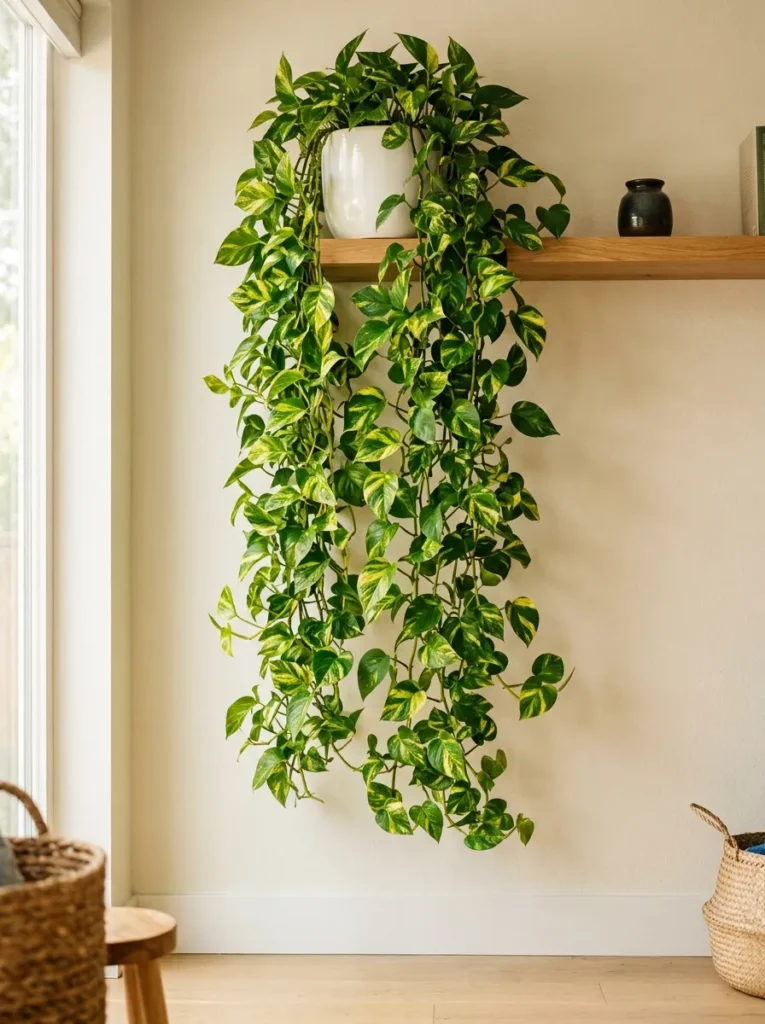
Vibe: The trailing pothos cascade feels like the shelf grew a green waterfall — the downward trail creating a living vertical element that no wall hanging or artwork can replicate at this dynamism.
Why it works: A golden pothos (Epipremnum aureum) positioned on a high shelf to trail downward applies the botanical cascade principle — the plant’s natural growth direction (trailing downward from its pot in the absence of a climbing support) is exploited as a design feature, converting the trailing growth habit from a management challenge into the piece’s primary visual quality. The shelf height of approximately 180cm provides the maximum trail development opportunity in a standard domestic space — at this height, vines can trail 100cm or more before reaching the floor, creating a botanical presence that occupies the room’s full vertical dimension. Golden pothos specifically is the most recommended species for this application because it is genuinely tolerant of a wide light range (medium to bright indirect), grows rapidly (adding 15–30cm of new growth per month in good conditions), and maintains the variegated yellow-green coloring that provides visual interest along the full trail length.
Light requirement: Medium to bright indirect light. Pothos is one of the most genuinely low-light tolerant plants — it will survive in medium-low light conditions but grows more slowly and develops less variegation.
Care: Water when the top half of the soil is dry (extremely forgiving of underwatering — one of the most neglect-tolerant species available). Can be propagated in water from any node cutting, producing new plants indefinitely.
Shop The Look
| Product |
|---|
| Golden pothos Epipremnum aureum |
| White ceramic pot 18cm |
| High shelf for plant display |
| Trailing plant potting mix well-drain |
| Plant propagation water vase |
Also view: 14 DIY Paper Craft Projects for Every Skill Level
3. Bathroom Botanical — Humidity-Loving Species
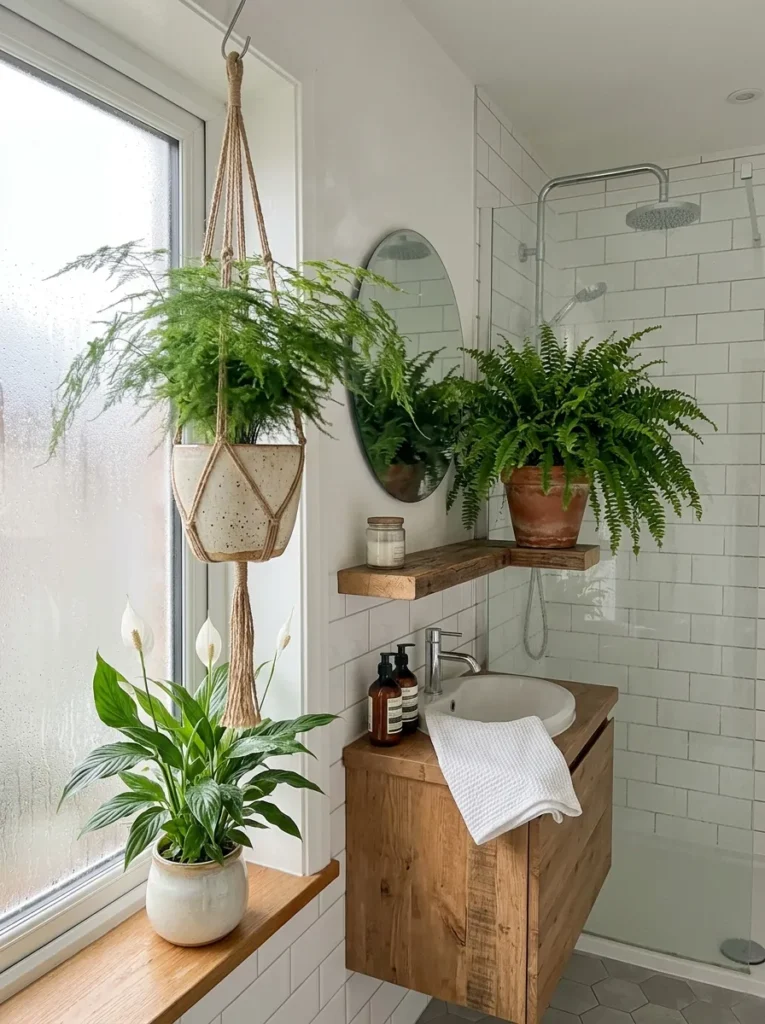
Vibe: The botanical bathroom feels like the spa that the bathroom always aspired to be — the ferns and peace lily creating the specific lush humidity-loving green that converts a functional room into a restorative environment.
Why it works: Humidity-loving plants in a bathroom apply the microclimate matching principle — the bathroom’s naturally elevated humidity (from showers and baths), its typically indirect north-facing window light, and its consistent warm temperature create a microclimate that many tropical plant species find significantly more comfortable than the dry air of heated living rooms. Species that require frequent misting or high humidity in other rooms — ferns, orchids, peace lilies, and asparagus ferns — can often be grown without supplementary humidity management in a regularly used bathroom. This microclimate advantage makes the bathroom, counterintuitively, one of the easiest rooms in the house for growing a lush botanical collection.
Species guide for bathrooms: Boston fern (requires high humidity and indirect light — ideal bathroom candidate), asparagus fern (tolerates low light and high humidity), peace lily (tolerates low light and high humidity, flowers in sufficient light), orchids (specifically Phalaenopsis orchids, which thrive in the humidity and indirect light of a bathroom window), and pothos (tolerates the full range of bathroom conditions). Avoid direct shower spray contact with plant foliage, which can cause rot.
Light requirement: Low to medium indirect light (north-facing frosted windows are ideal for most bathroom botanical species).
Shop The Look
| Product |
|---|
| Boston fern Nephrolepis exaltata |
| Peace lily Spathiphyllum |
| Asparagus fern hanging pot |
| Ceramic hanging pot bathroom |
| Bathroom shelf plant display |
4. Kitchen Herb Garden — Functional and Beautiful
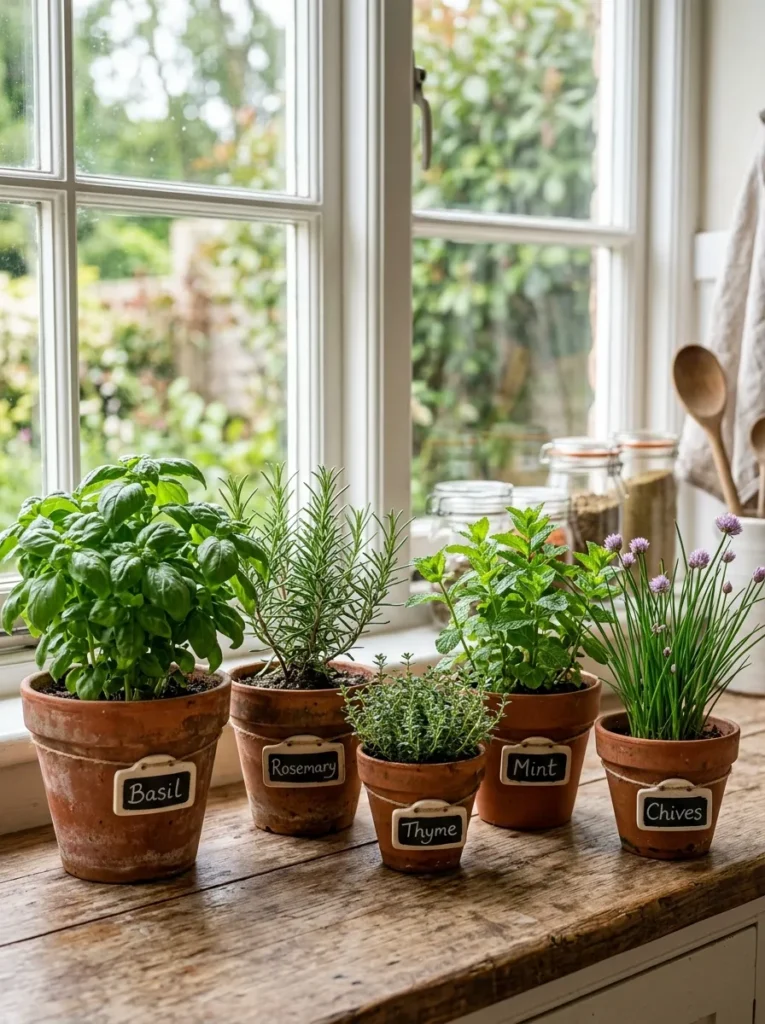
Vibe: The kitchen herb garden feels like the most useful version of a botanical collection — the herbs providing the simultaneous satisfaction of being beautiful to look at and immediately available for cooking.
Why it works: A kitchen herb garden applies the functional beauty principle — plants grown for culinary use are the one indoor plant category that provides a genuinely functional return (fresh herbs available immediately at the point of cooking) in addition to the aesthetic and atmospheric benefits that all indoor plants provide. The terracotta pot and handwritten label format converts what could be a supermarket pot plant collection into a curated botanical still life with the specific warmth of natural material and handwritten typography. The kitchen windowsill is typically one of the brightest positions in the domestic interior, providing the strong direct or bright indirect light that most culinary herbs require.
Species by light requirement: South or west-facing window (bright direct): basil, rosemary, thyme, oregano, sage, chives. East-facing window (morning sun): mint, parsley, coriander, chives. North-facing window (indirect): mint, parsley (survives but grows more slowly in lower light). Mint must always be grown in a separate contained pot — its rhizomatous root system will take over a shared container.
Care tip: Most supermarket herb plants are grown intensively in low-nutrient conditions and decline quickly when brought home. Repot into well-draining compost with slow-release fertilizer, water more sparingly than instinct suggests (most kitchen herbs tolerate underwatering better than overwatering), and harvest regularly — cutting back encourages bushier growth.
Shop The Look
| Product |
|---|
| Terracotta pot set varied sizes |
| Culinary herb seed or plant set |
| Handwritten ceramic herb label |
| Well-draining herb potting compost |
| Windowsill water drainage tray |
5. Snake Plant Collection — Structural and Neglect-Proof
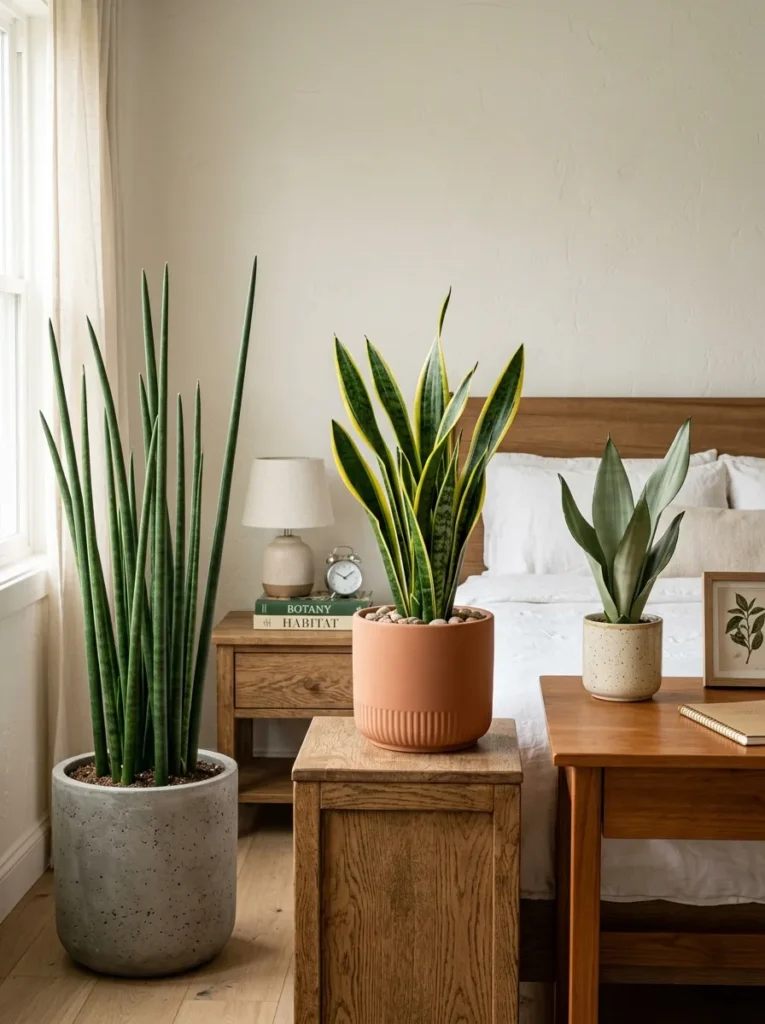
Vibe: The snake plant collection feels like structure that grew rather than was installed — the upright forms and varied heights creating a botanical statement that is simultaneously architectural and organic.
Why it works: A collection of snake plant varieties applies the species variation within genus principle — rather than buying multiple identical plants, selecting three different Sansevieria varieties (which vary in leaf width, height, pattern, and form while all sharing the genus’s characteristic architectural upright growth) creates a collection with visual diversity while maintaining the coherence of a single species family. Snake plants are among the most genuinely low-light tolerant and drought-tolerant houseplants available — they can survive in medium-low light and with watering intervals of 2–4 weeks, making them the most recommended species for rooms with limited light or for households with irregular watering routines.
Light requirement: Low to medium light — one of the few species that genuinely thrives in the medium-low light of north-facing rooms and positions well away from windows. Will also grow in bright indirect light.
Care: Water only when the soil is completely dry (every 2–4 weeks in normal conditions, less frequently in winter). The most common cause of snake plant failure is overwatering — this is the plant that benefits from neglect more than from attention.
Shop The Look
| Product |
|---|
| Sansevieria trifasciata Laurentii |
| Sansevieria cylindrica upright |
| Sansevieria Moonshine compact |
| Concrete pot neutral 15cm |
| Ceramic pot neutral set |
6. Hanging Plant Collection — Macramé Hangers at Varied Heights
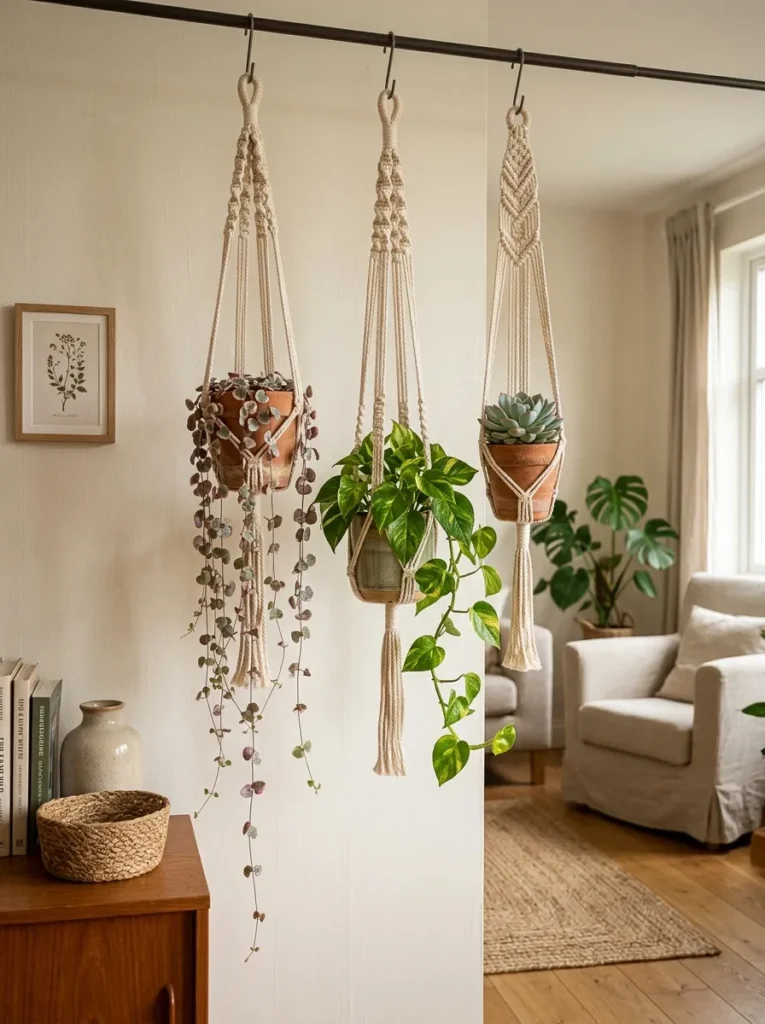
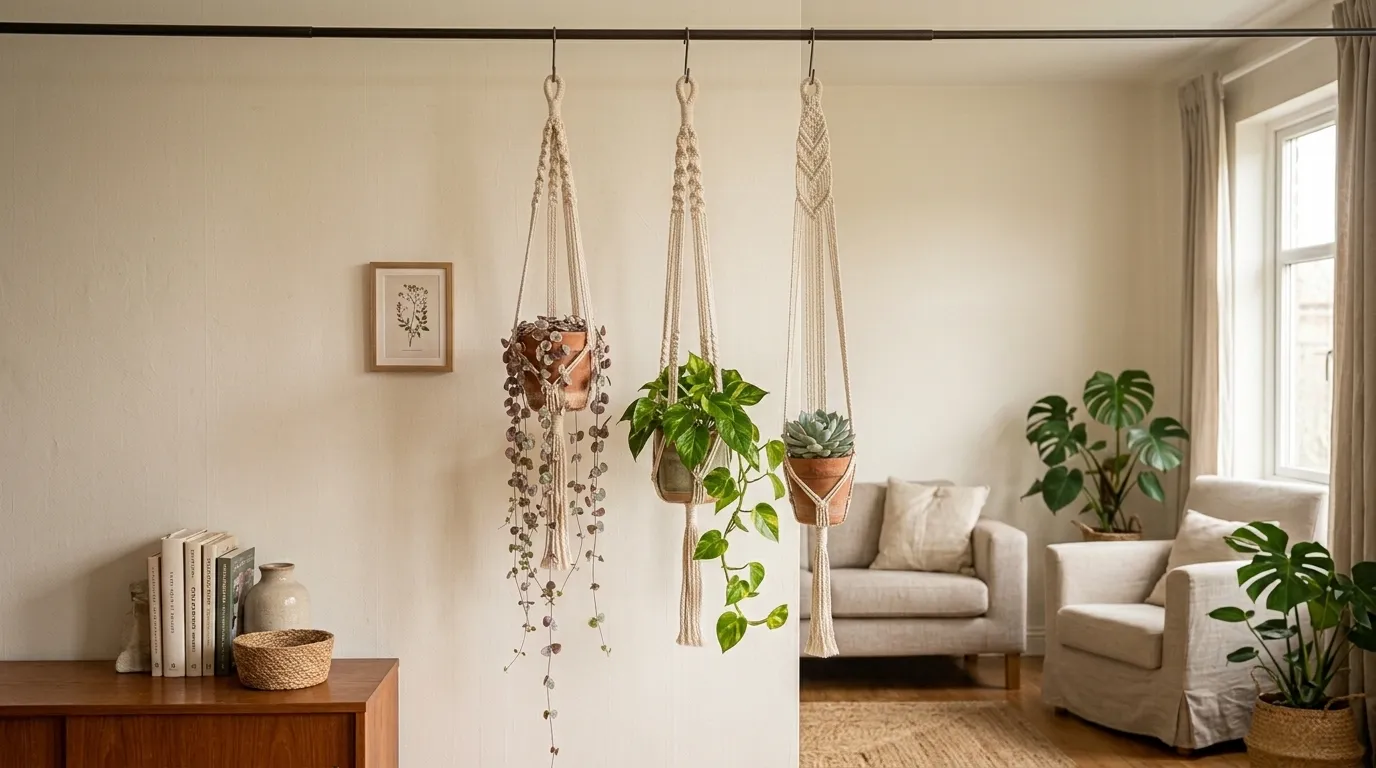
Vibe: The hanging plant collection feels like a botanical mobile at room scale — the three varied heights and plant forms creating a three-dimensional composition in the room’s vertical space that no shelf arrangement can achieve.
Why it works: A hanging plant collection at varied heights applies the aerial botanical composition principle — plants suspended from the ceiling or a ceiling hook occupy the room’s vertical space without requiring any floor or shelf footprint, making them the ideal botanical addition to small rooms or to spaces where floor and shelf space is fully utilized. Three hangers at three different heights (ideally staggered both vertically and horizontally — not all directly beneath each other) create a composition that the eye reads as a three-dimensional botanical installation rather than a line of hanging pots. The macramé hanger format (natural undyed cotton cord) coordinates with the botanical warmth of the plants while adding the textural richness of knotted natural fiber to the composition.
Light requirement per species: String of hearts (Ceropegia woodii) — bright indirect light; pothos — medium to bright indirect; echeveria — bright direct or bright indirect. For a mixed hanging collection, position the collection near a window that provides the minimum light requirement of the most demanding species.
Shop The Look
| Product |
|---|
| String of hearts Ceropegia woodii |
| Golden pothos small hanging |
| Echeveria succulent small |
| Macramé plant hanger natural cotton |
| Ceiling hook joist-fixed |
7. Bedroom Air-Purifying Collection — Three-Plant System
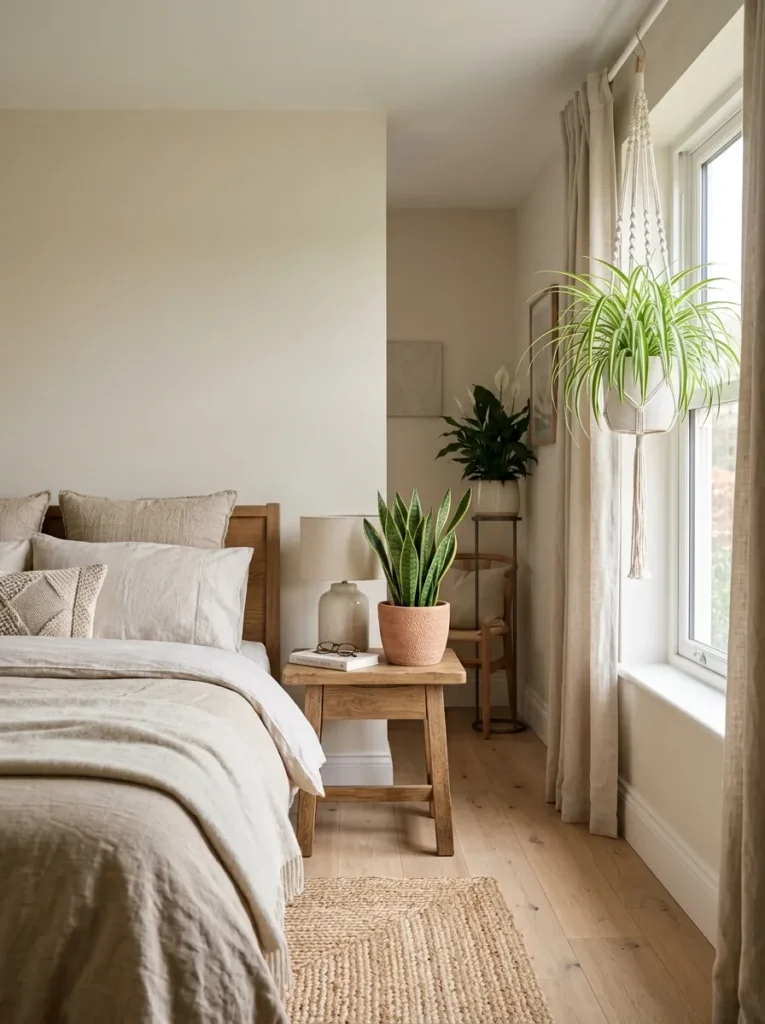
Vibe: The bedroom plant collection feels like the room has been given a specific therapeutic brief and acted on it — the three plant positions creating a botanical environment that the bedroom’s rest function benefits from.
Why it works: A bedroom three-plant collection applies the documented species selection principle — the three species in this combination (snake plant, peace lily, and spider plant) were among those identified in the NASA Clean Air Study and subsequent research as effectively processing volatile organic compounds in controlled environments. More practically for bedroom use, these three species share the low-to-medium light tolerance that most bedrooms require (without the bright window proximity that many attractive houseplants need), the ability to continue beneficial physiological processes through the night, and a non-toxic status to pets and children (peace lily is an exception — it is mildly toxic if ingested and should be positioned out of reach in households with pets or small children).
Light requirement: All three species — low to medium indirect light. This is one of the few plant combinations that genuinely tolerates the north-facing or restricted-light conditions of many bedrooms.
Care: Water all three when the top half of the soil is dry. Peace lily is one of the most communicative plants — it visibly wilts when it needs water and recovers quickly after watering, making it an excellent plant for developing watering intuition.
Shop The Look
| Product |
|---|
| Snake plant Sansevieria bedside |
| Peace lily Spathiphyllum medium |
| Spider plant Chlorophytum comosum |
| Small plant stand 60cm height |
| Ceramic hanging pot window |
8. Succulent and Cactus Display — Desert Aesthetic
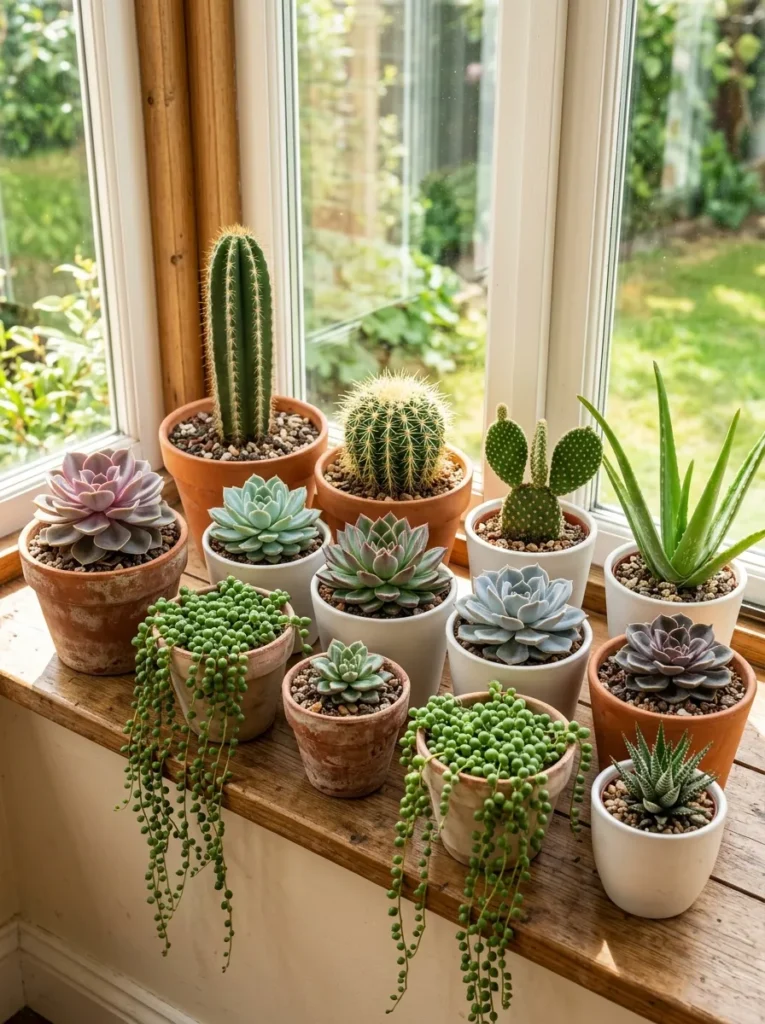
Vibe: The succulent collection feels like a desert landscape in miniature — the extraordinary variety of form and color available within the single plant family creating a botanical display of genuine visual richness.
Why it works: A coordinated succulent and cactus display applies the botanical taxonomy display principle — presenting a collection of related species (all within the succulent/cactus family, all with the shared characteristic of water-storing tissue) creates a display with the coherence of a collection rather than the randomness of an assortment. The variation within the succulent family (from the tight rosette form of echeveria through the columnar architecture of cacti to the bead-like trailing form of string of pearls) provides extraordinary visual variety while the family relationship maintains compositional unity. These are also among the easiest plants to maintain — their drought adaptation means they specifically benefit from infrequent watering and direct sunlight.
Light requirement: Bright direct light (within 30cm of a south or west-facing window with unobstructed sun). This is the most demanding light requirement in the list — do not attempt a cactus or echeveria collection in a north-facing or shaded position.
Care: Water thoroughly, then allow to dry completely before watering again (every 2–3 weeks in growing season, monthly in winter). Use a cactus and succulent specific potting mix (standard potting compost retains too much moisture for these species).
Shop The Look
| Product |
|---|
| Echeveria mixed variety set |
| Columnar cactus specimen |
| String of pearls Senecio rowleyanus |
| Cactus and succulent potting mix |
| Terracotta pot set 5–15cm |
9. Monstera Deliciosa — The Room-Scale Specimen
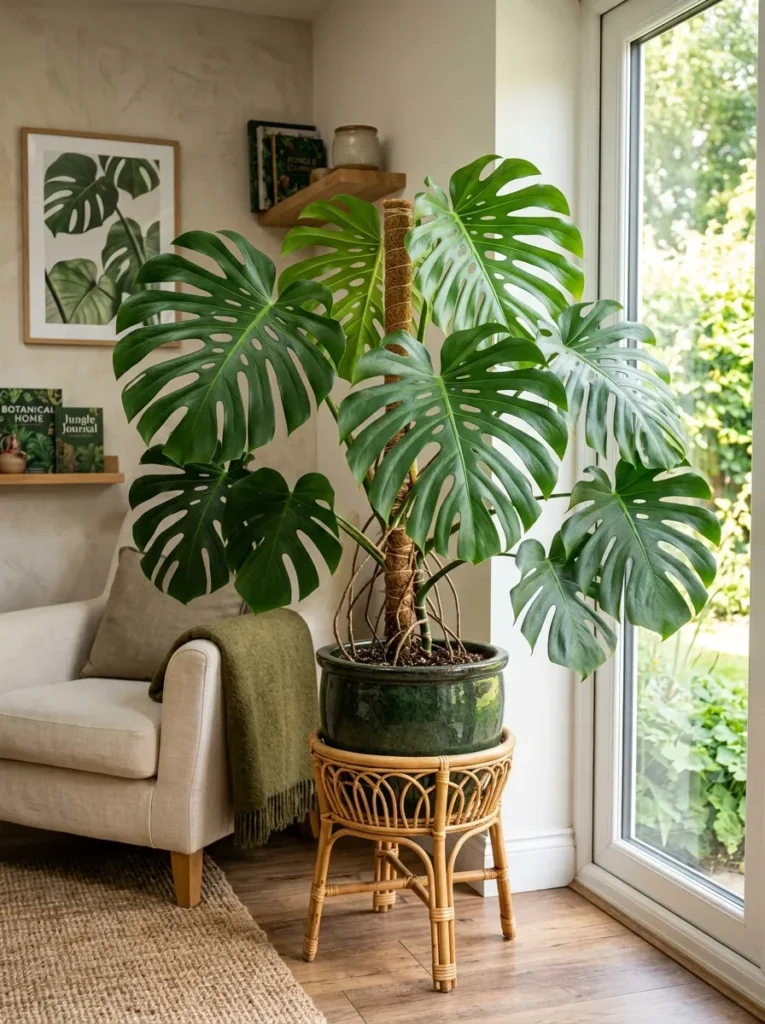
Vibe: The mature monstera feels like a room that decided to host a jungle rather than decorate itself — the dramatic scale of the split leaves creating a botanical installation that reads as genuinely ambitious and genuinely beautiful.
Why it works: A mature monstera deliciosa as a room-scale specimen applies the botanical drama principle — the monstera’s specific combination of large leaf scale (individual mature leaves reaching 60–90cm across), dramatic fenestration (the splits and holes that are the plant’s most recognizable visual signature), and lush deep green color creates a plant presence of a different category than other houseplants. A mature monstera in a large ceramic pot is one of the few houseplants that occupies the same visual scale as significant furniture pieces, creating a botanical anchor in the room that reads at the room’s full spatial scale. The moss pole at the center of the pot replicates the plant’s natural climbing behavior (monstera in the wild climb tree trunks using aerial roots) and encourages the largest leaf development.
Light requirement: Bright indirect light — within 90cm of a large window but not in direct midday sun (which causes leaf scorch on the large leaf surfaces).
Care: Water when the top 3–5cm of soil is dry (approximately every 7–14 days in active growth). Wipe the large leaves with a damp cloth monthly to remove dust accumulation that reduces photosynthesis. Aerial roots that emerge from the stem can be directed toward the moss pole and will attach naturally.
Shop The Look
| Product |
|---|
| Monstera deliciosa large specimen |
| Dark glazed ceramic pot 35cm |
| Moss pole 90cm support |
| Rattan plant stand display |
| Monstera well-drain potting mix |
10. Desk Plant Collection — Compact Specimens for Small Surfaces
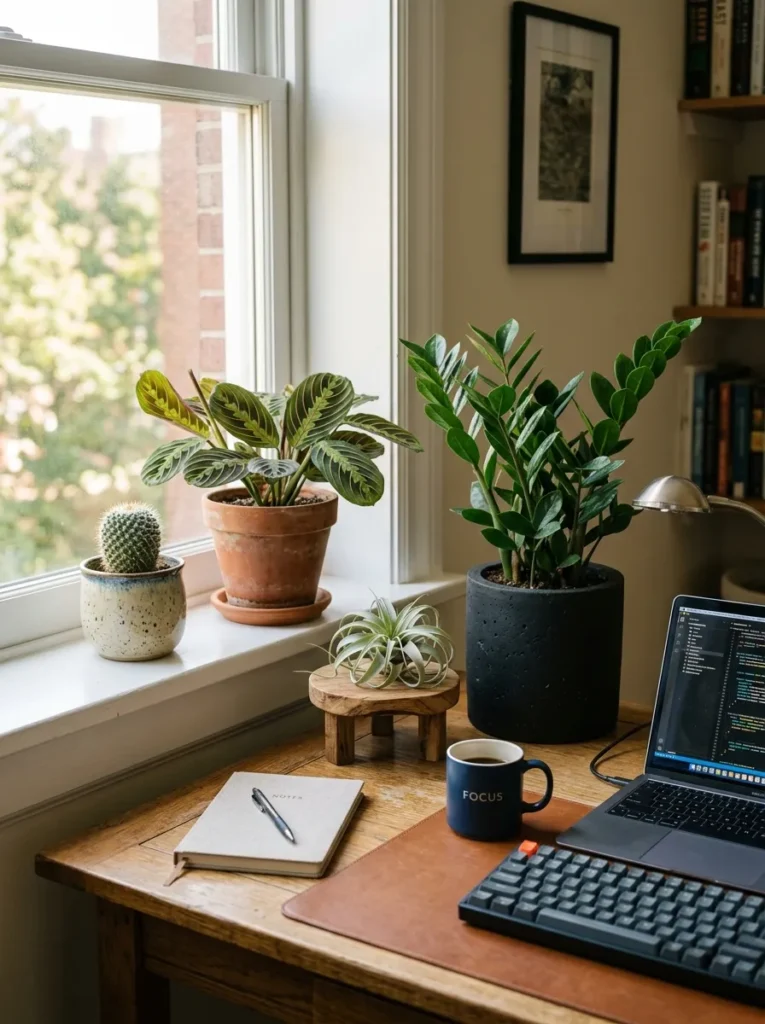
Vibe: The desk plant collection feels like the workspace has been given a visual reason to pause — the four small botanical specimens providing the specific “fascination without effort” that attention restoration theory documents as cognitively restorative.
Why it works: A compact desk plant collection applies the workspace botanical minimum principle — the research on plants in workplace environments documents cognitive and stress benefits from plant presence even at small scale: a single plant on or near a desk is sufficient to produce measurable reductions in physiological stress markers. The practical constraint of a functional desk (it must remain usable as a work surface) limits plant placement to corners, adjacent windowsills, and small standalone specimens. The four-plant combination (ZZ plant for low-light tolerance, prayer plant for visual interest with its moving leaves, small cactus for structural form, and Tillandsia air plant for the novelty of a pot-free specimen) provides visual variety within a compact footprint.
Tillandsia (air plant) care: Air plants require no soil — they absorb water and nutrients through their leaves. Submerge in room-temperature water for 20–30 minutes once weekly, allow to drain completely before returning to their display position. They require bright indirect light but no soil or pot.
Shop The Look
| Product |
|---|
| ZZ plant Zamioculcas zamiifolia small |
| Prayer plant Maranta leuconeura |
| Small cactus desk specimen |
| Tillandsia air plant variety |
| Small wood display stand air plant |
11. Vertical Plant Wall — Living Green Wall Panel
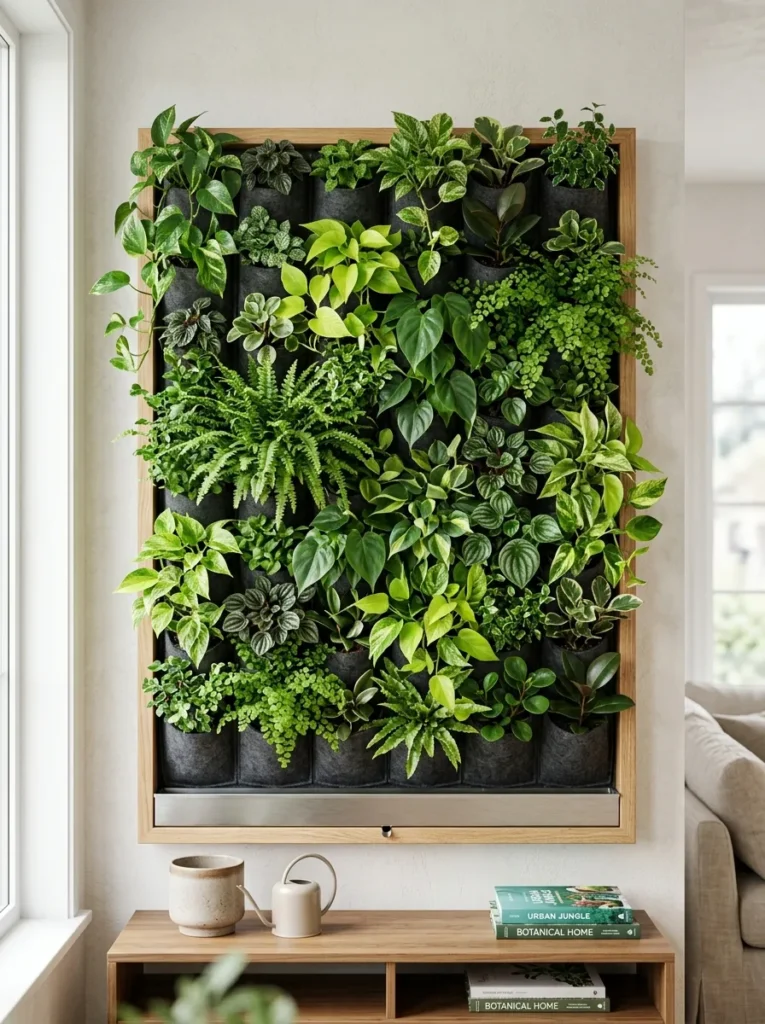
Vibe: The living plant wall feels like the wall learned to grow — the densely planted vertical panel creating a botanical artwork whose content changes with every week of growth.
Why it works: A vertical living plant wall panel applies the maximum botanical impact from minimum floor footprint principle — a 60×80cm wall panel holding 20–30 individual plants provides the visual impact of a large-scale botanical collection within a 0.48 square metre wall space, occupying no floor area. The vertical format also creates the specific impression of a natural environment reference (a forest wall, a cliff face planting, a green facade) that a collection of individual pots on a shelf does not produce. Commercial indoor living wall systems (VERDE, Florafelt, and similar) provide irrigation integration that reduces the maintenance burden of watering individual pockets.
Light requirement: Position the panel within 90–120cm of a bright indirect light source or supplement with a full-spectrum LED grow light if natural light is insufficient. The most successful species for living wall panels are compact, relatively slow-growing, and tolerant of the restricted root space of individual pockets: pothos, trailing philodendron, peperomia, small ferns, and Heuchera.
Irrigation: The most common cause of living wall panel failure is inconsistent watering — the individual pockets dry out faster than pots. Use a panel system with an integral base tray and a simple drip irrigation timer to ensure consistent moisture at each pocket level.
Shop The Look
| Product |
|---|
| Indoor living wall panel system |
| Pothos small pocket size |
| Trailing philodendron pocket |
| Peperomia compact variety |
| Grow light LED supplement |
12. Statement Cactus — Sculptural Desert Specimen
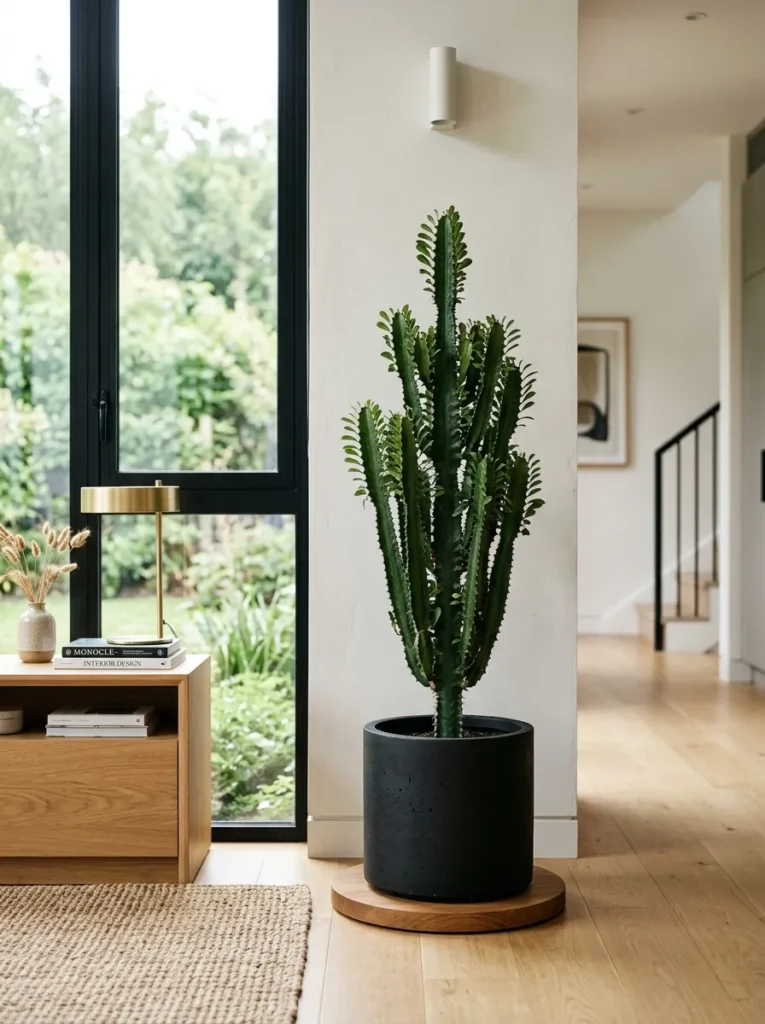
Vibe: The statement cactus feels like the most permanent possible conversation between the natural world and contemporary design — the angular, architectural form reading as sculpture while being unambiguously alive.
Why it works: A large statement cactus or Euphorbia applies the living sculpture principle — certain plant species, particularly columnar cacti and Euphorbia trigona, have growth forms of such architectural regularity and geometric precision that they read as sculptures as readily as plants. The matte dark pot (black ceramic, dark concrete, or charcoal glaze) is the specific material decision that most effectively frames the cactus as a sculptural specimen rather than a decorative plant — the dark pot provides maximum contrast to the cactus’s green angular form and eliminates the domestic warmth of terracotta in favor of the contemporary material palette.
Light requirement: Bright direct to bright indirect light — both Euphorbia trigona and columnar cacti require significant light for their architectural form to develop fully. Position within 60–90cm of a south or west-facing window.
Safety: Euphorbia trigona produces a white latex sap that is severely irritating to skin and eyes and toxic if ingested — wear gloves when handling and position out of reach of children and pets. True cacti do not produce toxic sap but their spines require careful handling.
Shop The Look
| Product |
|---|
| Euphorbia trigona or Cereus large |
| Matte black ceramic pot 30cm |
| Dark concrete pot large |
| Wooden disc platform round |
| Cactus and succulent specialist mix |
13. Windowsill Propagation Station — Living Display and Growing Practice
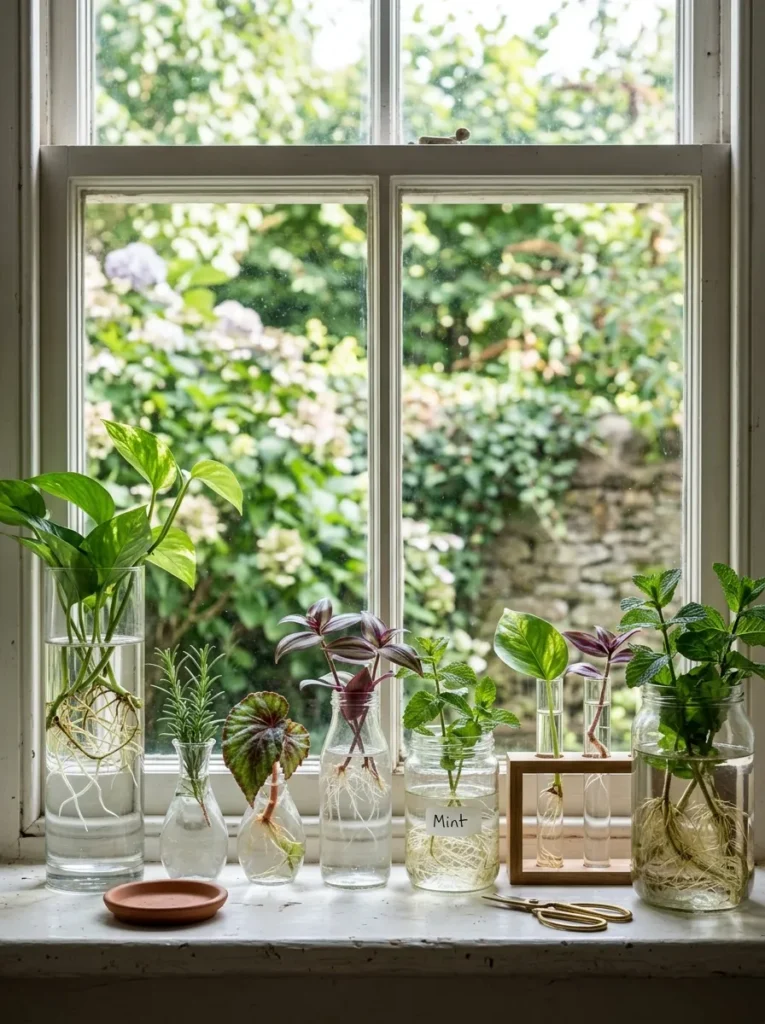
Vibe: The propagation station feels like a botanical laboratory that decided to be decorative — the varied glass vessels and rooting cuttings creating a living still life that changes weekly as roots develop and cuttings grow.
Why it works: A windowsill propagation station applies the living process display principle — propagation (growing new plants from cuttings) is a botanical process that takes 2–6 weeks, and the process itself (cutting resting in water, root emergence, root development, eventual potting) provides a week-by-week changing botanical still life that is more dynamic and more interesting than any static plant display. The varied glass vessel collection — using repurposed jars, bud vases, test tubes, and simple glass containers — creates a composed still life of form and transparency that provides visual interest independent of the plant material it holds. The backlit windowsill position illuminates the water in each vessel and makes the developing root systems visible.
Species for water propagation: Pothos (most reliable — roots in 7–14 days), tradescantia (roots in 7–10 days), begonia (roots in 14–21 days), wandering jew (roots in 7–10 days), rosemary (roots in 21–28 days), mint (roots in 7–14 days). Change the water weekly to prevent bacterial growth and refresh the oxygen available to developing roots.
Shop The Look
| Product |
|---|
| Clear glass bud vase set varied |
| Test tube display stand clear |
| Propagation cutting set varied |
| Repurposed glass vessel collection |
| Rooting hormone optional |
14. Bedroom Plant — The Single Perfect Specimen
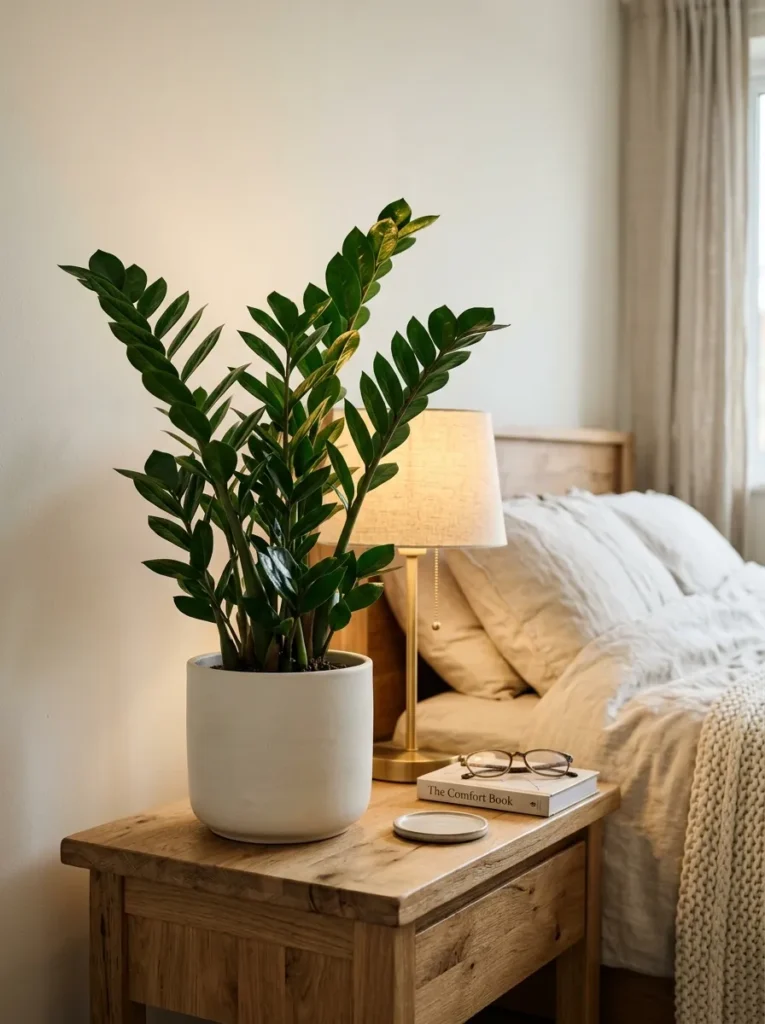
Vibe: The single bedroom plant feels like the most confident possible botanical statement — the restraint of one plant in the right position communicating more certainty than a dozen plants arranged without the same deliberate attention.
Why it works: A single perfect plant in the bedroom applies the botanical restraint principle — the instinct in botanical home decor is often to add more: more plants, more species, more variety. But the bedroom specifically benefits from restraint in its decor, including its botanical decor, because visual complexity in a sleep environment delays sleep onset. A single specimen plant, chosen for its specific qualities (the ZZ plant’s deep glossy leaves that catch the lamp light, its genuinely low maintenance requirement that makes it reliably present rather than gradually declining, its air-purifying classification, and its dark green color that reads as restful rather than stimulating), in the right position (bedside table at lamp height, where the light catches the leaf surface), makes a botanical statement of genuine sophistication.
Light requirement: The ZZ plant is the most genuinely low-light tolerant houseplant available — it survives in the low to medium light of most bedrooms, including those with north-facing or restricted windows.
Care: Water every 3–4 weeks — the ZZ plant’s rhizomatous root system stores water, making it among the most drought-tolerant indoor plants available.
Shop The Look
| Product |
|---|
| ZZ plant Zamioculcas zamiifolia |
| Simple white ceramic pot 18cm |
| Natural wood bedside table |
| Warm ceramic bedside lamp |
| Indoor low-light potting mix |
15. Seasonal Botanical Display — Bulbs, Branches, and Forced Bloom
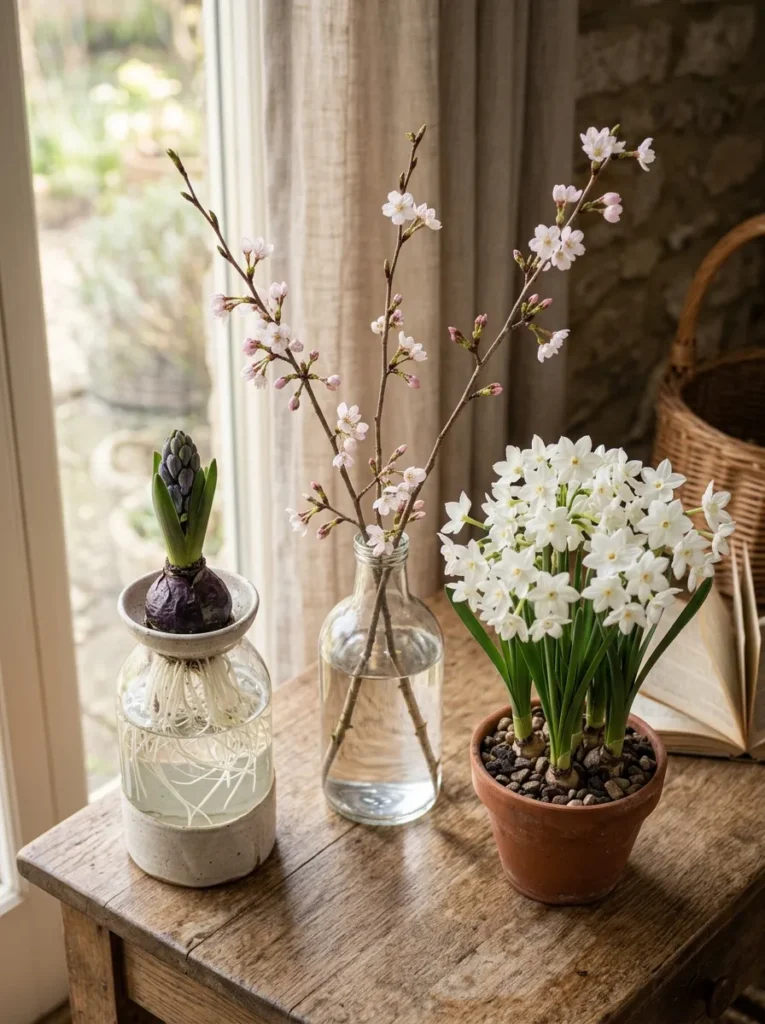
Vibe: The seasonal forced botanical display feels like evidence that the natural world is paying attention to the time of year — the forced blooms bringing spring into the home during the specific months when the outdoor world has not yet caught up.
Why it works: A seasonal forced bulb and branch display applies the temporal botanical practice principle — rather than permanent houseplants that remain unchanged through the year, a seasonal botanical display uses the natural forcing technique (chilling bulbs to trigger bloom outside their natural season, cutting branches and warming them to accelerate blossom) to create a continuously changing botanical calendar that marks the seasons with specific botanical events. Hyacinths forced in ceramic vessels provide both visual beauty and the specific hyacinth fragrance that many people associate with the first warming days of spring; paperwhite narcissus provide the earliest indoor bloom, beginning in November from bulbs planted in October; cherry or almond blossom branches cut in late January and forced in warm water produce spring blossom indoors in February, weeks before outdoor trees bloom.
Hyacinth forcing: Place the hyacinth bulb in a forcing vessel above water (the bulb should not touch the water — the roots will grow down toward it). Keep in a cool dark place (4–10°C) for 6–8 weeks, then bring to a warm bright room where the flower spike will emerge within 2–3 weeks.
Shop The Look
| Product |
|---|
| Ceramic hyacinth forcing vase |
| Hyacinth bulb set forcing |
| Paperwhite narcissus bulb set |
| Forcing vessel glass set |
| Forced branch cutting forsythia |
How to Start Your Indoor Plant Practice
The single best first move for anyone beginning or expanding an indoor plant practice is assessing the specific light conditions of each room before purchasing any plant — not estimating light conditions from memory but actually measuring them. The simplest measurement method requires no equipment: place a sheet of white paper in the intended plant position at noon on a clear day and hold a hand approximately 30cm above the paper. A sharp, clearly defined hand shadow indicates bright direct light; a soft but visible shadow indicates bright indirect light; a barely perceptible shadow indicates medium light; and no shadow indicates low light. This three-minute assessment at each intended plant position produces the specific light category information that determines which species will thrive there, before any purchase is made. Buying the plant first and finding the position second is the most common cause of indoor plant failure.
The most common mistake in indoor plant care is overwatering — the instinct to water frequently, to water on a schedule, and to water at the first sign of soil dryness is the cause of more houseplant deaths than any other factor. The correct watering approach for most houseplants is not a schedule but an assessment: before watering, push a finger 2–3cm into the soil. If soil is still moist, do not water. If the soil at 2–3cm depth is dry, water thoroughly (until water runs from the drainage hole) and do not water again until the next assessment. Most houseplants tolerate — and many prefer — a period of soil dryness between waterings. The plants in this list that are most tolerant of underwatering (and therefore most forgiving of the over-watering tendency that many beginners exhibit) are: ZZ plant, snake plant, pothos, cactus and succulents, and Tillandsia air plants. Begin with these species before progressing to the more water-sensitive species that require more precise moisture management.
Three specific plants under $20 that immediately improve any home’s botanical atmosphere: a golden pothos in a 14cm pot ($8–12 from a garden centre, providing the trailing cascade effect of Idea 2 immediately and growing rapidly to provide a significant botanical presence within six months); a snake plant in a 12cm pot ($6–10, the most genuinely low-maintenance specimen in this list and appropriate for any light condition from low to bright indirect); and a small Tillandsia air plant ($3–6, requiring no pot and no soil and providing an immediate and distinctive botanical accent on any surface or in a macramé hanger). These three plants combined for under $30 address three different display styles (trailing, structural, and aerial) and three different light conditions, providing immediate botanical improvements across the main rooms of any home.
Frequently Asked Questions About Indoor Plants for Every Home
Which indoor plants are genuinely safe for households with cats and dogs?
The most commonly kept houseplants that are confirmed non-toxic to both cats and dogs (according to the ASPCA toxic plant database) include: spider plant (Chlorophytum comosum), Boston fern (Nephrolepis exaltata), money plant (Pilea peperomioides), ponytail palm (Beaucarnea recurvata), calathea and maranta (prayer plant family), Tillandsia air plants, orchids (Phalaenopsis), haworthia, and most palms. Plants that are commonly kept but are toxic to pets and should be positioned out of reach or avoided entirely include: pothos and Epipremnum (toxic if ingested), snake plant (mildly toxic), peace lily (mildly toxic), monstera (toxic if ingested), and aloe vera (toxic if ingested). Always verify any plant species against the ASPCA toxic plant database before introducing it to a household with pets.
How do you know if an indoor plant needs more light?
The most reliable indicators that a plant is receiving insufficient light are: stem elongation toward the light source (etiolation — the plant grows rapidly but stems are thin and widely spaced between leaves as the plant reaches toward more light), color loss in variegated species (the yellow or white variegation in pothos, tradescantia, and similar species disappears in low light as the plant prioritizes chlorophyll production), very slow or absent growth during the growing season (spring and summer), and gradual leaf loss with no other identified cause. If a plant is showing two or more of these signs, it needs a brighter position — move it gradually over two weeks (an immediate move to full direct sun can cause scorch on leaves adapted to low light). Supplement with a full-spectrum LED grow light if a brighter position is not available.
How often should indoor plants be repotted?
Most indoor plants benefit from repotting every 1–2 years, when roots begin to emerge from the drainage holes, when water flows immediately through the pot without being absorbed (indicating the soil has compacted or the root ball has displaced all soil), or when the plant’s growth has visibly slowed despite adequate light and watering. Repot into a pot one size larger than the current one (approximately 3–5cm larger in diameter) — choosing a significantly larger pot than the root ball requires leads to overwatering problems because the excess soil stays wet after watering. The best time to repot is spring or early summer, at the beginning of the active growing season when the plant has maximum resilience for the repotting disruption.
What are the easiest indoor plants for a complete beginner?
The five easiest indoor plants for complete beginners, ranked by tolerance of neglect and environmental variation: ZZ plant (Zamioculcas zamiifolia — genuinely tolerates low light and months without water), snake plant (Sansevieria — tolerates low light and irregular watering), pothos (Epipremnum aureum — tolerates a wide light range and irregular watering, communicates stress clearly and recovers quickly), spider plant (Chlorophytum comosum — produces new plants on runners continuously, tolerates medium-low light), and aloe vera (tolerates direct sun and drought, useful medicinally for minor burns). All five of these species are available from most garden centres and large supermarkets, cost between $5 and $20 for a standard pot, and will survive and grow without specialist knowledge in the vast majority of domestic environments.
How do you prevent pests on indoor plants?
Indoor plant pests — primarily fungus gnats, spider mites, mealybugs, and scale insects — are most effectively prevented by the three conditions that make infestation unlikely: appropriate watering (overwatered soil is the primary breeding environment for fungus gnats — allow soil to dry between waterings), adequate air circulation (stagnant air encourages spider mite establishment — ensure rooms with plants have regular ventilation), and regular inspection (detecting early infestation before it spreads — check the undersides of leaves when watering, which is where spider mites and mealybugs first appear). For established infestations: spider mites respond to regular overhead watering and neem oil spray; mealybugs respond to isopropyl alcohol on a cotton swab applied directly to each individual; fungus gnats respond to allowing soil to dry completely between waterings and the application of beneficial nematodes to the soil; scale insects respond to neem oil applied to all stem surfaces weekly.
Ready to Fill Your Home with Plants?
These 15 ideas move through every dimension of what indoor plants can bring to a domestic interior — from the room-scale statement of a mature fiddle-leaf fig and the dramatic fenestrated presence of a monstera, through the cascading botanical curtain of a trailing pothos and the desert landscape in miniature of a succulent collection, to the living process display of a propagation station and the seasonal calendar of forced bulbs and blossom branches. Starting with the light assessment — the three-minute hand-shadow test at noon on a clear day at each intended plant position — is the beginning that makes every subsequent plant purchase purposeful rather than hopeful. It takes three minutes per position and produces the specific knowledge that no plant guide can provide in its absence. Assess the light today, purchase the pothos and the snake plant and the Tillandsia this weekend, and place them in the positions that their light needs match. When the pothos begins to trail from its high shelf, and the snake plant’s structural form begins to compose the corner of the bedroom, and the Tillandsia sits in its macramé hanger catching the window light — the home will have begun to be genuinely different in a way that no purchased decoration produces with the same quality of living warmth.