15 Bathroom Mirror Ideas for a Brighter, Small Space
A bathroom mirror in a small space is not merely a functional surface for reflection — it is the single most powerful optical and lighting tool available to make a compact bathroom feel larger, brighter, and more architecturally considered. This article gives you 15 bathroom mirror ideas across shape, framing, placement, lighting integration, storage, and small-space illusion so every square inch of your bathroom works harder and looks more intentional.
There is a reason interior designers reach for mirrors before almost any other intervention in a small bathroom. A well-chosen mirror doubles perceived light, extends apparent depth, adds architectural character, and solves the practical problem of grooming — all within the same square footage the wall already occupies. Done well, a bathroom mirror is the piece that makes a small bathroom feel designed rather than merely functional. Here are 15 ideas worth saving — and stealing.
Why Bathroom Mirrors Transform Small Spaces So Effectively
The transformative power of bathroom mirrors in small spaces draws from the optical physics of specular reflection — a mirror reflects the full luminous intensity of any light source aimed at it, effectively doubling the perceived brightness of the space by creating a secondary light field on the reflective surface. In a small bathroom where natural light may enter from a single window or none at all, this doubling effect is the most significant brightness intervention available without electrical work. Designers have exploited this principle since the Hall of Mirrors at Versailles demonstrated at architectural scale what a domestic bathroom demonstrates at intimate scale: that reflected light creates the perception of space where solid wall creates only limitation.
The material palette surrounding a bathroom mirror sets the tone for the entire room. Unlacquered brass and warm bronze frames age beautifully in humid bathroom environments and develop a patina that reads as intentional and luxurious. Matte black iron and steel frames provide graphic weight that grounds a small bathroom’s visual field rather than letting it dissolve into neutrals. Natural teak and eucalyptus wood frames are the correct timber choices for humidity-exposed bathroom environments — both contain natural oils that resist moisture without constant maintenance. Frameless mirrors in beveled or flat-edge formats communicate a clean architectural confidence that works in modern and transitional bathrooms equally.
The functional moment for bathroom mirror design has never been more considered. The growth of the “spa bathroom” aesthetic — the desire to make even a compact powder room or ensuite feel like a deliberate wellness environment — has elevated the mirror from a utility fixture to a design centerpiece. Mirror lighting integration (backlit panels, Hollywood-style bulb surrounds, and integrated LED strips) has become a standard expectation in bathroom renovation rather than a premium upgrade, and the variety of mirror shapes now available (arched, scalloped, sunburst, irregular organic, multi-panel) has made the mirror the primary style statement in bathroom design.
Small bathrooms — under 50 square feet — respond most dramatically to strategic mirror placement because the reflective surface represents a larger percentage of the total wall area and therefore has a proportionally greater optical effect. The specific small-space rules that apply: a mirror should never be smaller than the vanity it serves (visual imbalance reads as insufficient budget rather than restraint), the mirror’s top edge should reach at least 7 feet from the floor where ceiling height allows (vertical extension makes ceilings appear higher), and placement opposite the primary light source maximizes the reflection’s brightness contribution.
Style at a Glance
| Element | Detail |
|---|---|
| Philosophy | Reflection as spatial expansion — every mirror decision should serve light, depth, and design simultaneously |
| Key Materials | Unlacquered brass, matte black steel, natural teak, beveled glass, antique mirror glass |
| Key Colors | Warm brass gold, matte black, natural wood warm tone, silver chrome, aged bronze |
1. Floor-to-Ceiling Arched Mirror Leaning Against the Vanity Wall
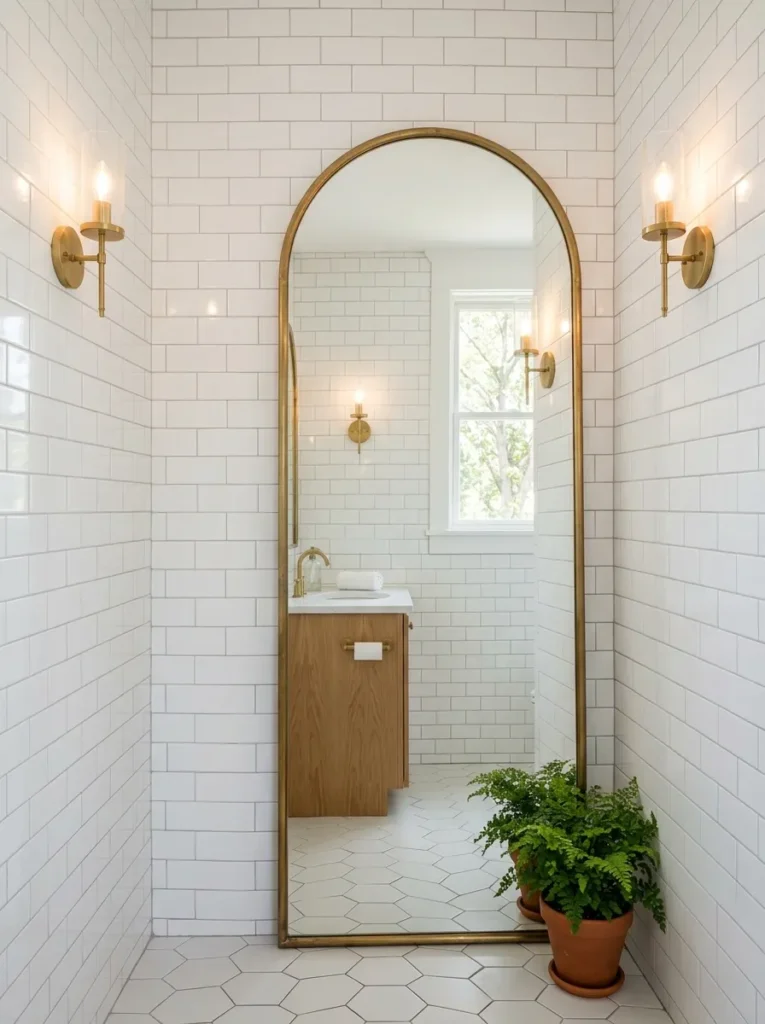
Vibe: The bathroom is expansive — a floor-to-ceiling arched mirror leaning against the vanity wall creates the optical impression of a doorway into another room, collapsing the sense of boundary at the most visually dominant surface.
Why it works: A leaning mirror taller than standard wall-hung mirrors (72 inches or more) exploits the full vertical dimension of the bathroom wall, which extends the reflected light field from floor to ceiling rather than confining it to the upper half of the room where standard vanity mirrors sit. The arch top form adds architectural vocabulary that references doorways and windows — forms the eye reads as openings rather than boundaries — which amplifies the spatial expansion effect beyond what a rectangular mirror of the same size achieves. The leaning angle (approximately 5–10 degrees from vertical) reflects the floor in addition to the wall opposite, further extending the perceived depth of the space.
How to get it: Source a full-length arched mirror (available from CB2, Anthropologie Home, and IKEA’s NISSEDAL in arch format) in a thin brass or matte black frame. Secure the leaning position with two anti-tip wall straps anchored into the wall at the mirror’s upper third — bathroom environments require secure anchoring that dry rooms may not. A DIY option: purchase an inexpensive arched mirror frame kit and insert standard glass cut to size by a local glass supplier, achieving the same effect for 40–60% of retail mirror cost.
Quick Win: An IKEA HOVET or NISSEDAL mirror (both under $150) leaned against a vanity wall and secured with anti-tip straps is the fastest single bathroom transformation available — the perceived room size increase is immediate and significant.
Shop The Look
- Tall arched floor mirror brass frame 72 inch
- Anti-tip furniture strap safety anchor set
- Unlacquered brass wall anchor hardware
- Small white ceramic plant pot bathroom
- Rolled towel holder rail matte brass
Also view: 17 Button Crafts for Adults You’ll Love to Make
2. Backlit LED Mirror for Shadowless Task Lighting
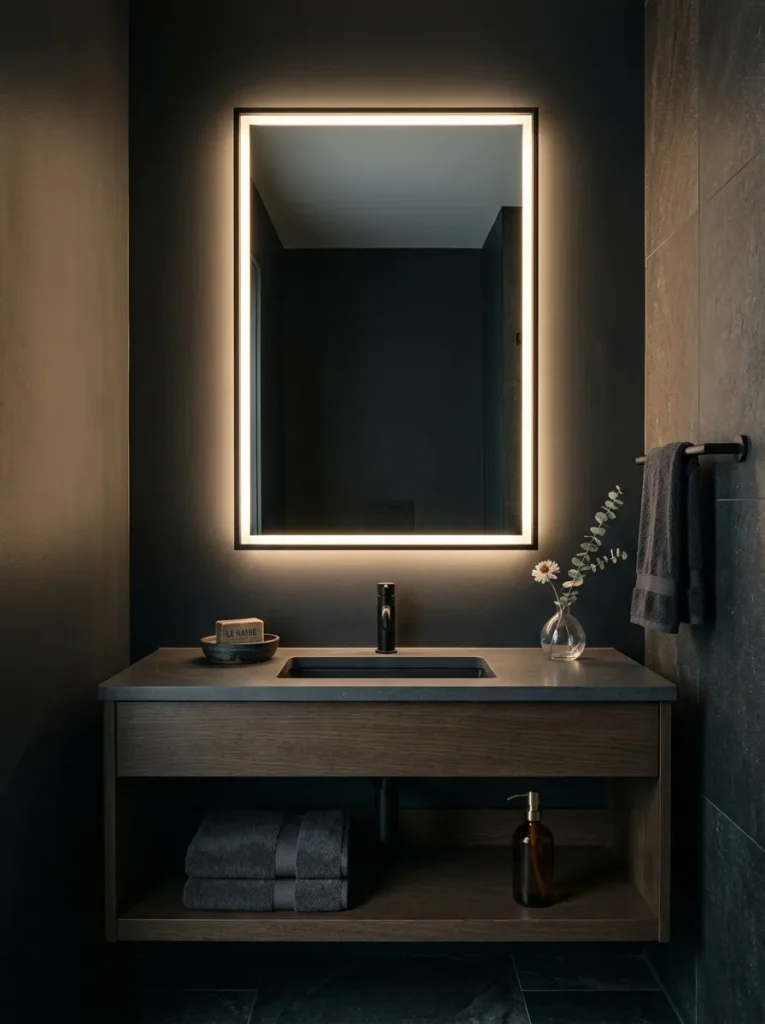
Vibe: The bathroom is spa-like — a backlit LED mirror on a dark wall creates the specific light quality of a high-end hotel bathroom, where the mirror glows as a light source rather than merely reflecting one.
Why it works: Backlit LED mirrors produce what lighting designers call “bias lighting” — a secondary light source behind the primary viewing surface that reduces the contrast ratio between the bright mirror face and the surrounding dark wall. This contrast reduction is what eliminates the harsh shadows under eyes, chin, and nose that overhead-only lighting creates, producing the even, flattering illumination associated with professional makeup lighting. In a small dark bathroom, the backlit perimeter also functions as ambient room lighting — a 24-watt LED strip running the full perimeter of a 36×48 inch mirror produces approximately 2,400 lumens, sufficient to light a 40–50 square foot bathroom as the primary light source.
How to get it: Anti-fog backlit LED bathroom mirrors with integrated dimmers and color temperature adjustment are available from Kohler, Robern, and NEUTYPE at $150–$500 depending on size. Install on a wall with the LED driver box concealed behind the mirror body. Choose a color temperature of 3000K for a warm bathroom atmosphere or 4000K for accurate color rendering in makeup application — the difference is significant and the choice depends primarily on the bathroom’s overall color palette.
Shop The Look
- Backlit LED bathroom mirror rectangular anti-fog
- LED mirror dimmer switch wall mount
- Matte black bathroom faucet single hole
- Deep navy bathroom wall paint sample
- Ceramic soap dish matte white minimal
3. Unlacquered Brass Framed Round Mirror Above Pedestal Sink
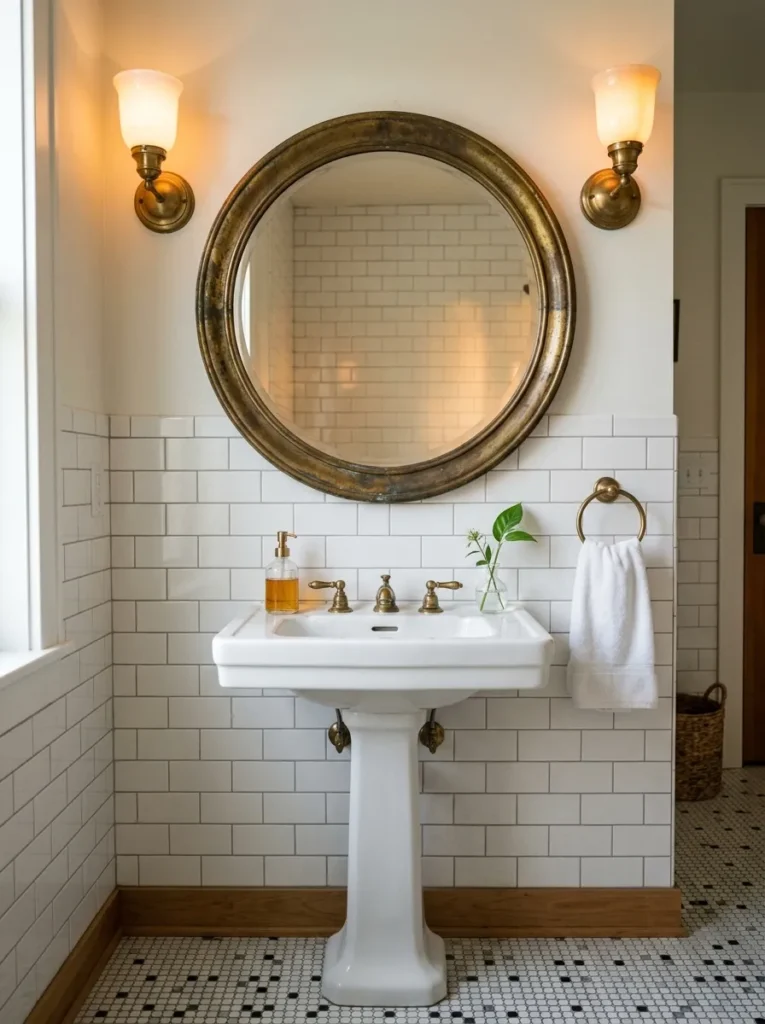
Vibe: The bathroom is classic — an unlacquered brass round mirror above a pedestal sink with flanking sconces is the bathroom composition that reads as architecturally complete regardless of the room’s size.
Why it works: The round mirror above a pedestal sink is one of the most compositionally resolved pairings in bathroom design — the circular mirror form softens the vertical geometry of the pedestal sink’s column base, and the symmetry of flanking sconces creates a triptych composition (sconce-mirror-sconce) that reads as architectural intention. Unlacquered brass develops a natural patina in the humid bathroom environment that lacquered brass resists — this patina is not a flaw but the material’s natural evolution toward a warmer, more complex tone, and it is precisely this quality that distinguishes a thoughtfully chosen bathroom fixture from a generic chrome alternative.
How to get it: Round unlacquered brass mirrors in the 24–30 inch diameter range are widely available from Rejuvenation, McGee & Co., and Pottery Barn at $150–$400. For flanking sconces, choose fixtures with a maximum projection of 5–7 inches from the wall to avoid protruding into the mirror’s reflective field at face level. Mount sconces at 60–65 inches from the floor to the center of the fixture — this positions the light source at face height for accurate grooming illumination.
Shop The Look
- Round mirror unlacquered brass frame 24 inch
- Wall sconce brass pair bathroom flanking
- White pedestal sink classic porcelain
- Glass soap dispenser clear pump
- White hand towel waffle weave set
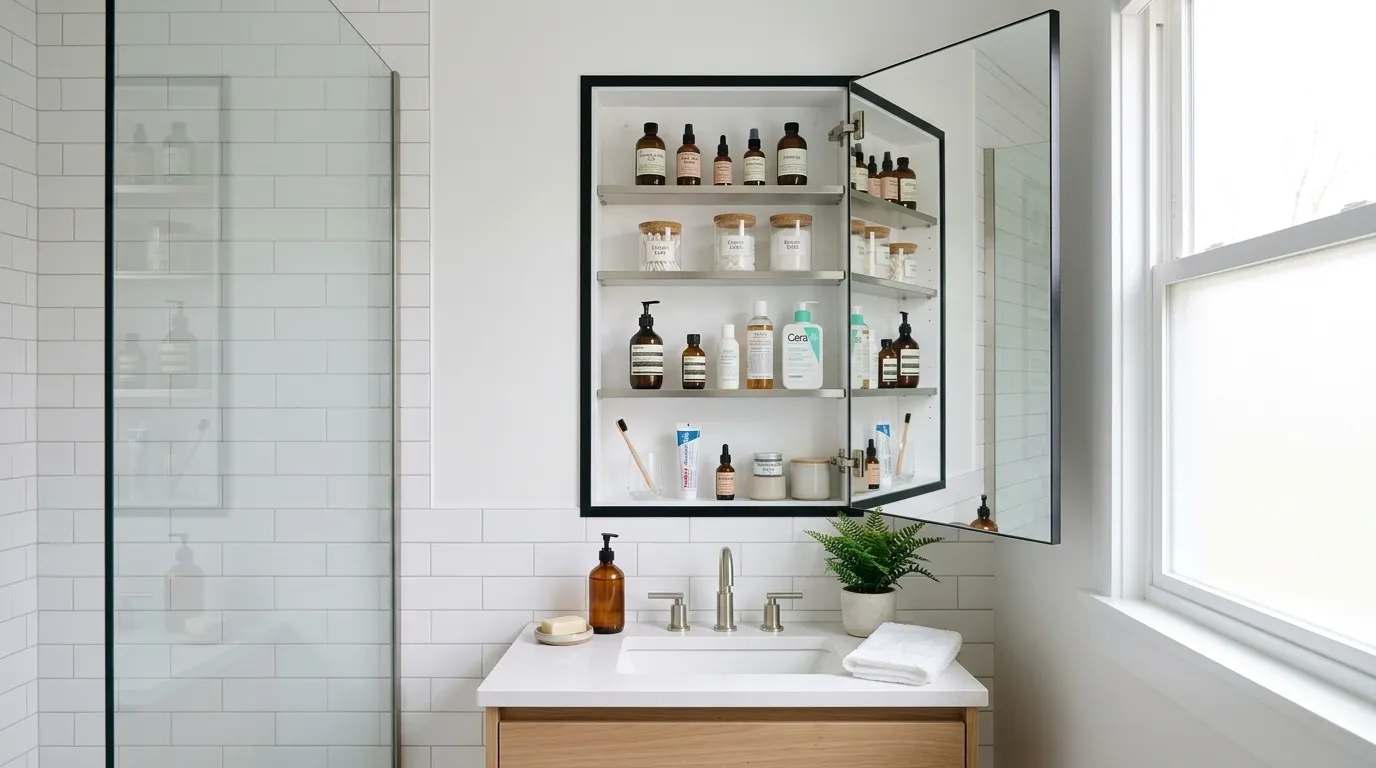
4. Medicine Cabinet Mirror with Recessed Storage
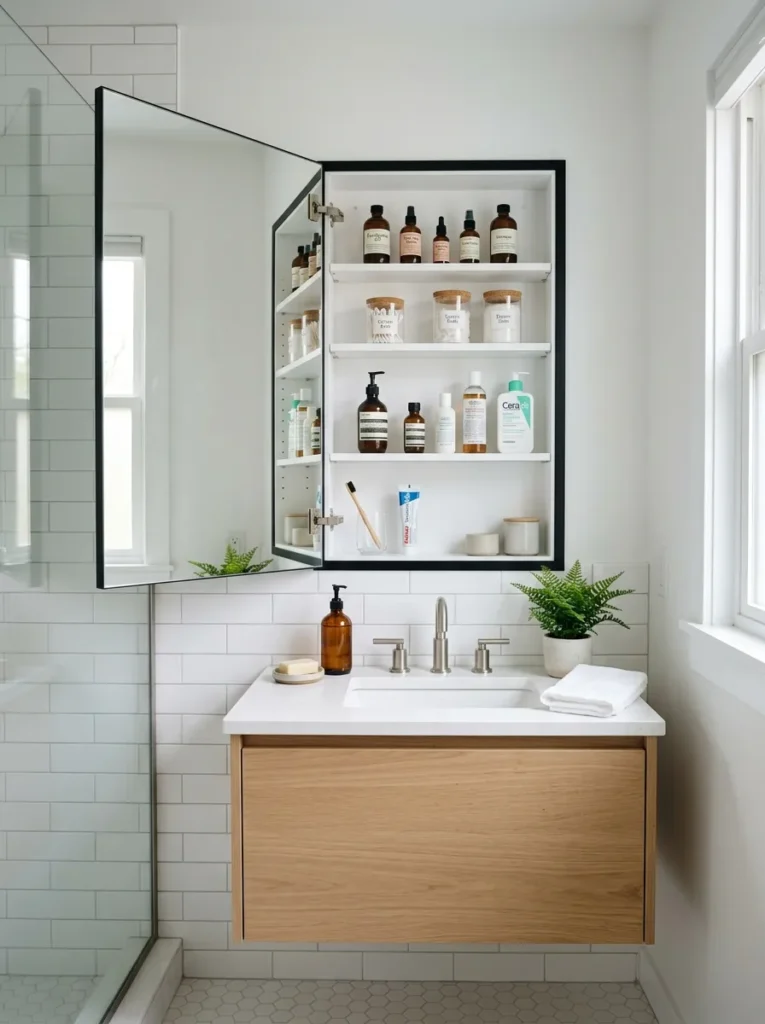
Vibe: The bathroom is organized — a recessed medicine cabinet solves the small bathroom’s most persistent problem: nowhere to put anything, at the wall depth that the room already has available.
Why it works: A recessed medicine cabinet is the most space-efficient storage solution in a small bathroom because it uses the cavity within the wall — typically 3.5 inches deep between studs — rather than projecting into the room. This wall depth is otherwise completely unused, and a standard 14×24 inch recessed cabinet provides approximately 30 linear inches of shelf storage within this zero-footprint cavity. The mirror front means the cabinet serves the grooming function simultaneously with the storage function, eliminating the need for a separate mirror and a separate cabinet as two distinct wall objects. In a bathroom under 40 square feet, this dual-function consolidation is significant.
How to get it: Kohler, Robern, and American Pride make recessed medicine cabinets in frameless, matte black, and brushed nickel frame options from $80–$400. Installation requires cutting an opening between wall studs — a non-load-bearing wall only, confirmed with a stud finder before cutting. The standard 14-inch cabinet width fits exactly between standard 16-inch-on-center stud spacing with minimal trimming. Surface-mount versions are available for walls where recessing is not possible (tile walls, load-bearing walls) at 3.5-inch projection depth.
Quick Win: A surface-mount medicine cabinet with a mirror front ($40–$80 at most hardware stores) mounted in place of an existing plain mirror adds 30+ linear inches of bathroom storage with zero floor footprint and no cutting — the fastest storage upgrade a small bathroom can receive.
Shop The Look
- Recessed medicine cabinet mirror front matte black
- Apothecary glass jar set bathroom storage
- Shelf liner cut to size cabinet interior
- Small glass pump bottle set refillable
- Cabinet hinge soft close replacement
5. Scalloped Edge Mirror for Decorative Statement
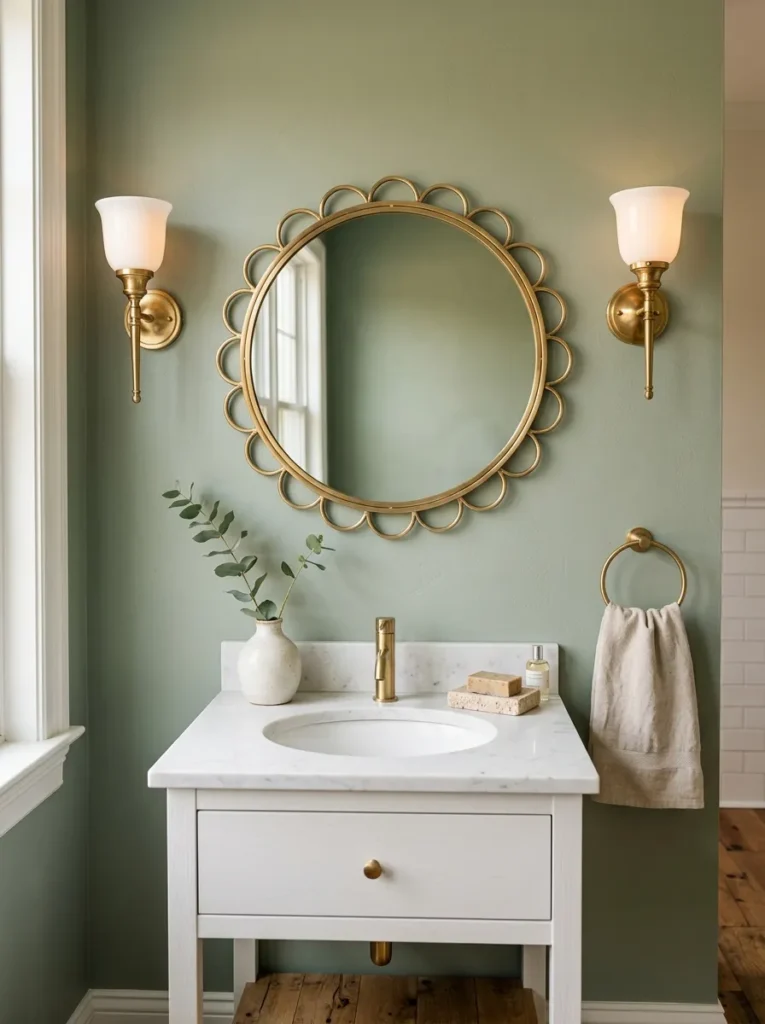
Vibe: The mirror is decorative — a scalloped edge mirror above a simple vanity is the piece that makes a small bathroom feel styled rather than simply equipped, delivering maximum visual interest from a single fixture.
Why it works: The scalloped perimeter creates a frame of repeated organic curves that introduces the design principle of pattern through repetition — each scallop is identical, but their continuous repetition around the mirror circumference creates a visual rhythm that a plain round mirror lacks entirely. This rhythmic pattern gives the mirror the visual presence of a decorative object rather than just a functional surface, which is particularly valuable in a small bathroom where space constraints limit the number of decorative elements possible. The scallop form also references both natural botanical shapes (flower petals, shell forms) and vintage architectural details (scalloped trim, fanlight windows), giving it the quality of something found rather than purchased.
How to get it: Scalloped mirrors in the 24–30 inch diameter range are available from Anthropologie, Urban Outfitters Home, and Target’s Threshold line at $80–$250. For a DIY version, purchase an inexpensive plain round mirror and frame it with a router-cut MDF scalloped ring painted in chalk white or warm brass spray paint — the ring is attached to the mirror back with construction adhesive and the result is indistinguishable from a purchased scalloped frame at a fraction of the cost.
Shop The Look
- Scalloped round mirror brass frame 24 inch
- Sage green bathroom wall paint sample
- Ceramic bud vase single stem bathroom
- Natural stone soap dish bathroom
- Linen hand towel set waffle weave
6. Full-Width Mirror Spanning the Entire Vanity Wall
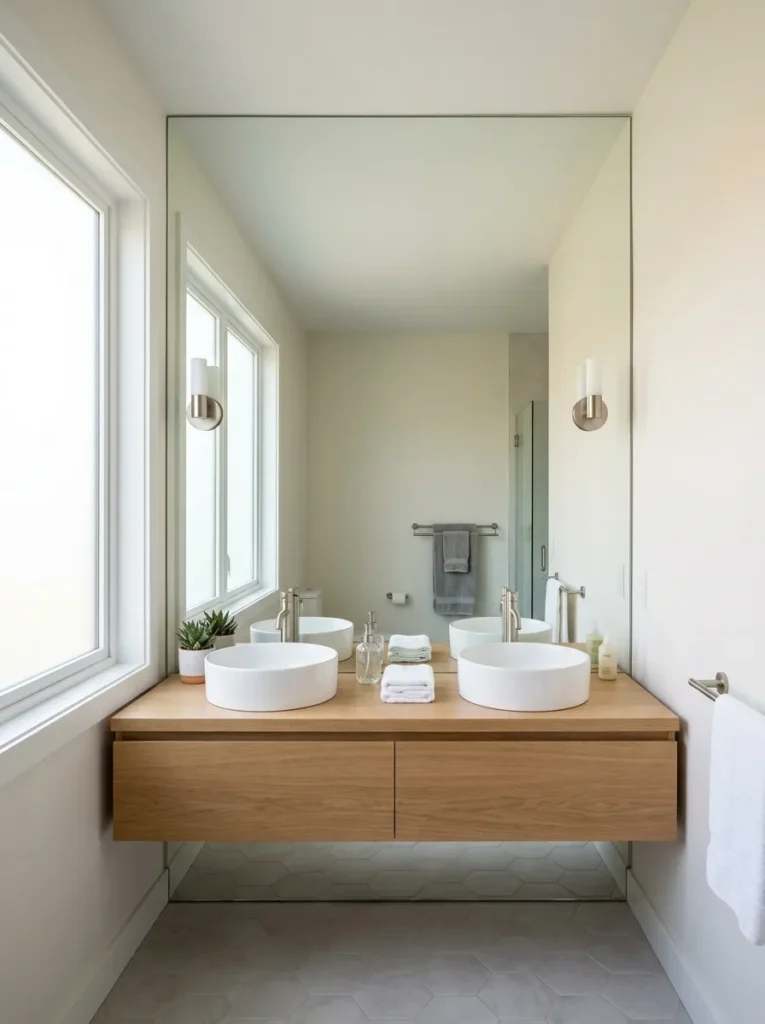
Vibe: The bathroom is doubled — a full-width mirror that spans the entire vanity wall creates the strongest spatial expansion effect available in bathroom design, effectively eliminating the wall as a visual boundary.
Why it works: A mirror that spans the complete width of a wall removes the visual endpoints that define a small room’s narrowness — the brain perceives room width through the identification of the wall’s left and right edges, and a full-width mirror eliminates both edges from the visual field, replacing them with the reflected image of the room’s opposite wall. This creates the perceptual equivalent of a room twice the actual width. Additionally, a full-width mirror reflects all light sources in the bathroom simultaneously (window light, overhead light, sconce light) rather than only those within the angle of reflection of a smaller mirror, producing the maximum possible light amplification within the space.
How to get it: Commission a custom cut mirror from a local glass supplier — most cut mirror glass to any dimension and polish all edges for $8–$15 per square foot, making a 60×36 inch full-wall mirror approximately $120–$180 in glass alone. Mount with mirror clips or construction adhesive applied to a plywood backing panel attached to the wall studs. Frameless installation creates the cleanest full-wall effect; a thin trim of metal channel ($3–$5 per linear foot) on the perimeter edges is optional.
Shop The Look
- Custom cut mirror glass frameless edge polished
- Mirror mounting clip set chrome finish
- Construction adhesive mirror safe formula
- Brushed nickel bathroom faucet pair
- White ceramic vessel sink bathroom
7. Vintage Ornate Frame Mirror Repurposed for Bathroom
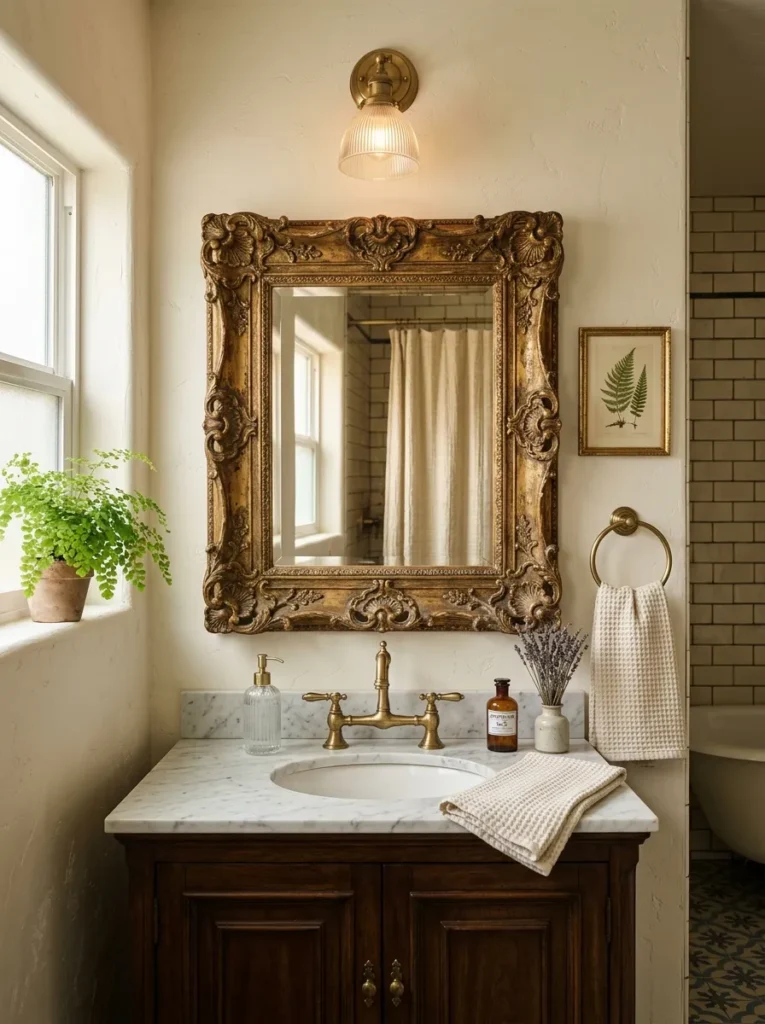
Vibe: The bathroom is character-rich — a vintage ornate frame repurposed as a bathroom mirror introduces a scale and decorative richness that no new bathroom fixture achieves, because the frame carries the visual complexity of a designed object rather than a purchased accessory.
Why it works: Repurposing a vintage picture or painting frame as a mirror frame works because the frame’s original function (containing and elevating a visual field) is architecturally identical to a mirror frame’s function. The advantage of a vintage frame is material quality — antique and vintage frames are typically made from carved wood, plaster, or gesso over a wood core, materials with depth of detail and aged finish that contemporary reproduction frames cannot replicate at any price. The key technical consideration is frame depth: the mirror glass (cut to fit by a local glazier) must be deep enough to sit within the frame’s rebate (typically 1/2 to 3/4 inch). This is achievable with any frame that originally held a canvas or heavy print.
How to get it: Source ornate vintage frames from thrift stores ($10–$60), estate sales, or antique markets — look for frames with intact corners and stable gesso detail, even if the gold finish is worn or the gesso has minor losses. Have a local glazier cut mirror glass to the interior rebate dimension. Insert mirror glass and secure with glazier’s points or mirror clips from the back. Mount the completed mirror with D-ring hardware rated for the combined weight of frame and glass.
Quick Win: A thrift store ornate frame ($15–$30) with a custom-cut mirror insert ($20–$40 from a local glass shop) produces a bathroom mirror with architectural character that would cost $300–$600 at a retail home furnishing store.
Shop The Look
- Ornate vintage picture frame gold large
- D-ring picture hanging hardware heavy duty
- Glazier’s points mirror glass securing
- Vintage style brass bathroom faucet
- Crystal glass soap dispenser pump
8. Triptych Three-Panel Mirror for Depth and Multi-Angle Reflection
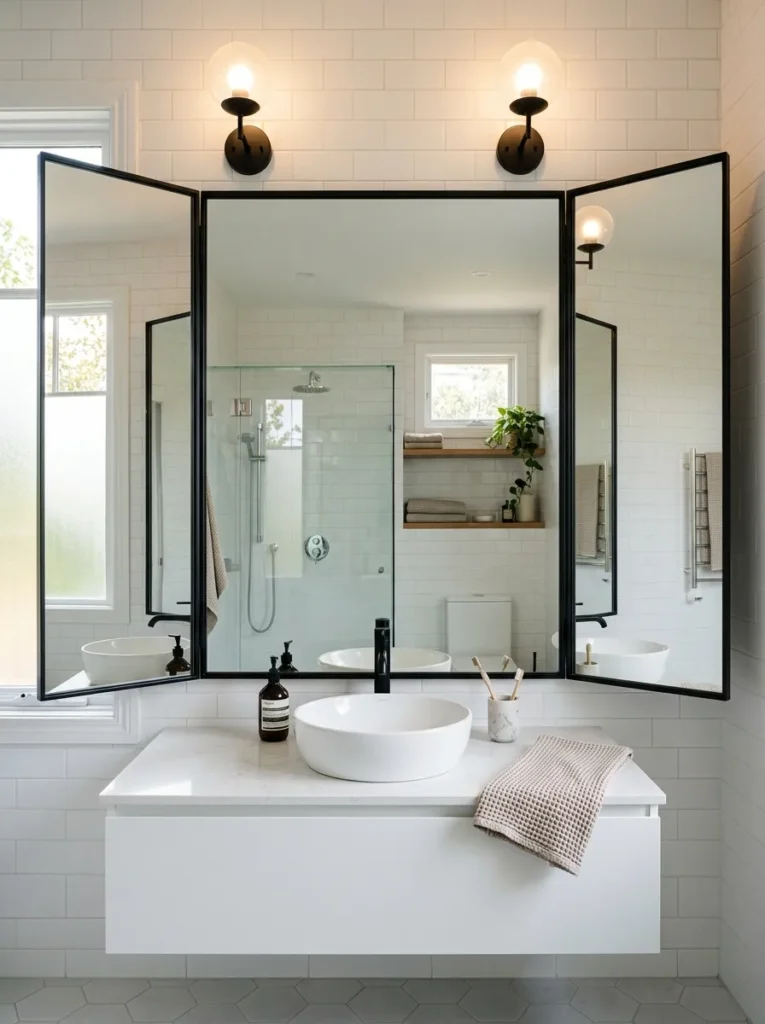
Vibe: The mirror is expansive — a three-panel triptych creates compound reflections that multiply the perceived depth of a small bathroom in multiple directions simultaneously, dissolving the sense of enclosure.
Why it works: The triptych format exploits the optical phenomenon of compound reflection — when two mirrors face each other at an angle less than 180 degrees, each mirror reflects the other’s reflection, creating a series of reflected images that multiply exponentially with each additional reflection bounce. The angled side panels of a triptych mirror create this compound effect laterally, reflecting the bathroom walls at oblique angles that the straight-on central mirror cannot reach. The practical result is a reflection that shows multiple simultaneous views of the space, which the brain interprets as spatial complexity and depth rather than the flat single-plane reflection of a standard mirror.
How to get it: Triptych mirrors are available as hinged three-panel units (the side panels adjust to any angle) from specialty mirror retailers and custom glass shops. A DIY version uses three separately framed mirrors (one 24-inch wide central mirror, two 8-inch wide side panels) mounted with piano hinges between panels — the central mirror mounts to the wall, and the side panels can fold flat when not in use for a space-saving configuration.
Shop The Look
- Triptych three panel bathroom mirror hinged
- Piano hinge long brass finish craft
- Matte black mirror frame set rectangular
- Wall anchor mirror heavy duty set
- Vanity light bar matte black three bulb
9. Fog-Free Heated Mirror for Functional Small Bathroom
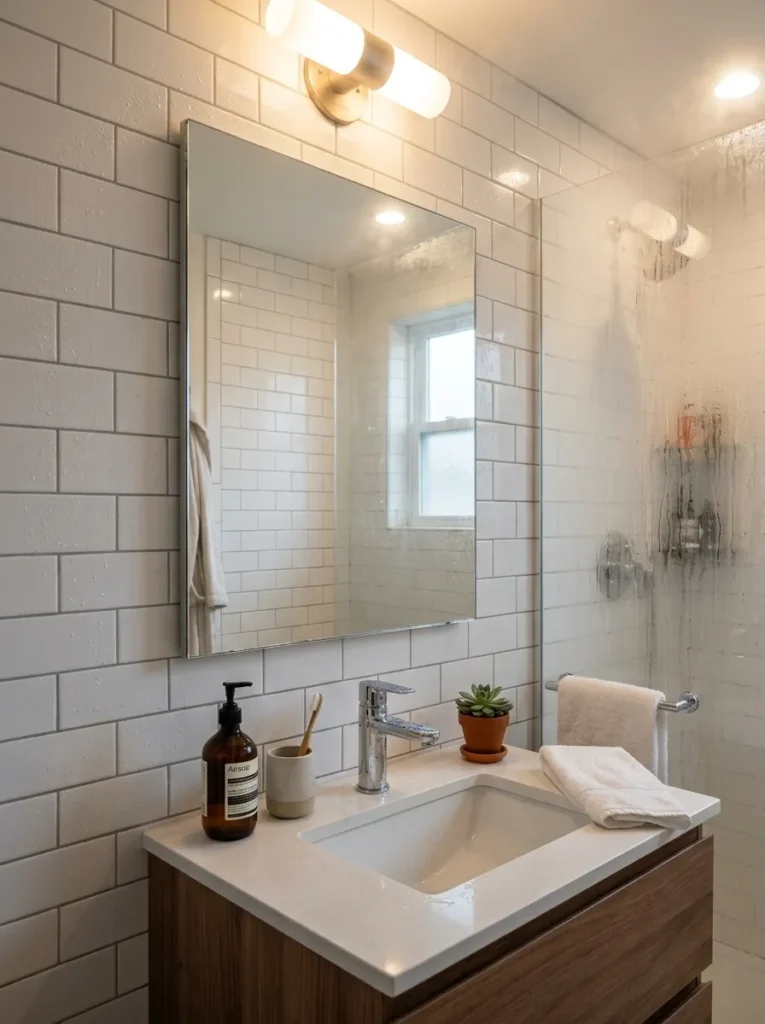
Vibe: The mirror is functional — a fog-free heated mirror that remains clear immediately after a hot shower removes the most common daily frustration of a small bathroom with limited ventilation.
Why it works: Bathroom mirror fogging occurs when humid post-shower air contacts the cooler mirror glass surface and condenses — the mirror surface temperature drops below the dew point of the humid air, and water vapor condenses as liquid droplets on the glass. A heated mirror maintains the glass surface temperature above the dew point (typically 5–10°F above ambient air temperature is sufficient) through a resistance heating element bonded to the mirror back, preventing condensation from forming rather than removing it after the fact. In a small bathroom with a single window and limited ventilation, this heating function eliminates the 2–5 minute wait after showering that is otherwise required before the mirror is usable — a practical quality-of-life improvement that compounds daily.
How to get it: Fog-free mirrors use either a dedicated heating pad bonded to the mirror back (hardwired to a 15-amp circuit) or a heated demister pad ($15–$35) that can be added to any existing mirror and powered by the bathroom lighting circuit. Kohler, Robern, and NuTone make integrated fog-free LED mirrors from $200–$600. The demister pad retrofit is the most accessible option — peel-and-stick application to any existing mirror’s back surface, with a simple plug-in power connection, achieves the same fog-prevention function without replacing the mirror.
Shop The Look
- Fog free demister pad bathroom mirror retrofit
- Heated bathroom mirror anti-fog LED
- Bathroom exhaust fan quiet high CFM
- Hygrometer humidity monitor bathroom
- Clean edge silicone mirror mounting
10. Sunburst Mirror as Sculptural Bathroom Focal Point
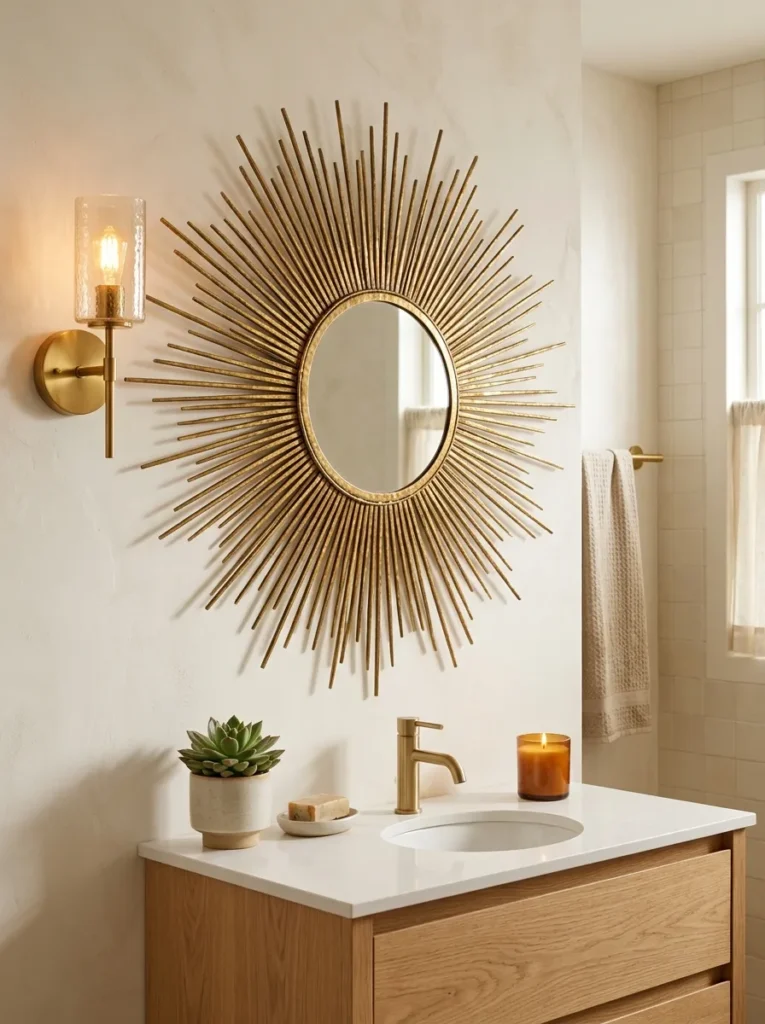
Vibe: The mirror is dramatic — a sunburst mirror with radiating brass rays is simultaneously a functional bathroom mirror and a sculptural wall installation that transforms the entire visual tone of a plain bathroom wall.
Why it works: The sunburst form’s radiating rays exploit a design principle called visual expansion through implied movement — the rays suggest outward motion from the central point, which the eye tracks along each ray to its tip and then back to center in a continuous scanning motion. This tracking gives the viewer the sense of a larger visual field than the mirror’s central reflective area alone occupies, making the overall piece read as a larger presence than its actual dimensions. The reflective quality of the metallic rays amplifies this effect — each ray reflects ambient room light at a different angle as the viewer moves, creating a dynamic light display that changes quality throughout the day.
How to get it: Sunburst mirrors in the 24–36 inch total diameter range (including rays) are widely available from West Elm, Threshold at Target, and Wayfair at $60–$250. For a DIY version, mount a simple round mirror (12-inch diameter) on a backing disc of painted MDF, then attach radiating wooden dowel rods (varying lengths of 3/8-inch dowel, spray-painted gold or brass) around the perimeter using construction adhesive — the result is a custom sunburst at approximately $30 in materials.
Quick Win: A 12-inch round mirror (under $15), a pack of 3/8-inch dowels ($4), and gold spray paint ($6) produces a custom sunburst mirror in 2 hours for under $25 — it reads as a purchased design object at $80+ at normal viewing distance.
Shop The Look
- Sunburst mirror brass rays 30 inch
- Gold metallic spray paint furniture finish
- Wooden dowel rod 3/8 inch pack
- Small ceramic plant pot white bathroom
- Warm amber candle beeswax bathroom
11. Antique Mirror Glass with Aged Foxing for Warm Depth
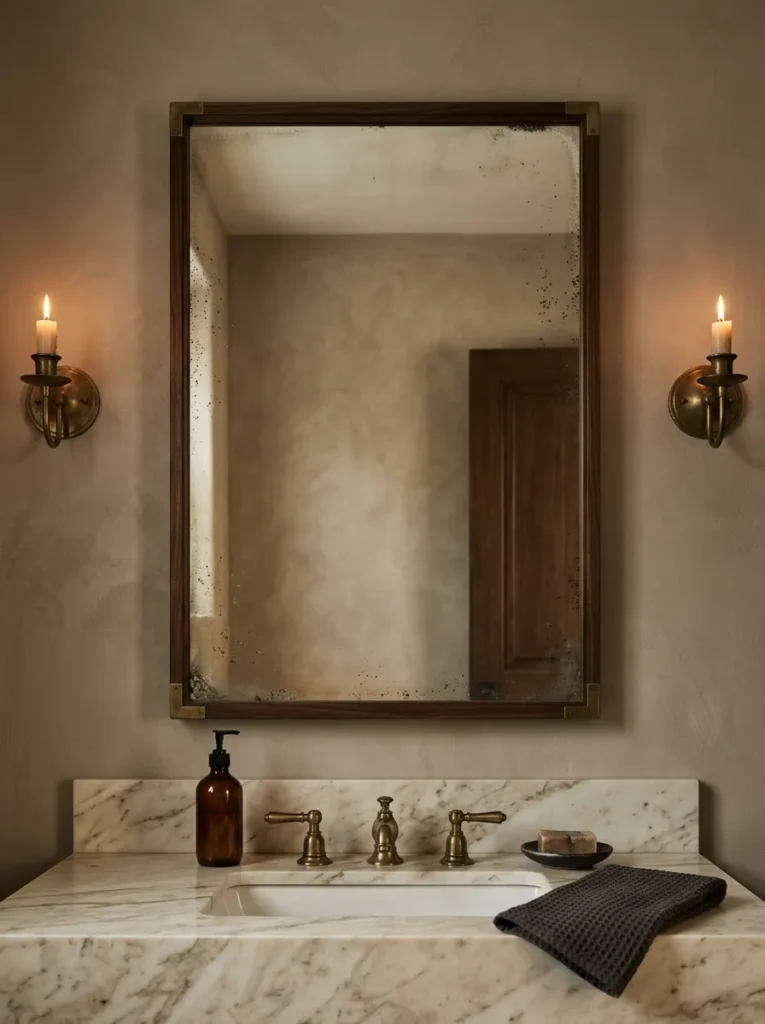
Vibe: The mirror is moody — antique mirror glass with aged toning and foxing produces a warm, slightly imperfect reflection that makes a small bathroom feel atmospheric and collected rather than newly fitted.
Why it works: Antique mirror glass differs from standard clear mirror glass in its silver backing — older silvering processes produced slightly uneven silver deposits that create tonal variation, warm amber cast, and the characteristic “foxing” spots that develop as the silver oxidizes at the glass edge. This tonal variation means the reflection is warmer and softer than a clear modern mirror’s high-contrast reflection, which is a specific quality advantage in bathroom environments — a warm, slightly imperfect reflection is more flattering than the clinical precision of clear modern glass. Antique glass also absorbs some light rather than reflecting all of it, giving the mirror surface a depth that reads as the mirror existing within the wall rather than sitting on it.
How to get it: Authentic antique mirror glass is available from specialty glass suppliers and architectural salvage dealers at $15–$30 per square foot. For a DIY antique glass effect: apply a spray of diluted nitric acid (1:10 acid to water, using rubber gloves and eye protection outdoors) to the back of a standard mirror — this selectively removes silver backing in organic patterns that mimic aged foxing. Alternatively, antique mirror film ($15–$25 per roll) applied to standard mirror glass produces a similar tonal effect without the chemical process.
Shop The Look
- Antique mirror glass sheet foxed aged
- Antique mirror DIY aging spray kit
- Dark walnut mirror frame simple rectangular
- Aged brass bathroom faucet vintage style
- Marble contact paper countertop vanity
12. Dual Mirrors Mounted Side by Side for Double-Sink Vanity
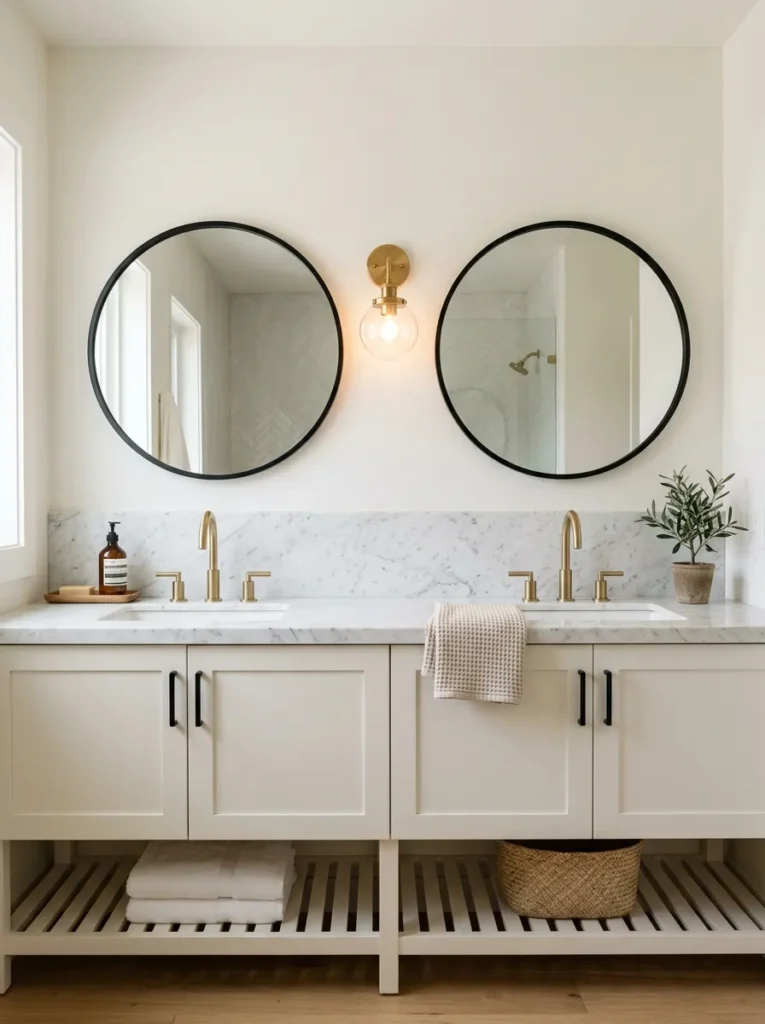
Vibe: The vanity is symmetrical — two matching mirrors above a double sink create the bathroom’s most resolved compositional arrangement, where every element finds its pair and nothing reads as an afterthought.
Why it works: The dual mirror arrangement above a double sink solves the compositional problem that a single large mirror creates in a double-sink context — a single mirror centered on two sinks is centered on neither, while two mirrors each centered on their sink creates the bilateral symmetry that the human visual system reads as balanced and complete. The gap between mirrors also provides the ideal location for a centered sconce or light fixture that illuminates both vanity positions simultaneously from a central angle, which is more effective than side-flanking sconces that illuminate only one position directly. The gap creates a natural visual separation between two personal grooming zones without requiring a physical partition.
How to get it: Mount two mirrors with a gap of 4–6 inches between them, each mirror centered on its sink. The mirror diameter or width should be 4–6 inches narrower than the individual sink bay width on each side — this creates even visual margins between the mirror edge and the vanity edge. A single centered sconce or pendant between the mirrors provides the lighting focal point; alternatively, a small wall shelf in the gap holds a plant or candle to create a visual anchor between the two mirror fields.
Shop The Look
- Round mirror pair matching matte black 24 inch
- Wall sconce single centered bathroom brass
- Double sink bathroom vanity white 60 inch
- Matching brass faucet set pair bathroom
- Small ceramic plant bathroom vanity accent
13. Mirror with Integrated Shelf for Compact Organization
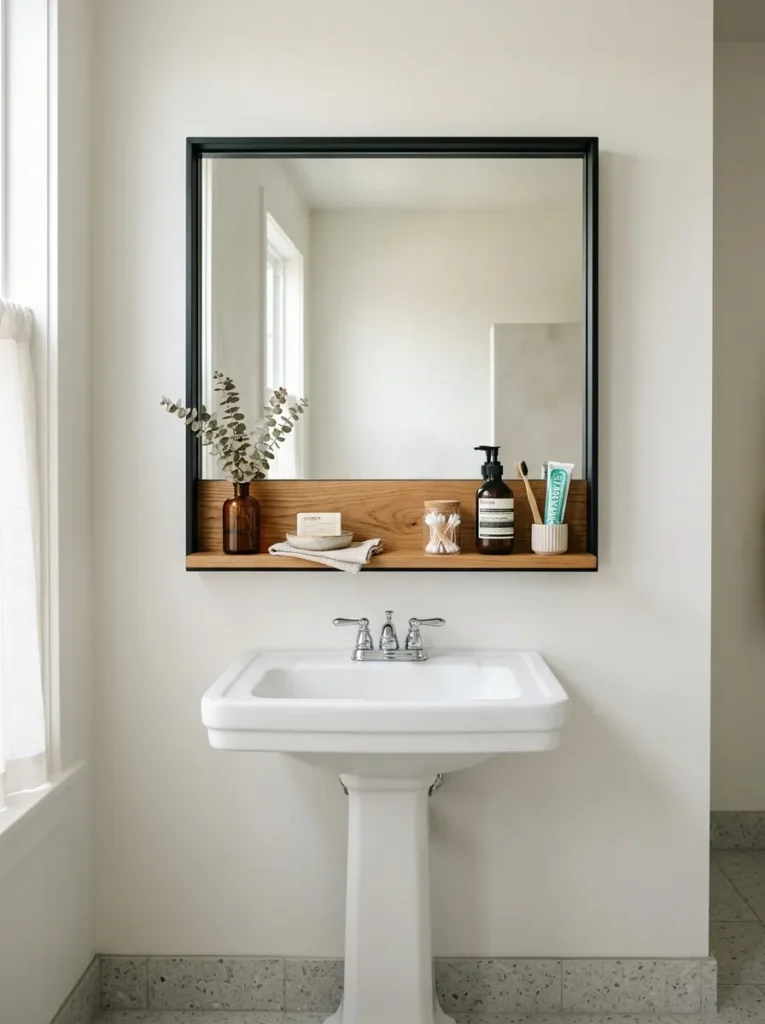
Vibe: The mirror is organized — a bathroom mirror with an integrated shelf solves the pedestal sink’s most significant limitation (no surface storage) within the wall space the mirror already occupies.
Why it works: A mirror with an integrated shelf addresses the specific constraint of pedestal sink bathrooms, where the architectural elegance of the exposed sink column comes at the cost of the counter storage that vanity cabinets provide. The integrated shelf (typically 3–4 inches deep, mounted at the mirror’s lower edge) provides a surface for the 3–5 daily-use items that would otherwise live on the sink edge — soap dispenser, small plant, toothbrush holder, hand lotion — without requiring additional wall area. The shelf’s visual integration with the mirror frame means it reads as part of the mirror composition rather than as an additional accessory, maintaining the clean single-object wall presentation.
How to get it: Several manufacturers including Umbra, CB2, and Pottery Barn make mirrors with factory-integrated shelves. A DIY version attaches a simple wood or marble shelf (cut to mirror width, 3–4 inches deep, 3/4-inch thick) to the bottom of any existing mirror frame using two small L-brackets and construction adhesive. A floating shelf mounted 2 inches below an existing mirror achieves the same functional result without modifying the mirror itself.
Shop The Look
- Bathroom mirror with integrated shelf wood
- Small marble shelf cut to size bathroom
- Glass soap dispenser pump refillable small
- Ceramic toothbrush holder minimal white
- Small trailing plant bathroom shelf
14. Black Steel Industrial Frame Mirror for Contrast
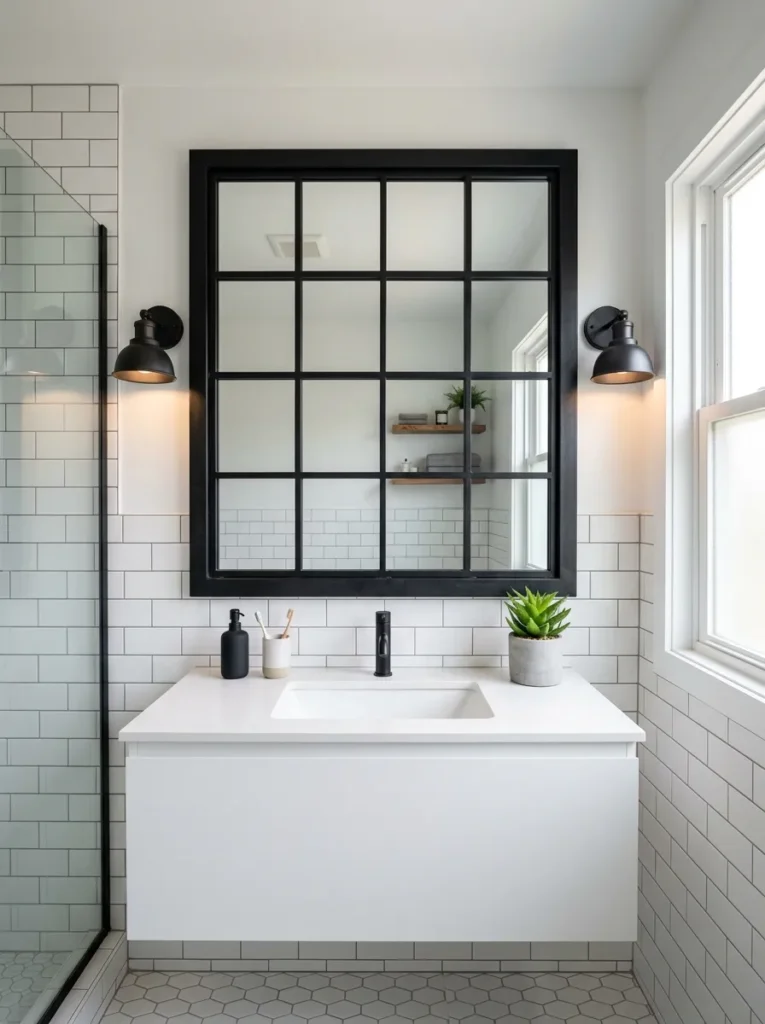
Vibe: The bathroom is graphic — a thick matte black industrial steel frame against white tile creates the highest-contrast bathroom composition available, where the mirror reads as an architectural element rather than a fixture.
Why it works: A thick matte black frame (2–3 inches wide) on a bathroom mirror functions through the design principle of figure-ground definition — the dark frame creates a strong, unambiguous boundary around the mirror’s reflective surface that makes the mirror read as a deliberate compositional element against the wall rather than a surface that blurs into its surroundings. Against white tile, the contrast ratio between the matte black frame and the white background is at its maximum, giving the frame the visual weight of architectural steel rather than a furniture accessory. The industrial steel window-pane detailing (multiple panes within the frame) further references structural architecture, elevating the mirror to a design statement.
How to get it: Industrial-style black steel framed mirrors are available from Kirkland’s, HomeGoods, and Wayfair at $80–$250. Custom options are available from steel fabricators who make steel window frames — the same product in a mirror-insert format. A DIY version uses standard angle iron ($0.80–$1.20 per linear foot from a metal supplier), cut and welded or bolted at the corners, spray-painted with matte black Rust-Oleum enamel, fitted with a standard cut-glass mirror insert.
Shop The Look
- Black steel industrial frame mirror large
- Matte black spray paint enamel finish
- Matte black bathroom faucet single handle
- White ceramic bathroom accessories set
- Small ceramic pot bathroom plant display
15. Smart Mirror with Integrated Display for a Modern Small Bathroom
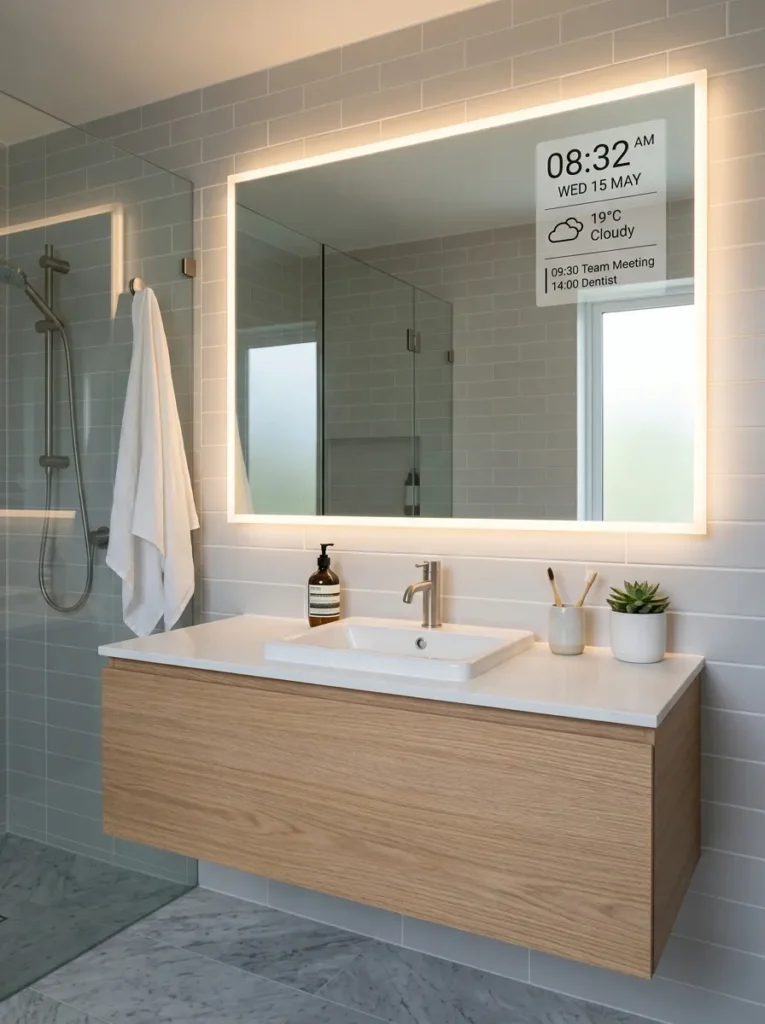
Vibe: The bathroom is modern — a smart mirror with an integrated display is the bathroom fixture that makes a small space feel technically considered rather than merely decorated, where information and function coexist with the grooming surface.
Why it works: A smart mirror combines the spatial expansion function of a large backlit mirror with the information utility of a small screen, without requiring a separate screen device that would occupy vanity counter space. The semi-transparent display technology overlays information (time, weather, news headlines, calendar events) on the mirror surface at low opacity — visible when actively read but not obtrusive to the reflection during standard grooming use. In a small bathroom where counter and shelf space is minimal, consolidating the information display function into the mirror surface eliminates one object from the room entirely. The integrated LED backlight provides the same circadian and shadowless lighting benefits as a standard backlit mirror (see Idea 2) with the additional function layer.
How to get it: Purpose-built smart mirrors from companies including HiMirror, Séura, and Electric Mirror range from $300–$2,000 depending on size and feature set. A DIY smart mirror uses a two-way mirror glass panel (semi-transparent mirror, $30–$60 per square foot) mounted in front of a monitor displaying a Raspberry Pi-powered MagicMirror² interface (free open-source software) — total DIY cost for a 24×36 inch smart mirror runs $200–$350 in components.
Quick Win: A Raspberry Pi-based MagicMirror² smart mirror can be built for under $200 using a second-hand monitor, a $35 Raspberry Pi board, and a two-way mirror acrylic panel — the software is free and fully customizable, and the build takes one weekend for a complete beginner following the extensive online documentation.
Shop The Look
- Smart bathroom mirror LED backlit display
- Two way mirror acrylic panel sheet
- Raspberry Pi 4 model B smart mirror
- Frameless mirror clips mounting chrome
- Brushed nickel vanity light bar modern
How to Start Your Bathroom Mirror Transformation
The single most important first decision in a bathroom mirror transformation is size — specifically, never choose a mirror smaller than the vanity it serves. This is the rule that most bathroom mirror mistakes violate: a 24-inch mirror above a 36-inch vanity creates visual imbalance that reads as an insufficient budget decision rather than a restrained design choice. The mirror’s width should match or exceed the vanity width, and its height should reach at minimum 36 inches from the vanity surface (placing the top edge at approximately 7 feet from the floor in a standard bathroom). This single sizing principle, applied before any style or material decision, eliminates 80% of bathroom mirror disappointments.
The most common beginner mistake in bathroom mirror selection is choosing a mirror in isolation from the lighting plan. A mirror without adequate flanking or backlit light produces the unflattering overhead-shadow effect that makes grooming difficult and the bathroom feel dim regardless of ambient brightness. The fix is to plan the mirror and the light source simultaneously — if wall sconces are to flank the mirror, choose the sconce first (it determines the required gap between mirror edge and sconce center, typically 30–36 inches between sconce centers) and size the mirror to fit that constraint. If backlit, choose the LED color temperature (3000K for warm atmosphere, 4000K for accurate color rendering) as part of the mirror selection rather than after installation.
Three bathroom mirror upgrades under $50 that make an immediate visual difference: a demister heating pad ($15–$35) applied to any existing mirror’s back surface that eliminates post-shower fogging permanently; a set of replacement mirror mounting clips in brushed brass or matte black ($8–$15) that upgrade the appearance of any existing frameless mirror without replacing the glass; and a can of mirror frame spray paint in warm brass or matte black ($6–$10) that transforms any existing plastic or chrome frame into a finish that reads as intentional and considered.
A single mirror swap — replacing an existing builder-grade mirror with a shaped, framed, or backlit alternative — is a 1–2 hour installation project for most wall-hung mirrors and represents the fastest available improvement in a small bathroom’s visual quality. A full mirror wall installation (full-width, floor-to-ceiling) is a half-day project with professional glass installation recommended for large mirror panels over 25 square feet. A complete bathroom mirror and lighting redesign (new mirror, new sconces, demister pad, and integrated shelf) is a weekend project with a realistic budget of $200–$600 for most small bathrooms.
Frequently Asked Questions About Bathroom Mirrors for Small Spaces
What size mirror is best for a small bathroom?
The guiding principle is that a bathroom mirror should never be narrower than the vanity it serves — if the vanity is 30 inches wide, the mirror should be at minimum 30 inches wide, and ideally 2–4 inches wider on each side for a total of 34–38 inches. Height matters equally: a mirror that extends from 6 inches above the backsplash to 7 feet from the floor maximizes the vertical light reflection that makes a small bathroom feel taller. In a bathroom under 40 square feet, a mirror that occupies 60–70% of the vanity wall’s total area produces the maximum spatial expansion effect without the installation complexity of a full-wall mirror. When in doubt between two sizes, always choose the larger — the most common small bathroom mirror mistake is choosing too small.
Should a bathroom mirror touch the ceiling in a small space?
Yes — in a small bathroom with standard 8-foot ceilings, extending the mirror to within 6 inches of the ceiling (or to the ceiling itself with a thin trim detail) maximizes the vertical dimension of the reflected light field and makes the ceiling appear significantly higher. The visual principle is that the eye follows the mirror’s edge — a mirror that stops at 6 feet creates a visual horizon at that height that emphasizes the ceiling’s lowness, while a mirror that extends to or near the ceiling removes that horizon and allows the eye to continue upward into the reflected space above. The practical consideration is that above approximately 6.5 feet from the floor, the mirror surface is not used for grooming — the additional height is purely spatial and optical, which is its entire function in a small bathroom.
What is the difference between backlit and front-lit bathroom mirrors?
Backlit mirrors place the LED light source behind the mirror glass, illuminating the wall behind and around the mirror perimeter to create an ambient glow effect — the mirror itself is not brighter, but the surrounding light field is warmer and more evenly distributed, eliminating harsh shadows. Front-lit mirrors (also called lighted mirrors or Hollywood mirrors) place the light source in front of the mirror glass on the mirror’s face, directly illuminating the reflection and the face in front of it. Front-lit mirrors provide more accurate task lighting for grooming and makeup application because the light comes from multiple directions around the mirror face. Backlit mirrors provide better atmospheric ambient light quality. In a small bathroom used for detailed grooming, front-lit or Hollywood-style mirrors are functionally superior; in a bathroom used primarily for morning and evening routines without detailed makeup, a backlit mirror’s atmospheric quality is the better choice.
Can I install a bathroom mirror myself or do I need a professional?
Most bathroom mirrors under 25 square feet (a 48×60 inch mirror is 20 square feet) can be safely DIY-installed with basic tools — a drill, wall anchors appropriate for the wall type (drywall anchors, tile anchors, or stud mounts depending on the wall), a level, and the mounting hardware included with the mirror. The critical safety consideration is weight: a standard 24×36 inch mirror weighs 15–25 pounds depending on glass thickness and frame material — this is well within the capacity of two properly installed stud-mounted wall anchors. For mirrors over 30 square feet, for full-wall mirror installations, or for mirrors being installed over tile (which requires a tile drill bit and careful technique to avoid cracking), professional installation is recommended. The most common DIY mirror installation mistake is anchoring into drywall only rather than into studs — drywall anchors should be a secondary measure, not the primary support for a heavy mirror.
How do I make a small bathroom feel bigger with mirrors beyond just the mirror itself?
The mirror’s contribution to perceived space is maximized by three supporting strategies. First, place the mirror directly opposite the room’s primary light source (window or overhead fixture) so the mirror reflects the light source back into the room rather than a dark wall — this doubles the effective brightness of the light source. Second, keep the vanity surface immediately below the mirror clear of tall objects that interrupt the mirror’s reflective field — a tall bottle in front of a mirror reduces the useful reflection area and creates visual clutter within the mirror’s field. Third, use the mirror’s reflection deliberately: position a small plant, an interesting wall detail, or a window view so that these elements appear in the mirror’s reflection and create the impression that these features exist twice in the space. The combination of these three strategies with a correctly sized and positioned mirror produces a spatial expansion effect significantly greater than the mirror alone achieves.
Ready to Transform Your Small Bathroom with the Right Mirror?
These 15 ideas cover the full spectrum of what a bathroom mirror can accomplish in a small space — from the optical doubling of a full-width vanity wall mirror and the atmospheric warmth of antique foxed glass, to the practical intelligence of a recessed medicine cabinet and the decorative statement of a scalloped frame or sunburst form. You do not need to implement all 15 — the most effective bathroom mirror transformation begins with one honest assessment of the current mirror’s most significant failure: is it too small, too dark, poorly lit, lacking storage, or visually generic? The answer to that single question points directly to the idea on this list that will make the greatest difference in your specific bathroom. Start this weekend by measuring your vanity width and your current mirror width — if the mirror is narrower than the vanity, that is your answer, and replacing it with a correctly sized mirror is the single highest-impact change your bathroom can receive. A bathroom mirror chosen with intention for light, size, material, and placement does not merely reflect your image back at you — it reflects the entire room at its best, and in a small space, that difference is everything. Pin the mirrors that made you look twice — in a small bathroom, the right mirror makes the whole room worth looking at.