14 Modern Tan Sofa Living Room Ideas Worth Saving
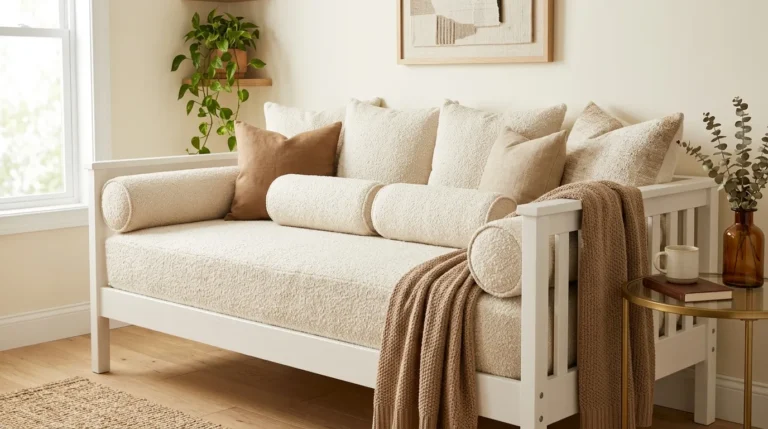
A modern tan sofa living room is a living space anchored by a tan, camel, or warm beige sofa — styled with contemporary design principles including clean lines, intentional material layering, and a restrained but sophisticated color palette that uses the sofa’s warm neutral tone as the compositional foundation for every other element in the room. This article gives you 14 modern tan sofa living room ideas across color pairing, material layering, lighting, furniture arrangement, accent choices, textiles, and small-space adaptation so your tan sofa becomes the most design-intelligent decision in the room rather than a safe default.
A tan sofa is one of the most quietly powerful starting points in residential design — warm enough to anchor a room with genuine color, neutral enough to accept almost any direction you take from there. The mistake most people make with a tan sofa is treating it as a blank slate that disappears into the room. The opportunity is to treat it as the room’s warmest material statement and design outward from it with intention. Done well, a modern tan sofa living room has a sophistication and livability that cooler, more fashionable sofa colors rarely achieve. Here are 14 ideas worth saving — and stealing.
Why Modern Tan Sofa Living Rooms Work So Well
The tan sofa’s design authority draws from a convergence of color theory, material tradition, and contemporary interior design philosophy. In color theory terms, tan sits at the warm end of the neutral spectrum — it carries the yellow and red undertones of natural materials (undyed leather, raw linen, unfinished oak, sand, clay) that the human eye reads as inherently warm, safe, and inviting. This warmth is not accidental: the colors of natural, untreated organic materials are exactly the tones that evolutionary psychology associates with shelter, nourishment, and rest. A tan sofa in a living room is working with the nervous system rather than against it.
The material context of a modern tan sofa living room is specific and important. Tan works most powerfully when surrounded by materials that share its warm undertone family — unfinished white oak and walnut for furniture, natural linen and cotton for textiles, terracotta and warm stoneware for ceramics, unlacquered brass and warm bronze for hardware and lighting. The combination of tan upholstery with these supporting materials creates the tonal cohesion that makes a room feel designed rather than assembled. Conversely, tan paired with cool materials — grey concrete, chrome, cool white walls, blue-toned stone — creates an undertone conflict that makes the sofa read as dated rather than warm.
The contemporary moment is ideal for the tan sofa. The dominant design movements of the current decade — quiet luxury, Japandi, biophilic design, and the warm minimalism aesthetic — all share a preference for warm neutrals, natural materials, and restrained but intentional color. The tan sofa is not a trend participant in this moment; it is a foundational element of it. Searches for “tan sofa living room,” “camel sofa styling,” and “warm neutral living room” have grown consistently, reflecting a broad design culture shift away from the grey-sofa coolness of the previous decade toward the warmer, more organic palette of the current one.
Small living rooms respond particularly well to tan sofa anchoring because the sofa’s warm neutral tone creates a sense of spatial warmth that makes compact rooms feel comfortable rather than cramped. A tan sofa in a small room with light walls and warm wood accents creates a unified, cozy quality that a dark sofa or a brightly colored sofa cannot — the warm neutral reads as belonging to the room rather than competing with it for visual dominance.
Style at a Glance
| Element | Detail |
|---|---|
| Philosophy | Warm neutral as design foundation — the tan sofa as the room’s most intentional material statement |
| Key Materials | Unfinished white oak, natural linen, walnut, unlacquered brass, terracotta, raw cotton |
| Key Colors | Warm white, dusty sage, deep forest green, burnt sienna, warm charcoal, camel, rust |
1. Tan Sofa with Deep Forest Green Accent Wall and Brass Fixtures
Vibe: The room is rich — deep forest green behind a tan sofa creates one of the most sophisticated color pairings available in residential design, where the warm neutral and the botanical dark green anchor each other with mutual contrast and equal weight.
Why it works: Forest green and tan sit in a complementary-adjacent relationship on the color wheel — green’s cool-to-neutral quality creates contrast with tan’s warm undertone without the jarring opposition of true complementary colors. The result is a pairing that feels simultaneously contrasting and harmonious. The design principle at work is simultaneous contrast — each color makes the other appear more saturated and distinct when placed in proximity. A deep matte forest green wall (Farrow & Ball Studio Green No. 93, or Sherwin-Williams Rookwood Dark Green SW 2809) reads as richer and deeper beside a warm tan sofa, and the tan sofa reads as warmer and more golden beside the cool-dark green wall.
How to get it: Paint the primary sofa wall in a deep matte forest green — flat or matte finish only, as eggshell or satin amplify the color’s intensity in a way that can overwhelm a living room at full wall scale. Pair with warm brass lighting (an arc floor lamp positions light over the sofa without requiring a ceiling fixture), white oak furniture, and terracotta ceramic accessories. Keep the remaining three walls in warm white (Benjamin Moore White Dove OC-17 or similar) to prevent the green from dominating the full room.
Quick Win: A single large art print or framed botanical illustration in deep green tones hung above a tan sofa creates the green-and-tan pairing effect without a full wall repaint — achievable in 20 minutes at zero permanent commitment.
Shop The Look
- Deep forest green matte wall paint sample
- Brushed brass arc floor lamp modern
- White oak coffee table rectangular modern
- Terracotta ceramic vase large dried stems
- Chunky jute area rug natural 8×10
Also view: 14 IKEA KALLAX Styling Ideas You’ll Absolutely Love
2. Tan Sofa with Warm White Walls and Layered Natural Textiles
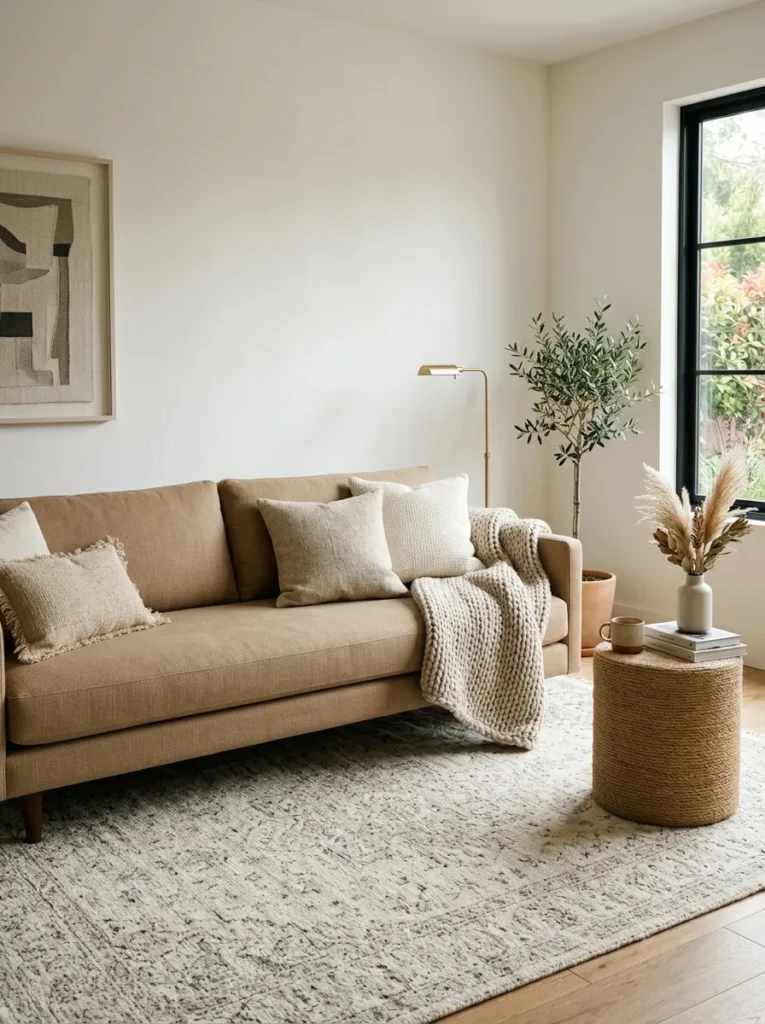
Vibe: The room is serene — a warm tonal monochrome palette built entirely within the tan-to-cream-to-white spectrum creates a cohesion and restfulness that multi-color rooms cannot achieve, because nothing in the room demands the eye’s attention over anything else.
Why it works: Tonal monochrome design — using multiple values and textures within a single color family rather than introducing contrasting colors — creates the visual quality designers call “quiet luxury.” The key technical requirement is that all tones must share the same warm undertone (yellow-red base, no cool grey or blue cast) or the palette reads as muddy rather than cohesive. Warm white walls (LRV 85+, yellow-red undertone), tan sofa (LRV 45–55), ivory wool rug (LRV 75–80), and oat linen pillows (LRV 60–70) create a graduated value sequence from lightest (walls and ceiling) to darkest (sofa body) that gives the room tonal depth without color contrast. The texture variation between materials (woven linen, knotted wool, knitted throw) provides visual interest that color variation would otherwise supply.
How to get it: The critical discipline of this approach is undertone consistency — every material in the room must be warm-toned. Test wall paint against the sofa fabric in the room’s actual light before committing. Replace any cool-toned accessories (grey ceramic, chrome hardware, blue-white linen) with warm equivalents. Add texture through at minimum four different material types — woven, knitted, knotted, and smooth — to prevent the all-neutral room from reading as flat.
Shop The Look
- Hand knotted wool rug ivory warm grey 8×10
- Linen throw pillow cover set varied texture
- Chunky knit throw oat natural
- Warm white interior paint sample set
- Jute wrapped side table natural small
3. Tan Sofa with Walnut Wood and Rust Accent Color
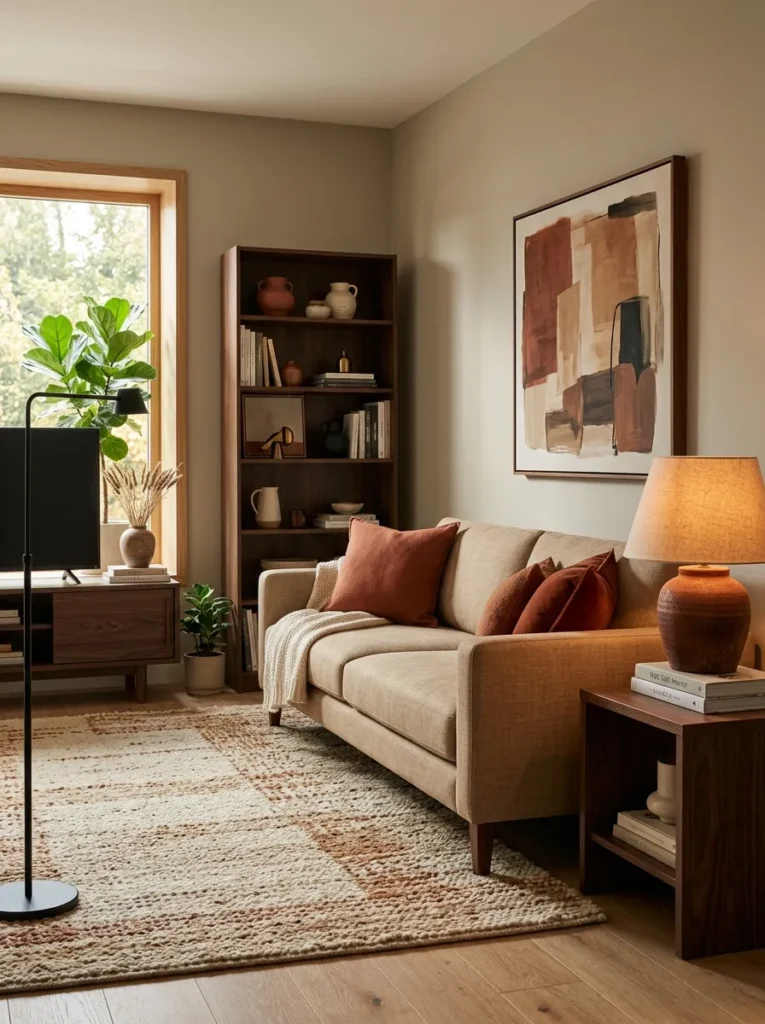
Vibe: The room is deeply toned — walnut’s dark warm brown paired with tan and accented with rust creates a tricolor warm palette of extraordinary richness, where each tone intensifies the others through proximity.
Why it works: The tan-walnut-rust combination works through the principle of warm analog harmony — all three tones exist within the warm half of the color wheel (yellow through red-orange) and share the same underlying warmth, which means they coexist without visual tension while providing enough tonal variation for visual interest. Walnut’s deep brown grounds the composition at the furniture level, rust elevates the temperature with its orange-red energy, and tan bridges both as the room’s mid-tone. The relationship between these three tones mirrors the color composition of autumn — the season that most reliably produces harmonious warm palettes from nature itself.
How to get it: Source walnut furniture in solid or walnut-veneer format — the dark, warm brown of genuine walnut is distinct from pine stained walnut, which reads cooler and flatter. Add rust through textile (cushion covers in rust-toned linen or velvet, $20–$40 each) and ceramics (rust or terracotta table lamp, $40–$90). Keep walls in warm white to prevent the room from becoming too dark — the walnut furniture and rust accents provide sufficient depth without wall color contribution.
Shop The Look
- Dark walnut media console modern clean line
- Rust linen throw pillow cover set
- Walnut side table solid wood modern
- Rust terracotta ceramic table lamp
- Warm white sheer curtain panel linen
4. Tan Sofa with Black Accents and Graphic Contrast
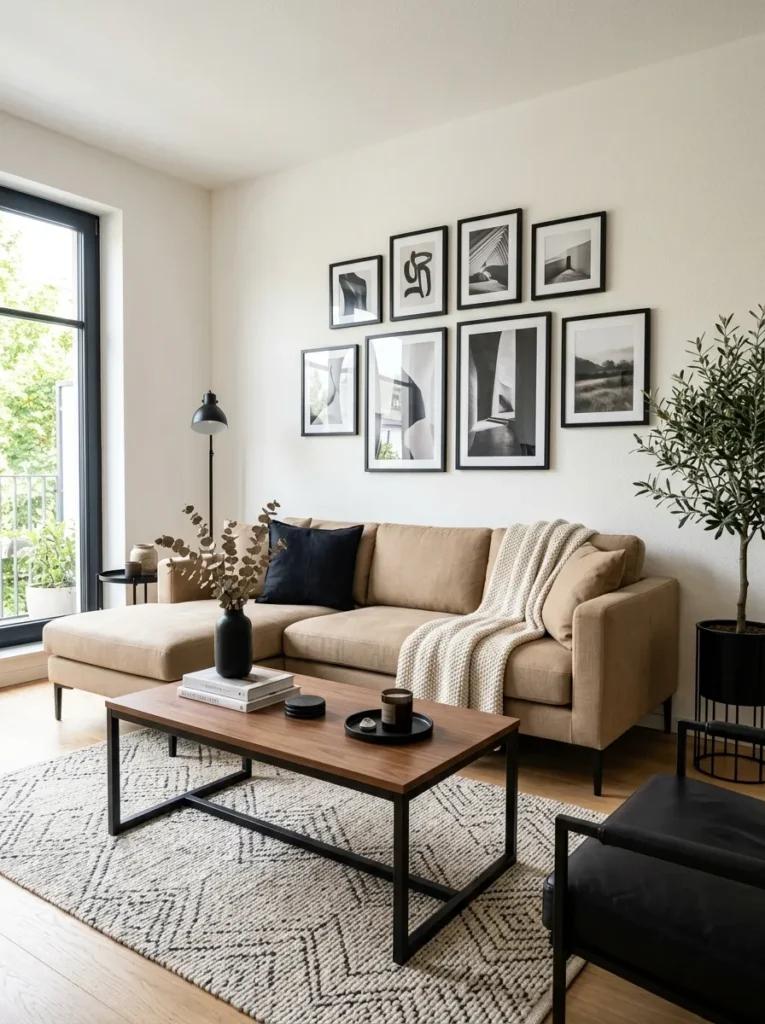
Vibe: The room is confident — matte black accents against a tan sofa create the sharpest possible warm-neutral contrast, giving the room a graphic quality that reads as deliberately designed rather than comfortably assembled.
Why it works: Black and tan is one of the most historically validated color pairings in design — it appears in traditional equestrian interiors, Japanese wabi-sabi pottery, and contemporary Scandinavian design for the same reason: the maximum value contrast between the darkest and warmest possible neutrals creates a composition that is simultaneously dramatic and warm. Matte black (rather than gloss black or charcoal) is the correct finish for this application because it absorbs light rather than reflecting it, which prevents the black accents from reading as harsh or cold in a warm-toned room. The restraint of black accents — two or three black elements maximum — ensures they read as punctuation rather than as a competing design story.
How to get it: Introduce matte black through furniture legs and hardware first (the least expensive and most reversible option), then through ceramics (a single large black vase on the coffee table, $20–$60), then through gallery wall frames (black frames in varying sizes, $8–$25 each). Resist the temptation to add black through textiles — a black cushion or throw introduces a heaviness that the accent approach is specifically avoiding.
Quick Win: Replacing existing coffee table legs with matte black hairpin legs ($25–$40 for a set of four) introduces the black accent through the room’s largest horizontal surface without purchasing any new furniture.
Shop The Look
- Matte black hairpin coffee table legs set 4
- Black ceramic vase tall modern
- Matte black picture frame set 5×7 8×10
- Black linen cushion cover 18×18
- Matte black table lamp base modern
5. Tan Sofa with Dusty Sage Green Pillows and Plants
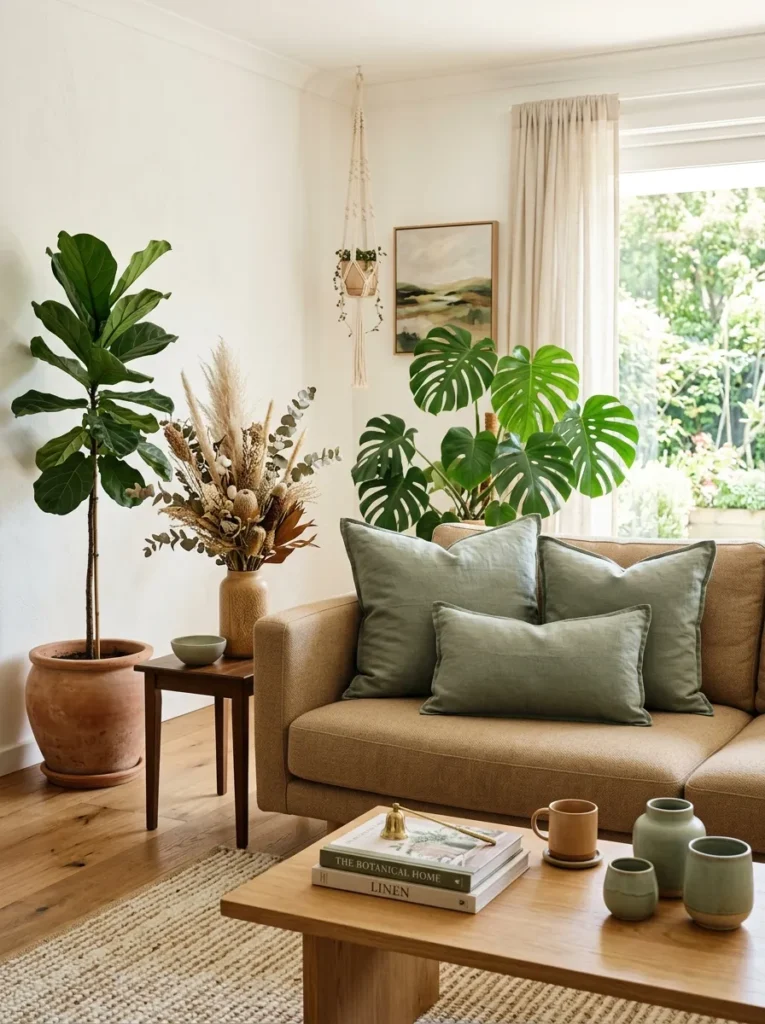
Vibe: The room is botanical — dusty sage green cushions and living plants against a tan sofa create the most naturalistic living room palette available, where the sofa’s warm earth tone and the sage’s botanical green reference the color relationship of soil and plant in a garden.
Why it works: Dusty sage and tan are nature’s most reliable color pairing — the desaturated, grey-green of sage and the warm ochre-neutral of tan appear together in the natural landscape wherever dry grasses meet Mediterranean scrub, olive groves meet clay soil, or prairie meets sage brush. The key is that the sage must be dusty (grey-green, not bright or yellow-green) — a bright grass green against tan reads as jarring, while a dusty, muted sage reads as organic and earned. Dusty sage in linen specifically is the most effective material format because linen’s natural texture and warm undertone shifts the sage slightly toward warmth, preventing it from reading as cool despite its green base.
How to get it: Introduce dusty sage through cushion covers first — a combination of three sage cushions (two square, one lumbar) in slightly varied sage tones creates the layered botanical quality. Source sage cushion covers in 100% linen ($18–$35 each) from Etsy makers or Crate & Barrel. Add one large floor plant (olive tree, fiddle-leaf fig, or tall snake plant) in a terracotta pot at one end of the sofa for scale and living color. Place sage-toned ceramics on the coffee table as a finishing layer.
Shop The Look
- Dusty sage linen cushion cover set
- Large olive tree indoor live plant
- Terracotta floor planter pot large
- Sage ceramic bud vase small
- Dried botanical arrangement neutral tones
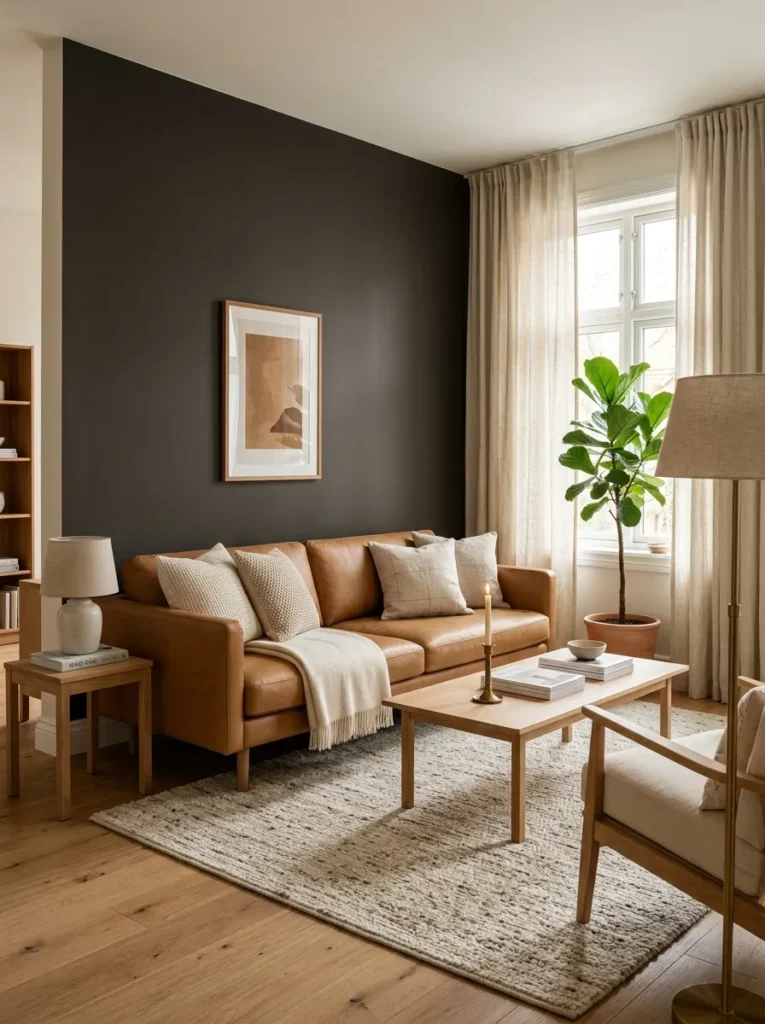
6. Tan Sofa with Warm Charcoal and Cream for Sophisticated Contrast
Vibe: The room is sophisticated — warm charcoal behind a tan sofa creates the depth that true black provides but without the harshness, producing a combination that reads as considered and mature rather than graphic and stark.
Why it works: Warm charcoal (a dark tone with brown or grey-brown undertones rather than blue or purple undertones — Farrow & Ball Mole’s Breath No. 276 or Benjamin Moore Kendall Charcoal HC-166 are ideal) creates a background depth that makes the tan sofa appear to advance forward visually, increasing its presence and warmth. The critical distinction between warm charcoal and cool grey is undertone — a warm charcoal reads as a very deep tan or brown-grey, maintaining the room’s warm material conversation; a cool grey reads as a different temperature register entirely and creates the undertone conflict that makes tan sofas read as dated. Cream linen curtains floor-to-ceiling add vertical warmth and height.
How to get it: Paint the primary sofa wall in a warm charcoal (test on the wall for 48 hours — charcoal shifts dramatically between natural and artificial light and the test is essential). Keep ceiling and remaining walls in warm white. Install floor-to-ceiling cream linen curtains wider than the window frame to maximize the perceived window height. Add warm brass accents through candle holders and table lamp — the brass reads as warm gold against the charcoal in a way that silver or chrome cannot.
Shop The Look
- Warm charcoal interior paint sample mole grey
- Cream linen curtain panel floor length
- White oak side table simple modern
- Warm brass candle holder set
- Cream velvet cushion cover set
7. Tan Sofa with Gallery Wall and Layered Rugs
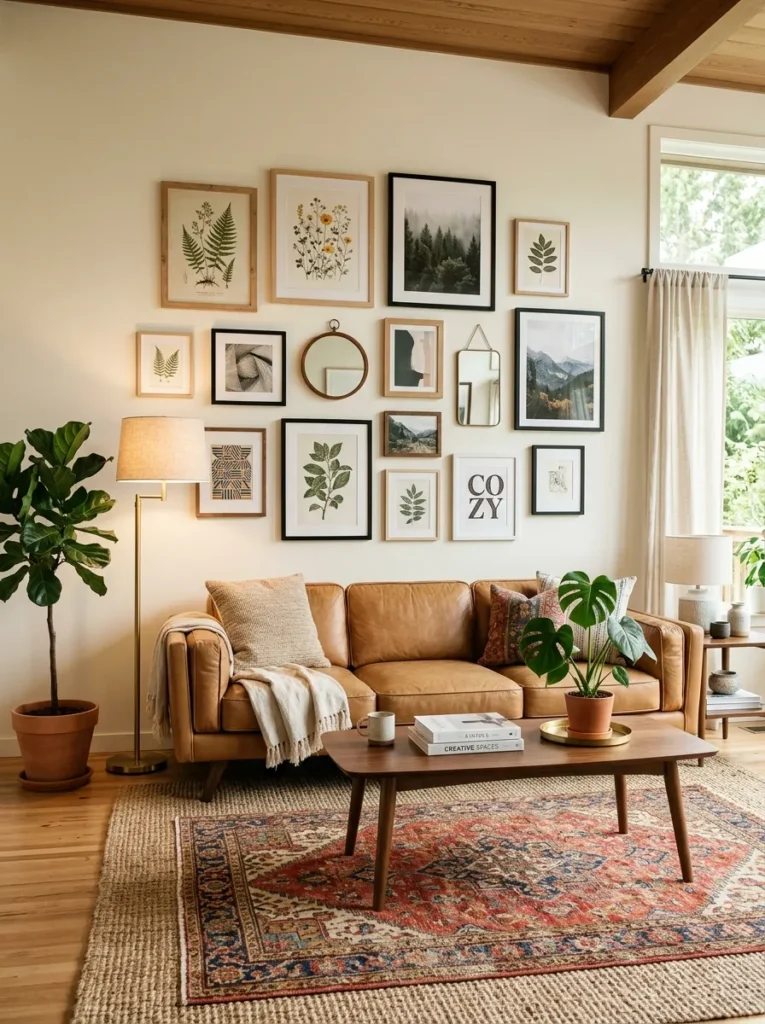
Vibe: The room is curated — a gallery wall behind a tan sofa with layered rugs beneath creates the most compositionally rich living room arrangement possible, where the sofa becomes the anchor between two major design installations above and below.
Why it works: The gallery wall above and layered rugs below create a vertical composition that uses the sofa as the literal and figurative midpoint — the eye moves from the rug texture at floor level, up through the sofa’s warm horizontal mass, and into the gallery wall’s varied art and frame composition. This vertical layering gives the room a completeness that single-layer rooms lack, because every zone of the visual field (floor, mid, wall, ceiling) has considered content. The layered rug technique (jute base layer, vintage or patterned top layer) introduces pattern and warmth at floor level that a single rug cannot, and the top rug’s smaller size ensures the jute base reads as its own layer rather than as padding.
How to get it: Plan the gallery wall on paper before hanging — a common template is a large central piece (24×30 inches or larger) surrounded by smaller frames in varied sizes, with the bottom edge of all frames aligned at 8–10 inches above the sofa back. Mix natural wood and matte black frames (two or three frame tones maximum) for visual interest without chaos. For rugs, layer a natural jute 9×12 as the base with a vintage-style 5×8 wool rug centered on top, both front-loaded under the sofa’s front legs.
Shop The Look
- Natural wood gallery frame set varied sizes
- Botanical art print set neutral tones
- Large natural jute area rug 9×12
- Vintage style wool rug 5×8 warm tones
- Small round mirror for gallery wall
8. Tan Sofa with Terracotta Tones and Mediterranean Warmth
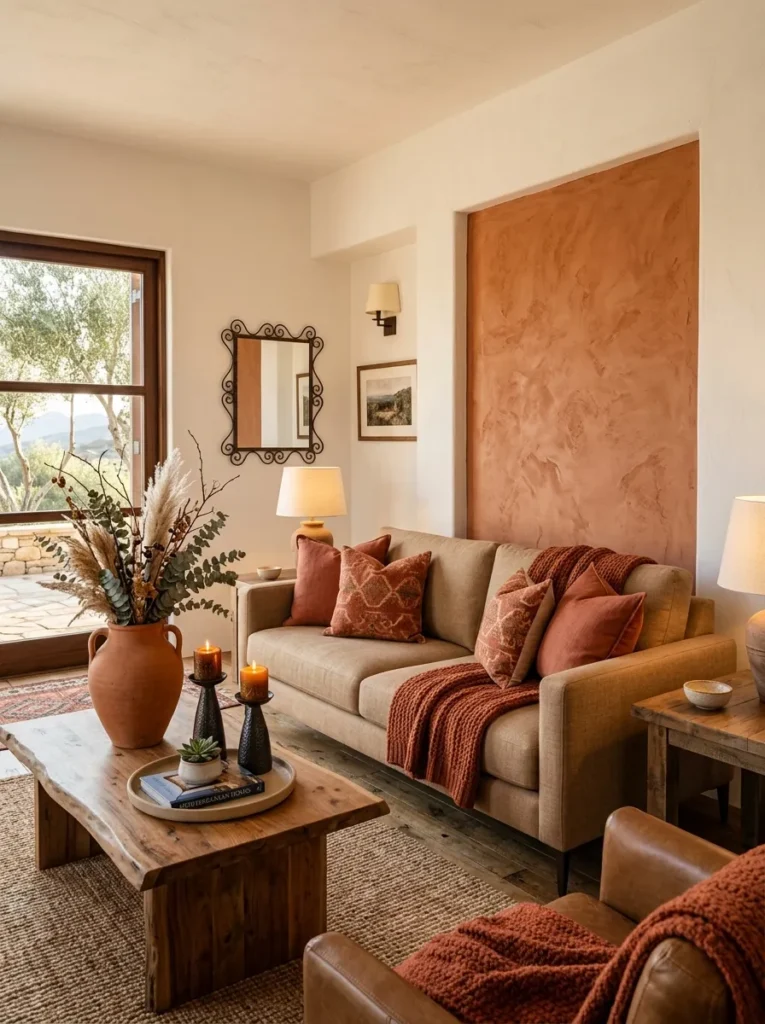
Vibe: The room is Mediterranean-warm — terracotta tones layered through walls, ceramics, and cushions around a tan sofa creates the specific warmth of a Provençal or Tuscan interior, where the entire palette references the colors of clay earth and dried grasses in warm southern light.
Why it works: Tan and terracotta are the same color family at different values — terracotta is a deeper, more saturated version of the tan-camel-ochre family, which means the two tones are inherently harmonious while providing enough value contrast to create visual interest. This color relationship means terracotta accents do not compete with a tan sofa but instead enrich it — the deeper, more saturated terracotta accents make the tan sofa appear more golden and warm by comparison. Clay plaster walls in terracotta (or a warm terracotta paint such as Sherwin-Williams Cavern Clay SW 7701) on one wall section adds the material depth that painted drywall cannot achieve and strongly references Mediterranean architectural tradition.
How to get it: Introduce terracotta through ceramics first — a large terracotta floor vase ($30–$80, either genuine fired clay or a convincing composite material) is the single most impactful terracotta element. Add terracotta cushion covers (terracotta linen or cotton, $20–$40 each) and wrought iron or blackened steel candle holders. For the clay plaster accent wall, American Clay and Portola Paints both make wall finish products that achieve the terracotta plaster effect without traditional plastering skill.
Shop The Look
- Large terracotta ceramic floor vase
- Terracotta linen cushion cover set
- Clay plaster wall finish terracotta tone
- Wrought iron candle holder set
- Dried pampas grass stems arrangement
9. Tan Sofa with Warm Minimalism and Negative Space
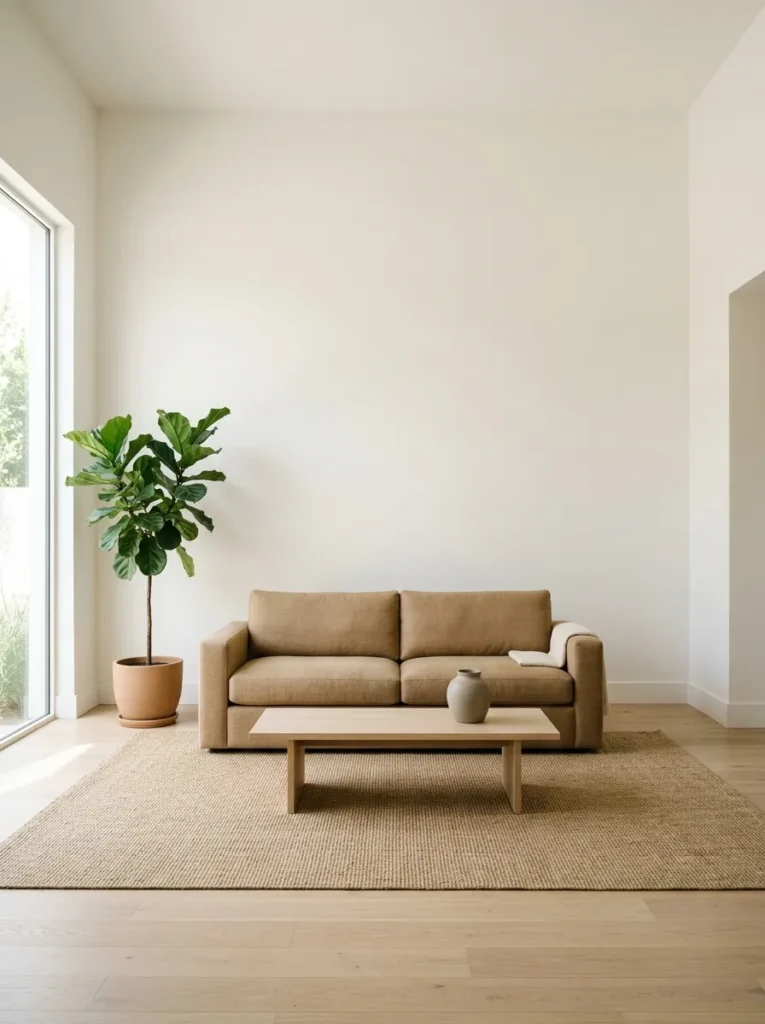
Vibe: The room is intentional — a warm minimalist tan sofa living room where negative space is the primary design element communicates that every object in the room was chosen rather than accumulated, and that restraint reads as confidence.
Why it works: Warm minimalism differs from cold minimalism in one specific quality: the materials chosen for the few objects present must be warm, rich, and tactilely interesting enough to carry the room’s visual weight alone. In a cold minimalist room, the sparseness can read as empty; in a warm minimalist room, the sparseness reads as breathing room around objects of genuine quality. The tan sofa is the ideal anchor for this approach because its warm tone and fabric texture provide the room’s emotional warmth at the scale needed to balance significant negative space. A single large plant provides organic relief, a single ceramic object on the coffee table provides human scale, and nothing else competes.
How to get it: Begin by removing — take everything that is not essential out of the room and then return only what genuinely earns its place. The rule for warm minimalism is that every object in the room must pass two tests: it must be beautiful in its material quality (not merely functional or sentimental), and it must contribute to the room’s warmth rather than being neutral to it. Replace all small decorative objects with one larger, higher-quality version. Ensure the sofa itself is the best quality available within budget — in a minimalist room, the sofa cannot hide behind accessories.
Quick Win: Removing all objects from a living room’s surfaces and returning only the three most beautiful (by material quality, not sentimental value) creates the warm minimalist effect immediately and at zero cost — the edit itself is the transformation.
Shop The Look
- White oak minimalist coffee table clean line
- Large ceramic vase single modern neutral
- Natural sisal area rug 8×10
- Large monstera plant indoor live
- Simple ceramic pot floor large white
10. Tan Sofa with Indigo Blue Accents and Global Textile Influence
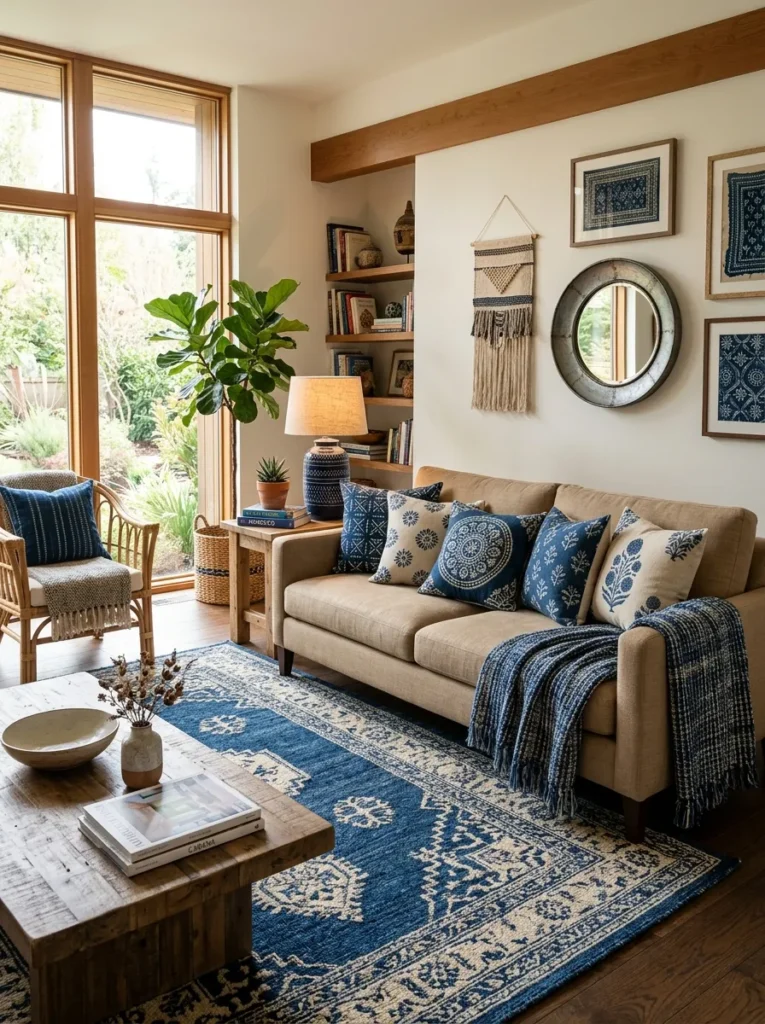
Vibe: The room is globally textured — deep indigo against a tan sofa creates the most traditionally validated warm-cool contrast in textile design history, referencing centuries of indigo-dyed fabric paired with undyed natural fiber across Japanese, Indian, and West African textile traditions.
Why it works: Indigo and tan is one of the most historically documented color pairings in global textile design — the combination appears in Japanese katazome stencil dyeing on natural hemp, in Indian block-printed cotton on undyed ground, and in West African kente cloth alternating indigo with undyed natural fiber. The reason for this recurrence across cultures is straightforward: indigo (a true blue-violet) and tan (a warm yellow-brown) sit in near-complementary relationship on the color wheel, creating maximum color contrast with minimum color clash. The desaturation of both tones (indigo rather than bright blue, tan rather than pure yellow) softens this contrast to a livable, sophisticated level.
How to get it: Source indigo textiles specifically — hand-dyed or block-printed indigo has color variation and depth that synthetic indigo printing lacks. An indigo block-print cushion set ($30–$60 for two), an indigo woven throw ($40–$80), and an indigo-and-cream woven rug ($80–$250) introduce the color comprehensively. Keep all furniture in natural wood tones and walls in warm white — the indigo and tan are doing enough color work without additional color competition.
Shop The Look
- Indigo block print cushion cover set
- Hand dyed indigo throw blanket woven
- Indigo cream area rug woven 6×9
- Indigo ceramic table lamp shade
- Natural wood side table simple profile
11. Tan Sofa in an Open-Plan Space with Zoning Rug Strategy
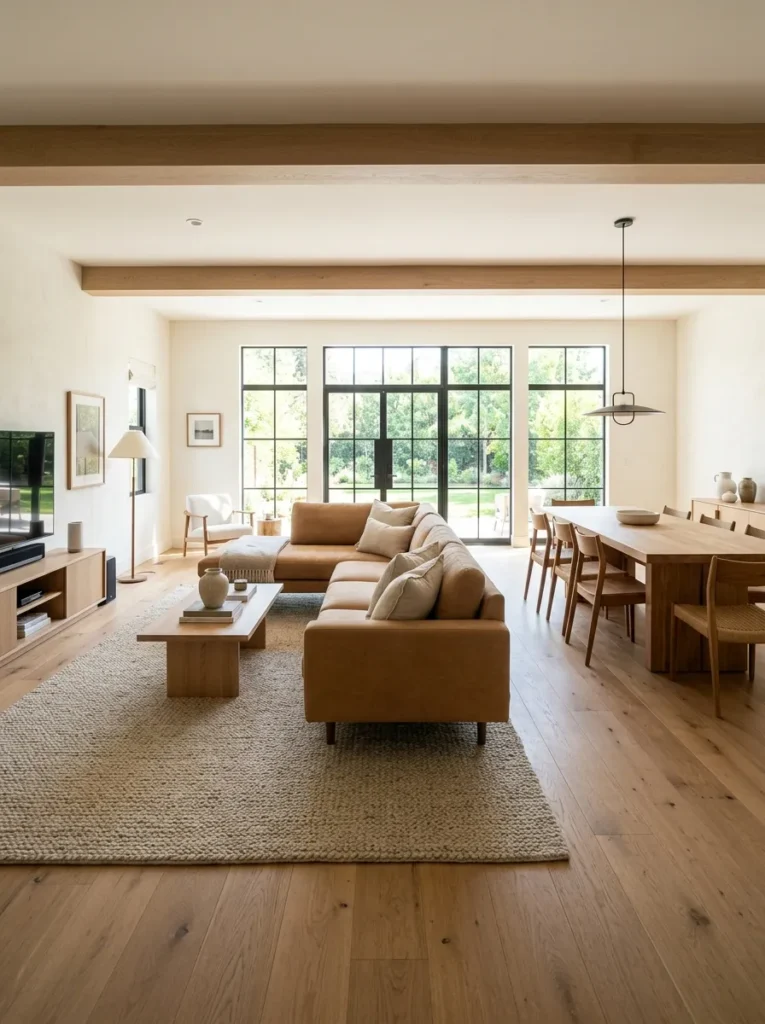
Vibe: The space is organized — a tan sofa anchoring a clearly defined rug zone within an open-plan space demonstrates that the sofa’s warm neutral tone and strong horizontal profile make it uniquely effective as a zone-defining piece.
Why it works: In an open-plan space, the rug beneath a sofa functions as the room’s floor-level boundary marker — the rug’s edge defines where the living zone ends and the adjacent zone (dining, kitchen, corridor) begins more effectively than any furniture arrangement alone. The tan sofa’s warm horizontal mass reinforces this boundary at seating height, creating a two-level zone definition that is legible from any point in the open-plan space. The critical sizing rule: the area rug must extend at least 18 inches beyond the sofa on both sides and at least 12 inches in front of the coffee table — an undersized rug undermines the zone-definition function entirely.
How to get it: Size the living zone rug at minimum 9×12 feet for a standard open-plan living area — measure the intended furniture grouping (sofa, coffee table, two chairs) and add 18 inches on all sides. Position the sofa with all front legs on the rug. Orient the sofa perpendicular to the main open-plan axis to create a clear back wall to the living zone. Choose a rug in a warm natural tone (natural jute, sisal, or a low-pile wool in warm grey or ivory) that coordinates with the tan sofa without matching it exactly.
Shop The Look
- Large natural jute rug 9×12 open plan
- Low pile wool rug warm ivory 9×12
- Rug pad non-slip thick felt large
- Tan sofa modern clean line modular
- Open plan room divider shelf low profile
12. Tan Sofa with Burnt Sienna and Amber for an Autumnal Palette
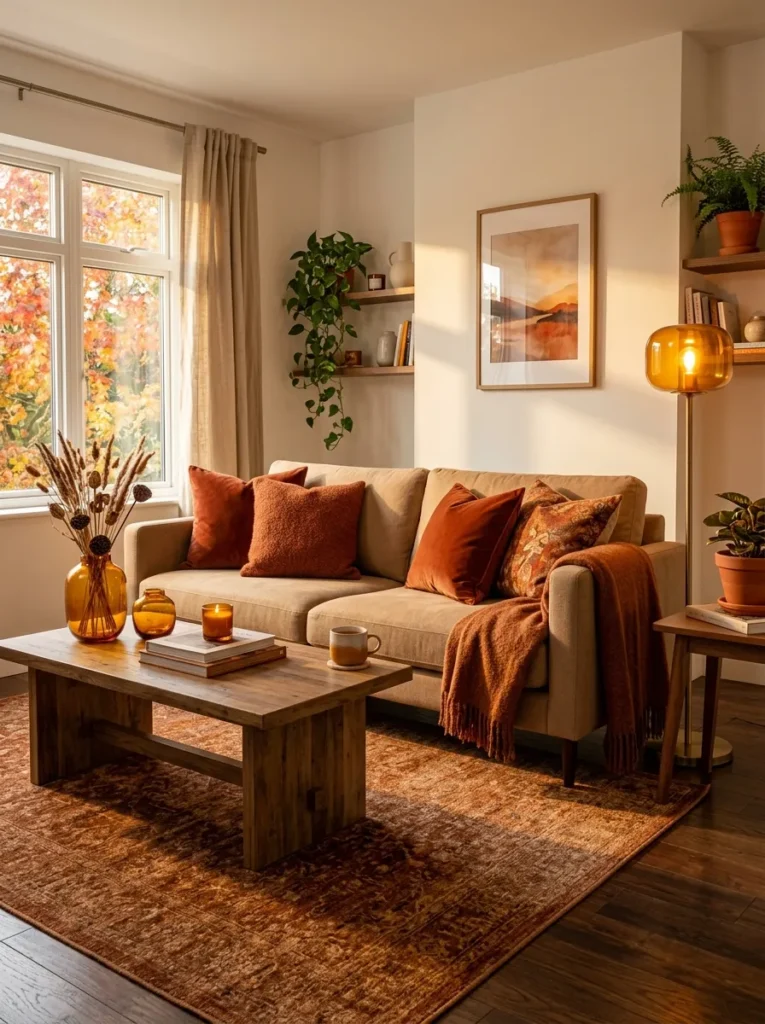
Vibe: The room is deeply warm — burnt sienna and amber accents around a tan sofa create the most intensely warm living room palette possible within the neutral register, where the room glows with the color quality of late afternoon autumn light.
Why it works: Burnt sienna and amber are both higher-saturation members of the same warm yellow-red-orange family as tan, which means adding them to a tan sofa room is a tonal intensification rather than a color contrast — the room becomes warmer and more saturated in a continuous way rather than gaining a contrasting color note. This approach is the opposite of the green-and-tan or indigo-and-tan pairings — instead of cool-warm contrast, this creates warm-warm harmony at escalating intensity. The result is a room that reads as genuinely glowing, particularly under late afternoon or artificial warm light, when the amber, sienna, and tan tones all respond to warm light sources in the same intensifying way.
How to get it: Introduce burnt sienna through velvet cushion covers ($25–$45 each in burnt sienna or deep rust velvet) — velvet amplifies the color intensity of warm tones more than any other fabric through its light-absorbing pile. Add amber through glass (amber glass vases, $15–$40, and an amber glass floor or table lamp shade, $30–$70) rather than paint or ceramic — glass transmits warm amber light rather than reflecting it, creating a literal warm glow. Choose an area rug in a warm sienna or rust tone to ground the palette at floor level.
Shop The Look
- Burnt sienna velvet cushion cover set
- Amber glass vase set varied sizes
- Amber glass floor lamp shade replacement
- Sienna rust toned area rug 8×10
- Warm amber LED bulb set 2200K
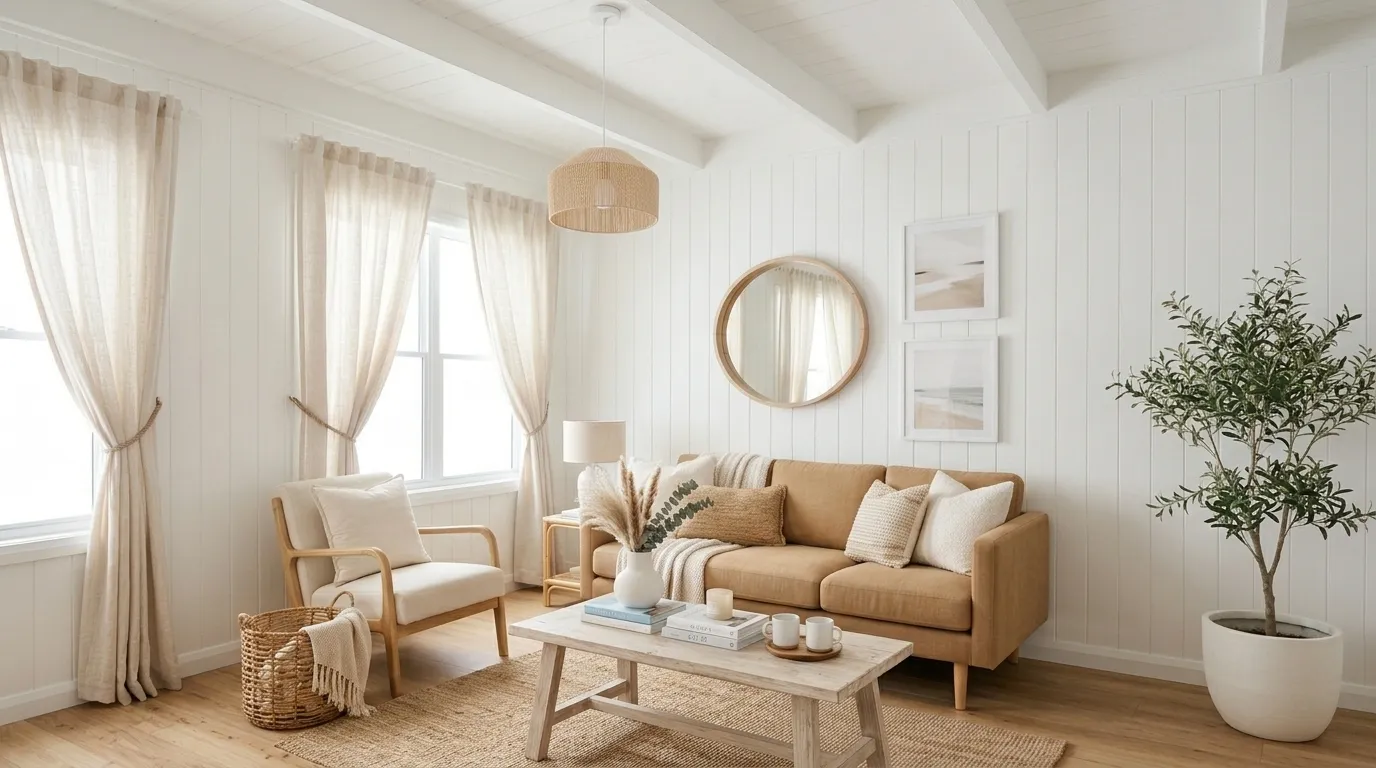
13. Tan Sofa with Cream and White for a Warm Coastal Look
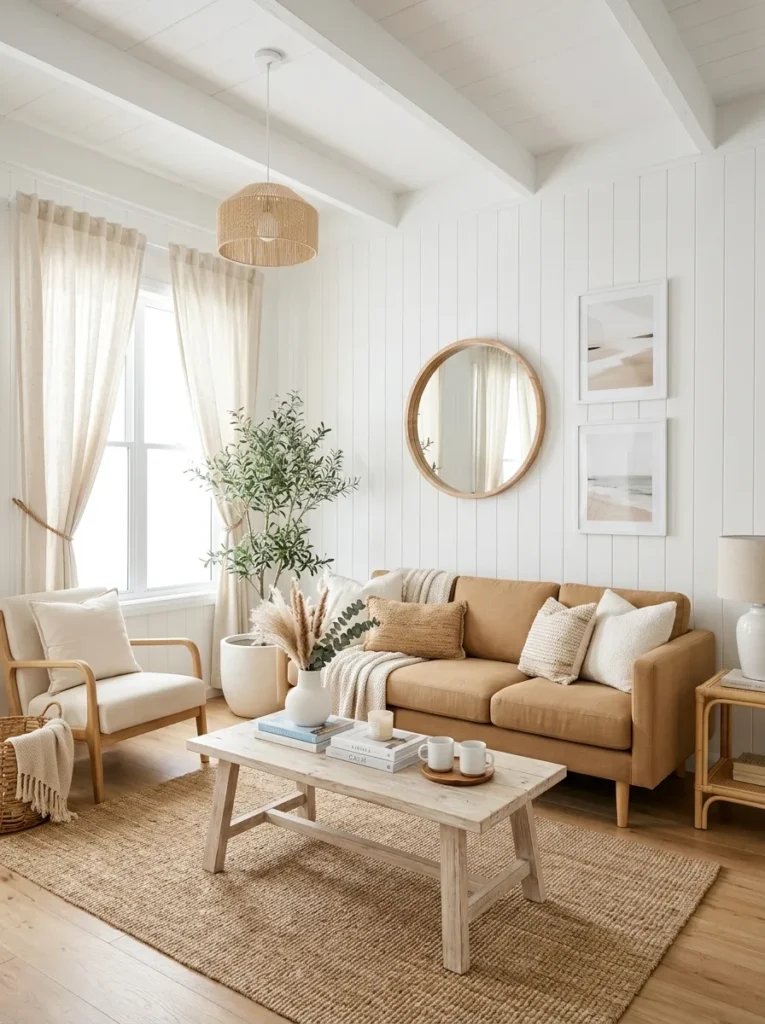
Vibe: The room is airy — tan, cream, and white with bleached wood and natural rattan creates the specific quality of warm coastal light without any of the anchors, ropes, and driftwood signifiers that make coastal decorating feel costumed.
Why it works: Warm coastal design at its most sophisticated references the colors and materials of coastal environments — bleached sand, driftwood, sea grass, white surf — rather than the iconography of maritime life. A tan sofa is the ideal anchor for this approach because its warm beige tone directly references beach sand, the material that defines the coastal palette more than any other. White shiplap (or white-painted planks) on the sofa wall references whitewashed beach architecture while providing the textural surface interest that plain drywall lacks. The absence of explicit nautical signifiers (no anchors, no ropes as decor, no nautical stripes) is what elevates this from coastal theme to coastal quality.
How to get it: Install a shiplap or board-and-batten accent wall in white behind the sofa (peel-and-stick shiplap panels are widely available for a non-destructive installation, $35–$80 per panel). Hang cream linen curtains floor-to-ceiling at the windows. Choose bleached or whitewashed wood for the coffee table and side tables. Add natural rattan and seagrass as accent materials through a basket, a small stool, or a lampshade. Keep all ceramics in pure white for maximum brightness contrast with the tan sofa.
Shop The Look
- Peel stick shiplap wall panel white
- Cream linen curtain panel floor length
- Bleached wood coffee table modern
- White ceramic vase set varied heights
- Rattan accent stool small natural
14. Tan Sofa as Sectional Anchor for a Large Modern Living Room
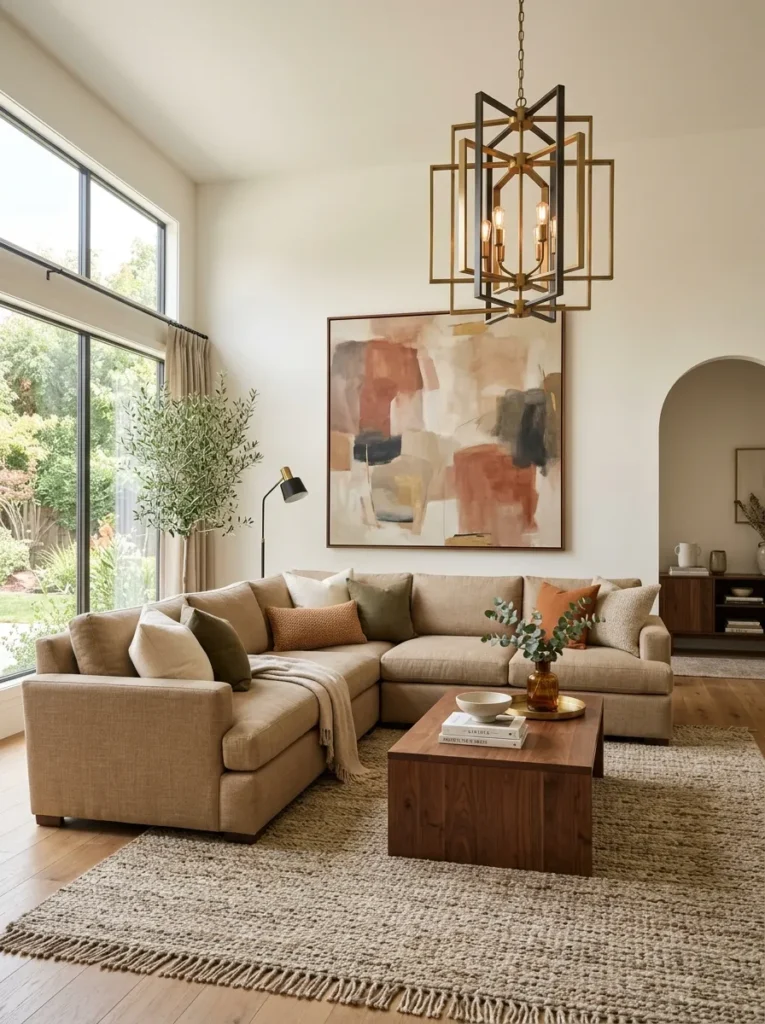
Vibe: The room is generous — a large tan sectional anchoring a living room with an oversized pendant and substantial rug creates the sense of a room designed at proper scale, where the furniture’s proportions match the room’s ambition rather than being dwarfed by it.
Why it works: A tan sectional sofa in a large room exploits one of the tan sofa’s most significant material advantages — its warm neutral tone prevents the visual heaviness that a large sectional in a dark or saturated color creates. A large dark sectional can overwhelm a room by consuming too much visual weight; a large tan sectional fills the same floor area while remaining visually open because its warm neutral tone reflects light rather than absorbing it. The L-shape defines the seating zone’s two boundaries simultaneously, eliminating the need for a secondary sofa or chair arrangement to complete the conversation area. An oversized pendant light (30–40 inches diameter) above the coffee table provides the vertical element that balances the sectional’s strong horizontal presence.
How to get it: Size the sectional to the room — the longer section should be at least 1/3 the room’s length for proportional credibility. Choose a sectional with legs rather than a base-to-floor skirt, as legs allow light to pass under the piece and prevent it from reading as a floor-level mass. Pair with a rug at least 10×14 feet for a large room — a sectional on an undersized rug is one of the most common large living room design mistakes. Choose one large-scale artwork (minimum 36×48 inches) rather than multiple smaller pieces for the wall behind the sectional’s long section.
Shop The Look
- Large tan sectional sofa L shape modern
- Oversized pendant light geometric brass 36 inch
- Large natural area rug 10×14 warm tone
- Large abstract canvas art warm tones
- Walnut wood accent table large modern
How to Start Your Modern Tan Sofa Living Room
The single most important first decision in a modern tan sofa living room is the sofa’s undertone — and this decision must be made before purchasing anything else. Not all tan sofas are the same: some lean pink-beige (rose undertone), some lean grey-beige (greige, cool undertone), and some are true warm tan (yellow-red undertone, the correct choice for the approaches in this article). Bringing home paint samples, rug swatches, and cushion covers that work beautifully with a warm-undertone tan sofa and discovering that your sofa is actually pink-beige or greige is the most common and most expensive styling mistake in this category. Identify your sofa’s specific undertone in the room’s natural light before purchasing any accent element.
The most common beginner mistake in styling a tan sofa living room is over-accessorizing to compensate for uncertainty about the sofa’s neutrality. A tan sofa does not need to be “given personality” by surrounding it with many objects — it already has a warm, grounded material presence that becomes more apparent as the room is edited, not more decorated. The fix is subtraction: remove accessories until only the three to five most materially significant objects remain (the rug, one or two cushion groupings, one plant or large ceramic, one lighting piece) and assess whether the room needs more. In almost every case, it does not.
Three tan sofa living room upgrades under $50 that make an immediate, significant visual difference: a set of two linen cushion covers in a complementary tone to your sofa’s specific undertone ($18–$35 for two, with dusty sage for warm-tan, indigo for true warm-tan, and terracotta for tan-to-camel tones) that set the room’s accent color direction instantly; a warm white LED bulb replacement in every lamp and ceiling fixture ($12–$20 for a four-pack of 2700K warm white bulbs) that shifts the room’s entire ambient quality from cool and flat to warm and golden; and a single large ceramic object on the coffee table ($20–$45 for a quality stoneware or ceramic vase) that replaces multiple small objects with one materially significant piece.
A complete modern tan sofa living room styling — rug, cushions, one accent color direction, quality lighting, and one or two furniture additions — is achievable over a single weekend of intentional editing and shopping. Total investment for a full room refresh built around an existing tan sofa ranges from $150–$400 for a restrained, high-impact approach (new cushions, new rug, new lighting) to $800–$2,000 for a complete material and furniture upgrade. The most important insight is that the tan sofa itself is already doing significant design work — the styling job is to support and amplify what it already offers rather than to compensate for or work around it.
Frequently Asked Questions About Modern Tan Sofa Living Rooms
What colors go best with a tan sofa in a modern living room?
The most successful color pairings with a tan sofa depend on the design effect sought. For richness and botanical warmth, deep forest green is the strongest pairing — it creates maximum warm-cool contrast while maintaining the organic material palette that tan sofa rooms excel at. For sophistication and graphic clarity, warm charcoal or matte black accents create the sharpest neutral contrast. For earthy Mediterranean warmth, terracotta tones extend the tan sofa’s color family toward greater saturation and depth. For globally textile-influenced warmth, deep indigo creates the historically validated warm-cool textile pairing. For the warmest possible palette, burnt sienna and amber tones intensify the room’s warmth continuously. The one pairing to avoid is cool grey — the undertone conflict between cool grey and warm tan is the most reliable way to make a tan sofa read as dated rather than warm.
What type of rug works best under a modern tan sofa?
The rug beneath a tan sofa must be warm-toned (no cool grey or blue-toned rugs) and large enough to anchor the full furniture grouping — minimum 8×10 feet for a standard sofa and coffee table, minimum 9×12 for a sofa with two accent chairs. Natural fiber rugs (jute, sisal, seagrass) in their natural honey-tan tone coordinate most effortlessly with a tan sofa because they share the same warm neutral family. Hand-knotted or hand-woven wool rugs in ivory, warm grey, or dusty sage provide more texture and luxury while remaining tonally compatible. Patterned rugs work well when the pattern’s dominant tone is warm — a vintage-style rug in warm ochre, rust, and cream reads as designed with a tan sofa; the same style in blue and grey reads as unresolved. The most reliable approach: when in doubt, choose a natural jute or sisal rug in its natural color, which coordinates with any warm-undertone tan sofa without any risk of undertone conflict.
Should curtains in a tan sofa living room be light or dark?
For most tan sofa living rooms, light curtains (warm white, cream, or natural linen) are the superior choice because they maximize natural light and maintain the room’s warm, open quality. Floor-to-ceiling cream linen curtains hung wide of the window frame (to expose the maximum glass area when open) make the room’s light quality the most compelling element in the room, which is appropriate when the tan sofa and warm materials are doing the design work. Dark curtains work specifically when the room has an accent wall (dark curtains on an accent wall create excessive contrast that competes with the accent wall’s own statement) or when light control is the primary need. If dark curtains are desired, choose them in a warm tone (deep terracotta, warm forest green, or warm charcoal) that aligns with the room’s accent color direction rather than introducing a new color.
How do I make a tan sofa look more expensive and modern?
Four specific changes make any tan sofa look more expensive and more modern regardless of the sofa’s original quality. First, replace the cushion inserts with down or down-alternative inserts (minimum 95/5 feather-down ratio) even if keeping the existing covers — the fullness and drape of a properly filled cushion immediately elevates the sofa’s apparent quality. Second, have the sofa professionally cleaned or steam-cleaned — a clean, bright tan reads as expensive while a dull, slightly grey-toned tan reads as old regardless of actual age. Third, remove all decorative items from the coffee table except one quality object (a large ceramic, a quality art book, a single large candle) — visual restraint reads as confidence and quality. Fourth, ensure the lighting in the room is warm (2700K or lower) — tan upholstery under cool white light reads as flat and institutional, while under warm light it reads as rich and intentional.
Can a tan sofa work in a small living room without making it feel smaller?
Yes — a tan sofa in a small living room is actually one of the most space-sensitive design choices available, because the sofa’s warm neutral tone reflects light rather than absorbing it, which is the critical optical characteristic for making a small space feel larger. The practical application: pair the tan sofa with warm white walls (not cream, which can yellow in small rooms and reduce the brightness benefit), a light-toned natural fiber rug, and minimal accessories rather than dense layering. Avoid dark accent walls in small tan sofa living rooms — the forest green or charcoal accent wall approaches that work beautifully in medium to large rooms make small rooms feel cave-like. For small rooms specifically, the warmth and brightness approach (tan sofa, warm white walls, light rug, warm natural light) is significantly more effective than the accent color approaches, and the room’s warmth can be introduced through one or two quality accessory pieces rather than through wall color.
Ready to Style Your Modern Tan Sofa Living Room?
These 14 ideas cover the full range of what a modern tan sofa living room can be — from the tonal serenity of a warm white and natural textile monochrome, to the graphic confidence of matte black accents, to the botanical richness of deep forest green and brass, to the sectional-anchored generosity of a large modern living space. The tan sofa is not a compromise or a default — it is one of the most versatile, warmest, and most design-intelligent sofa choices available, and every idea in this article is a demonstration of that versatility in a different direction. Start by identifying your sofa’s specific undertone and choosing one pairing direction from this list that most aligns with how you want the room to feel — warm and serene, rich and botanical, graphic and confident, or globally textured. Then begin with the single highest-impact element for that direction: a rug, an accent wall color, a cushion set, or a lighting change. A tan sofa living room done with intention does not just look good — it feels genuinely warm, livable, and like somewhere a person would actually want to spend their time. Pin the ideas that made you see your sofa differently — those are the ones your room is already ready for.