15 Beautiful Spring Home Decor Ideas
Spring home decor is the seasonal shift in a home’s palette, materials, and atmosphere that responds to the return of light, warmth, and natural growth — introducing fresher colors, lighter textiles, natural botanical elements, and the visual quality of an environment opening up after winter’s enclosure. Here are 15 ideas for transitioning your home into spring in ways that feel genuinely considered rather than seasonally obligatory.
Spring decor done well doesn’t announce itself. It doesn’t require a complete room overhaul or a shopping cart of seasonal purchases. It is subtler than that — a shift in the quality of light the room holds, a change in what sits on the counter or the windowsill, a color that wasn’t there in January. The homes that make spring feel most present are the ones that respond to what the season actually is: more light, more warmth, more life coming back. Here are 15 ideas worth saving — and stealing.
Why Spring Home Decor Works So Well
What makes spring home decor distinct from general seasonal decoration? Spring home decor is the most nuanced of the four seasonal decorating moments because it operates through addition and subtraction rather than wholesale replacement — the most effective spring interiors don’t swap out a winter aesthetic for a spring one so much as lighten, brighten, and enliven what already exists. Spring decor draws from the same principles that govern landscape design in the season: the emergence of color from a neutral base, the return of organic life, and the quality of light changing from the warm amber of winter evenings to the cooler, more luminous quality of longer days. Applied to interiors, this translates to lighter textiles, fresher botanicals, cleaner palettes, and a reduction of the visual weight that makes winter rooms feel cozy.
Core materials and colors. The spring home decor material palette leans toward the natural and the fresh: white and cream linen in lighter weights than winter counterparts, natural cotton in warm white and soft sage, rattan and wicker in natural honey tones, terracotta and ceramic in soft blush and pale sage finishes, fresh and dried botanicals in every format from tulip stems to eucalyptus branches. The color palette moves in two directions simultaneously: softer and more muted (dusty sage, warm blush, pale lavender, soft butter yellow) and fresher and more saturated (clear coral, grass green, warm daffodil, soft robin’s egg blue) — the most successful spring palettes choose one direction and commit to it rather than mixing both registers in the same room.
Why spring home decor matters more than other seasonal transitions. The spring seasonal shift is the one that most people feel most acutely — after months of reduced light, heavier textiles, and indoor enclosure, the first visual signals of spring in the home carry an emotional weight disproportionate to their decorative significance. Research in environmental psychology consistently demonstrates that the introduction of natural botanical elements and increased color saturation in domestic environments produces measurable improvements in mood and sense of wellbeing — effects that are most pronounced in late winter and early spring when the contrast with the preceding season is greatest.
Can spring decor be achieved through small, low-cost interventions? Spring is the seasonal decor moment most achievable through small changes — because the season’s essential qualities (more light, more color, more life) can be introduced through a bunch of tulips on the kitchen counter, a swap of heavy linen curtains for lighter sheers, and a change of throw pillow covers as effectively as through a complete room redesign. The spring decorating investment that returns the most emotional value is almost always fresh botanicals — a $15 bunch of seasonal flowers does more for a room’s spring atmosphere than $150 of seasonal accessories.
Style at a Glance
| Element | Detail |
|---|---|
| Philosophy | Lighten, brighten, and enliven rather than replace |
| Key Materials | Light linen, cotton, rattan, terracotta, fresh botanicals, ceramic |
| Key Colors | Dusty sage, warm blush, butter yellow, soft coral, warm cream, lavender |
15 Beautiful Spring Home Decor Ideas
1. Fresh Tulip and Ranunculus Arrangements in Ceramic Vessels
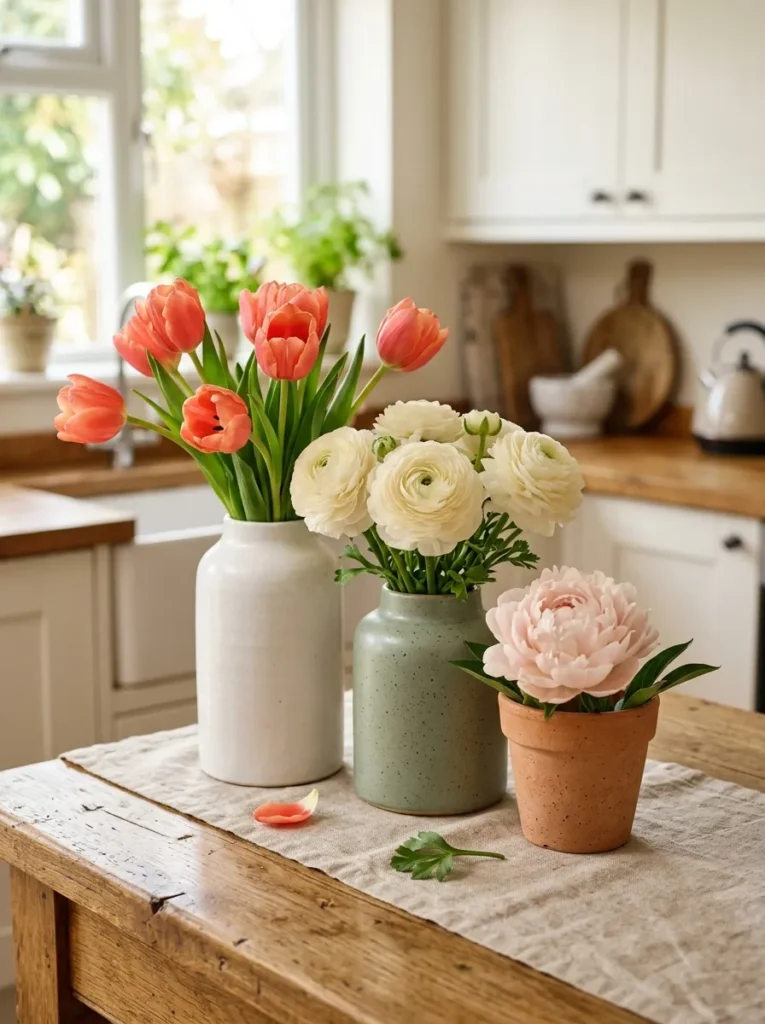
Vibe: A fresh spring flower cluster feels immediately alive — the room change that costs $20 and makes every other element in the kitchen look more considered.
Why it works: Fresh spring flowers are the spring home decor intervention with the highest emotional impact per dollar — they introduce the season’s essential qualities (color, life, fragrance, impermanence) simultaneously and cannot be replicated by any other decorative element. The design principle is varied vessel clustering: placing three different flower types in three different ceramic vessels creates a composed floral installation rather than a single vase arrangement, which allows each flower to be appreciated individually while the three vessels together create a visual conversation. Varying the vessel height, material, and color (white, sage, terracotta) across the three pieces provides the material complexity that makes a flower cluster read as designed rather than simply placed.
How to get it: Source tulips, ranunculus, and peonies from a florist, farmers market, or grocery store with a good floral section in early to mid-spring. Arrange each flower type separately in its own vessel rather than combining all three in one large vase — separation creates more visual drama and extends the life of each variety independently, since different flowers have different water requirements. Place the tallest vessel at the back of the group, the medium vessel slightly in front and to one side, and the smallest vessel closest to the viewer at a slight angle to the group.
Quick Win: A single bunch of ten coral or warm pink tulips in a tall white ceramic vase on the kitchen counter or dining table is the fastest, lowest-cost spring decor intervention available — $8–$15 at most grocery stores or farmers markets, and more atmospherically effective than any seasonal accessory at the same price point.
Shop The Look
| Product |
|---|
| Matte white ceramic vase tall for spring flowers |
| Dusty sage ceramic vessel medium |
| Small terracotta pot for single stem display |
| Floral preservative packet for fresh cut flowers |
| Linen table runner for counter display |
Also view: 13 Elegant Tan Sofa Styling Ideas for Every Home
2. Swap Heavy Curtains for Sheer Linen Panels
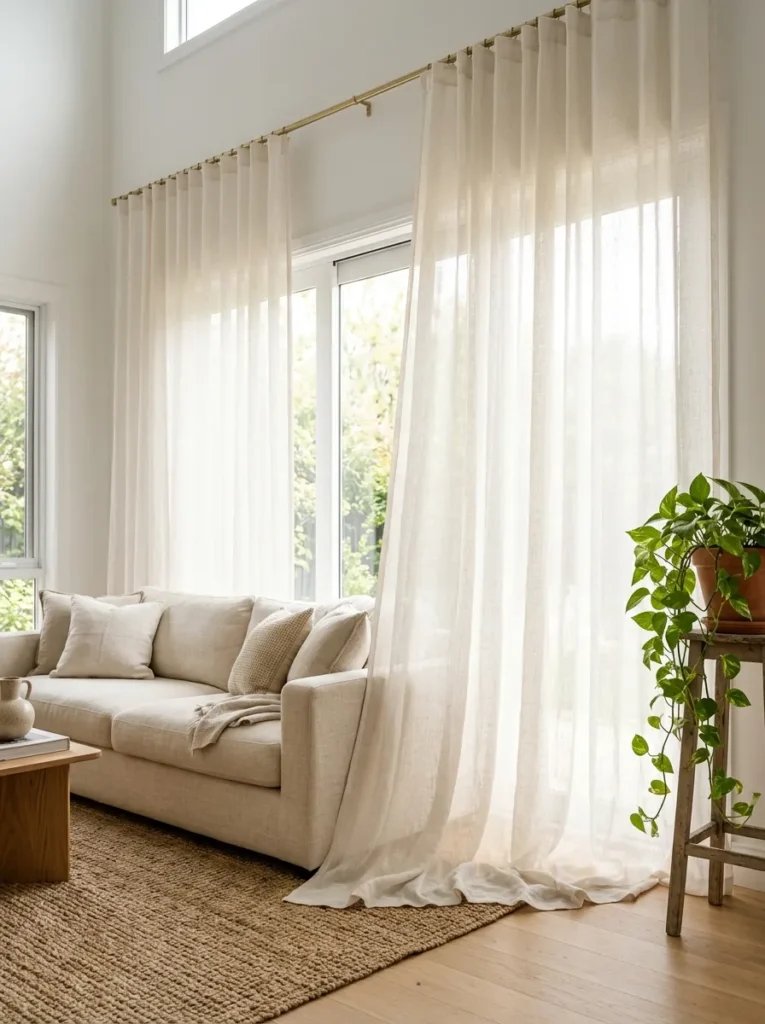
Vibe: Sheer linen panels in spring light feel luminous — the window treatment that makes the whole room glow from the inside.
Why it works: Replacing heavy winter curtains with sheer linen panels is the spring home decor change with the most dramatic atmospheric impact — it converts the room’s relationship with natural light from controlled and contained to open and diffused. The design principle is light quality transformation: a heavy curtain blocks and interrupts natural light; a sheer linen panel filters and distributes it, creating the soft, luminous quality that characterizes the spring interior atmosphere. Natural linen sheers specifically — rather than synthetic voile or polyester sheers — have a warmth and texture that reads as intentional interior design rather than temporary window covering. The slight warm tone of natural linen also warms the quality of light passing through it, preventing the cool, clinical quality that white synthetic sheers can produce.
How to get it: Replace existing winter curtain panels with natural linen sheers at the same rod and ceiling-height installation. Choose a linen or linen-cotton blend sheer at 40–60 gsm for adequate translucency — heavier linen sheers at 80 gsm and above block more light than they filter and lose the characteristic spring luminosity. Mount the rod at ceiling height or 2 inches below crown molding and use panels long enough to create a 1–2 inch floor puddle for the most elegant spring draping.
Shop The Look
| Product |
|---|
| Sheer natural linen curtain panel set floor length |
| Slim brass curtain rod ceiling mount |
| Brass curtain ring set for linen panels |
| Natural linen tieback set for gathered look |
| Ceiling mount bracket for high rod installation |
3. Spring Wreath on the Front Door in Seasonal Botanicals
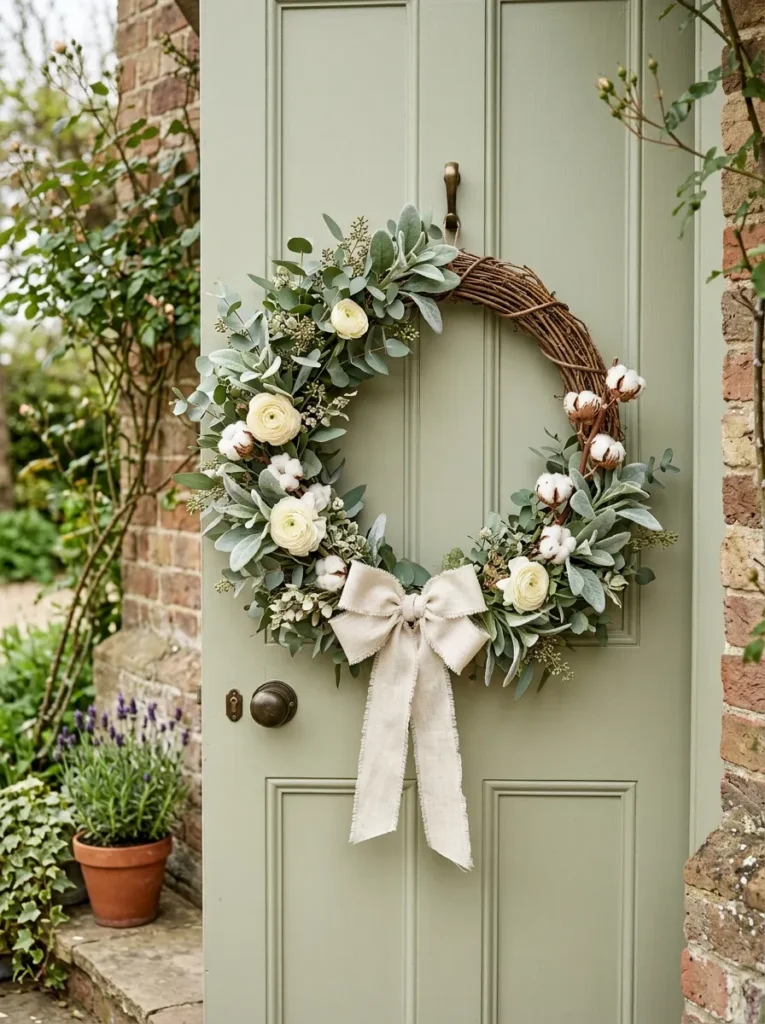
Vibe: A spring botanical wreath on the front door feels welcoming in the most literal sense — the first spring element every visitor encounters.
Why it works: A front door wreath is the spring home decor element with the widest social reach — it communicates spring’s arrival to everyone who approaches the home before they’ve entered, making it a seasonal gesture that extends beyond the private interior. The design principle is botanical composition as seasonal signal: a wreath built from seasonal botanicals (eucalyptus, ranunculus, lamb’s ear, spring blossoms) communicates spring through its materials rather than through its form, which gives it a sophistication that a generic floral wreath cannot achieve. A grapevine base in natural brown tones provides the visual structure that allows varied botanical components to read as a composed arrangement rather than a random collection of attached materials.
How to get it: Purchase a natural grapevine wreath base (40–50 cm diameter) from a craft supplier. Arrange botanical components in a C-shape on one side of the base rather than covering the full circumference — partial botanical coverage on a natural base reads as more organic and less manufactured than uniform coverage. Attach stems using floral wire wound around the base. Layer botanical types from largest (eucalyptus branches) to smallest (individual flower heads) to create depth. Finish with a loose linen ribbon tied in a relaxed bow at the six o’clock position.
Shop The Look
| Product |
|---|
| Natural grapevine wreath base 50cm |
| Fresh or dried eucalyptus bundle for wreath |
| Cream ranunculus stem bundle artificial or fresh |
| Dried lamb’s ear bundle for wreath |
| Natural linen ribbon 5cm for bow |
4. Botanical Print Gallery Refresh with Spring Subjects
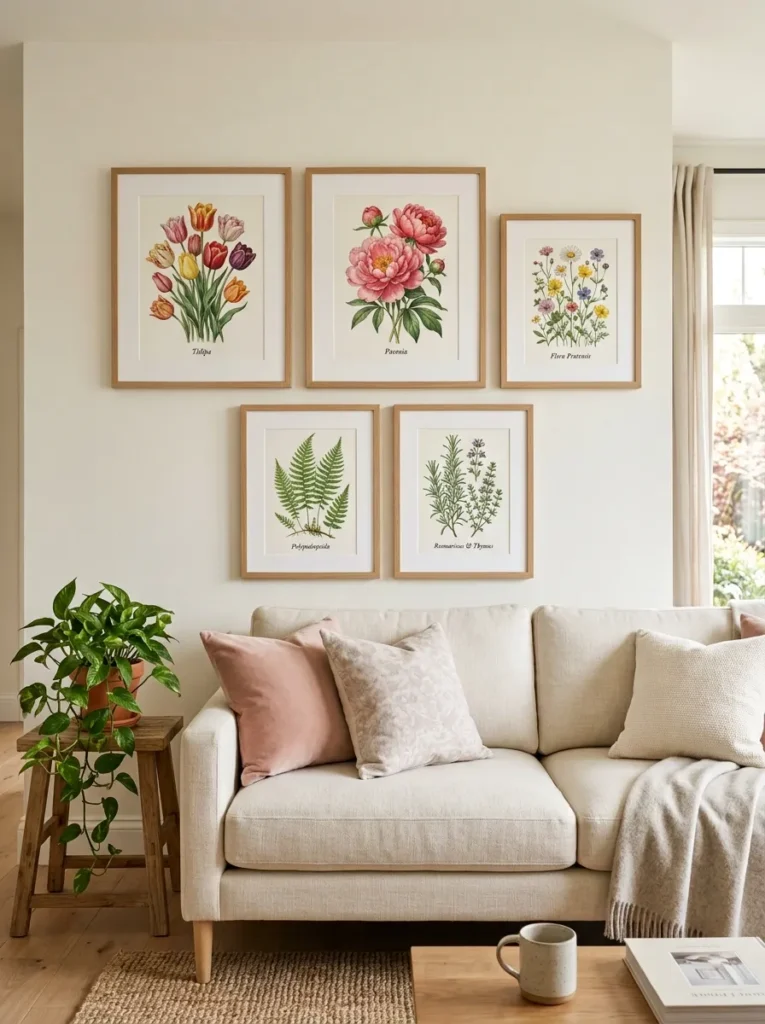
Vibe: A botanical print gallery wall feels intellectually spring — the seasonal refresh that changes the room’s subject matter rather than its furniture.
Why it works: Refreshing gallery wall prints seasonally is the spring home decor approach most often overlooked — most homeowners treat gallery walls as permanent installations, when they are actually one of the most easily and inexpensively updated room elements available. The design principle is content rotation as seasonal signal: swapping winter-appropriate gallery wall content (moody abstracts, dark photography, geometric prints) for spring botanical illustrations changes the room’s visual subject matter to the season’s themes without changing any furniture, paint, or structural element. Botanical illustration specifically — the tradition of scientific plant illustration from the 16th century onward — is the print category that most directly connects spring home decor to its natural sources.
How to get it: Source spring botanical illustration prints from Etsy digital download sellers (printable files for $3–$8 per print), the Biodiversity Heritage Library (free high-resolution historical botanical illustrations), or contemporary botanical illustration artists on Society6. Print at home on 100gsm matte photo paper or at a local print shop for the most accurate color reproduction. Frame in the same slim natural oak frames as existing gallery wall pieces to maintain visual coherence while refreshing the content. Botanical prints in the Redouté or Audubon illustration tradition are the most consistently well-received spring botanical print styles.
Shop The Look
| Product |
|---|
| Slim natural oak picture frame set mixed sizes |
| White mat board pre-cut assorted botanical sizes |
| Botanical illustration art print spring flowers |
| Tulip botanical print vintage style |
| Picture hanging strip damage free for refresh |
5. Linen and Cotton Throw Pillow Refresh in Spring Tones
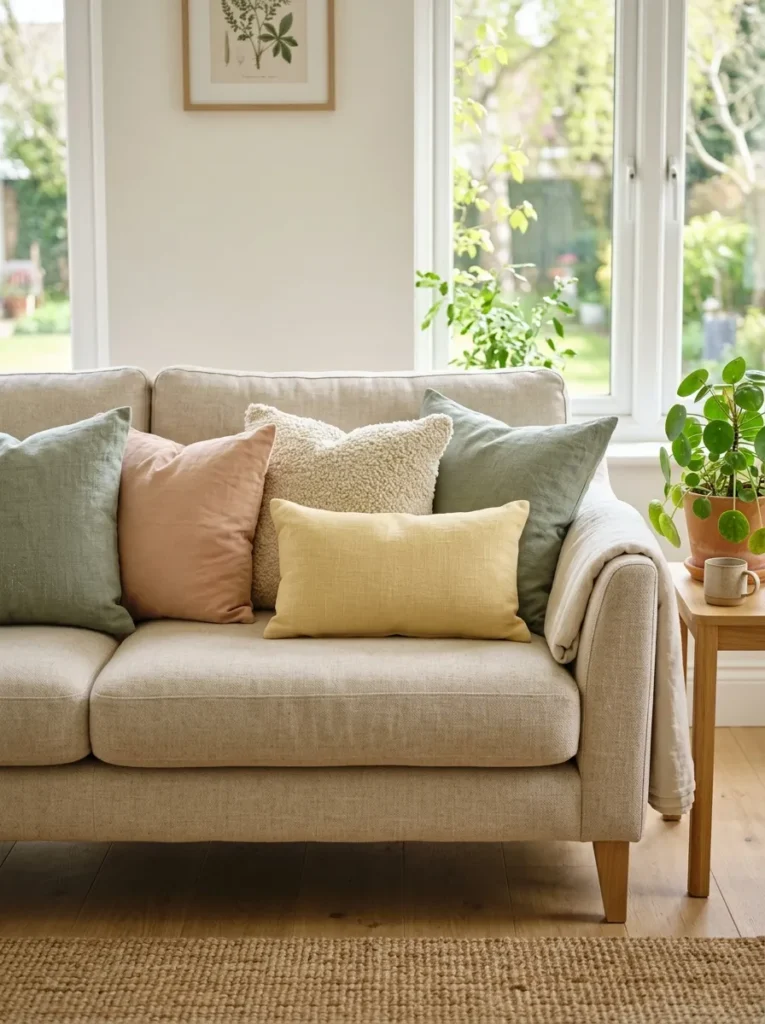
Vibe: A spring pillow refresh feels immediately lighter — the sofa that says the season has changed before anyone has looked at a calendar.
Why it works: Throw pillow refreshes are the spring home decor change with the highest impact-to-effort ratio — changing four to five pillow covers on an existing sofa changes the room’s entire color atmosphere in under ten minutes at a material cost of $40–$80. The design principle is color palette shift through soft furnishings: the sofa’s primary pillow arrangement is the room’s largest soft surface outside of the upholstery itself, and its color therefore has an outsized impact on the room’s overall palette. Moving from a winter palette (warm rust, deep ochre, charcoal) to a spring palette (dusty sage, warm blush, butter yellow) on the same sofa and the same arrangement structure changes the room’s seasonal register completely while requiring no furniture movement or paint change.
How to get it: Identify the four to five throw pillow positions on your sofa and purchase new covers (not new inserts — pillow cover swaps are the sustainable approach) in the spring palette. Keep the same size structure as winter (two 22-inch squares, two 18-inch squares, one lumbar) but change the colors and textures to spring equivalents: dusty sage linen replaces deep ochre wool, warm blush cotton replaces rust velvet, cream bouclé replaces dark charcoal knit. Store winter covers in a labeled box for reuse next season.
Shop The Look
| Product |
|---|
| Dusty sage linen throw pillow cover 22×22 |
| Warm blush cotton pillow cover 20×20 |
| Cream bouclé accent pillow cover 18×18 |
| Butter yellow linen lumbar cover 14×22 |
| Light linen throw blanket for sofa arm |
6. Terracotta Pot Cluster with Spring-Blooming Plants
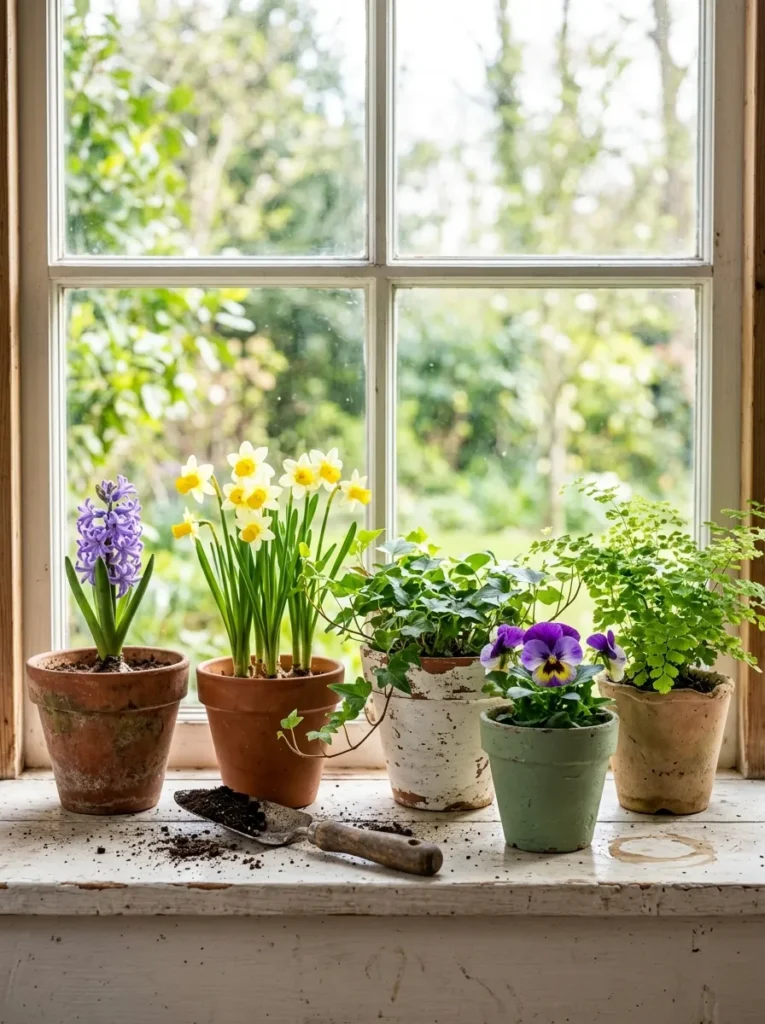
Vibe: A terracotta spring plant cluster feels alive and sun-warm — the windowsill that makes you notice the morning light differently.
Why it works: A cluster of spring-blooming plants in terracotta pots is the spring home decor element that most directly brings the season’s biological reality indoors — these are not representations of spring (prints, textiles, ceramic flowers) but spring itself, in miniature growing form. The design principle is material authenticity as seasonal presence: a hyacinth in bloom in a terracotta pot on a window ledge communicates spring through fragrance, color, and living growth simultaneously — three channels of seasonal information that no decorative object can replicate. Terracotta is the optimal container material for spring plant clusters because its warm, raw clay tone connects the indoor cluster to the garden context from which the season draws its visual identity.
How to get it: Source spring-blooming bulb plants (hyacinth, narcissus, grape hyacinth, small tulip varieties) from a florist, garden center, or grocery store floral section in early spring. Place on a bright window ledge or shelf in their existing nursery pots nested inside terracotta pots — no repotting required for temporary display. Vary the pot sizes by choosing three to four sizes and mixing aged, raw, and softly painted terracotta for variety. Water sparingly — most forced bulb plants in pots are in their final bloom cycle and do not require heavy feeding.
Shop The Look
| Product |
|---|
| Terracotta pot set varied sizes 3 piece |
| Small hyacinth bulb plant spring blooming |
| Compact narcissus daffodil potted bulb |
| Maidenhair fern small indoor potted |
| Sage painted terracotta pot small |
7. Spring Table Setting with Fresh Linen and Florals
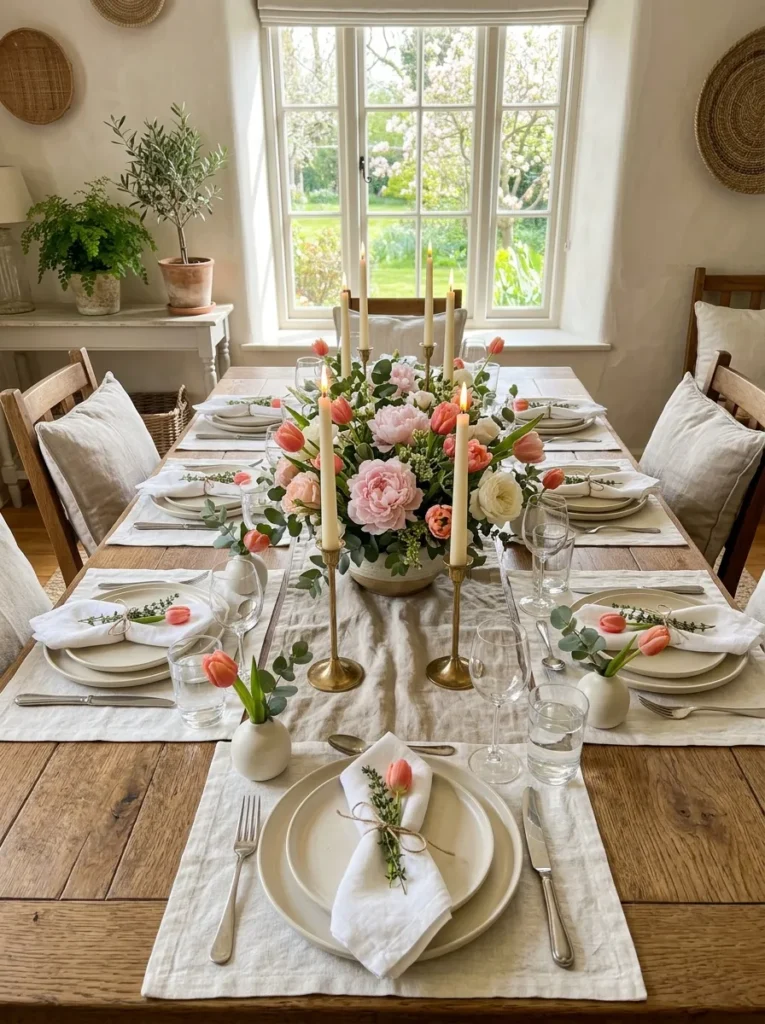
Vibe: A spring table setting feels deliberately celebratory — the table that makes an ordinary Tuesday dinner feel like it was worth dressing for.
Why it works: A seasonally considered table setting is the spring home decor expression that is most directly experienced by the people sharing the meal — it creates a composed visual environment that frames conversation and connection within a deliberately crafted atmosphere. The design principle is place setting as hospitality gesture: the decision to add a small bud vase with a single tulip stem at each place setting communicates individual attention to each diner in a way that a single centerpiece cannot. A linen runner along the table center grounds the individual place settings in a unified composition without requiring a formal tablecloth that would cover the warm oak grain of the table below.
How to get it: Layer the table from largest to smallest: linen runner down the center, linen placemats at each place, white ceramic plates on each placemat, napkins folded and tied with a short length of linen twine and a small herb sprig. Build the centerpiece loosely along the linen runner — stem flowers directly into a low vessel of water without arranging tightly, allowing the stems to find their own angles. Place a single bud vase with one tulip stem at each place setting. Brass candlesticks at each end of the runner complete the composition.
Shop The Look
| Product |
|---|
| Natural linen table runner 180cm |
| Natural linen placemat set of 4 |
| White ceramic bud vase small set of 4 |
| Slim brass candlestick set of 2 |
| Linen napkin set natural with twine |
8. Dried and Fresh Botanical Mantel Display
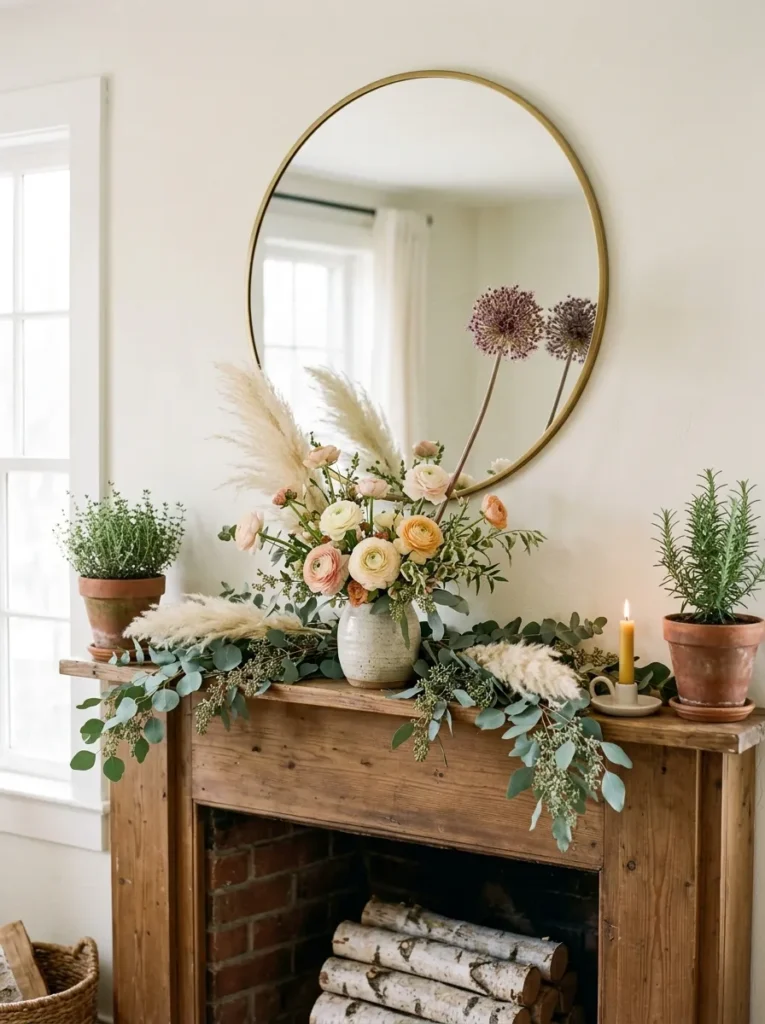
Vibe: A spring botanical mantel feels organically generous — the display that makes the fireplace feel useful again when you no longer need the fire.
Why it works: The fireplace mantel in spring presents a specific design challenge — it has been the room’s warm focal point throughout winter, but the fireplace itself is no longer in use, which risks making the mantel feel purposeless in spring. A botanical mantel display resolves this by converting the mantel’s focal role from warmth-giver to nature-displayer, transferring the room’s visual interest from the fire below to the botanical arrangement above. The design principle is varied botanical height for visual rhythm: using botanical elements at three distinct heights (low horizontal eucalyptus branches, mid-height ceramic vessel with ranunculus, tall allium stem) creates a composition with the visual complexity of a garden border — diverse and layered without appearing chaotic.
How to get it: Begin with the longest, lowest elements — eucalyptus branches or trailing botanical stems laid horizontally along the mantel shelf. Add mid-height elements at the center: a ceramic vessel with fresh flowers, a cluster of pampas plumes, or a group of dried botanical stems. Place the tallest element (a single allium stem, a tall branch, or a large ceramic vase) at an off-center position rather than dead center — asymmetric placement reads as organic while centered placement reads as formal. Finish with small potted herbs at each end of the mantel as living anchors.
Shop The Look
| Product |
|---|
| Dried eucalyptus branch bundle for mantel |
| Dried pampas grass plume natural |
| Round mirror 60cm for above mantel |
| Small terracotta herb pot set for mantel ends |
| Dried allium stem set for height accent |
9. Lemon and Citrus Kitchen Display
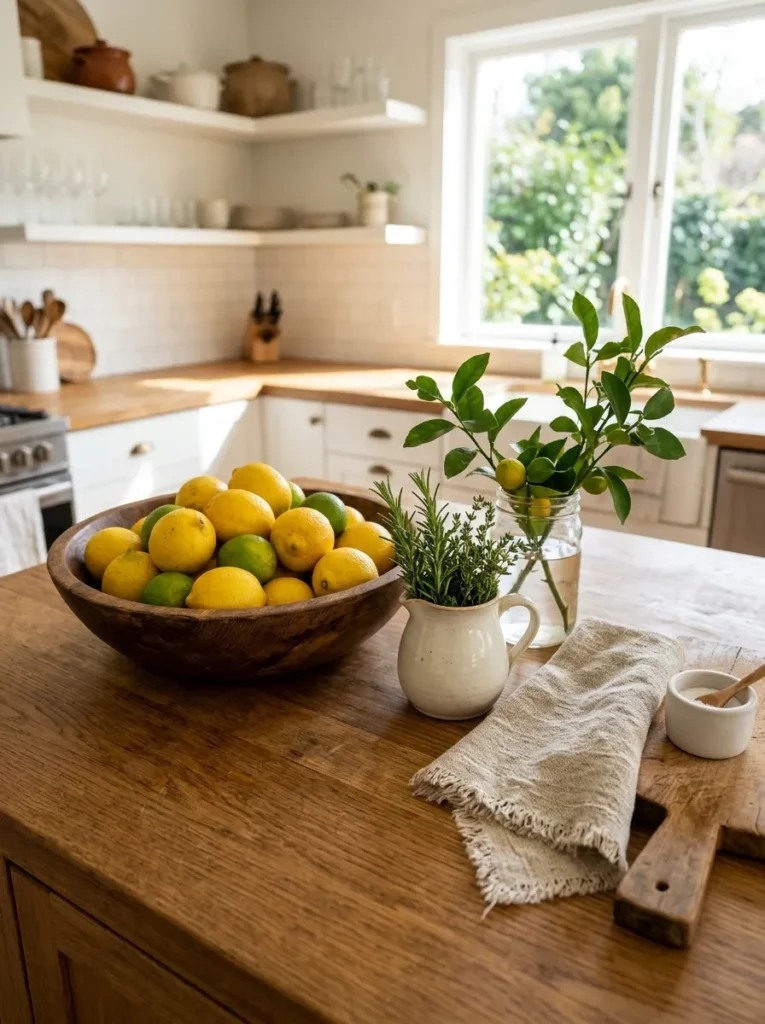
Vibe: A lemon kitchen display feels brightly optimistic — the counter arrangement that makes the kitchen feel like the season has arrived without a single decorative purchase.
Why it works: A bowl of lemons on the kitchen counter is one of the oldest and most enduringly effective spring kitchen decor ideas because it introduces the season’s essential color (bright, saturated yellow) in the most natural, functional, and fragrant way possible. The design principle is functional object as decoration: lemons are both decorative objects and cooking ingredients, which means the display is simultaneously aesthetically serving and practically stocked — a combination that connects the kitchen display to the room’s purpose rather than interrupting it. The bright yellow of lemons against a warm wood bowl and a white ceramic counter creates the color contrast that visually announces spring more effectively than almost any decorative accessory.
How to get it: Fill a wooden bowl or woven basket with eight to twelve unwaxed lemons — the natural, matte-skin lemons available at farmers markets have a more organic, textured appearance than supermarket lemons treated with wax for extended shelf life. Add two to three limes for color variation. Place a small ceramic pitcher with fresh herb stems (rosemary and thyme create a fragrant herb display) beside the lemon bowl. The combination of citrus and fresh herbs engages two senses — sight and fragrance — creating a kitchen atmosphere that extends beyond the visual.
Quick Win: A bag of lemons from a grocery store placed in any wooden bowl already in the kitchen is the fastest spring kitchen update available — under $5 and achievable on the way home from work.
Shop The Look
| Product |
|---|
| Natural wood fruit bowl large round |
| Small ceramic pitcher for herb stems |
| Fresh unwaxed lemon bag for display |
| Linen kitchen cloth set natural |
| Small ceramic salt cellar for counter |
10. Bud Vase Windowsill Collection
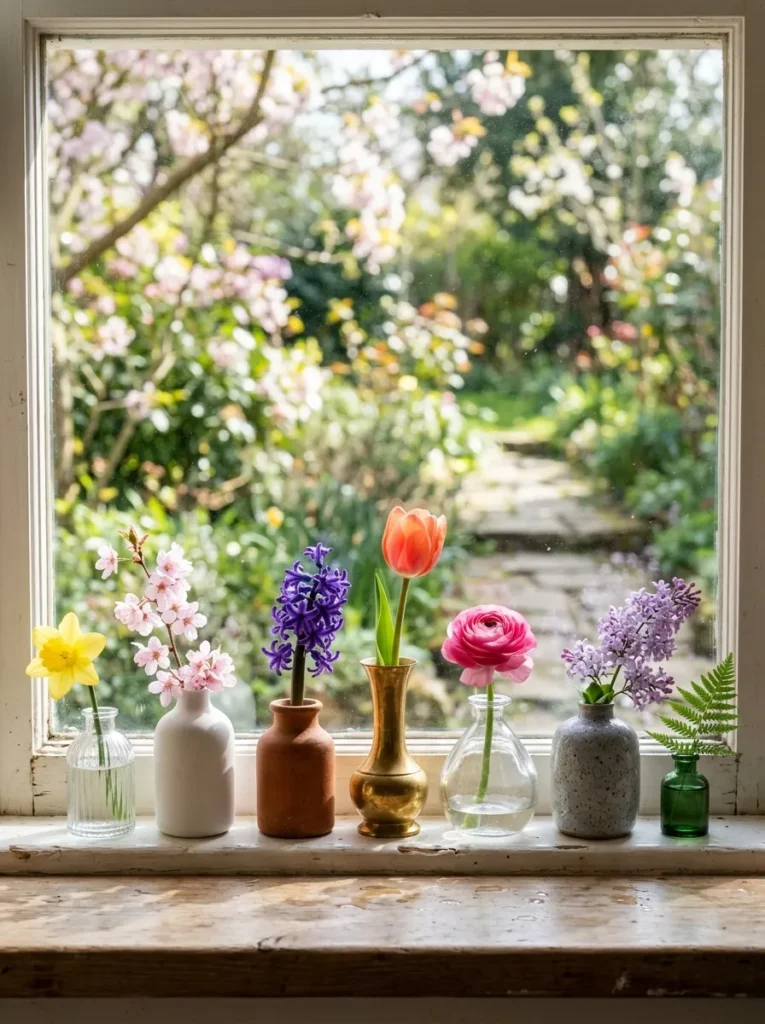
Vibe: A windowsill bud vase collection feels delicate and specific — the spring display that rewards close attention as much as it rewards first glance.
Why it works: A windowsill bud vase collection with one stem per vase is the spring home decor arrangement that most effectively uses the season’s characteristic light quality — the bright, angled light of spring passing through petals and glass simultaneously creates a luminous, backlit effect that no other season’s light can replicate. The design principle is singular emphasis through individual display: placing one stem per vessel rather than multiple stems per vase focuses the viewer’s attention on each flower’s individual character — the hyacinth’s dense floral column, the tulip’s cup form, the cherry blossom’s branching structure — in a way that mixed arrangements cannot achieve. Varied vessel materials (glass for transparency, ceramic for opacity, brass for warm reflection) create a material variety that makes the collection visually interesting even before the flowers are placed.
How to get it: Collect seven bud vases in varied sizes and materials from your existing collection, local vintage shops, or ceramic artists. Fill each with 3–4 cm of fresh water and place a single spring flower or botanical stem — one stem per vase, all stems in the same season’s current offering (what is available right now at the market or the garden). Arrange on the sunniest windowsill in the most-used room. Replace individual stems as they fade rather than replacing the whole collection — the windowsill evolves through spring as different flowers come into season.
Shop The Look
| Product |
|---|
| Small glass bud vase set of 3 varied heights |
| Ceramic bud vase white small set of 2 |
| Brass bud vase small decorative |
| Terracotta small pot for single stem display |
| Single stem floral preservative solution |
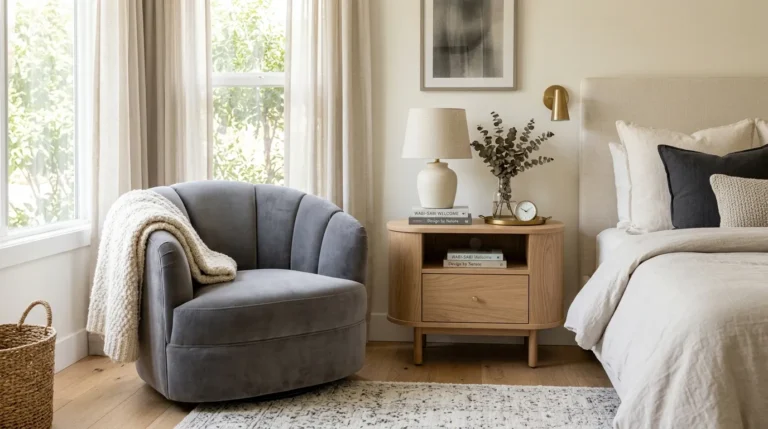
11. Soft Sage and Cream Bedroom Textile Refresh
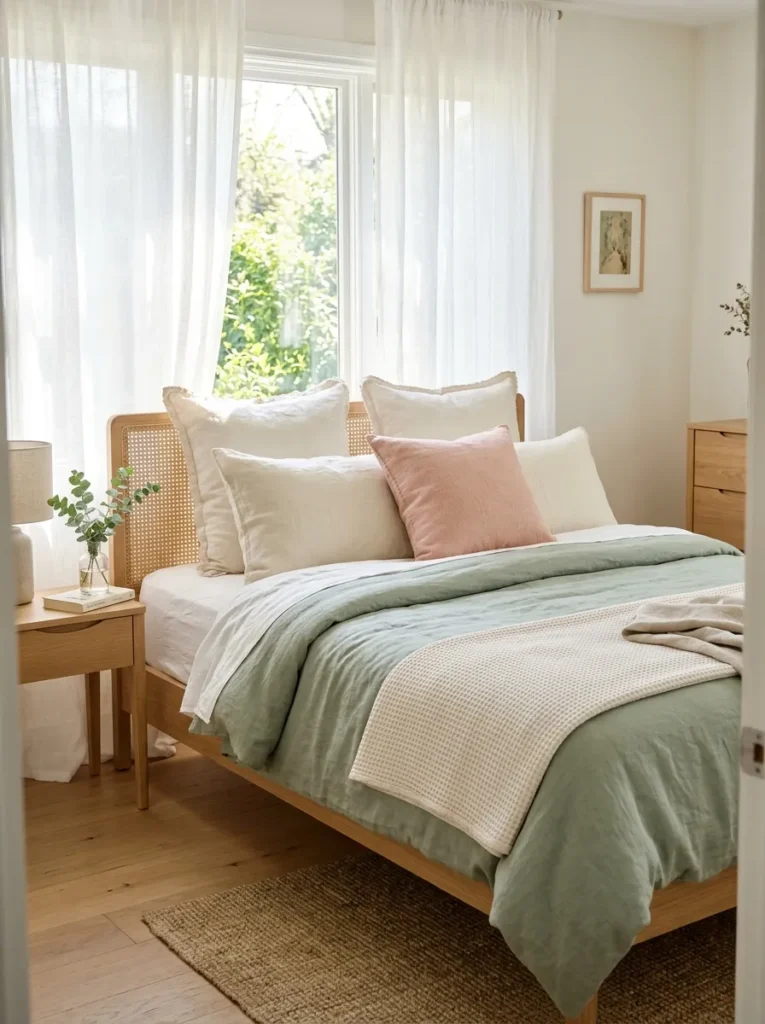
Vibe: A spring bedroom textile refresh feels physically lighter — the bed that makes sleeping feel like it belongs to a different, easier season.
Why it works: The bedroom textile refresh is the most physically impactful spring home decor change — it affects not just the visual quality of the room but the sensory experience of sleeping in it. Winter bedding (flannel, heavy cotton, weighted duvets, dark tones) is physically heavier, thermally warmer, and visually denser than the spring equivalent; the shift to lightweight linen in soft sage and cream changes not just how the bed looks but how it feels to get into it at night and wake up in it in the morning. The design principle is material weight reduction as seasonal signal: linen in a lower thread count (150–200) breathes and drapes more loosely than winter cotton, which gives the spring bed its characteristic airy, unbothered quality.
How to get it: Swap winter duvet inserts for a lighter-weight spring/summer alternative (a 4.5–7.5 tog duvet for spring in temperate climates rather than the 10.5–13.5 tog winter insert). Replace dark winter duvet covers with a soft sage or warm cream washed linen cover — washed linen is pre-washed to soften the fiber and create the characteristic slightly crinkled texture that reads as deliberately relaxed rather than newly purchased. Store winter bedding in a labeled vacuum storage bag to compress and protect through the warm months.
Shop The Look
| Product |
|---|
| Soft sage washed linen duvet cover queen |
| Cream linen euro sham set of 2 |
| Blush linen accent pillow cover 20×20 |
| Cream cotton waffle blanket lightweight |
| Summer weight duvet insert 7.5 tog queen |
12. Herb Garden Trug or Basket on the Kitchen Counter
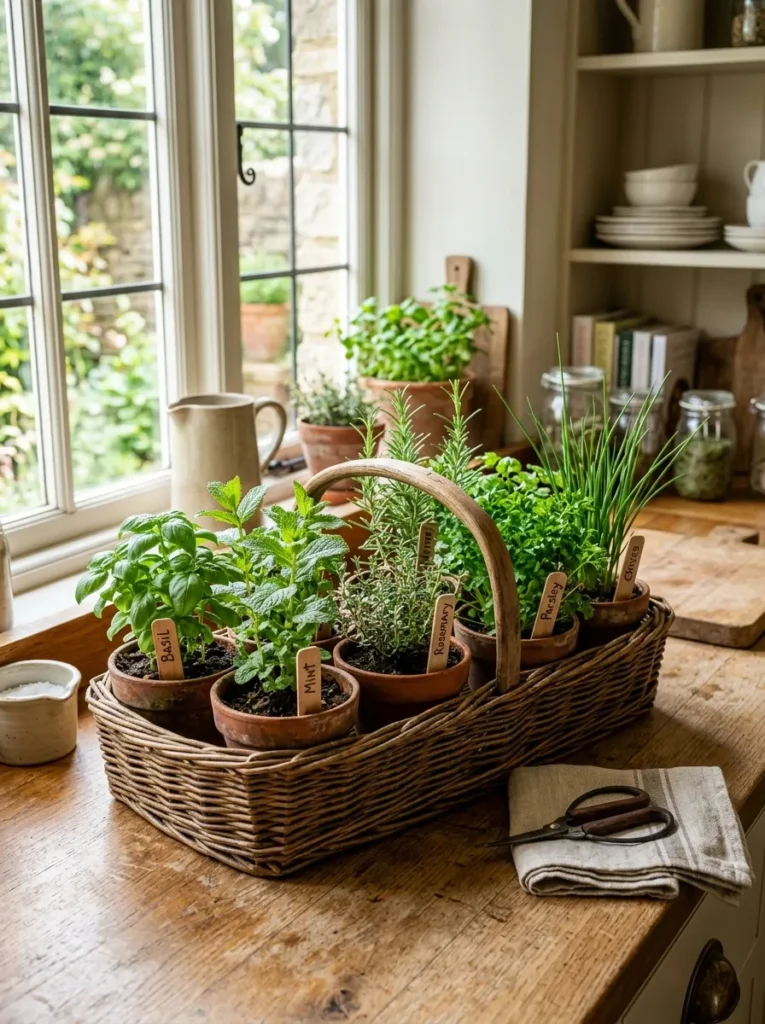
Vibe: A kitchen herb trug feels domestically generous — the kitchen feature that is simultaneously functional, fragrant, and visually fresh.
Why it works: A kitchen herb garden displayed in a garden trug or woven basket is the spring kitchen decor idea that most effectively bridges the kitchen’s functional and decorative roles — the herbs are genuinely used in daily cooking while their collective display creates a spring kitchen moment that reads as considered and professionally styled. The design principle is functional abundance as decoration: a trug filled with six different herbs creates a kitchen scene of generous, living abundance that a single potted herb cannot achieve — it implies that cooking happens here regularly, that the cook pays attention to ingredients, and that the kitchen is a place where things grow. The garden trug or woven basket as the containing element connects the indoor herb collection to the garden from which spring’s identity draws.
How to get it: Source a wooden garden trug (a traditional curved wooden garden carrying basket) or a long woven willow basket that fits six small terracotta pots side by side. Purchase small herb plants in 9 cm pots from a garden center or grocery store. Leave the herbs in their nursery pots — placed inside the trug’s terracotta pots, no repotting is required. Position in a bright kitchen counter location with at least 4–6 hours of natural light per day for most herb varieties. Water individually rather than from above — lift each pot to water at the base.
Shop The Look
| Product |
|---|
| Wooden garden trug basket long handle |
| Fresh herb starter plant set assorted |
| Small terracotta pot 9cm set of 6 |
| Herb scissors sharp kitchen set |
| Small linen pot cloth for trug base |
13. Rattan and Natural Fiber Accessory Introduction
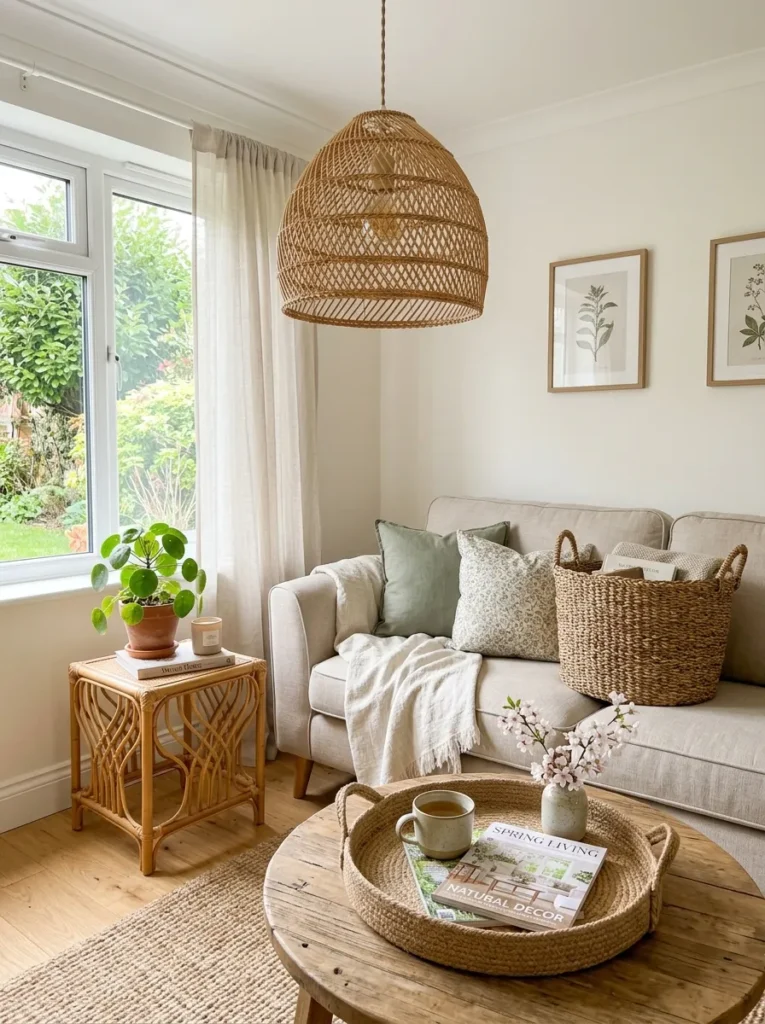
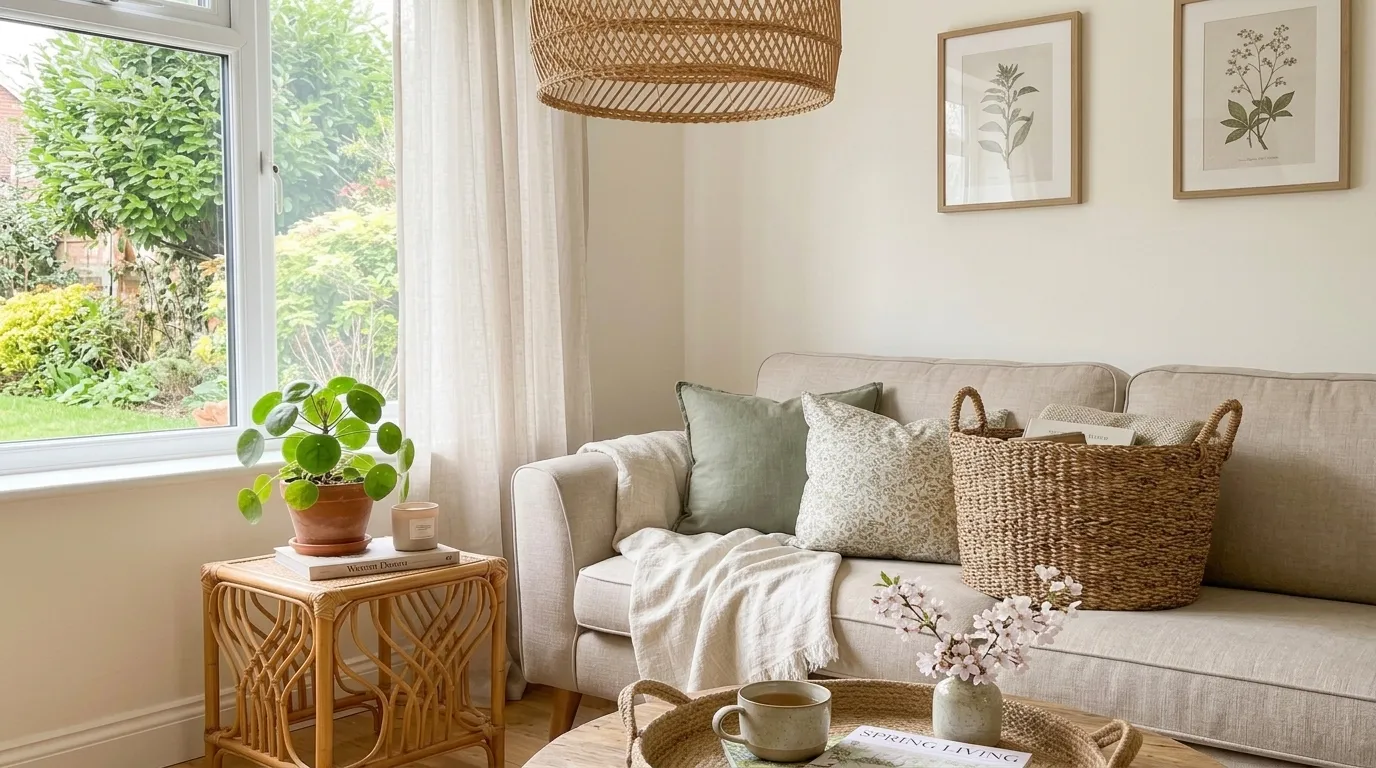
Vibe: Natural rattan accessories introduced for spring feel organically light — materials that carry the warmth of natural fiber without the weight of winter textiles.
Why it works: Rattan, seagrass, jute, and wicker are the natural fiber materials most associated with spring and summer interiors because of their connection to the natural world and their visual lightness — they read as materials that belong in the garden, on the porch, or in rooms flooded with natural light. The design principle is material seasonality: just as heavy wool and velvet are the natural materials of winter interiors, natural fiber basketry materials are the natural materials of spring and summer interiors — introducing them as the season arrives creates a material shift that registers as seasonal even without any color change. A rattan pendant light, a seagrass basket, and a woven jute tray are all accessories that can be introduced for spring and stored or relocated for winter, making them investment pieces that earn their cost across multiple seasonal cycles.
How to get it: Identify three to four positions in the living room where natural fiber accessories would replace heavier winter equivalents: a rattan side table replacing a dark metal table, a seagrass storage basket replacing a solid wood box, a woven tray replacing a lacquered tray, a rattan pendant replacing a winter chandelier. The substitution approach — same position, same function, different material — creates the most integrated and design-coherent spring refresh rather than simply adding new objects to an existing arrangement.
Shop The Look
| Product |
|---|
| Rattan pendant light shade natural plug in |
| Seagrass storage basket large with handles |
| Woven jute tray oval natural for coffee table |
| Small rattan side table round |
| Natural fiber woven placemat set of 4 |
14. Cherry Blossom Branch Display in Tall Vessels
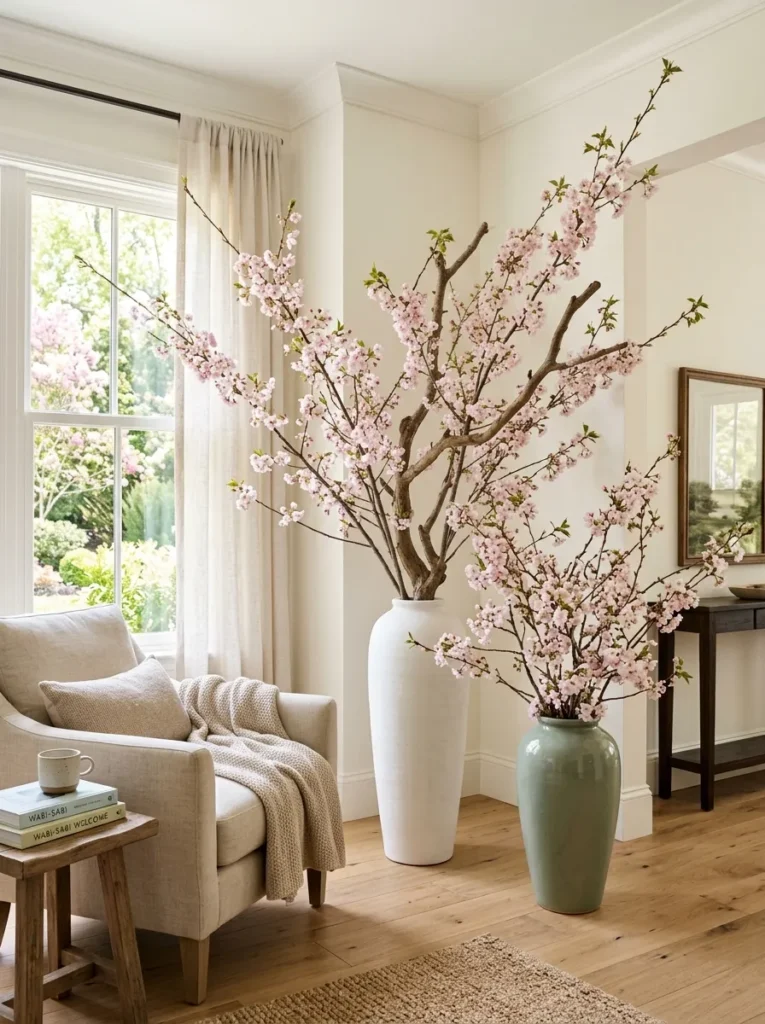
Vibe: Cherry blossom branches in tall floor vessels feel dramatically spring — the indoor display that commands the room with the season’s most celebrated botanical.
Why it works: Cherry blossom branches at significant scale — long branches in tall floor vessels rather than short stems in small vases — create a spring botanical installation with the visual presence of a large piece of art. The design principle is branch scale as architectural element: cherry blossom branches at 100–120 cm length extend into the room’s vertical and horizontal space, creating a natural canopy effect that small-scale spring botanicals cannot achieve. The delicate pale pink blossoms and emerging small leaves on bare branches are the botanical expression of spring’s essential quality — the return of life to what was bare — which gives the installation its emotional resonance beyond its visual impact.
How to get it: Source cherry blossom or ornamental plum branches from a florist, Asian supermarket (where they are often sold as seasonal cutting branches in spring), or from a garden pruning if you have an ornamental cherry or plum tree. Re-cut stems at a 45-degree angle and split the bottom 5 cm of the woody stem vertically with scissors to maximize water uptake. Place in tall floor vessels filled with fresh water, changing the water every two to three days to extend the blossom life. Alternatively, high-quality artificial cherry blossom branches from specialist faux botanical retailers provide a longer-lasting installation.
Shop The Look
| Product |
|---|
| Tall matte white ceramic floor vessel 60cm |
| Dusty sage ceramic floor vessel 50cm |
| Cherry blossom branch artificial high quality |
| Floral preservative tablet for cut branches |
| Natural wood floor protector mat for vessels |
15. Small-Space Spring Refresh: One Botanical Moment Per Room
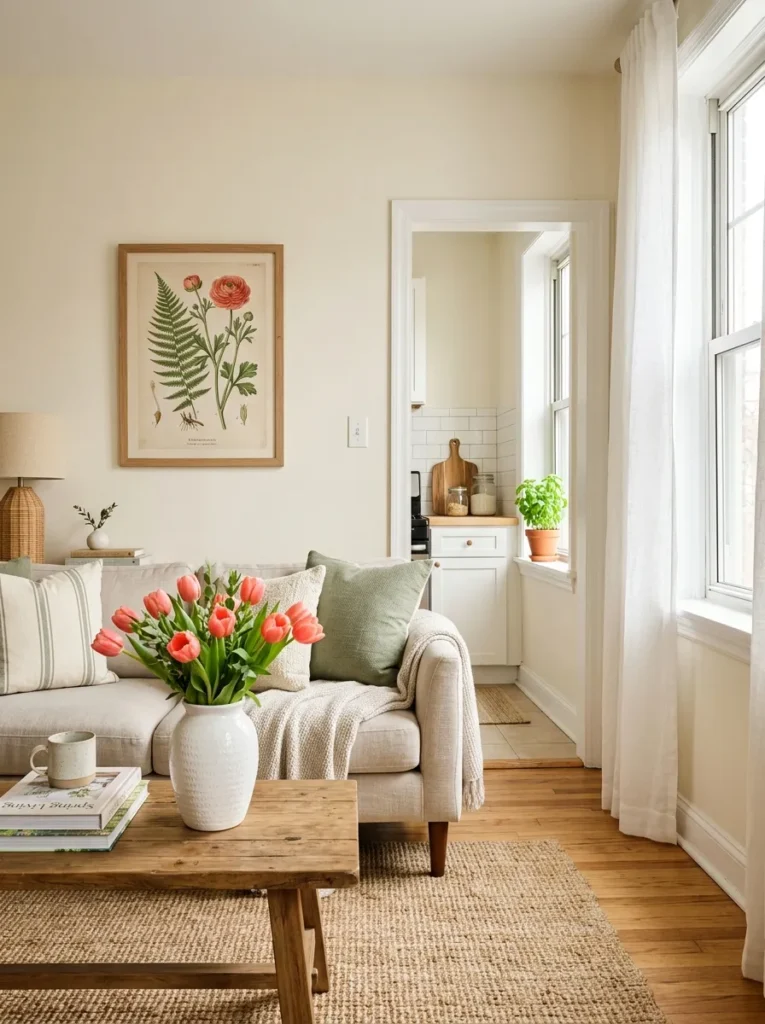
Vibe: Three botanical moments distributed through a small space feel completely spring — the proof that a seasonal atmosphere is a design decision, not a square footage question.
Why it works: The small-space spring refresh strategy distributes spring’s essential qualities — botanical life, fresh color, natural materials — across the full home in individual, carefully placed moments rather than concentrating everything in one location. The design principle is distributed botanical presence: one strong botanical element per room (a fresh flower arrangement in the living room, a potted herb on the kitchen windowsill, a botanical print in the bedroom) creates a consistent spring atmosphere throughout the home that no single large installation achieves. In a small space where each room is visible from multiple others, this distributed approach means spring is present in every sightline simultaneously, creating a pervasive seasonal atmosphere in a fraction of the space that a concentrated approach would require.
How to get it: Walk through each room of your home and identify the single surface that receives the most visual attention from the primary use position in that room — the coffee table from the sofa in the living room, the windowsill from the kitchen counter, the nightstand from the bed. Place one spring botanical element in each identified position: a small ceramic vase with three tulip stems on the coffee table, a single potted hyacinth on the kitchen windowsill, a botanical print or a small bud vase with a single stem on the bedroom nightstand. The three elements together — costing under $30 in total for flowers, a potted bulb plant, and a printable botanical image — create a complete spring atmosphere across the full home.
Shop The Look
| Product |
|---|
| Small white ceramic vase for tulips coffee table |
| Single bulb hyacinth potted spring plant |
| Botanical print digital download spring floral |
| Small bud vase for bedroom nightstand |
| Slim frame 5×7 for botanical print bedroom |
How to Start Your Spring Home Decor Refresh
The single first move is to buy a bunch of fresh spring flowers — specifically, ten to twelve stems of the most vividly colored spring flower currently available at your local market or grocery store — and place them in the most visible location in your most-used room. This single intervention costs $10–$18 and creates more spring atmosphere than any combination of seasonal accessories at the same budget, because fresh flowers introduce the season through four channels simultaneously: color, fragrance, organic form, and the pleasant impermanence of something living that will change and fade. The flower purchase also serves as a diagnostic tool — it reveals which vessels in your home best suit the spring palette and which surfaces benefit most from a botanical element, which informs every subsequent spring decor decision.
The most common mistake in spring home decor is purchasing dedicated spring-only decorative objects — ceramic rabbits, plastic egg displays, novelty seasonal accessories — that have no place in the home outside of a narrow seasonal window and accumulate in storage boxes between uses. The fix is to invest spring decor budget exclusively in elements that transition seasonally but serve year-round functions: throw pillow covers in spring tones that can rotate with the season, botanical prints that belong to the home’s permanent art collection, ceramic vessels that hold spring flowers in spring and dried botanicals in autumn, and natural fiber accessories that read as spring-fresh in March and coastal-relaxed in July.
Three spring home decor interventions under $30 that create the most immediate seasonal atmosphere: a bunch of ten tulips in the most used room’s primary vessel ($8–$15), a swap of one heavy winter throw pillow cover for a dusty sage or blush linen equivalent ($15–$25), and the opening of all window treatments to maximum natural light for one full day — which costs nothing and reveals both the room’s spring light potential and any winter-installed light-blocking elements worth removing. Together these three interventions address the season’s three essential qualities — botanical life, fresh color, and increased light — for under $40 in combined investment.
Realistic expectations: a complete spring home refresh across a full home — new bedding, new pillow covers, fresh botanicals in every room, new curtain panels in sheers, and a botanical gallery wall — represents a $200–$500 investment in new elements plus the time to implement each change. Most of the refresh is reversible: pillow covers, throw blankets, curtain panels, and botanical arrangements can all be replaced and stored when seasons change. The botanical investment (flowers, potted bulbs, fresh herbs) is consumed rather than stored — budget $20–$40 per month through spring for fresh botanical replacement, as the ongoing presence of fresh botanicals is more atmospherically effective than a larger one-time botanical investment that fades and is not replaced.
Frequently Asked Questions About Spring Home Decor
What colors define a spring home decor palette?
Spring home decor palettes divide into two registers that rarely mix successfully: soft and muted (dusty sage, warm blush, pale lavender, butter yellow, warm cream) and fresh and saturated (clear coral, grass green, daffodil yellow, robin’s egg blue, clear white). The soft-muted register reads as sophisticated and contemporary; the fresh-saturated register reads as celebratory and classically spring. Choose one register for each room and commit to it — a room that mixes dusty sage with bright daffodil yellow reads as two different seasonal intentions competing rather than one coherent spring atmosphere. The most versatile spring neutral across both registers is warm cream or warm white, which connects to both the muted and the saturated spring palettes without conflict.
How do I transition from winter to spring decor without buying everything new?
The four interventions that create the most spring atmosphere using primarily what you already own are: maximum natural light (open all window treatments fully and remove any winter light-blocking additions), a change of throw pillow covers in spring-adjacent tones from your existing collection (most homes have some lighter-toned pillows that were stored through winter), the introduction of fresh botanicals to every room’s primary surface (fresh flowers, a potted plant, a branch), and the removal of two to three of the heaviest visual elements from each room (a dark throw blanket, a heavy ceramic object, a dark-toned vase) to visually lighten the room. These four changes require no new purchases beyond the flowers and cost under $20 in total.
When should I start decorating for spring?
The most effective approach is to follow the actual seasonal signals rather than a calendar date — when the local farmers market begins selling spring bulb flowers (typically late February to early March in temperate Northern Hemisphere climates), spring home decor can begin. The transition works best as a gradual process over two to three weeks: introduce fresh botanicals first, then swap heavy textiles for lighter ones as temperatures rise, then add color through accessories as the season fully establishes itself. A complete overnight switch from winter to spring decor in early February (as some editorial calendars suggest) often reads as premature — the light is still winter light, the temperatures don’t support lighter textiles practically, and the seasonal contrast between the spring-decorated interior and the winter exterior feels jarring rather than aspirational.
What spring decor works best for a minimalist interior?
Minimalist spring home decor achieves the seasonal shift through material and color quality rather than quantity of decorative objects: a single ceramic vessel with three tulip stems on a clean counter creates spring atmosphere as effectively as an elaborate arrangement in a more maximalist interior. The three minimalist spring interventions with the most impact are a switch from winter textile tones (rust, ochre, charcoal) to spring textile tones (sage, cream, blush) in the existing throw pillow arrangement, the replacement of one indoor plant’s heavy ceramic pot with a simple terracotta equivalent that reads as spring-fresh, and the introduction of one large-format botanical print to the primary wall — single, confident, and seasonally specific.
How do I make spring decor feel cozy rather than overly fresh and cold?
The spring decor palette that maintains warmth while reading as seasonal avoids the cooler end of the spring color spectrum (ice blue, bright white, cool lavender) in favor of the warmer spring tones (butter yellow, warm blush, dusty sage, warm coral, soft terracotta). Natural materials throughout — linen rather than polyester, terracotta rather than painted ceramic, rattan rather than plastic — maintain the material warmth that makes rooms feel cozy regardless of the color palette. Fresh botanicals — particularly fragrant ones like hyacinth, sweet peas, and lilac — add the sensory warmth of fragrance that cozy rooms share with the warmth of fire and food, making the spring room feel simultaneously fresh and invitingly inhabited.
Ready to Welcome Spring into Your Home?
These 15 spring home decor ideas span every room, every budget, and every scale of seasonal refresh — from a single bunch of tulips on the coffee table and a lemon bowl on the kitchen counter to a full bedroom textile refresh, a cherry blossom branch installation, and a botanical gallery wall — so whether you have an afternoon and $20 or a full weekend and a considered budget, there is a specific, achievable, and genuinely atmospheric starting point here for exactly where you are. The most important thing to understand about spring home decor is that the season does most of the work — the longer days, the returning warmth, the spring light that enters rooms at a different angle than winter light — and your role is simply to respond to it with a few well-chosen interventions that let that quality in rather than resisting it. Today, open every curtain in your home to its fullest position, buy one bunch of the most colorful spring flower you can find, and place it where you will see it most — that single morning of more light and more color will show you exactly what your home wants from spring. Pin the ideas that made you picture your own rooms differently, and let those be the ones you begin with first.