13 Elegant Tan Sofa Styling Ideas for Every Home
A tan sofa is one of the most compositionally generous pieces of furniture available in a residential interior — its warm, mid-toned neutral occupies the precise tonal position that allows it to read as grounded without reading as dark, warm without reading as orange, and sophisticated without reading as cold. This article gives you 13 genuinely creative, styled tan sofa ideas that span the full range of interior aesthetics — from a Japandi-minimal living room to a maximalist bohemian salon — making the most versatile sofa color available work at its full potential in every design context.
Most tan sofa styling defaults to the safe and the obvious — a grey throw, a white cushion, a wooden coffee table, and little else that communicates design intention. The living rooms in this list make more considered choices: they treat the tan sofa as the room’s primary compositional anchor and build outward from its specific warmth with the same design intention that a confident interior designer brings to any primary furniture decision. Here are 13 ideas worth saving — and styling.
Why Tan Sofa Styling Works So Well
The tan sofa’s specific tonal position — that warm, mid-toned neutral between the paleness of ivory and the depth of cognac — has made it one of the most consistently popular sofa colors in residential interior design for reasons that extend well beyond fashion. Tan belongs to the yellow-red sector of the warm neutral spectrum, which means it shares its color temperature with the warmth of natural timber, aged leather, beeswax candles, and fired terracotta — all materials that human neuroscience associates with the warmth, safety, and abundance of the domestic hearth. A tan sofa in a room does something that a grey sofa, a white sofa, or a navy sofa cannot do: it warms the room from the floor up, contributing to the room’s overall temperature before a single additional warm element is introduced.
The materials that most naturally and most powerfully amplify the tan sofa’s specific warmth are those that share its tonal family. Cognac and caramel leather — the materials historically associated with the tan palette in furniture design — introduce the material richness and aging quality that tan’s own warmth implies. Warm timber in its many forms (natural oak, walnut, teak, and rattan) provides the structural counterpoint that grounds the tan sofa’s warmth in the organic material world. Terracotta and warm rust textiles provide the chromatic depth that the tan sofa’s own mid-toned warmth requires as a counterpoint — where the tan provides the foundational warm neutral, the terracotta or rust cushion provides the saturated warmth that gives the composition its visual energy. Aged brass and burnished gold are the metal finishes that most naturally extend the tan palette into the room’s hardware — sharing tan’s yellow-red warmth in metallic form.
The tan sofa’s extraordinary versatility as a compositional starting point comes from its mid-tonal position — it is neither dark enough to dominate nor pale enough to recede, occupying a tonal middle ground that allows it to receive almost any color, material, or tonal approach as a companion without creating competition or conflict. A forest green cushion against a tan sofa creates the same comfortable botanical pairing as a green leaf against warm earth; a dusty blush cushion creates the desert landscape of blush sandstone and warm clay; a deep navy cushion creates the nautical pairing of warm wood and deep sea. This compositional generosity — the tan sofa’s willingness to work with almost any color — makes it the most useful starting point for a considered living room that needs to evolve over time through seasonal and stylistic changes.
Style at a Glance
| Element | Detail |
|---|---|
| Philosophy | The tan sofa is a compositional anchor, not a neutral backdrop — its specific warmth is the room’s foundational color decision from which every other choice radiates |
| Key Companion Materials | Warm timber, cognac leather, terracotta, aged brass, rattan, natural linen, velvet in deep tones, natural wool |
| Color Companions | Forest green, deep rust, dusty blush, warm ivory, deep navy, warm charcoal, dusty sage, burnt orange |
13 Elegant Tan Sofa Styling Ideas
1. Tan Sofa with Terracotta, Rust, and Warm Amber — an Earthy Palette
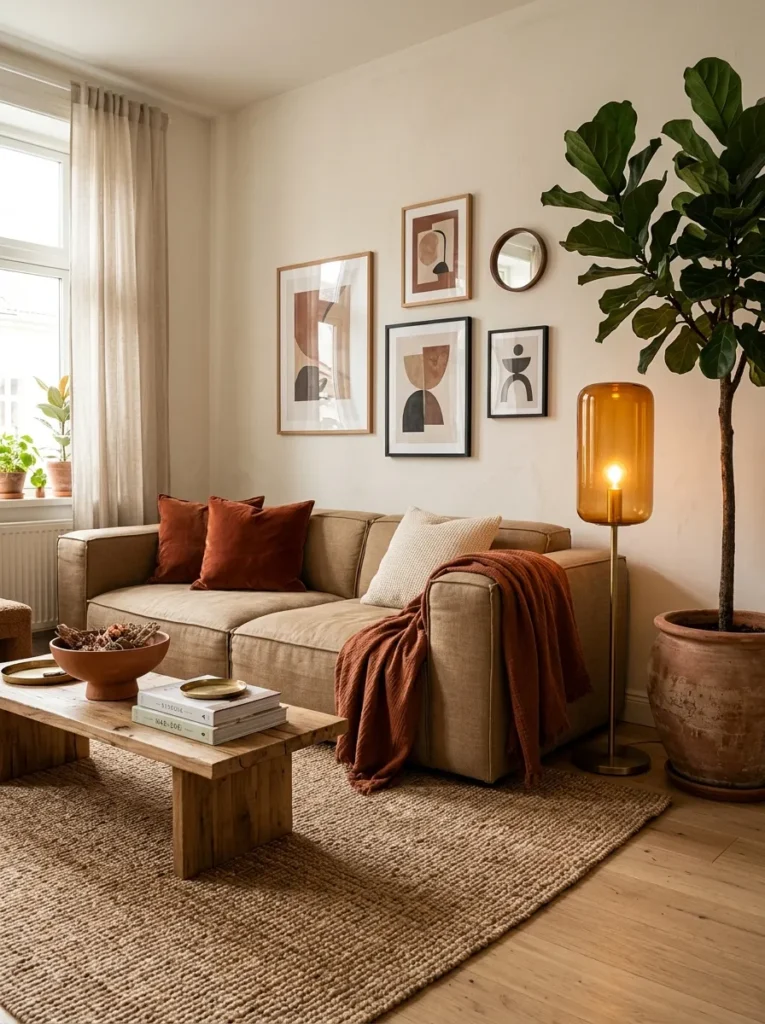
Vibe: Warm and earthy — the living room that looks like the palette was taken directly from the landscape and brought inside without losing anything in the translation.
Why it works: The tan sofa with terracotta, rust, and warm amber is the living room palette that most completely develops the tan sofa’s own warmth into a full room composition — every element in the palette shares the yellow-red warmth of the tan sofa’s own color temperature, creating a room in which the warmth compounds across every surface and material rather than being interrupted by a contrasting cool element. This warmth compounding is the specific quality that makes an earthy palette feel deeply inhabitable and genuinely restful: the eye moves around the room without encountering any temperature shock or tonal conflict, which creates the neurological state of low arousal that is the physiological basis of the feeling of comfort and relaxation. The rust velvet cushion is the element that provides the palette’s chromatic peak — at a higher saturation than the tan sofa or the terracotta accessories, the rust provides the visual energy that prevents the warm palette from reading as flat.
How to get it: Layer the earthy palette from the floor upward — the jute rug establishes the natural ground plane, the tan sofa sits in the middle tonal register, and the rust velvet cushions provide the chromatic peak at seated eye height. The amber glass floor lamp is the lighting choice that most specifically extends the palette into the room’s artificial light source — an amber glass shade produces a warm yellow-orange glow that reads as continuous with the earthy palette’s own warmth rather than introducing a contrasting neutral light quality.
Quick Win: A single rust velvet cushion ($25–55 from any quality homewares retailer) placed on a tan sofa immediately shifts the sofa’s palette from neutral to earthy and provides the chromatic depth that makes the room read as deliberately styled rather than furnished by default.
Shop the Look
| Product |
|---|
| Rust velvet cushion cover |
| Terracotta linen throw |
| Jute rug natural large |
| Raw timber coffee table |
| Amber glass floor lamp |
Also view: 14 Soft Pink Bedroom Decor Ideas for Cozy Spaces
2. Tan Sofa with Forest Green and Natural Timber — a Botanical Study
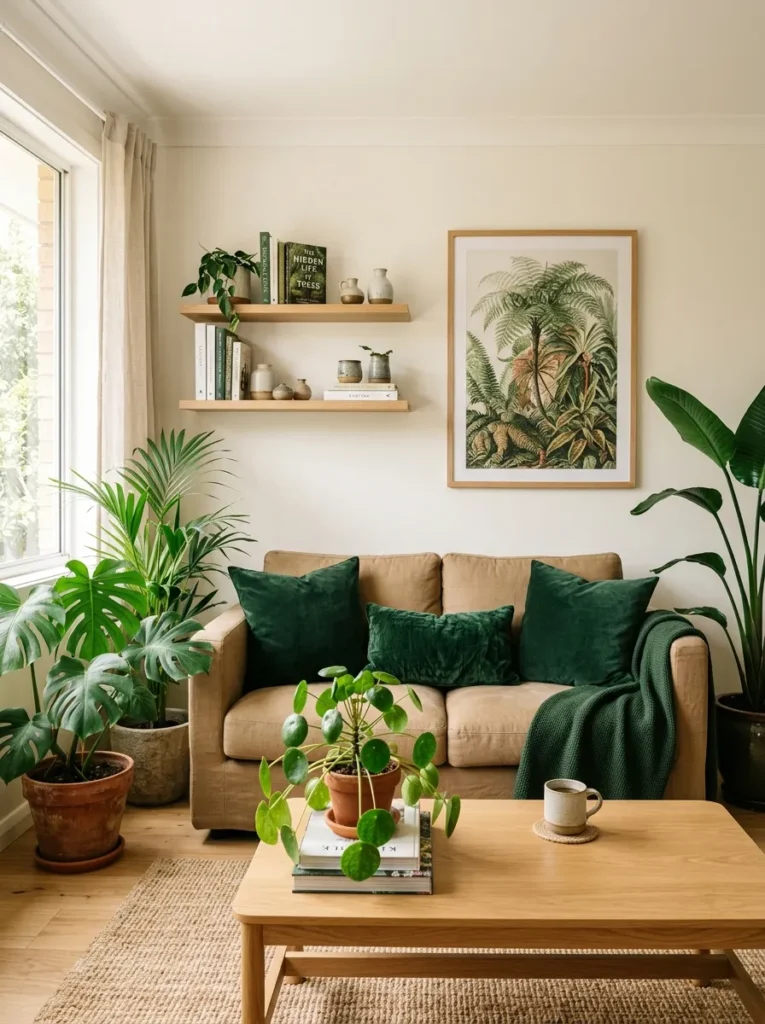
Vibe: Botanical and warm — the living room that makes the distinction between inside and outside feel like a matter of perspective rather than architecture.
Why it works: The tan sofa with forest green and natural timber is the living room combination that most naturally and most organically references the outdoor environment — the tan of the sofa references the warm earth, the forest green of the cushions and plants references the deep foliage of a mature garden, and the natural oak references the warm timber of a woodland floor. This palette triad (warm earth, deep foliage, warm timber) is the specific color combination that appears most consistently in the natural landscape and therefore the combination that produces the strongest biophilic response in a domestic interior — the room reads as a designed extension of the outdoor environment rather than as a sealed room containing a few plants. The botanical print above the sofa is the wall element that most explicitly names the design intention of the palette, creating a compositional through-line from the floor’s warm rug through the sofa’s warmth to the green cushions to the wall’s botanical imagery.
How to get it: Introduce the forest green through multiple material registers simultaneously — velvet cushions, a throw, and real indoor plants — to create the tonal depth that prevents the green from reading as an accent rather than a primary design element. A single green cushion on a tan sofa reads as an accent; multiple green elements (cushions, throw, plants, a botanical print) read as a palette decision. The indoor plants should include at least one large-leaf specimen (fiddle-leaf fig, rubber plant, or bird of paradise) at floor level to anchor the green palette at room scale.
Shop the Look
| Product |
|---|
| Forest green velvet cushion pair |
| Natural oak coffee table |
| Large leaf indoor plant |
| Botanical print natural oak frame |
| Forest green linen throw |
Also view: 15 Dreamy Luxe Bedroom Ideas for Elegant Living
3. Tan Sofa with Cream, Ivory, and Natural Linen — Tonal Restraint
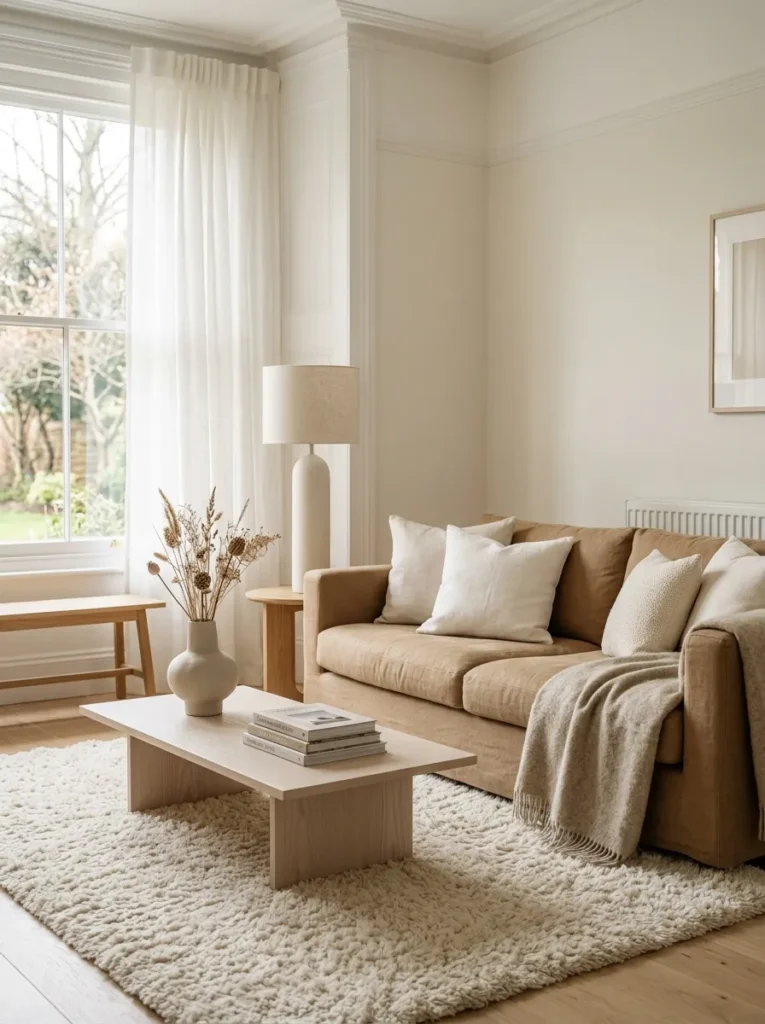
Vibe: Serene and Scandinavian — the living room that makes stillness feel like the most considered design decision in the room.
Why it works: The tonal monochromatic palette — tan sofa through ivory cushions through cream rug through white walls — is the living room approach that most completely allows the tan sofa’s material quality to be the room’s primary visual content rather than its backdrop for more colorful elements. When the room’s palette is a continuous warm tonal range without any contrasting cool or saturated element, every textural difference between materials becomes the composition’s primary visual interest — the grain of the oak table against the smoothness of the ceramic lamp against the texture of the wool throw against the woven pile of the shag rug. This texture-as-content approach requires more compositional discipline than a multi-color palette because every material choice must contribute genuine textural interest or its absence is immediately visible.
How to get it: The success of the tonal monochromatic palette depends entirely on the warmth consistency of all white and cream elements — a cool bright white cushion in a warm cream palette creates a temperature shock that breaks the tonal continuity. All whites and creams in the palette must be warm-toned (containing yellow-red rather than blue-grey undertones) to maintain the compositional continuity. Source the ivory cushion covers, oatmeal throw, and cream rug from suppliers whose warm neutral range is consistent across product categories — mixing suppliers creates temperature inconsistency that undermines the palette’s coherence.
Shop the Look
| Product |
|---|
| Ivory linen cushion cover set |
| Oatmeal natural wool throw |
| Cream shag wool rug large |
| Pale ash coffee table |
| Dried botanical pale ceramic vase |
4. Tan Sofa with Deep Navy and Brass — a Classic Contrast
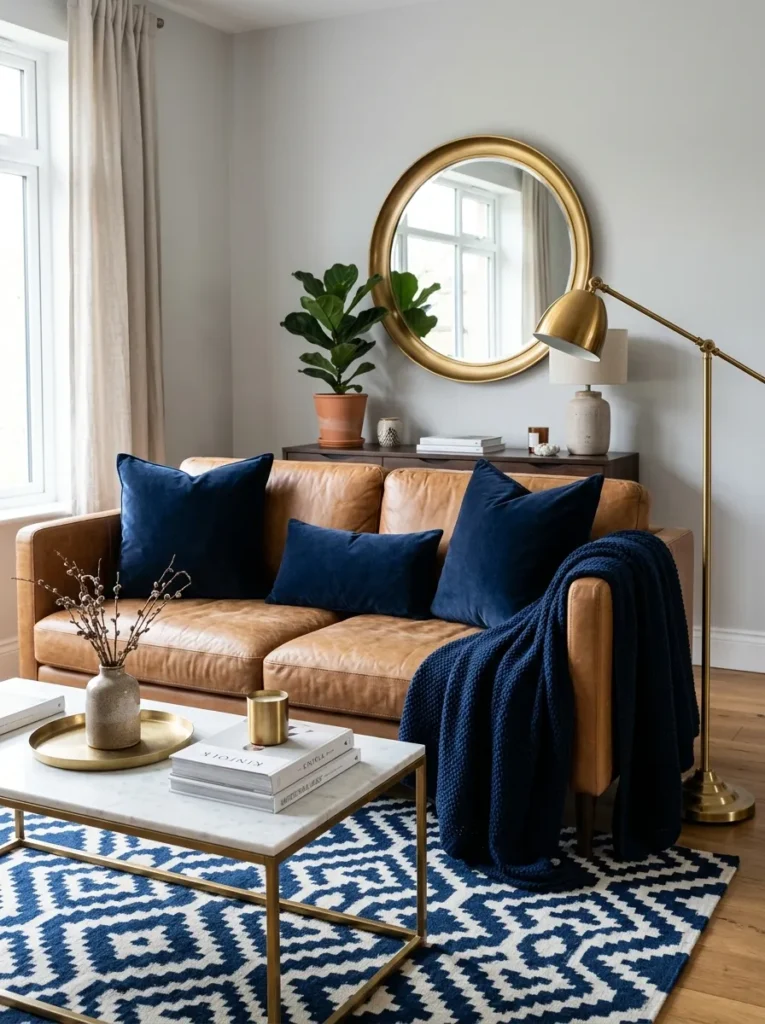
Vibe: Classic and warm — the living room that reads like the result of a genuine design education rather than a series of decorating decisions.
Why it works: The tan sofa with deep navy and brass is the living room combination that most powerfully demonstrates the principle of warm-cool complementarity — the tan sofa’s warm yellow-red temperature is placed in direct visual dialogue with the deep navy cushion’s cool blue temperature, creating the complementary contrast that the eye reads as visually complete rather than one-directional. The brass is the mediating material that bridges the warm and cool poles: its yellow-warm metallic tone shares the warmth of the tan sofa while its reflective surface quality introduces a luminosity that the matte tan cannot provide, making it the compositional link that prevents the warm-cool contrast from reading as a color clash rather than a designed complement. This tan-navy-brass triangle is the most frequently recurring color combination in contemporary living room design at its most confident and most resolved.
How to get it: The navy must be a warm, deep navy — a navy with warm undertones rather than the cool, blue-grey navy that reads as steely and cold — to maintain the compositional warmth that the tan sofa’s own temperature requires as its environment. Specify navy cushion covers in velvet rather than linen or cotton — the velvet’s deep pile creates the richness and depth in the navy that makes it read as genuinely luxurious rather than simply dark. The brass lamp should be a floor lamp positioned slightly behind and beside the sofa rather than in front of it — the warm brass light source positioned behind the sofa creates a warm halo around the tan sofa that amplifies its warmth in evening light.
Shop the Look
| Product |
|---|
| Deep navy velvet cushion set |
| Slim brass floor lamp |
| Brass framed round mirror |
| Navy geometric wool rug |
| Marble tray travertine warm |
5. Tan Sofa with Dusty Blush and Warm Rose — a Feminine Palette
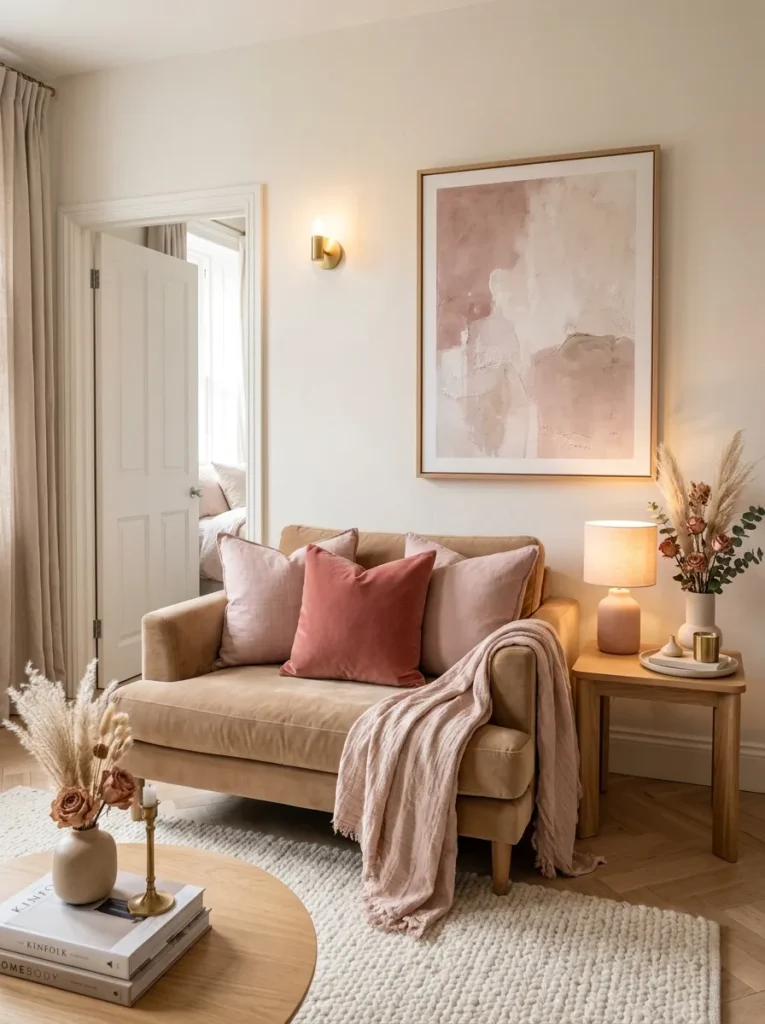
Vibe: Warm and softly feminine — the living room that makes soft, deliberate warmth feel like a design philosophy rather than a color preference.
Why it works: The tan sofa with dusty blush and warm rose is the living room palette that most gracefully develops the tan sofa’s own warm undertones in a feminine direction — the dusty blush and warm rose both share the tan sofa’s yellow-red warmth, occupying adjacent positions on the warm color spectrum and creating a palette of genuine tonal harmony rather than the jarring contrast that a bright pink or cool lavender would create against tan. The dusty quality of both the blush and the rose — both colors being desaturated versions of their respective pink tones — is the specific tonal characteristic that makes the palette read as sophisticated rather than sweet: dusty blush and dusty rose belong to the earthy warm palette of dried flowers and aged pigments rather than to the commercial pink palette of bright primaries.
How to get it: The key to the dusty feminine palette is maintaining consistent desaturation across all pink and rose elements — mixing a dusty blush cushion with a bright coral or vivid pink breaks the palette’s sophisticated quality and shifts it from editorial to domestic in the least flattering direction. All pink-family elements should share the dusty, earthy quality of the blush and rose specified here. Dried botanical elements — pampas grass and dried roses specifically — are the table and shelf accents that most naturally and most cost-effectively complete this palette, because dried botanicals in their natural state are already desaturated warm tones that belong to the palette without requiring any color selection effort.
Shop the Look
| Product |
|---|
| Dusty blush linen cushion set |
| Warm rose velvet cushion |
| Blush linen throw |
| Abstract rose ivory artwork |
| Dried pampas and dried rose |
6. Tan Sofa with Black, Charcoal, and Warm White — a Graphic Palette
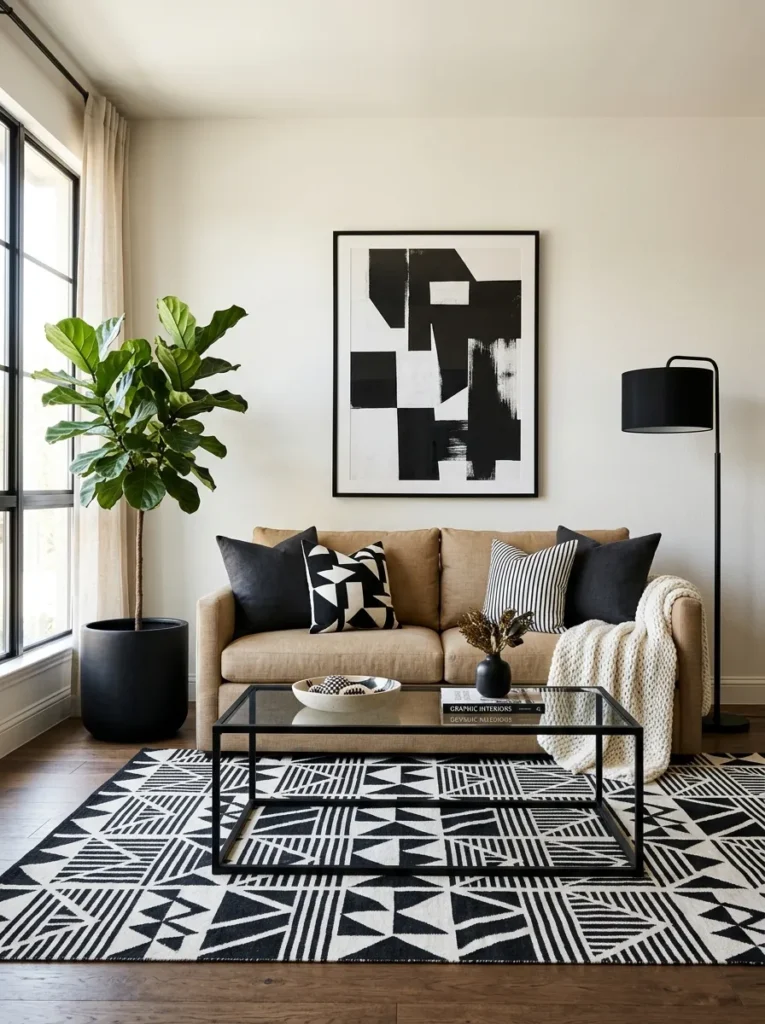
Vibe: Graphic and warm — the living room that uses the tan sofa to prevent a graphic black and white scheme from feeling cold or clinical.
Why it works: The tan sofa with black, charcoal, and warm white is the living room palette that most clearly demonstrates the tan sofa’s specific compositional function in a graphic room — it is the element that prevents the black and white palette from reading as cool, clinical, or industrial by introducing warmth at the room’s most visually dominant surface level. A black and white living room without a warm anchor (a tan sofa, a warm timber element, or a warm rug) reads as stark and potentially cold regardless of the quality of the individual elements; the same black and white living room with a tan sofa reads as warm and considered because the tan’s warmth permeates the room’s primary seating zone. The tan sofa is doing the work of a warm wall color in this palette — providing the ambient warmth that allows the graphic black and white elements to read as bold design decisions rather than temperature failures.
How to get it: Specify charcoal rather than pure black cushions on the tan sofa — the charcoal linen maintains the graphic palette’s dark anchor while sharing the tan’s warm undertone in a way that pure black cannot. Pure black against warm tan creates a stark contrast that reads as abrupt; warm charcoal against tan creates a sophisticated contrast that reads as deliberate. The warm white throw provides the light anchor of the graphic palette at the sofa surface level — its specific warm white (containing yellow rather than blue undertones) maintains the tonal temperature that pure cool white would interrupt.
Shop the Look
| Product |
|---|
| Charcoal linen cushion set |
| Warm white knitted throw |
| Black steel glass coffee table |
| Black and white abstract artwork |
| Black floor lamp shade |
7. Tan Sofa in a Maximalist Bohemian Living Room
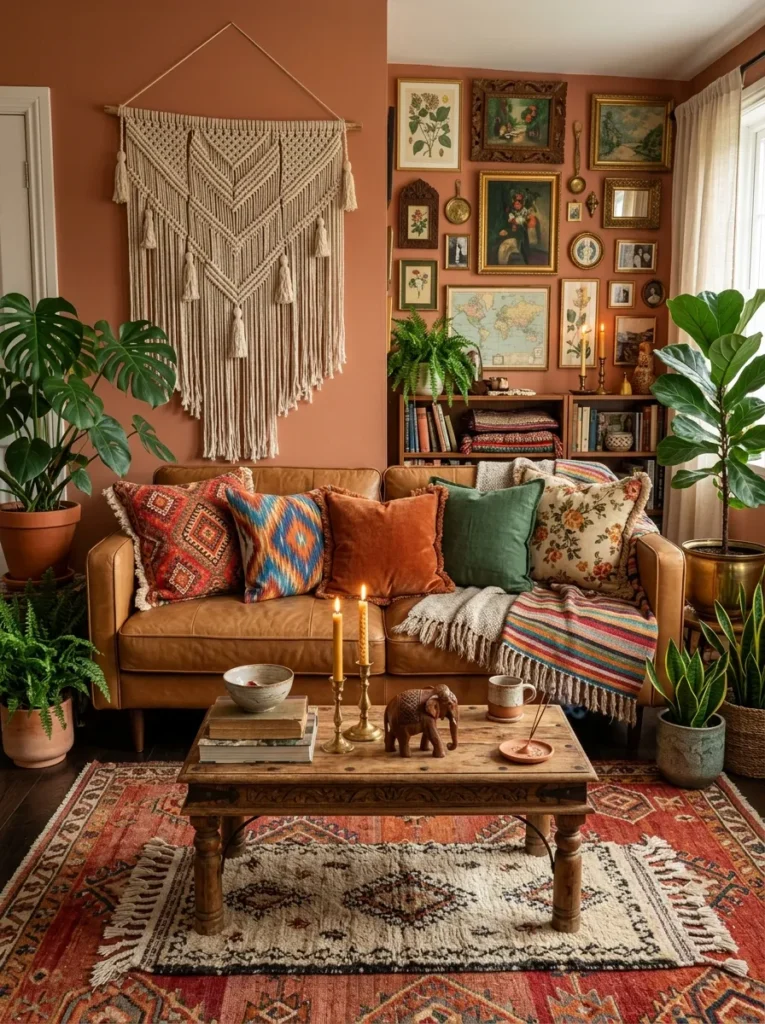
Vibe: Abundant and personal — the bohemian living room that reads like the autobiography of someone who has been everywhere interesting and brought something home from each place.
Why it works: The tan sofa in a maximalist bohemian living room is the application that most reveals the tan sofa’s compositional generosity — its warm, mid-toned neutrality allows it to anchor a room of considerable visual complexity and pattern richness without competing with any of the other elements for dominance. A brighter, more saturated sofa in the same bohemian room would compete with the kilim rug, the patterned cushions, and the gallery wall for visual primacy, creating a room where no single element reads as the anchor; the tan sofa’s warmth provides the ground from which all the room’s richer, more saturated elements are received and composed. The layered cushion approach — multiple patterns and textures in warm bohemian tones — is the specific styling decision that most authentically communicates the bohemian aesthetic’s core value: the accumulated, personal, and globally influenced collection of beautiful things.
How to get it: The layered cushion approach on a tan sofa requires a unifying color temperature principle to prevent the varied patterns from creating visual chaos — every cushion fabric in the bohemian layering should belong to the warm color family (warm reds, oranges, rusts, forest greens, warm yellows, and warm neutrals). Cool-toned patterns (cool blues, greys, or lavenders) in the bohemian cushion mix create temperature disruptions that read as unintentional rather than eclectic. Layer the rugs with the largest rug positioned first and the smaller, more patterned rug positioned above it at a slight diagonal — the diagonal placement of the top rug creates the layered quality that a perfectly aligned stack cannot achieve.
Shop the Look
| Product |
|---|
| Moroccan pattern cushion warm |
| Kilim rug large warm |
| Macrame wall hanging large |
| Carved timber coffee table |
| Terracotta plant pot collection |
8. Tan Sofa with Warm Sage and Natural Materials — a Quiet Luxury
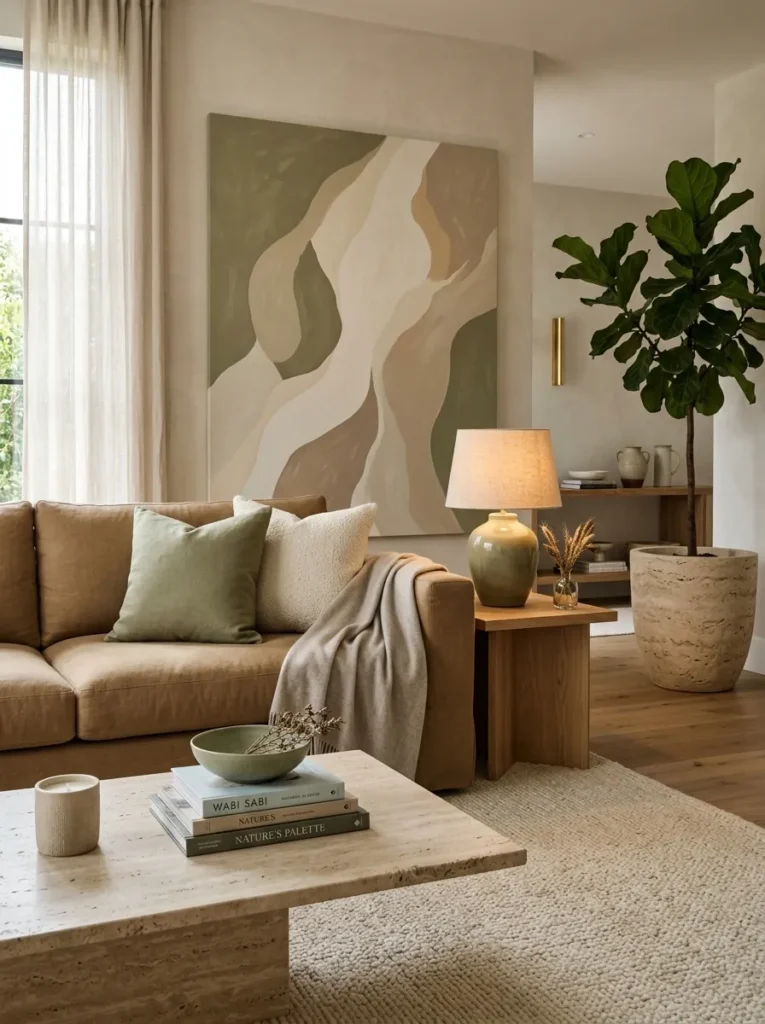
Vibe: Quiet and luxurious — the living room where every material is the right material and nothing announces itself more loudly than it needs to.
Why it works: The tan sofa with warm sage and natural materials is the living room palette that most completely realizes the quiet luxury aesthetic — the design philosophy that positions material quality and compositional restraint above decorative elaboration, communicating luxury through the quality of individual materials rather than through their quantity or their visual complexity. Warm sage is the specific green that most naturally coordinates with the tan sofa’s warm palette because it shares tan’s yellow-green warmth — a cool or grey-toned sage would create a temperature conflict with the tan, while warm sage creates a natural tonal relationship that reads as composure. The travertine coffee table is the material statement that most confidently communicates quiet luxury: travertine’s natural pore structure, warm cream color, and honed surface quality read as genuinely premium material investment at the room’s primary use surface.
How to get it: Source the throw in cashmere or a high-quality wool-cashmere blend rather than synthetic or standard wool — the throw is the element in this palette that is experienced at the most intimate, tactile level, and its material quality is perceived through touch before it is perceived through sight. A cashmere throw on a quality linen sofa communicates material sophistication at a register that no visual element can achieve. The travertine coffee table is a significant material investment ($400–1,200 for a genuine stone table) but the highest-return single furniture investment available for the quiet luxury palette — it elevates every adjacent material through association with genuine natural stone.
Shop the Look
| Product |
|---|
| Warm sage linen cushion set |
| Cashmere greige throw |
| Travertine coffee table |
| Sage ceramic table lamp |
| Natural wool cream rug large |
9. Tan Sofa with Burnt Orange and Warm Sunset Tones
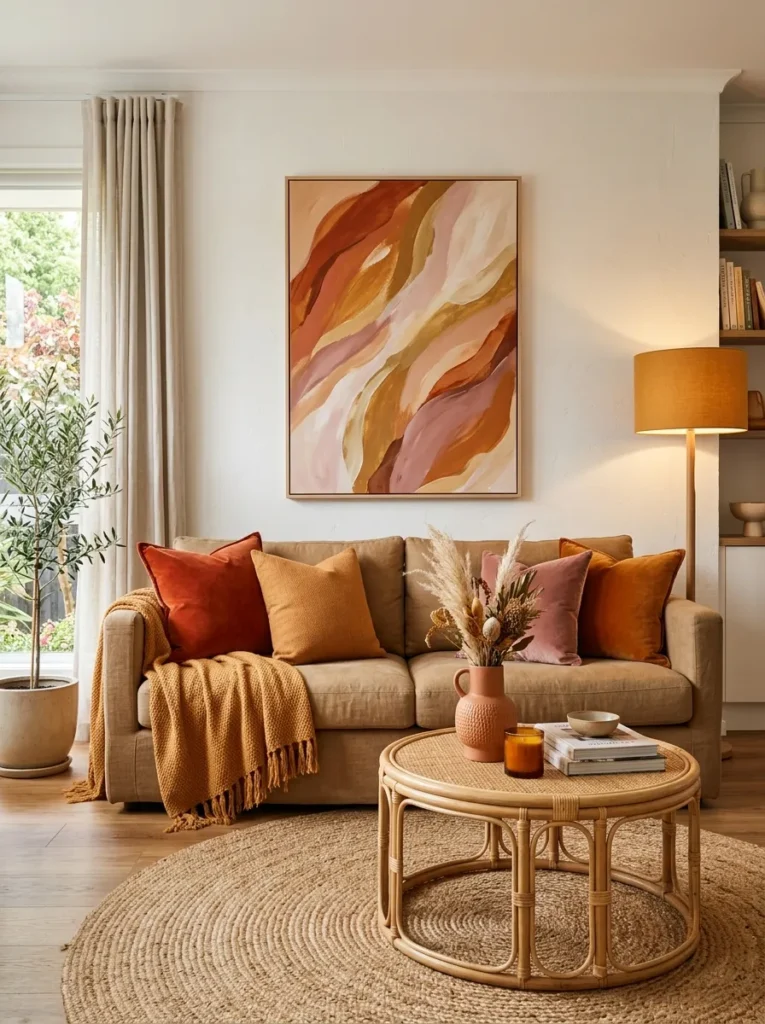
Vibe: Warm and expressively colorful — the living room that feels like the last hour of afternoon light has been captured and made permanent.
Why it works: The tan sofa with burnt orange and warm sunset tones is the living room palette that most exuberantly celebrates the tan sofa’s own warmth — by choosing companion colors that are all in the same yellow-orange-red sector of the warm color wheel, the composition creates an intensely warm, high-energy palette that reads as joyful and genuinely alive rather than the subdued warmth of the earthy or the tonal palettes. Burnt orange is the color that most powerfully activates the tan sofa’s own warmth — the orange is sufficiently close to tan in its yellow-red character that the two read as part of the same warm family, while being sufficiently saturated and vivid to provide the chromatic contrast that prevents the tan from reading as flat. The sunset abstract artwork above the sofa is the compositional element that names and validates the palette — by framing the room’s warm color composition within an artwork that references the natural phenomenon of the sunset, the entire color decision reads as culturally grounded rather than merely fashionably warm.
How to get it: Restrict the burnt orange to the velvet cushions as the palette’s primary chromatic statement — distributing the burnt orange to multiple surfaces simultaneously creates visual saturation that the palette cannot sustain. The amber throw and the amber lamp shade provide the orange family’s warmth at a lower saturation level, creating the graduated warmth spectrum that reads as sunset-quality rather than paint-swatch-quality. The rattan coffee table introduces the natural material element that prevents the warm color palette from reading as synthetic or artificially vivid.
Shop the Look
| Product |
|---|
| Burnt orange velvet cushion set |
| Amber woven throw |
| Rattan timber coffee table |
| Amber drum shade floor lamp |
| Sunset abstract artwork warm |
10. Tan Sofa in a Coastal Living Room with Natural Fibers
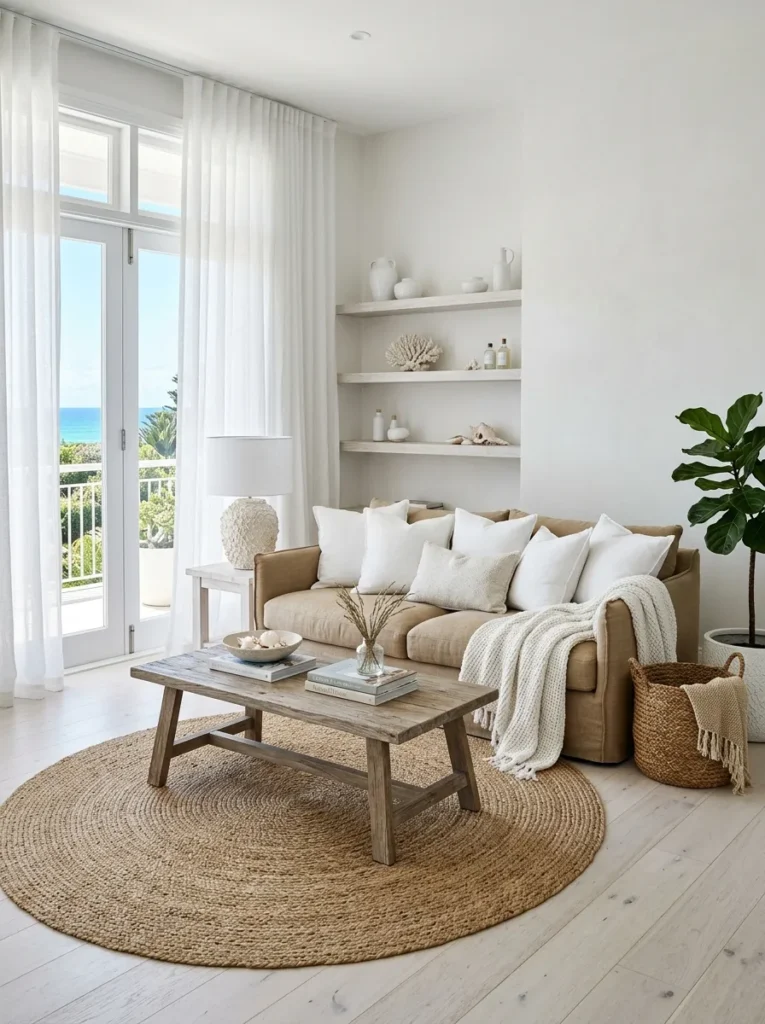
Vibe: Fresh and coastal — the living room that makes the quality of light feel like the most important architectural feature.
Why it works: The tan sofa in a coastal living room is the application that most effectively uses the tan sofa’s warmth as a foil for the coastal palette’s characteristic brightness and lightness — the tan’s warmth prevents the bleached white, natural seagrass, and bright linen coastal palette from reading as cold or washed-out, grounding the lightness of the coastal scheme in a warmth that reads as genuinely coastal rather than clinically pale. The coastal palette’s chromatic restraint (primarily bleached whites, natural fibers, and sand tones) makes the tan sofa the room’s primary warm element, which is the specific compositional role that most naturally complements the coastal aesthetic’s tendency toward material lightness and spatial openness. The sheer white linen curtains are the window treatment that most specifically creates the coastal light quality — their translucency diffuses the direct coastal light into the softly luminous glow that is the characteristic quality of a well-designed coastal interior.
How to get it: Maintain the coastal palette’s natural fiber consistency throughout — seagrass rug, linen cushion covers, woven cotton throw, and the driftwood-effect timber coffee table should all be in natural materials rather than synthetic alternatives. The natural fiber palette is the specific quality that makes a coastal living room read as authentic rather than thematic — synthetic coastal decor reads as decoration; natural material coastal decor reads as a genuine relationship with the coastal environment.
Shop the Look
| Product |
|---|
| Bleached white linen cushion set |
| Natural white woven throw |
| Driftwood effect coffee table |
| Natural seagrass rug round large |
| Sheer white linen curtain pair |
11. Tan Sofa with Emerald Green and Aged Brass — a Jewel Palette
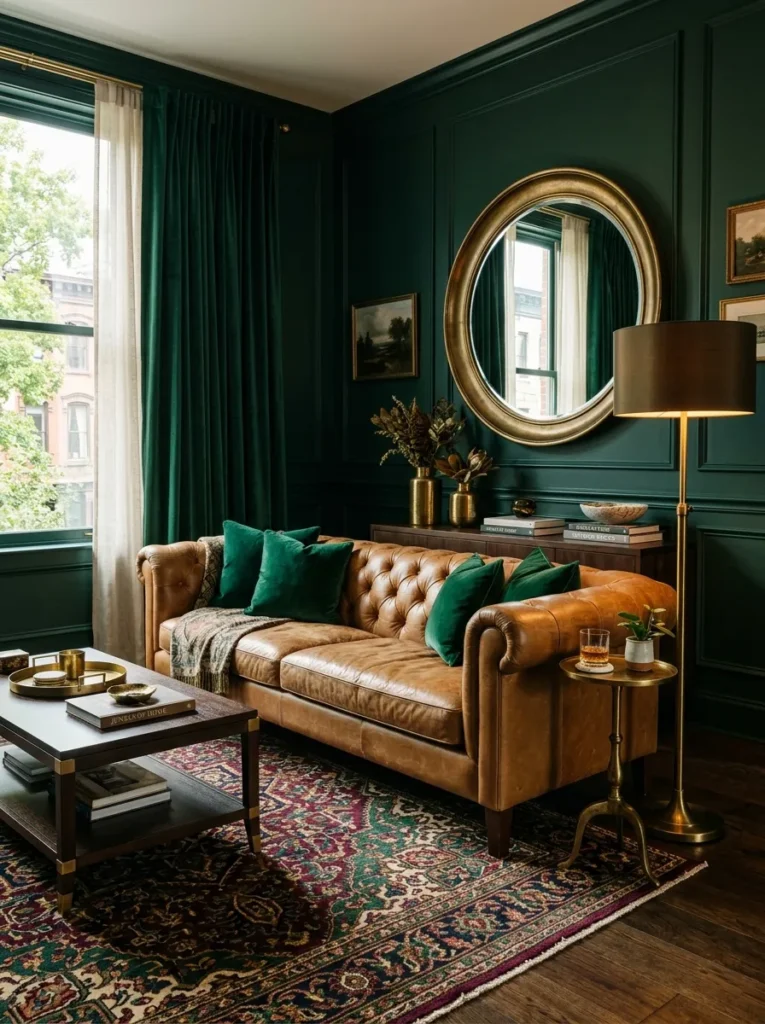
Vibe: Jewel-toned and luxurious — the living room that reads like the most private and most beautiful room in a very old house.
Why it works: The tan sofa with emerald green and aged brass is the living room palette that most powerfully channels the jewel-box aesthetic — the combination of warm tan leather, deep emerald velvet, and aged brass creates the specific chromatic richness that Victorian and Edwardian drawing rooms achieved with their jewel-toned upholstery, metallic hardware, and rich carpet compositions. The tan leather sofa is specifically appropriate for this jewel palette because leather’s natural warmth and aged quality share the same material philosophy as aged brass — both materials improve with time, developing patina and character as they are used, which gives the jewel palette room a sense of material history that fabric sofas cannot provide. The Persian-style rug in jewel tones of burgundy, emerald, and gold is the floor element that most completely grounds the jewel palette in a design tradition — the Persian rug’s color composition is not a random collection of jewel tones but a historically specific compositional tradition that makes the room’s palette read as culturally informed.
How to get it: The aged brass hardware must be genuinely aged or at minimum unlacquered raw brass that is developing its own patina — polished brass or gold-toned chrome reads as decorative hardware rather than material investment, and the jewel palette requires the material depth of genuine brass that has been allowed to age. Source aged brass pieces from antique dealers, specialty brass hardware suppliers, or new unlacquered brass that has been allowed to develop a natural patina over several weeks of open-air exposure.
Shop the Look
| Product |
|---|
| Emerald green velvet cushion set |
| Aged brass side table |
| Brass framed round mirror |
| Emerald green velvet curtain pair |
| Persian style jewel toned rug |
12. Tan Sofa with White, Warm Timber, and Minimalist Styling
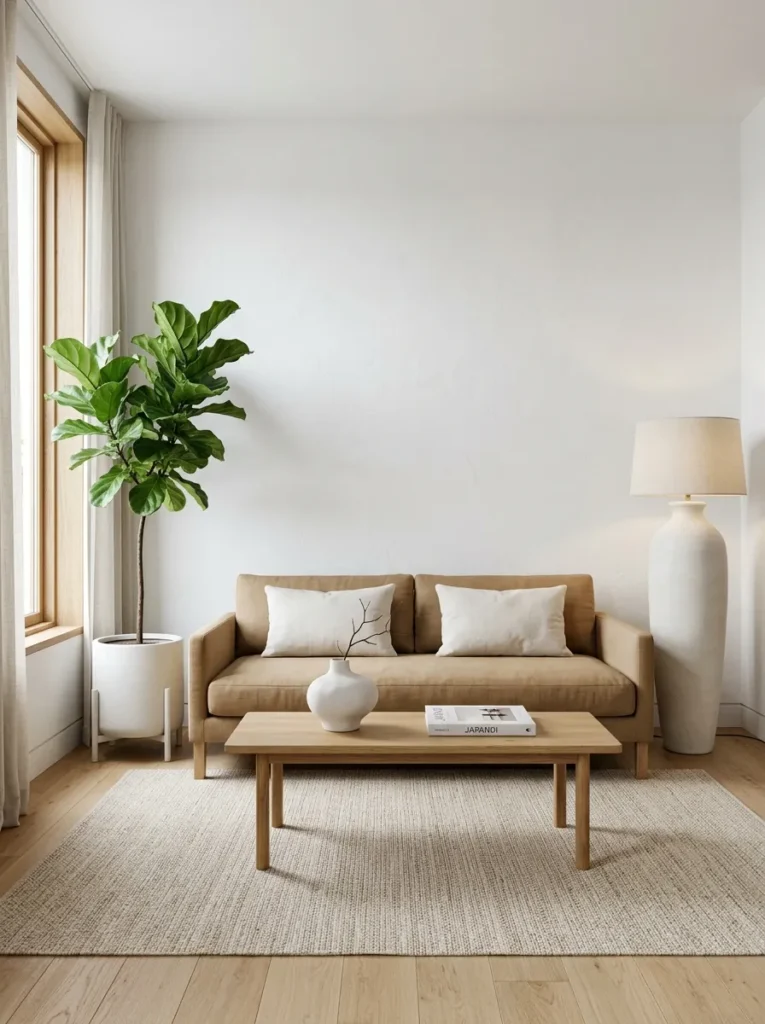
Vibe: Minimal and resolved — the living room that makes restraint feel like the most powerful design statement available.
Why it works: The tan sofa with white, warm timber, and minimalist styling is the application that most directly demonstrates the design principle that the tan sofa’s warmth can do more compositional work when it is given more visual space. In a room stripped of all but the most essential elements, the tan sofa’s warmth is not competing with other warm elements but is instead the room’s primary warm quality — it radiates outward into the white walls and the minimal room without interruption, creating a room whose warmth is perceived as a spatial quality rather than a decorative one. The two white cushions rather than an abundant cushion arrangement is the discipline that makes this minimal approach legible as a design choice rather than an incomplete room — two carefully chosen, correctly sized white cushions on a tan sofa read as precisely considered; an empty sofa reads as unfurnished.
How to get it: The success of the minimalist tan sofa approach depends entirely on the quality of the individual elements — in a minimal room, each object is perceived in isolation without the visual complexity of surrounding elements to draw attention away from its individual quality. The ceramic object on the coffee table, the single design book, the architectural plant, and the ceramic floor lamp must each be genuinely beautiful and precisely chosen — in the minimalist approach, an object of mediocre quality cannot be camouflaged by surrounding elements and is immediately visible as the room’s weakest compositional decision.
Shop the Look
| Product |
|---|
| White linen cushion pair minimal |
| Slim natural oak coffee table |
| Single quality ceramic object |
| Large architectural plant white pot |
| Ceramic floor lamp warm white |
13. Tan Sofa with Warm Burgundy and Deep Red — a Winter Palette
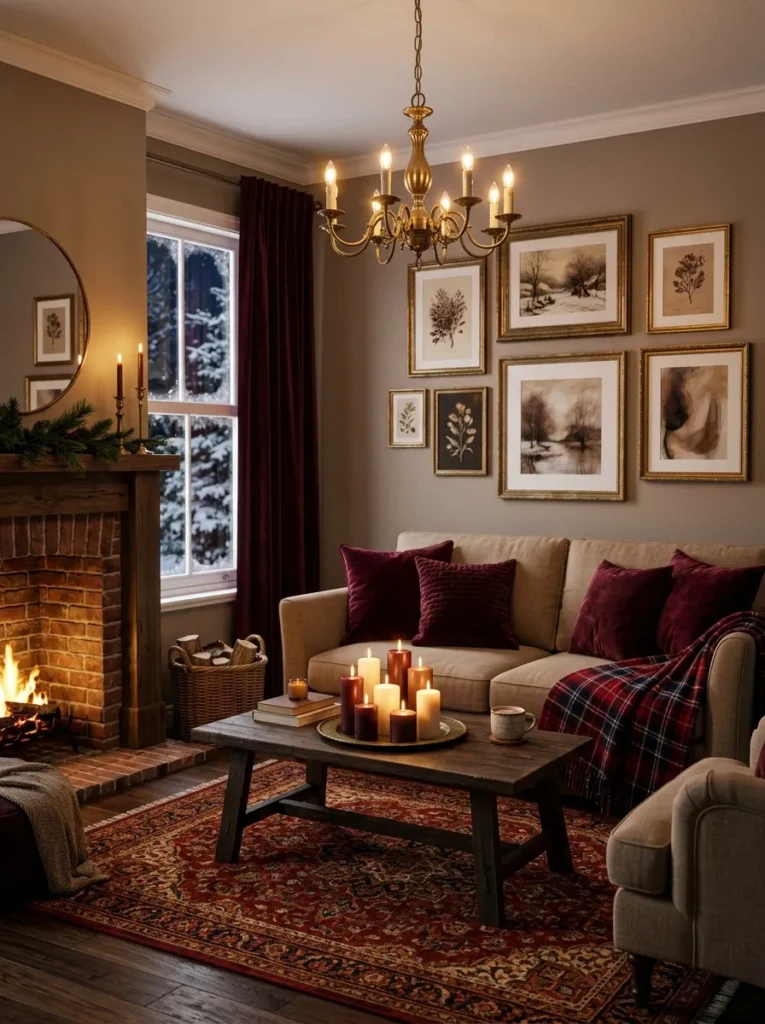
Vibe: Warm and winter-intimate — the living room that makes every evening from May to August feel like the most comfortable place on earth.
Why it works: The tan sofa with warm burgundy and deep red is the winter living room palette that most completely creates the sense of warmth, shelter, and seasonal intimacy that winter interiors specifically seek — the deep burgundy and warm red both belong to the red-purple sector of the warm color wheel, which is the color family most associated with warmth, richness, and the specific coziness of fire-lit winter evenings. The tan sofa provides the warm, lighter tonal base from which the deeper burgundy and red elements create their visual depth — without the tan’s warmth, the burgundy and red palette would read as dark and potentially heavy; with the tan’s lighter warmth providing the base, the same burgundy and red read as rich and enveloping rather than oppressive. The collection of pillar candles in varied heights on the coffee table is the lighting element most specifically appropriate to the winter palette — pillar candles at varied heights create the most visually complex and most atmospherically rich candlelight arrangement available at the table surface.
How to get it: The red plaid wool throw is the element that most specifically communicates the seasonal and cultural context of the winter palette — the plaid pattern references the Scottish and Scandinavian textile traditions that are culturally associated with winter warmth and domestic shelter, and the red colorway within the plaid connects to the burgundy cushion palette while providing the pattern variation that prevents the winter room from reading as one-dimensionally dark. Source the throw in genuine wool rather than synthetic fleece — the weight and warmth of a genuine wool throw is the tactile quality that makes the winter room’s throw a sensory experience rather than a visual one.
Shop the Look
| Product |
|---|
| Deep burgundy velvet cushion set |
| Red plaid wool throw |
| Burgundy pillar candle set |
| Deep red Persian style rug |
| Aged gilt picture frame set |
How to Start Your Tan Sofa Styling Transformation
Your single first move is to identify the specific color warmth of your existing tan sofa before purchasing any cushions, throws, or accessories — because tan occupies a wide tonal spectrum from the warm yellow-tan of caramel through the neutral warm-tan of biscuit to the slightly cooler warm-tan of greige, and the specific warmth of your sofa determines which companion colors will coordinate naturally and which will create an unintentional color conflict. Place fabric samples or paint swatches against your sofa in natural light and observe their color relationship — a cushion color that reads as warm and coordinated in a shop or on a screen may read as cool and conflicting against your specific sofa’s warmth when placed together in your room’s specific light quality. This observation, costing nothing and taking ten minutes, is the design research that prevents the most common and most costly tan sofa styling mistake.
The most common tan sofa styling mistake is over-accumulating cushions without a clear palette principle — adding cushions over time as they become available or as trends suggest, without reference to a considered palette decision, creates a sofa that reads as covered in cushions rather than styled with them. The number of cushions on a tan sofa is less important than their compositional logic: two cushions that share a clear material and color relationship communicate more design intention than eight cushions in unrelated patterns and tones. The correct palette principle for a tan sofa cushion arrangement: one primary companion color in two or three cushions, one accent color in one cushion, and one natural material (linen, cotton canvas) cushion in a neutral tone. This four-to-five cushion formula covers the sofa generously while maintaining the compositional clarity that makes the arrangement read as designed.
Three specific investments under $100 that create immediate tan sofa styling impact: (1) A quality velvet cushion in the primary companion color of your chosen palette ($35–60 from quality homewares retailers) provides the chromatic depth and material richness that most powerfully elevates a tan sofa’s visual quality — velvet specifically, rather than linen or cotton, because the velvet’s pile depth creates a color richness that flat fabrics cannot achieve. (2) A natural fiber throw in a complementary neutral (natural wool, cashmere blend, or cotton waffle) draped casually over the sofa arm ($45–85 from quality linen and textile retailers) introduces the tactile warmth and casual comfort that makes a tan sofa read as genuinely inhabitable rather than staged. (3) One quality ceramic object or a small curated tray grouping on the adjacent coffee table ($20–45) creates the three-dimensional surface composition that completes the sofa corner as a designed vignette — the coffee table styling in relationship to the sofa is as important to the tan sofa corner’s overall visual quality as the sofa styling itself.
Realistically, a complete tan sofa living room transformation — new cushions and throw in a considered palette, a quality rug of the correct size, a statement lamp in the correct finish, a coffee table in the appropriate material, and a wall element (artwork, mirror, or botanical print) that completes the vertical composition above the sofa — costs $600–2,000 depending on the quality and quantity of new pieces. A focused three-element styling refresh — a velvet cushion pair in the primary companion color, a quality natural fiber throw, and one new ceramic object for the coffee table — costs $100–200 and produces an immediately visible and genuinely significant improvement in the tan sofa’s visual quality and the room’s overall design coherence. Most homeowners begin with the cushions — the most accessible, most reversible, and most immediately visible styling decision — use the changed cushion palette to observe how the room responds to the new color direction for a season, and then invest in the rug, the lamp, and the coffee table in the subsequent season with the benefit of the living experience that the cushion experiment provided.
Frequently Asked Questions About Tan Sofa Styling
What colors look best with a tan sofa?
The colors that look best with a tan sofa are those that share its warm yellow-red color temperature rather than contrasting against it with cool tones. The five most consistently successful companion colors are deep forest green (which creates the botanical pairing of warm earth and deep foliage), deep navy (which creates the classic warm-cool contrast that reads as most formally considered), rust and burnt orange (which develops the tan’s own warmth in a more saturated, expressive direction), dusty blush and warm rose (which create the softest, most harmonious warm palette available), and deep burgundy (which provides the richest, most formally luxurious companion to the tan’s warmth). Cool greys, cool blues, and bright whites are the colors least naturally compatible with a tan sofa because their cool temperature contrasts with the tan’s warmth in a way that reads as a color mismatch rather than a designed complement.
What rug looks best under a tan sofa?
The rug that looks best under a tan sofa depends on the palette being developed. For earthy palettes, a natural jute or sisal rug in warm natural tones provides the material ground plane that connects the tan sofa to the organic material world. For more colorful palettes, a Persian or Moroccan-style rug in warm jewel tones provides the patterned complexity that a tan sofa can anchor without competing with. For minimalist palettes, a large natural wool rug in cream or oatmeal provides the warm neutral plane that extends the sofa’s warmth across the floor without adding visual complexity. The most important rug specification for any tan sofa is size — the rug must be large enough for at least the front legs of all seating pieces to rest on its surface, which for a standard tan sofa and two chairs requires a minimum rug size of 240cm × 300cm.
How do I make a tan sofa look more expensive?
A tan sofa reads as more expensive when the elements immediately surrounding it are in quality natural materials — the combination of a quality linen or velvet cushion, a cashmere or wool throw, a natural stone or solid timber coffee table, and a quality ceramic object on that coffee table creates the material environment that elevates the sofa’s perceived value through association with genuinely premium adjacent materials. The single most impactful upgrade is replacing any synthetic or low-quality throw on the sofa with a genuine cashmere or merino wool alternative — cashmere or merino draped over a tan sofa communicates material luxury at the most intimate tactile level before any other element of the room is considered.
Should a tan sofa have cushions in the same color family or contrasting colors?
A tan sofa typically reads as most sophisticated when styled with cushions that provide a clear contrast of saturation (a deeper, more saturated color than the tan itself) while remaining in the warm color temperature family. Pure same-color-family cushions (ivory, cream, camel) create a beautiful tonal monochromatic arrangement that reads as refined but requires exceptional material quality in every element to avoid reading as flat. Pure contrasting colors (cool grey, cool blue, bright white) create a temperature conflict with the tan that reads as unintentional unless the contrasting color is very specifically chosen and very deliberately applied. The most reliably successful approach is a warm companion color at a higher saturation than the tan — rust, forest green, deep navy with warm undertones, or deep burgundy — which creates the compositional contrast that makes the tan sofa read as a deliberate design anchor rather than a neutral backdrop.
What style of coffee table suits a tan sofa best?
The coffee table that suits a tan sofa best depends on the room’s overall aesthetic direction but shares one quality across all styles: it should be in a warm material rather than a cool one. Warm timber (oak, walnut, rattan), warm stone (travertine, marble with warm veining), and aged brass are all appropriate coffee table materials for the tan sofa’s warm palette, while cold glass alone, cold grey stone, or chrome-finished metal tables create temperature conflicts that undermine the tan sofa’s warmth. The specific form of the coffee table is secondary to its material temperature — a round natural oak table, a rectangular travertine slab, and a rattan and timber combination are all appropriate in their respective design contexts, and all share the warm material quality that complements the tan sofa’s own warmth.
Ready to Style Your Tan Sofa?
These 13 ideas span the full range of what a tan sofa can anchor in a living room — from an earthy palette of rust velvet, terracotta, and amber that celebrates the warmth of the earth itself, and a forest green botanical study that brings the outdoor landscape inside, to a graphic black and white composition where the tan sofa provides the warmth that prevents the graphic palette from feeling cold, a maximalist bohemian salon where the tan’s warmth grounds a room of abundant pattern and collected object, and a quiet luxury arrangement where travertine, cashmere, and warm sage allow the quality of each individual material to speak without competition — so whether your tan sofa is the existing anchor of a room you want to improve or the new purchase around which you are building a living room from the beginning, there is a genuinely achievable, genuinely beautiful styling approach here for your specific sofa warmth, your specific room proportions, and your specific design aesthetic. The styling begins with the cushion — with the single velvet cushion in the primary companion color that most immediately demonstrates what the palette will become — and continues through the throw, the rug, the coffee table, and the wall element that complete the sofa corner’s visual composition. Today’s specific action: identify the one companion color from this list that most strongly appeals to you for your tan sofa’s specific warmth, find the highest-quality velvet cushion cover available in that color within your budget, place it on your sofa, and observe the room for 48 hours in both natural and artificial light. That observation will tell you more about which direction your living room wants to go than any mood board, because it is grounded in your specific room, your specific light, and the specific warmth of your specific tan sofa. Save the ideas that matched your room’s existing material palette and your own aesthetic instincts — those are the ones that will look right from the first day they are assembled and better every day after that.