14 Creative Craft Night Themes for a Fun Gathering
A craft night theme is a curated creative gathering concept — a specific material focus, aesthetic direction, and project menu that gives a group of adults a shared creative experience, a defined skill to develop together, and a finished object to take home at the end of the evening. This article gives you 14 craft night themes across material types, seasonal occasions, design styles, and skill levels so every gathering you host has a clear creative identity, a satisfying arc from arrival to completion, and the kind of shared making experience that turns a social evening into a genuinely memorable one.
A well-themed craft night does something that a dinner party or movie night cannot — it gives every person at the table something to do with their hands, which fundamentally changes the social dynamic of the evening. Conversations deepen when hands are busy. People who would otherwise be guarded in purely social settings become generous when they are focused on a shared creative challenge. And the finished object each person takes home is a physical memory of the evening — more lasting than a photograph and more personal than a souvenir. Here are 14 ideas worth hosting — and remembering.
Why Themed Craft Nights Work So Well for Adult Gatherings
Themed craft nights draw from the long tradition of communal making — the American quilting bee, the European lace-making circle, the Japanese textile dyeing workshop, and the craft guild traditions of medieval Europe all recognized that making things together is a fundamentally different social experience from passive gathering. The shared creative challenge creates what psychologists call a state of flow — the absorbed, time-distorted concentration of genuine making — and experiencing flow together creates a social bond that conversation alone does not produce. The theme provides the structure that makes flow possible: without a specific project and a defined material, a craft gathering becomes indecisive and scattered; with a strong theme, even complete beginners can achieve a finished, genuinely beautiful object in a single evening.
The material palette of a well-themed craft night is specific and pre-sourced by the host — this is the critical difference between a themed craft night and an open craft session. The host’s role is to eliminate decision paralysis by choosing materials that are appropriate for the theme, the skill level of the group, and the time available, and to pre-prepare (cut, measure, and organize) everything needed so that guests can begin making immediately rather than spending the first hour of the evening selecting and preparing. This preparation investment (typically 1–3 hours for the host) is what transforms a social gathering into a creative experience.
The current cultural moment is ideal for adult craft nights. The convergence of the wellness movement (manual making as stress relief and mindfulness practice), the social media documentation culture (every craft night produces highly photographable content at every stage from setup to finished object), and the genuine adult craft revival (the growth in pottery studios, botanical dyeing workshops, and weaving classes as adult leisure activities) has made the craft gathering not merely acceptable but genuinely desirable as a social format. The themed craft night is the home-hosted equivalent of the paid workshop experience that has become one of the fastest-growing categories in the adult leisure market.
Small gatherings of four to eight people work best for craft nights because they maintain the intimacy required for focused making and conversation while providing enough social energy to sustain the evening’s atmosphere. More than ten participants creates a workshop dynamic where individual attention becomes difficult; fewer than four can feel more like a tutoring session than a social gathering. The host’s home, with its personal atmosphere and proximity to the kitchen for refreshments, is the ideal craft night venue — it creates the comfort and familiarity that encourages creative risk-taking in ways that rented studio spaces cannot.
Style at a Glance
| Element | Detail |
|---|---|
| Philosophy | Shared creative challenge as the foundation of genuine social connection |
| Key Elements | Defined theme, pre-prepared materials, achievable project, shareable result |
| Ideal Group Size | Four to eight adults for maximum creative and social dynamic |
| Timing | Two to three hours for the making session, plus thirty minutes before and after for social time |
14 Creative Craft Night Themes for a Fun Gathering
1. Botanical Candle Making Night
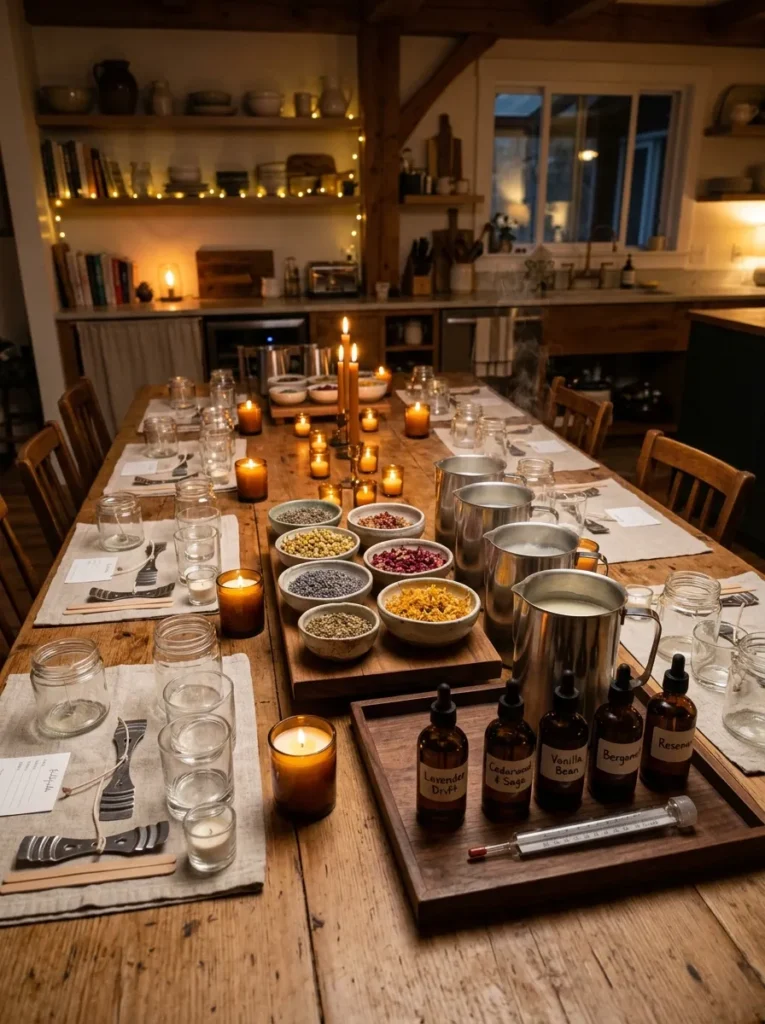
Vibe: The table is sensory — a candle making craft night engages smell, touch, and sight simultaneously from the first moment of arrival, where the warm wax, the fragrance oils, and the dried botanical bowls create an atmosphere that is the experience before the making even begins.
Why it works: Candle making is the ideal first craft night theme because it produces a genuinely beautiful and immediately functional finished object in approximately 90 minutes — the technical skill required is low (melt, scent, pour, and wait), but the design decisions (fragrance combination, botanical placement, vessel choice) are genuinely creative and personal. The drying time built into the process (candles need 30–45 minutes to set) creates a natural mid-session pause for refreshments and conversation, and the finished candles can be safely transported home the same evening. The sensory dimension — choosing fragrance combinations, arranging dried botanicals — makes even the most craft-hesitant guest engaged from the beginning.
How to get it: Pre-melt soy wax flakes in a large pitcher on the stove (approximately 8 oz per candle, at 185°F). Organize dried botanicals in small ceramic dishes in the center of the table — lavender, chamomile, rose petals, calendula, and dried citrus peel are all botanically beautiful and fragrance-compatible. Set out fragrance oils (three to five options per person: lavender, vanilla, sandalwood, eucalyptus, and citrus are reliably popular) with droppers marked at the recommended usage rate (typically 1 oz fragrance per lb of wax). Each guest selects their vessel, positions their botanicals, blends their fragrance combination, and pours when ready. Total host prep cost: $40–$80 for 6–8 guests.
Quick Win: Candle kits for groups ($25–$40 for a starter set) from candlemaking supply companies like CandleScience provide pre-measured wax, a fragrance starter set, and appropriate wicks — the host adds vessels and botanicals for a complete setup at minimal preparation time.
Shop The Look
- Soy wax flakes 5 lb bag natural
- Candle fragrance oil sampler set
- Glass vessel variety set clear
- Dried botanical candle decoration set
- Candle wick set pre-tabbed cotton
Also view: 15 Mason Jar Crafts That Look Surprisingly Luxe
2. Japanese Shibori Indigo Dyeing Night
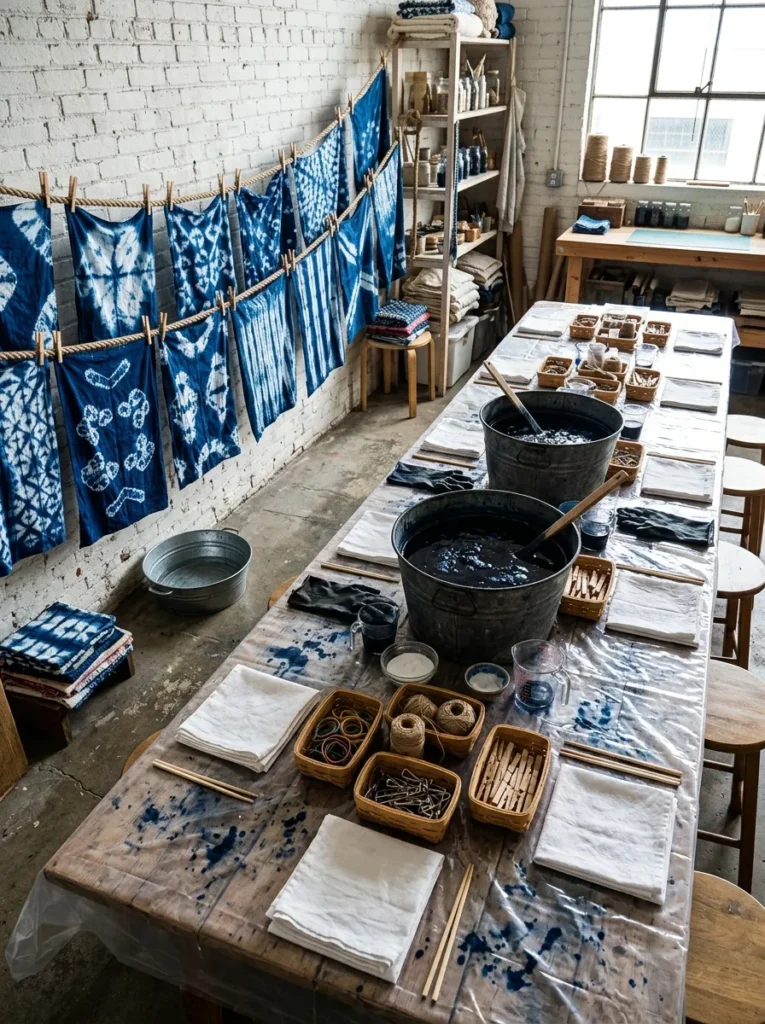
Vibe: The table is artisan — a shibori indigo dyeing night creates the visual atmosphere of a Japanese textile workshop, where the deep blue dye vats, the white fabric waiting to be transformed, and the unpredictable reveal of each pattern make every piece genuinely surprising and genuinely beautiful.
Why it works: Shibori is the ideal craft night theme for a group because the pattern results are always unique — two people using the same binding technique produce different patterns — which means every participant has a genuinely individual creative experience even when working in the same medium. The process is sequenced naturally over an evening: folding and binding (30 minutes), dyeing (15 minutes in the vat, 15 minutes oxidizing), rinsing and unbinding (15 minutes of anticipatory reveal), and hanging to dry (the evening’s most social moment, as everyone compares patterns). The indigo color on white fabric produces consistently beautiful results even on a first attempt, which makes this theme accessible to the most craft-hesitant guests.
How to get it: Pre-mix an indigo dye vat using a cold-process indigo kit (Jacquard or Dharma Trading, $20–$35) in a large dark bucket — mix the day before the event so the vat is properly reduced and ready. Provide pre-washed white or natural linen/cotton fabric squares (20×20 inch squares work well for a first project, $2–$4 each from fabric suppliers). Pre-set each place with rubber bands, binder clips, clothespins, and wooden craft sticks for binding. Cover all surfaces with plastic sheeting — shibori is beautiful but splattery. Hang a clothesline for drying finished pieces. Total host prep cost: $60–$100 for 6–8 guests.
Shop The Look
- Indigo shibori dye kit cold process
- Natural cotton fabric square set white
- Rubber band assortment thick dyeing
- Binder clip set dyeing binding
- Plastic drop cloth table protection
Also view: 15 Ladybug DIY Ideas Perfect for Adult Crafters
3. Terrarium Building Night
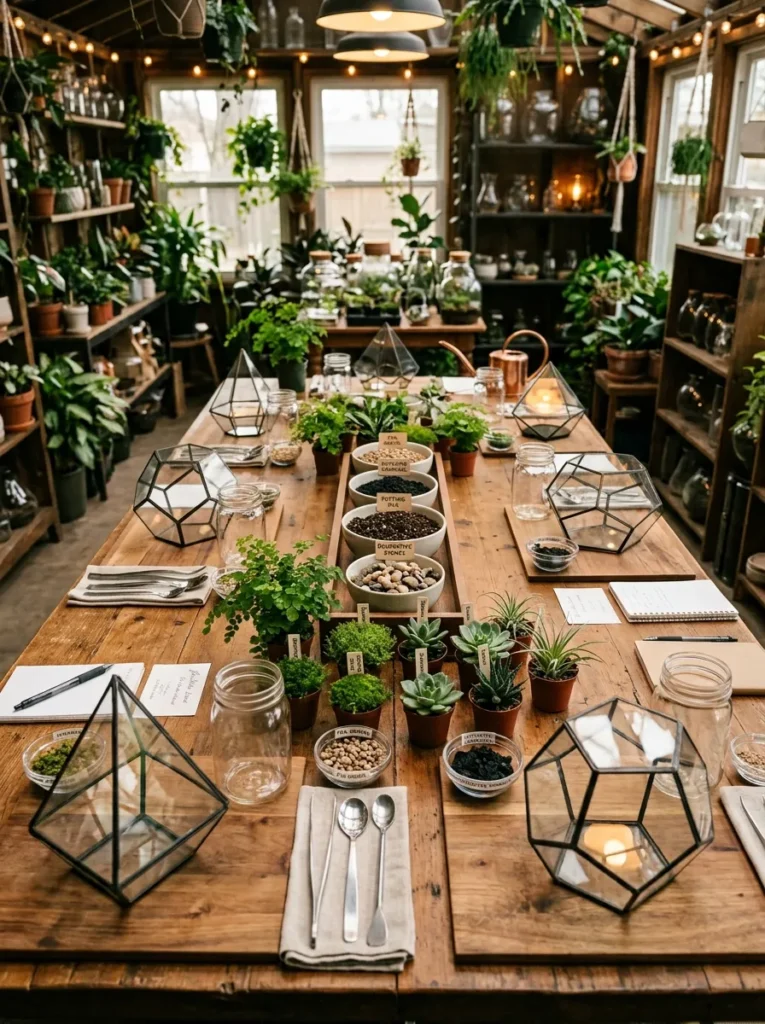
Vibe: The table is botanical — a terrarium building night creates a small-world making experience where each person builds their own enclosed garden ecosystem, and the collective table of geometric glass vessels and miniature plants creates a greenhouse atmosphere that transforms an ordinary dining room into something genuinely verdant.
Why it works: Terrarium building combines the satisfying spatial puzzle of arranging living plants within a defined glass container with the immediate gratification of a finished, living object to take home. The skill gradient is low — the layered soil technique (gravel, charcoal, potting mix, plants, decorative top dressing) is taught in minutes and produces professional-looking results immediately. The design dimension (plant selection, spatial arrangement, top dressing choice) is highly personal and produces genuinely different results across a group, creating the comparison and conversation that makes the collective reveal moment socially energetic. Terrariums are long-lived objects — a well-made closed terrarium can thrive for years — giving the craft night an unusual emotional resonance as a long-lasting living memory.
How to get it: Provide geometric glass terrariums or wide-mouth vessels in varied sizes at each place ($8–$25 each from home decor retailers). Pre-organize terrarium layering materials in small labeled bowls at the table center — pea gravel for drainage, activated charcoal for odor control, potting mix for plants. Source small plant varieties in individual pots from a garden center (ferns, mosses, baby tears, air plants, or succulents depending on the terrarium type — open or closed). Provide long tweezers, bamboo skewers, and long-handled spoons for plant placement in narrow-necked vessels. Add decorative top dressing options (fine gravel, preserved moss, miniature stones). Total host prep cost: $80–$150 for 6–8 guests.
Shop The Look
- Geometric glass terrarium varied set
- Activated charcoal terrarium layer
- Terrarium long tweezers tool set
- Small fern plant live terrarium
- Preserved moss sheet green natural
4. Macramé Wall Hanging Night
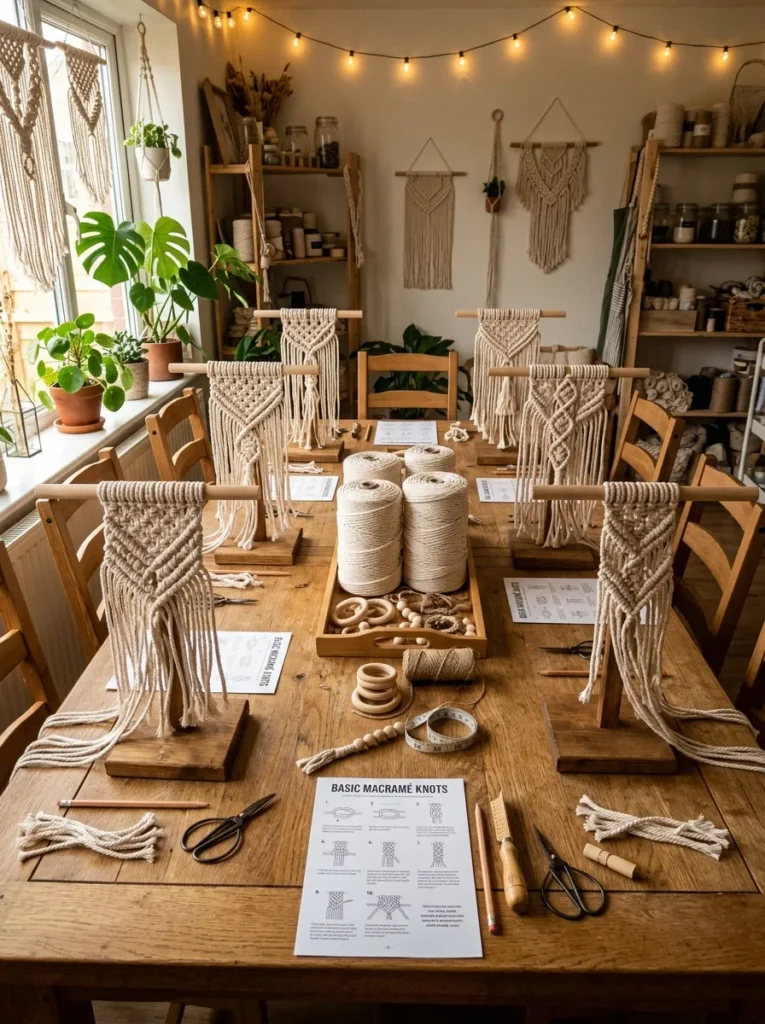
Vibe: The table is natural — a macramé wall hanging night creates a communal textile making experience where the natural cotton rope, wooden dowels, and the rhythmic repetition of knot work create the specific quiet focus of fiber craft, and the conversation flows most freely in this particular mode of occupied hands.
Why it works: Macramé is one of the craft night themes with the highest skill-to-result efficiency — the two or three fundamental knots required for a basic wall hanging (the lark’s head knot for mounting, the square knot for pattern, and the spiral half hitch for texture) can be taught in 15 minutes and used to produce a genuinely beautiful finished piece in a two-hour session. The rhythmic, repetitive nature of macramé knot work is genuinely meditative — participants often describe a state of absorbed focus that feels simultaneously social (talking) and solitary (making), which is the specific quality that makes craft night conversation different from purely social conversation. The finished wall hanging is large enough (typically 12–18 inches wide and 18–24 inches long) to be immediately displayable at home.
How to get it: Pre-cut rope lengths for each participant (a standard beginner wall hanging using a 12-inch dowel requires approximately 20 lengths of 3mm cotton macramé cord cut to 60 inches each) — this preparation is the most time-consuming host task but is essential for eliminating the measuring confusion that delays making. Attach lengths to dowels before the event (lark’s head knot is simple to demonstrate but time-consuming for a large group to master simultaneously). Provide printed knot reference cards at each place. Supply scissors, a measuring tape, and a small comb for fringe finishing. Natural jute twine for hanging completes the piece. Total host prep cost: $30–$60 for 6–8 guests.
Shop The Look
- Natural cotton macramé cord 3mm roll
- Wooden dowel rod set craft macramé
- Macramé knot guide card printable
- Craft scissors sharp clean cut
- Natural jute twine thin hanging cord
5. Watercolor Botanical Illustration Night
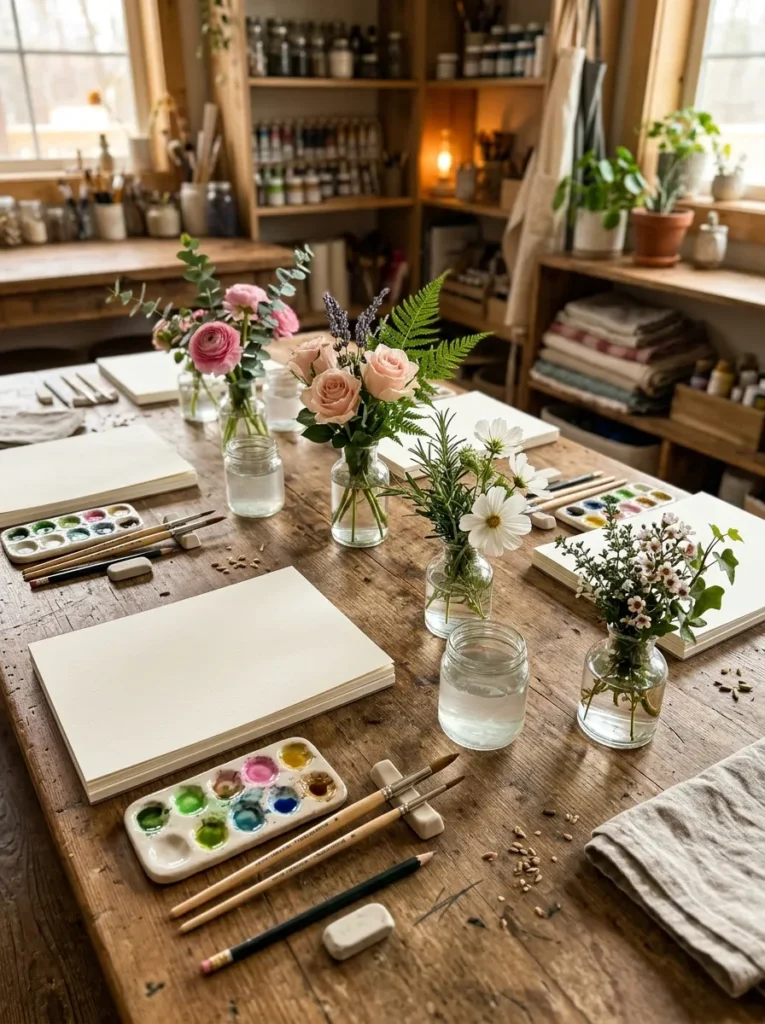
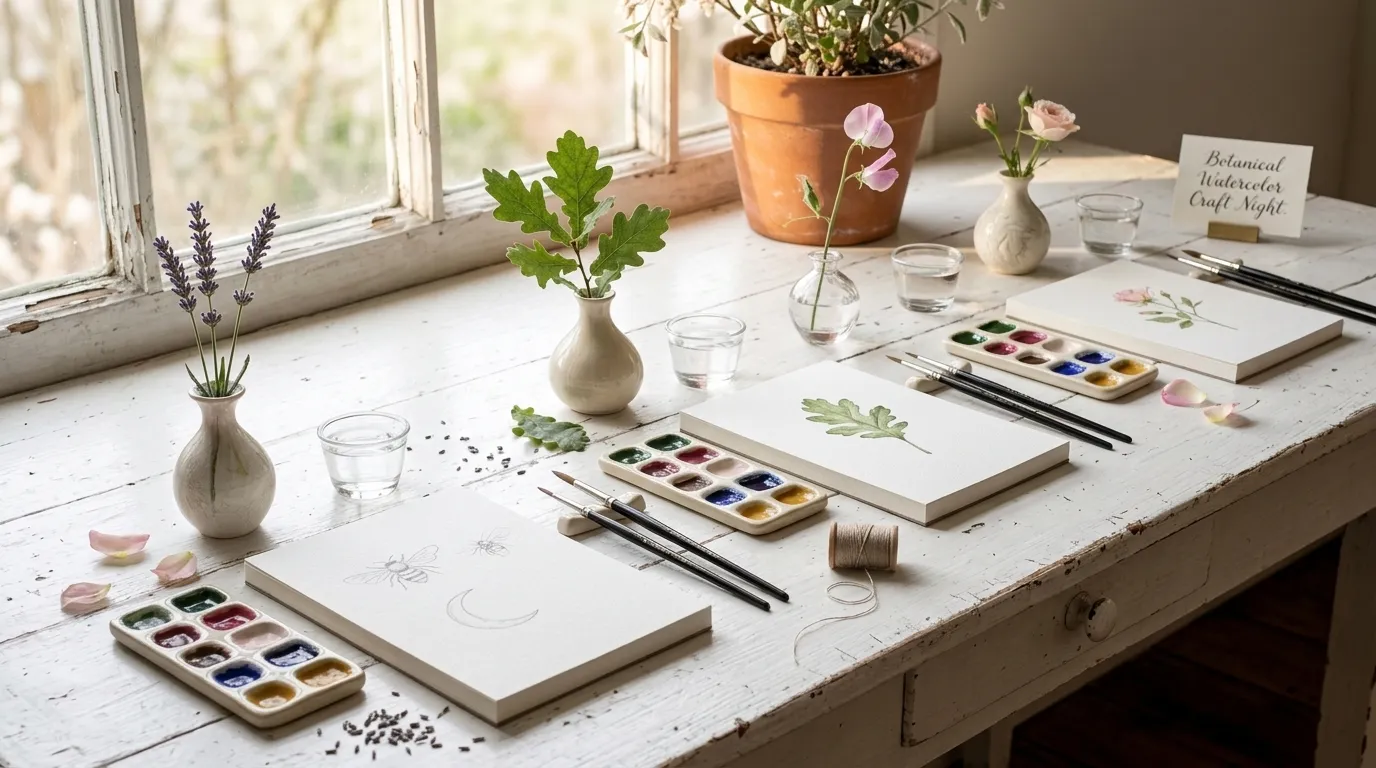
Vibe: The table is focused — a watercolor botanical illustration night creates the specific atmosphere of an artist’s studio at the dining room table, where the combination of fresh botanical specimens, quality materials, and a defined subject transforms an informal gathering into a genuine creative session.
Why it works: Watercolor botanical illustration is the craft night theme with the highest perceived sophistication — guests arrive uncertain of their ability and leave with paintings they are genuinely proud of, which makes the evening’s arc (from intimidation through absorption to pride) unusually satisfying. The botanical subject is specifically appropriate because plants are patient models (unlike humans or animals, a flower stem doesn’t move), their forms are familiar enough to be recognizable but varied enough to be interesting, and the color palette of botanical subjects (warm greens, blush pinks, cream whites, deep burgundy) is inherently beautiful in watercolor. Pre-loading the palette (the host applies colors to each ceramic palette before guests arrive) eliminates the most intimidating moment for beginners — confronting the full range of available colors and not knowing where to begin.
How to get it: Source fresh botanical specimens from a garden or florist the day before — one or two stems per person of varied species (ranunculus, eucalyptus, lavender, and herbs all work beautifully). Pre-load ceramic palettes with a curated botanical color range: sap green, olive green, rose pink, crimson, yellow ochre, burnt sienna, and indigo — this is sufficient for 90% of botanical subjects. Provide 140-lb cold-press watercolor paper blocks (Arches or Fabriano, $4–$6 per block of 10 sheets). A three-brush set (size 2, 6, and 10 round brushes) per person covers all detail levels. Set each place with a full water cup and a small folded cloth for brush wiping. Total host prep cost: $60–$100 for 6–8 guests.
Shop The Look
- Watercolor paper block 140lb cold press
- Watercolor paint set botanical palette
- Round watercolor brush set sizes 2 6 10
- Ceramic mixing palette small individual
- Fresh flower stem assortment botanical
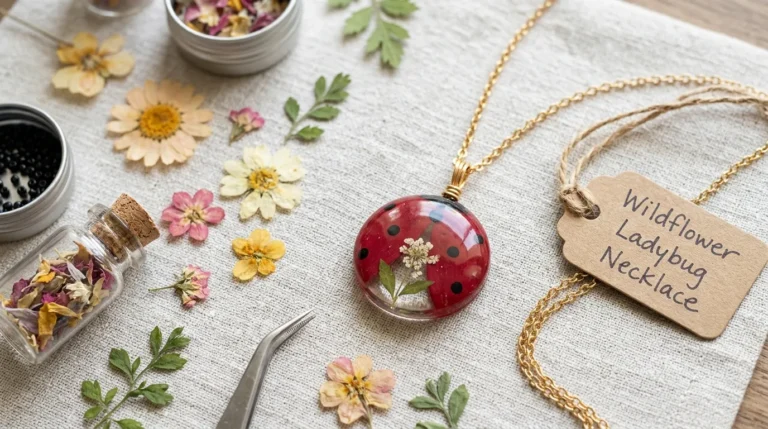
6. Pressed Flower and Botanical Collage Night
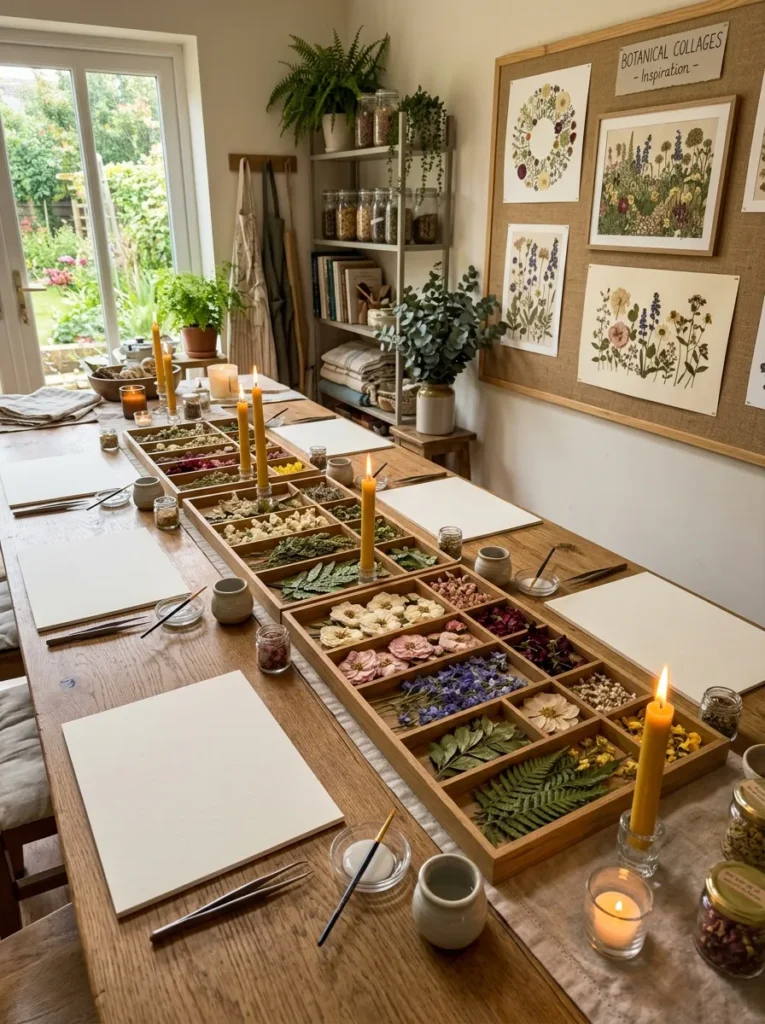
Vibe: The table is botanical — a pressed flower collage night creates an archival, naturalist atmosphere where each person composes a personal herbarium page from pre-pressed specimens, and the combination of delicate dried material and compositional decision-making produces a finished piece with the specific beauty of preserved nature.
Why it works: Pressed flower collage is the craft night theme with the lowest technical barrier and the highest design satisfaction — the botanical specimens do the visual work, and the maker’s contribution is purely compositional (where to place each element, how to layer them, what to leave uncovered). This accessibility makes it genuinely inclusive for a mixed-skill group while remaining deeply satisfying for more experienced crafters who use composition, spacing, and botanical variety to create more complex arrangements. The intimacy of handling delicate, preserved botanical material — placing a tiny dried fern frond with tweezers, positioning a single pressed violet petal — creates a focused, quiet making atmosphere that is unusually conducive to meaningful conversation.
How to get it: Press botanical specimens 2–4 weeks before the craft night by layering fresh botanicals between absorbent paper in a heavy book or flower press. Include a variety of forms and colors: small flowers (pansy, viola, ranunculus), leaf varieties (fern, ivy, herb leaves), grasses, and berry stems. Pre-organize by type in shallow display trays. Provide archival quality cream or warm white cardstock (5×7 or 8×10 inch) at each place. Archival PVA glue applied with a fine brush or with an adhesive pen works for attaching specimens. Provide fine-tip tweezers for precise placement. Frame options ($5–$12 per frame) let guests leave with a frameable finished piece. Total host prep cost: $30–$60 for 6–8 guests, plus 3–4 weeks advance for pressing.
Shop The Look
- Flower press board natural wood set
- Archival PVA glue craft acid free
- Fine tip tweezers craft precision
- Cream cardstock 8×10 set blank
- Simple frame 8×10 natural wood
7. Hand-Thrown Pottery Night (Clay Pinch Pot Session)
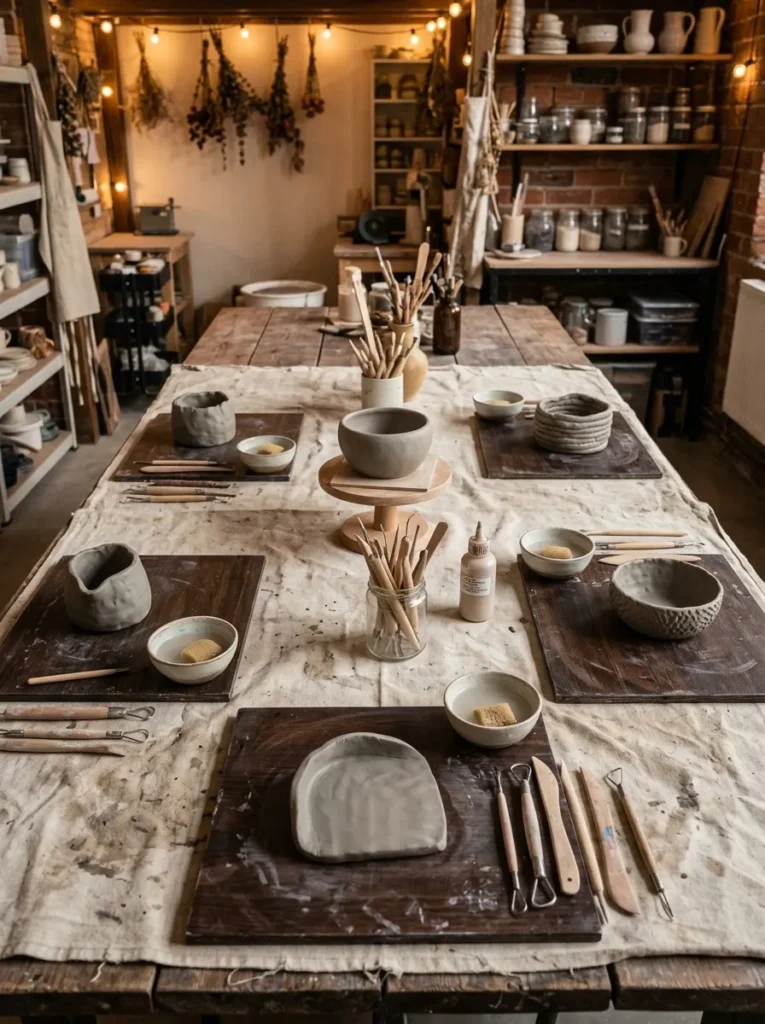
Vibe: The table is grounded — a clay hand-building night brings the specific, tactile pleasure of working with earth material to a social gathering, where the centering effect of clay in hands and the immediate responsiveness of the material to touch creates a communal creative focus that no other craft material quite replicates.
Why it works: Clay hand-building is the most tactilely engaging craft night theme — the direct contact between hands and material, the immediate responsiveness of clay to pressure and movement, and the meditative quality of the pinching and building process create a physical making experience that most adults have not had since childhood. The pinch pot format is specifically ideal for a craft night because it requires no wheel, no kiln, and no specialized equipment beyond clay and basic tools — air-dry clay (white or terracotta) produces genuinely beautiful results when hand-built and decorated with acrylic paint after drying, and finished pieces can be sanded and sealed to a ceramic-like quality. The imperfection of hand-built clay — the slight asymmetry, the visible finger impressions — is a design quality rather than a flaw.
How to get it: Provide each guest with approximately 1 pound of air-dry clay on a wooden board (a small cutting board works perfectly). Set up small bowls of water at each place for keeping hands moist during building. Provide a basic tool set: a wooden modeling tool, a loop trimming tool, and a small sponge. Demonstrate the pinch pot technique: form a ball, insert both thumbs, and pinch outward while rotating — the basic lesson takes 5 minutes and the rest of the session is individual exploration. Allow pieces to dry at home (24–72 hours) before painting — plan for a follow-up sharing of finished painted pieces, or provide a painting add-on at the end of a longer session. Total host prep cost: $25–$50 for 6–8 guests.
Shop The Look
- Air dry clay white 5 lb natural
- Wooden modeling tool set clay
- Loop trimming tool clay hand building
- Small wooden board clay work surface
- Watercolor paint set clay decoration
8. Natural Fiber Weaving Night with Small Looms
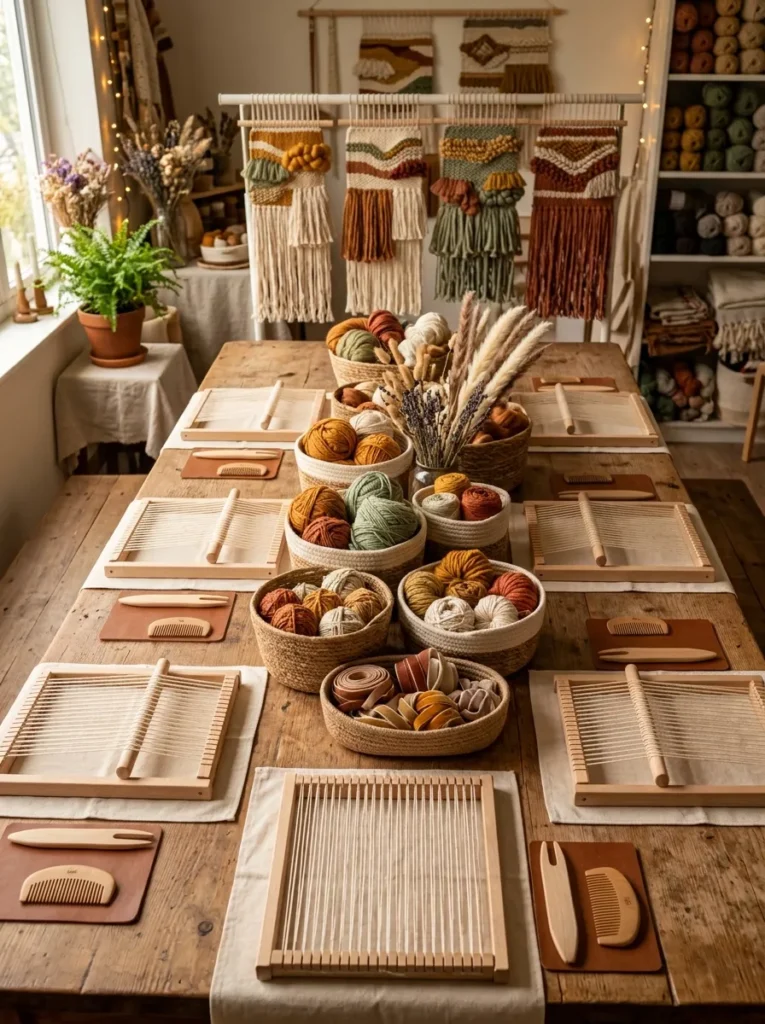
Vibe: The table is textile-warm — a weaving craft night with small looms and a basket of earthy yarns and natural fibers creates the communal textile-making atmosphere of a studio weaving class at intimate home scale, where the tactile pleasure of varied fiber and the rhythm of the weaving process creates the most absorbed creative focus of any craft night theme.
Why it works: Weaving on small frame looms is specifically ideal for craft nights because the pre-warped loom eliminates the most technical aspect of weaving (warping) while preserving the genuinely creative dimension (weft selection, pattern, and texture). A pre-warped 8×10 inch loom with 8 warp ends per inch produces a weaving with enough technical involvement to feel genuinely skilled without being so complex that beginners struggle — a simple plain weave with varied fiber creates beautiful results, and more confident crafters can explore twill patterns or rya knots. The weft fiber selection — yarn, roving, torn fabric strips, ribbon, dried grasses — is inherently tactile and enjoyable, and the combination of different weft materials in a single weaving produces the richest results.
How to get it: Pre-warp small frame looms ($8–$20 each from craft suppliers) before the event using natural cotton warp thread — this is the most time-consuming host preparation but takes approximately 10 minutes per loom once practiced. Wind warp at 8 ends per inch for a balanced, medium-weight fabric. Organize weft fiber in shared center baskets — a combination of chunky wool yarn, thin cotton yarn, wool roving, linen ribbon, dried ornamental grasses, and torn fabric strips in a coordinated earthy palette. Provide a wooden tapestry needle and a small comb or fork per person for packing wefts. Demonstrate plain weave (over one, under one) and let participants discover texture through fiber choice. Total host prep cost: $40–$80 for 6–8 guests.
Shop The Look
- Small frame loom 8×10 inch wood
- Cotton warp thread natural craft
- Wool yarn chunky natural earthy tones
- Wool roving fiber craft weaving
- Tapestry needle wooden large eye
9. Soap Making and Natural Beauty Night
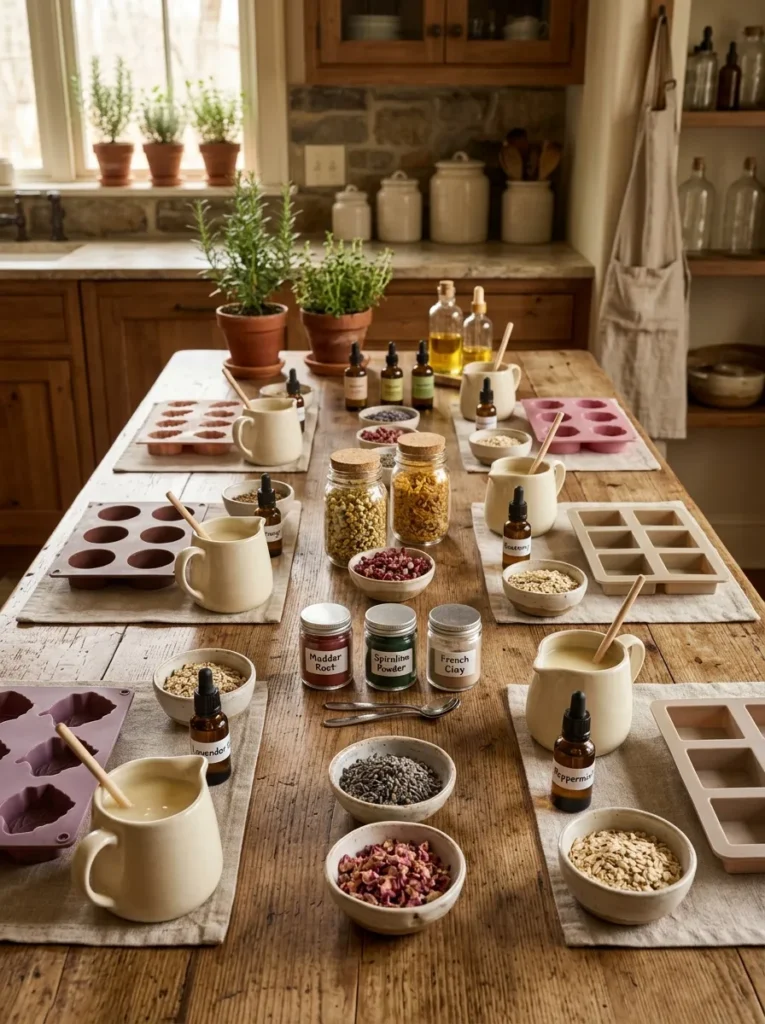
Vibe: The table is apothecary — a natural soap and beauty making night creates the atmosphere of a botanical laboratory in miniature, where essential oils, dried herbs, and natural colorants combine with the chemistry of soap making to produce genuinely beautiful, genuinely useful handcrafted beauty products.
Why it works: Soap making with melt-and-pour base is the craft night theme with the highest finished-object utility — every participant leaves with functional handmade soap bars that will be used daily rather than displayed or stored. The melt-and-pour method (melting a pre-made soap base and adding fragrance, color, and botanicals before pouring into molds) eliminates the hazardous lye chemistry of cold-process soap making while preserving the genuine creative decisions: fragrance blending, color choice, botanical inclusion, and mold selection. The fragrance-blending component specifically creates a sensory engagement throughout the evening — guests smell different combinations on their wrists, discuss what they prefer, and make genuinely personal choices about what they want their soap to smell like.
How to get it: Pre-melt melt-and-pour soap base (available from Brambleberry or SoapGoods, $15–$25 for 5 pounds, sufficient for 8–10 bars per person) in a large pitcher. Keep warm in a slow cooker set to low. Set out small silicone soap molds (four-cavity molds work well for a craft night portion) at each place. Organize essential oils in small dropper bottles — lavender, eucalyptus, peppermint, rose, and sweet orange are reliable starting points. Provide natural colorants (mica powder in muted tones) and dried botanical additions in small bowls. Each guest adds fragrance and color to their portion of base, pours into molds, and adds botanicals on top. Bars harden in 1–2 hours. Total host prep cost: $50–$90 for 6–8 guests.
Shop The Look
- Melt and pour soap base white natural
- Essential oil sampler set natural fragrance
- Silicone soap mold 4 cavity set
- Mica colorant powder soap muted set
- Dried lavender botanical soap addition
10. Wire and Stone Jewelry Making Night
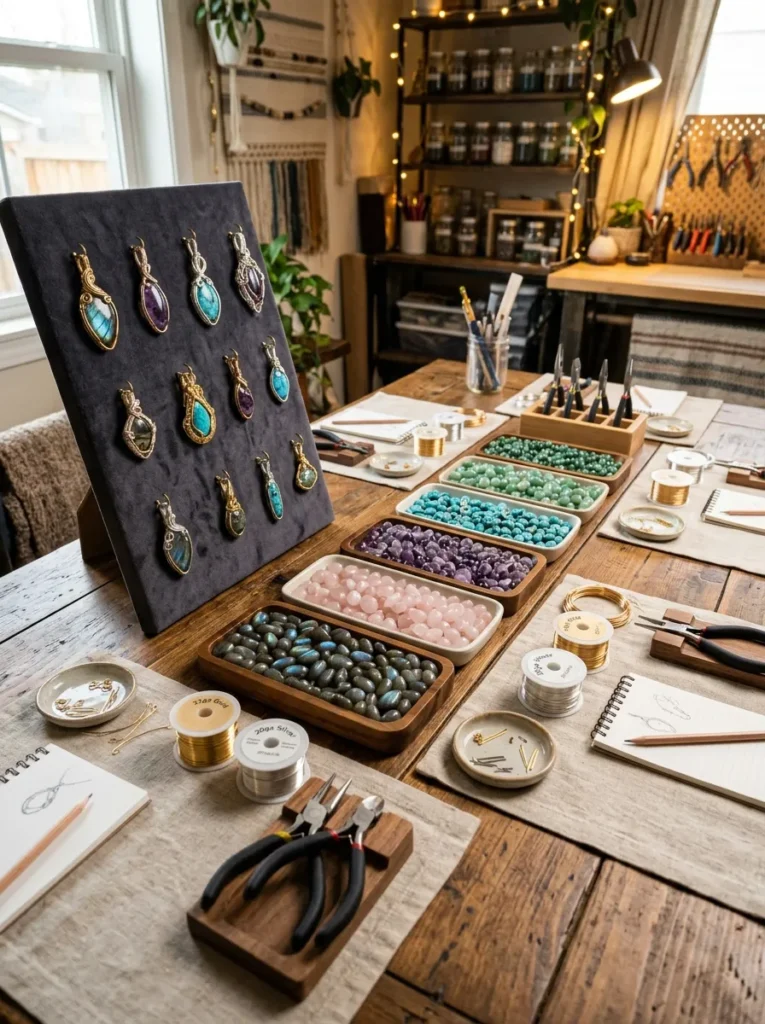
Vibe: The table is precise — a wire and stone jewelry night creates the focused, detail-oriented atmosphere of a jeweler’s bench translated to a social setting, where the selection of natural stones and the learning of wire techniques produces a wearable finished piece that carries the specific pride of making something genuinely beautiful.
Why it works: Wire wrapping is the jewelry making technique most accessible to beginners while producing genuinely wearable, sophisticated results — the basic wire wrap pendant technique requires only a round-nose pliers, flat-nose pliers, and wire cutters, and produces a clean, professional-looking stone pendant in 20–30 minutes per piece. The stone selection process at the beginning of the evening creates immediate engagement and personal investment — each person choosing their stone based on color, energy, or aesthetic preference creates the personal connection to the finished piece that makes craft night jewelry feel different from purchased jewelry. Each guest can make two or three pendants in a craft night session.
How to get it: Provide natural stone focal beads in a central tray — labradorite, rose quartz, amethyst, raw citrine, turquoise, and moonstone drilled beads are reliably beautiful and diverse enough for varied personal selection ($3–$10 per bead from jewelry supply stores). Provide 20-gauge and 24-gauge wire in both gold-fill and silver per person (small pre-cut coils of approximately 3 feet each). Set up a pliers kit per person or pair: round-nose, flat-nose, and chain-nose pliers plus wire cutters ($15–$25 per set). Demonstrate the basic wire wrap loop technique at the start (5–10 minute demonstration) before individual work begins. Chain and clasp sets ($2–$4 per person) complete the pendant to necklace. Total host prep cost: $60–$120 for 6–8 guests.
Shop The Look
- Natural stone drilled bead assortment
- Gold filled wire 20 gauge jewelry
- Sterling silver wire 24 gauge jewelry
- Round nose pliers jewelry set
- Chain necklace clasp finding set
11. Seasonal Wreath Making Night
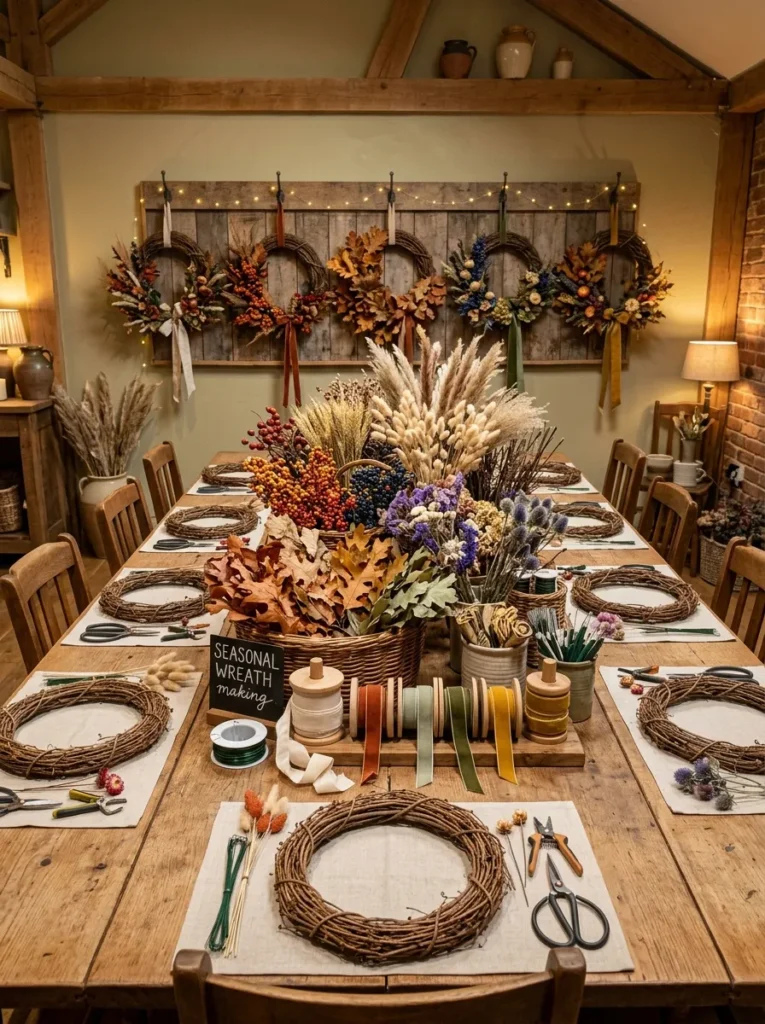
Vibe: The table is abundant — a seasonal wreath making night with baskets of natural botanicals and a grapevine base at each place creates the atmosphere of a florist’s workroom in miniature, where the abundance of material and the shared process of botanical composition produces a genuinely generous evening.
Why it works: Wreath making is the craft night theme with the clearest connection to a practical domestic function — every participant leaves with a wreath that will hang on their door, over their mantel, or on their wall, creating a seasonal home decoration with the personal investment that purchased wreaths cannot replicate. The grapevine base is specifically ideal for craft night use because it accepts botanicals without any adhesive (stems can simply be woven into the vine) and produces a natural, organic result even with minimal technique. The shared botanical basket format creates the most social dynamic of any craft night — reaching for the same dried grass bundle, comparing placement decisions, borrowing a particularly beautiful berry cluster — and the conversation flows naturally around the shared material selection.
How to get it: Provide grapevine wreath bases in the same size for all guests ($4–$8 each, 14-inch diameter for a standard door wreath) — the consistent size creates a useful comparative element when the group compares their varied designs. Organize shared botanical baskets at the table center with generous quantities: dried pampas stems, bittersweet berry clusters, dried citrus slices, preserved eucalyptus, dried cotton stems, and ribbon options. Provide floral wire and hot glue guns (with extra glue sticks) at each place for securing elements. Demonstrate attaching the first two or three elements to establish the technique — the rest is personal design decision. Total host prep cost: $60–$100 for 6–8 guests.
Shop The Look
- Grapevine wreath base 14 inch natural
- Dried pampas grass small bundle
- Dried botanical assortment wreath set
- Floral wire paddle green 24 gauge
- Ribbon variety set seasonal craft
12. Block Printing Night on Fabric or Paper
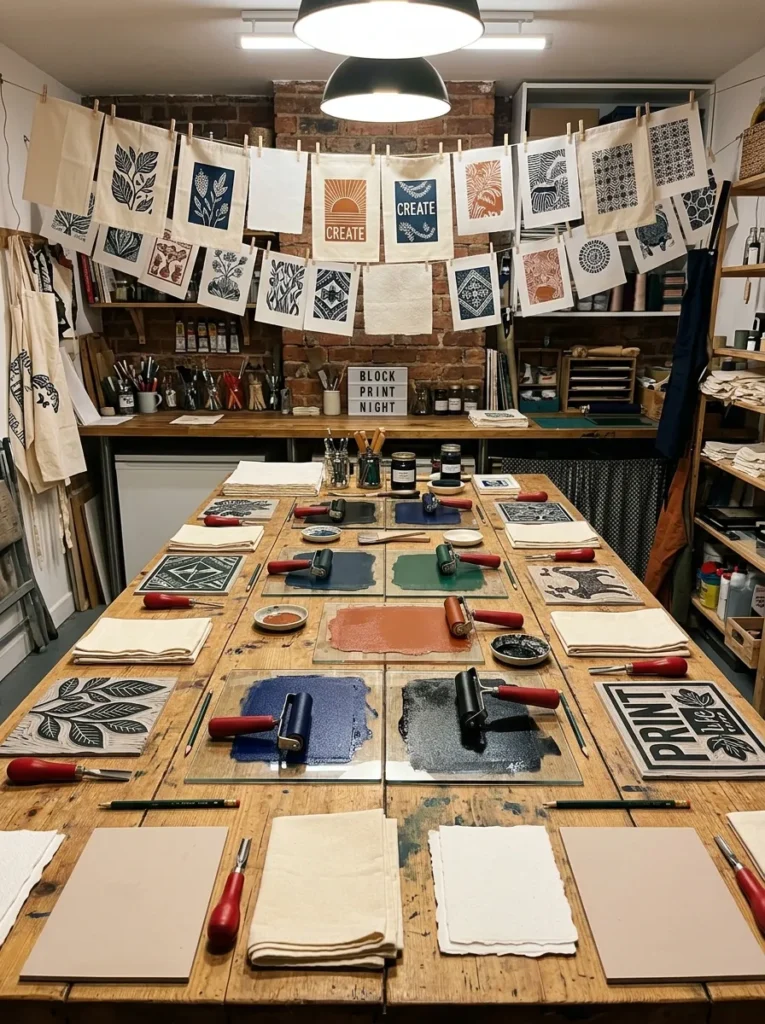
Vibe: The table is graphic — a block printing night creates a print studio atmosphere where the making of marks on fabric and paper with carved blocks produces the specific satisfaction of printmaking — the inking, the pressing, the lifting reveal — that is unlike any other craft making experience.
Why it works: Block printing is the craft night theme with the most immediate, dramatic result — the moment of lifting a printed block from paper or fabric to reveal the print is one of the most satisfying single moments in any craft practice, and the repeatability of that moment (each impression of the same block produces a slightly different result) keeps the process engaging for the full evening. The fabric tea towel format is specifically ideal for a craft night — it is large enough to show the print at a useful scale, absorbent enough for good ink transfer, and immediately functional as a kitchen or gift item. Pre-carving simple designs before the event (botanical forms, geometric patterns, simple animal motifs) ensures that guests who are not comfortable with carving tools can immediately begin printing, while guests who want to carve their own design can use the blank linoleum blocks and tools provided.
How to get it: Pre-carve 2–3 simple linoleum block designs per guest (botanical leaf, geometric repeat, simple bird or insect) — carving takes 15–30 minutes per simple design and can be done in the days before the event. Provide blank linoleum blocks and Speedball carving tools for guests who want to try their own carving. Set up inking plates (a ceramic tile works perfectly) with fabric block printing ink (Speedball or Jacquard) rolled to an even thin layer with a brayer. Provide pre-washed natural cotton tea towels and quality printing paper at each place. Demonstrate the ink-and-print process: ink the block, press firmly and evenly, lift. Heat-set fabric prints with an iron after the event for permanence. Total host prep cost: $50–$90 for 6–8 guests.
Shop The Look
- Linoleum block printing set blank
- Speedball carving tool set lino
- Block printing ink fabric safe set
- Rubber brayer ink roller small
- Natural cotton tea towel blank set
13. Resin Art Night with Geode and Abstract Pours
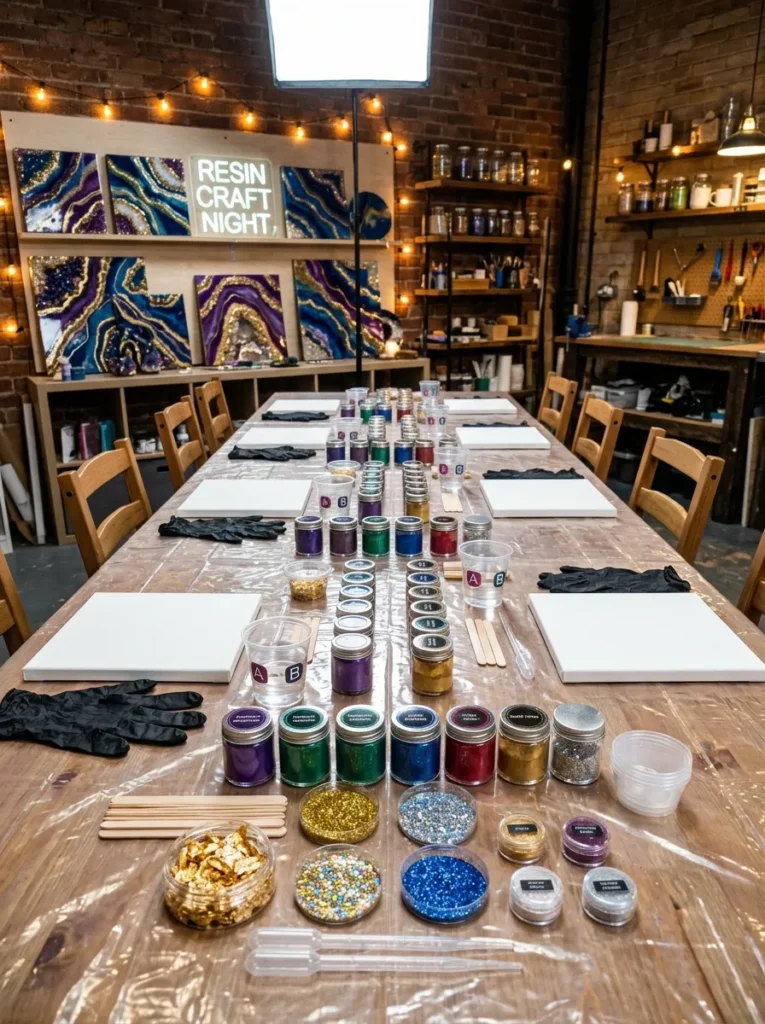
Vibe: The table is dramatic — a resin geode art night with metallic pigments, gold leaf, and gem-tone colors creates the most visually spectacular craft night setup available, where the materials alone — the metallic powders, the gold leaf flakes, the gem-colored pigments — create a table that is photographically beautiful before any making begins.
Why it works: Resin geode art is the craft night theme with the highest social media documentation potential — every stage of the process (pigment mixing, pouring, gold leaf application, and the final swirling and spreading technique) is visually dramatic and highly photographable, which makes it ideal for craft night groups who want to document the evening as well as make. The geode format (an abstract mineral-inspired design with gem-tone color areas separated by gold leaf “crystal” veining) is also specifically forgiving — the organic, fluid nature of resin means that even technically inexperienced participants produce beautiful, unique results because the resin’s own movement behavior is inherently aesthetic.
How to get it: Pre-measure resin components (a 2:1 ratio epoxy art resin in 2-oz total portions per participant works for a 6-inch panel) in small labeled cups — mixing happens at the table. Cover all surfaces with plastic sheeting — resin is permanent and will ruin unprotected surfaces. Provide circular or square wooden or canvas panel bases (6-inch size works well for a craft night piece). Set out gem-tone pigment powders (amethyst purple, emerald green, sapphire blue, rose gold), gold leaf flakes, and white pigment for the quartz zones. Gloves are essential — provide nitrile gloves in all sizes. Demonstrate the geode layout process: place color areas, add gold leaf veining, add white crystal areas, use a heat gun or torch to enhance movement. Total host prep cost: $80–$150 for 6–8 guests.
Shop The Look
- Epoxy art resin 32 oz two part
- Mica pigment powder gem tone set
- Gold leaf flakes craft art
- Circular wood panel blank 6 inch
- Nitrile glove set craft protection
14. Letterpress and Hand Stamping Stationery Night
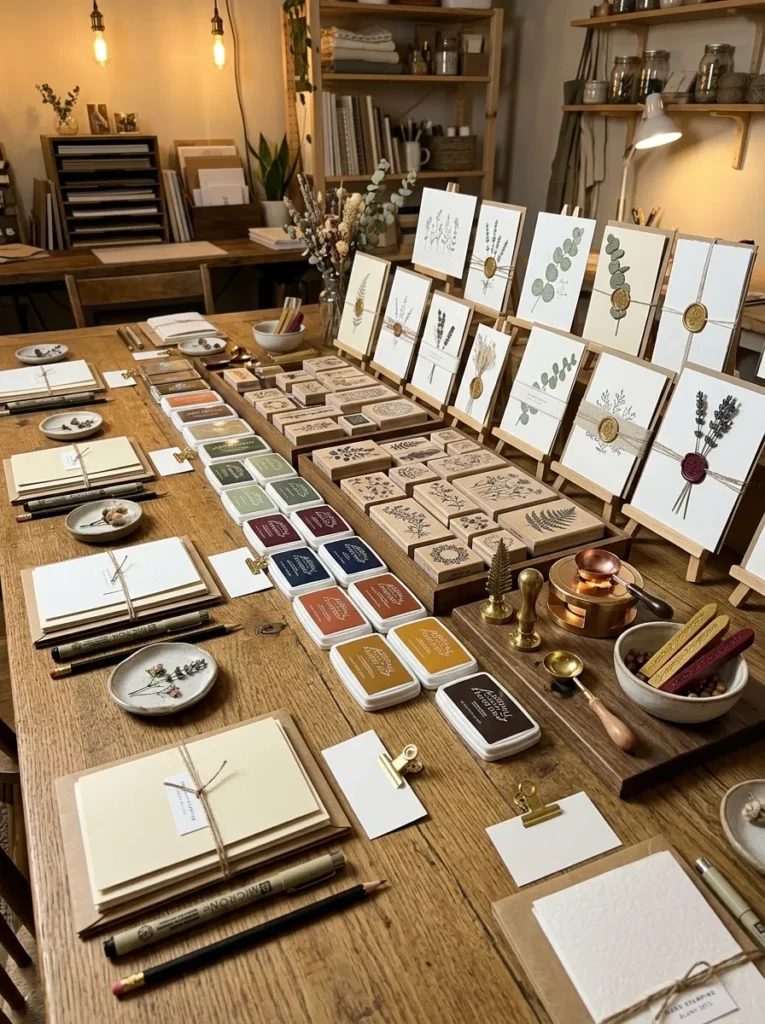
Vibe: The table is refined — a stationery making night with quality card blanks, botanical stamp sets, and wax sealing creates the atmosphere of a paper goods studio, where the combination of high-quality materials and the making of objects designed to be given away produces an unusually generous creative experience.
Why it works: Stationery making is the craft night theme most immediately oriented toward others — the primary question throughout the making process is “who will receive this card?” rather than “what will I display?”, which creates a social warmth within the making that other craft themes do not generate. The wax seal component specifically is the element that creates the most engaged group energy — the ritual of melting wax, pressing the seal, and lifting to reveal the embossed impression has a drama and satisfaction disproportionate to the technique’s simplicity. The finished stationery set (a guest might complete 6–10 cards and envelopes in a craft night session) is immediately usable and represents genuine gifting value.
How to get it: Provide quality blank card and envelope sets ($8–$15 per set for 10 blank cards and matching envelopes, Strathmore or similar). Organize stamp sets in shallow trays at the table center — botanical stamps (leaf, flower, and herb designs) and geometric stamps (repeat patterns, borders, and corner designs) work best for mixed-skill groups. Ink pads in sophisticated tones (sage, navy, burgundy, forest green, warm gold) rather than primary colors create adult-appropriate results immediately. Set up a wax seal station at one end of the table (a shared resource): wax seal stamps in 1–2 designs, sealing wax in gold and burgundy, a small candle for melting. Provide fine liner pens for adding text to cards. Total host prep cost: $50–$80 for 6–8 guests.
Shop The Look
- Blank card and envelope set quality cream
- Botanical rubber stamp set craft
- Ink pad set sophisticated tones
- Wax seal stamp set letter monogram
- Sealing wax stick gold burgundy set
How to Host a Successful Craft Night
The single most important hosting principle for a successful craft night is complete material preparation before the first guest arrives. The host’s primary function is not to teach or to demonstrate — it is to eliminate every friction point that stands between arrival and making. Pre-cut materials, pre-measured components, pre-organized shared resources, and a completely set table mean that guests can begin creating within five minutes of sitting down rather than spending the first twenty minutes of the evening searching for scissors, measuring rope, or figuring out what quantity of clay to use. This preparation is what transforms a craft gathering from a social event with a craft component to a creative event with a social dimension — the distinction is meaningful and felt by guests even when they cannot articulate why one evening felt more satisfying than another.
The most common hosting mistake for craft nights is choosing a theme that is technically too advanced for the group’s experience level, which turns what should be an absorbed, sociable evening into an anxious tutorial session. The correct difficulty calibration for a craft night is a theme that any complete beginner can achieve a beautiful finished result in under two hours, while still offering enough depth and variation for more experienced crafters to push further if they choose. Of the 14 themes in this article, botanical candle making, pressed flower collage, stationery making, and terrarium building are the most beginner-accessible; wire sculpture jewelry, resin geode art, and weaving have slightly higher technical entry points but remain accessible with adequate host demonstration and support.
Three craft night hosting upgrades under $30 that significantly improve the evening’s quality and atmosphere: a playlist curated to the theme’s aesthetic (Japanese ambient music for the shibori night, botanical folk music for the terrarium night, French café music for the watercolor night) that plays softly throughout the session and sets the evening’s tone from arrival; a small printed card at each place with the basic technique instructions and a brief material guide, so guests can self-refer rather than constantly asking the host; and a “craft night kit bag” for each guest to take home — a small paper bag or box containing any leftover materials specific to the theme (extra wax for the candle night, extra rope for the macramé night, extra pressed flowers for the botanical collage night) so the making can continue at home after the evening ends.
A complete craft night for six to eight guests — materials, preparation time, and setup — realistically costs the host $40–$150 depending on the theme’s material requirements, which is comparable to the cost of a dinner party and produces a more memorable and more personally meaningful shared experience for most adult groups. The social return on the craft night investment is consistently higher than equivalent social gatherings because every person at the table has something to do, something to make, and something to take home — three qualities that passive social gatherings cannot offer simultaneously.
Frequently Asked Questions About Hosting Craft Nights
How do I choose the right craft night theme for my specific group?
The theme selection decision should be guided by two questions: what is the group’s collective experience level with making, and what is the physical setting of the evening? For groups with little or no craft experience (typical of friend groups where craft night is a new idea), choose themes with the lowest technical barrier and the highest finished-object gratification: candle making, pressed flower collage, stationery making, and terrarium building consistently produce beautiful results for complete beginners. For groups with some craft experience or curiosity about specific techniques, intermediate themes like macramé, block printing, weaving, and clay building offer genuine skill development within a single evening. For the physical setting: shibori dyeing and resin art require the most space and protective covering — they work best on an outdoor table or a kitchen with plastic-sheeted surfaces; watercolor illustration and stationery making are the most apartment-friendly as they require minimal space and produce no mess.
How far in advance should I prepare materials for a craft night?
Preparation timelines vary significantly by theme. Pressed flower collage requires the most advance notice — 3–4 weeks for flower pressing. Shibori dyeing requires 24–48 hours for vat preparation. Soap making, candle making, resin art, and jewelry making require 2–3 hours of host preparation on the day of the event for material organization, melting, and setup. Weaving requires pre-warping looms, which takes approximately 10 minutes per loom and can be done 1–3 days before the event. Watercolor illustration requires same-day fresh flower sourcing only. The general rule: start planning the craft night theme three to four weeks before the event, source and purchase materials two weeks out, and complete all host preparation on the day of or the day before.
What is the ideal length for a craft night and how should the evening be structured?
A craft night runs most successfully in a three-part structure over approximately three hours total. The first thirty minutes are for arrival, refreshment, and social ease before making begins — guests settle, the table creates immediate visual interest and conversation, and the host demonstrates the basic technique. The middle two hours are the making session itself — this is the evening’s core, and it benefits from minimal interruption beyond refreshment refilling and individual guidance as needed. The final thirty minutes are for collective reveal (everyone shares their finished pieces), cleanup, and social wind-down. Themes with a natural mid-session pause (candle making’s drying time, shibori’s oxidation time) benefit from using that pause for a more substantial refreshment break. Themes with continuous active making (weaving, macramé, jewelry) may benefit from a gentle mid-session refreshment break that the host initiates around the 60–90 minute mark.
How do I handle guests with different skill levels in the same craft night?
Mixed skill levels are the norm for craft nights and can be managed through theme selection and material design. Themes with genuine skill depth (weaving, block printing, wire jewelry) accommodate varied skill levels naturally — a beginner’s plain weave and an experienced crafter’s more complex pattern both succeed on the same loom. Themes with a strong material aesthetic (resin geode art, shibori dyeing) produce beautiful results regardless of skill level because the material itself contributes much of the aesthetic quality. For all themes, providing both a simple version and a more complex version of the project allows guests to self-select their level — the simple version as the expected completion goal, the complex version as an extension for those who want more challenge. The host should explicitly give permission to keep things simple: “the goal tonight is to make something you love, not to make something perfect” is a phrase that immediately reduces craft anxiety for less experienced guests and allows the evening’s social dimension to take priority over technical achievement.
What refreshments work best for a craft night and how should they be served?
Refreshments for craft nights require specific consideration because most craft materials involve hands-on contact that makes eating from plates or drinking from regular glasses logistically complicated. The most successful craft night refreshment approach is a single substantial snack served before the making begins (a cheese and charcuterie board, or warm soup in mugs that can be finished before making) combined with wine, cocktails, or non-alcoholic drinks in stemless, wide-based glasses that are stable on a working table and can be set aside easily. During the making session, limit refreshments to drinks only — finger foods during making invariably introduce food into craft materials or craft materials into food, neither of which is desirable. For craft night themes that involve a natural pause in the making process (candle drying, shibori oxidation, resin curing), use that pause for a more substantial mid-session refreshment moment. Reserve dessert for the final reveal and social wind-down period, when hands are clean and the making session has concluded.
Ready to Host Your First Craft Night?
These 14 themes cover the full range of creative gathering possibilities — from the sensory warmth of a candle making and soap crafting evening, to the technical satisfaction of wire jewelry and block printing, from the meditative focus of weaving and macramé to the dramatic reveal of shibori dyeing and resin geode art, from the naturalist intimacy of pressed flower collage to the communal abundance of seasonal wreath making. You do not need to host all 14 to build a craft night practice — the most successful hosts start with the one theme that most closely matches their own craft interests and their group’s temperament, host it once, refine the preparation based on what worked and what didn’t, and build from there. Choose the theme that made you most want to sit at that table, gather the materials this week, and set a date. The specific magic of a craft night — hands busy, conversation deep, something beautiful taking shape in front of every person at the table — is available to any host willing to do the preparation that makes it possible. Pin the evenings that made you want to send a group text immediately — those are the ones worth hosting first.