12 Smart KALLAX Toy Organization Ideas for Homes
KALLAX toy organization uses IKEA’s iconic cube shelving system as the structural backbone of a tidy, visually calm play space — turning what could be a chaotic room into one where every toy has a home and cleanup takes minutes. This article gives you exactly 12 ideas spanning labels, bins, layouts, lighting, small-space hacks, and styling so your KALLAX works as hard as your kids play.
A well-organized play space has a particular quality — things settle back into place almost on their own, because the system makes it easy. Toys sorted by type, bins that a three-year-old can pull out and push back in, shelves that look considered even when they’re fully loaded. KALLAX toy organization makes all of that achievable without a renovation or a designer. Here are 12 ideas worth saving — and stealing.
Why KALLAX Toy Organization Works So Well
The KALLAX shelving unit was designed as a modular storage system — its 33×33 cm cubby interior is not a coincidence but a calculated dimension that accommodates IKEA’s own range of inserts, fabric bins, and drawer units while remaining compatible with a wide range of third-party baskets. For toy organization specifically, this modularity is transformative. A 2×4 KALLAX holds eight cubbies — enough to give a distinct home to every major toy category a child between two and eight years old owns, from building blocks to art supplies to dress-up accessories.
The materials that make KALLAX so adaptable to family spaces include white-painted MDF (the most common finish, and the most forgiving of crayon marks and sticker residue), birch veneer for a warmer aesthetic, and black-brown for more design-forward playrooms. Inside the cubbies, the best-performing materials are polypropylene bins (washable, impact-resistant), woven seagrass baskets (soft-edged, visually warm), linen fabric cube inserts (compressible, quiet), and solid pine KALLAX drawer inserts for items requiring contained, toddler-proof storage.
The organized playroom aesthetic has dominated Pinterest’s family living category since 2020, fueled by the Montessori-at-home movement and a broader cultural interest in intentional parenting environments. The principle driving this trend is that the environment itself teaches — a room where every toy is visible, accessible, and returnable to a specific spot builds a child’s independence and reduces the parent’s daily reset burden. KALLAX sits at the center of this movement because it is affordable enough to scale and neutral enough to adapt to any home aesthetic.
Small living rooms and shared spaces absolutely support KALLAX toy organization — in fact, the system was built for exactly these situations. A 1×4 KALLAX used horizontally as a room divider between the living and play zones takes up no more floor space than a console table while providing four cubbies of organized toy storage. The honest caveat: in rooms under 120 square feet shared by adults and children, the 2×4 vertical configuration can dominate visually. Opt for a 1×4 or 2×2 and mount it at child height rather than adult height.
Style at a Glance
| Element | Functional Core | Aesthetic Edge |
|---|---|---|
| Philosophy | Every toy earns a home | Calm space, independent child |
| Materials | MDF, polypropylene, linen | Seagrass, solid pine, birch veneer |
| Color Palette | White, oat, natural rattan | Sage, dusty blush, warm gray |
1. Color-Coded Fabric Bin System by Toy Category
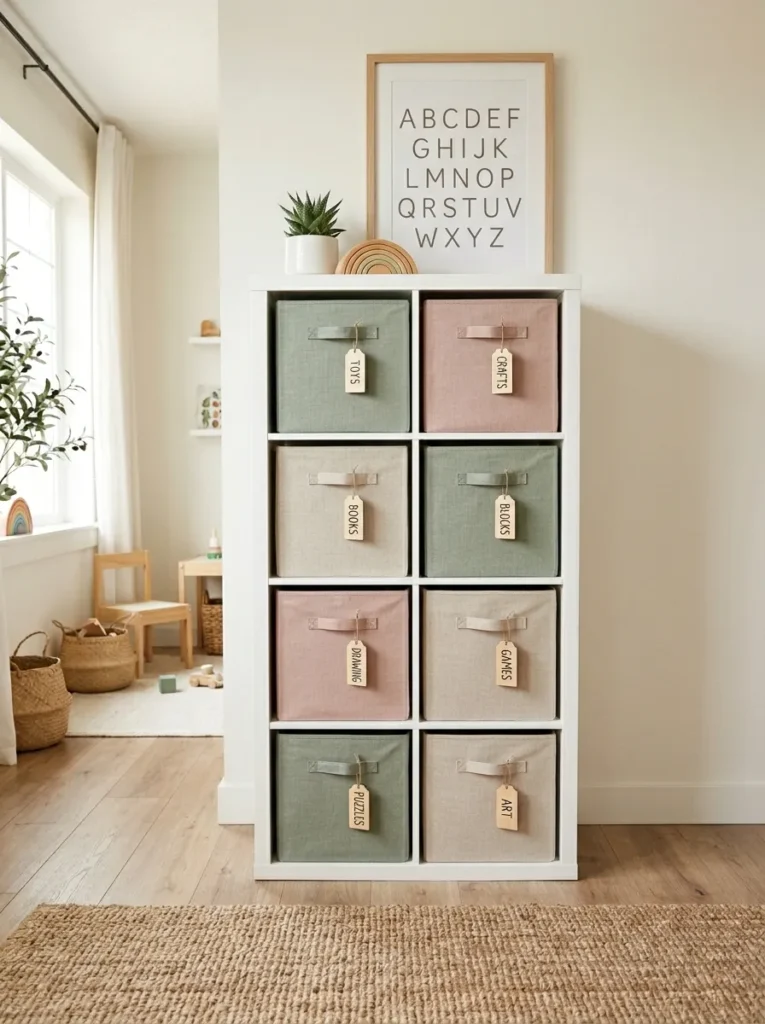
Vibe: The shelving unit reads as calm even when every bin is full.
Why it works: Color-coding by category applies the cognitive principle of pre-attentive processing — the brain identifies color before it reads text, which means even a pre-literate toddler can learn to return toys to the right bin by color alone. Using muted, tonal fabric bins rather than primary-color plastic keeps the visual noise low from an adult perspective, preventing the playroom from looking chaotic even when it’s in active use. The linen texture of quality fabric bins also absorbs ambient sound, which matters in a room full of hard-surface toys.
How to get it: Assign one color per category — sage for building blocks, blush for art supplies, oat for soft toys, gray for puzzles — and be consistent. Buy IKEA DRÖNA bins or third-party linen cube inserts sized exactly to KALLAX’s 33×33 cm interior. Attach small wooden tag labels using thin cotton twine and write categories with a fine-point paint pen in a lowercase font for a hand-crafted look.
Quick Win: IKEA DRÖNA bins ($6.99 each) in a mix of their available neutral tones create an instant color-coded system for under $56 for an 8-cubby KALLAX — no third-party shopping required.
Shop The Look
| Product |
|---|
| Linen fabric cube storage bin set KALLAX size 13 inch |
| Small wooden tag label set with cotton twine |
| Fine point paint pen black set crafts |
| Potted artificial succulent small white pot |
| Framed alphabet print children nursery wall art |
Also view: 15 IKEA Nursery Storage Hacks Every Parent Needs
2. KALLAX with Drawer Inserts for Toddler-Proof Small Toy Storage
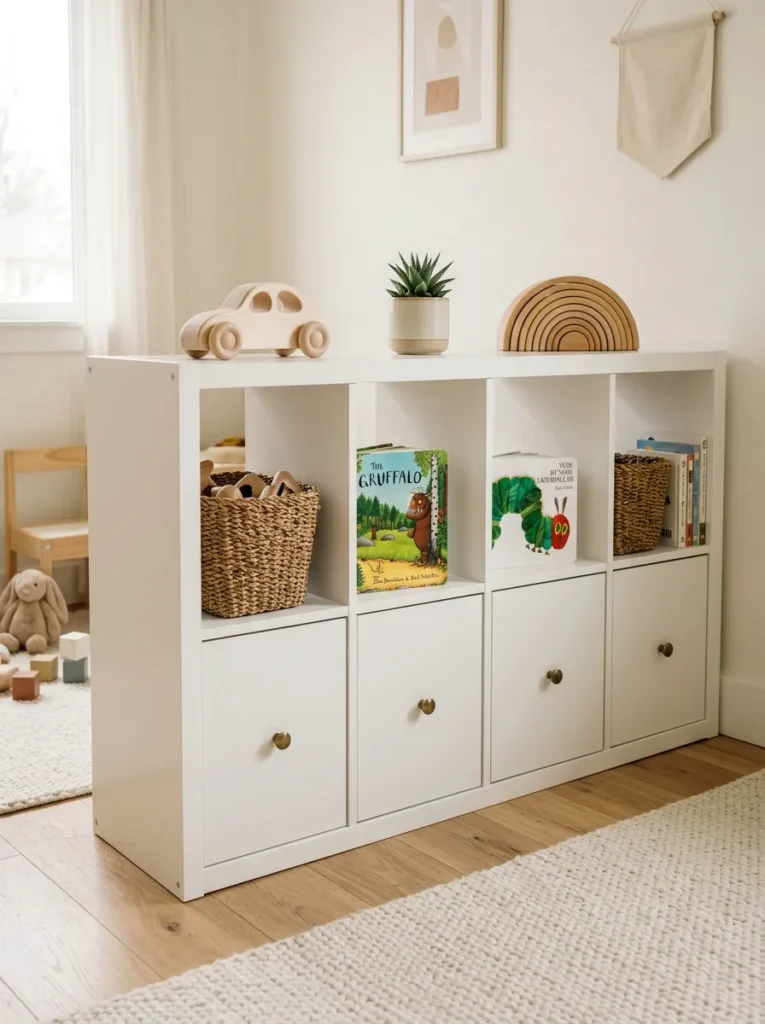
Vibe: The unit feels purposeful — some things tucked away, others on display, and you know exactly why.
Why it works: KALLAX drawer inserts solve the small-toy problem that open bins cannot — LEGOs, puzzle pieces, crayons, and dice all disappear to the bottom of a fabric bin and become difficult to retrieve cleanly. A solid drawer with a knob keeps small pieces contained and the drawer’s smooth-slide action is manageable for children as young as three. Mixing drawer inserts with open cubbies applies the design principle of reveal and conceal — visual variety across the unit’s face prevents the storage from looking like a solid, impenetrable wall.
How to get it: Install KALLAX drawer inserts in the lower two rows only — these are the cubbies children reach into most frequently, and drawers at knee-to-waist height are most ergonomic for small users. Reserve upper cubbies for baskets and face-out book display, which adults manage and children view. Replace the stock flat drawer pulls with small brass or ceramic knobs ($2–4 each) for a more intentional finish.
Shop The Look
| Product |
|---|
| KALLAX insert drawer white with knob storage |
| Small round brass cabinet knob drawer pull set |
| Natural seagrass storage basket KALLAX cubby size |
| Small wooden toy car natural toddler |
| Board book set illustrated animals baby toddler |
3. Face-Out Book Display in KALLAX Cubbies Using Ledge Inserts
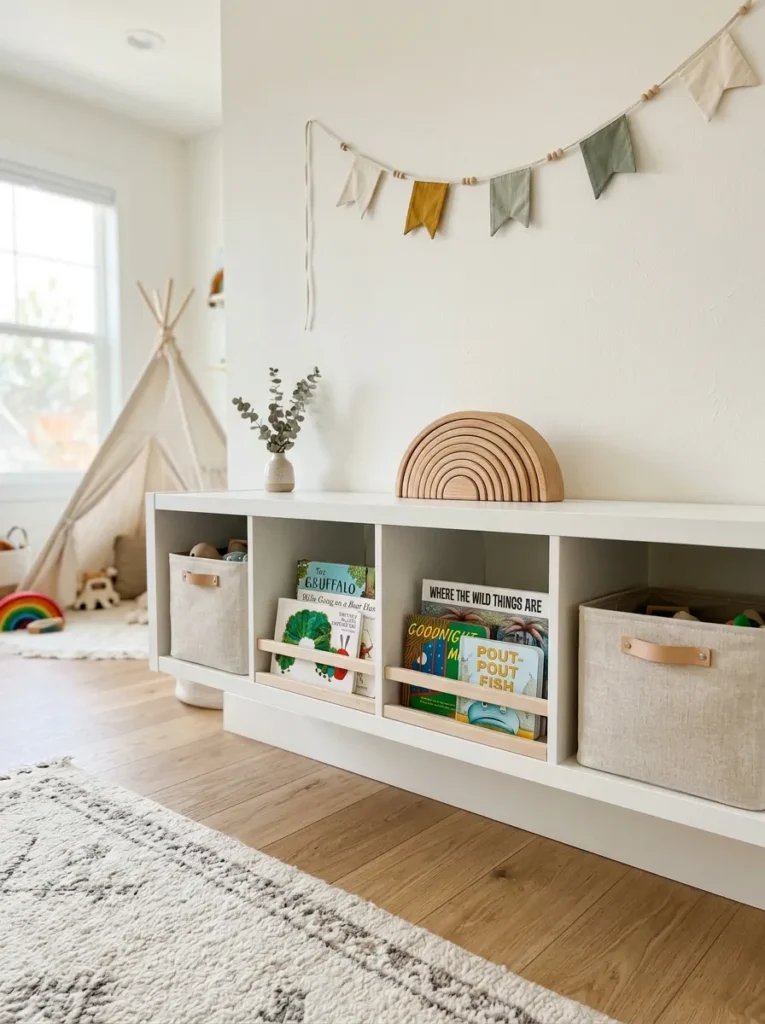
Vibe: The books feel chosen rather than stored — which means they actually get read.
Why it works: Face-out book display inside a KALLAX cubby applies the Montessori prepared environment principle — when the cover is visible, the book is an invitation, not an archived object. Research in children’s literacy environments consistently shows that face-out display increases a child’s voluntary book engagement compared to spine-out shelving. A slim wooden ledge insert (a short piece of 1×2 pine cut to 33 cm, sanded and screwed flush to the cubby base) lifts books off the cubby floor at a slight angle, making covers fully visible and preventing books from sliding flat.
How to get it: Cut a piece of 1×2 unfinished pine to exactly 32.5 cm (just under the cubby interior width), sand the edges smooth, and attach it to the inside bottom of the cubby with two small L-brackets and wood screws. Paint or stain to match the KALLAX finish. Each cubby holds three to five picture books displayed face-out at this size.
Quick Win: IKEA KNOPPÄNG picture ledges (12-inch, $7.99 each) cut down to 32 cm with a hand saw drop into KALLAX cubbies as ready-made book display inserts — no custom building required.
Shop The Look
| Product |
|---|
| Small wooden picture ledge wall shelf white 12 inch |
| Cotton fabric bunting banner nursery playroom |
| Wooden rainbow stacker toy natural toddler |
| Children picture book set illustrated classics |
| Small L-bracket set chrome shelf support |
4. KALLAX as a Low Room Divider Between Play and Living Zones
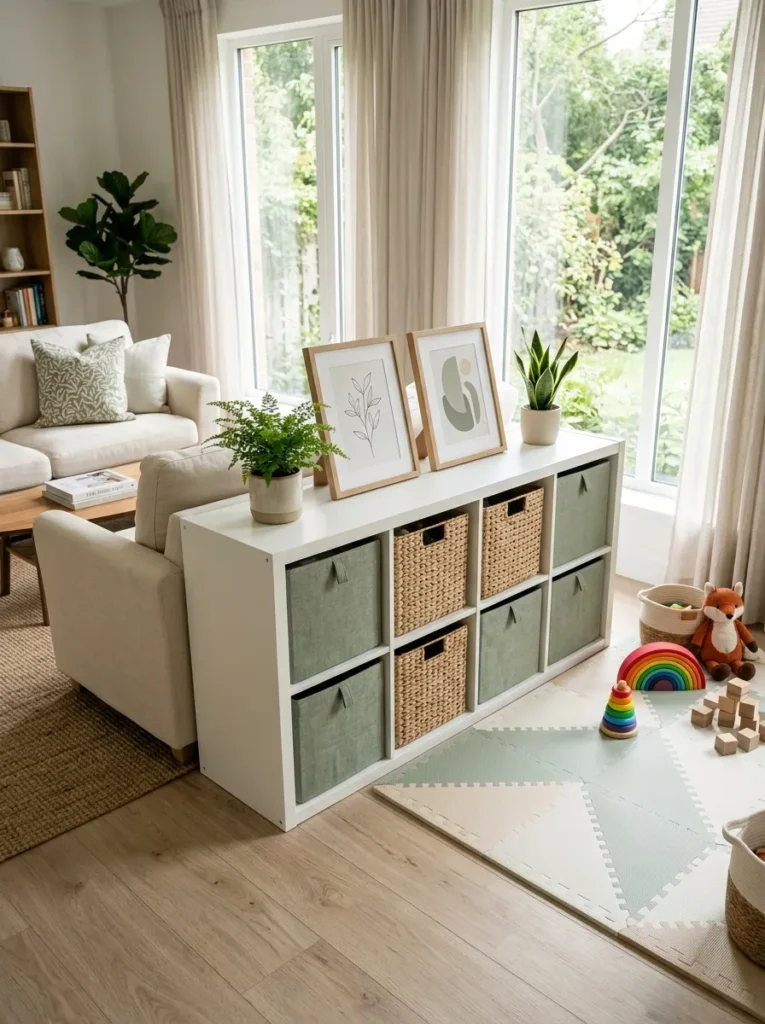
Vibe: The room has zones now — and both sides feel intentional.
Why it works: A horizontal 2×4 KALLAX used as a room divider sits at exactly 77 cm tall — low enough to maintain sightlines across an open-plan room while clearly delineating the play zone from the adult living area. This applies the spatial design principle of implied boundary: the division is suggested rather than enforced, allowing adults to supervise children across the unit without physical obstruction. The flat top surface becomes a secondary display zone for plants and art that reads from the adult side of the room, making the unit work double duty aesthetically.
How to get it: Secure the horizontal KALLAX to the wall at one end using the included anti-tip hardware — do not leave a freestanding horizontal unit unsecured in a room with children, as the lateral stability of a horizontal configuration is lower than vertical. Style the adult-facing top surface with no more than three objects (a plant, a tray, a framed print) to maintain the visual calm that justifies the divider from a design perspective.
Shop The Look
| Product |
|---|
| Anti-tip furniture wall anchor strap safety set |
| Small potted fern artificial realistic indoor |
| Simple oak wood picture frame set 5×7 |
| Sage linen storage cube bin 13 inch |
| Round woven seagrass tray low profile decor |
5. Pegboard Panel Mounted Above KALLAX for Overflow Art Supply Storage
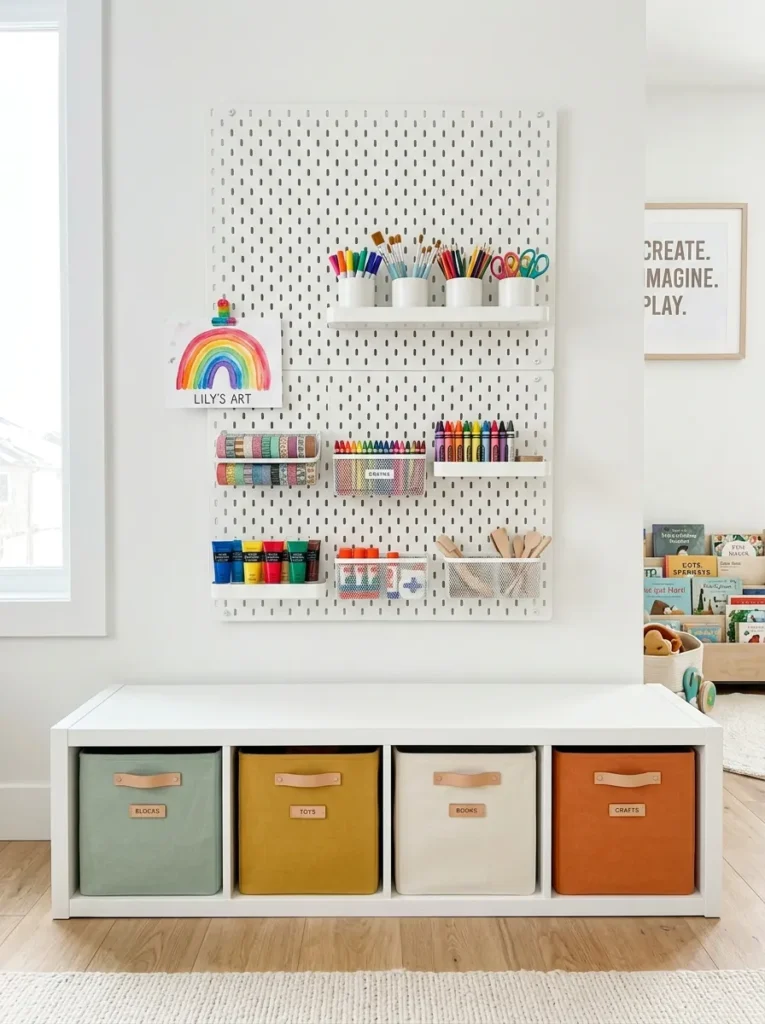
Vibe: The art corner feels ready — every supply visible, reachable, and returned to the same spot.
Why it works: Mounting a pegboard directly above a KALLAX unit creates a vertical storage column that exploits the full wall height from floor to ceiling rather than stopping at the KALLAX’s top edge. This doubles the effective storage capacity of the wall zone without adding any floor footprint. The pegboard handles the small-format, frequently accessed supplies (markers, scissors, tape) that would create clutter inside a fabric bin, while the KALLAX below manages the larger, heavier items. The visual connection between the two systems makes the combined unit read as a single designed feature.
How to get it: Mount the pegboard panel at the same width as the KALLAX unit below (58 cm for a 1×4, or 147 cm for a 2×4) so the visual alignment creates a unified composition. Use pegboard bins in one consistent color — white or natural wood — to prevent the art supply display from reading as visual noise.
Shop The Look
| Product |
|---|
| White pegboard panel wall organizer modular |
| Pegboard small bin holder set white accessories |
| Washi tape roll set rainbow colors art supply |
| Simple word art print frame children playroom |
| Pegboard slim wooden shelf insert accessory |
6. Warm Pendant Light Above KALLAX Reading Nook Corner
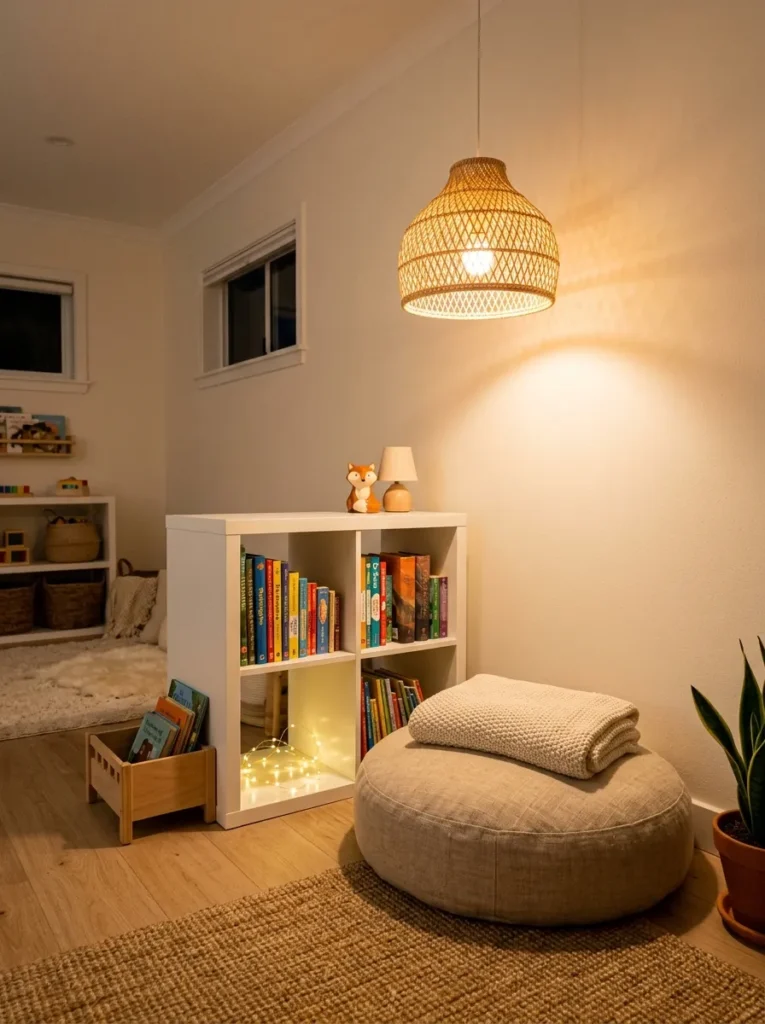
Vibe: The corner feels hushed — the kind of spot a child actually wants to sit in.
Why it works: A pendant light hung low over a reading nook corner (approximately 48–54 inches from the floor to the bottom of the shade) creates a pool of warm light that visually “claims” the corner as a designated zone. This applies the lighting design principle of task-zone definition — the light tells the child (and the adult) what this corner is for without a sign or barrier. A natural rattan shade diffuses warm amber light with an organic texture that reads as soft rather than harsh, encouraging the relaxed body posture that actual reading requires.
How to get it: Use a swag-mount pendant kit to hang a rattan pendant without hardwiring — the cord hooks to a ceiling anchor and drapes to a wall outlet, keeping the install tool-free and renter-friendly. Choose a bulb at 2200–2400K and no more than 400 lumens for a reading nook — bright enough to read by, dim enough to feel cozy rather than like an interrogation room.
Quick Win: A plug-in rattan pendant light ($28–45) on a swag hook creates a fully defined reading nook atmosphere in 20 minutes without any electrical work or ceiling modification.
Shop The Look
| Product |
|---|
| Rattan woven pendant light plug-in swag mount |
| Round floor cushion pouf oat linen children |
| Small knit throw blanket children neutral oat |
| Battery powered fairy light string warm white |
| Swag ceiling hook pendant light cord mount kit |
7. Chalkboard Labels on Wicker Baskets for Rotating Toy Rotation System
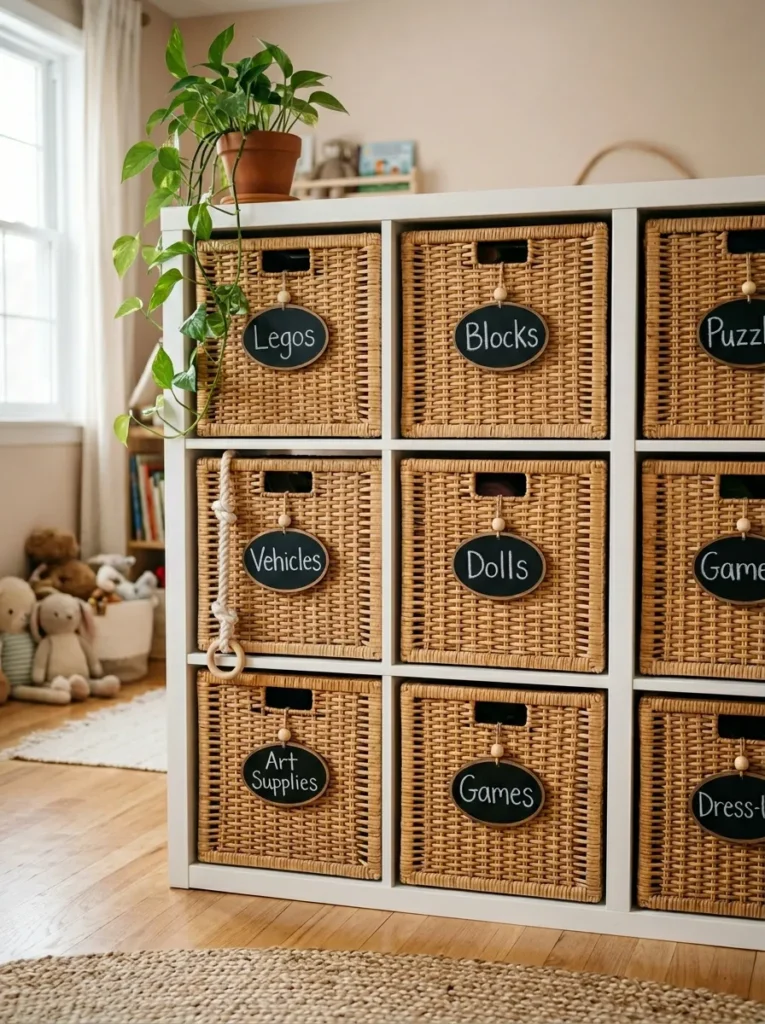
Vibe: The system feels alive — labels that can change mean the organization actually keeps up with the child.
Why it works: Chalkboard labels on wicker baskets solve a problem that printed or permanent labels cannot: children’s toy collections change constantly. A category that matters at age two (stacking rings, shape sorters) is irrelevant at age four, and a fixed label system becomes obsolete within months. Chalkboard labels are erasable and re-writable, allowing the category system to evolve without replacing the baskets. Wicker’s natural warm tone prevents a fully loaded KALLAX from reading as cold or corporate — the organic texture adds warmth that plastic bins and fabric cubes cannot deliver.
How to get it: Buy oval chalkboard labels with self-adhesive backing (available in sets of 30–50 online for under $8) and attach them centered on each basket front. Use a white chalk marker rather than stick chalk for clean, rain-resistant lettering that photographs well and doesn’t smear when baskets are pulled in and out.
Shop The Look
| Product |
|---|
| Natural wicker storage basket set KALLAX size |
| Oval chalkboard self-adhesive label set |
| White chalk marker pen set |
| Cotton rope dog tug toy natural toddler safe |
| Small trailing artificial ivy plant pot playroom |
8. KALLAX with Fabric Curtain Panel Inserts for Hidden Toy Storage
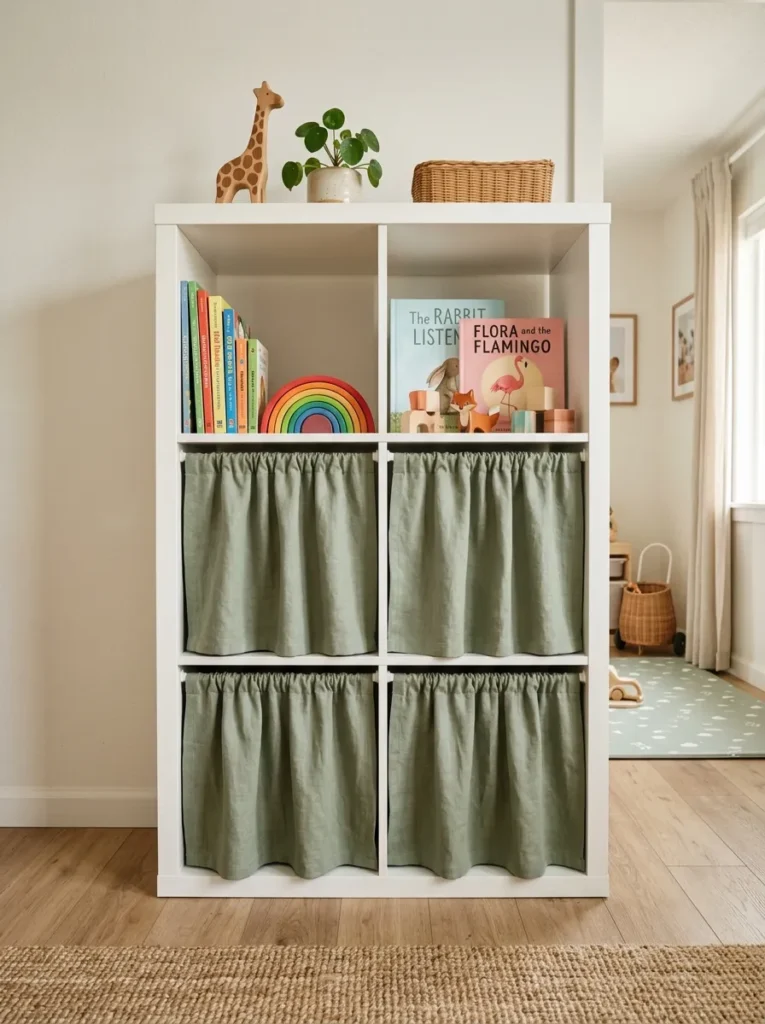
Vibe: The unit feels finished — the lower half quiet, the upper half curated.
Why it works: Fitting the lower KALLAX cubbies with small curtain panels applies the design principle of visual hierarchy through concealment: the eye is drawn upward to the curated open display while the practical, often-messier storage stays hidden at child level. Linen curtain panels introduce softness and texture to what would otherwise be an entirely hard-surface unit. The tension rod installation requires no tools or permanent hardware — a 33 cm mini tension rod fits inside each cubby and holds a small hemmed curtain panel reliably.
How to get it: Cut linen fabric to 34 cm wide and 36 cm tall (slightly wider and taller than the cubby opening for a gathered look), hem all four edges with iron-on hem tape, and thread a 33 cm mini tension rod through a folded top casing. Tension rods hold without screws or damage — ideal for rented properties or frequently reconfigured playrooms.
Quick Win: Pre-made linen cocktail napkins (18×18 inches, $2–4 each) hemmed with a top casing and a mini tension rod become instant KALLAX curtain panels for under $6 per cubby.
Shop The Look
| Product |
|---|
| Mini tension rod set 12-13 inch curtain window |
| Sage green linen fabric by yard natural |
| Iron-on hem tape fabric no-sew craft |
| Small wooden animal figure set natural toy |
| Linen cocktail napkin set neutral undyed |
9. Two-Tone KALLAX Paint Hack for a Designer Playroom Look
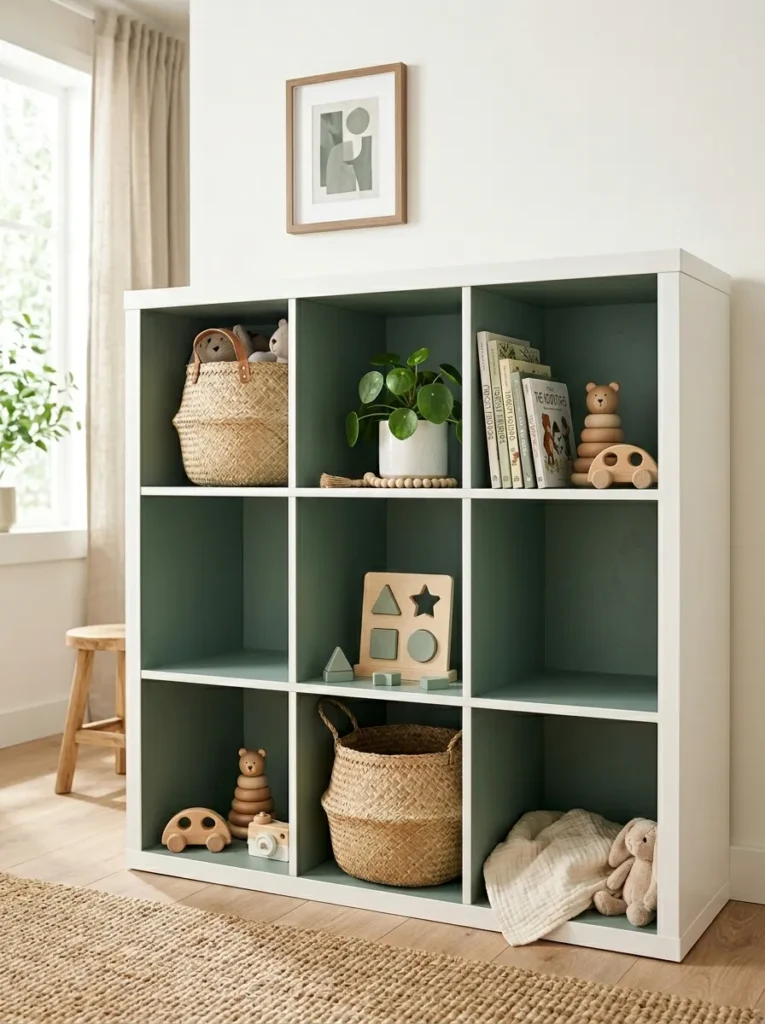
Vibe: The unit looks custom — like something from a design studio rather than a flat-pack box.
Why it works: Painting only the interior surfaces of KALLAX cubbies in a contrasting color applies the principle of depth perception through color — the darker value of the sage interior makes each cubby appear deeper and more intentional than the painted-white alternative. From across the room, the two-tone effect creates a grid of colored squares that reads as a design feature rather than furniture. The technique costs one sample pot of paint ($5–8) and two hours of careful brush work on the interior walls of each cubby.
How to get it: Use a small 2-inch angled brush to cut in the sage color at the back wall of each cubby first, then roll the side walls with a short-nap foam roller. Apply two coats of eggshell finish for washability — playroom surfaces take fingerprints and scuff marks regularly. Tape the cubby openings with low-adhesion painter’s tape to keep the white exterior clean.
Shop The Look
| Product |
|---|
| Sample pot sage green interior paint eggshell |
| Small angled paintbrush set 2 inch |
| Low adhesion painter’s tape delicate surface |
| White ceramic small pot indoor plant decor |
| Wooden shape puzzle set toddler natural |
10. Montessori-Style Open Toy Display in Low KALLAX Configuration
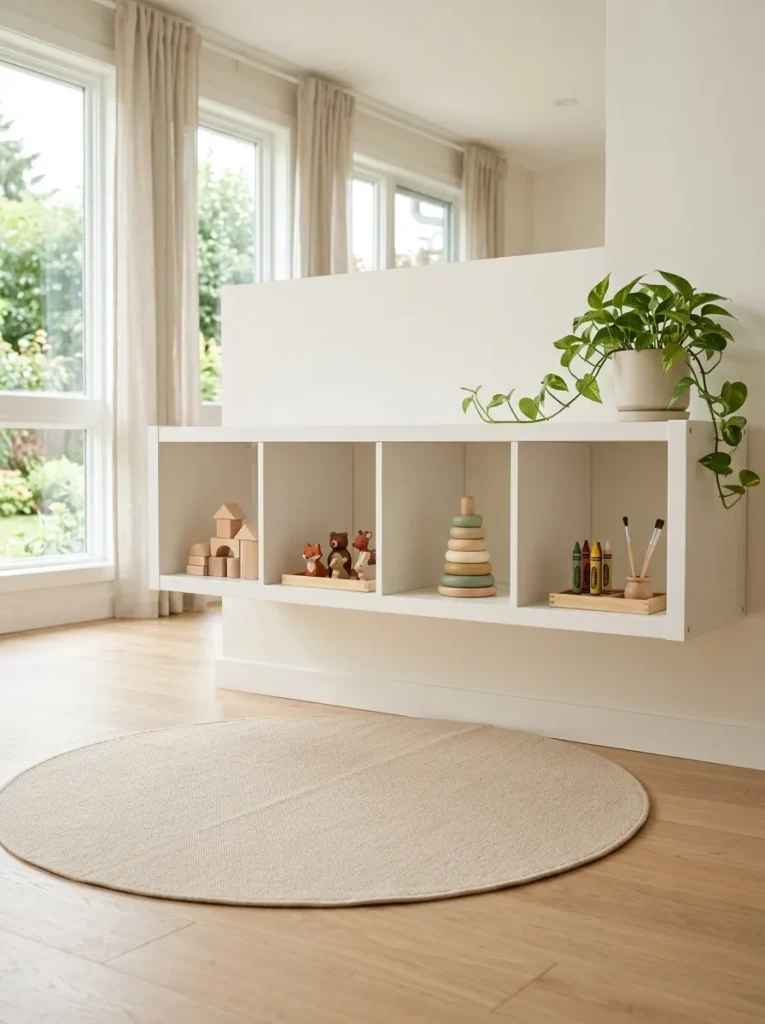
Vibe: The play space feels open — like an invitation rather than a storage room.
Why it works: The Montessori approach to toy display prioritizes limitation over abundance: three to five items per cubby, visible from a child’s standing height, rotated every two to three weeks to maintain novelty without adding new toys. Mounting a horizontal KALLAX at 12 inches from the floor (rather than on the floor) applies the ergonomic principle of child-height access — a toddler can reach and return items independently without tipping or climbing. The open display with no bins or lids removes every barrier between the child and the toy, which directly supports self-directed play.
How to get it: Mount a horizontal 1×4 KALLAX on the wall at 12 inches from the floor using heavy-duty wall anchors (the unit is wall-mounted rather than floor-standing in this configuration, which requires two people and a stud finder). Limit each cubby to one toy category and never fill a cubby more than 60% — the empty space is as important as the object displayed.
Quick Win: Rotate half the toys in the KALLAX into a closed storage bin every two weeks — the toys that “return” after a rotation feel new to a child, extending engagement without any new purchases.
Shop The Look
| Product |
|---|
| Round play mat oat natural cotton children |
| Wooden block set natural toddler open play |
| Small wooden tray display natural nursery |
| Low profile wall anchor heavy duty drywall |
| Wooden stacking ring toy natural toddler |
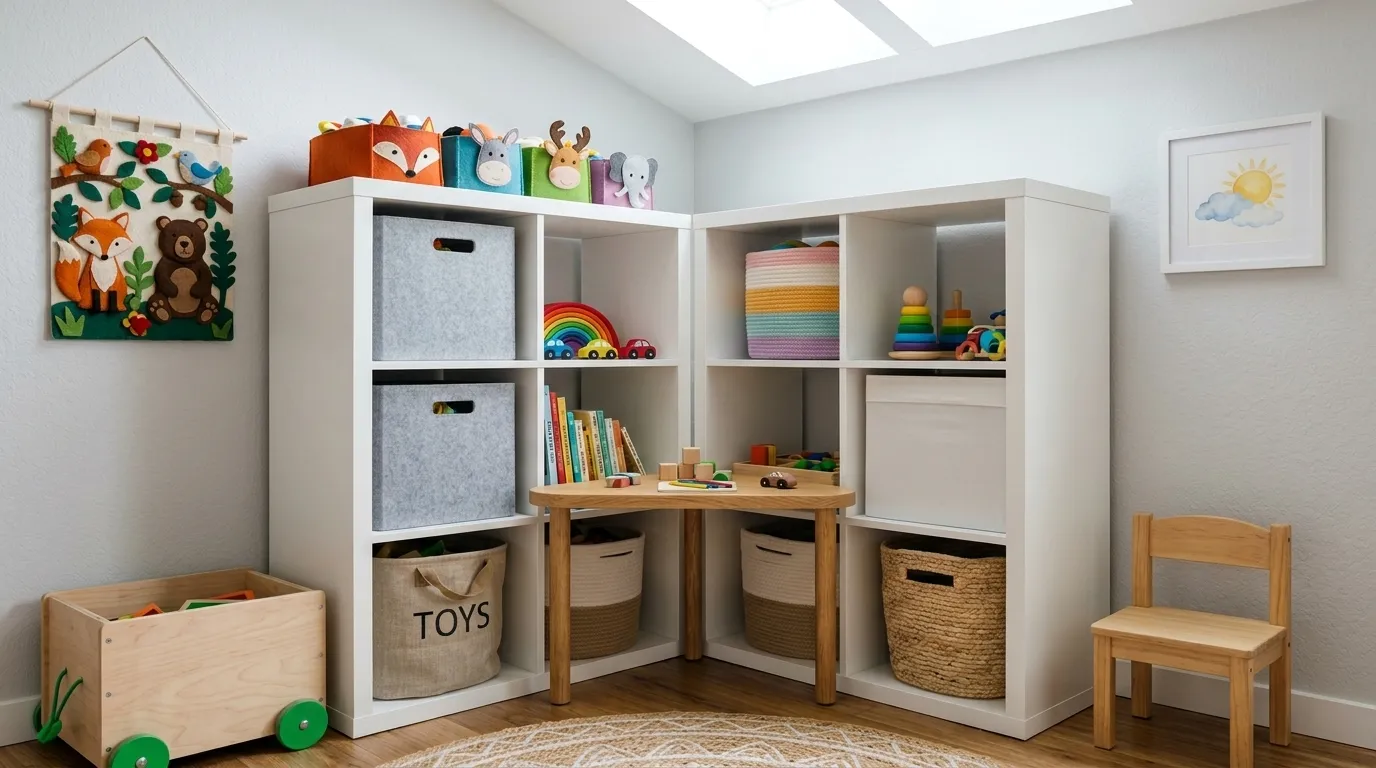
11. KALLAX Corner Configuration for Maximum Toy Storage in Small Rooms
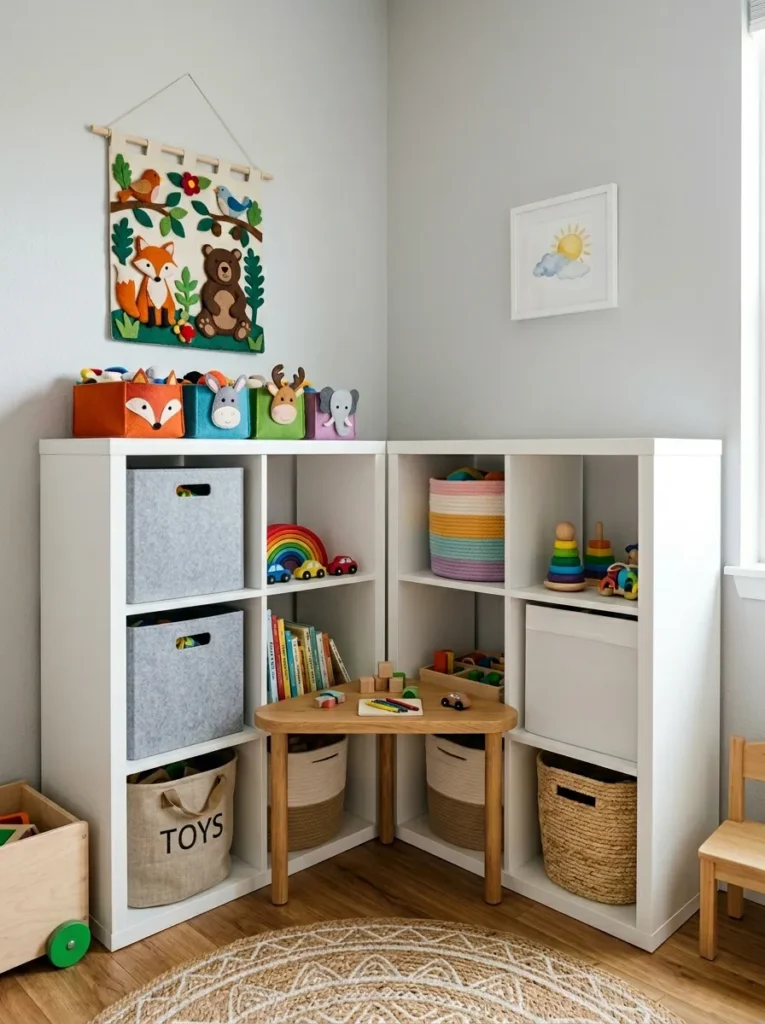
Vibe: The corner becomes the room — a complete, self-contained play world in the least useful space.
Why it works: Two KALLAX 2×2 units arranged in an L-shape corner configuration exploit the room’s dead zone — corners are typically the hardest square footage to use and the first to accumulate clutter. The L-configuration creates 8 cubbies of organized storage while occupying a footprint of only approximately 77×77 cm in each direction. The corner joint between the two units creates a natural alcove where a small triangular or round play table fits precisely, turning the entire corner into a self-contained activity zone with storage, surface, and enclosure.
How to get it: Position the two KALLAX 2×2 units at a precise 90-degree angle and anchor both to the wall using anti-tip straps before placing anything inside. The gap at the inner corner where the two units meet can be closed with a short piece of 3/4-inch plywood cut to fit, painted to match, for a fully built-in appearance.
Shop The Look
| Product |
|---|
| Small children’s activity table round wood natural |
| Felt wall hanging colorful playroom children |
| Anti-tip furniture strap anchor wall safety |
| Oat linen storage cube bin 13 inch set |
| Small wooden figure set toy natural |
12. KALLAX Toy Library System with Rotating Weekly Bins
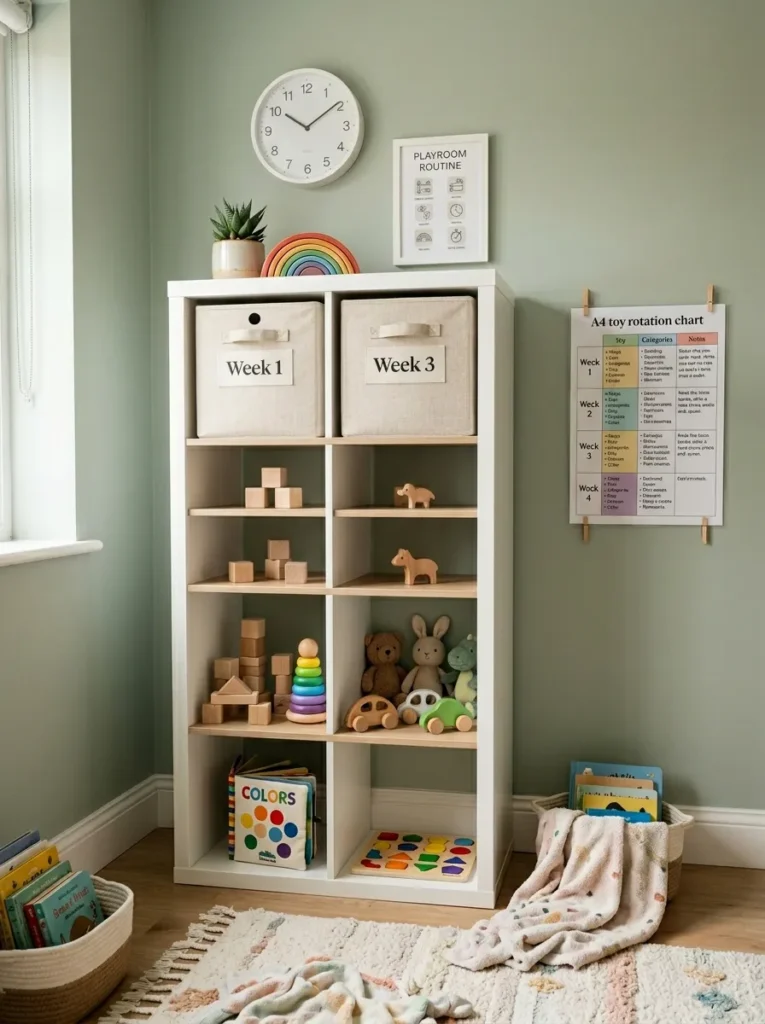
Vibe: The room feels managed — not by constant tidying, but by a system that does the work.
Why it works: A toy rotation system using the KALLAX as a physical library applies the behavioral design principle of scarcity-induced engagement: children play more deeply with fewer toys when the selection is limited and rotated, because the reduced choice eliminates the decision fatigue that leads to dumping every bin on the floor and playing with nothing. The KALLAX makes this system visual — the “active” cubbies are open, the “resting” bins are closed and labeled by week, and the entire rotation is transparent to the child. When a bin returns after three weeks, the toys inside feel genuinely new.
How to get it: Divide all toys into four equal groups and place each group in a labeled linen bin. Each Monday, swap the previous week’s active bin to storage and bring the new week’s bin to an open cubby. Laminate a simple rotation chart (printed at home for free) and pin it beside the KALLAX so the child can see what’s coming — anticipation is half the engagement.
Quick Win: Label four identical linen bins “Week 1” through “Week 4” with a white paint marker, fill them with random toy groups, and start the rotation this Monday — the system works from day one without sorting, categorizing, or reorganizing the toys first.
Shop The Look
| Product |
|---|
| Natural linen storage cube bin set of 4 KALLAX |
| White paint marker pen fine tip labeling |
| Small round white wall clock playroom |
| Laminating pouches sheet set home office |
| Simple daily routine chart print frame children |
How to Start Your KALLAX Toy Organization Transformation
The single best first move is deciding the KALLAX configuration before buying it — horizontal or vertical, 2×4 or 2×2 — based on the specific wall your room offers rather than what looks best in a photo. A 2×4 KALLAX mounted vertically on a short wall will dominate the room; the same unit laid horizontally becomes furniture rather than a feature. Measure the wall, measure the room’s longest sight line, and choose the configuration that leaves at least 60% of the floor clear for play.
The most common mistake is over-filling every cubby on day one. A KALLAX with something in every single cubby — baskets, bins, drawer inserts, open toys — reads as a full wall of storage rather than a designed playroom feature. The fix is intentional negative space: leave two to three cubbies either empty or holding a single small plant or object. The empty cubbies make everything else in the unit look more purposeful.
Three specific items under $50 that create immediate impact: a set of four IKEA DRÖNA bins in matching neutral tones ($6.99 each, total $28); a white chalk marker pen ($6) for hand-lettered labels on any surface; and a bag of small oval chalkboard label stickers ($7 for 50) that stick to baskets, bins, and drawer fronts and wipe clean.
Expect to spend two to three hours assembling the KALLAX unit and one additional hour organizing and styling it. A fully organized system — unit, bins, labels, lighting, and a reading nook cushion — runs $150–$280 depending on configuration size. A more elaborate system with drawer inserts, pegboard above, and custom paint inside the cubbies adds $50–$100 to that total. The organization system itself takes one weekend; the habit of maintaining it takes about three weeks to establish with children.
Frequently Asked Questions About KALLAX Toy Organization
What size KALLAX is best for toy organization in a living room?
The 2×4 KALLAX (horizontal orientation, four cubbies wide and two tall) is the most versatile configuration for a family living room because it sits at 77 cm tall — low enough to not dominate the room visually, and flat enough on top to function as a surface for plants, trays, and art. In a dedicated playroom, the 2×4 vertical configuration (two wide, four tall) maximizes wall storage and allows categorization across more cubbies. For shared spaces under 150 square feet, the 2×2 (four cubbies total) is the honest recommendation — it contributes meaningful storage without making the room feel like a storage unit.
What color KALLAX bins work best for a neutral, non-chaotic playroom?
Muted, tonal colors in the oat, sage, dusty blush, and warm gray range create the calmest visual result in a playroom. Avoid mixing more than three bin colors in a single KALLAX unit — the eye begins to read the unit as “busy” rather than organized once it processes more than three distinct color signals simultaneously. IKEA’s DRÖNA bins are available in white, gray, and beige, all of which work as a cohesive neutral set. For a warmer look, natural seagrass or wicker baskets in a single tone across all cubbies produce the most cohesive, magazine-quality result.
How much does a complete KALLAX toy organization system cost?
A KALLAX 2×4 unit ($109.99 at IKEA as of 2024) plus eight DRÖNA fabric bins ($6.99 each, $55.92 total) plus chalkboard labels and a chalk marker ($15) brings a complete starter system to approximately $180. Adding KALLAX drawer inserts ($30–35 each) for four cubbies adds another $120–140. A fully styled system with a rattan pendant reading light, floor cushion, and pegboard above the unit runs $280–380 total. KALLAX is consistently one of the best cost-per-cubby storage values available — no comparable unit at this price point offers the same insert compatibility or design flexibility.
Can KALLAX toy organization work in a bedroom shared by two children?
Yes — a 2×4 KALLAX used as a room divider between two sleeping zones gives each child four cubbies of their own storage while simultaneously creating a visual and acoustic boundary between the two sides of the room. Use a consistent bin color across both children’s sections (same oat linen, for example) but assign each child a distinct label color or label shape so their cubbies are clearly differentiated without the unit reading as visually split. Wall-mounting the unit as a room divider requires two people, a level, and wall anchors in every stud the unit spans.
What goes inside KALLAX cubbies besides bins and baskets?
KALLAX cubbies accept IKEA’s own line of compatible inserts: drawer inserts (white or birch), door inserts (adds a hinged door to close a cubby), and shelf inserts (divides one cubby into two horizontal sections for books or small items). Beyond IKEA’s own system, standard 13-inch fabric cube bins from third-party sellers fit the 33×33 cm interior precisely. Cubbies also work as open display niches for a single framed print, a small plant in a 4-inch pot, a clock, a small speaker, or — using the DIY ledge insert technique — a face-out book display. The most overlooked option: leave one cubby completely empty as a “drop zone” where a child puts things they can’t categorize — it prevents the entire system from being overwhelmed by one uncategorizable toy.
Ready to Create Your Dream KALLAX Toy Organization System?
These 12 ideas cover every dimension of what makes a KALLAX toy organization system actually work — from color-coding and drawer inserts to room-divider layouts, reading nook lighting, Montessori-style open display, and the rotating toy library that does your organizational work for you week after week. Start with one change — even just swapping existing bins for matching linen cubes and adding chalkboard labels — and the system reveals itself from there. Today, measure the wall where your KALLAX will live and decide on horizontal or vertical orientation before anything else; that single decision determines everything. When the bins go back where they belong — by a child who knows exactly where that is — the room stops being something you manage and becomes something that runs itself. Pin the ideas that match your space now, and return to the rotation system and reading nook once the unit is settled.