14 Crochet Wall Hangings for Cozy Home Decor
Crochet wall hangings are handmade textile art pieces created using crochet techniques — interlocking loops of yarn or cord worked with a hook — mounted on wooden dowels, driftwood, or frames and hung on walls as decorative textile features that add warmth, texture, and handmade personality to any room. This article gives you exactly 14 ideas spanning design styles, yarn materials, color palettes, size variations, and mounting approaches so every skill level and every interior finds a crochet wall hanging that genuinely fits.
There is a quality of warmth in a handmade textile that no print, canvas, or photograph quite replicates — the dimensionality of knotted fiber catching light at its surface, the organic irregularity that signals a human hand rather than a machine, the particular stillness of something that took time to make. A crochet wall hanging brings all of that into a room at wall scale, and does it in a language as old as cloth itself. Here are 14 ideas worth saving — and making.
Why Crochet Wall Hangings Work So Well for Cozy Home Decor
Textile wall art has a continuous history across virtually every human culture — from the woven tapestries of medieval Europe to the knotted fiber art of the Pacific Islands to the embroidered hanging scrolls of East Asia — and crochet’s specific contribution to that tradition is relatively recent. The modern crochet wall hanging as a home decor category emerged from the broader macramé and fiber art revival that began in the 1960s and 70s, was partially absorbed into the mass-market during the 80s and 90s, and returned in earnest with the handmade and craft revival of the 2010s. The contemporary version differs from its predecessors in its design sophistication: where earlier generations of crochet wall hangings tended toward floral granny squares and novelty subjects, the current category encompasses geometric abstraction, naturalistic botanical forms, tonal gradient work, and minimalist textile sculpture that holds its own alongside any contemporary visual art medium.
The core materials of contemporary crochet wall hangings span a deliberately wide range: natural cotton cord (3–5mm, the standard medium for structured geometric work), chunky merino wool roving (for textural, painterly pieces with visible stitch structure), natural jute or hemp (for earthy, organic pieces referencing basket-weaving and natural textile traditions), linen yarn (for lightweight, finely textured pieces with a subtle sheen), and cotton-bamboo blend yarns (for pieces requiring drape and softness). Color palettes range from the natural undyed cord look (cream, oat, and warm linen tones that coordinate with virtually any interior) through carefully curated tonal ranges (dusty sage, terracotta, and blush in the warm botanical register) to bold single-color statements and graphic two-tone geometric work. The mounting material — a birch or oak dowel, a piece of driftwood, a bent willow branch, or a brass rod — is itself a design decision that contributes to the piece’s visual character.
The crochet wall hanging category has driven significant engagement on Pinterest and Instagram since approximately 2018, where the combination of the handmade aesthetic, the accessibility of the medium (crochet is one of the most widely practiced fiber crafts globally, with millions of practitioners at varied skill levels), and the photogenic quality of textured fiber work at wall scale has made the category consistently popular. The cultural drivers are the broader return to slow-making, craft as self-care, and the documented shift away from mass-produced decor toward handmade or artisan objects that carry the evidence of their making. A crochet wall hanging that takes eight hours to complete communicates eight hours of care and attention in a way that a printed canvas simply cannot.
Small rooms and rental apartments benefit particularly from crochet wall hangings because they add significant visual warmth and design character without any permanent wall modification — a single command strip or a picture hook supports most wall hanging weights, and the piece moves with the owner when they leave. The honest consideration for large spaces: a single small crochet wall hanging in a room with high ceilings and large walls can feel undersized and tentative. In large rooms, the design strategy shifts to either a very large single piece (minimum 60cm wide for a wall over 3 meters), a grouped installation of multiple pieces at varied heights, or a wide-format piece on a long dowel that spans the available wall width. Every idea in this list includes a size guidance note.
Style at a Glance
| Element | Craft Function | Decor Edge |
|---|---|---|
| Philosophy | Slow-made warmth at wall scale | Handmade personality in every room |
| Materials | Cotton cord, merino, linen, jute | Driftwood, brass rod, birch dowel |
| Color Palette | Natural cream, oat, warm linen | Dusty sage, terracotta, warm charcoal |
1. Boho Sun Mandala in Natural Cotton Cord
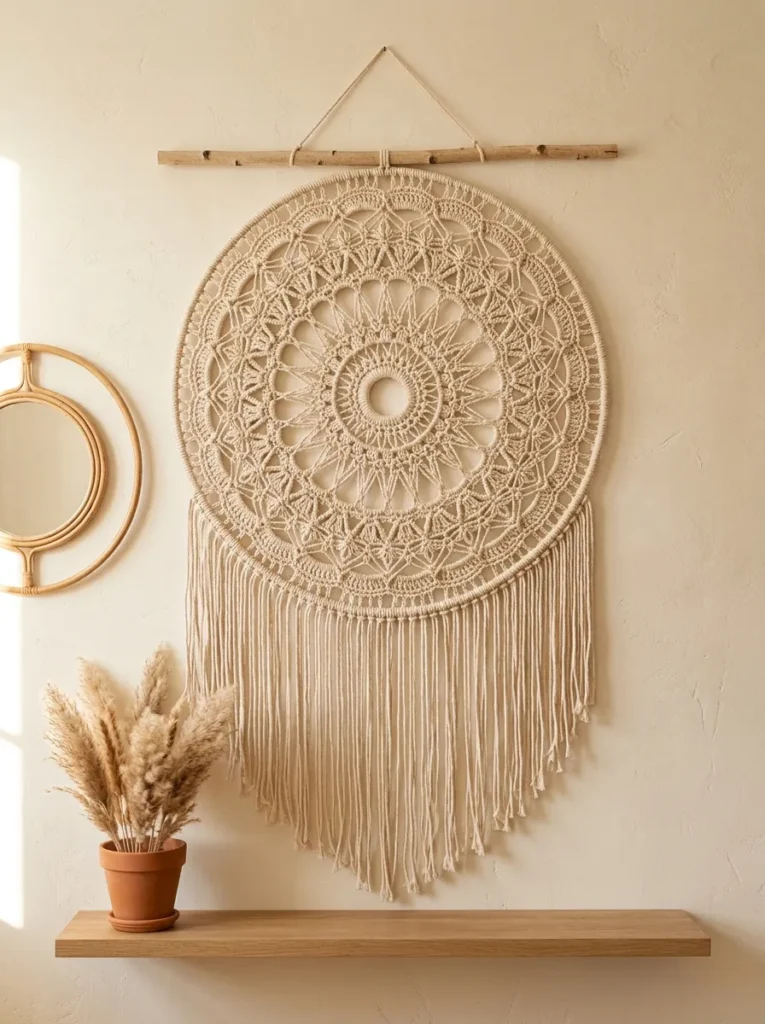
Vibe: The mandala feels centered and warm — a circle on a wall is the oldest calming form in human decoration.
Why it works: A circular crochet mandala wall hanging applies the design principle of geometric focal point — a circle on a wall naturally draws the eye to its center and holds attention in a way that rectangular art cannot, because the eye travels around the circumference and returns to the center repeatedly. The radiating pattern of a crocheted mandala amplifies this effect by creating directional lines that pull from edge to center, making the piece appear to generate visual energy rather than simply occupy wall space. Natural undyed cotton cord is the most appropriate material for this form — its warm cream tone coordinates with virtually any interior palette, and its smooth twist structure shows geometric crochet pattern clearly without the color interference of dyed yarn.
How to get it: Work the mandala from the center outward in continuous rounds using a 4mm crochet hook and 3mm natural cotton macramé cord. Begin with a magic ring and work standard mandala construction: rounds of double crochet alternating with chain-space rounds, increasing on every round to maintain the flat circular form. Add fringe by cutting cord to double the desired fringe length, folding in half, and attaching through the final round stitches using a lark’s head knot. Finished diameter for a standard room: 50–70cm.
Quick Win: A single 500g cone of 3mm natural cotton macramé cord ($12–18) provides enough material for a 50cm mandala wall hanging with full fringe — the most material-efficient of all wall hanging formats.
Shop The Look
| Product |
|---|
| Natural cotton macramé cord 3mm 500g cone |
| Birch dowel rod set 40cm craft |
| Terracotta pot small indoor plant |
| Dried pampas grass stem natural |
| Rattan round mirror wall natural |
Also view: 14 IKEA KALLAX Styling Ideas You’ll Absolutely Love
2. Tonal Sage Green Geometric Wall Hanging
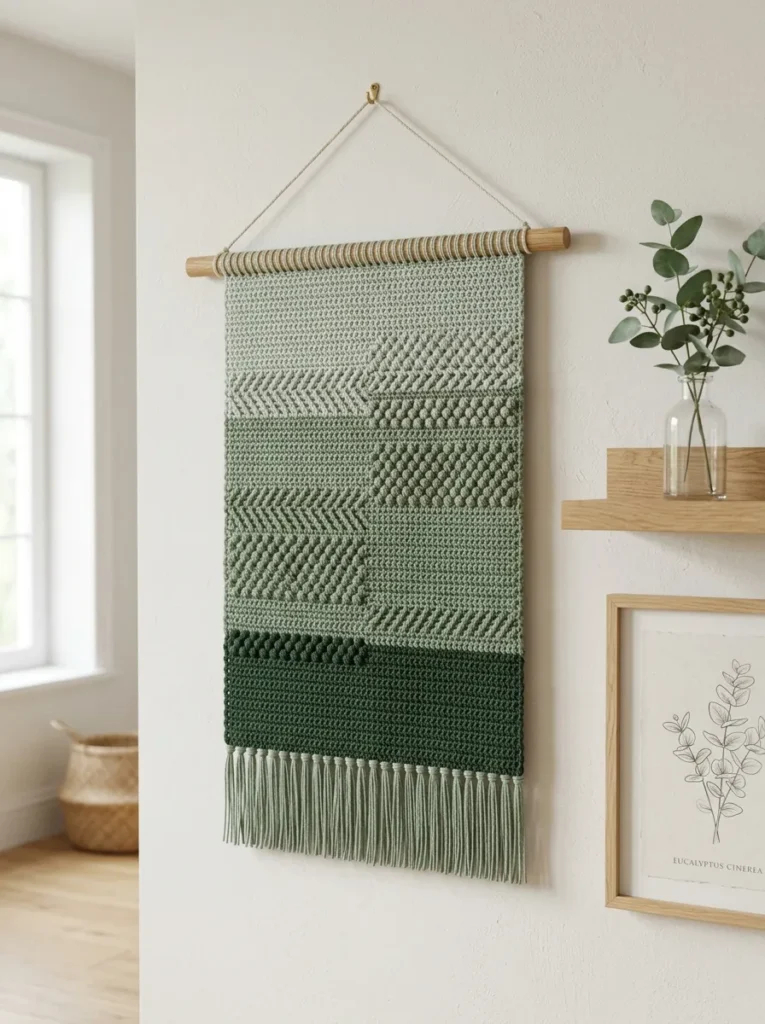
Vibe: The hanging feels still and botanical — three greens working together the way leaves do when the light changes.
Why it works: A tonal color scheme — three values of the same hue (sage green from pale to deep) arranged in horizontal blocks — applies the color design principle of value graduation, which creates visual depth and movement within a monochromatic composition. The eye reads the color change as a shift in spatial plane (lighter values appear closer, darker values recede) producing an impression of dimensionality in a flat textile object. Using three different crochet stitch textures (smooth double crochet for the pale block, textured spike stitch for the mid block, and relief bobble stitch for the dark block) compounds the visual interest — color change and texture change occurring simultaneously creates the maximum visual richness from the minimum material palette.
How to get it: Select three tonal sage green yarns from the same brand in the same fiber content (100% cotton DK or worsted weight) — different brands’ “sage” will rarely share the same undertone and will fight rather than harmonize. Work each section in a different stitch texture to maximize visual variation. Cut fringe straight across using a comb and ruler for a clean, architectural base edge rather than the organic tapered fringe of boho styles.
Shop The Look
| Product |
|---|
| Sage green DK cotton yarn set 3 tonal shades |
| Natural oak dowel rod 50cm craft |
| Slim white ceramic vase nursery shelf |
| Dried eucalyptus stem bundle natural |
| Small botanical framed print sage tones |
3. Chunky Merino Loop Hanging for Textural Drama
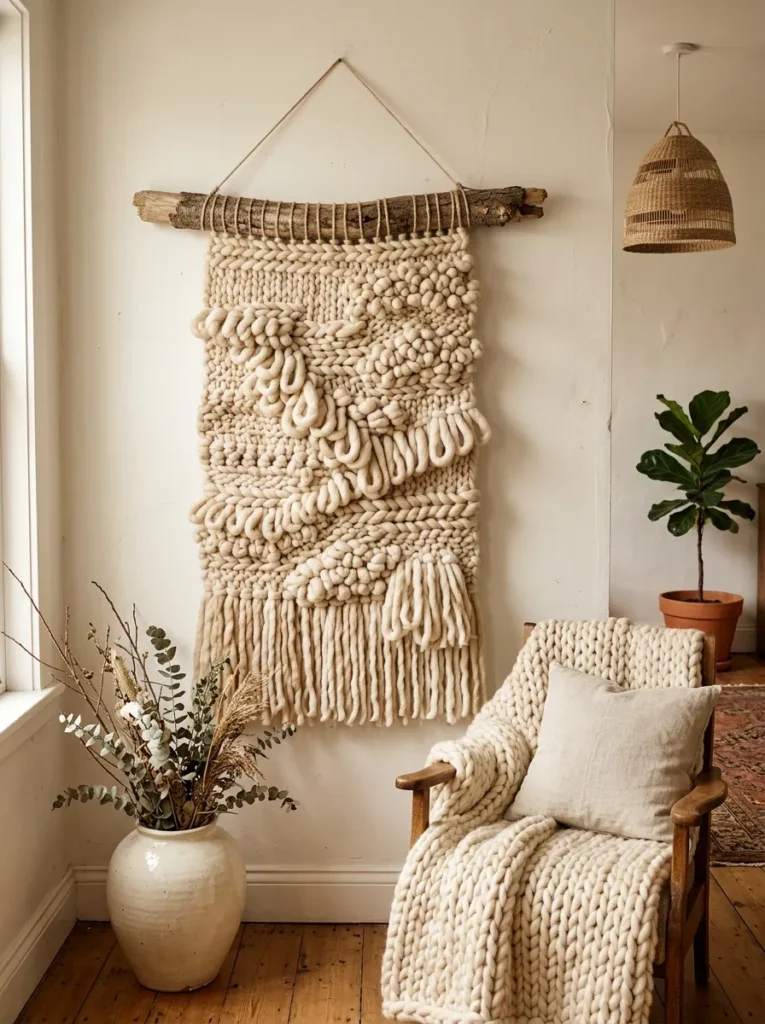
Vibe: The hanging feels tactile and warm — a surface that makes people reach out to touch before they’ve decided to.
Why it works: A chunky merino loop hanging worked in extra-long stitch heights and loop constructions applies the textile design principle of exaggerated relief — intentionally elongating the stitches far beyond standard proportions creates a three-dimensional surface whose shadow depth at wall scale produces sculptural quality rather than the flat textile quality of standard crochet work. Merino wool roving in chunky weight (Super Bulky, weight 6) is the ideal material for this effect because its unspun or loosely spun structure has visual bulk that structured yarn lacks — each stitch appears thick and substantial rather than merely thick. The driftwood mounting reinforces the organic, tactile aesthetic established by the merino roving — the two materials (wool and weathered wood) share the same quality of natural, hand-processed material character.
How to get it: Work with a 10mm or 12mm crochet hook and Super Bulky merino roving or extreme arm-knit weight yarn. Create the looped texture by working extended chains within the stitches — after inserting the hook and drawing up a loop, chain 5–8 before completing the stitch — these extended chains form the visible loops at the front of the work. Vary loop length across the piece for a naturalistic rather than mechanical appearance. Mount on driftwood using the same loop-tie mounting as standard wall hangings, threading through the top edge of the crochet piece.
Shop The Look
| Product |
|---|
| Super bulky merino roving yarn oat cream |
| Driftwood piece large natural craft |
| Large ceramic vessel floor standing cream |
| Chunky knit throw blanket oat natural |
| Rattan pendant light woven natural |
4. Terracotta and Cream Geometric Diamond Hanging
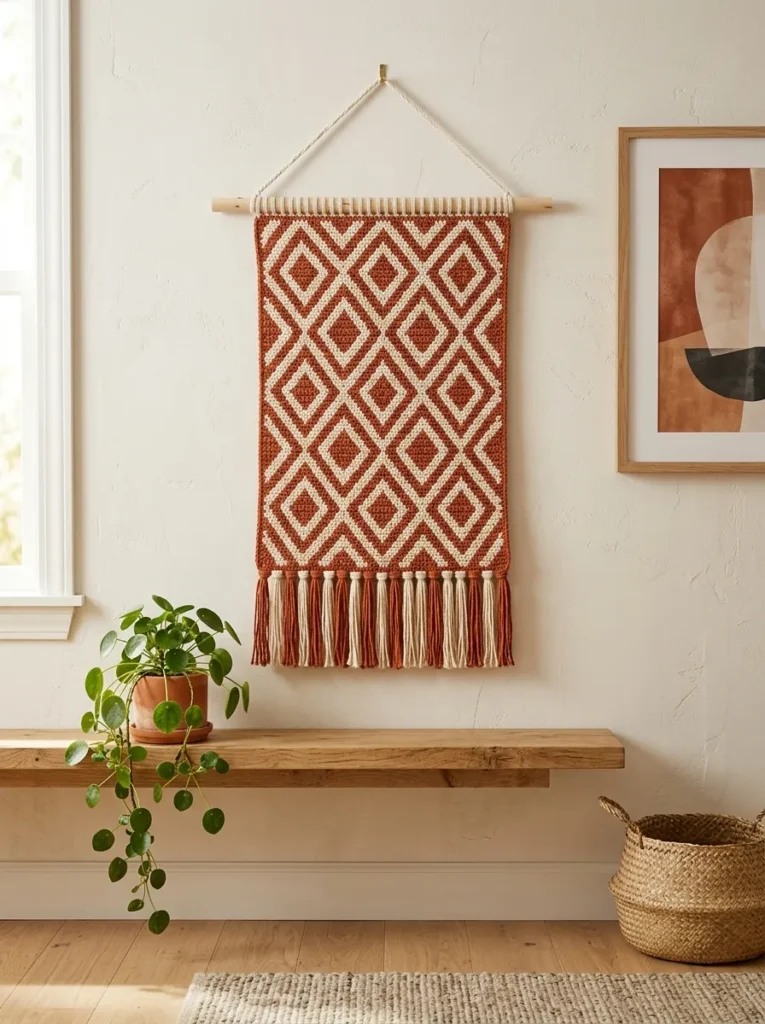
Vibe: The hanging feels warm and graphic — earthy enough to be organic, geometric enough to be designed.
Why it works: A two-color geometric diamond pattern in terracotta and cream applies the textile design principle of colorwork contrast — the high contrast between the warm red-orange of terracotta and the neutral warmth of cream makes the diamond geometry maximally legible, creating a pattern that reads clearly from across a room while remaining visually interesting at close range. Terracotta specifically reads as warm and grounded in a way that other high-contrast partners (black and white, navy and white) do not — the red-orange earth tone references the material palette of Mediterranean and Southwest American interiors, carrying both cultural warmth and the particular quality of a color that has been found in the earth rather than manufactured. The tasseled fringe (individual cord lengths knotted rather than looped) adds vertical extension below the geometric body of the hanging.
How to get it: Work the diamond pattern using the colorwork technique of carrying the unused color across the back of the work — hold both the terracotta and cream yarns, crocheting over the unused color rather than cutting and rejoining at each color change. This produces a float-free back and clean color transitions on the front. Use 4-ply or DK weight cotton yarn for the crispest color definition — bulkier yarns blur the color boundaries between diamonds. Create tassels by wrapping yarn around a 15cm piece of cardboard 20 times, cutting at the base, and knotting through the final row stitches.
Shop The Look
| Product |
|---|
| Terracotta DK cotton yarn 100g |
| Cream natural DK cotton yarn 100g |
| Smooth birch dowel rod craft 45cm |
| Small seagrass woven basket floor |
| Terracotta ceramic trailing plant pot |
5. Minimalist Linen Wall Hanging with Single Botanical Motif
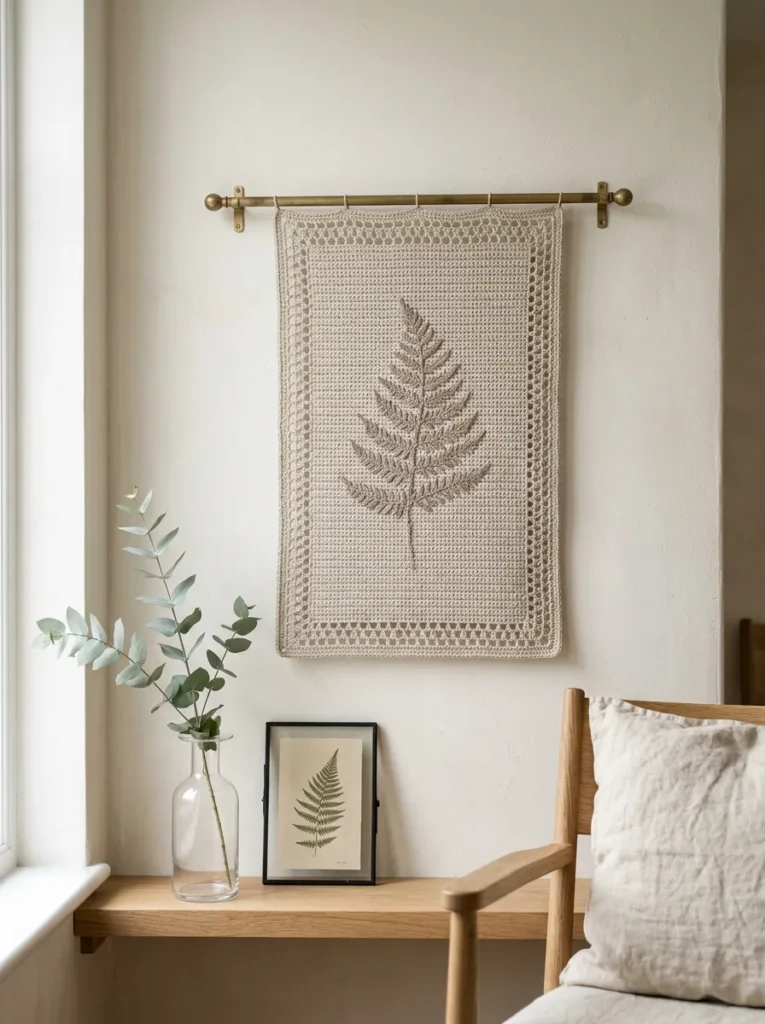
Vibe: The hanging feels refined and still — the botanical motif barely whispering above the linen ground.
Why it works: A minimalist single-motif crochet hanging applies the design principle of restrained ornamentation — a decorative object that uses the minimum elements necessary to communicate its aesthetic intention carries more visual authority than an overly elaborate equivalent, because the eye is not distracted by competing elements and can engage fully with the quality of the single design decision. Natural linen yarn has a visual quality unavailable in cotton or wool — a slight irregularity in the twist (linen’s natural slub) that gives the surface a subtle life that smooth yarn lacks, making even a simple ground stitch appear interesting. A brass rod mounting is the most refined alternative to the standard birch dowel for this level of material and design sophistication.
How to get it: Use a linen or linen-cotton blend yarn (linen has low stretch and high stitch definition — ideal for motif work) with a 2.5–3mm crochet hook for fine gauge work. Work the ground in a simple mesh or linen stitch (alternating single crochet and chain-2 spaces) and the botanical motif in solid double or treble crochet for contrast. Source a 6mm brass rod from a hardware or craft supplier, cut to width, and smooth the cut ends with fine sandpaper. Hang from two small brass picture hooks at the rod’s ends.
Shop The Look
| Product |
|---|
| Linen cotton blend yarn natural undyed |
| Slim brass rod 6mm 40cm cut to length |
| Small brass picture hook set wall |
| Clear glass vase single stem slim |
| Thin frame botanical illustration print |
6. Rainbow Gradient Hanging in Soft Naturals
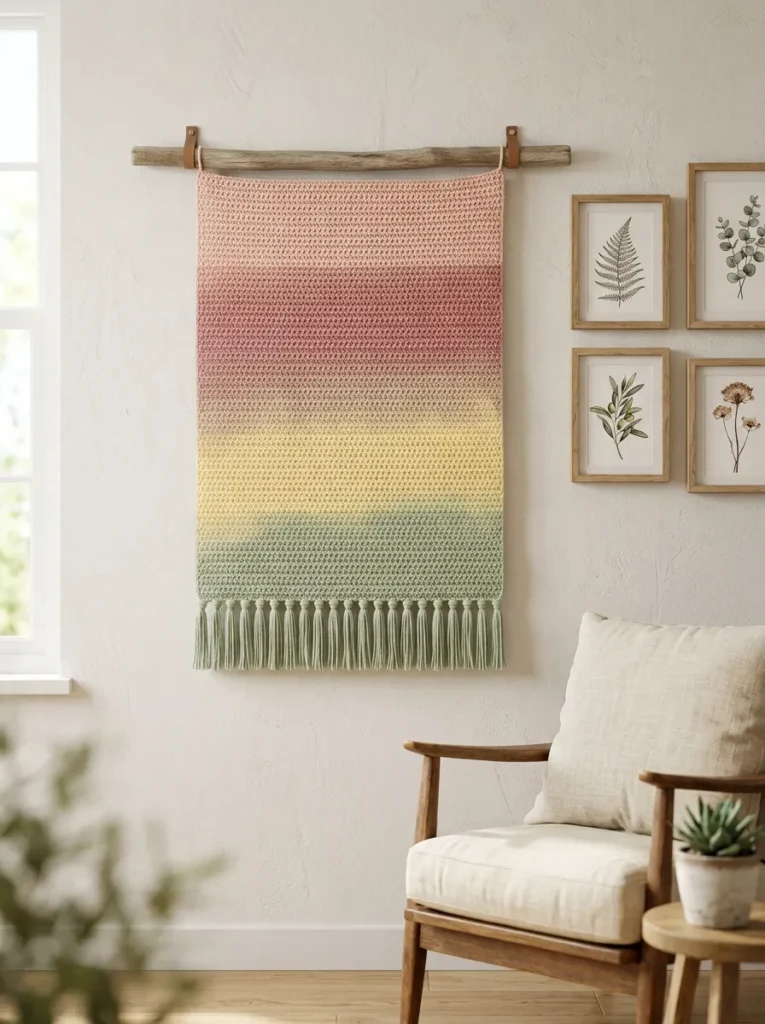
Vibe: The gradient feels like early morning light moving through a room — the colors shifting so gradually you notice the change only in comparison.
Why it works: A gradient color hanging in soft naturals applies the color design principle of analogous progression — moving through adjacent color families (blush pink to rose to warm oat to butter yellow to sage) rather than across contrasting ones creates a harmonious, calming effect that resembles natural color transitions (sunrise, a field at dusk, a fading flower). The eye travels from top to bottom following the color change, making the hanging feel taller and more dynamic than its physical dimensions suggest. Using a muted, low-saturation version of each color (dusty rather than bright) keeps the gradient in the sophisticated rather than juvenile register — the same color sequence in full saturation would read as a children’s room motif; in dusty, natural tones it reads as interior design.
How to get it: Select five DK cotton or cotton-linen blend yarns in the gradient sequence — pull the colors together physically before purchasing and assess their transition quality: each color should read as a step toward the next, not as a jump. Work each color section in the same simple stitch (half double crochet creates the most even stripe lines for a clean gradient effect) and complete a minimum of 6–8 rows per color to allow each band to read clearly. Cut fringe to a uniform length using a cardboard template.
Shop The Look
| Product |
|---|
| DK cotton yarn gradient set 5 soft tones |
| Natural wooden dowel rod set craft |
| Botanical print gallery set small nursery |
| Cream linen cushion cover living room |
| Small ceramic flower pot shelf decor |
7. Oversized Starburst or Sunburst Hanging in Warm Gold and Cream
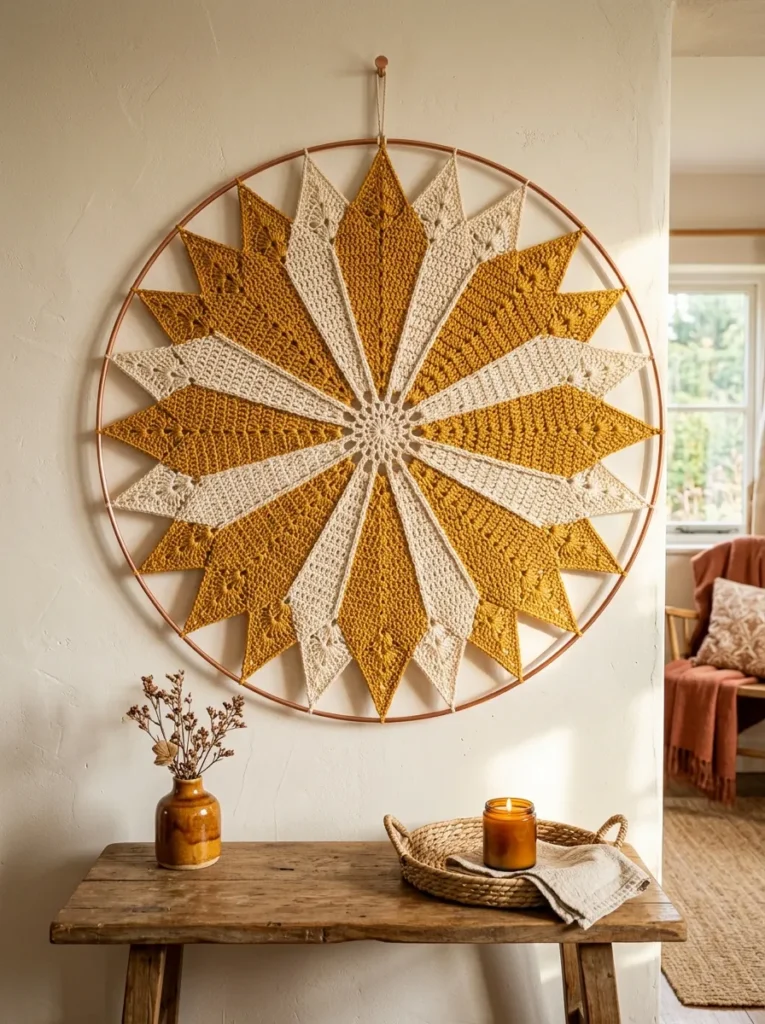
Vibe: The starburst feels celebratory and warm — like bringing a piece of the sun inside and mounting it on the wall.
Why it works: A radiating starburst crochet hanging applies the design principle of centrifugal composition — all visual energy moves outward from the center, creating a dynamism and liveliness that circular mandala forms (which are centripetal, drawing inward) do not. The alternating two-color spoke structure makes the radiating geometry maximally legible — each spoke sector is clearly defined by color change, and the overall starburst form reads at distance before the individual stitch structure becomes visible. Warm mustard gold is the most photogenic accent color for a textile wall hanging because it reads as warm and luminous in varying light conditions, appearing to glow against a neutral wall in a way that cooler colors do not.
How to get it: Work the starburst in separate wedge-shaped panels, each worked from the center point outward in double crochet increases, and join the panels as you go or seam after completion. Alternate the mustard and cream panels consistently throughout (if working 8 panels, four in each color). Block each panel firmly to the desired pointed tip shape — the points are the defining detail of the starburst form and must be crisp. Mount on a copper wire hoop (bent to the final diameter and joined) sewn into the back of the work at the outer perimeter.
Shop The Look
| Product |
|---|
| Mustard gold DK cotton yarn 100g warm |
| Cream DK cotton yarn 100g natural |
| Copper craft wire 2mm hoop frame |
| Amber ceramic vessel small warm toned |
| Seagrass tray woven natural decor |
8. Woodland Forest Scene Wall Hanging in Pictorial Crochet
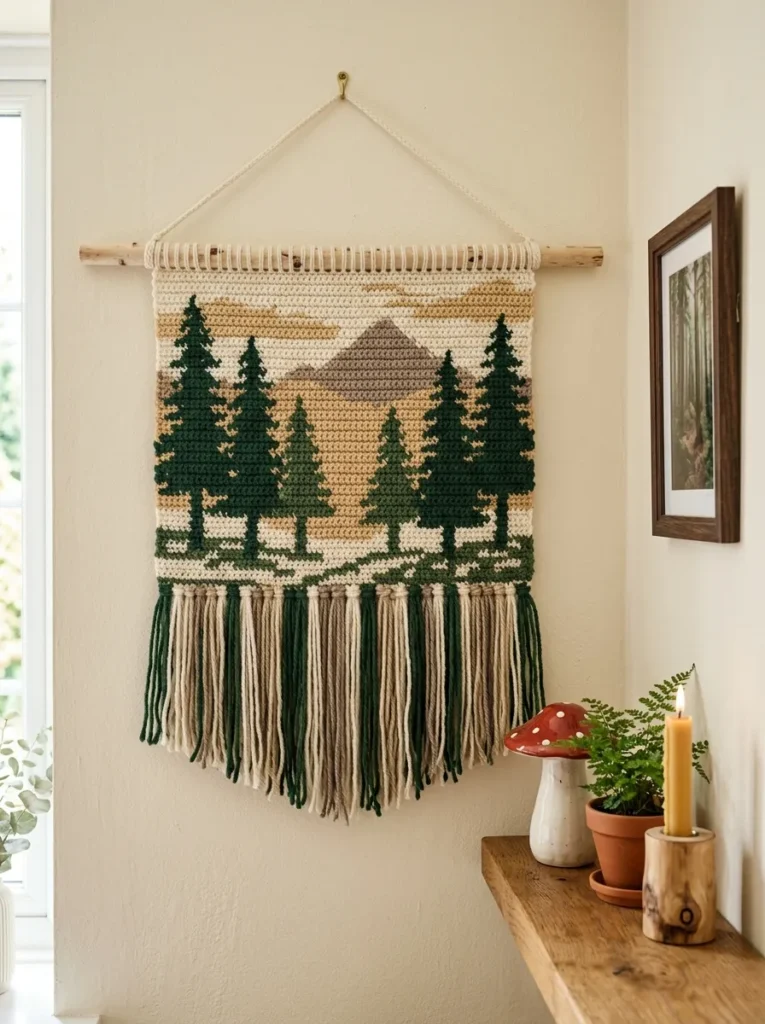
Vibe: The scene feels like looking out of a window into a forest — small enough to be intimate, specific enough to transport.
Why it works: A pictorial tapestry crochet hanging applies the textile art principle of narrative image-making in fiber — representing a recognizable subject (a forest, a landscape, botanical forms) in crochet creates a category of wall art that is neither painting nor print but something specifically textile in its warmth and texture. Tapestry crochet (working with multiple colors simultaneously, carrying unused colors within the stitches) produces color-block images with a pixel-like quality — the individual stitches function as pixels, and the image resolves from individual stitch blocks at close range to a cohesive picture at normal viewing distance. This dual reading quality (abstract at close range, pictorial at distance) gives the hanging visual interest at every scale of observation.
How to get it: Create a tapestry crochet chart by converting a simplified image into a grid (each square represents one crochet stitch) — free tapestry crochet charting tools are available online (Stitch Fiddle, Moogly’s tapestry chart generator). Work with two or three colors simultaneously in single crochet, following the chart row by row. Use DK weight cotton yarn for the clearest stitch definition — too chunky a yarn blurs the image detail; too fine a yarn requires excessive stitches for a visible scale.
Shop The Look
| Product |
|---|
| Forest green DK cotton yarn 100g |
| Cream oat DK cotton yarn 100g |
| Birch dowel rod natural set craft |
| Ceramic mushroom figurine small decor |
| Small forest illustration framed print |
9. Wabi-Sabi Irregular Weave Crochet Hanging
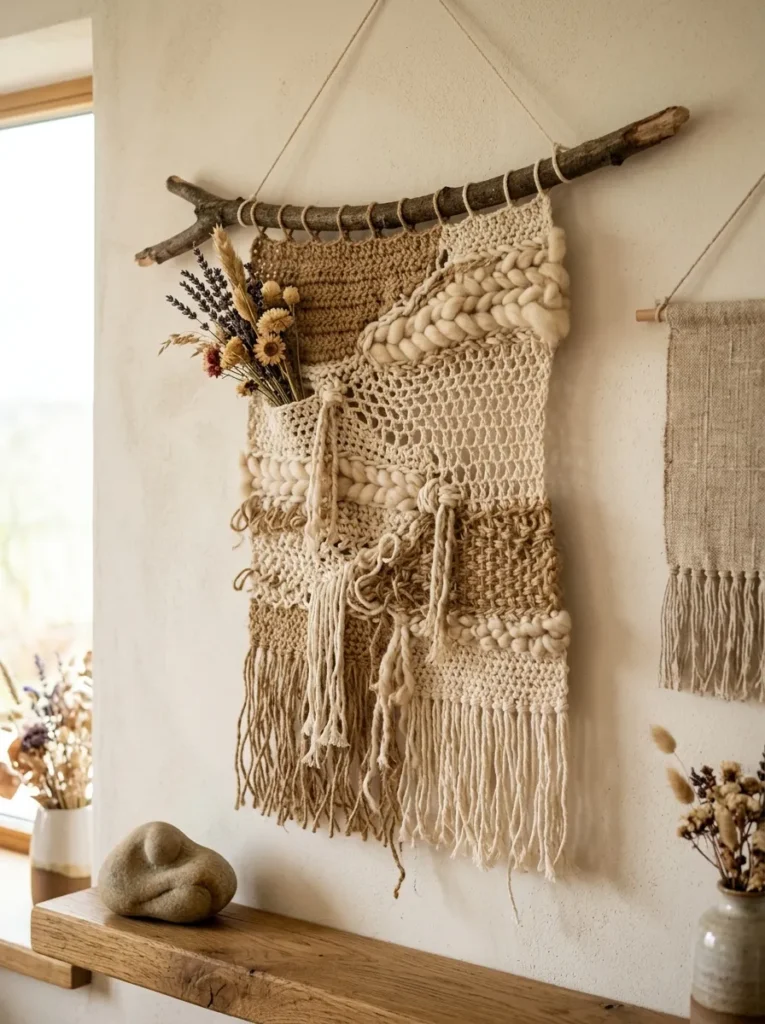
Vibe: The hanging feels found rather than made — as though the materials gathered themselves into this particular form.
Why it works: A wabi-sabi crochet hanging applies the Japanese aesthetic philosophy of imperfection as beauty — the deliberate use of varied, imperfect elements (mixed yarn weights, irregular tensions, open and dense sections) celebrates the asymmetry and incompleteness that industrial production eliminates. This approach is the direct antithesis of the polished, uniform craft object and produces a result with significantly more artistic character — the eye reads the variation as expressive decision-making rather than technical inconsistency when the material palette remains cohesive (all natural, undyed fibers in the oat-cream-warm gold family). A found branch with natural curves and bark texture is the ideal mounting for this piece — its organic irregularity harmonizes with the hanging’s intentional imperfection.
How to get it: Gather a palette of four to six natural-fiber yarns in varied weights (linen thread, thin jute, DK cotton, thick cotton-bamboo, super bulky merino) all in undyed or naturally toned versions of the same warm neutral family. Work sections in each yarn without following a pattern — change yarn, stitch type, and tension freely, working toward an overall rectangular form but allowing irregularities at the edges. Leave some sections open (mesh) and some dense, some with long fringe ends and some with none. Mount on a found branch gathered from a garden or woodland — remove loose bark but leave the natural curvature intact.
Quick Win: The wabi-sabi approach is the most beginner-forgiving style in this list — any stitch inconsistency, tension variation, or edge irregularity reads as intentional artistic expression rather than technical error. It requires only one rule: keep all materials in the same natural tone family.
Shop The Look
| Product |
|---|
| Natural jute twine craft cord thin |
| Undyed linen yarn thin natural |
| Super bulky merino yarn oat natural |
| Small natural stone sculpture decor |
| Dried wildflower bundle small natural |
10. Scallop Border Hanging in Dusty Blush and Cream
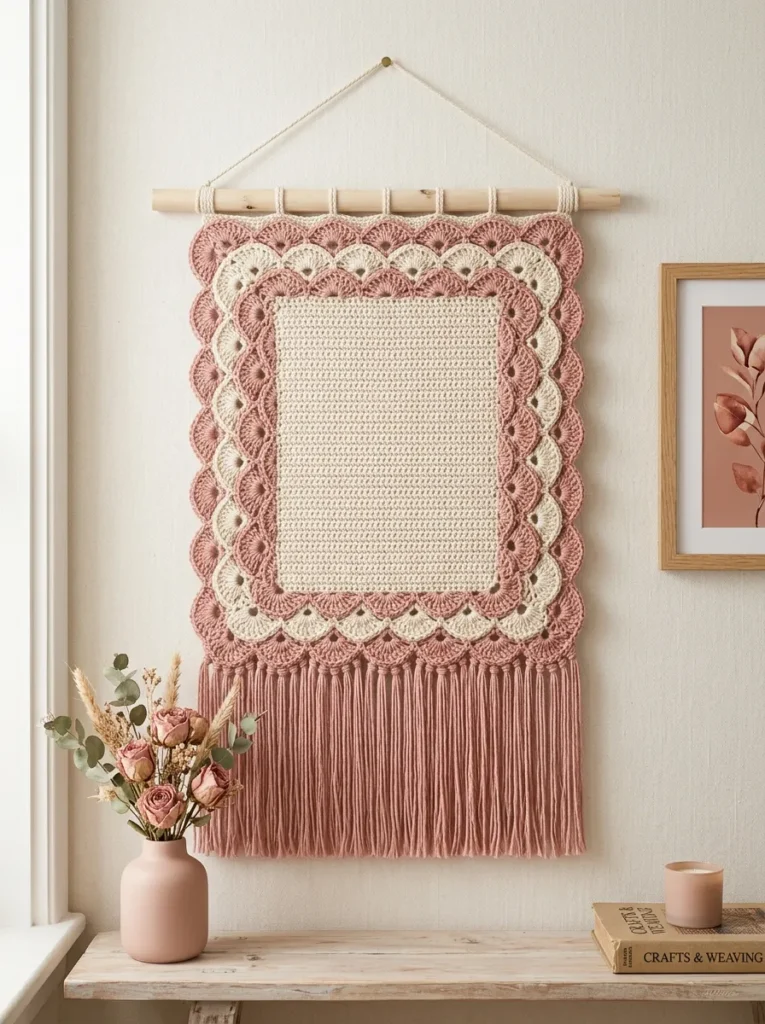
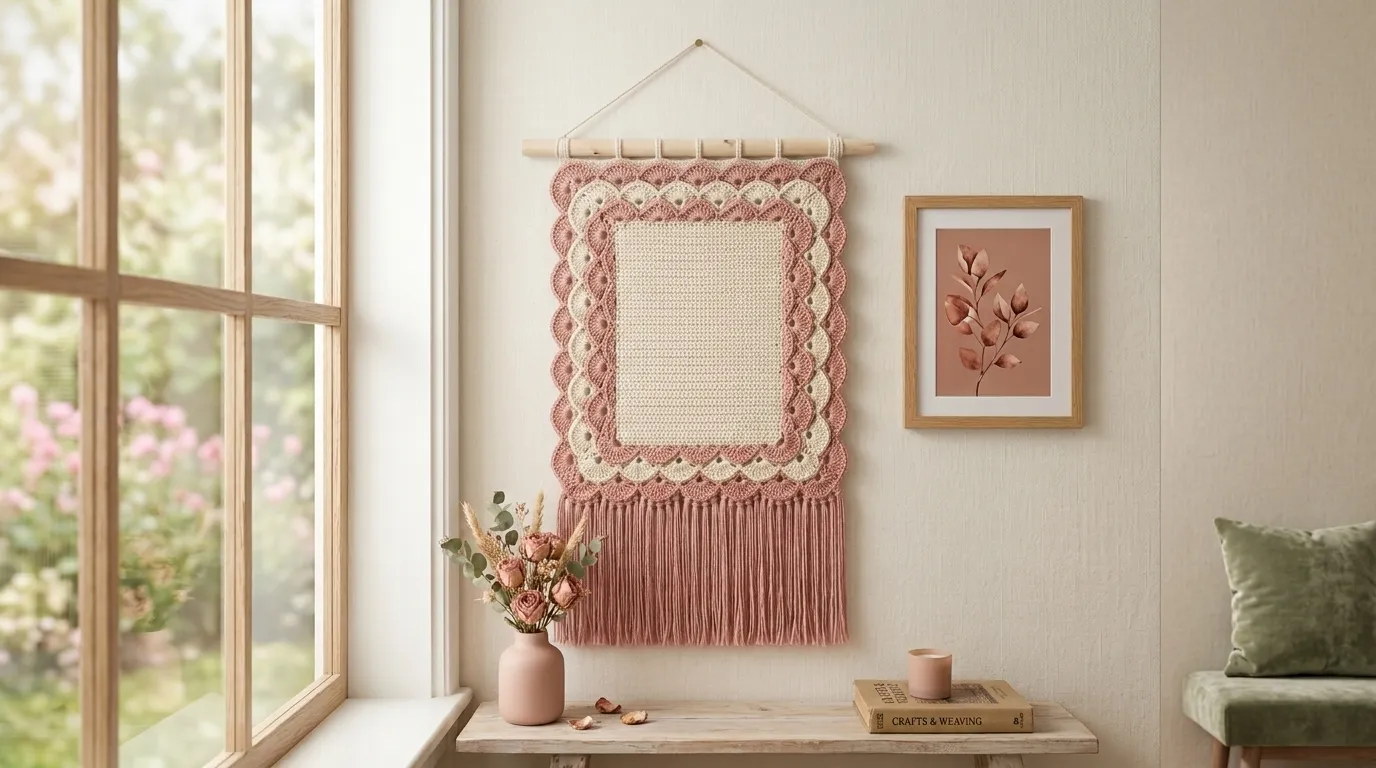
Vibe: The hanging feels soft and feminine without being saccharine — dusty blush at the right tone is earthy before it is sweet.
Why it works: A scallop border crochet hanging applies the craft design principle of frame-within-frame — surrounding a plain textile ground with a decorative border creates an internal composition that references the format of a framed artwork while communicating its own textile identity. The scallop stitch pattern (shell stitches in a repeating arc formation, traditionally worked as a series of five double crochets worked into the same stitch) has one of the longest continuous traditions in crochet design — it appears in antique Irish and Victorian crochet lace — giving the hanging historical resonance and formal authority. Dusty blush’s specific quality (a pink with enough gray in it to read as sophisticated rather than juvenile) makes it the most contemporary and commercially successful color for this traditional pattern form.
How to get it: Work the central ground first in a simple half double crochet mesh (for lightness and drape), then apply the scallop border by working shell stitches around all four edges in the alternating blush and cream color scheme — work three cream shells, three blush shells, alternating around the perimeter. Add a silky fringe using a silk-cotton blend yarn for the fringe specifically — the slightly lustrous quality of silk blend fringe distinguishes it from the cotton ground in a subtle, refined way.
Shop The Look
| Product |
|---|
| Dusty blush DK cotton yarn 100g |
| Natural cream DK cotton yarn 100g |
| Silk cotton blend yarn dusty rose fringe |
| Pale birch dowel rod smooth 50cm |
| Dried rose bud set small blush decor |
11. Farmhouse Plaid Crochet Panel in Warm Neutrals
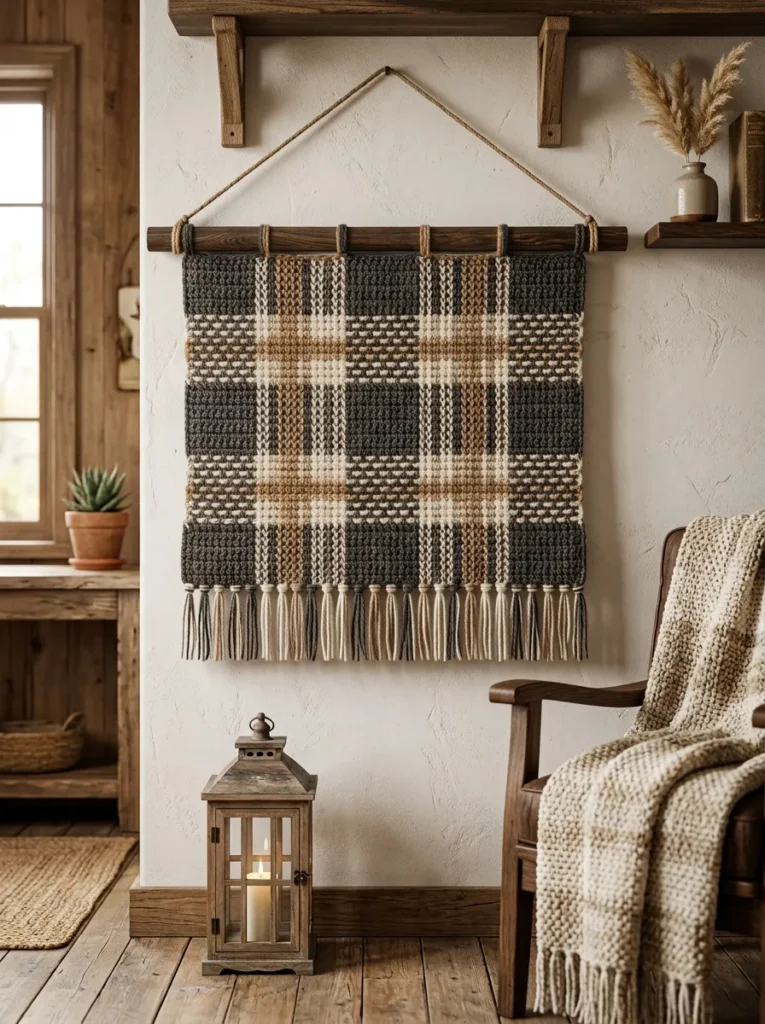
Vibe: The panel feels familiar and warm — like a woven blanket that decided to become art.
Why it works: A plaid-inspired crochet panel applies the interior design principle of textile reference — invoking the warm cultural associations of plaid (Scottish tartans, American frontier blankets, winter cabin aesthetics) through the crochet medium creates a piece that carries those associations into the room without the weight or formality of an actual woven textile. The woven-look slip stitch (a crochet technique that produces a surface resembling woven fabric) is essential to this piece — standard crochet stitches read as clearly crocheted; the slip stitch surface reads as woven at a slight distance, reinforcing the plaid blanket reference. Wide-format mounting (65cm or wider) suits the horizontal, panoramic quality of plaid patterns better than a narrow vertical format.
How to get it: Work the horizontal stripes in single crochet, changing colors at each stripe boundary and carrying unused colors within the stitch body to avoid loose floats. Create the vertical plaid lines using a second pass of surface slip stitch worked over the completed horizontal stripe ground — run the surface slip stitch in a contrasting yarn along vertical columns of the horizontal stripe body, pulling through without penetrating to the back of the work. This technique adds the visual intersection of plaid without requiring complex colorwork management during the main body construction.
Shop The Look
| Product |
|---|
| Warm charcoal DK cotton yarn 100g |
| Oat cream DK cotton yarn set 2 colors |
| Dark stained oak dowel thick craft |
| Wooden lantern small decor |
| Woven wool throw warm neutral |
12. Botanical Leaf Crochet Hanging with Three-Dimensional Elements
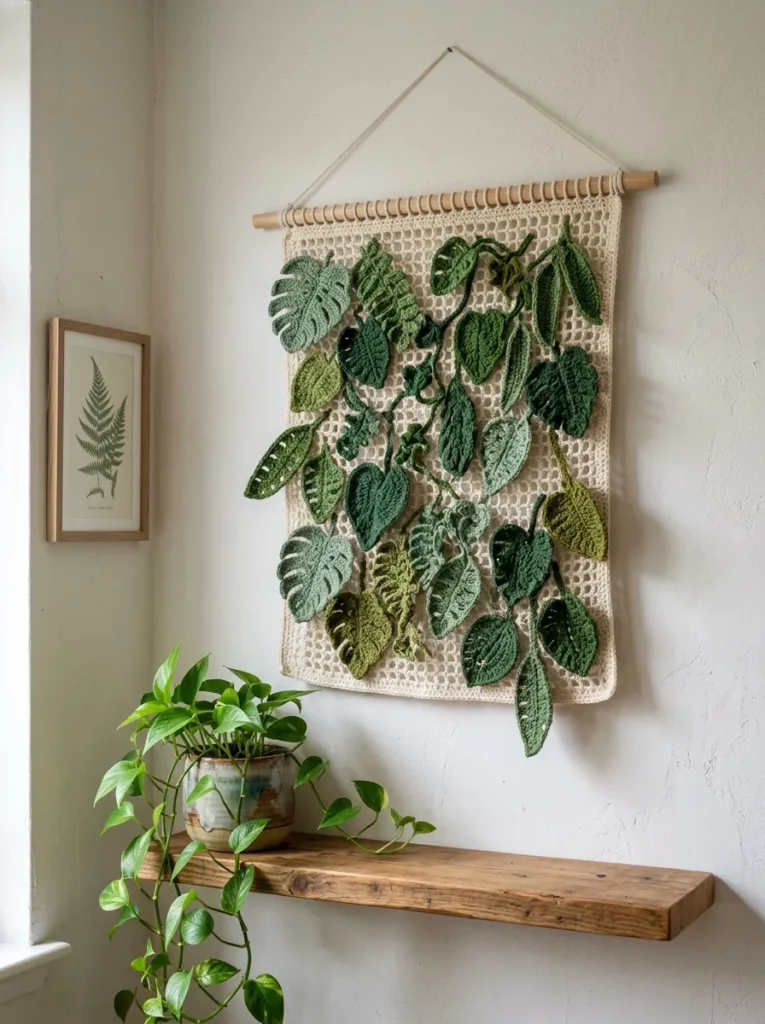
Vibe: The hanging feels alive — the three-dimensional leaves casting their own small shadows, the piece participating in the room’s light.
Why it works: A three-dimensional botanical crochet hanging applies the sculptural textile principle of dimensional attachment — adding crocheted elements that project outward from the flat ground plane creates actual depth and shadow that engages with the room’s changing light throughout the day. As light moves across the wall, the shadows cast by each leaf shift position and length, making the piece visually dynamic without any actual movement. The botanical subject (varied leaf forms in multiple green tones) connects naturally to the biophilic design impulse — the desire to incorporate plant references into interiors as a source of calm and organic vitality. Positioning a real trailing plant below the hanging blurs the boundary between the crocheted botanical representation and the actual living plant.
How to get it: Crochet the base mesh in 4mm natural cotton cord on a 5mm hook using a simple double crochet mesh (chain spaces alternating with double crochet, working in rows). Crochet individual leaf shapes separately (from a free leaf crochet pattern — dozens of free patterns are available on Ravelry and Yarnspirations for varied leaf forms) in sage, forest, and olive green yarns. Block each leaf slightly curved by pinning while damp. Attach to the mesh base using a tapestry needle and matching yarn, placing some flat and some angled outward from the mesh plane using a small bend in the leaf’s midrib.
Shop The Look
| Product |
|---|
| Natural cotton cord 4mm natural 200m |
| Sage green DK yarn botanical |
| Forest green DK yarn dark botanical |
| Olive green DK yarn botanical |
| Trailing pothos small ceramic pot |
13. Monochrome Charcoal Architectural Crochet Hanging
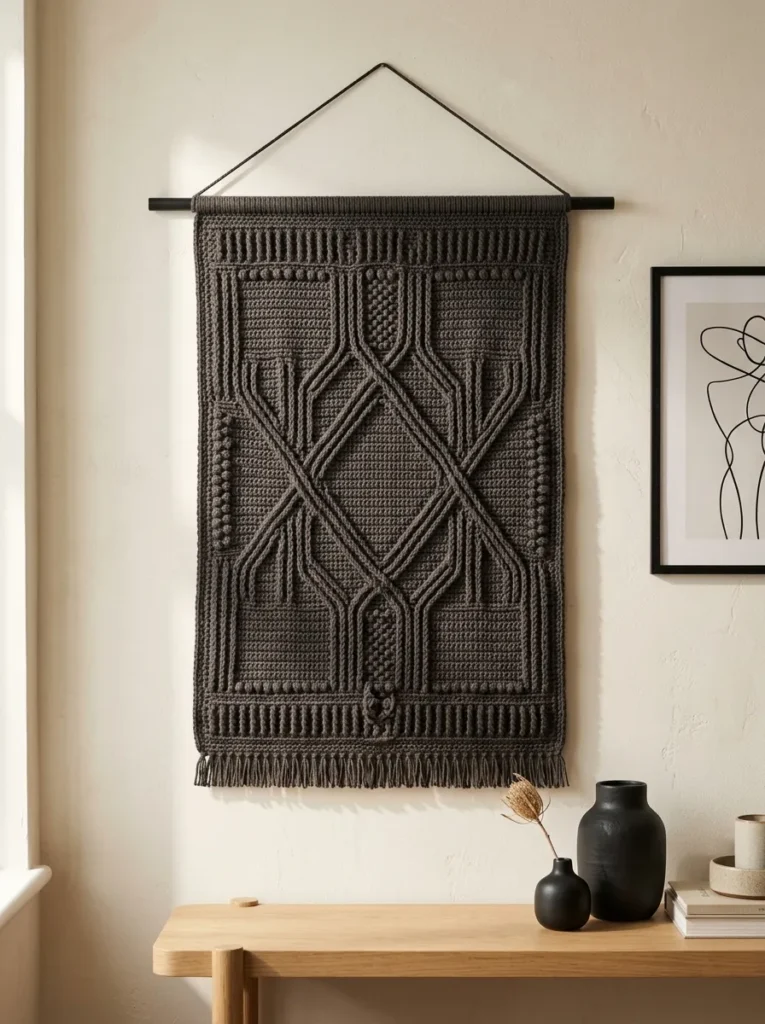
Vibe: The hanging feels architectural and sophisticated — monochrome proving that texture is the design element that color can only support.
Why it works: A monochrome architectural crochet hanging applies the design principle of tonal texture — using a single color throughout forces all visual interest to derive from the dimensional quality of the stitches themselves rather than from color contrast. This approach rewards directional light (as the light source moves, the shadows within the raised stitches shift, changing the piece’s visual character throughout the day) and reads as significantly more sophisticated than multi-color equivalents because it demonstrates design confidence in material rather than relying on color for appeal. Warm charcoal is the optimal single color for this approach — dark enough to cast visible internal shadows from raised stitches, warm enough to not read as cold or clinical against most wall tones.
How to get it: Use relief crochet techniques — front post and back post double crochet stitches that raise or recess the yarn relative to the ground plane — to create the dimensional architectural texture. Work alternating sections of front post doubles (which raise the stitch forward of the ground) and back post doubles (which push the stitch behind the ground) in geometric patterns: vertical ridges, diagonal crossing lines, and recessed rectangular panels. Mount on a slim 6mm matte black metal rod (painted with a flat black spray paint) for the most architecturally resolved finish.
Shop The Look
| Product |
|---|
| Warm charcoal DK cotton yarn 200g |
| Slim metal rod 6mm black painted 50cm |
| Matte black ceramic vessel small |
| Black bud vase slim single stem |
| Black framed abstract line art print |
14. Grouped Trio Installation — Small, Medium, Large Format Hanging
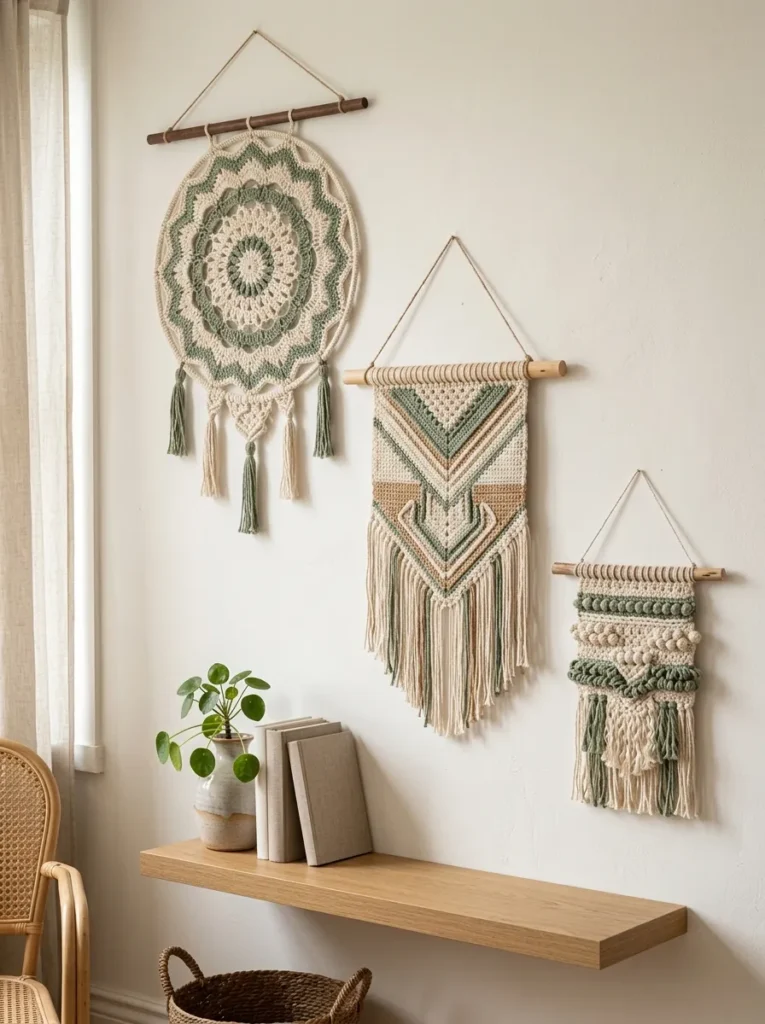
Vibe: The arrangement feels composed and collected — three objects that belong together without being a set.
Why it works: A grouped trio installation applies the gallery wall principle of visual family through varied individual — three pieces that share a color palette and material language but differ in size, pattern, and mounting create the collected, accumulated quality that reads as a genuine artistic statement rather than a purchased collection. The size graduation (large, medium, small) and height variation create a composition with visual hierarchy — the eye enters at the largest piece, moves to the medium, and settles on the small. This reading order makes the trio feel narratively structured rather than randomly arranged. The negative space between the three pieces is as designed as the pieces themselves — too close together and the trio reads as a crowded cluster; too far apart and it reads as three unrelated pieces.
How to get it: Design the three pieces with shared color palette (natural cream as the ground, sage green as the accent across all three) but varied pattern types — one circular, one rectangular geometric, one textural — to maximize visual variety within the cohesive family. Hang the largest piece at 150cm to center from the floor, the medium at 130cm, and the small at 160cm — this staggered height with the small piece highest creates the most dynamic composition. Space pieces 15–20cm apart horizontally for the correct negative space proportion. All three can be made individually over several weeks and installed as a group when complete.
Shop The Look
| Product |
|---|
| Natural cream cotton cord 3mm 500g |
| Sage green DK yarn 100g set |
| Birch dowel rod set assorted lengths |
| Small ceramic vessel shelf decor |
| Trailing plant small pot shelf |
How to Start Your Crochet Wall Hanging Practice
The single best first move is making one small test swatch before beginning any wall hanging pattern — a 15×15cm sample in the yarn and hook size you’ve chosen, worked in the stitch or stitches the pattern requires. The swatch tells you the three things you need to know before committing to a full piece: how the yarn’s color looks against your intended wall color (pull the swatch from the wall and assess in the room’s actual light), whether your tension produces the stitch definition the pattern requires (too loose and geometric patterns blur; too tight and the piece won’t drape), and whether the stitch is comfortable to work at pace for the hours the full piece will require. No amount of careful pattern reading substitutes for this physical information.
The most common mistake beginners make when attempting their first crochet wall hanging is choosing a pattern beyond their current skill level because of its finished appearance rather than its technical requirements. The fix is to assess a pattern’s technique list rather than its photograph — if the techniques include any you have not successfully worked before (tapestry colorwork, surface slip stitch, three-dimensional attached elements), complete a smaller practice project in each unfamiliar technique first. The wall hanging format specifically punishes uneven tension because the piece hangs flat under gravity and shows every inconsistency that a formed object (a bag, a hat) would conceal in its structure.
Three specific items under $50 that enable a first crochet wall hanging: a 500g cone of 3mm natural cotton macramé cord ($12–18, enough for a 50cm mandala plus fringe); a set of five birch dowel rods in 30, 40, and 50cm lengths ($8–12, covering the most common wall hanging widths); and a blocking mat and T-pin set ($15–22, essential for finishing a wall hanging to its correct shape and ensuring it hangs straight). These three purchases prepare for any of the 14 ideas in this list at beginner-appropriate scale.
A simple beginner wall hanging (small mandala or basic geometric rectangle, 30–40cm) takes 4–8 hours of working time spread across two to three evenings. A mid-complexity piece (gradient, pictorial, or three-dimensional botanical, 45–60cm) takes 10–20 hours over one to two weeks. A large, complex piece (oversized starburst, architectural monochrome, wide-format plaid, 60cm+) represents 20–40 hours of working time over three to four weeks. Materials cost for most single wall hangings falls between $15 and $45 — the labor is the significant investment, and that labor is entirely the maker’s own creative and meditative time rather than a cost.
Frequently Asked Questions About Crochet Wall Hangings
What is the best yarn for a crochet wall hanging?
The best yarn for most crochet wall hangings is 100% cotton in DK or worsted weight — cotton has no stretch (unlike wool), which means the finished piece hangs straight and maintains its shape without distortion over time. Natural cotton macramé cord (3–5mm) is the standard material for boho and geometric styles because its twisted structure shows stitch definition clearly and its neutral cream tone coordinates universally. For textural and wabi-sabi styles, mixed natural fibers (jute, linen, hemp) add organic variation. For softness and color richness, merino wool works well in styles that prioritize texture over precise geometric pattern — the slight elasticity of wool blurs sharp color boundaries in colorwork but adds warmth and dimensional quality to textural stitches.
How do you hang a crochet wall hanging without damaging the wall?
Most crochet wall hangings mount on a wooden dowel, rod, or branch that is suspended from two small picture hooks or Command adhesive strips — neither of which causes significant wall damage. For pieces under 1kg in weight (the majority of wall hangings), two Command Large Picture Hanging Strips ($8–12 for a pack) support the dowel from two points at its ends without any nails. For heavier pieces or pieces on natural branches (which are irregularly shaped and may weigh more), two small picture hooks driven into the wall at the dowel’s hanging points provide more reliable support. Never hang a wall hanging directly from the crochet — always mount through the dowel, which distributes the hanging weight evenly across the piece’s width rather than pulling at a single point.
How do you keep a crochet wall hanging from curling or warping?
The most effective way to prevent curling and warping is wet blocking before mounting — soaking the finished piece in cool water, gently squeezing out excess moisture without wringing, and pinning the piece to its correct shape on a foam blocking mat using rust-proof T-pins while damp. Allow to dry completely (12–24 hours) before removing pins and mounting. This process relaxes and sets the fiber into the desired flat shape and significantly reduces the tendency to curl. For pieces that curl even after blocking, a light application of spray starch (ironed in with a pressing cloth on natural fiber pieces) sets the shape more permanently. Avoid hanging a crochet wall hanging in direct humid conditions (directly above a kitchen stove, in a bathroom without adequate ventilation) as ongoing humidity will cause cotton and linen pieces to relax and droop over time.
Can a complete beginner make a crochet wall hanging?
Yes — and the wall hanging format is actually more beginner-forgiving than most wearable crochet projects because gauge tension matters less precisely (a wall hanging doesn’t need to fit a body) and small inconsistencies read as handmade character rather than sizing errors. The most accessible starting patterns for complete beginners are the simple geometric rectangle (using only single crochet or double crochet in rows) and the basic circular mandala (using only double crochet in continuous rounds) — both require only the most fundamental crochet stitches and produce genuinely attractive finished pieces. Most beginners complete their first wall hanging in five to eight hours of working time across three to four sessions, producing a finished piece ready to hang.
What size should a crochet wall hanging be?
Size selection should be driven by the wall space available and the surrounding furniture scale. For a small wall above a side table or between two windows: 25–40cm wide is appropriate. For a standard wall above a sofa or bed: 50–80cm wide. For a large statement wall in an open-plan space: 80–120cm wide or a grouped trio installation. Height is typically 1.2 to 1.8 times the width for a proportioned single hanging (a 50cm wide piece at 60–80cm height reads well). The most common beginner error is making the piece too small for the intended wall — a 30cm hanging on a 3-meter wall is barely visible and reads as tentative. When in doubt, make the piece wider rather than taller — width dominates the visual impression of a wall hanging more than height does.
Ready to Create Your Dream Crochet Wall Hangings?
These 14 ideas move through every dimension of what makes a crochet wall hanging genuinely contribute to cozy home decor — from the warm centripetal focus of a natural cotton mandala, to the tonal sophistication of a sage green gradient, to the sculptural drama of chunky merino loops and three-dimensional botanical leaves, to the composed visual intelligence of a grouped trio installation. Beginning with one small swatch in the yarn you’ve chosen before committing to a full piece is not a cautious beginning — it is the specific act that determines whether the full piece will succeed, because everything the finished hanging will look and feel like is already present in those first 15 centimeters of worked fabric. Order the cotton cord and the dowel rods today, make the swatch this evening, and the wall hanging practice has already begun at its most important moment. Pin the patterns that made you reach for your hook while reading — those are the ones worth the hours they’ll ask of you, and the ones that will make the wall they hang on worth looking at for years.