15 KALLAX Desk Storage Hacks for Better Organization
KALLAX desk storage hacks are creative, design-led modifications and styling strategies that transform IKEA’s KALLAX shelving unit from a standard bookcase or room divider into a highly functional, personalized desk and workspace storage system — maximizing every cube, surface, and vertical space for better organization, productivity, and visual calm. This article gives you exactly 15 KALLAX desk storage hacks for better organization, spanning setup configurations, insert combinations, cable management, and styling, with practical guidance and curated product tables for every idea.
There is a particular kind of working clarity that comes from a desk setup where everything has a place, cables are invisible, supplies are reachable without searching, and the surface in front of you is uncluttered by anything that does not need to be there right now. The KALLAX is one of the most versatile organizational platforms available at any price point — its standardized cube dimensions, flat top surface, and modular insert system make it infinitely configurable for any workspace need. These hacks range from a 20-minute cube refresh to a full dual-monitor standing desk configuration. Here are 15 ideas worth saving — and stealing.
Why KALLAX Desk Storage Hacks Work So Well
The IKEA KALLAX shelving unit — introduced as a replacement for the EXPEDIT range in 2014 with thinner walls but identical internal cube dimensions — has become one of the most hacked and modified pieces of furniture in the world, with a dedicated global community of makers, designers, and organizers sharing modifications across Pinterest, Reddit’s r/malelivingspace and r/femalelivingspace communities, and dedicated IKEA hack sites including IKEAhackers.net. The KALLAX’s appeal as a base for desk and workspace hacking stems from three specific design qualities: its standardized 33x33cm internal cube dimension (which accommodates a precisely defined universe of compatible inserts, boxes, and organizers), its flat, load-bearing top surface (which supports monitors, printers, and desk accessories without additional reinforcement for standard loads), and its modular range format (available in 1×1, 1×2, 1×4, 2×2, 2×4, and 4×4 configurations that can be combined, stacked, and oriented in multiple directions).
The materials and products that make KALLAX desk hacks most effective combine IKEA’s own insert ecosystem with the broader universe of compatible third-party products: IKEA KALLAX inserts including the DRÖNA fabric box, KALLAX drawer insert, KALLAX door insert, and KALLAX shelf insert; compatible third-party drawer units from brands including Alex (IKEA’s own desk drawer unit, which fits the KALLAX cube perfectly), and Moppe; desk accessories in natural wood, brushed brass, matte black, and concrete finishes; cable management solutions including cable trays, cable boxes, Velcro ties, and desk grommets; monitor risers in solid oak and bamboo; and organizational inserts including magazine files, letter trays, pen cups, and desktop organizers in coordinating neutral finishes.
KALLAX desk hacks are experiencing sustained growth in popularity driven by two intersecting trends: the permanent shift toward home working that accelerated during the pandemic and has remained embedded in working culture, creating demand for home office setups that are both functionally excellent and visually compatible with the living spaces they occupy; and the broader IKEA hacking culture that has grown from a niche DIY interest into a mainstream design approach embraced by interior designers, content creators, and productivity enthusiasts globally.
Small spaces and studio apartments gain the most from KALLAX desk configurations because the unit combines storage and desk surface in a single footprint, eliminating the need for a separate desk and bookcase — two pieces of furniture that in a small room consume twice the wall space of a single KALLAX setup.
Style at a Glance
| Element | Trait 1 | Trait 2 |
|---|---|---|
| Philosophy | Modular by design | Organized for clarity |
| Materials | Pine, MDF, fabric inserts | Bamboo, oak, matte black metal |
| Color Palette | White, birch, black | Natural wood, warm grey, sage |
15 KALLAX Desk Storage Hacks for Better Organization
1. KALLAX as Standing Desk Base with Monitor Riser
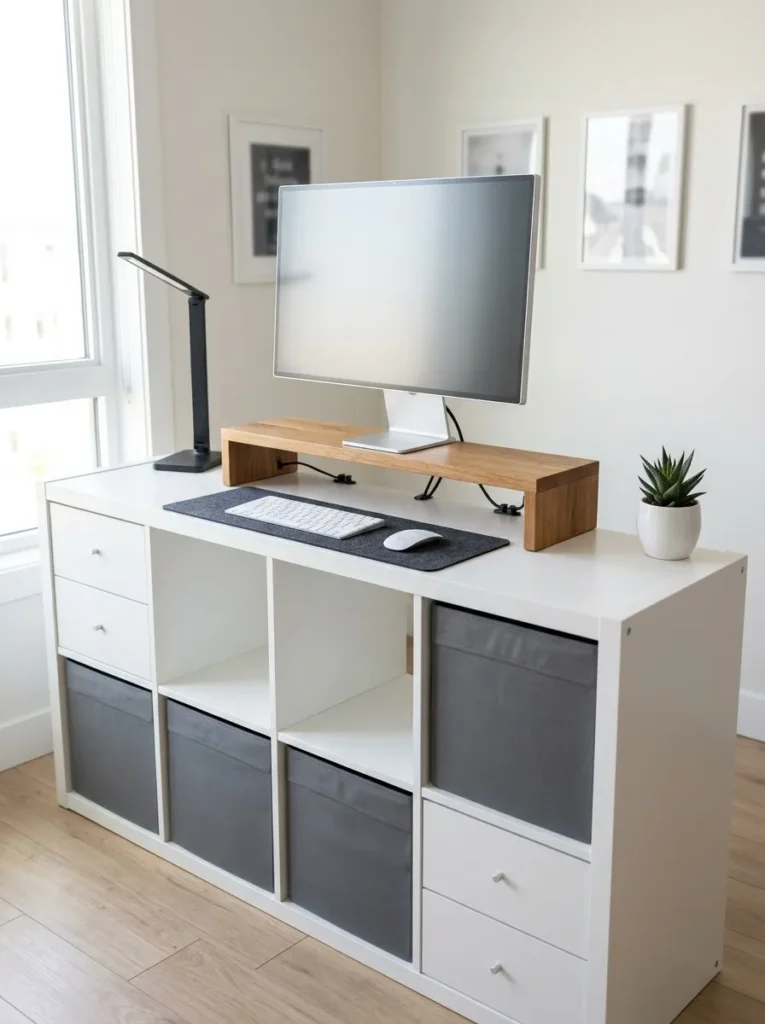
Vibe: The setup feels clean and purposefully configured — a standing desk that costs a fraction of commercial alternatives and looks more considered than most.
Why it works: A 2×4 KALLAX unit oriented horizontally — cubes running in a 2-high by 4-wide configuration — reaches approximately 77cm in height, which is within the adjustable range of many standing desk preferences and precisely the right height for a countertop-style working surface for users between 165–175cm tall. The flat, load-bearing top surface supports a monitor, keyboard, and accessories without additional reinforcement, and the eight cubes below provide a substantial organizational footprint that no conventional standing desk can match. A solid oak monitor riser on the surface elevates the screen to eye level and adds the warm natural material contrast that prevents an all-white KALLAX setup from reading as clinical.
How to get it: Orient the 2×4 KALLAX horizontally with the open side facing the user. Fill the lower row of four cubes with KALLAX drawer inserts for office supplies, cables, and documents. Fill the upper row with a mix of open display cubes and DRÖNA fabric boxes for less frequently accessed items. Place a solid oak or bamboo monitor riser at the center rear of the top surface, positioning the monitor at eye level. Route all cables through a cable management tray mounted under the KALLAX top surface using adhesive cable clips.
Quick Win: A 2×4 KALLAX in white ($109 at IKEA) used as a standing desk surface costs less than most commercial standing desk frames alone — and comes with eight cubes of integrated storage that a conventional standing desk cannot provide at any price point.
Shop The Look
| Product |
|---|
| Solid oak monitor riser desk stand natural wood |
| Cable management tray under desk adhesive mount |
| KALLAX drawer insert compatible white set |
| Bamboo desk mat surface protector natural large |
| Adhesive cable clip set wall desk management |
Also view: 16 Beautiful Craft Room Storage Ideas for Small Spaces
2. KALLAX with ALEX Drawer Insert Combo (LAYOUT)
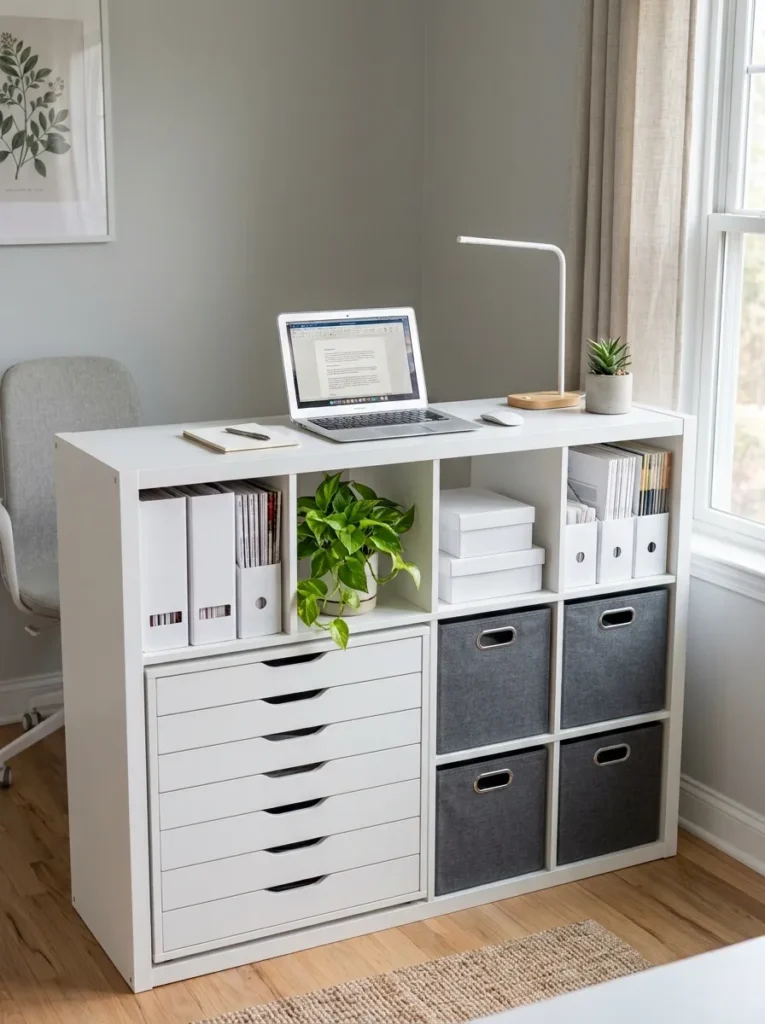
Vibe: The setup feels organized and cohesive — a seamlessly integrated storage system that looks purpose-built rather than assembled from separate pieces.
Why it works: The IKEA ALEX drawer unit (the narrow version, 36cm wide) fits almost perfectly within a KALLAX double-cube opening — created by removing the central shelf divider from two vertically adjacent cubes — producing a drawer tower that appears built-in rather than inserted. This is the most popular KALLAX hack in the IKEA hacking community for a specific functional reason: the ALEX provides six shallow drawers ideal for office supplies, stationery, cables, and documents, while the remaining KALLAX cubes handle larger items that do not fit in shallow drawers. The combined unit delivers the drawer storage of a traditional office desk pedestal within the footprint of a bookcase.
How to get it: Remove the central shelf divider from two vertically adjacent KALLAX cubes using a rubber mallet — the divider is press-fitted rather than glued and releases cleanly with firm lateral pressure. Slide the ALEX narrow drawer unit into the resulting double-height opening. The ALEX may require a thin shim (a folded piece of cardboard works) to fill a small gap at the sides — this prevents lateral movement without any permanent modification. Fill remaining cubes with magazine files for documents, DRÖNA fabric boxes for supplies, and leave one cube open for display.
Shop The Look
| Product |
|---|
| Magazine file set 6 piece white desk organization |
| Desk organizer set matching white office supplies |
| DRÖNA compatible fabric box set white grey |
| Drawer divider set adjustable small office |
| Label maker set office organization adhesive |
Also view: 14 Creative Craft Night Themes for a Fun Gathering
3. Pegboard Back Panel KALLAX Hack (LAYOUT / ACCESSORIES)
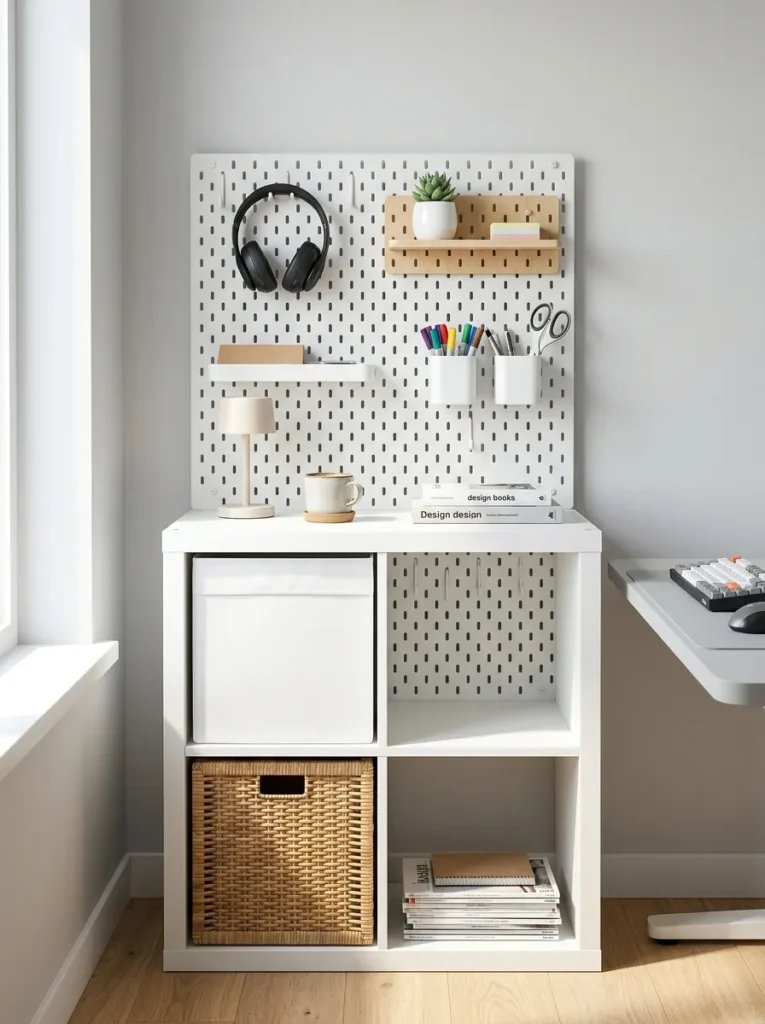
Vibe: The wall behind the desk feels activated and purposeful — every frequently used item within reach without consuming a centimeter of desk surface.
Why it works: Mounting a pegboard directly behind a KALLAX desk setup extends the organizational footprint of the workspace into vertical wall space that would otherwise be decorative at best, wasted at worst. The visual principle is zone separation: the KALLAX handles document storage, supplies in bulk, and equipment below the desk surface, while the pegboard handles the frequently accessed, smaller items that would otherwise scatter across the desk surface — scissors, markers, headphones, sticky notes, phone chargers. Together, the two systems cover the full range of workspace organizational needs without either one becoming overloaded. White pegboard behind a white KALLAX creates a seamless visual field that reads as a single, unified organizational wall.
How to get it: Mount a 60x60cm or 60x120cm white pegboard panel on the wall directly behind the KALLAX, ensuring the panel’s bottom edge aligns with the top of the KALLAX unit. Use wall anchors appropriate to the wall type — pegboards are lightweight and require only small fixings. Fit the pegboard with a combination of straight hooks for hanging items, small shelves (typically 15cm deep) for small plants and containers, and pegboard cups for loose small items. Change the configuration freely — this is the pegboard’s primary advantage over fixed wall storage.
Shop The Look
| Product |
|---|
| White pegboard panel 60x60cm wall organization |
| Pegboard hook set assorted sizes white metal |
| Pegboard shelf small 15cm white accessory |
| Pegboard cup container small white desk supplies |
| Pegboard mounting kit wall anchor set white |
4. Cube-by-Cube Color-Coded Organization System (COLOR)
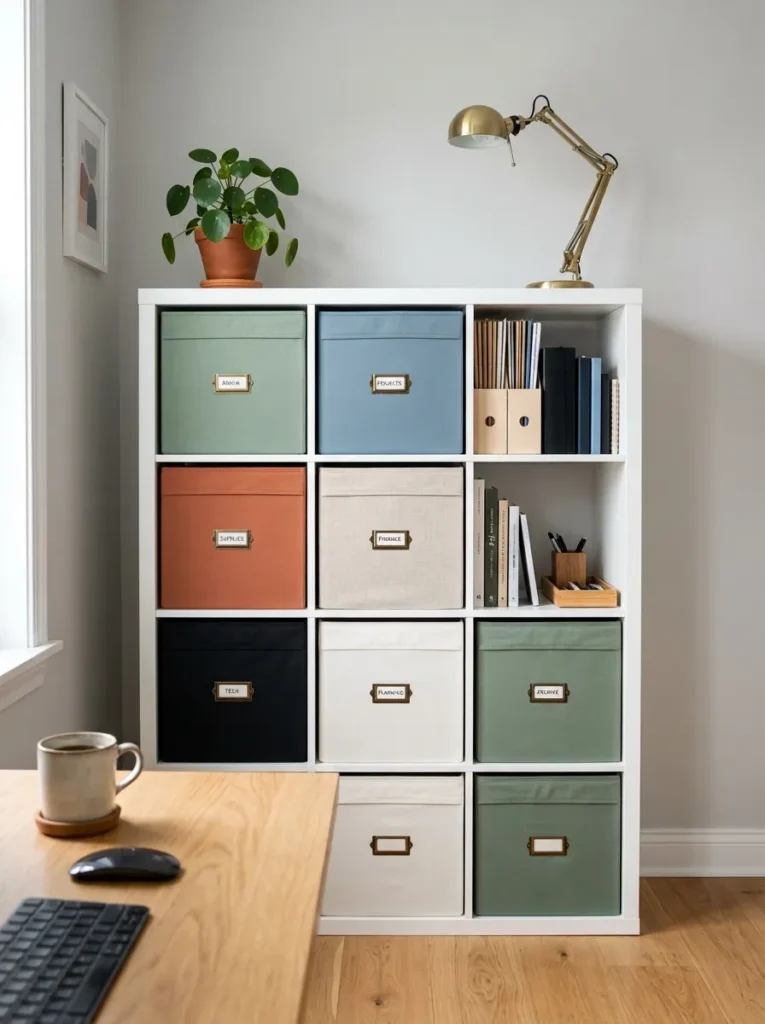
Vibe: The unit feels organized and visually calm — a color system that tells you where everything is before you even read a label.
Why it works: Color-coding a KALLAX organizational system works because it creates a dual retrieval system — you can find items by color memory before reading any label, which is significantly faster under cognitive load than reading labels alone. The design principle is muted palette cohesion: choosing a palette of four to six muted, tonal colors (dusty sage, soft terracotta, natural linen, dusty blue, warm grey, matte black) rather than bright primaries creates an organizational system that is visually calm to work near for extended periods rather than visually stimulating in a way that competes with the work itself. Each color maps to a category: sage for current projects, blue for reference materials, terracotta for personal items, black for technology accessories.
How to get it: Choose a five or six-color palette from the muted spectrum — avoid bright primaries, which create visual noise in a workspace. Assign each color to one category of workspace content before purchasing boxes, writing the assignment on paper first. Label each box with a small brass or matte black label holder — self-adhesive label holders are available for under $1 per unit and can be repositioned as the system evolves. Maintain the color system strictly for the first month — consistent use of any organizational system for 30 days creates the retrieval habits that make it genuinely useful long-term.
Shop The Look
| Product |
|---|
| Fabric storage box KALLAX compatible set muted tones |
| Brass label holder self adhesive small set of 12 |
| Label maker tape set office color organization |
| Matte black storage box KALLAX cube compatible |
| Natural linen fabric cube storage box set |
5. Under-Desk KALLAX Cable Management System (LAYOUT / SMALL SPACE).
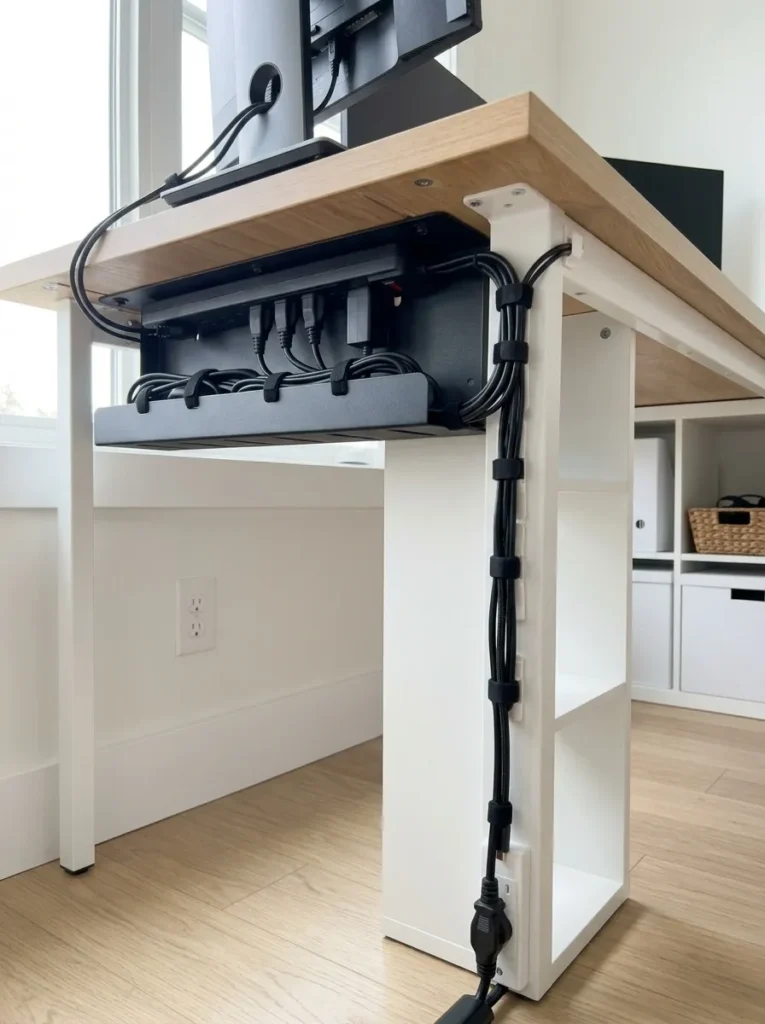
Vibe: The under-desk area feels invisible and resolved — the kind of cable management that makes the whole desk look more expensive immediately.
Why it works: Cable management is the single highest-impact upgrade available to any desk setup because visible cable chaos undermines the visual calm of even the most beautifully organized surface above it. The KALLAX desk base is particularly well-suited to integrated cable management because its solid MDF construction provides secure attachment points for adhesive cable trays, clips, and raceways along the underside and back surfaces. The key system principle is cable grouping: separating cables into three logical bundles — power cables, data cables, and peripheral cables — and routing each group along a dedicated path from source to destination eliminates the tangled, chaotic quality of unmanaged cable setups without requiring any cutting or permanent modification.
How to get it: Begin by mapping all cables before managing them: follow each cable from device to power source and identify which group it belongs to. Mount a cable management tray under the KALLAX top surface using the included adhesive or screw mounts — place it 10cm from the back edge, centered on the desk width. Place a power strip inside the tray with the cable exiting at one end toward the wall outlet. Group cables with Velcro reusable ties (not zip ties, which prevent easy future reconfiguration) before routing them along adhesive cable clips fixed to the KALLAX’s rear surface.
💡 Quick Win: A 30-pack of reusable Velcro cable ties ($6–$8) used to group cables before any permanent cable management is installed produces an immediate 80% improvement in cable visual chaos — the fastest and cheapest single cable management upgrade available.
Shop The Look
| Product |
|---|
| Under desk cable management tray adhesive mount black |
| Reusable Velcro cable tie set 30 piece black |
| Adhesive cable clip set 50 piece wall desk black |
| Power strip surge protector flat plug compact |
| Cable management box desktop power strip hide |
6. KALLAX as Room Divider Desk Station (LAYOUT)
Vibe: The room divider feels dual-purpose and genuinely clever — two functional zones created from one piece of furniture without closing off either space.
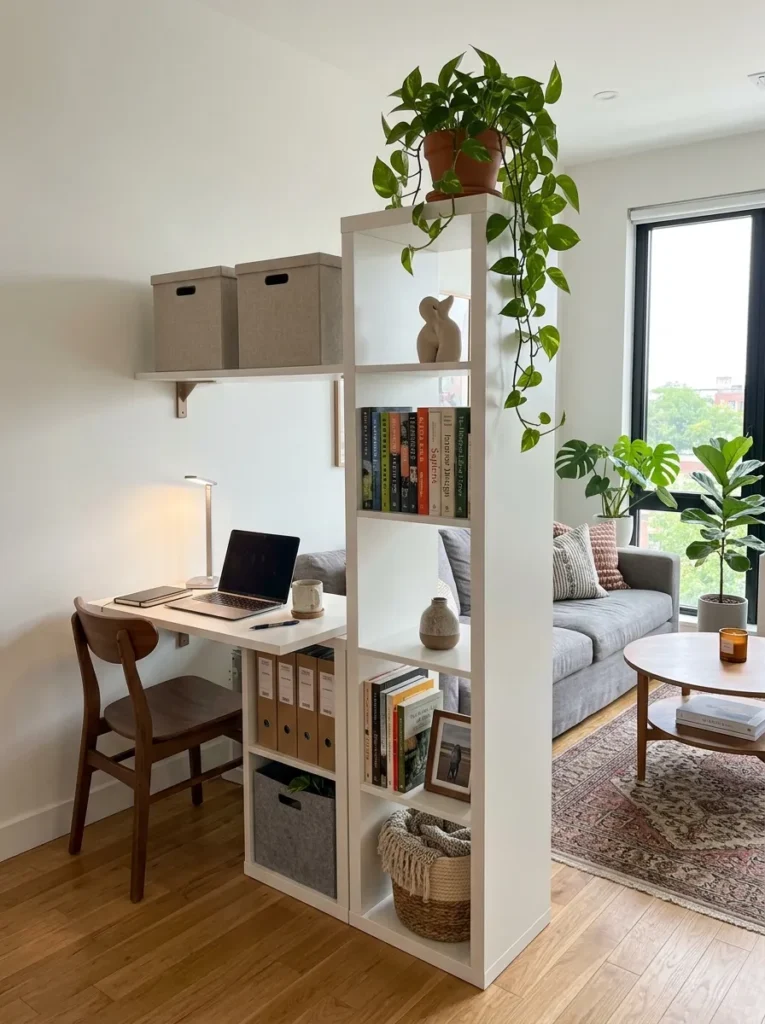
Why it works: A 1×4 KALLAX unit oriented vertically as a room divider — open cubes accessible from both sides — creates a desk zone within an open-plan living space without the visual weight of a solid partition wall or the spatial cost of a separate room. The design principle is face differentiation: the desk-facing side of each cube is organized for workspace function (magazine files, supply boxes, equipment storage) while the living-room-facing side of the same cubes holds decorative objects, books, and plants. Since the cubes are open-backed, careful curation of both sides is required — but this constraint produces a display quality on the living-room face that a conventional bookcase rarely achieves, because every object in the cube is visible from both directions.
How to get it: Position the 1×4 KALLAX vertically (four cubes stacked, one cube wide) as a room divider at 90 degrees to the main wall. Secure with an anti-tip wall bracket to the nearest wall stud — this is a non-negotiable safety requirement for any freestanding tall unit. Assign each cube a dual personality: organizational on the desk face, decorative on the living room face. Use closed inserts (fabric boxes, drawer inserts) on the desk face to prevent the organizational contents from being visible from the living room side. Place trailing plants on the top surface of the living room side to soften the unit’s upper edge.
Shop The Look
| Product |
|---|
| Anti-tip furniture strap wall anchor safety set |
| Trailing pothos plant live indoor hanging display |
| Closed fabric box KALLAX insert living room side |
| Open cube display object ceramic small decorative |
| Desk lamp adjustable arm clamp mount workspace |
7. KALLAX Craft and Hobby Desk Organization (ACCESSORIES)
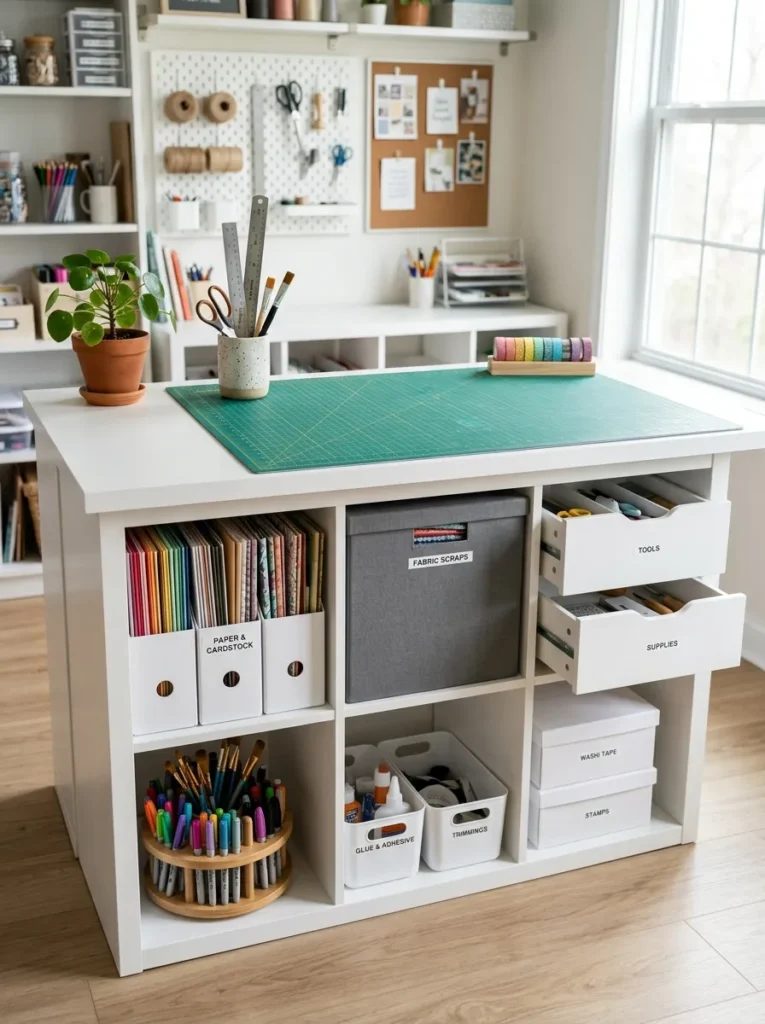
Vibe: The craft desk feels organized and creatively ready — every supply category in its place, the surface clear for whatever the current project demands.
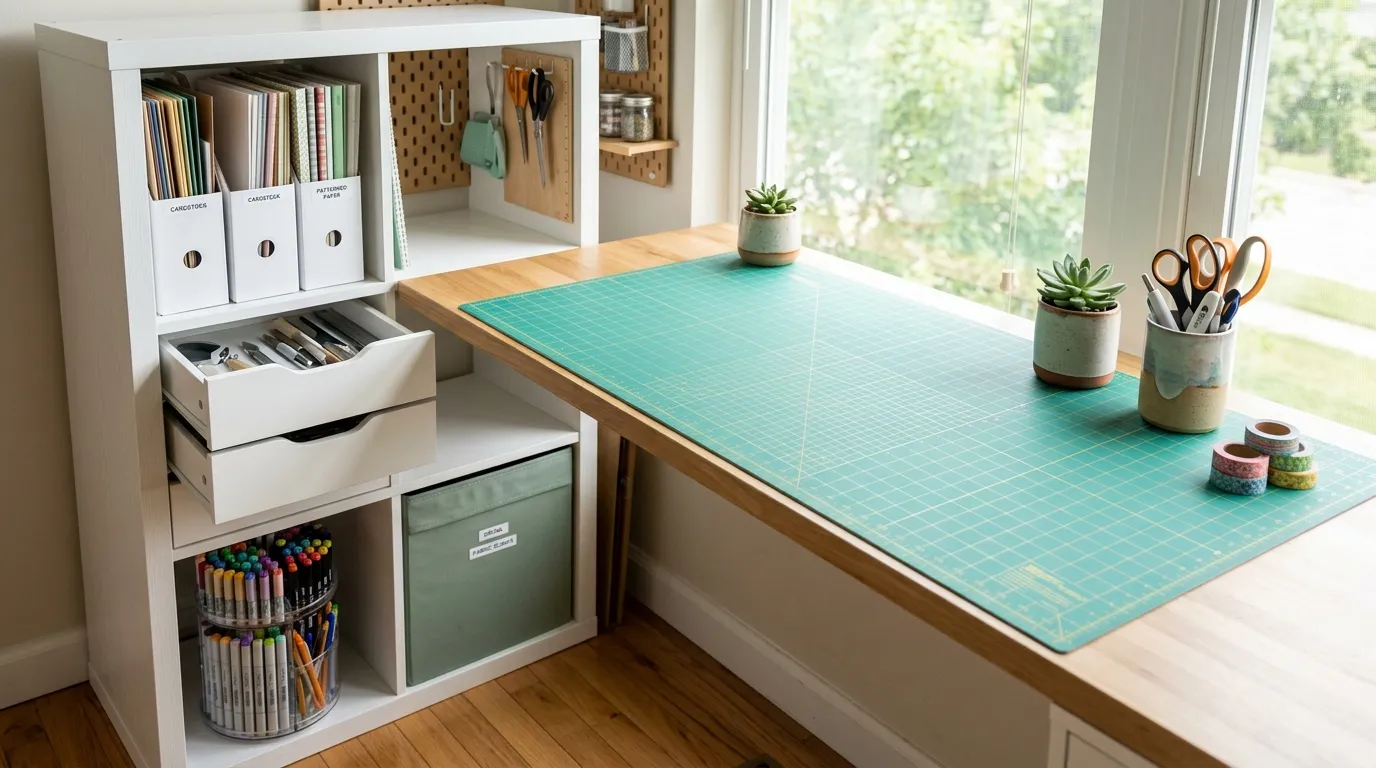
Why it works: A KALLAX craft desk organization system works because the cube format naturally maps to the category-based organization that craft and hobby supplies require — different cubes for different material types, with each cube’s insert chosen to suit the storage requirements of that specific material. Paper and card stock want vertical magazine files (which allow individual sheet removal without disturbing the stack); fabric scraps want deep fabric boxes (which accommodate the irregular, compressible nature of fabric without fixed compartmentalization); small tools and hardware want shallow drawers (which prevent the loss of small items at the bottom of a deep container). The cutting mat laid flat across the full KALLAX top surface creates a continuous, protected work surface equal in quality to a purpose-built craft table.
How to get it: Map your craft supplies to cube categories before purchasing inserts — group by material type (paper, fabric, tools, adhesives, embellishments) rather than by project type, as material-based organization remains stable across changing projects. Use magazine files for any flat, sheet-format material. Use a rotating desk organizer placed inside an open cube for writing tools, brushes, and markers — accessible from the desk surface by simply rotating toward you. Install a pull-out drawer insert in the cube closest to your dominant hand for the most frequently accessed tools.
Shop The Look
| Product |
|---|
| Self healing cutting mat A1 large craft desk surface |
| Rotating desk organizer pencil pen holder 360 |
| Magazine file holder set 6 piece white vertical |
| Pull out drawer insert KALLAX compatible white |
| Washi tape storage holder dispenser craft desk |
8. KALLAX with Solid Oak Desktop Surface Upgrade (MATERIAL)
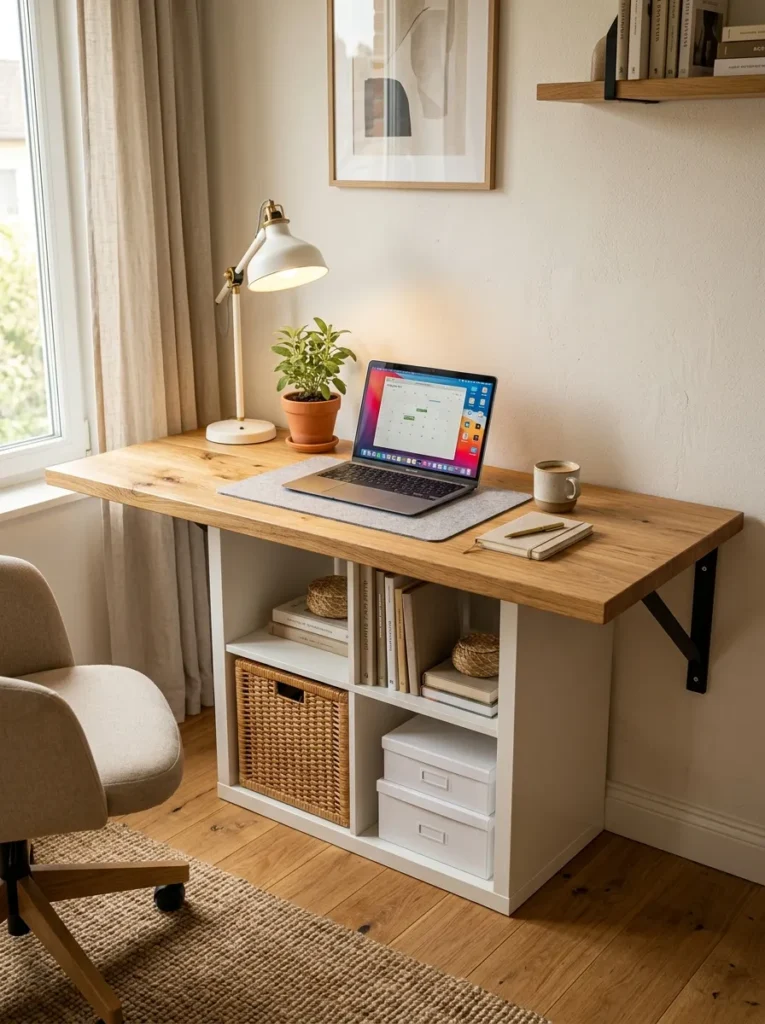
Vibe: The desk feels warm and custom-built — the kind of workspace upgrade that makes an inexpensive unit look like bespoke furniture.
Why it works: Placing a solid oak or beech butcher-block desktop board on top of a KALLAX unit is the single material upgrade that most dramatically changes the perceived quality and visual warmth of the entire setup. The KALLAX’s white MDF top surface reads as utilitarian; a solid wood desktop in warm oak reads as considered and premium, and changes the aesthetic of the entire setup from flat-pack furniture to intentional workspace design. Extending the oak desktop 15–20cm beyond the KALLAX edge on each side with simple L-bracket support creates a wider working surface than the KALLAX alone provides, which is the most common practical limitation of KALLAX-as-desk setups.
How to get it: Source a solid oak or beech desktop board (available from IKEA as the KARLBY or PINNARP countertop, or from timber merchants as a butcher-block panel) cut to the desired desk width — typically 120–160cm. Sand to 180-grit and finish with two coats of hard-wax oil for a food-safe, water-resistant surface that develops a natural patina with use. Attach L-brackets at each extended overhang end, screwing into a wall stud or attaching to a support leg for stability. The desktop rests on the KALLAX top surface and is secured with a small bracket or furniture connector to prevent shifting.
💡 Quick Win: IKEA’s PINNARP solid pine worktop ($69 for 186cm x 63.5cm) can be cut to the exact desk width needed, sanded, and oiled in a single afternoon — producing a custom-width solid wood desktop for less than $80, including the oil finish.
Shop The Look
| Product |
|---|
| Solid oak butcher block desktop board natural |
| Hard wax oil finish clear natural wood protection |
| L-bracket support steel desk extension set |
| Orbital sander 125mm craft wood finishing |
| Desktop grommet cable hole cover 60mm brushed steel |
9. KALLAX Cube Lighting Hack (LIGHTING)
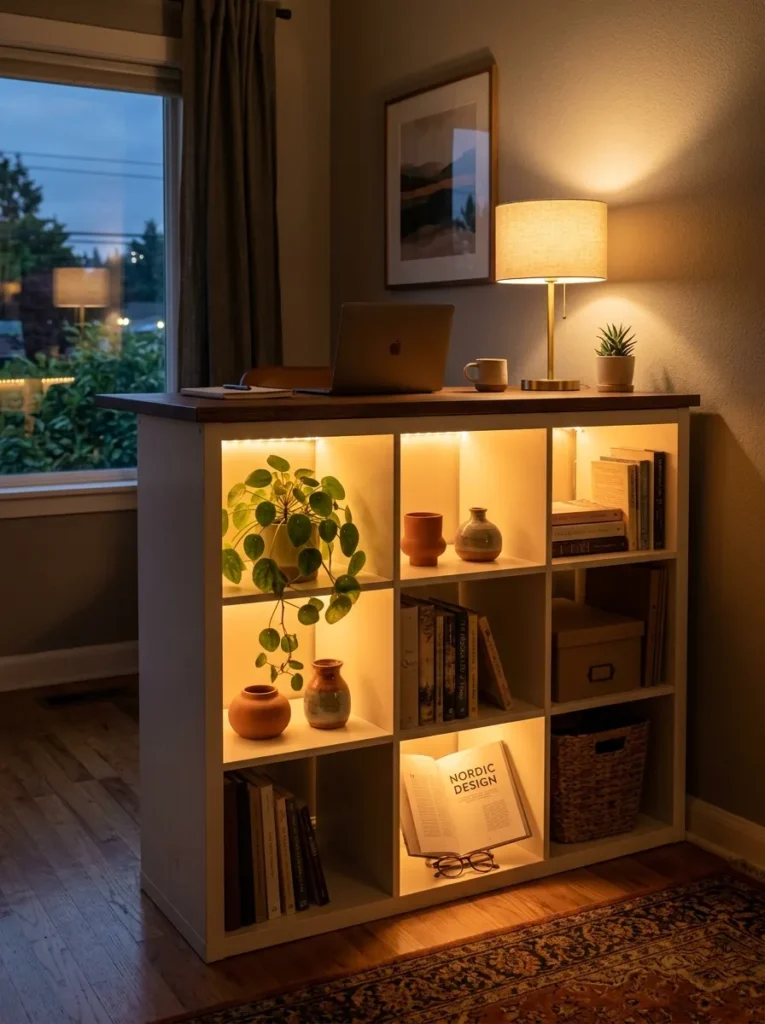
Vibe: The desk at dusk feels warm and genuinely atmospheric — the kind of workspace that makes staying at the desk in the evening feel pleasant rather than obligatory.
Why it works: Installing LED strip lights inside select KALLAX cubes creates a layered lighting scheme within the desk setup that serves both practical and atmospheric functions. Practically, illuminated cubes make the contents of open display cubes visible in low ambient light without requiring overhead lighting that would create screen glare. Atmospherically, warm-toned LED strips (2700–3000K color temperature) inside white KALLAX cubes create a lantern effect — the white interior walls of each cube amplify and diffuse the LED light, producing a soft, warm glow that makes the workspace feel inviting during evening work sessions. Selecting which cubes to illuminate (display cubes with decorative objects) and which to leave dark (storage cubes with functional inserts) creates a visual hierarchy that guides the eye toward the most intentionally styled elements of the setup.
How to get it: Use a peel-and-stick LED strip light rated at 2700K (warm white) — never cool white, which creates a harsh, clinical quality inside white cubes. Cut the strip to fit the top interior edge of each selected cube (most LED strip lights have cut points every 3 segments). Power from a single controller unit hidden in one cube or behind the unit. Alternatively, use individual battery-operated LED puck lights placed at the rear top corner of each cube — these require no wiring and can be switched independently.
Shop The Look
| Product |
|---|
| LED strip light warm white 2700K peel stick 5m |
| LED strip controller dimmer switch wireless |
| Battery LED puck light warm white set of 6 |
| Cable raceway strip adhesive white desk wall |
| Smart plug timer outlet LED automation schedule |
10. KALLAX Modular Desk Expansion with Two Units (LAYOUT / SMALL SPACE)
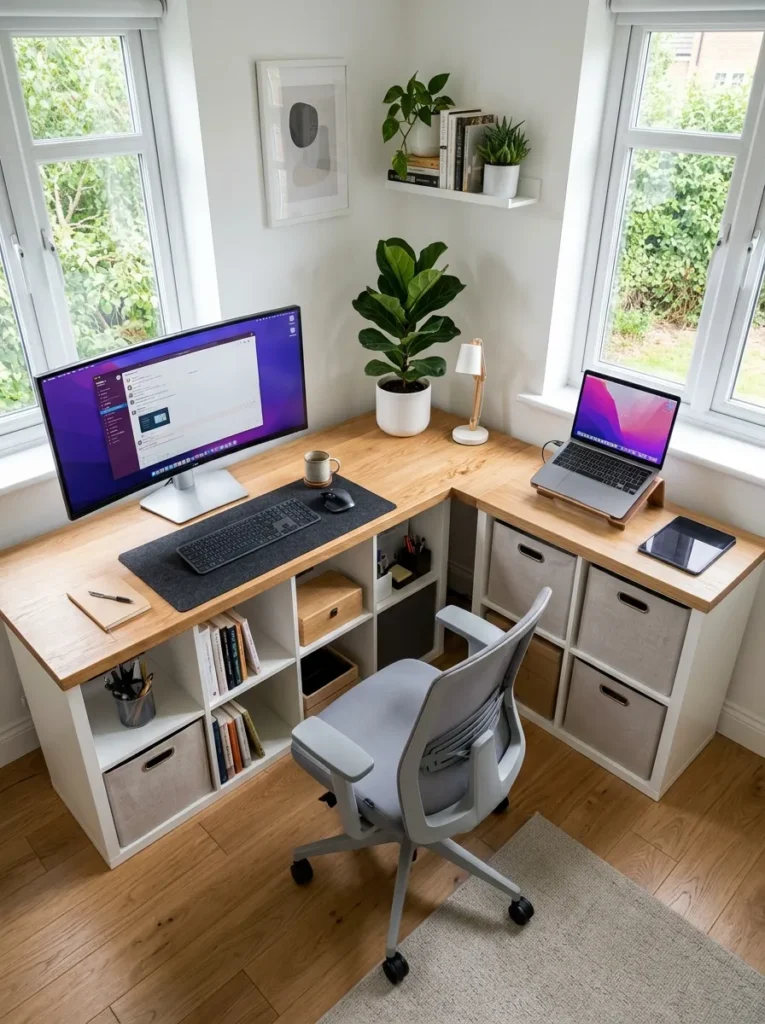
Vibe: The L-shaped desk feels spacious and seriously configured — the kind of workspace that communicates genuine productivity before anything is switched on.
Why it works: Two KALLAX units configured as an L-shaped desk deliver the ergonomic and organizational advantages of a corner desk — a primary monitor surface, a secondary work surface, and a natural division between computer work and manual work — at a fraction of the cost of a purpose-built corner desk. The organizational logic of an L-shaped KALLAX setup follows zone specialization: the main arm (the longer unit) handles primary computer work and its associated storage (monitor, keyboard, current project files, technology accessories); the return arm (the shorter unit) handles secondary activities (sketching, reading, craft work, phone area) with different storage requirements. A custom corner piece in matching wood bridges the two units at the junction, creating a continuous working surface.
How to get it: Position both KALLAX units at 90 degrees to each other with a 3–5cm gap at the corner to accommodate the wall corner or baseboard. Cut a corner filler piece from MDF or a solid wood offcut — measure the gap precisely and cut to fit flush with both unit top surfaces. Secure both units to the wall with anti-tip brackets before using as a desk surface, as the desk use adds lateral load beyond the units’ freestanding stability. Fill cubes on both arms using different insert types that reflect each arm’s specific function.
Shop The Look
| Product |
|---|
| Corner desktop piece solid oak custom cut natural |
| Monitor arm dual desk mount adjustable VESA |
| Anti-tip wall bracket furniture strap safety set |
| Cable pass-through desk grommet 60mm white set |
| Desk pad large extended mousepad natural leather |
11. KALLAX Door Insert as Hidden Supply Station (ACCESSORIES / SMALL SPACE)
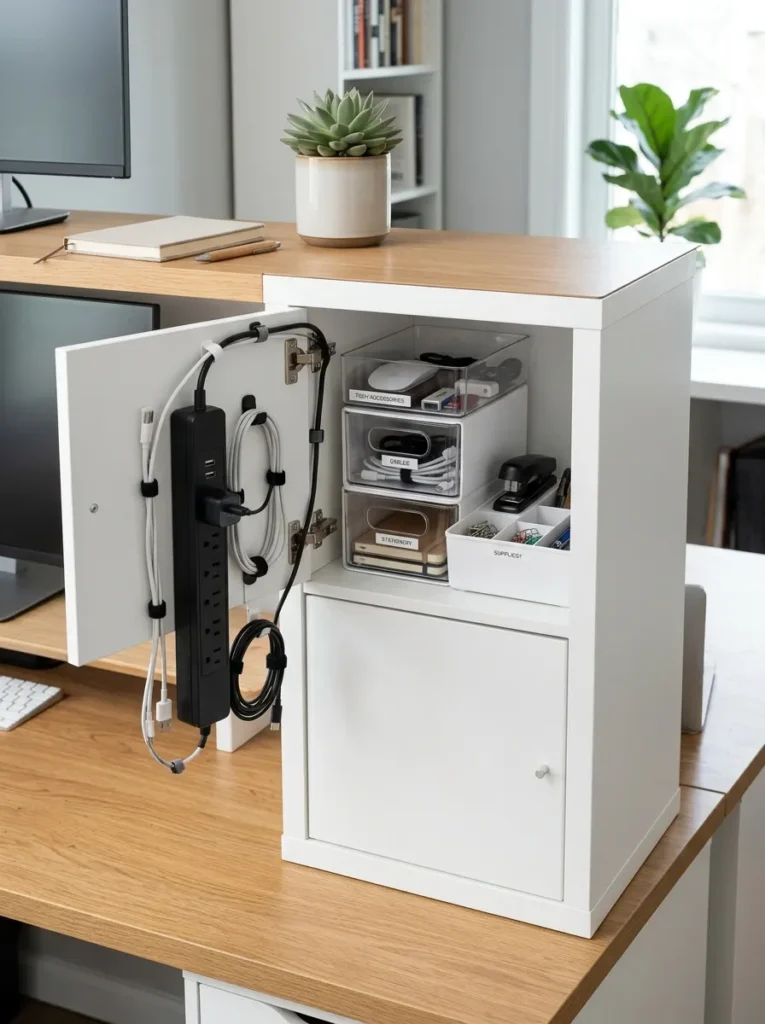
Vibe: The closed doors feel seamlessly clean — the organizational equivalent of a magic trick where the mess simply ceases to exist behind a white door.
Why it works: KALLAX door inserts transform open cubes into closed compartments with a push-to-open magnetic closure, creating a visual cleanliness on the desk unit’s face that open cube organization can never fully achieve. The door insert hack becomes a hidden supply station when the interior of the cube behind the door is fitted with small organizers, mounted accessories, and even a compact power strip — turning dead cube space into a functional, fully equipped supply hub that disappears completely when the door is pushed closed. This hidden supply station approach is particularly valuable for video call backgrounds, where the KALLAX forms the visible wall behind the desk and visual calm is professionally important.
How to get it: Install KALLAX door inserts in the cubes most likely to accumulate visual clutter — supply cubes, technology accessory cubes, and charging stations are the primary candidates. Inside the door-equipped cubes, mount a small power strip at the rear wall of the cube using adhesive cable mounts — this creates a charging station with cables entering through the back of the KALLAX and completely hidden when the door is closed. Fit small stackable organizers or divided trays inside each closed cube to maximize the storage capacity of the hidden space.
Shop The Look
| Product |
|---|
| KALLAX door insert compatible white push open |
| Small stackable desk organizer set clear acrylic |
| Compact power strip flat plug 4 outlet cable |
| Adhesive wall mount hook small inside cabinet |
| Small divided tray organizer desk supply sorting |
12. KALLAX Vertical 1×4 Side Tower Configuration (SMALL SPACE)
.
Vibe: The tower feels efficient and compact — four distinct organizational functions in the narrowest possible floor footprint.
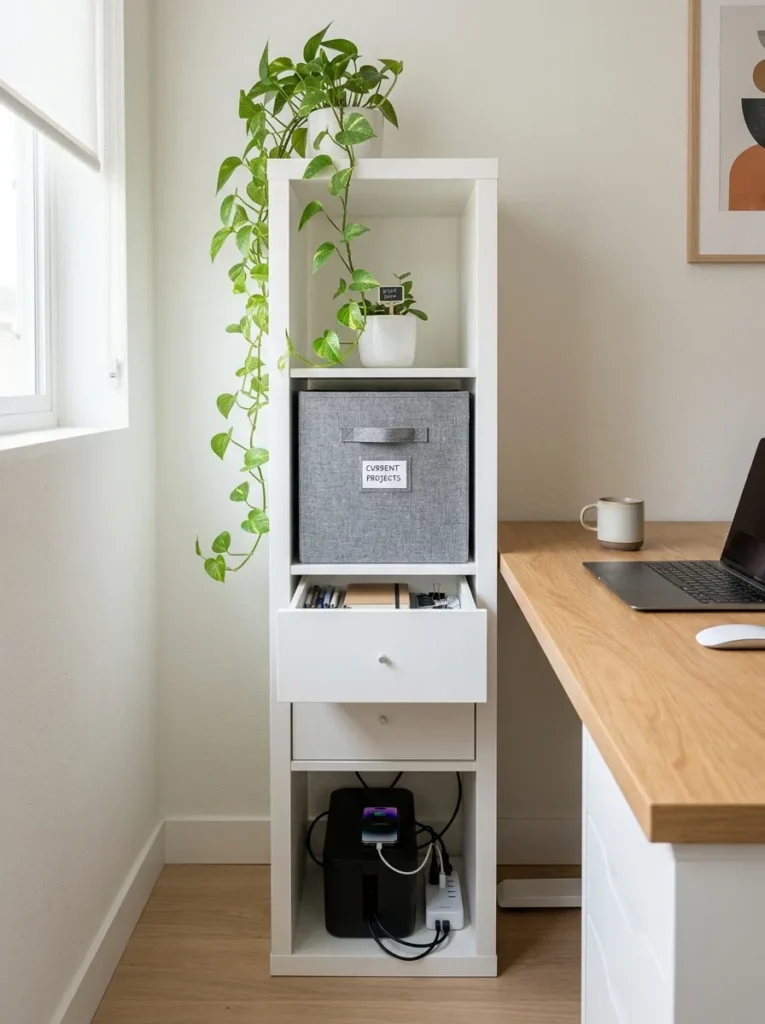
Why it works: A 1×4 KALLAX oriented vertically is 147cm tall and only 42cm wide — the most space-efficient KALLAX configuration available, and the most powerful for small desk setups where a horizontal unit would consume too much wall length. The vertical tower’s four cubes naturally organize by accessibility and visual hierarchy from top to bottom: the top cube is at eye level, making it ideal for display and frequently referenced items; the second and third cubes are at chest and waist height, ideal for active project storage and supplies; the bottom cube is at floor level, making it the natural location for infrastructure items (charging station, cable management box, printer paper) that need access but not visibility.
How to get it: Position the 1×4 vertical KALLAX beside the main desk surface rather than behind it, so all four cubes are accessible without leaving the desk chair. Secure to the wall with an anti-tip bracket — at 147cm tall, the vertical 1×4 is the most top-heavy KALLAX configuration and the most important to anchor. Assign the top cube to display and frequently referenced items, the second to active project materials in a fabric box, the third to a drawer insert for loose supplies, and the bottom to infrastructure — a cable management box that hides the power strip and charging cables for the desk.
💡 Quick Win: A 1×4 KALLAX in white ($34.99 at IKEA) used as a desk side tower provides more organized desk storage per dollar than any other furniture piece available at any price — four cubes of configurable storage in a 42cm footprint that costs less than most desk organizer sets.
Shop The Look
| Product |
|---|
| Cable management box desktop power strip hide white |
| Pull out drawer insert KALLAX cube compatible |
| Fabric storage box KALLAX cube natural linen |
| Trailing pothos small pot display top cube |
| Anti-tip furniture wall strap safety anchor set |
13. KALLAX Cube Desktop Organizer Inserts (ACCESSORIES / COLOR)
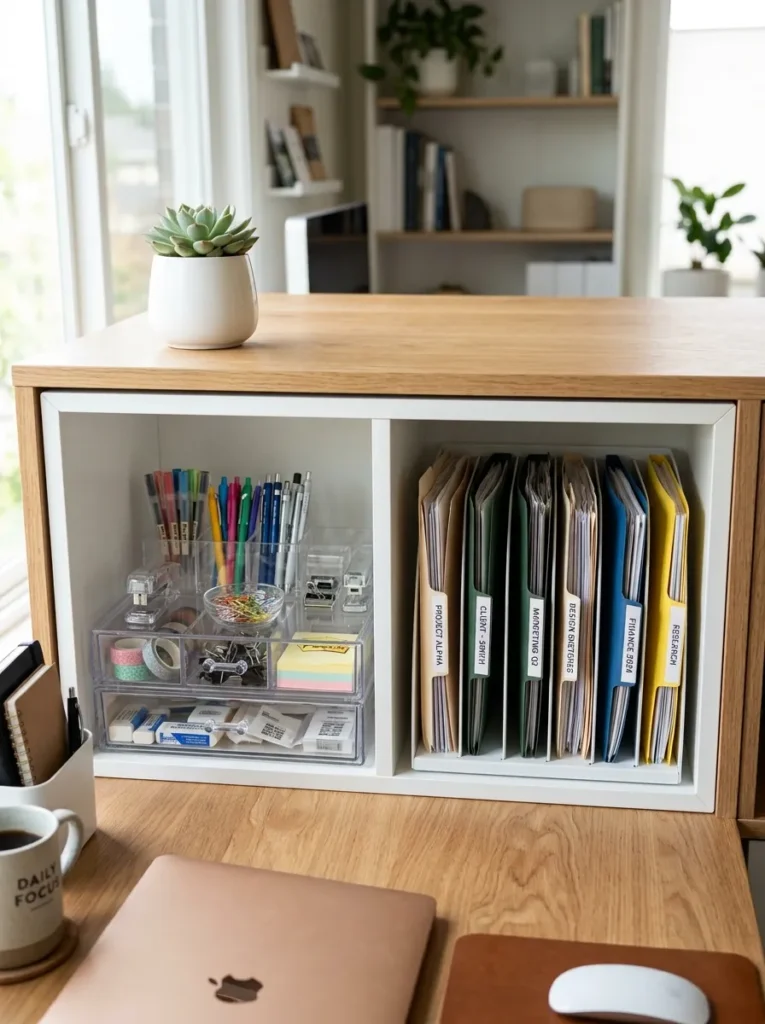
Vibe: The open cubes feel organized at close range — the kind of detailed supply management that makes desk work feel genuinely controlled.
Why it works: Using open KALLAX cubes at desk height as desktop organizer inserts — fitting them with small divider trays, vertical file organizers, and sorted supply containers rather than large fabric boxes — creates the most accessible form of desk-level storage, where the cube contents function as an extension of the desk surface rather than as below-desk storage. The design principle is proximity-based access: supplies that are used multiple times per work session should be within arm’s reach at desk height, not requiring the user to bend to lower cubes or stand to reach upper ones. Acrylic divider trays visible through the cube opening provide at-a-glance inventory of supplies without opening any container.
How to get it: Identify the two or three cubes most accessible from the primary sitting position at the desk — these are the cubes that should receive the desktop organizer treatment. Install an acrylic desk organizer set with multiple compartments in one cube for stationery and small supplies. Place a vertical file organizer in the adjacent cube for current project folders and documents. Keep these cubes’ contents to items used at least once per week — less frequently used items belong in closed storage cubes elsewhere on the unit. Label folder tabs and supply compartments for a system that maintains itself through consistent use.
Shop The Look
| Product |
|---|
| Clear acrylic desk organizer set multiple compartments |
| Vertical file organizer desktop metal mesh black |
| Acrylic pen holder cup clear desk supply |
| Sticky note organizer acrylic clear desk |
| Small succulent plant ceramic white pot desk |
14. KALLAX Fabric Box Labeling and Rotation System (COLOR / ACCESSORIES)
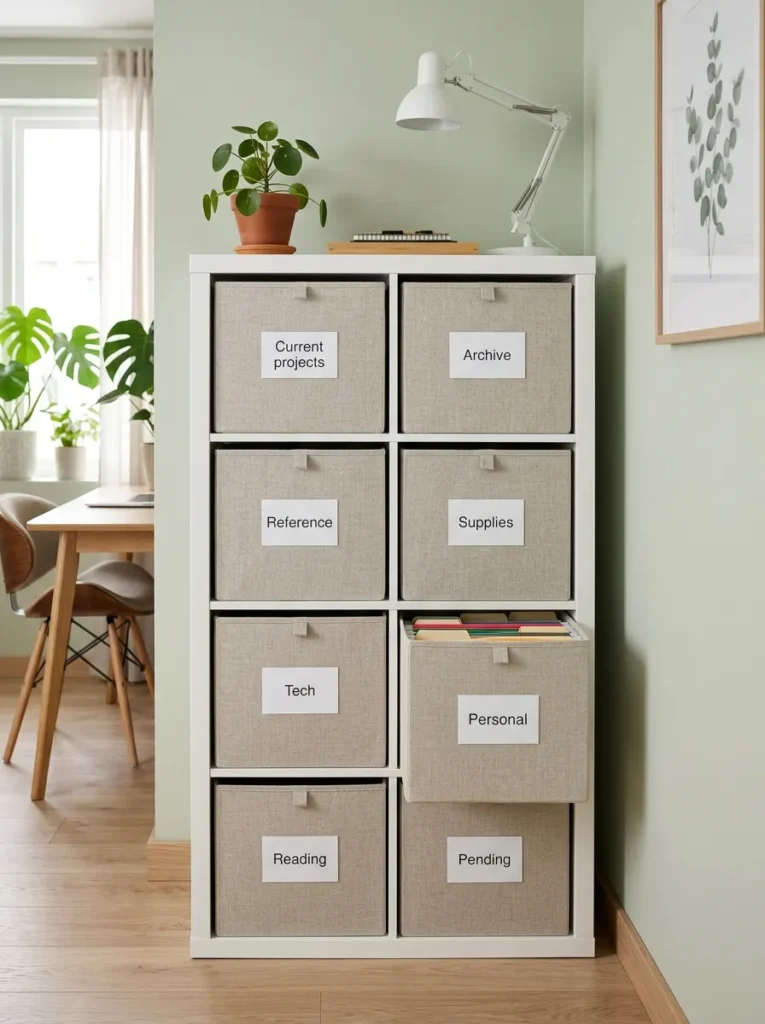
Vibe: The unit feels systematically organized and self-explaining — a storage system so clearly labeled that anyone could navigate it in seconds.
Why it works: A complete fabric box labeling system transforms the KALLAX from a storage unit into an information architecture — a physical system where the location of any item can be predicted from first principles rather than requiring memory. The design principle is labeling consistency: every box in the system must be labeled in the same location, using the same label format, with the same level of specificity. Inconsistent labeling (some boxes with general category labels, some with specific content labels, some unlabeled) is the primary reason that organizational systems fail after the initial setup enthusiasm fades — the system becomes navigable only by the person who created it, which defeats the fundamental purpose.
How to get it: Choose a maximum of eight category labels that cover the full range of your desk work without overlapping — broad categories (Current Projects, Reference, Archive, Supplies, Technology, Personal, Reading, Pending) work better than narrow ones (February Invoices, Old Cables, Books to Read) because they remain stable as contents change. Print labels using a label maker or print-and-cut approach in consistent typography. Apply all labels at the same height on each box face using a ruler to ensure alignment. Review and rotate box contents monthly — the physical act of removing everything from a box and replacing only what belongs there is the maintenance routine that keeps any organizational system functional.
Shop The Look
| Product |
|---|
| Natural linen fabric storage box KALLAX set of 8 |
| Label maker electronic compact home office white |
| Label tape set 12mm white black lettering refill |
| Hanging file folder set color coded office |
| Desk calendar weekly planner pad desk reference |
15. KALLAX Japandi-Styled Minimal Desk Setup (COLOR / MATERIAL)
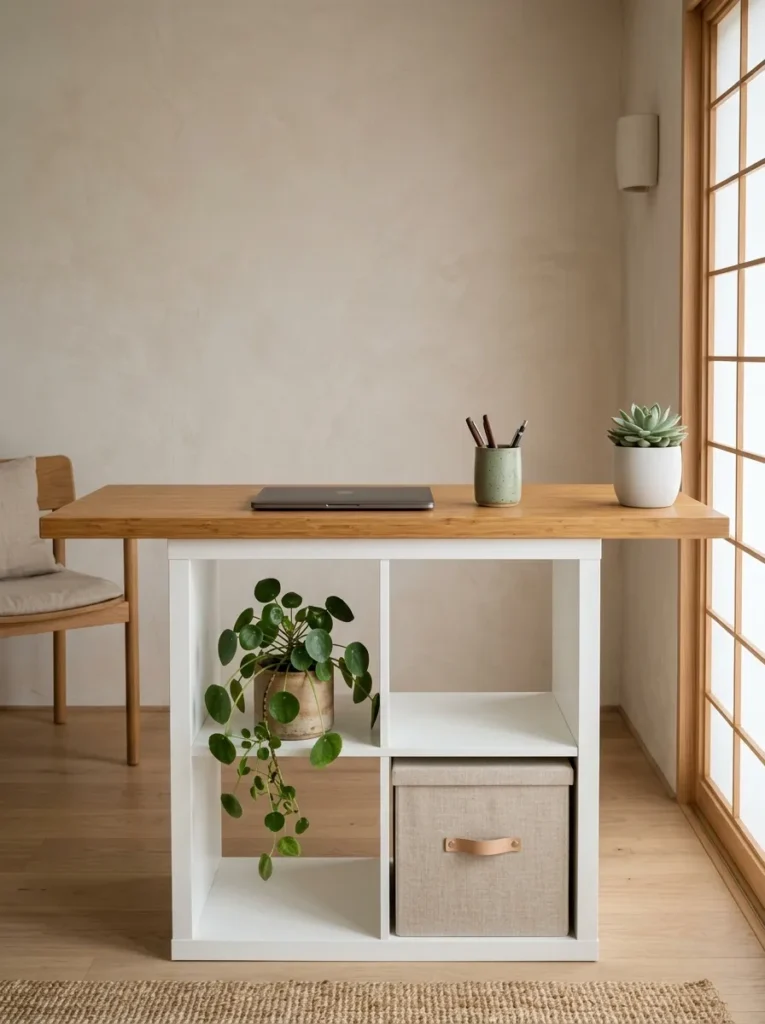
Vibe: The desk setup feels meditative and uncluttered — the deliberate calm of a workspace where less is genuinely more.
Why it works: A Japandi-styled KALLAX desk setup applies the aesthetic principles of Japanese wabi-sabi and Scandinavian minimalism to workspace organization — treating negative space as a positive design element, limiting visible objects to those with both functional and aesthetic value, and choosing natural materials (bamboo, linen, ceramic) over synthetic ones throughout. The organizational philosophy that underpins a Japandi desk setup is not minimalism as deprivation but minimalism as clarity: everything that would normally live on or near the desk is stored behind closed doors, in closed boxes, or in a separate filing system — the desk surface itself is reserved for the one task currently in progress and nothing else. This single discipline — a genuinely clear desk surface — produces a measurable improvement in cognitive clarity and task focus.
How to get it: Begin by removing every object currently on or near the desk and returning only the items needed for the specific task currently in progress. Identify closed storage solutions for everything else — KALLAX door inserts, linen fabric boxes with consistent labels, and a cable management system that removes all visible infrastructure. On the desk surface, permit only three categories: current task materials, one writing instrument in a beautiful holder, and one living plant. The Japandi KALLAX setup is less about what you add and more about what you commit to keeping out of sight — a discipline that becomes easier with practice and produces compounding benefits over time.
Quick Win: Removing every non-essential object from the desk surface right now — everything except the current task, one pen, and one plant — costs nothing and produces an immediate, measurable improvement in the clarity and calm of the workspace, before a single organizational purchase is made.
Shop The Look
| Product |
|---|
| Solid bamboo desktop surface natural large |
| Ceramic pen holder matte white minimalist desk |
| Single linen storage box KALLAX cube natural |
| Small trailing plant ceramic pot white minimalist |
| Bamboo desk tray organizer small natural |
How to Start Your KALLAX Desk Organization Transformation
Your single best first move is to choose the KALLAX configuration that matches your available wall space before purchasing any inserts, accessories, or organizational products. The most common KALLAX desk setup mistake is purchasing inserts before the unit is assembled and in position — insert requirements change significantly depending on which cubes are most accessible from the primary seating position, which are at eye level versus floor level, and which face outward in a room-divider configuration versus against a wall. Assemble the KALLAX, sit at it for one full work day using it as-is, and note which cubes you naturally reach toward most often before spending a single dollar on inserts.
The most common beginner mistake in KALLAX desk organization is filling every cube with a closed fabric box immediately after setup — a visual decision driven by the desire for a tidy appearance rather than an organizational decision driven by actual workflow needs. The result is a uniformly tidy-looking unit where nothing is accessible without removing and replacing box lids, and the system is abandoned within two weeks in favor of piling things on the desk surface. Fix this by identifying the three cubes most frequently accessed from the desk position and keeping them as open cubes with acrylic organizers or visible vertical files — accessibility in those three cubes is more valuable than visual uniformity across all eight.
Three specific items under $50 that create the greatest immediate KALLAX desk organization impact: a set of six matching linen fabric boxes in natural or a single muted tone ($18–$28) that immediately unifies the visual appearance of the unit’s cube faces and creates the foundation for a labeling system; a 30-pack of reusable Velcro cable ties ($6–$8) that addresses cable chaos before any permanent cable management infrastructure is installed; and a solid bamboo monitor riser ($22–$32) that elevates the monitor to eye level, creates under-monitor storage for a keyboard and mouse, and adds the warm natural material contrast that distinguishes a considered setup from an assembled one.
A basic KALLAX desk setup with the unit already owned — adding inserts, a desktop surface, and cable management — takes one weekend and costs $40–$120 depending on insert choices and desktop material. A full KALLAX desk transformation including a solid wood desktop, pegboard installation, LED cube lighting, and a complete insert system runs $150–$350 in materials, with the investment producing a workspace of significantly higher functional and aesthetic quality than any purpose-built desk available at the same price point. The dual-unit L-shaped configuration requires two KALLAX units ($70–$220 depending on size) plus corner desktop and brackets ($50–$80), producing a complete home office desk and storage system for $120–$300 total.
Frequently Asked Questions About KALLAX Desk Storage Hacks
Can a KALLAX unit support a monitor and desktop equipment safely?
Yes — the KALLAX top surface has a stated load capacity of 25kg when the unit is wall-anchored, which is sufficient for a single monitor (typically 3–7kg), a desktop computer (5–12kg), and accessories within the remaining weight budget. For dual-monitor setups or setups including a heavy laser printer, distribute the load across the full surface rather than concentrating it at one point, and always anchor the unit to the wall with the supplied anti-tip bracket. Never exceed the 25kg stated limit, and always anchor before loading — an unanchored KALLAX under desk loads is a genuine stability risk.
What is the exact internal dimension of a KALLAX cube?
The internal dimension of each KALLAX cube is 33x33x38cm (width x height x depth) — this is the critical measurement for selecting compatible inserts, as third-party products described as “KALLAX compatible” are designed to this specification. The KALLAX cube internal dimensions are unchanged from the EXPEDIT unit it replaced, which means any EXPEDIT-compatible insert from before 2014 is equally compatible with the current KALLAX. Note that the external dimension of each cube module is 42x42cm due to the 4.5cm shelf thickness — relevant when calculating the total unit footprint.
How do I make a KALLAX desk setup stable enough for daily use as a desk?
Three measures create a stable KALLAX desk setup: wall anchoring with the supplied anti-tip bracket to a wall stud (not a drywall anchor alone) is the most important single safety measure; filling the lower cubes with heavier items (books, binders, equipment) and the upper cubes with lighter items (fabric boxes, decorative objects) lowers the center of gravity significantly; and placing the unit with its back against the wall rather than freestanding eliminates the risk of forward tipping under the load of someone leaning on the desk surface. A horizontally oriented 2×4 KALLAX used as a desk surface is inherently more stable than a vertically oriented 1×4 used as a side tower — the tower configuration requires wall anchoring without exception.
What IKEA inserts are most useful for a KALLAX desk setup?
The four most functionally useful KALLAX inserts for a desk setup are: the KALLAX drawer insert (a single shallow drawer ideal for frequently accessed small supplies — pens, sticky notes, small tools); the KALLAX insert with door (a push-to-open door for cubes containing clutter that needs to be visually hidden); the DRÖNA fabric box (the most versatile closed storage insert, available in multiple colors and ideal for larger supply categories); and the KALLAX shelf insert (which divides a single cube horizontally, creating two half-height compartments ideal for storing smaller items that would otherwise be lost in a full-height cube). Third-party alternatives to all four IKEA inserts are available at comparable or lower prices from Amazon and specialist storage retailers.
How do I hide the back of a KALLAX used as a room divider?
The simplest solution for finishing the back of a room-divider KALLAX is fabric backing panels — cut pieces of fabric or wallpaper to the exact back panel dimension (the thin MDF back of each cube section) and attach with removable adhesive or spray mount. This provides a different finish on each face of the divider without permanent modification. For a more polished result, remove the back panels entirely (they are thin MDF attached with staples, removable with a thin flat tool) and replace them with cut-to-size panels in a different material — thin plywood painted in a contrasting color, patterned contact paper, or cork sheet — creating a genuinely different aesthetic on each face of the divider unit.
Ready to Create Your Dream KALLAX Desk Organization Setup?
These 15 hacks span the full range of KALLAX desk organization — from the structural foundation of the standing desk configuration and the L-shaped dual unit setup, through the material warmth of the solid oak desktop upgrade and the bamboo Japandi minimal arrangement, to the detailed functionality of the cube lighting hack, the hidden door supply station, and the complete fabric box labeling system — covering layout, color, accessories, lighting, and small-space solutions across every organizational need. Begin with the one configuration that matches your current wall space and working style most closely, rather than planning the most ambitious possible setup — a single KALLAX unit used thoughtfully outperforms a complex multi-unit setup used inconsistently every time. Today’s specific action: sit at your current desk for five minutes and write down the three things that most frequently interrupt your working clarity — the cable you trip over, the supply you can never find, the surface clutter that expands to fill every available space — and let those three friction points guide your first three organizational decisions rather than aesthetic preference alone. When you sit down at a desk where every cable is hidden, every supply is labeled and reachable, and the surface in front of you holds only what today’s work requires, you will understand exactly why the KALLAX desk setup earns its permanent place at the top of every home office Pinterest board. Save your favorites now, especially the solid oak desktop upgrade and the Japandi minimal configuration — they are the two ideas that, once implemented, make every hour spent at the desk feel qualitatively different from the one before.