14 Book Page Craft Ideas for Creative Homes
Book page crafts are creative projects that repurpose the printed pages of old, damaged, or discarded books — transforming them into decorative objects, functional home accessories, and art pieces through folding, cutting, rolling, painting, and collaging techniques. Here are 14 ideas for using book pages to create genuinely beautiful home decor that honors the material’s literary heritage rather than simply treating it as textured paper.
There is something specifically satisfying about making something beautiful from a book. The printed text — even when the specific words aren’t legible from a distance — carries a visual warmth and intellectual quality that plain paper cannot replicate. The pages of an old novel, a vintage encyclopedia, a worn paperback dictionary are warm in color, rich in texture, and dense with human thought. Crafted into something new, they carry that quality forward. Here are 14 ideas worth making — and displaying.
Why Book Page Crafts Work So Well
What makes book page crafts distinct from other paper crafts? Book page crafts occupy a specific creative territory that distinguishes them from general paper crafts — the printed text and the material’s literary origin give every project a visual and conceptual depth that plain paper cannot provide. A cone of white paper is simply a paper cone; a cone of book pages is an object that references reading, knowledge, narrative, and the specific aesthetic of printed text simultaneously. This layered quality — simultaneously decorative and referential — is what makes book page crafts consistently more visually interesting than equivalent projects in unprinted materials.
Core materials and approaches. Book page crafts use three primary material interventions: the pages as found (using the printed text and paper color as the primary aesthetic), the pages painted or washed (applying a color or tonal treatment that integrates the text with a specific palette), and the pages combined with other materials (paired with fabric, wire, botanical elements, or paint to create mixed-media pieces). The most successful book page projects tend to use older book pages (yellowed paper with aged typography and denser letterpress printing) rather than newer pages, because the aging process creates a warm cream-to-amber tone that reads as artisan and handmade rather than recently photocopied.
Why book page crafts resonate particularly strongly now. Book page crafts sit at the intersection of several currently resonant cultural values — sustainability and upcycling (repurposing materials that would otherwise be discarded), the celebration of analog objects in a digital world (books as physical artifacts of human knowledge), the maker movement’s valorization of hand-produced objects, and the broader interior design preference for objects with visual warmth, history, and material specificity. The aged paper tone connects naturally to the warm neutral palettes that dominate contemporary home decor.
Can book page crafts look sophisticated rather than craft-fair generic? The distinction is entirely in restraint, material quality (using genuinely old, well-printed book pages rather than modern photocopied text), and display context. A single large book page art piece in a quality frame, displayed on a well-composed shelf with other considered objects, reads as sophisticated literary art. Twelve small book page projects covering every surface of a room reads as a themed craft display. The same principles of curation and restraint that govern all home decor determine whether book page crafts read as sophisticated or generic.
Style at a Glance
| Element | Detail |
|---|---|
| Philosophy | Honor the material’s literary origin — don’t simply use it as textured paper |
| Key Materials | Aged book pages, vintage typography, Mod Podge, wire, dried botanicals |
| Key Approach | Restraint, quality page selection, considered display context |
14 Book Page Craft Ideas for Creative Homes
1. Folded Book Page Art — Origami-Style Wall Display
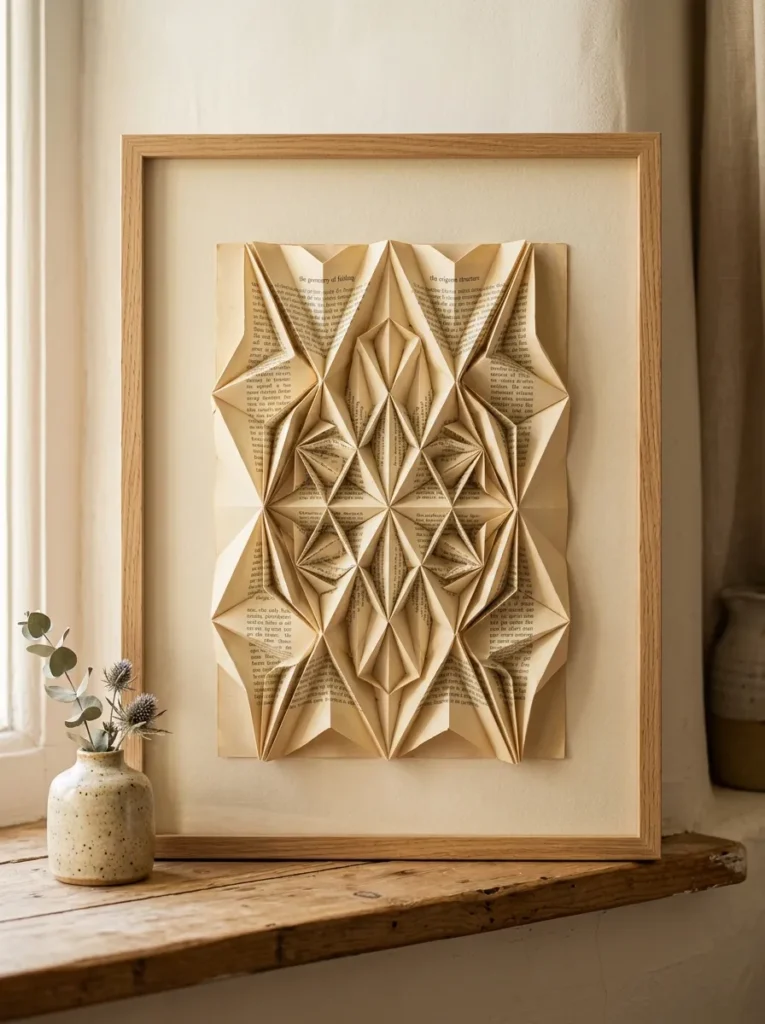
Vibe: Folded book page art in a frame feels geometrically warm — the intersection of literary material and architectural form.
Why it works: Folding book pages into geometric patterns creates a dimensional artwork that exploits the paper’s most distinctive quality — its ability to hold a crease precisely — while the printed text adds visual complexity that a folded plain paper piece cannot achieve. The design principle is dimensional texture as wall art: when book pages are folded into a pattern of mountain and valley folds and mounted within a frame, the natural light creates shifting shadows across the folded surfaces throughout the day, making the piece dynamically different at morning and evening. The cream-to-amber tone of aged book pages against a warm cream mat board creates the warmth that white paper on white mat would entirely lack.
How to get it: Select 8–10 pages from an aged book (dictionary pages, encyclopedia pages, and vintage novel pages all work well — the denser the printing, the richer the finished surface). Arrange in an overlapping grid on a piece of thick watercolor paper or mat board as a base. Fold each page section using basic origami mountain-valley fold patterns — a simple alternating mountain-valley fold grid creates a pleated dimensional surface. Attach each folded section to the base using a thin line of PVA glue on the fold edges. Allow to dry flat under a heavy book, then mount in a frame with a generous white or cream mat.
Quick Win: A single folded book page section mounted in a 5×7 inch frame creates an immediate book page art moment for under $5 in materials — start with one framed piece before committing to a larger installation.
Shop The Look
| Product |
|---|
| Slim natural oak frame 11×14 with mat |
| Warm cream mat board pre-cut |
| PVA glue precision tip for page mounting |
| Aged vintage book for page sourcing |
| Bone folder for crisp origami folds |
Also view: 14 Easy Book Page Crafts for Creative Adults
2. Book Page Cone and Vase Collection
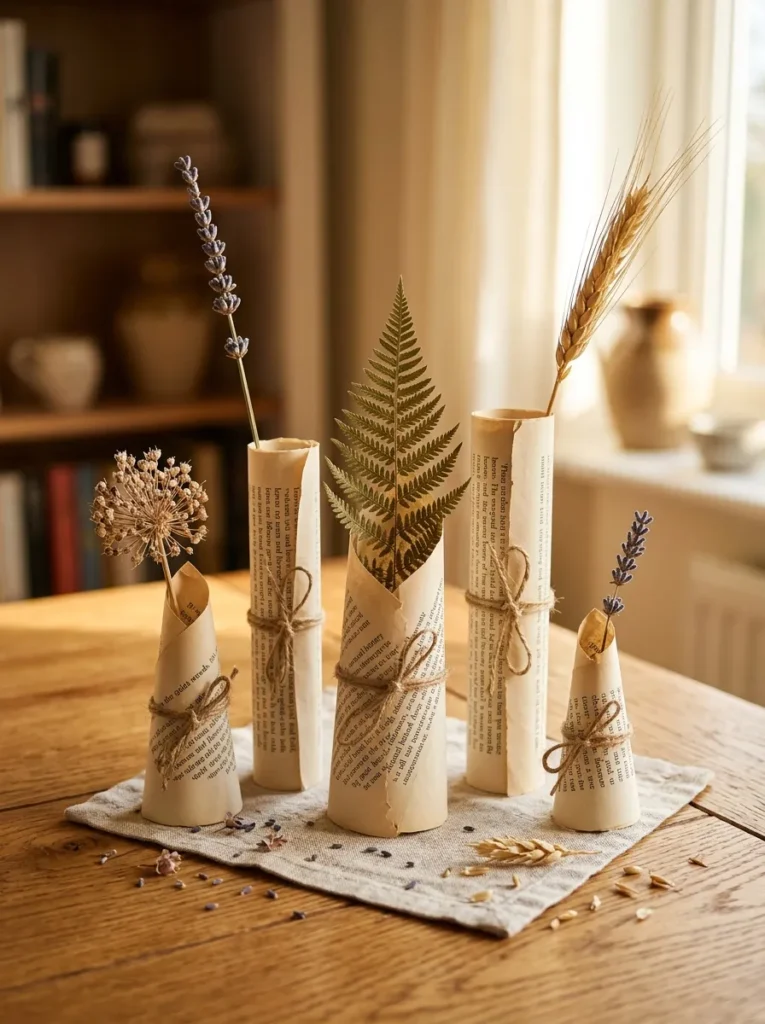
Vibe: Book page botanical cones feel warmly literary — the vase collection that smells faintly of old libraries and dried flowers simultaneously.
Why it works: Rolling book pages into cones and cylinders creates vessels that are simultaneously functional (holding dried botanical stems) and decorative (displaying the printed text as a visual surface). The design principle is text as surface texture: from a distance of two to three feet, the printed text on a rolled book page cone reads as warm, complex surface texture rather than as legible words — the visual effect is of a warm, patterned surface that printed paper creates and plain paper cannot approximate. A cluster of five cones in varied heights holding five different single-stem dried botanicals creates a composed botanical installation for the cost of book pages and a rubber band.
How to get it: Roll single book pages into cone shapes with a narrow top opening (1–2 cm diameter) and a wider base (4–5 cm diameter). Secure the rolled cone with a small piece of clear tape or a dot of hot glue on the interior. For cylindrical vases, roll pages around a cylindrical form (a pen, a small jar, or a piece of dowel) at the desired diameter and secure with tape inside. Insert dried botanical stems — the narrow opening holds individual stems upright without requiring water or floral foam. Display in a cluster on a wooden tray or a styled shelf.
Shop The Look
| Product |
|---|
| Aged vintage book for page sourcing |
| Dried botanical stem set assorted |
| Clear tape for cone securing |
| Small wooden display tray for cluster |
| Hot glue gun mini for securing |
3. Decoupage Tray with Vintage Book Page Collage
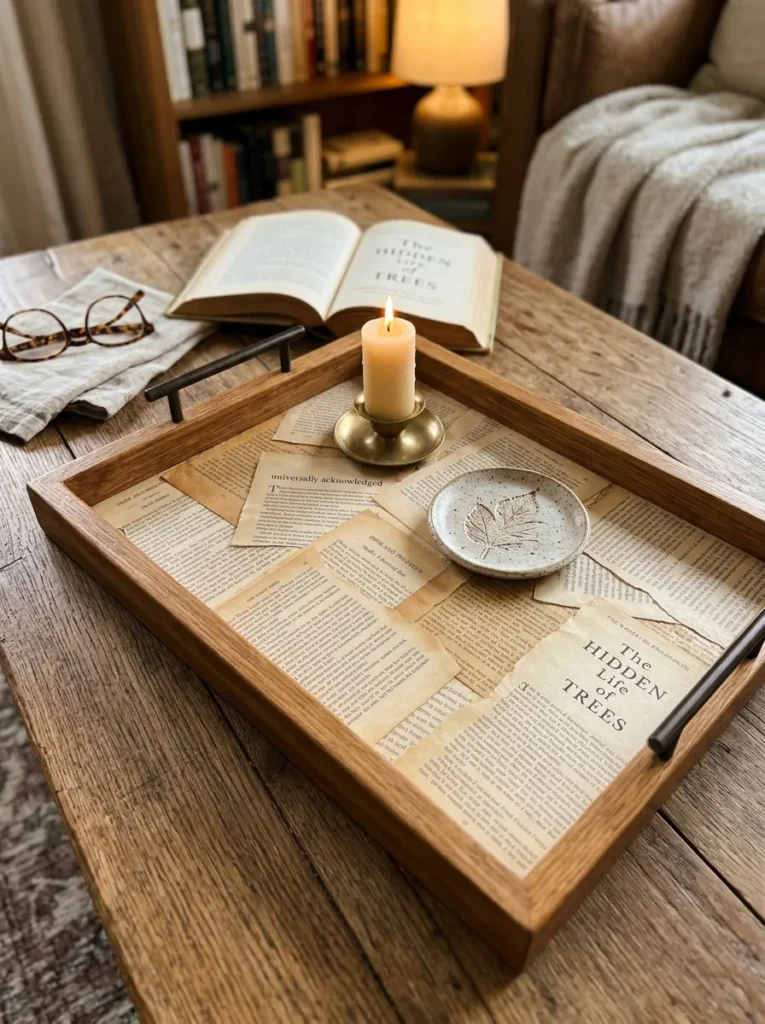
Vibe: A book page decoupage tray feels warm and layered — the functional object that makes every coffee table moment feel more considered.
Why it works: Decoupage is the book page craft technique that most effectively converts flat pages into a functional surface — the multiple layers of Mod Podge seal the paper to the wood and create a durable, water-resistant surface that can withstand daily use. The design principle is collage as surface: overlapping torn book page pieces in varied orientations creates a surface with the visual complexity of a written manuscript — dense, warm, and full of partially legible fragments that reward close attention. The wooden tray’s visible frame and handles provide a defined border that makes the decoupage interior read as an intentional design decision rather than a paper application.
How to get it: Tear book pages into irregular pieces 3–8 cm across — torn rather than cut edges read as more organic and less mechanical on the finished surface. Brush a thin layer of Mod Podge onto a section of the tray, press a page piece onto the wet Mod Podge, then brush another layer of Mod Podge over the top. Continue overlapping pieces, varying orientation, until the full tray interior is covered. Allow to dry, then apply four to six additional coats of Mod Podge over the full surface, allowing each coat to dry completely. The final surface should be smooth enough to place objects on without catching edges.
Shop The Look
| Product |
|---|
| Wooden serving tray natural finish handles |
| Matte Mod Podge large bottle decoupage |
| Foam brush set 2 inch for Mod Podge application |
| Aged vintage book for page sourcing |
| Clear polyurethane topcoat matte for durability |
4. Book Page Wreath on a Wire Frame
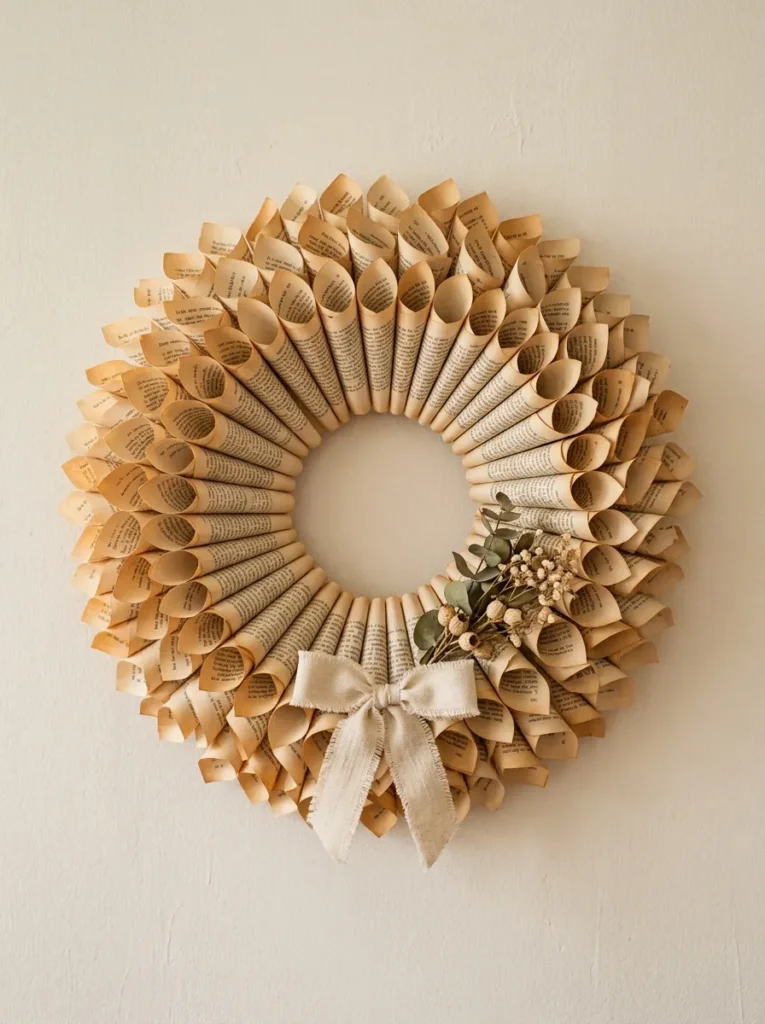
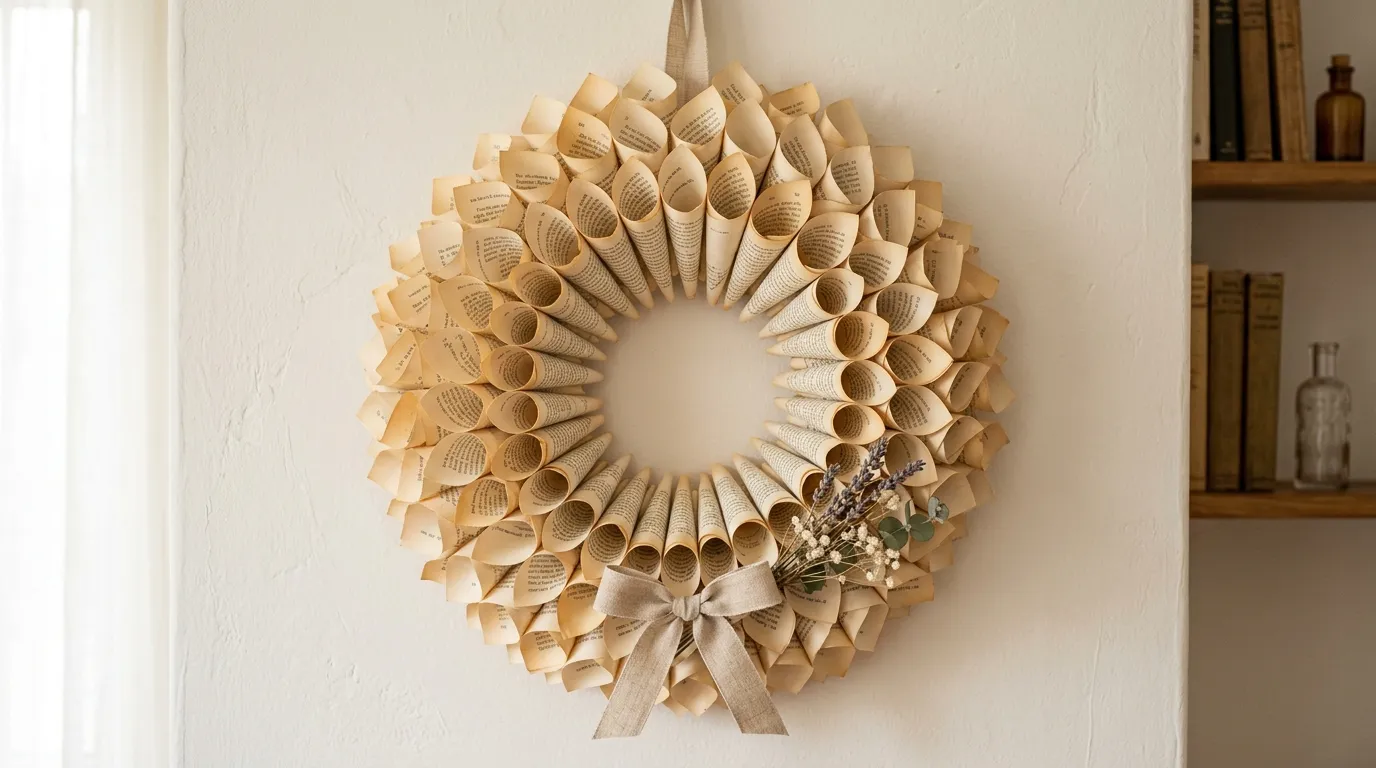
Vibe: A book page cone wreath feels warmly dimensional — a literary object that reads as sophisticated wall art from across the room.
Why it works: A wreath constructed entirely from rolled book page cones creates a sculptural object with the visual complexity of a textile surface — the individual cones’ shadows against their neighbors create depth and dimension that a flat paper wreath cannot achieve. The design principle is dimensional repetition as form: when a single simple element (a rolled book page cone) is repeated 60–80 times around a circular frame, the accumulation of identical elements creates a form greater than the sum of its parts — the wreath reads as a unified circular composition rather than a collection of paper cones. The warm cream-amber tone of aged book pages makes this wreath work in warm-neutral interiors without requiring any additional color element.
How to get it: Roll 60–80 book pages into tight cones (approximately 5–6 cm long, 1 cm diameter at the wide end). Secure each cone with a small dot of hot glue at its seam. Attach each cone to a wire wreath frame (30–35 cm diameter) using additional hot glue, pointing all cones outward from the frame and packing them tightly enough that no wire frame is visible. Work in concentric rows, starting from the outer edge and working inward. Tie a linen ribbon bow at the six o’clock position to give the wreath a defined base orientation.
Shop The Look
| Product |
|---|
| Wire wreath frame 35cm round |
| Hot glue gun with extra glue sticks |
| Aged vintage book bulk for page sourcing |
| Linen ribbon 3cm cream for bow |
| Wreath hanger over-door hook |
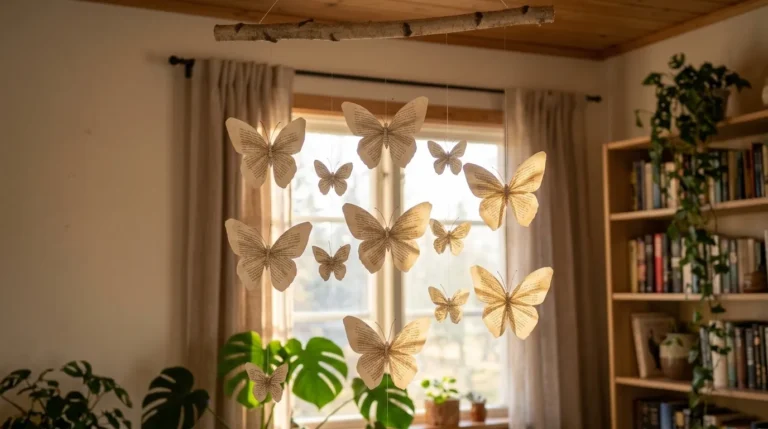
5. Book Page Butterflies as Framed Art or Mobile
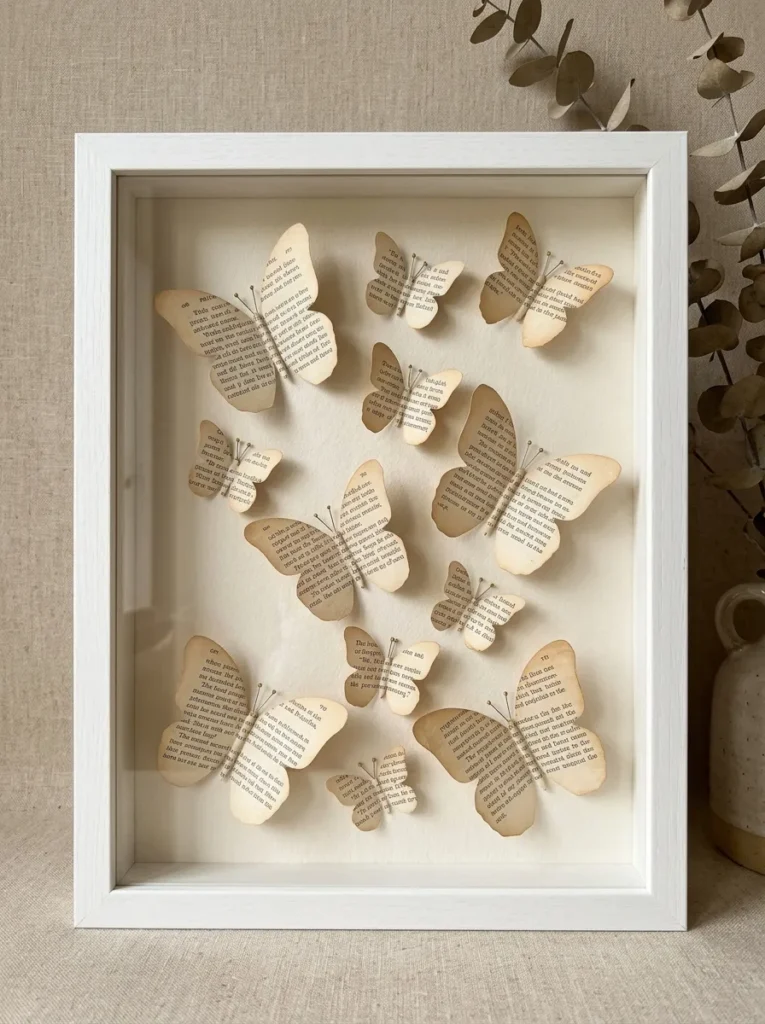
Vibe: Book page butterflies in a shadow box feel delicately literary — an entomological specimen display that uses the printed word as its primary material.
Why it works: Book page butterflies in a shadow box create a display that references the tradition of natural history specimen mounting while using printed text as the primary material — the combination of the scientific display format and the literary material creates an intellectually layered object that neither natural specimens nor plain paper butterflies could achieve. The design principle is dimensional layering within a constrained space: mounting butterflies at varied pin heights within the shadow box’s depth creates front-to-back dimension in an object viewed from directly in front, which is the visual trick that distinguishes a shadow box installation from a flat framed piece. The slight curvature applied to each butterfly’s wings before mounting adds a three-dimensional quality that suggests arrested flight.
How to get it: Print or freehand-draw butterfly templates in three sizes (6 cm, 8 cm, and 10 cm wingspan). Trace onto book pages and cut cleanly with sharp scissors. Fold each butterfly along the body centerline to create a slight wing angle. Use a heat gun or the warmth of your hands to curve the wing tips very slightly upward. Mount on pins (entomological mounting pins or regular dressmaking pins) at varied depths inside a white shadow box frame. Use three different pin heights to create the illusion of butterflies at different distances from the viewer.
Shop The Look
| Product |
|---|
| White shadow box frame 30x30cm deep |
| Butterfly cut template set for tracing |
| Sharp craft scissors for clean cutting |
| Entomological mounting pin set |
| Aged vintage book for page sourcing |
6. Book Page Gift Wrapping and Gift Bags
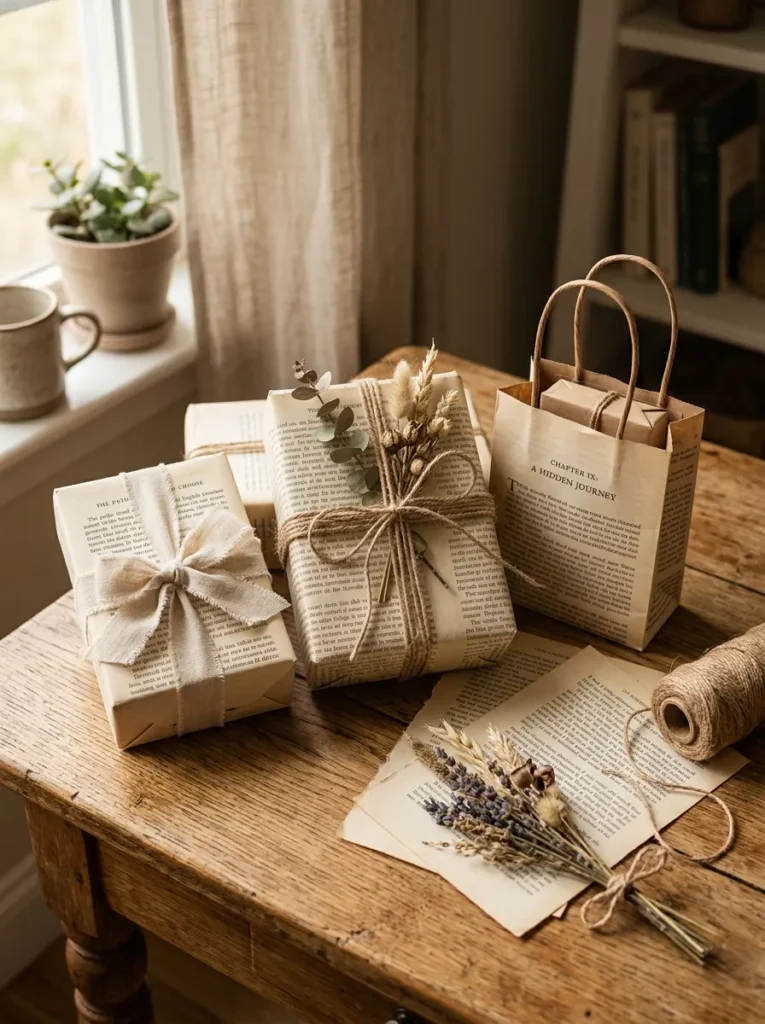
Vibe: Book page gift wrapping feels thoughtfully personal — the presentation that communicates the gift was wrapped by a person who considered the wrapping as much as the contents.
Why it works: Book page gift wrapping is the book page craft with the highest ratio of immediate impact to time investment — wrapping a gift in a book page with a linen ribbon bow takes three minutes and produces a wrapped gift that reads as considerably more considered than commercially purchased gift wrap. The design principle is material meaning as packaging statement: a gift wrapped in book pages communicates to the recipient that the giver chose a material with warmth, literary reference, and sustainability — three qualities that commercial wrapping paper cannot carry simultaneously. The printed text visible through the wrapping adds visual richness that patterned gift wrap achieves through manufactured pattern.
How to get it: Use book pages as wrapping paper for small to medium gifts — for larger gifts, tape multiple pages together before wrapping. The aged cream-amber tone works especially well with linen ribbon in cream or natural tones, jute twine, and copper wire. For gift bags, fold and crease a large book page into a rectangular bag shape with a folded base, punch holes near the top edge, and thread twisted paper or jute twine through the holes to create handles. Tuck a small dried botanical sprig under the ribbon bow for the most considered gift presentation.
Quick Win: Wrapping any gift in old book pages with a sprig of dried rosemary tucked under a linen ribbon bow costs approximately nothing in materials and consistently produces the most commented-upon gift presentation at any occasion — the literary material and the natural botanical together create a presentation that feels genuinely thoughtful.
Shop The Look
| Product |
|---|
| Linen ribbon natural cream 3cm roll |
| Jute twine natural thin for gift bow |
| Aged vintage book for wrapping pages |
| Dried rosemary or botanical for bow tuck |
| Copper wire thin for decorative binding |
7. Book Page Botanical Prints — Fern and Leaf Printing
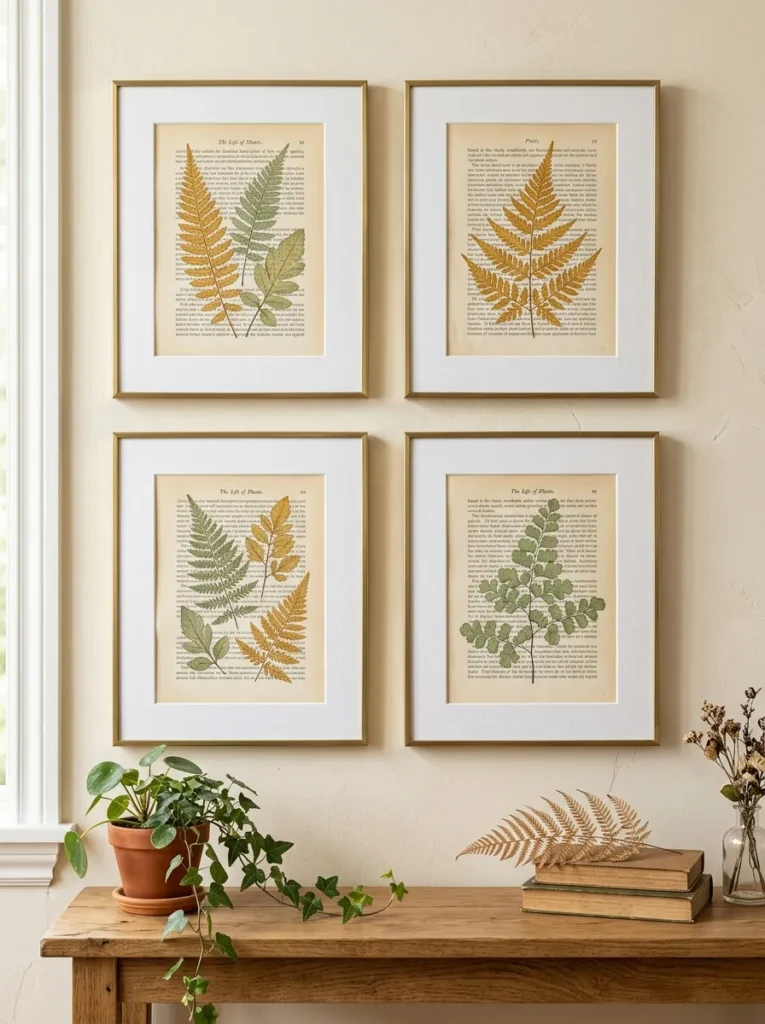
Vibe: Botanical prints on book pages feel warmly scientific — the herbarium specimen that found its way into contemporary art.
Why it works: Pressing inked botanical specimens onto book pages creates prints where the botanical impression reads over and through the printed text — the two layers of visual information (the fern’s natural form and the book’s printed words) create a visual complexity that either element alone cannot achieve. The design principle is visual layering as depth: the botanical print operates as a translucent layer over the textual layer below, creating depth and complexity in a two-dimensional object. The warm aged tone of the book page background warms all botanical colors placed over it — sage green reads as more muted and sophisticated, ochre reads as richer, burnt sienna reads as deeper against the warm cream page than against white paper.
How to get it: Gather fresh ferns, large leaves, or herb stems with interesting botanical structures. Apply watercolor paint or block printing ink to the upper surface of the botanical using a foam brush or brayer — ochre, burnt sienna, sage green, and deep teal all work beautifully over aged page tones. Press the inked botanical firmly onto the book page, cover with a piece of clean paper, and press with a rolling pin or brayer. Lift carefully to reveal the botanical impression. Allow to dry completely before framing. Mount in slim brass frames with generous (2-inch minimum) white mats.
Shop The Look
| Product |
|---|
| Watercolor paint set botanical warm tones |
| Slim brass picture frame set 5×7 8×10 |
| White pre-cut mat board assorted sizes |
| Foam brush set for botanical inking |
| Brayer roller for botanical printing |
8. Book Page Paper Flowers for Vase or Wreath
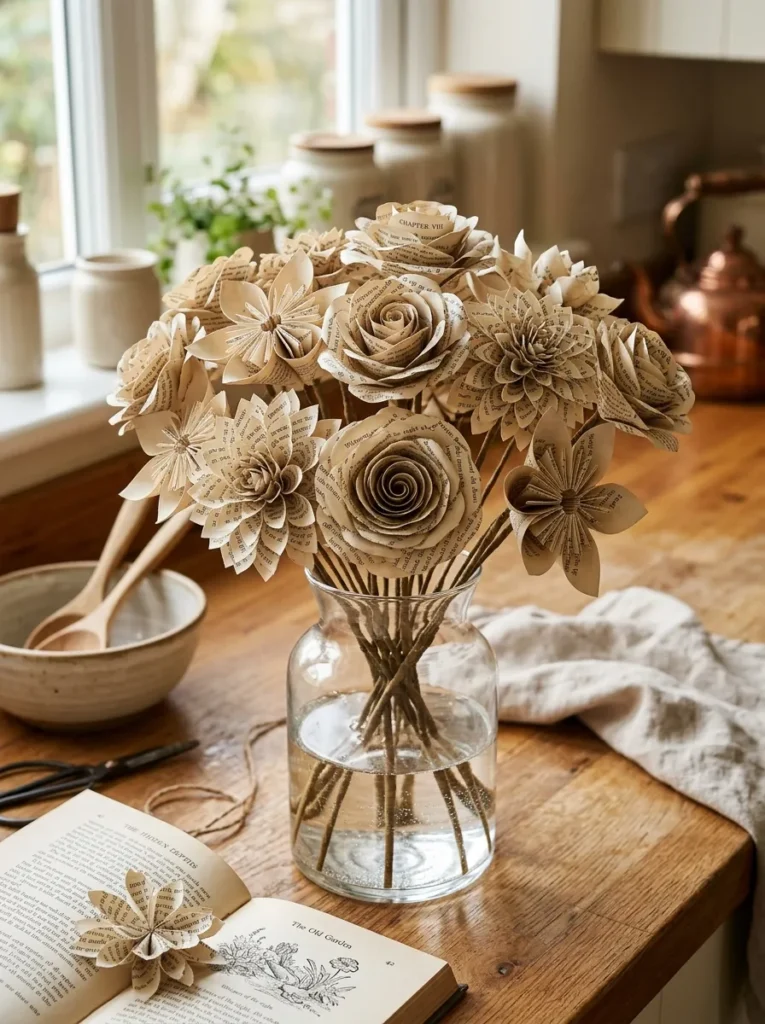
Vibe: A vase of book page paper flowers feels warmly permanent — the arrangement that never wilts and rewards closer attention with legible text on every petal.
Why it works: Book page paper flowers are the craft that most consistently surprises viewers — what reads as a conventional flower arrangement at a glance reveals itself as paper at closer inspection, which creates the doubled perception that is one of craft’s most pleasurable effects. The design principle is material surprise through familiar form: the flower’s familiar form (recognized immediately as a rose or dahlia from any distance) draws the viewer in, and the material’s unexpected nature (book page text on every petal) rewards the approach with a secondary discovery. Aged book pages are specifically superior to plain paper for paper flowers because their warm cream-amber tone approximates the color of dried or antique flowers, giving the finished arrangement the quality of a preserved botanical collection rather than a paper art project.
How to get it: For a book page rose: cut five circles in graduated sizes (3 cm, 4 cm, 5 cm, 6 cm, 7 cm) from a single book page. Cup each circle by pressing the center with your thumb over a soft surface. Layer from smallest to largest, securing each layer with a hot glue dot at center. Push a floral wire through the center of the assembled flower and wrap the wire stem with brown floral tape. For a book page dahlia: cut sixteen identical pointed petal shapes and layer in two offset rings of eight petals each around a small center circle, securing all with hot glue.
Shop The Look
| Product |
|---|
| Aged vintage book for page sourcing |
| Floral wire set 22 gauge green or brown |
| Brown floral tape for stem wrapping |
| Hot glue gun for petal assembly |
| Clear glass vase for paper flower display |
9. Book Page Map — Vintage Typography Travel Wall Art
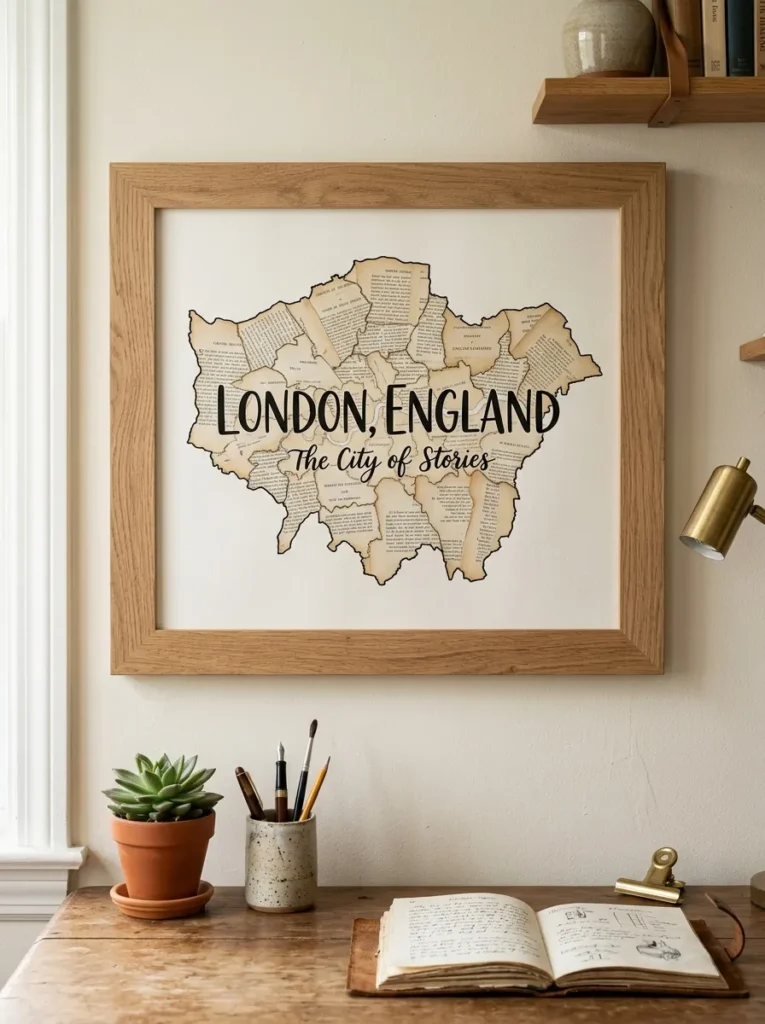
Vibe: A book page map feels personally significant — the art piece that connects literary material to geographic and personal meaning simultaneously.
Why it works: A map filled with book page collage combines two of interior design’s most consistently meaningful art subjects — cartography and text — in a single piece that works as abstract art from across the room and as a personally significant object up close. The design principle is personal geography as literary material: using book pages as the fill material inside a meaningful map shape creates an object where the literary material (printed text, knowledge, narrative) fills a geographic form (the outline of a place with personal significance), which is a combination of personal meaning and visual interest that purchased art cannot replicate. The handwritten place name in calligraphy over the collage surface adds the final personal touch that makes the piece irreplaceable.
How to get it: Print or trace a map outline of a meaningful city, country, or region onto a piece of watercolor paper or thick card. Tear book pages into small irregular pieces and decoupage them inside the map outline using Mod Podge, working from the outline edge inward and being precise at the boundary. Allow to dry completely. Write the place name in black ink calligraphy over the finished collage surface. Frame in a wide natural oak or dark walnut frame with a generous mat.
Shop The Look
| Product |
|---|
| Wide natural oak frame large format |
| Calligraphy pen and black ink set |
| Watercolor paper 300gsm for base |
| Matte Mod Podge for collage |
| Warm cream mat board wide for frame |
10. Book Page Lampshade for Warm Literary Glow
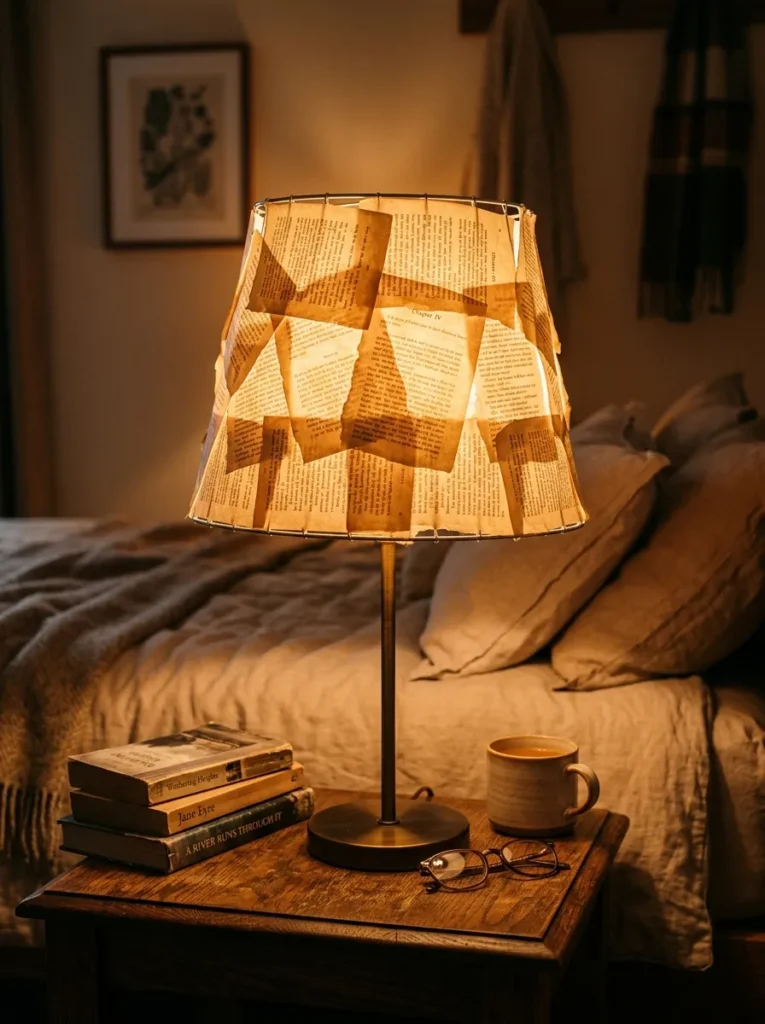
Vibe: A book page lampshade feels warmly luminous — the light source that makes the printed word glow rather than read.
Why it works: A lampshade made from book pages creates a light effect impossible to achieve with any commercial shade material — when the bulb illuminates the pages from within, the printed text becomes luminous rather than simply visible, creating a warm, amber-glowing surface that reads as specifically beautiful in a way that relates directly to the material’s printed origin. The design principle is material transparency as light design: book pages have a translucency that reveals itself only when backlit, which the lampshade application specifically activates. The warm amber glow through cream-toned aged pages creates a light quality equivalent to a 2700K warm white LED — intimate, warm, and literary.
How to get it: Purchase a wire lampshade frame (a drum or empire shape works best for book page application). Cut book pages into panels sized to fit the frame’s vertical height with 1–2 cm overlap between panels. Apply panels to the frame using a light coat of Mod Podge on the wire frame sections, pressing each page panel flat before moving to the next. Overlap adjacent panels by 1 cm for full coverage. Apply a thin finishing coat of matte Mod Podge over the full outside surface when dry. Use a low-wattage warm LED bulb (maximum 40-watt equivalent) to prevent heat damage to the paper shade.
Shop The Look
| Product |
|---|
| Wire lampshade frame drum 25cm |
| Aged vintage book for page sourcing |
| Matte Mod Podge for shade construction |
| Warm LED bulb 2700K 40w equivalent |
| Table lamp base for new shade fitting |
11. Book Page Bunting and Garland for Seasonal Display
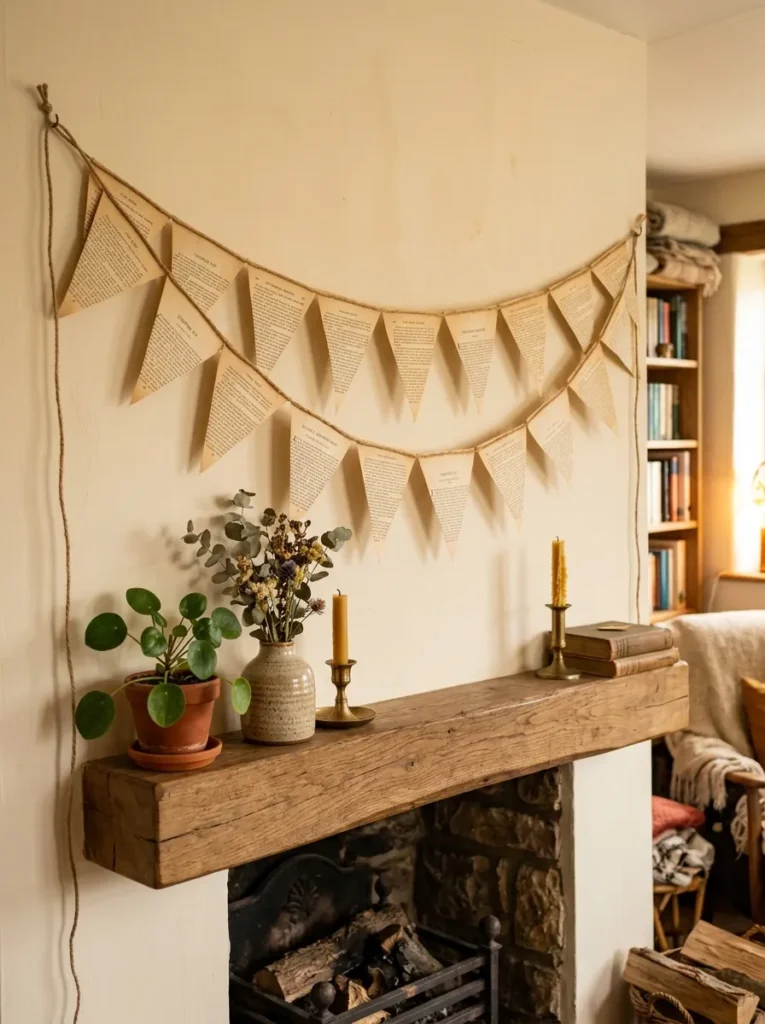
Vibe: Book page bunting feels warmly celebratory — the party decoration that works in a living room year-round without reading as perpetually festive.
Why it works: Book page bunting is the seasonal and celebratory craft that works most effectively as permanent home decor because the warm cream-amber tone of aged book pages reads as a neutral, warm textile rather than a bright, overtly celebratory material. The design principle is material sobriety as year-round decorative viability: bunting made from aged book pages in warm cream tones reads as a warm, textural garland that is appropriate on a mantel, a bookshelf, or a study wall year-round — unlike colored fabric bunting, which reads as specifically festive and season-limited. The printed text visible on each triangular flag adds the literary quality that makes this bunting specifically suited to spaces defined by a love of reading and books.
How to get it: Cut book pages into isosceles triangles (10 cm base, 14 cm height is a pleasing proportion). Fold each triangle over a length of jute twine at the 1 cm mark below the wide edge and glue the two sides together with a line of PVA glue, sandwiching the twine inside the fold. Space triangles 3 cm apart along the twine. For a 2-meter garland, you need approximately 25–30 triangles. Allow glue to dry completely before hanging. The garland can be pressed flat under a heavy book to flatten any pages that buckled during gluing.
Shop The Look
| Product |
|---|
| Jute twine 4mm for bunting base |
| Aged vintage book for triangle sourcing |
| PVA glue for triangle assembly |
| Paper trimmer for consistent triangle cutting |
| Craft scissors for triangle cutting |
12. Book Page Candle Holder — Wrapped Pillar
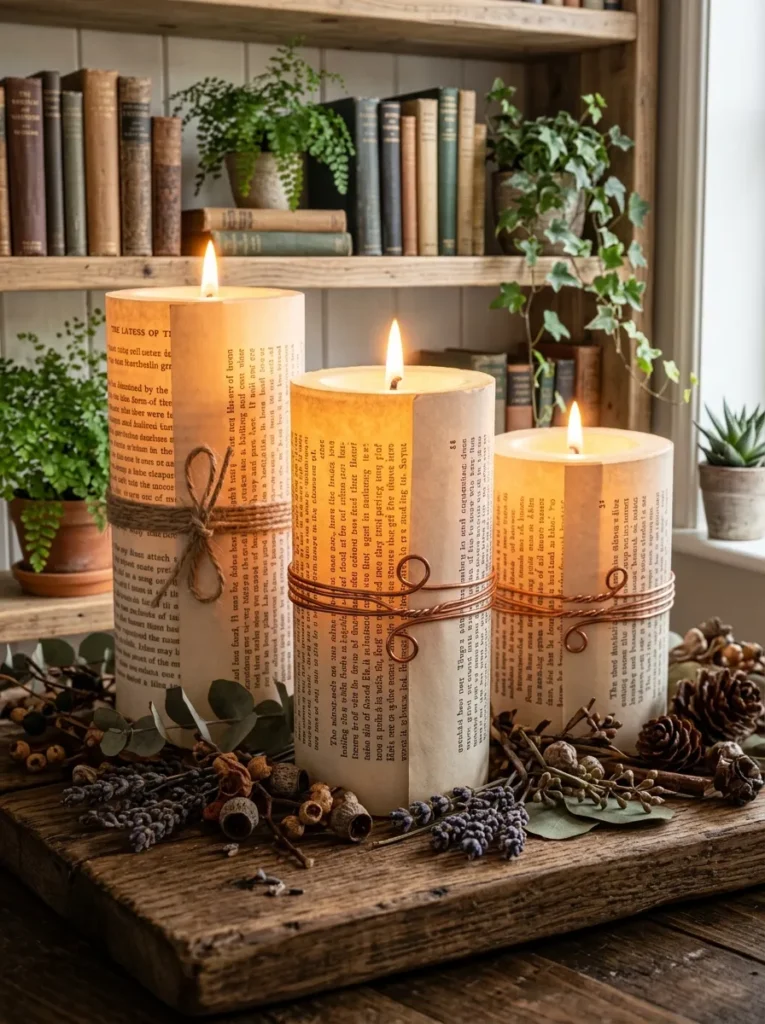
Vibe: A book page-wrapped candle feels warmly luminous — the craft that makes a $3 pillar candle read as a designed object.
Why it works: Wrapping a pillar candle in a single layer of book page and securing it with copper wire or linen twine creates a luminous candle holder where the warm candlelight glows through the paper, rendering the printed text as a warm, amber-backlit surface. The design principle is thin material as light filter: a single book page layer is translucent enough to allow the warm candlelight to pass through while the text remains visible as warm shadows in the illuminated paper — creating a light quality that is both warm and specifically literary. Safety is paramount: the book page wrapping must never extend above the candle’s wax pool level, and the candle must be monitored at all times when lit. Alternatively, LED tea light inserts eliminate the fire risk entirely while approximating the luminous effect.
How to get it: Wrap a pillar candle (not a taper — tapers generate more heat at the flame) in a single book page, trimming the page to sit 2–3 cm below the candle’s top edge. Secure with a single loop of copper wire or linen twine tied in a simple knot. Ensure the page wrapping is not loose enough to contact the flame — it should be snug against the candle body. Only use with LED tea light inserts placed inside the candle for fire safety, or use only in supervised settings and extinguish before the wax pool reaches the paper level.
Shop The Look
| Product |
|---|
| Cream pillar candle 3×6 inch set of 3 |
| Copper wire thin 26 gauge for binding |
| Linen twine thin for wrapping |
| Aged vintage book for wrapping page |
| LED tea light insert safe alternative |
13. Book Page Collage Portrait or Abstract Art
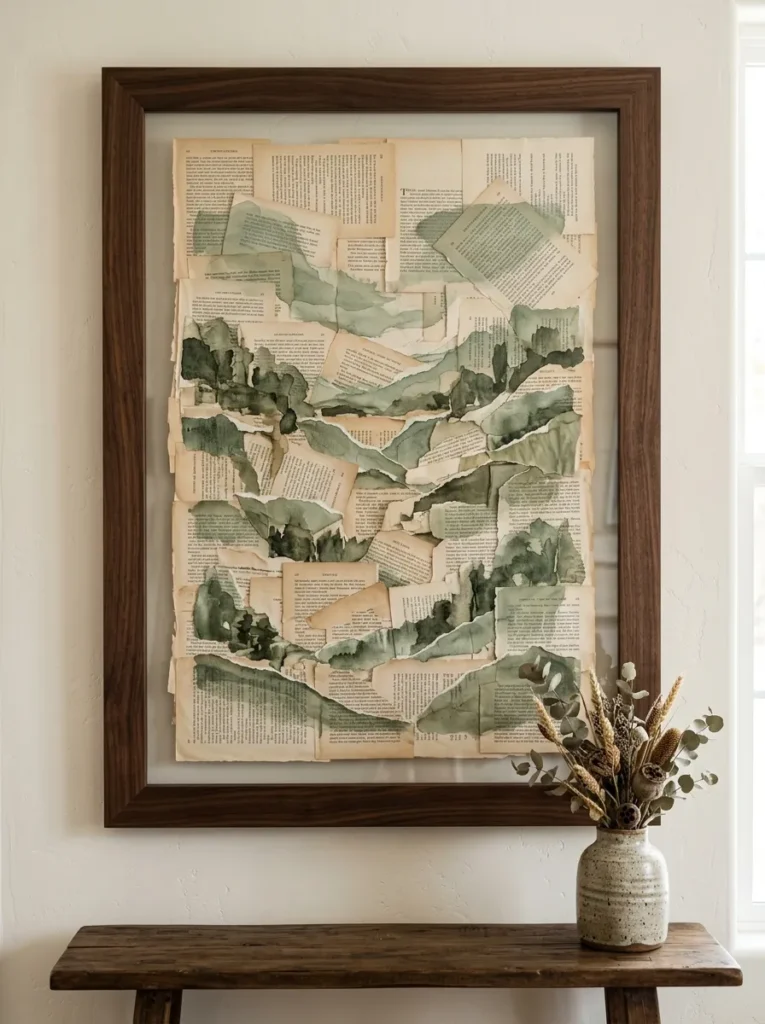
Vibe: A book page collage portrait feels abstractly personal — art made from a specific reading life, expressing something that words alone could not.
Why it works: A book page collage approached as fine art — with compositional intention, material restraint, and a considered relationship between the text-covered pages and any additional color elements — produces a wall piece that reads as genuine contemporary art rather than a craft project. The design principle is collage composition as artistic practice: the deliberate selection of specific pages (visually interesting typography, relevant subject matter, pleasing tonal variation), their arrangement in a compositional structure with a clear focal point and visual rhythm, and the selective application of a thin watercolor wash to integrate some elements while leaving others in their raw state — these decisions are artistic rather than craft decisions, and they produce an object with corresponding artistic quality.
How to get it: Select pages from one or several books that have particular personal significance or visual interest — dictionary pages, poetry, vintage technical illustrations. Arrange pages on a large sheet of heavyweight paper or canvas (50×70 cm for a statement piece) in a composition that has a clear focal point and deliberate negative space. Glue with Mod Podge, layering pages so some overlap and some are partially covered. Apply a thin watercolor wash (sage green, dusty blue, or warm ochre in a very diluted wash — 90% water, 10% paint) over selected sections to integrate the collage tonally. Frame in a wide, dark frame for the most sophisticated presentation.
Shop The Look
| Product |
|---|
| Heavyweight watercolor paper 300gsm large |
| Watercolor paint set muted tones |
| Wide dark walnut frame large format |
| Matte Mod Podge large for collage |
| Foam brush set for wash application |
14. Small-Space Book Page Craft — Miniature Framed Page Art Collection
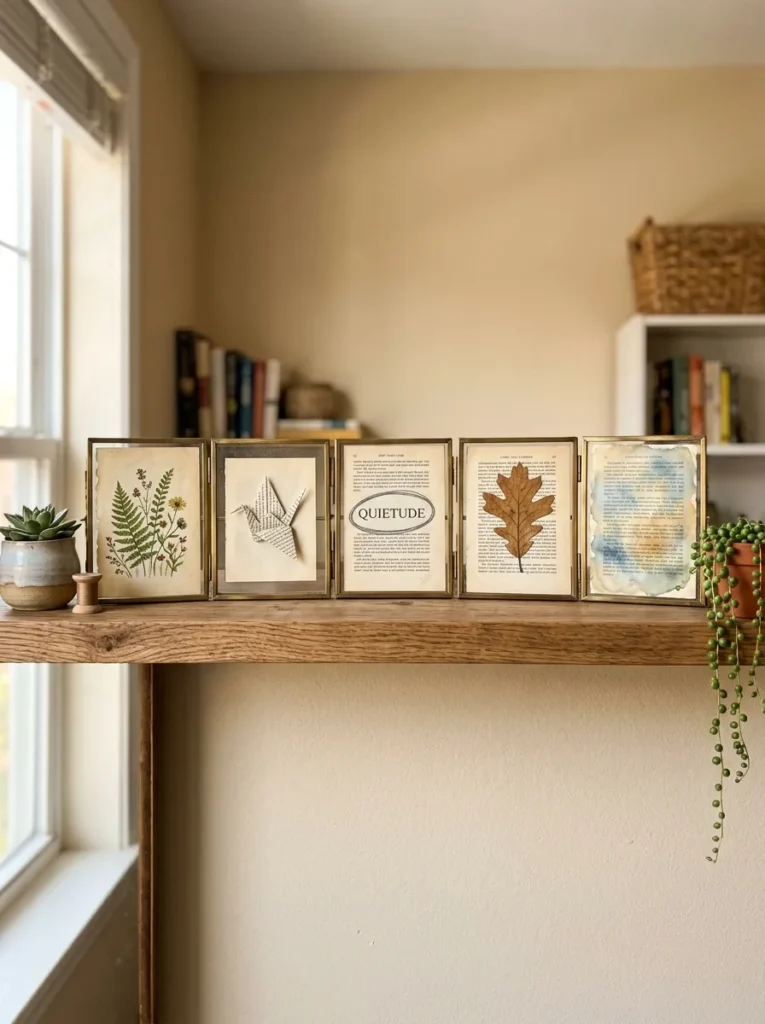
Vibe: A miniature book page art collection feels quietly personal — five tiny frames that together tell more about their maker than five large ones could.
Why it works: A collection of miniature framed book page pieces treats each frame as a different interpretive experiment with the same base material — one page with a botanical pressed onto it, one folded into a geometric pattern, one with a single word circled in pencil, one with a thin watercolor wash, one with a pressed leaf. The design principle is material exploration as collection: when five different treatments of the same material (aged book page) are displayed together at the same scale in matching frames, they form a collection that communicates the maker’s curiosity about the material rather than simply displaying the finished object. The matching frame system (all small brass, all the same profile) provides the visual coherence that allows the varied treatments to read as a composed series.
How to get it: Choose five different book page treatments from the projects in this list — one folded (from idea 1), one with a botanical print (from idea 7), one with a pressed leaf (a new variation), one with a hand-painted watercolor wash, and one with a single circled or underlined word that has personal significance. Mount each in a matching miniature brass frame (4×4 inch or 5×7 inch) with a small white mat. Arrange in a row on a floating shelf with consistent 4 cm spacing between frames.
Shop The Look
| Product |
|---|
| Miniature brass frame set 4×4 5×7 mixed |
| White mini mat board pre-cut |
| Pressed leaf set for page adhering |
| Watercolor set for miniature wash |
| Pencil set HB 2B for page marking |
How to Start Your Book Page Craft Practice
The single first move is to source a genuine aged book — not a modern paperback, not a freshly printed volume, but a book with warm cream-to-amber pages, dense letterpress or offset printing, and the particular visual weight that only genuinely aged paper carries. Check thrift stores, estate sales, library book sales, and antique markets for damaged or incomplete books that are no longer serviceable as reading copies but whose pages are intact and beautiful. The material quality of the pages determines the quality of everything made from them — modern white printer-weight paper produces projects that read as paper crafts; aged, warm-toned letterpress-printed pages produce projects that read as art objects. The book sourcing step is the most consequential single decision in any book page craft project.
The most common mistake in book page crafting is using too many different techniques in the same display — a shelf with a book page wreath, three book page vases, a book page lampshade, and a book page garland all in the same visual field reads as a themed craft display rather than a home with literary sensibility. The fix is the same as for all home decor: one book page project per surface, displayed alongside non-book-page objects in a mixed-material composition. A single book page cone wreath on a wall beside a ceramic vase and a trailing plant reads as warm and personal. The same wall plus a book page garland plus a book page framed piece plus a book page lampshade reads as a craft project room.
Three book page craft projects under $10 each that deliver the most immediate home decor impact: the botanical print series (idea 7 — book pages from one source, watercolor paint, fresh leaves, and slim brass frames totaling $8–$15 for a set of four), the gift wrapping technique (idea 6 — book pages plus linen ribbon, total material cost under $5), and the framed folded page art (idea 1 — one aged book page, a bone folder, Mod Podge, and one frame totaling $5–$12). These three projects cover wall art, gift presentation, and decorative object in a single morning’s making session.
Realistic expectations: book page crafts are among the most accessible creative practices because the primary material (aged book pages) is typically free or near-free, the additional materials are inexpensive and widely available, and the techniques range from genuinely simple (gift wrapping, bunting, wrapped candles) to moderately skilled (folded origami art, botanical printing, paper flower construction). The skill ceiling is determined by the technique chosen rather than by the material — the same aged book page can produce a project achievable by a beginner in ten minutes or a sophisticated art piece requiring an afternoon of careful work. Begin with the simplest technique that appeals to you, make it once for practice, and make it again for display.
Frequently Asked Questions About Book Page Crafts
Which books should I use for book page crafts?
The best book sources for home decor crafts are old, damaged, or incomplete books that can no longer serve as reading copies — specifically, those with warm cream-to-amber aged pages, dense typography (letterpress or high-quality offset printing reads as visually richer than modern laser printing), and interesting visual content (vintage encyclopedia illustrations, botanical illustrations, musical notation, maps, and dense text all produce richer visual surfaces than plain text alone). Thrift store books in poor condition (water damage, broken spines, missing pages) are ideal — they are typically priced at $0.25–$1.00 and their damage makes them appropriate for repurposing. Dictionary pages and encyclopedia pages are particularly prized for book page crafts because of their dense, consistent typography.
How do I age book pages to make them look older?
Modern white book pages can be artificially aged using several techniques: a light tea wash (brew strong black tea or coffee, brush onto pages with a foam brush, allow to dry flat) creates a uniform warm amber tone; a water spray followed by crumpling and smoothing creates a distressed surface texture; heating with a heat gun at low setting darkens and slightly warps pages in an authentic way; and storing damp pages under a weight creates slight texture and natural wrinkling. For the most convincing aging, combine a tea wash with light heat treatment and edge burning (carefully, with control — only the very edge of the page using a candle flame held at a distance, extinguished immediately if the burn progresses).
Are there any ethical considerations about using books for crafts?
The most thoughtful approach to book page crafts distinguishes between books that still have value as reading copies and those that have been rendered non-functional by damage, incompleteness, or simply the passage of time. Using a first edition, a rare book, or any book that still functions as a complete, undamaged reading copy is difficult to justify when the same material is widely available in damaged or non-functional form. Damaged library discards, water-damaged thrift store finds, incomplete sets from estate sales, and books with significant damage but intact pages are the most ethically comfortable source material — they are already beyond functional use and their repurposing into home decor gives the material a continued life rather than the landfill alternative.
How do I seal and protect book page crafts for longevity?
The most durable sealant for book page crafts used as functional objects (trays, lampshades, candle holders) is a matte water-based polyurethane applied over a Mod Podge base coat — the polyurethane provides significantly more resistance to moisture and abrasion than Mod Podge alone. For purely decorative objects displayed away from moisture and direct handling, matte Mod Podge alone provides adequate protection. All book page crafts should be kept away from direct sunlight, which will cause the pages to yellow and become brittle accelerated beyond their natural aging rate. Book page projects displayed in humid environments (bathrooms, kitchens near steam) require the full polyurethane topcoat treatment regardless of their primarily decorative function.
Can book page crafts be made with children?
Many book page crafts are appropriate for children with adult supervision and guidance on material selection. The most child-accessible book page projects are the gift wrapping and gift bags (idea 6 — requires only tearing and folding), the botanical print making (idea 7 — appropriate for children comfortable with paints and supervision required for the inking step), the bunting and garland (idea 11 — cutting and gluing, appropriate from age 6 with rounded scissors), and the paper flowers (idea 8 — cutting and hot glue with adult handling of the glue gun). Projects involving candle flames (idea 12), edge burning for aging effects, or sharp craft scissors require adult execution or close adult supervision depending on the child’s age and skill level.
Ready to Make Something Beautiful from the Pages of a Book?
These 14 book page craft ideas span every room, every skill level, and every degree of time investment — from the three-minute gift wrapping that transforms any present’s presentation to the afternoon collage art project that produces a wall piece of genuine artistic quality — so whether you have an hour and a single aged book or a full creative weekend and a box of vintage volumes, there is a specific, achievable, and genuinely beautiful starting point here for exactly where you are. The most important thing to understand about book page crafts is that the material is already half the work — the warmth, the texture, the intellectual reference, the aged tone of genuine printed pages carry so much of the finished object’s quality that the maker’s job is primarily one of selection, arrangement, and restraint rather than technical skill. Today, find one old book at a thrift store, open it to a beautiful page, and hold it up to the light — that warmth and translucency is already art. Pin the ideas that made you reach for your scissors, and let those be the ones you make first.