15 Creative Kids Bedroom Ideas with Clever Storage
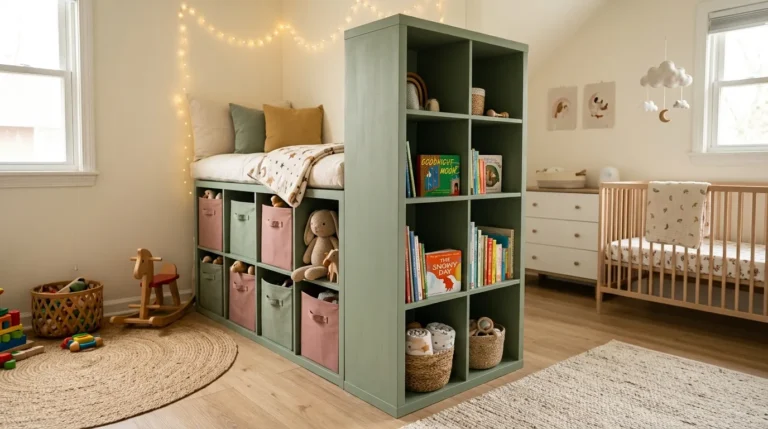
A creative kids bedroom with clever storage is a sleeping, playing, learning, and growing space designed with the dual intelligence of genuine visual warmth and functional organization — a room where the storage system is so well-integrated into the room’s design that it contributes to the bedroom’s character rather than competing with it, and where the child’s need for personal expression, developmental play, accessible materials, and genuine rest are all served simultaneously. This article gives you 15 kids bedroom ideas across loft and bunk configurations, under-bed storage, wall-mounted systems, reading nooks, activity zones, and seasonal organization approaches so every square foot of the bedroom works harder and feels more genuinely designed.
A kids bedroom that works well is not the room with the most storage — it is the room where the storage is in the right place, accessible to the right person (the child), organized at the right scale, and integrated with the right visual approach so the room feels like a considered whole rather than a collection of storage solutions applied over a basic bedroom. The difference between a kids bedroom that the child inhabits enthusiastically and one that accumulates clutter regardless of organization attempts is almost always a question of storage intelligence rather than storage quantity. Here are 15 ideas worth saving — and building.
Why Clever Storage Transforms Kids Bedrooms
Kids bedroom storage design draws from the intersection of child development research, ergonomic design, and the interior design tradition that treats storage as an architectural element rather than a furniture afterthought. The developmental imperative is clear and well-documented: children who can independently access, use, and return their play materials maintain longer, more focused play sessions, develop stronger executive function skills, and experience less frustration-driven behavioral disruption than children who must ask an adult for help accessing materials or who cannot independently maintain the organization of their own space. Storage that is sized, positioned, and organized for the child — not for the adult — is both a welfare and a developmental investment.
The physical parameters of effective children’s storage are specific and age-dependent. For children aged 2–5, accessible storage means floor-level or very low shelf-level placement (24 inches maximum height for independent access by a 3-year-old), large-category organization (all art supplies in one tray, all blocks in one bin) rather than the fine-grained organization that adults prefer, and containers sized for the child’s hand rather than the adult’s. For children aged 6–10, accessible storage can extend to 48-inch shelf height, can accommodate more specific categorization (by type of toy, by subject area in school materials, by activity type), and can include labeled systems that the child can read and maintain independently. For children aged 10–14, the storage system should be designed for the child’s specific interests and activities (musical instrument storage, art material organization, sports equipment management, book collection display) rather than for generic toy storage that no longer serves the room’s primary function.
The design tradition that most effectively integrates storage into kids bedroom aesthetics is the Scandinavian children’s room tradition — specifically the Danish and Swedish approach to children’s spaces that treats the child’s room as a serious interior design project with the same material quality, functional intelligence, and visual consideration as any adult space in the home. This tradition produces kids bedrooms where the storage system is made from quality materials (solid birch, painted MDF in warm tones, natural rattan), designed in appealing forms (house-shaped shelves, tree-themed units, mountain-profile headboards with integrated storage), and organized at the child’s scale — creating rooms that children genuinely love to be in rather than merely tolerating as a place to sleep.
Design at a Glance
| Element | Detail |
|---|---|
| Philosophy | Storage in service of the child’s independence, creativity, and genuine inhabitation of the space |
| Key Materials | Solid birch, painted MDF warm tones, natural rattan, cotton canvas, clear acrylic |
| Age Calibration | Storage height, organization specificity, and category depth must match the child’s developmental stage |
| Guiding Principle | Every object the child uses regularly must have a designated, accessible home within the bedroom |
15 Creative Kids Bedroom Ideas with Clever Storage
1. Loft Bed with Full Study and Storage Zone Beneath
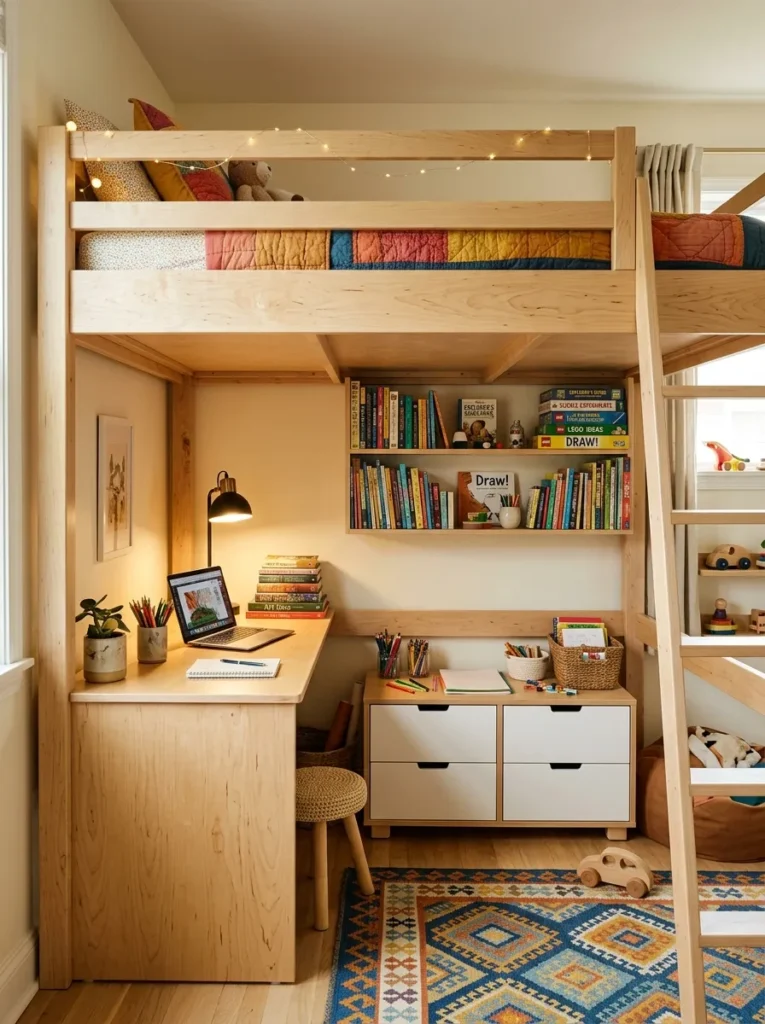
Vibe: The room is functional — a loft bed that elevates the sleeping platform and converts the floor space beneath into a complete study and storage environment creates the most space-efficient children’s bedroom configuration available, where two functional zones (sleeping and studying) occupy the floor footprint of one.
Why it works: The loft bed is the children’s bedroom’s most powerful space-multiplier because it uses the room’s vertical dimension — typically under-utilized at ceiling height — to create two stacked functional zones within the horizontal footprint of a single bed. The under-loft zone gains 35–50 square feet of usable floor area (depending on bed size and room configuration) that would otherwise be inaccessible beneath a standard bed frame — area that, when purposefully designed, accommodates a full study desk, open book shelving, and drawer storage for art supplies and school materials within a completely dedicated workspace. For children who share bedrooms or live in apartments with limited square footage, the loft bed with under-zone study is the single most impactful space-planning decision available.
How to get it: The IKEA KURA bed (reversible bunk/loft, $249) or the SVÄRTA loft bed ($329) are the most accessible starting points for under-loft zone development — both provide sufficient clearance for a desk and shelving beneath. Custom-built solid birch loft frames ($800–$2,000 from specialist children’s furniture makers) provide better material quality and more precise dimensional customization. The desk beneath should extend the full loft width (typically 39–55 inches) and be positioned at the correct ergonomic height for the child’s seated working position — 24–28 inches from floor to desk surface for primary school children, 28–30 inches for older children.
Quick Win: Adding a simple tension-rod curtain to the front opening of an existing loft bed’s under-zone creates a private, den-like study enclosure for under $20 in materials — the curtain can be opened for active study and closed for imaginative den play.
Shop The Look
- IKEA KURA loft bed birch white
- Under loft desk full width compact
- Open shelf unit low profile under loft
- Drawer unit art supply storage
- Clip desk lamp adjustable warm
Also view: 14 Inspiring Open Shelving Ideas for Kitchens
2. Built-In Window Seat with Drawer Storage Beneath
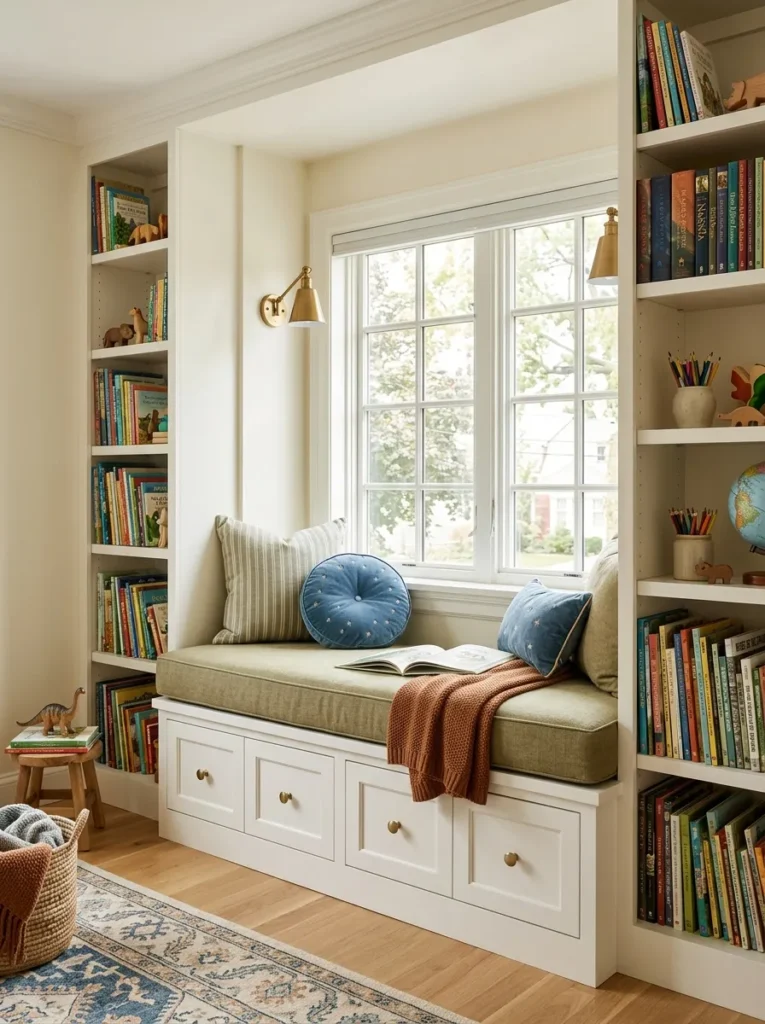
Vibe: The nook is cozy — a built-in window seat with deep storage drawers beneath and built-in bookshelves flanking creates the children’s bedroom’s most beloved architectural feature — the reading nook — while making the window alcove’s underutilized volume the room’s most efficient storage zone.
Why it works: A window seat built across the full width of a bedroom window alcove creates storage in three zones simultaneously — the drawers beneath the seat surface (ideal for seasonal clothing, extra bedding, or toy category storage), the seat surface itself (as a display and soft storage zone for cushions and soft toys), and the flanking bookshelves from seat height to ceiling (for book display and storage within the reading nook’s visual field). The drawer storage beneath a window seat is specifically effective because the drawers access 18-inch-deep, full-alcove-width volume that would otherwise be completely unused — the space beneath a window in most bedrooms contains only air, and the built-in seat captures it entirely. Deep pull-out drawers (full-extension slides, 18-inch drawer depth) provide storage comparable to a full chest of drawers within the same footprint.
How to get it: Build the window seat base from 3/4-inch MDF or birch plywood, with the seat surface at 18 inches from the floor. Install four full-extension drawer slides ($8–$15 per pair) at equal intervals within the base. Frame flanking shelf units from the seat surface to the ceiling, with adjustable shelf pins every 2 inches for future reconfiguration as book collection grows. Top the seat with a custom foam pad ($25–$60 depending on dimensions and foam density) covered in a durable, machine-washable fabric. Paint the entire installation in a semi-gloss white or warm cream paint for durability and easy cleaning.
Shop The Look
- Window seat drawer base plywood
- Full extension drawer slide set
- Foam seat pad custom cut density
- Machine washable fabric seat cover
- Adjustable shelf pin set bookcase
3. House-Shaped Bookshelf as Feature Wall Storage
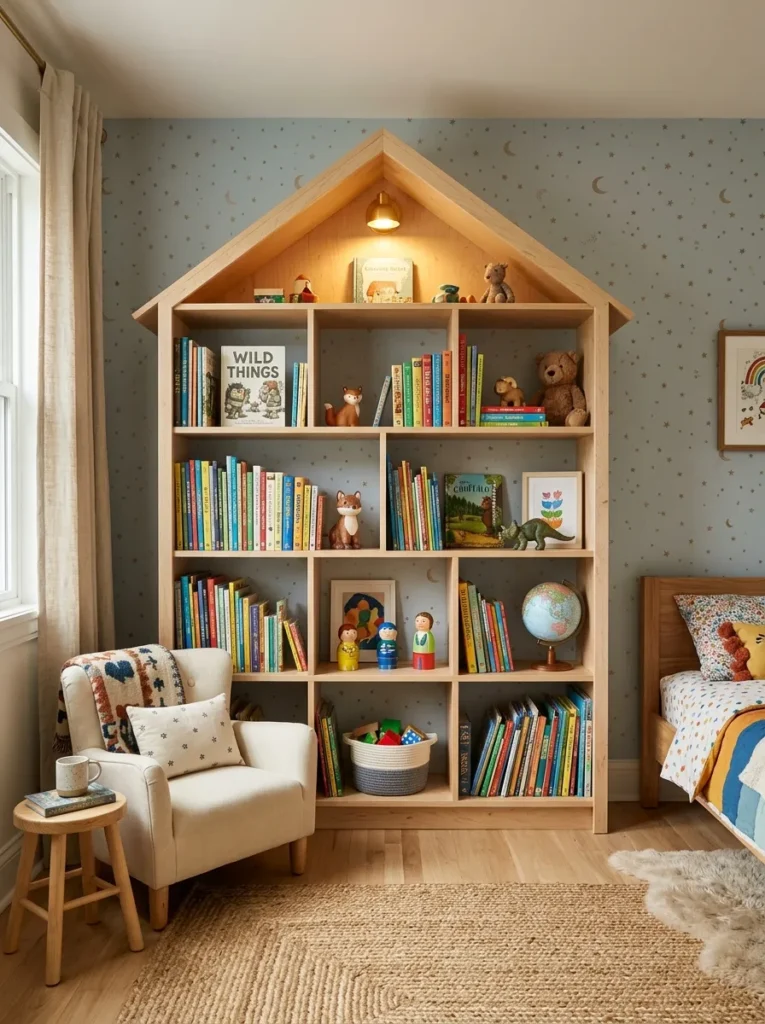
Vibe: The shelf is playful — a house-shaped bookshelf as the bedroom’s feature wall element creates the most beloved type of children’s storage: a functional object that is also a characterful piece of furniture the child relates to as a friend rather than a filing system.
Why it works: House-shaped bookshelves work as children’s bedroom feature walls because the house form is universally legible as a safe, sheltering, welcoming shape — the peaked roofline references the archetypal house drawing that children make from approximately age 3, making the shelf form emotionally resonant in a way that rectangular shelving cannot be. The house shape also allows varied shelf heights within a single unit — the peak’s narrow upper section provides display space for special objects, the wider middle section accommodates picture books upright, and the lower section accommodates larger toy categories in bins or baskets. The single warm light at the peak creates a glow that makes the house shape read as genuinely inhabited rather than merely decorative.
How to get it: House-shaped bookshelves are available from specialty children’s furniture retailers (Oliver Furniture, Lifetime, Land of Nod) at $200–$600 for quality solid wood versions. DIY versions can be built from 3/4-inch birch plywood with a simple peaked top frame ($80–$150 in materials) in an intermediate woodworking session. The key dimension is the internal shelf spacing — spaces of 9 inches, 11 inches, and 14 inches accommodate the range from board books to chapter books to large format picture books that a children’s book collection spans.
Shop The Look
- House shaped bookshelf birch natural
- House bookcase white painted children
- Small LED light warm peak display
- Book bin storage lower shelf
- Adjustable shelf natural birch
4. Under-Bed Storage System with Rolling Bins
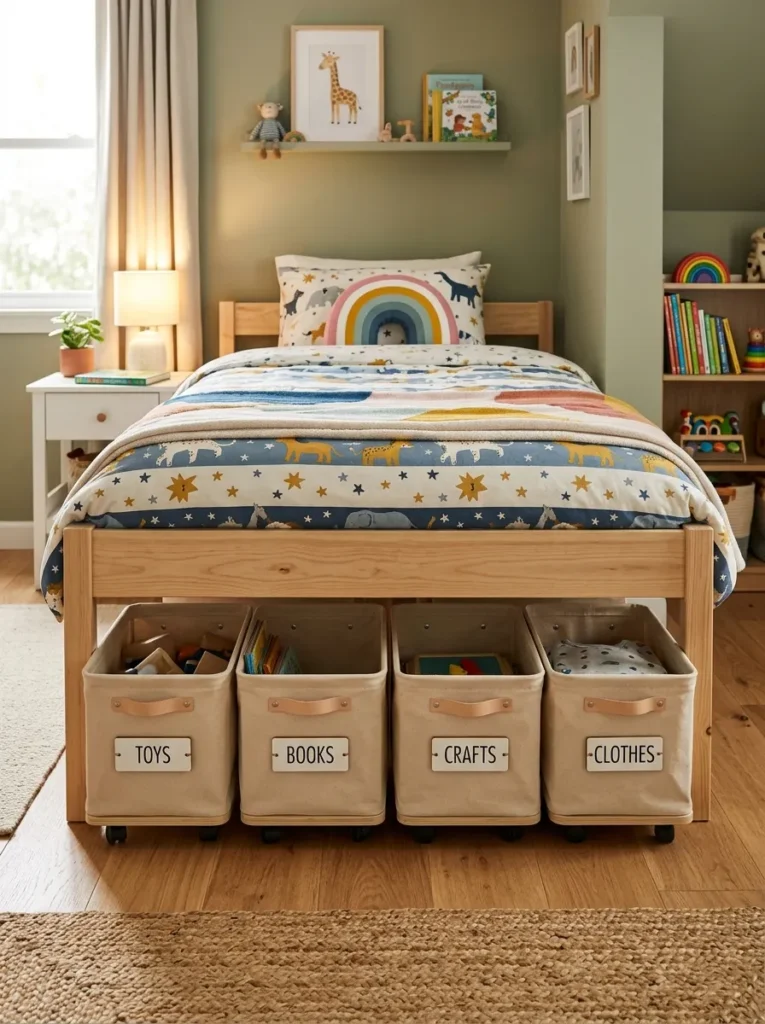
Vibe: The storage is hidden — a well-organized under-bed storage system with rolling bins converts the room’s largest single dead space into significant organized storage that is completely invisible from the doorway and accessible to the child within seconds.
Why it works: The space beneath a standard bed is the largest single underutilized volume in most children’s bedrooms — typically 40–50 cubic feet of air beneath a twin or full bed with standard 7–8-inch frame clearance. Low-profile rolling bins (4–6 inches tall, on swivel casters for smooth extraction from either side) access this volume in its entirety, providing storage capacity equivalent to two or three large dresser drawers within the footprint of the bed. The category labeling system (a simple label for each bin: “stuffed animals,” “LEGOs,” “dress-up,” “sports equipment”) allows the child to locate specific items and return them independently — the rolling system is specifically important because it allows the child to extract bins without adult assistance and without disrupting the bed.
How to get it: Ensure the bed frame provides at least 7 inches of clearance for low-profile rolling bins — standard platform beds often provide only 4–6 inches, which requires either raising the bed on additional risers or selecting a frame specifically designed for under-bed storage. Low-profile rolling storage bins in natural canvas or seagrass weave ($15–$30 each) are available from The Container Store, IKEA (SKUBB flat storage bags, or the SOCKERBIT bins on furniture risers), and specialty children’s storage retailers. Label each bin with a simple washi tape label written in marker or with a printable label system.
Shop The Look
- Low profile rolling storage bin canvas
- Bed riser set 4 inch elevation
- Under bed storage bin rattan woven
- Label maker children’s storage
- Canvas bin set organizational four pack
5. Pegboard Art Station with Tool and Supply Organization
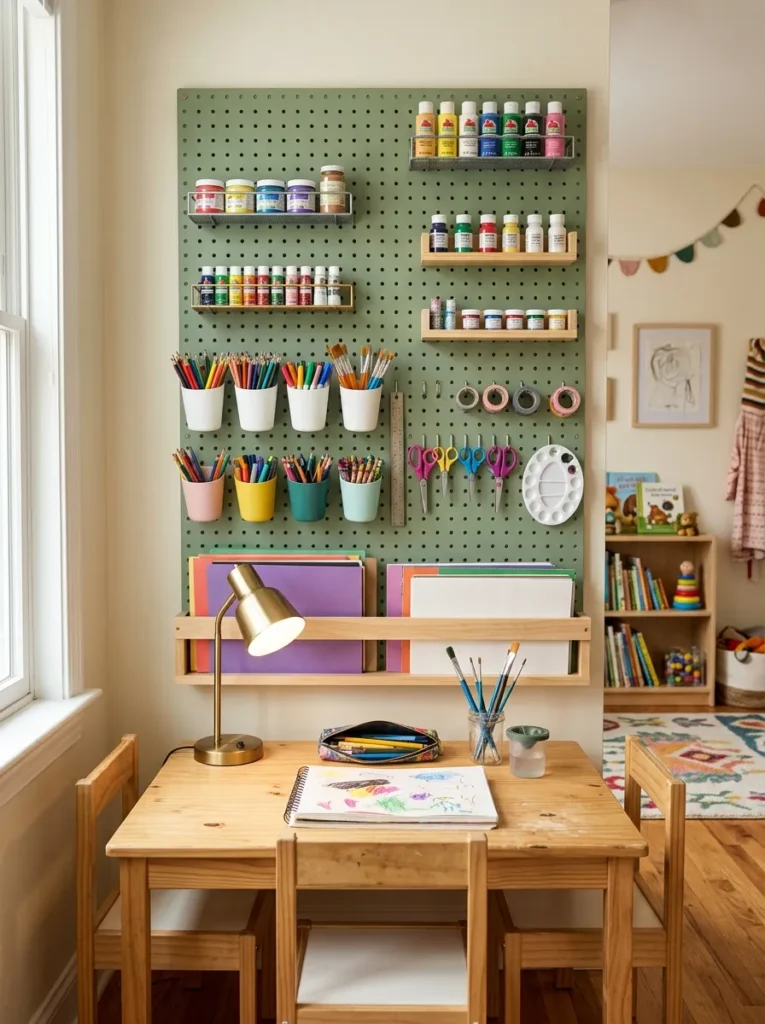
Vibe: The station is creative — a pegboard art station with all supplies visibly organized and immediately accessible creates the specific condition for sustained independent creative work: every tool available at a glance, at the child’s reach, without any drawer-searching or adult-assistance required.
Why it works: Visible, accessible art supply organization is the single most effective intervention for increasing the frequency and duration of children’s creative activity — research in early childhood education consistently shows that children engage in significantly more creative work when materials are visible (rather than hidden in drawers), organized by type (rather than jumbled in a single container), and independently accessible (rather than requiring adult retrieval). The pegboard wall system provides all three conditions simultaneously: every supply is visible from the art table, each supply type has its own designated location, and all supplies are at the child’s reach height. The system is also infinitely reconfigurable — as the child’s art interests develop and change, the pegboard accessories can be repositioned in minutes without any new hardware.
How to get it: Mount a 1/4-inch pegboard panel (available at any hardware store, $12–$18 for a 4×4-foot panel cut to size) above the art table using 1-inch standoffs that provide clearance for the pegboard hook shafts behind the panel. Paint the pegboard in a warm color before mounting (two coats of chalk paint or latex paint in sage, warm white, or terracotta works well on pegboard). Equip with standard pegboard accessories: small metal cups for pencils and brushes, small shelf brackets for paint jar storage, S-hooks for scissors and rulers. Mount the panel at the child’s eye height when seated at the art table — typically 36–42 inches from the floor to the panel bottom.
Shop The Look
- Pegboard panel 1/4 inch white painted
- Pegboard accessories cup set metal
- Pegboard shelf bracket small set
- Art table children height adjustable
- Chalk paint sage color craft
6. Rotating Bookshelf Tower for Small Spaces
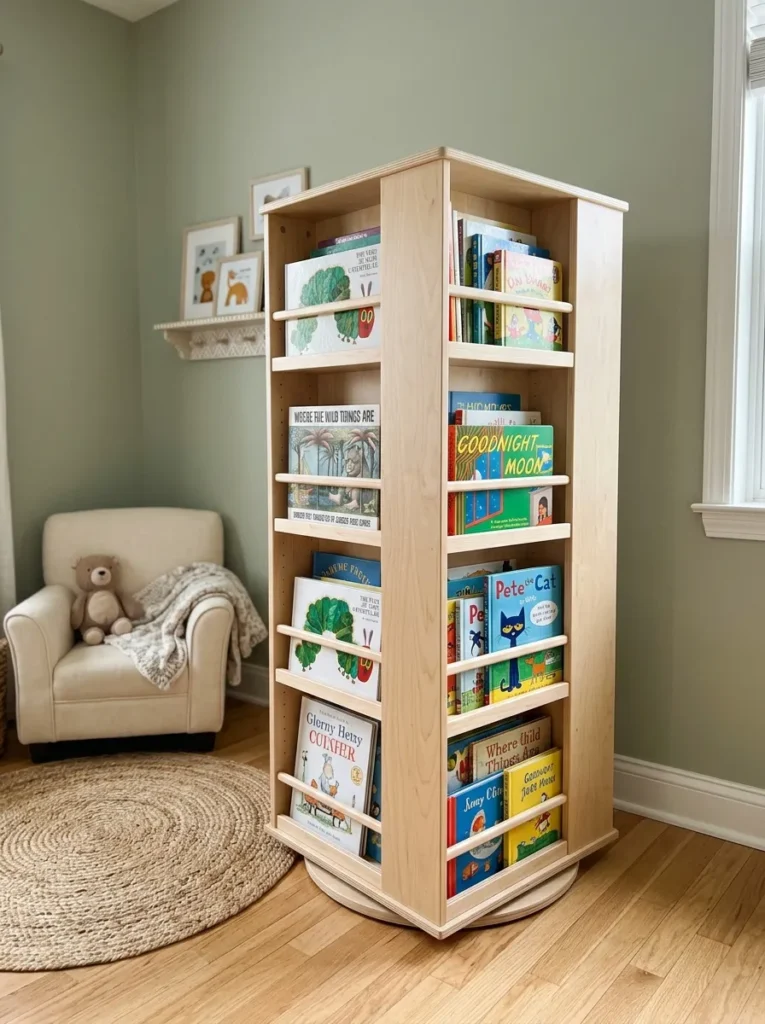
Vibe: The tower is accessible — a rotating bookshelf that displays books with covers facing outward on four sides and rotates to make all faces visible from a single standing position is the most reading-accessible bookshelf format available for children, combining maximum book visibility with minimum floor footprint.
Why it works: Children’s book selection is cover-driven — children choose books by recognizing and being attracted to cover imagery, not by reading spines as adult readers do. Standard bookshelves that display spines outward make children’s books essentially invisible as individual titles and effectively reduce the available selection to the books the child has memorized by heart. Cover-facing bookshelf display (books stored with the front cover visible rather than the spine) increases independent book selection by children by a significant margin in every library and classroom environment that has studied the question. A rotating tower that displays covers on all four faces makes the entire book collection visible from a single standing position — the most efficient use of limited floor space for maximum book accessibility.
How to get it: Rotating bookcases for children are available from Guidecraft (their rotating book display is specifically designed for cover-facing display of children’s books), IKEA (the SNIGLAR and TROFAST systems can be adapted), and specialist children’s furniture retailers at $80–$200 for quality rotating models. The rotating mechanism should move smoothly under the weight of 40–60 children’s books — test the rotation load before purchasing or building. Position the tower on a low-pile rug or felt pads to prevent floor scratching during rotation.
Shop The Look
- Rotating bookshelf tower children
- Cover facing book display stand
- Four sided rotating book tower
- Children’s book display front facing
- Book tower felt pad protection
7. Floating Wall Shelves at Child Height for Display and Storage
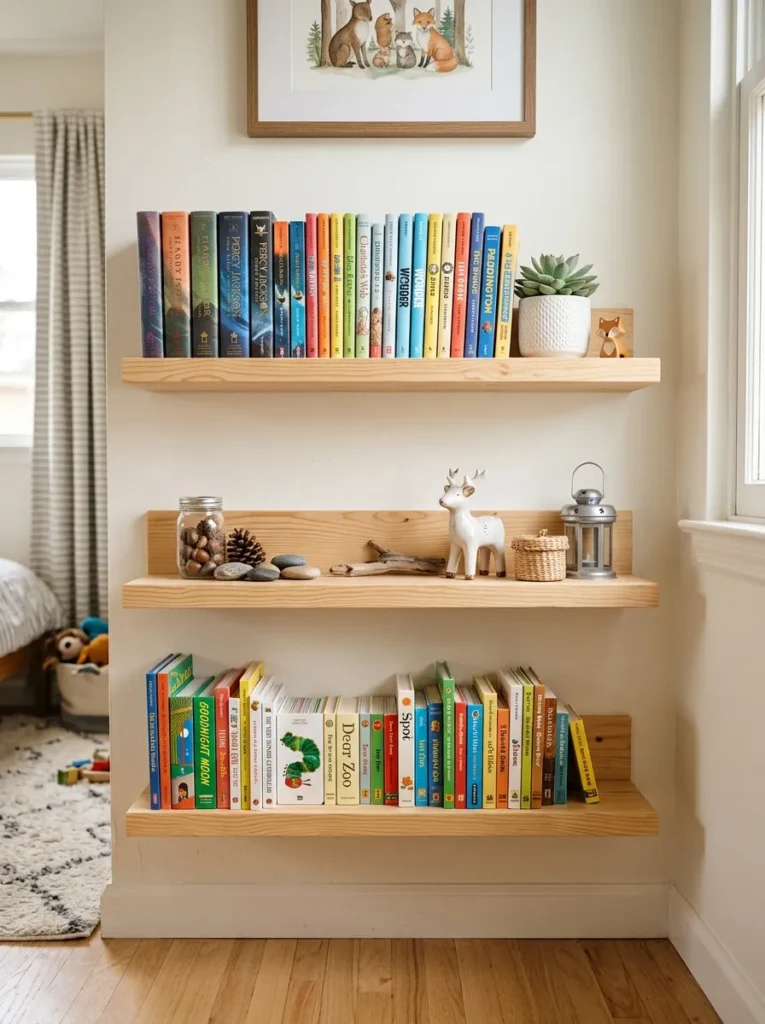
Vibe: The shelves are child-scaled — floating wall shelves positioned at child height rather than adult height create a display and storage system that the child can fully interact with independently, making books, small toys, and personal objects accessible and returnable without any adult involvement.
Why it works: Standard wall shelves installed at adult height (typically 48 inches and above) are inaccessible to children under 8 without assistance, which means the objects stored on them are effectively unavailable for independent play and are also unlikely to be independently returned to storage after use. Floating shelves installed at child height (24–40 inches from the floor, spanning the child’s accessible reach zone) create a display and storage system that the child can fully self-manage — choosing a book, displaying a found natural object, returning a toy — without requiring adult involvement. This independence is the design quality that makes child-height shelving a developmental investment as well as a storage solution.
How to get it: Install three floating shelves at child-height intervals using standard shelf brackets (concealed or visible) anchored into wall studs. The lowest shelf at 24 inches is optimal for board books and toys for toddlers; the middle shelf at 32 inches is the primary display zone for the child’s most-used current books and objects; the upper shelf at 40 inches provides slightly more aspirational storage for books the child is growing into. Each shelf should be at most 8 inches deep at child height — shallow shelves at child level prevent the shelf from becoming a surface for accumulated clutter.
Shop The Look
- Floating shelf natural pine 36 inch
- Floating shelf bracket hidden steel
- Book ledge rail display shelf child
- Wall shelf white painted 8 inch deep
- Shelf pin adjustable set installation
8. Bunk Bed with Integrated Staircase Storage
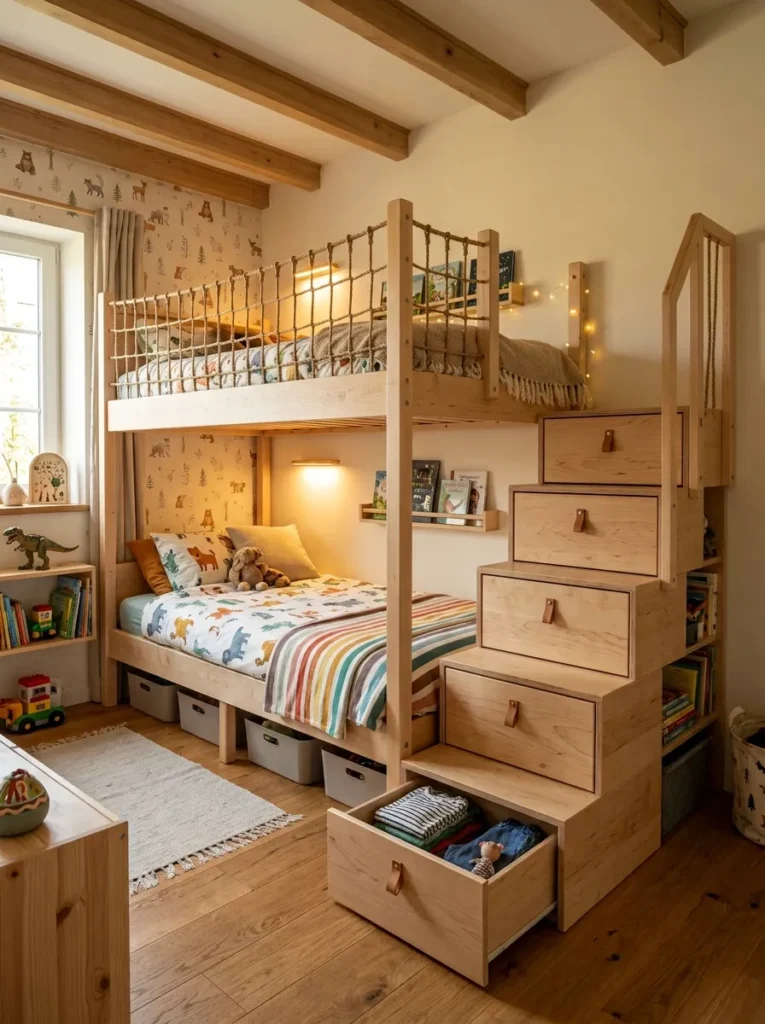
Vibe: The bunk is functional — a bunk bed with a storage staircase that incorporates pull-out drawers in every step converts the bunk access structure into a complete clothing and toy storage system, eliminating the need for a separate chest of drawers in the shared children’s bedroom.
Why it works: The bunk bed staircase storage system is the highest-density storage innovation in children’s bedroom furniture because it uses the structural volume of the staircase — which must exist for safe bunk access regardless of whether it contains storage — for maximum storage capacity. A standard staircase with 6 steps, each step containing one full-width pull-out drawer, provides storage equivalent to a 6-drawer tall chest of drawers within the footprint of the staircase structure (typically 18×30 inches floor plan). The staircase’s additional functional advantages over a conventional bunk ladder are significant: it is significantly safer for young children (eliminates the climbing challenge and fall risk of rungs), provides a sleep-adjacent mounting surface for reading lights, and creates a more architecturally resolved visual element than the conventional ladder.
How to get it: Bunk beds with staircase storage are widely available from specialist children’s furniture retailers (Maxtrix, Pottery Barn Kids, Land of Nod) and from IKEA (the HEMNES bunk bed with a complementary staircase unit) at $600–$2,000 depending on material quality and configuration. Custom-built versions from local furniture makers ($1,500–$3,500) allow precise room dimension fit and material specification. The drawer dimension within each step should be at minimum 16 inches wide, 20 inches deep, and 8 inches tall — sufficient for folded clothing items.
Shop The Look
- Bunk bed staircase storage solid wood
- Stair drawer bunk bed pull out
- Children bunk reading light clip
- Bunk bed safety rail wood
- Staircase bunk bed white painted
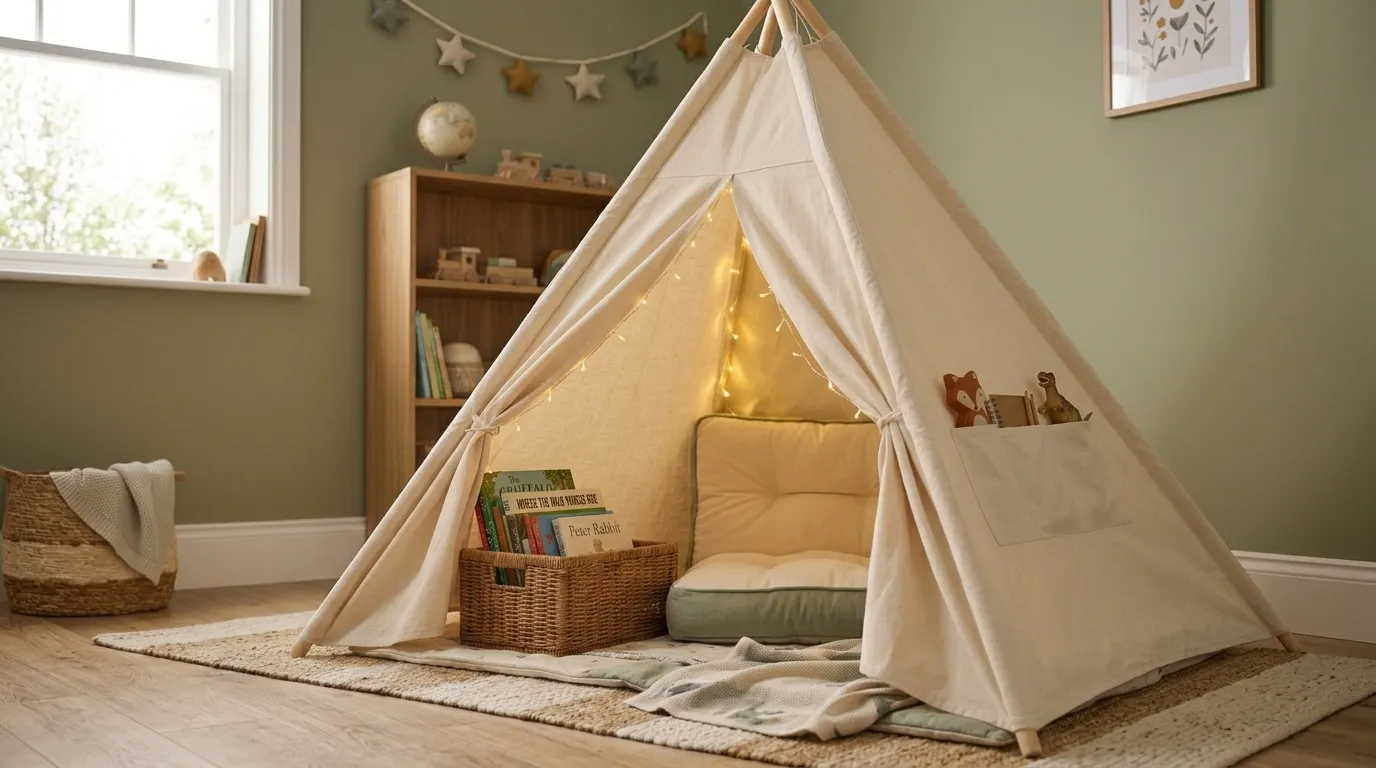
9. Teepee or Canopy Reading Corner with Hidden Storage Bin
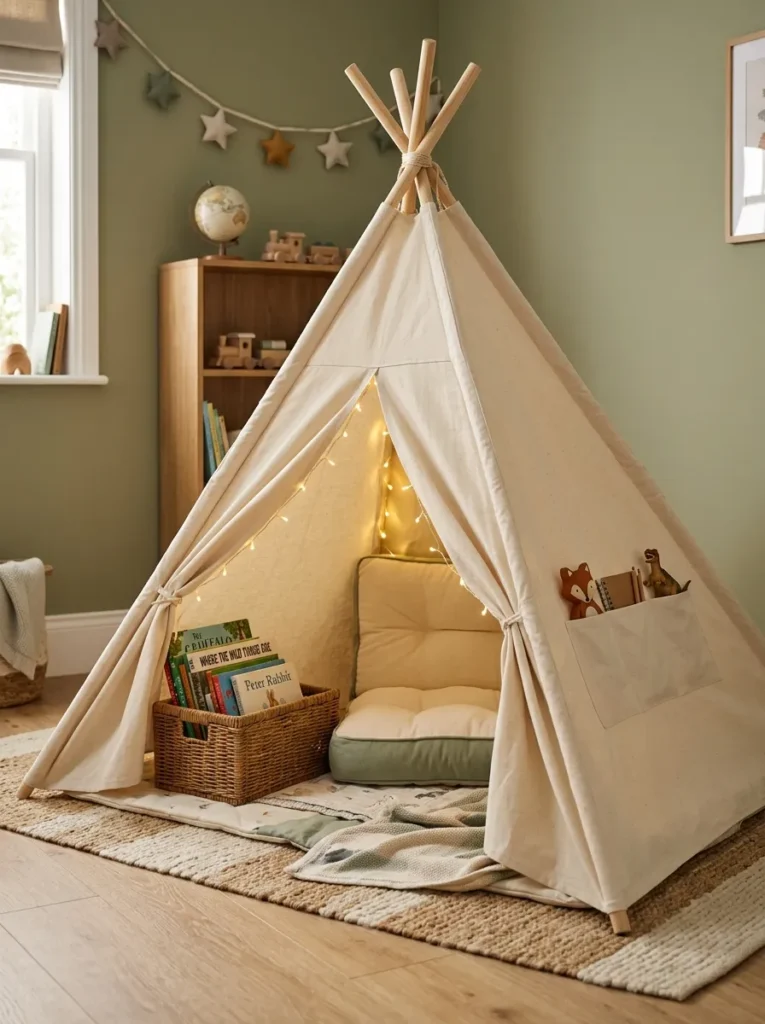
Vibe: The corner is imaginative — a teepee reading corner with internal storage for books and external pockets for small accessories creates the private, sheltered reading world that children seek out instinctively, where the storage is part of the world-building rather than a functional interruption.
Why it works: The teepee or floor canopy creates a children’s bedroom feature that simultaneously addresses three distinct needs: the need for a semi-private, enclosed space that children developmentally seek for independent and imaginative play (the “refuge” quality identified in environmental psychology research); the need for a dedicated reading space with appropriate ambient light (the fairy lights create exactly the warm, intimate light level that reading requires); and the need for near-access storage for the books and small objects used within the reading session (the wicker bin inside and the pocket organizer outside). The teepee’s storage capacity is modest but precisely calibrated to its use — the 20–30 books that fit in the internal bin are the current favorites, and the external pockets accommodate the small toys and accessories that accompany the child into the reading space.
How to get it: Canvas floor teepees with wooden poles are widely available from children’s lifestyle retailers at $40–$120 for quality natural cotton versions. The internal reading cushion should be sized to fit the teepee’s internal floor diameter (typically 36–48 inches) with a washable cover. Install battery-operated fairy lights ($8–$15 for a warm white 20-light set) along the interior pole structure for reading-appropriate warm ambient light. A natural wicker or seagrass basket ($15–$25) inside the tent holds the current book collection; a hanging fabric pocket organizer ($10–$20) attached to an exterior pole stores the small items that accompany reading sessions.
Shop The Look
- Floor teepee natural canvas children
- Round floor cushion large reading
- Battery fairy lights warm white indoor
- Wicker basket small book storage
- Pocket organizer fabric hanging
10. Wardrobe with Internal Organization System
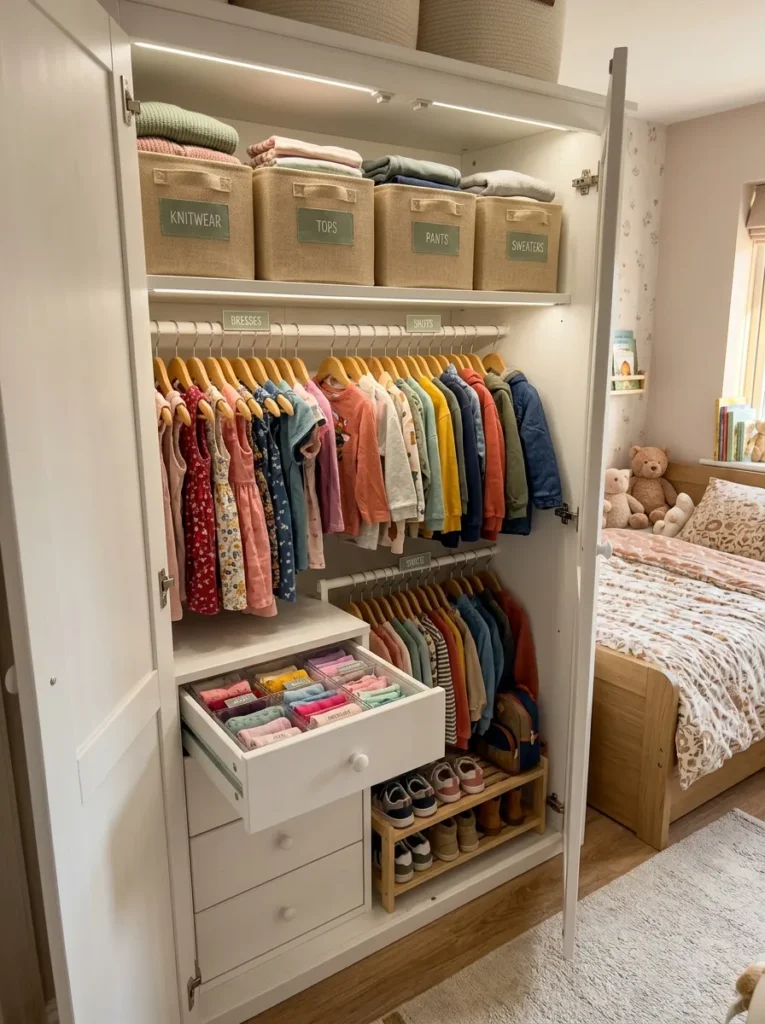
Vibe: The wardrobe is organized — a child-calibrated wardrobe organization system where the hanging zone, bin storage, and drawer division are all positioned for the child’s independent dressing creates a daily routine of autonomous getting-dressed that reduces morning friction and develops organizational confidence.
Why it works: The most common wardrobe configuration in children’s bedrooms — a single hanging rail at adult height, a shelf above, and an empty floor space below — is organized for adult storage logic rather than for child use. Children aged 3–8 cannot independently access a hanging rail at adult height (typically 60–66 inches from the floor), cannot reach an upper shelf, and cannot organize the floor space into meaningful storage. A child-calibrated wardrobe divides the same space into a hanging zone at 18–24 inches from the floor (child-accessible height for selecting and hanging garments), labeled fabric bins on the upper shelf for folded categories (the labels allow the child to find and return items independently), a shoe rack on the floor at child height, and small labeled drawers for underwear and socks (with drawer dividers that maintain category separation even when the child returns items independently).
How to get it: The IKEA PAX wardrobe system ($120–$400 depending on configuration) is the most flexible and most accessible starting point for child-calibrated wardrobe organization — the internal accessory range (KOMPLEMENT drawers, pull-out trouser hangers, shelf inserts) allows precise customization of the internal space for a child’s specific clothing quantity and type. Install a secondary hanging rail at 24-inch height beneath the primary rail — IKEA KOMPLEMENT hanging rails ($15–$20) are specifically designed for this secondary installation. Label all drawers and bins with simple picture labels (for pre-readers) or text labels (for readers) to enable fully independent dressing.
Shop The Look
- IKEA PAX wardrobe children configuration
- Secondary hanging rail child height
- Fabric storage bin label wardrobe
- Clear acrylic drawer divider set
- Shoe rack low profile wardrobe floor
11. Magnetic Wall Panel for Art Display and Organization
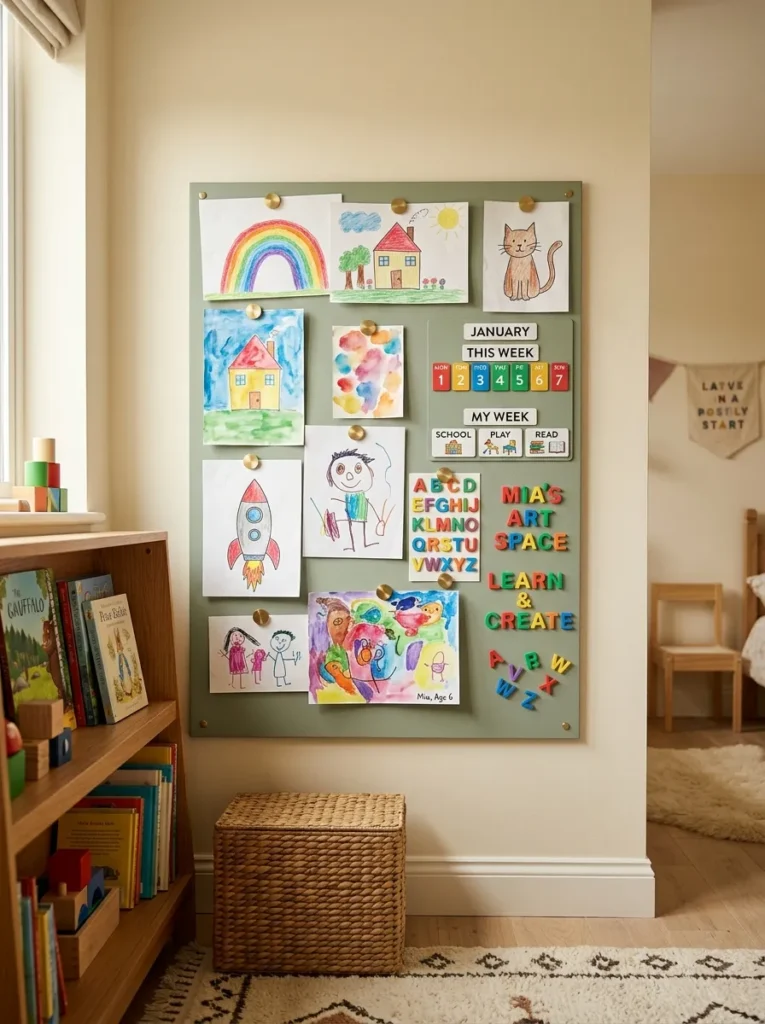
Vibe: The panel is creative — a large magnetic wall panel at child height that displays the child’s own artwork creates the most personally meaningful room feature available, where the bedroom wall is genuinely the child’s own gallery rather than an adult-curated space.
Why it works: Children’s artwork display at child height serves multiple simultaneous functions that adult-height art display cannot provide. The child can see and engage with their own displayed work from seated and standing positions throughout the day — research in art education suggests that children who regularly see their own displayed work develop greater creative confidence and produce more work than children whose art is stored or displayed beyond their visual field. The magnetic system allows the child to independently change the display — adding new work, rotating pieces, organizing the panel — without any adult involvement and without the damage of tape or pins on the wall. The inclusion of magnetic learning tools (calendar, letters, numbers) creates an integrated functional panel that serves multiple daily activities.
How to get it: Apply magnetic paint (two or more coats of a quality magnetic paint product, $25–$45 per quart) to the chosen wall zone, or mount a commercially available magnetic whiteboard panel ($30–$80 for a quality 24×36-inch panel) painted in the desired color with chalk or standard paint on its surface. Round rare-earth magnets ($8–$15 for a set of 20) are sufficiently strong to hold multiple sheets of paper and are small enough to be aesthetically minimal on the panel surface. Position the panel with its bottom edge at 18–24 inches from the floor for full child accessibility across the panel’s height.
Shop The Look
- Magnetic paint wall panel children
- Round rare earth magnet set small
- Magnetic whiteboard panel painted
- Magnetic calendar children’s room
- Magnetic letter number set learning
12. Narrow Bookshelf Wall Beside the Bed as Bedside Storage
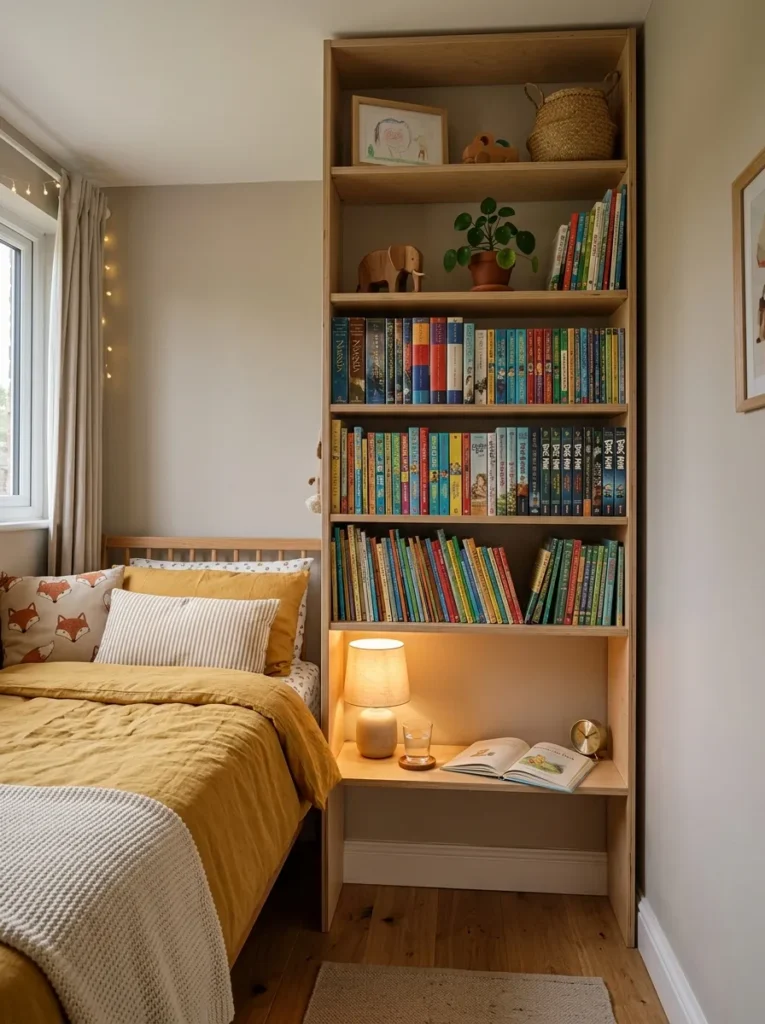
Vibe: The shelf is practical — a narrow floor-to-ceiling bookshelf positioned beside the bed combines the bedside table and the book storage functions in a single unit, eliminating the need for both a separate nightstand and a separate bookshelf in a space-limited children’s bedroom.
Why it works: The narrow floor-to-ceiling shelf beside the bed is the children’s bedroom’s most space-efficient furniture piece because it combines two functions — bedside storage and book storage — within a floor footprint that is smaller than either a standard nightstand or a standard bookshelf alone. A 12-inch-deep, 24-inch-wide unit uses only 2 square feet of floor area while providing 6–8 linear feet of shelf space and a dedicated bedside surface at mattress height. The positioning beside the bed rather than at the room’s wall also creates a slight enclosure of the sleeping zone — the shelf at the bed’s head creates a subtle den quality that many children find comforting — while keeping the book collection within literal arm’s reach for bedtime reading.
How to get it: The IKEA BILLY bookcase in 15.75-inch depth with additional shelves ($50–$80) or the KALLAX 1×4 vertical configuration ($55) both provide appropriate dimensions for this application. Position with the unit’s long axis vertical (floor to ceiling), the bottom shelf at mattress height (18–22 inches from floor for a standard children’s bed), and secure to the wall with the included anti-tip hardware. The bottom shelf serves as the bedside surface; configure middle shelves for current reading material and upper shelves for display.
Shop The Look
- Narrow bookshelf 12 inch deep white
- IKEA BILLY narrow children bedroom
- Small bedside lamp clip warm
- Book organization by spine color
- Anti tip furniture strap safety wall
13. Labeled Clear Bin System for Toy Category Organization
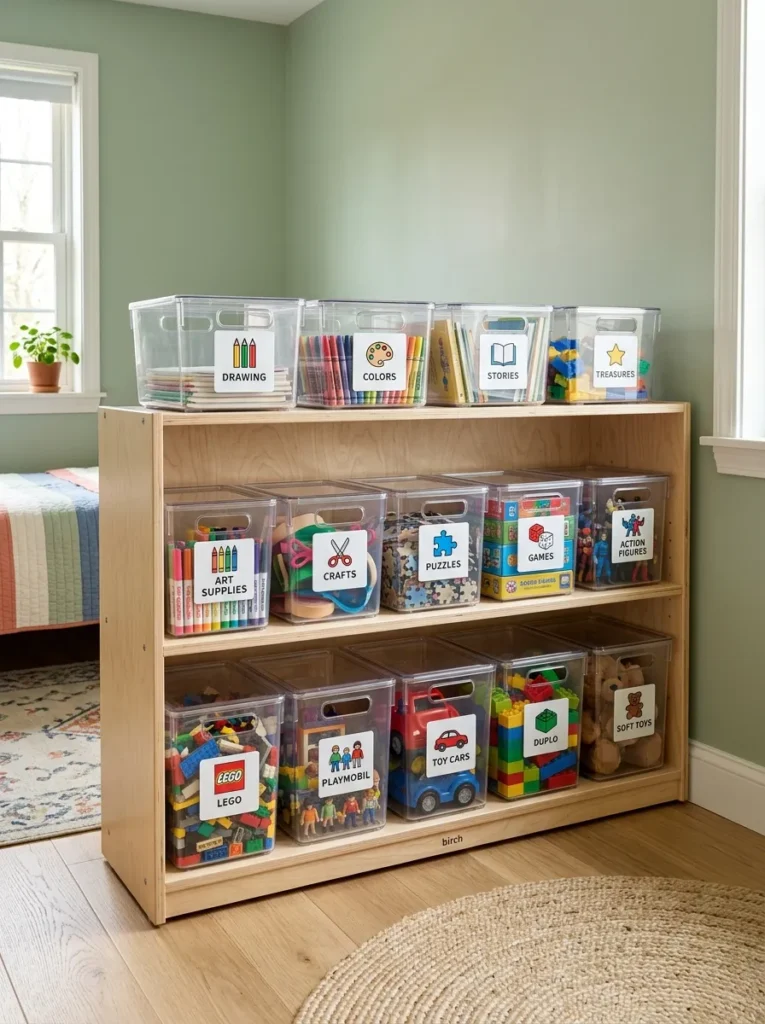
Vibe: The system is clear — a labeled clear bin organization system where every toy category has a designated transparent container creates the most sustainable children’s bedroom organization available, because the child can see where everything is and where everything goes without any adult assistance.
Why it works: Clear bins with picture-and-text labels are consistently the most successful children’s bedroom organization format in independent assessments by professional organizers and early childhood educators for three specific reasons. First, visibility — the child can see the bin’s contents without opening it, which eliminates the “search and scatter” behavior where bins are emptied in a search for a specific toy. Second, independence — the picture label makes the organization system accessible to pre-readers, allowing children as young as 3 to find and return items independently. Third, sustainability — the category system is maintained by the child rather than requiring adult reorganization because the visual cues are strong enough to guide independent return of items even by children with limited organizational attention spans.
How to get it: Purchase clear acrylic or clear polypropylene bins in three sizes — small (for LEGO, figurines, small car collections), medium (for art supplies, puzzles, construction sets), and large (for stuffed animals, dress-up accessories, sports equipment). The IKEA SAMLA and TROFAST systems provide appropriately sized clear bins at accessible price points ($2–$15 per bin). Create labels using a combination of a printed or hand-drawn picture of the category content plus the category name in the child’s reading font — laminate labels for durability. Update labels as interests change.
Shop The Look
- Clear storage bin set small medium large
- Label maker children’s organization
- Low shelf unit open storage children
- Picture label template printable set
- IKEA TROFAST bin clear children
14. Homework and Craft Station with Wall-Mounted Organizer
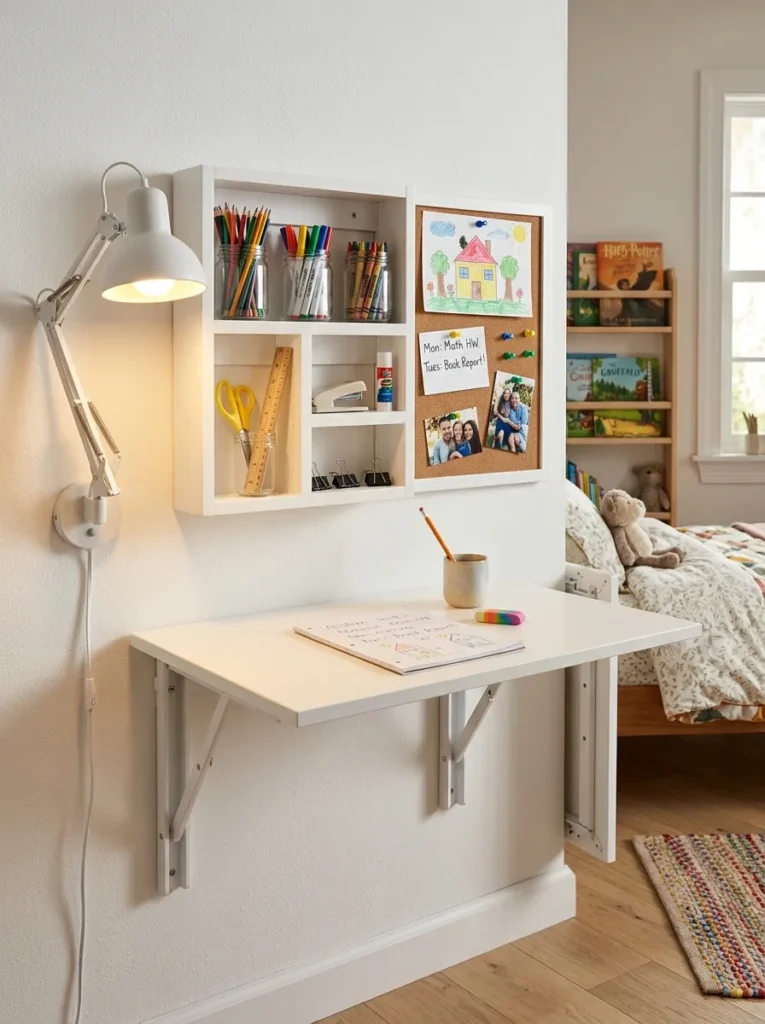
Vibe: The station is compact — a wall-mounted fold-down homework and craft desk that occupies zero floor space when closed creates a complete school and creative work zone in a small bedroom without any permanent floor footprint commitment.
Why it works: The fold-down wall-mounted desk is the small children’s bedroom’s most spatially efficient workspace solution because it occupies 0 square feet of floor space when not in use — the desk folds flat to the wall and the entire zone reads as a wall organizer and cork board rather than a piece of furniture. When the desk is deployed (a 10-second operation), it provides a full working surface of approximately 18×24 inches with all supplies immediately accessible on the wall organizer above. The articulating arm desk lamp (wall-mounted, requiring no desk surface space) keeps the entire desk surface available for work. This configuration is specifically appropriate for bedrooms under 100 square feet where a conventional desk and chair would occupy 15–20% of the total floor area.
How to get it: Wall-mounted fold-down desks (also called Murphy desks or wall desks) are available from IKEA (the NORBERG fold-down table, $70), Pottery Barn, and specialty space-saving furniture retailers at $80–$300. Install into wall studs using the provided hardware — the fold-down desk must be anchored into structural elements to safely support the weight of a working child. Mount a complementary wall organizer (IKEA SKÅDIS pegboard or a simple divided wall shelf) above the desk at accessible height. Install a wall-mounted articulating lamp ($25–$60) to keep the desk surface clear.
Shop The Look
- Wall mounted fold down desk children
- IKEA NORBERG fold down table
- Wall organizer school supply storage
- Articulating arm wall lamp bedroom
- Cork board small note display
15. Seasonal Toy Rotation System for Long-Term Organization
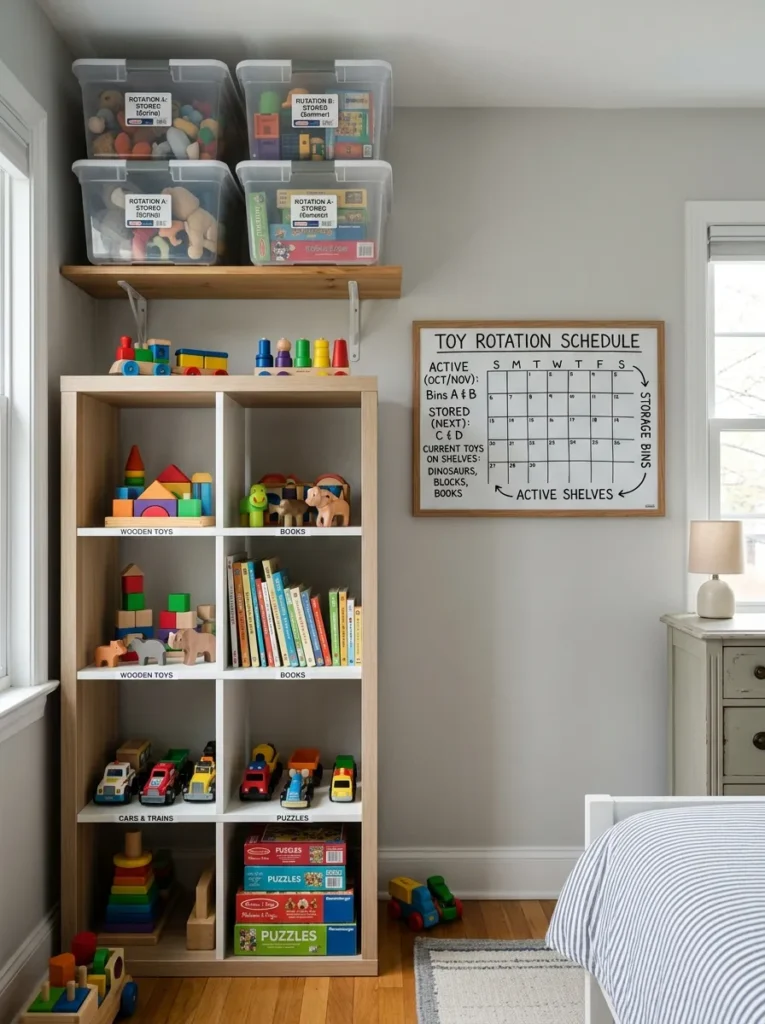
Vibe: The system is manageable — a deliberate toy rotation system that keeps only a curated selection of toys active in the bedroom at any time and rotates in “new” (previously stored) toys on a regular schedule creates the most sustainably organized children’s bedroom over the long term, while keeping play engagement high through the novelty effect of returned toys.
Why it works: Toy rotation is the organizational strategy with the strongest evidence base for maintaining both bedroom organization and child play engagement over time. Research consistently shows that children play more creatively and for longer durations with fewer toys than with many — the reduced toy selection requires more creative engagement with each available toy, while the abundance of many available toys simultaneously produces shorter, more superficial play sessions and greater difficulty maintaining organized storage. The rotation system addresses both problems: the bedroom at any time contains only the toys that fit its storage capacity (maintaining organizational sustainability), while the regular rotation of stored toys back into the active collection creates the “novelty effect” — returning a stored toy generates engagement similar to a new toy without any purchase.
How to get it: Assess the bedroom’s total storage capacity and determine the maximum number of toy categories the room can store organized and accessibly. Divide the total toy collection into two or three equal groups by category — ensure each group contains sufficient variety (building, creative, imaginative, physical) for a complete play environment. Store non-active groups in labeled clear bins on high shelves, in the wardrobe, or in an adjacent closet. Rotate on a regular schedule (every 4–8 weeks is the most commonly cited effective interval) by swapping the active group for a stored group. Create a simple visual rotation schedule on the bedroom wall so the child understands and anticipates the rotation process.
Shop The Look
- Large clear bin rotation storage labeled
- Rotation schedule whiteboard small
- High shelf storage organization bin
- Category bin label set printable
- Seasonal toy rotation timer reminder
How to Start Your Kids Bedroom Storage Transformation
The single most important first step in any children’s bedroom storage transformation is to conduct a complete inventory of the room’s actual contents before purchasing any storage product. The most common children’s bedroom storage mistake is purchasing new bins, baskets, and shelves without first understanding what needs to be stored — which produces a room with more storage capacity than before but no improvement in organization, because the storage purchased does not match the actual content categories, quantities, or use patterns of the specific child and their specific collection. A complete inventory (taking every object out of every drawer, shelf, and bin and sorting into broad categories on the floor) reveals the actual storage challenge: which categories are largest, which are most frequently accessed, which need accessible storage and which can tolerate higher placement or secondary locations.
The most common ongoing children’s bedroom storage mistake is maintaining more objects in the room than the room’s storage system can manage organized. Every children’s bedroom has a maximum object count that its storage system can sustain — a number above which the room tips into perpetual clutter regardless of how many bins, baskets, and shelves are added. This maximum is not the room’s total storage capacity but the storage capacity that can be maintained by the child independently with reasonable effort. Adding more storage to a room that already has more objects than the child can organize independently does not solve the organization problem — it raises the object count ceiling temporarily while the underlying problem (more objects than the child can self-manage) remains. The sustainable solution is a combination of storage calibrated to the child’s independence level and a regular decluttering practice that keeps the total object count within the child’s manageable range.
Three children’s bedroom storage upgrades under $50 that produce immediate, significant organizational improvement: adding a rotating cover-facing book display ($40–$80, at the top end of this range) that immediately increases the child’s independent book selection and reading engagement without any additional floor space; applying a picture-and-text label system ($10–$20 for printed labels plus lamination) to every existing storage bin, drawer, and shelf in the room, which immediately improves the child’s storage return accuracy and reduces the adult-organized-then-immediately-messy cycle; and purchasing two or three additional low-profile rolling bins ($15–$25 each) for the under-bed space, which immediately captures the largest single dead storage volume in most children’s bedrooms without any furniture change.
A complete children’s bedroom storage transformation — loft or bunk with under-zone function, built-in window seat with drawer storage, pegboard art station, rotating bookshelf, labeled clear bin system, and seasonal toy rotation implementation — is achievable over one weekend of focused installation work and one dedicated inventory and organization session, with total material investment ranging from $200–$600 for a IKEA-based system to $800–$3,000 for a custom-built room with built-in elements. The return on this investment — in the child’s independence and organizational confidence, in the reduction of adult organizational labor, in the quality of the child’s creative and learning engagement with their space, and in the daily quality-of-life improvement of a room that stays organized through the child’s own efforts — makes children’s bedroom storage one of the highest-return home improvement investments available per dollar spent.
Frequently Asked Questions About Kids Bedroom Storage
At what age can children be expected to maintain their own bedroom organization?
The developmental readiness for independent bedroom organization depends on both age and the quality of the storage system’s design. With well-designed, child-calibrated storage (labeled bins at accessible heights, clear containers that show contents, category systems with limited decision points), most children can independently maintain basic organization from approximately age 3–4 for simple systems (all blocks in the block bin, all books on the book shelf) to age 6–8 for moderately specific systems (art supplies by type, books by category, clothing by garment type). The critical variable is not the child’s age but the storage system’s match to the child’s current cognitive and physical capacity — a 5-year-old with a well-designed picture-labeled system at child height will out-organize a 9-year-old with an adult-oriented system that requires adult-height access and fine-grained category decisions.
How do I stop toys from spreading throughout the entire house?
Zone-based toy organization with a clear “home base” for each category is the most effective structural approach to containing toy spread. Each toy category should have a specific designated location in the child’s bedroom — not a general instruction to “put your toys away” but a specific bin, shelf, or storage location that belongs to that category exclusively. The child must understand and be able to articulate where each category lives (“LEGOs go in the clear bin on the bottom shelf, cars go in the red basket on the floor”) rather than understanding only that toys should be “put away somewhere.” When the home base location is specific, consistent, and accessible, children are significantly more likely to return toys to their designated location because the decision of where to put the toy has already been made.
What storage works best for a shared children’s bedroom?
Shared children’s bedrooms require storage systems with clear individual ownership zones — each child’s storage must be visually and physically distinguished from the other’s to prevent territorial conflicts and to enable each child to maintain their own zone independently. The most effective approaches for shared bedrooms: assign each child one complete zone of the room (including bed, storage, and display) rather than sharing storage containers; use color coding (each child’s storage zone in a distinct but harmonious color) to reinforce ownership without explicit labeling of every item; and provide each child with identical storage structures (same bin sizes, same shelf heights, same organizational framework) to prevent ownership conflicts over storage capacity equity.
How do I manage the constant influx of new toys and art projects?
A systematic “one in, one out” approach combined with a regular seasonal decluttering schedule is the most sustainable long-term approach to managing the constant growth of children’s possessions. The “one in, one out” principle (when a new toy enters the bedroom, one existing toy moves to the donation or rotation bin) maintains a constant total object count within the bedroom’s manageable capacity. A seasonal decluttering session (every 3–4 months, before major gift-giving occasions, or when seasonal interests shift) assesses the current collection against the child’s current interests and development stage, moving age-outgrown items to donation and temporarily-outgrown items to the rotation storage. Involving the child in the decluttering decision (with the frame of “which toys should we give to younger children who would really love these?” rather than “which toys should we get rid of?”) produces significantly more cooperative and consistent participation than adult-directed decluttering.
What is the best storage solution for a very small children’s bedroom?
For children’s bedrooms under 80 square feet, the three highest-priority storage strategies are vertical space maximization, multi-function furniture, and elimination of floor-contact storage wherever possible. Vertical space maximization means using floor-to-ceiling shelving wherever wall space is available — the wall area above the standard furniture height zone (above 60 inches) is significantly underused in most small children’s bedrooms and can provide as much storage as the entire floor-level furniture zone. Multi-function furniture means every piece of furniture serving at least two functions — a loft bed with under-zone storage, a window seat with drawer storage, a narrow shelf that also serves as a bedside table. Eliminating floor-contact storage means replacing floor-standing chests and toy boxes with wall-mounted shelving, under-bed storage bins, and wardrobe-integrated organization that keeps the maximum possible floor area clear — clear floor area is the most valuable visual element in a small bedroom, making the room feel significantly larger than its measured dimensions.
Ready to Transform Your Child’s Bedroom?
These 15 ideas cover the full spectrum of what creative children’s bedroom storage can achieve — from the space-multiplying magic of a loft bed with a complete under-zone study to the cozy intimacy of a window seat with deep drawer storage, from the developmental support of a pegboard art station with every supply at the child’s reach to the sustainable organization of a labeled clear bin system that the child can genuinely maintain independently, from the architectural character of a house-shaped bookshelf feature wall to the long-term organizational wisdom of a seasonal toy rotation system. You do not need all 15 to create a genuinely well-organized, genuinely loved children’s bedroom — you need the three or four that most directly address the specific organizational challenges and developmental needs of the specific child who lives in the room. Start with the inventory: take everything out, sort by category, and let what you find tell you exactly which storage solutions the room actually needs rather than which ones look appealing in photographs. A children’s bedroom that works for the child who inhabits it — that supports their independence, sustains their creativity, and stays organized through their own efforts — is among the most valuable and most lasting home design investments available. Pin the ideas that named your child’s room’s specific challenge — those are the ones worth implementing first.