13 Gorgeous Table Decor Ideas for Stylish Dining
Table decor is the art of composing a dining table surface as a designed environment — using florals, textiles, ceramics, glassware, lighting, and natural materials to create the visual and sensory quality that transforms eating from a daily routine into an occasion worth setting the table for. This article gives you 13 genuinely creative, achievable table decor ideas that work for everything from a Tuesday dinner for two to a celebratory gathering of twelve, making the table itself the most considered surface in the room regardless of the occasion it serves.
Most table settings default to the functional minimum — plates, cutlery, water glasses, and whatever centerpiece arrived in the house and never left. The tables in this list make a more considered choice: they treat the table as a compositional canvas whose arrangement communicates care, attention, and aesthetic intention before a single dish arrives from the kitchen. Here are 13 ideas worth saving — and setting.
Why Gorgeous Table Decor Works So Well
The dining table as a designed environment has a cultural history as rich as any other domestic design tradition — from the elaborate Baroque banqueting tables of 17th-century Europe, where the centerpiece was an architectural composition of sugar sculpture, silver plate, and candelabra that could take a team of servants a full day to assemble, to the Japanese kaiseki tradition of seasonal material composition in which the lacquer of the serving vessel, the color of the pottery, and the single seasonal blossom on the tray communicate the meal’s relationship to a specific moment in the natural year. Both traditions share the fundamental insight that the table’s visual composition is as much a part of the meal’s quality as its food — that the experience of eating is profoundly shaped by the sensory environment in which it occurs.
The materials that define a beautiful table setting are those that engage multiple senses simultaneously. Candlelight is the table decor element that most powerfully transforms the quality of a dining experience because it operates at the physiological level — the 1800–2200K color temperature of candlelight is the specific light quality that the human visual system reads as evening, intimacy, and social warmth, activating the neurological state most conducive to relaxed conversation and extended presence at the table. Natural flowers and botanicals introduce the olfactory and visual richness of the living plant world into the dining environment, creating the biophilic sensory quality that manufactured objects cannot provide. Linen and natural fiber table textiles introduce tactile warmth — the texture of a linen runner or a cotton napkin is perceived at the skin-level contact of daily table use, contributing to the meal’s sensory richness at a register that purely visual elements cannot reach.
The contemporary table decor aesthetic has been shaped by three converging cultural forces: the hospitality industry (which has progressively elevated baseline expectations for dining environment quality), the food media culture of Instagram and Pinterest (which has made styled table photography one of the most-shared categories of domestic content globally), and the sustainability movement (which has driven a preference for natural, seasonal, and locally sourced table decor materials over synthetic or mass-produced alternatives). The intersection of these forces has produced the contemporary beautiful table setting: natural linen textiles, seasonal botanical centerpieces, warm candlelight, ceramic and handmade glassware, and the specific kind of considered imperfection that reads as genuinely human rather than magazine-perfect.
Small dining tables and compact dining rooms benefit specifically from the beautiful table decor approach because the scale of a small table means that every element is experienced at close range — the quality of a napkin’s fabric, the form of a ceramic jug, the fragrance of a single gardenia — and this proximity amplifies both the pleasure of beautiful elements and the disruption of careless ones. A beautifully set small table read as more intimate and more considered than a generously sized table with a mediocre setting.
Style at a Glance
| Element | Detail |
|---|---|
| Philosophy | The table is a compositional canvas — its arrangement communicates care and intention before the food arrives, and that communication is as much a part of the meal as anything that comes from the kitchen |
| Key Materials | Natural linen, beeswax candles, seasonal botanicals, ceramic and handmade pottery, natural stone, aged brass, handblown glass, dried botanicals |
| Three Principles | Sensory layering, material coherence, seasonal specificity |
13 Gorgeous Table Decor Ideas
1. Low Floral Meadow Centerpiece with Taper Candles
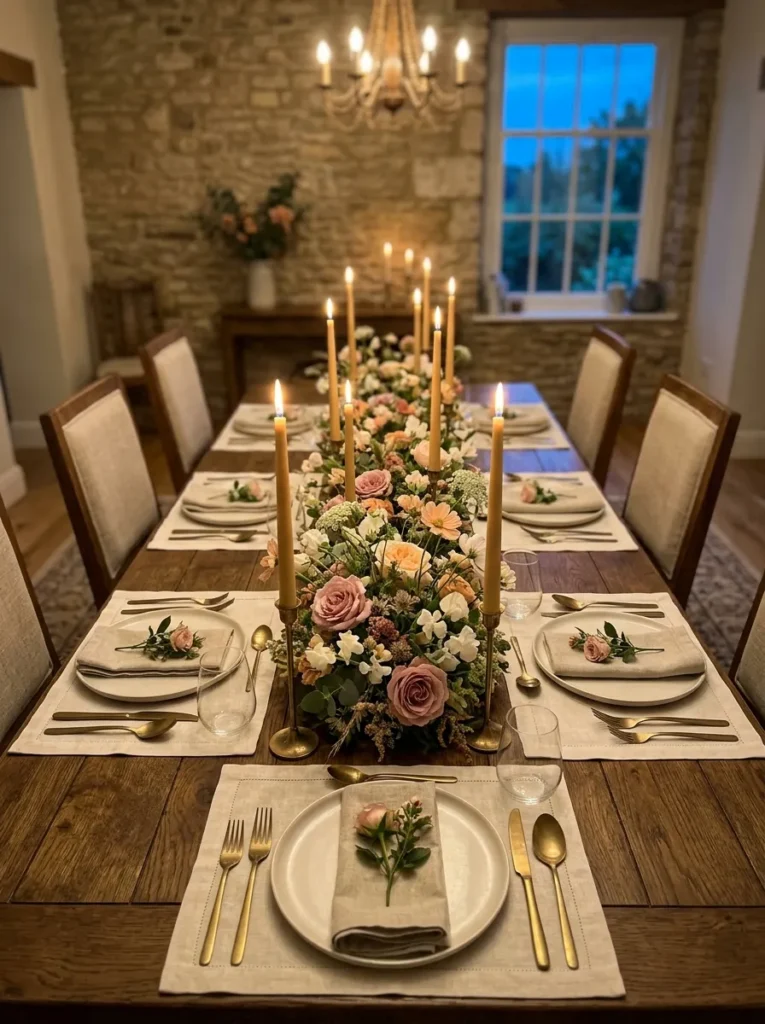
Vibe: Warm and celebratory — the table that makes every person who sits down at it feel like the dinner was made specifically for them.
Why it works: The low floral meadow centerpiece with taper candles is the table decor idea that most completely achieves the balance between visual richness and conversational practicality — keeping all floral elements below 200mm ensures that no guest’s sightline across the table is blocked, allowing conversation to flow uninterrupted while the table reads as abundantly decorated. The meadow-style arrangement (loose, naturalistic, asymmetric) reads as more genuinely beautiful and more personally invested than a formal florist arrangement because it references the spontaneous abundance of a garden rather than the controlled precision of a professional composition. Taper candles interspersed through the floral arrangement at varied heights create the warm amber lighting quality at table level that overhead lights cannot replicate — the candlelight at seated eye height is what creates the specific intimacy quality of the most memorable dinner parties.
How to get it: Arrange the meadow centerpiece in a series of small bud vases, jam jars, and ceramic jugs placed at irregular intervals along the table’s central axis rather than in a single large vessel — this distributed arrangement approach allows the meadow quality to fill the full table length without requiring a single large arrangement. Cut all flower stems to a maximum of 250mm above the waterline — this keeps the arrangement below the 200mm visual threshold when placed in their vessels. Intersperse taper candle holders between the vessels at irregular heights (180mm, 250mm, 320mm candlestick heights) to create the varied height rhythm that reads as natural rather than regimented.
Quick Win: A simple meadow centerpiece for a dinner party of six or eight can be assembled in 20 minutes from a mixed bunch of seasonal garden flowers ($15–25 from a farmers market) divided among five or six small glass jars of varied sizes placed along the table’s central axis — the distribution across multiple small vessels immediately achieves the meadow quality that a single florist arrangement cannot produce at any price.
Shop the Look
| Product |
|---|
| Beeswax taper candle set |
| Slim brass candlestick holder |
| Small bud vase set glass |
| Garden rose mixed bunch |
| Cream linen placemat set |
Also view: 15 Creative Kids Bedroom Ideas with Clever Storage
2. Marble and Brass Table Setting with Geometric Details
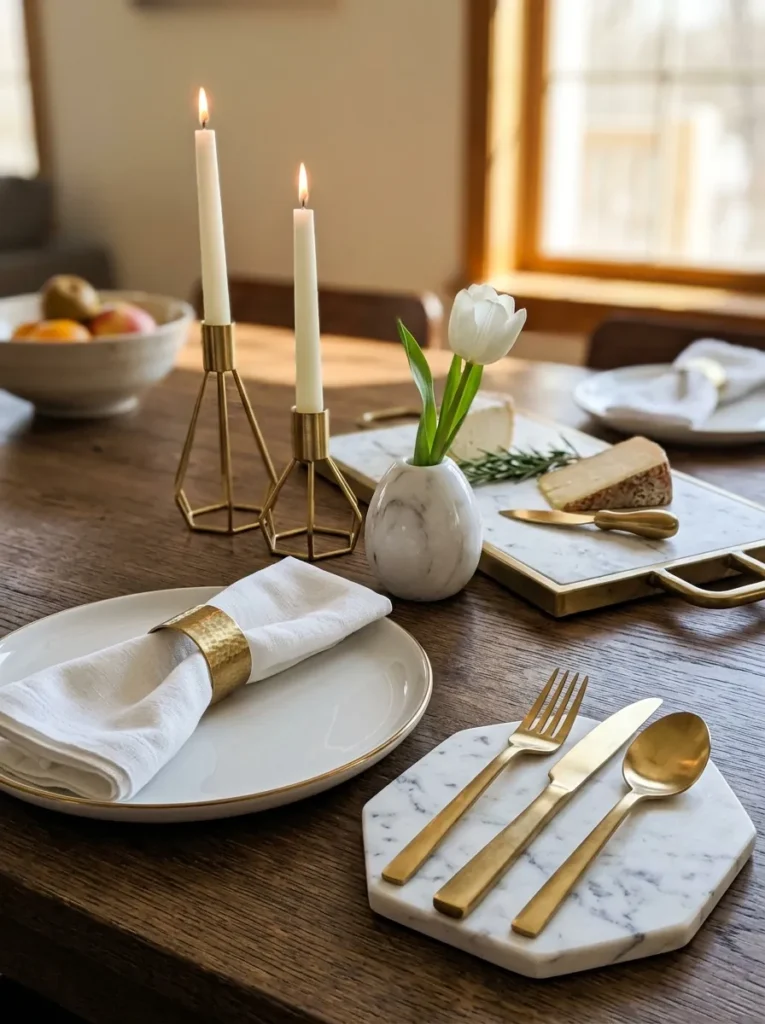
Vibe: Warm and refined — the table setting that reads as the result of a genuine material philosophy rather than individual decorating decisions.
Why it works: The marble and brass table setting is the table decor approach that most powerfully demonstrates the principle of material coherence applied to a dining table — when the same two materials (marble and brass) appear consistently across every element of the place setting and the centerpiece, the table reads as a unified, composed environment rather than a collection of separately purchased objects. The material coherence principle is what distinguishes a table that has been set from a table that has been designed — individual objects of high quality placed together without material logic read as expensive; the same objects unified by a consistent material palette read as designed. Marble and brass is the specific pairing that most consistently produces this designed reading because the two materials share a warm, slightly formal character that elevates any table setting while remaining accessible through a wide range of price points.
How to get it: Source marble and brass table accessories as complete sets from a single retailer where possible — the most important detail in a material coherence table setting is consistency of marble color temperature and brass tone across all pieces. Marble pieces from different quarries have different color temperatures (some warmer and more cream-toned, some cooler and more grey-toned) that clash when placed together on the same table. Confirm that all marble pieces are from the same or closely matched stone variety before purchasing separately sourced items.
Shop the Look
| Product |
|---|
| Marble round coaster set |
| Brushed brass cutlery set |
| Brass napkin ring set |
| Geometric brass taper holder |
| Marble bud vase |
3. Seasonal Autumn Table with Foraged Botanicals and Warm Tones
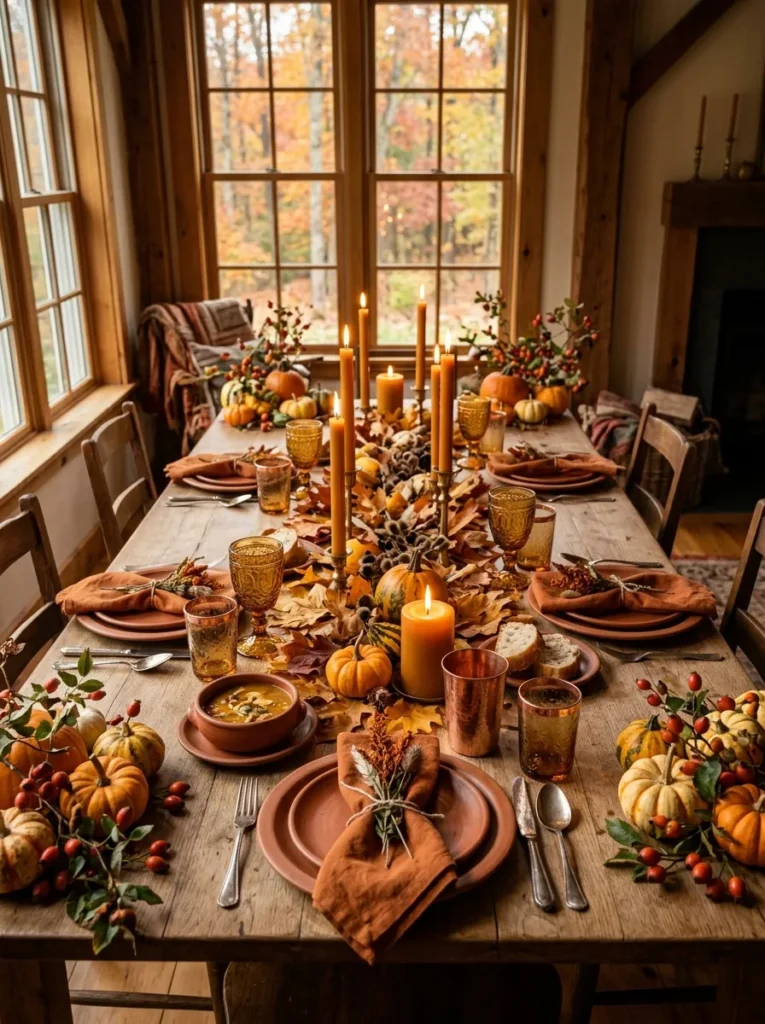
Vibe: Warm and seasonally abundant — the autumn table that makes the season itself feel like the celebration.
Why it works: The seasonal autumn table with foraged botanicals is the table decor idea that most completely realizes the principle of seasonal specificity — the idea that the most beautiful and most meaningful table decor is that which could only exist at this specific moment in the natural year, using materials that are simultaneously available, beautiful, and contextually appropriate to the season. Foraged autumn botanicals (fallen leaves, dried seed heads, rosehip branches, small gourds) provide the table decor material that is simultaneously the most cost-effective (foraged materials are free) and the most visually authentic (their natural aging, color variation, and organic form are the specific qualities that manufactured autumn-themed decor consistently fails to replicate). The warm tonal palette of the autumn table — amber, terracotta, burnt orange, deep red — is achieved through the coordinated selection of existing household items (amber glassware, terracotta plates, warm linen) rather than requiring dedicated seasonal purchases.
How to get it: Forage the botanical materials from parks, garden paths, and your own garden in the weeks before the dinner — gathering fallen leaves in peak color, dried seed heads from finished summer flowers, and rosehip branches from mature plants. Press and dry the leaves between books for 24–48 hours before placing them on the table — pressed leaves retain their color and form for 2–3 weeks without curling or crumbling. Arrange the foraged material along the table’s central axis in a continuous low composition, placing the larger gourds and branches first to establish the structural rhythm and filling in with smaller leaves and seed heads.
Shop the Look
| Product |
|---|
| Amber pillar candle set |
| Terracotta ceramic plate set |
| Burnt orange linen napkin |
| Copper amber glassware set |
| Small decorative gourd collection |
4. Monochromatic White and Cream Table for Maximum Elegance
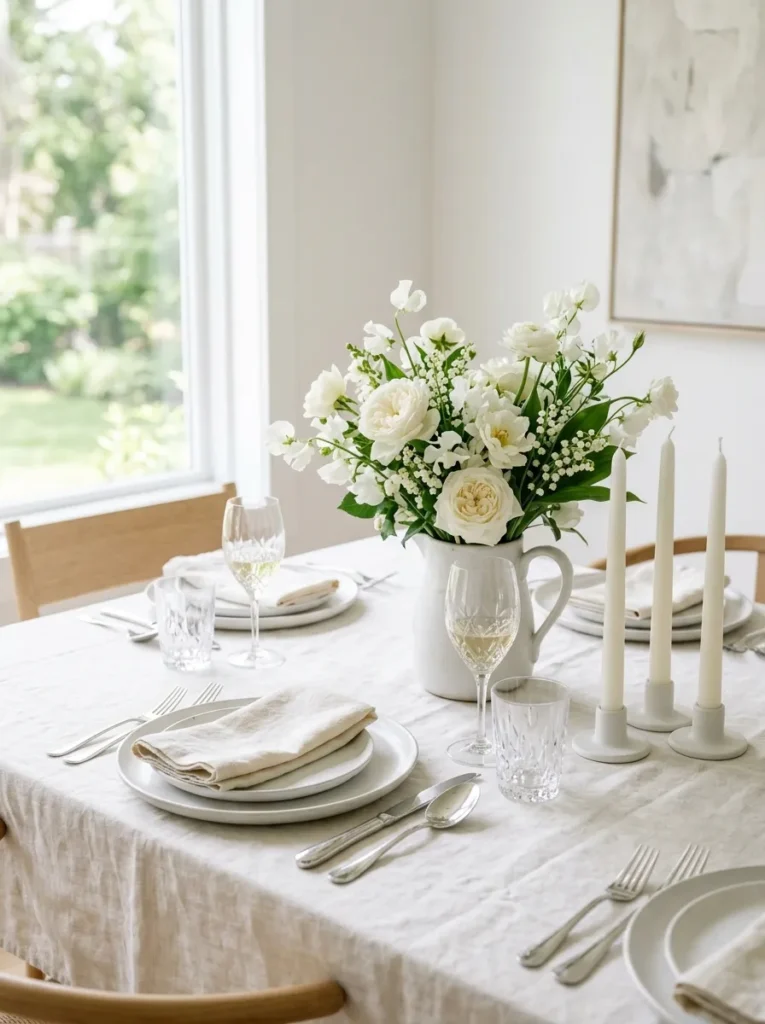
Vibe: Serene and elegant — the table that demonstrates that the most sophisticated color choice is the restraint to use only one.
Why it works: The monochromatic white and cream table setting is the table decor approach that most completely applies the interior design principle of tonal monochromatism to the dining table — using a single color family (warm white through ivory through cream) across all table elements while achieving visual richness through textural variety rather than color variety. The visual complexity of the all-white table comes from the different surface qualities of the white materials: the slight texture of the linen, the matte smooth surface of the ceramic, the waxy surface of the beeswax candle, the petal surface of the garden rose, the light-refracting facets of the crystal glass — each material’s white reads differently from every other, creating a tonal composition of genuine depth. This approach requires more compositional discipline than a multi-color table because the absence of color contrast means that every textural and tonal choice is visible and matters.
How to get it: Restrict the white palette to warm whites and ivories exclusively — introducing a cool bright white alongside warm cream creates a temperature clash that reads as a color inconsistency rather than a deliberate tonal range. White beeswax candles are warmer in tone than paraffin white candles — use beeswax specifically for a warm white that coordinates with the linen and ceramic palette. White flowers provide the most organic textural variety within the monochromatic palette because flower petals have a specific translucent quality that reflects ambient light differently from any manufactured white surface.
Shop the Look
| Product |
|---|
| White linen tablecloth |
| Cream linen napkin set |
| White ceramic dinner plate |
| White beeswax taper candle |
| White ceramic pitcher vase |
5. Dried Botanical Centerpiece for a Low-Maintenance Permanent Display
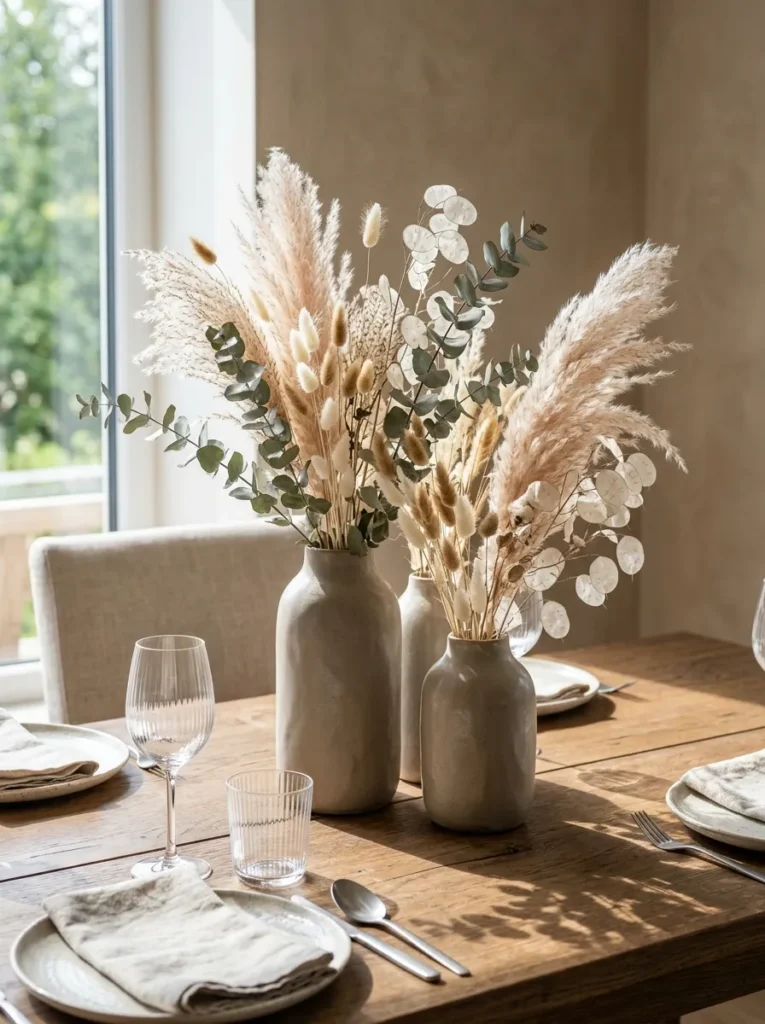
Vibe: Natural and contemporary — the centerpiece that improves the table whether dinner is being served or not.
Why it works: The dried botanical centerpiece in a trio of ceramic vases is the table decor idea with the highest daily-use design return — it improves the table’s aesthetic quality every day regardless of whether dinner is being served, requiring no watering, no replacement, and no seasonal maintenance beyond occasional gentle dusting. Dried botanicals have a specific visual quality that fresh flowers cannot replicate: the dimensional transparency of pampas grass plumes, the silver disc quality of dried lunaria, and the warm grey of preserved eucalyptus create a material composition of genuine tactile and visual interest that is as compelling at close range as at a distance. The trio of varied-height ceramic vases is the vessel format that most effectively presents a dried botanical arrangement as a designed composition — three vessels at different heights create the visual rhythm and spatial depth that a single arrangement in one vessel cannot achieve.
How to get it: Source dried pampas grass (Cortaderia selloana) from specialty florists, dried botanical suppliers, or farm gates where pampas is commercially grown — the quality variation between commercially dried and freshly home-dried pampas is significant, as commercial drying produces fuller plumes with more consistent color. Lunaria (money plant) seed pods can be harvested from the garden in late summer when the outer casings have dried to a papery texture and the silver inner membrane is visible — strip the outer casing by rubbing gently between fingers to reveal the silver disc beneath. Mix fresh-dried botanicals with preserved eucalyptus (glycerin-preserved, available from specialty florists) for a combination of airy plume texture and structural branch form.
Shop the Look
| Product |
|---|
| Dried pampas grass stems |
| Dried lunaria silver disc |
| Preserved eucalyptus bunch |
| Putty grey ceramic vase set three |
| Dried lagurus bunny tail grass |
6. Mediterranean Table with Terracotta, Olive, and Ceramic
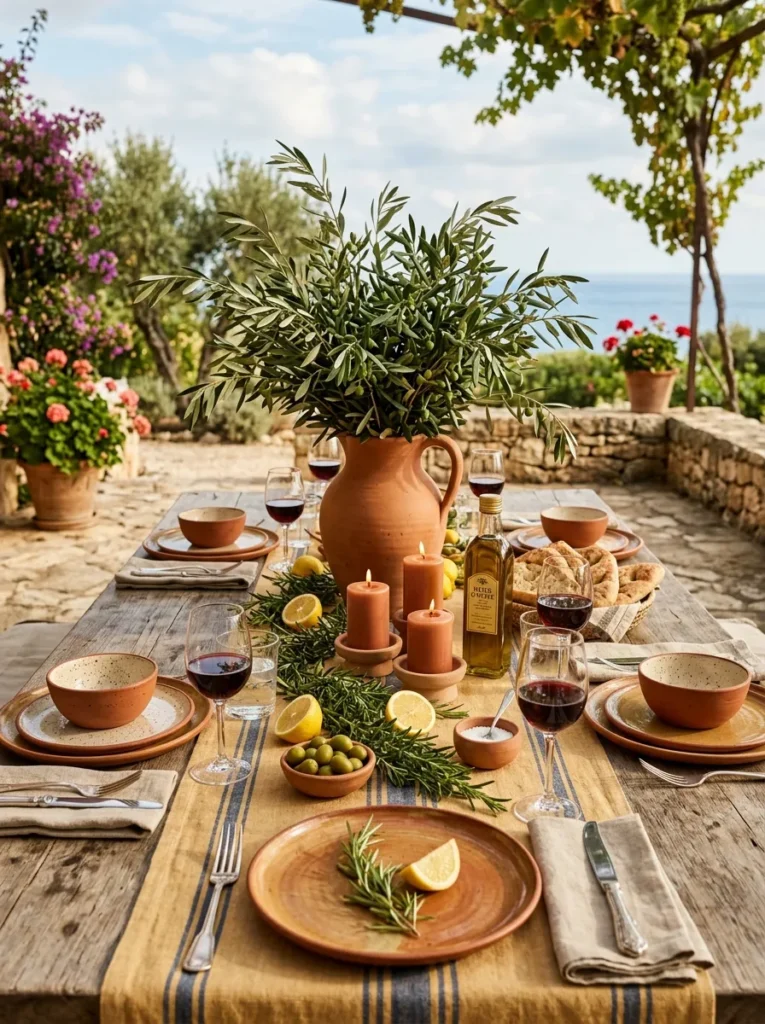
Vibe: Abundant and warm — the table that smells of rosemary and lemon before the food arrives and makes the meal feel like a celebration of the Mediterranean itself.
Why it works: The Mediterranean table with terracotta, olive, and ceramic is the table decor idea that most completely engages the olfactory dimension of table decor — the combination of fresh rosemary, halved lemons, and olive branches creates a scent layer at the table surface that is registered before any food aroma arrives, priming the olfactory sense for the meal’s flavors in the most pleasurable way. This sensory engagement through scent is the table decor dimension that distinguishes a merely beautiful table from a genuinely immersive one — the olfactory experience of a scattered rosemary and lemon arrangement activates the same physiological responses (appetite stimulation, positive mood, sensory anticipation) that the restaurant industry deliberately engineers through atmospheric scent design. The scattered approach — rosemary sprigs and lemon halves distributed directly along the table runner without vessels — is the casual abundance that is specifically Mediterranean in its visual language and in its implicit message of generosity.
How to get it: Use fresh rosemary cut in short 100–150mm sprigs distributed directly on the table runner surface — the rosemary releases more scent when the sprigs are gently bruised by brief handling before placement, and the quantity should be generous enough to read as scattered rather than placed. Cut lemons in half rather than in wedges — the cut face of the lemon releases the citrus oil immediately and the yellow cut face reads as the most visually vibrant element of the table when placed face-up along the runner. Replace the rosemary and lemons immediately before each use — a day-old lemon half and wilted rosemary communicate the opposite of the fresh abundance the Mediterranean table intends.
Shop the Look
| Product |
|---|
| Hand-thrown terracotta plate set |
| Provençal stripe linen runner |
| Large ceramic jug for branches |
| Terracotta pillar candle holder |
| Small clay bowl olives |
7. Maximalist Floral Table with Bold Color and Drama
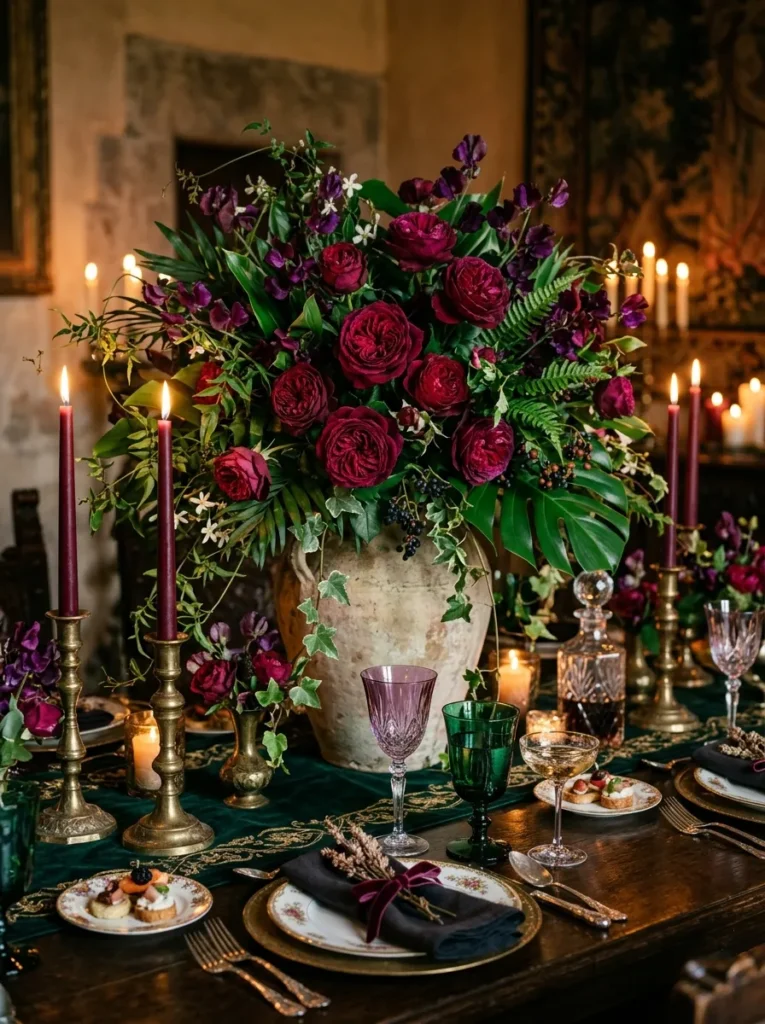
Vibe: Dramatic and opulent — the dinner table that makes the evening feel like an event before anyone has been seated.
Why it works: The maximalist floral table with a tall, dramatically generous centerpiece is the table decor idea that most powerfully challenges the standard advice that table centerpieces should be kept low — for a formal dinner party where the table is set for a celebratory occasion rather than a conversation-centered meal, a tall, architecturally ambitious centerpiece communicates the scale of the occasion’s importance in a way that a low arrangement simply cannot. The tall centerpiece works specifically for large, long tables where the center of the table is physically distant from the guests at either end — at a 2-meter long dining table for eight, a tall centerpiece occupies a position that no guest sits directly beside, making conversation across the centerpiece a non-issue while the arrangement provides the dramatic visual anchor that a long formal table requires.
How to get it: Specify the centerpiece vessel as a large antique or aged ceramic of at least 300mm diameter to provide the stable base that a tall floral arrangement requires — a tall arrangement in a narrow-necked vessel is both visually precarious and physically unstable. Source deep burgundy or dark-toned roses from specialty florists rather than supermarket rose collections — dark-toned roses (Black Baccara, Deep Secret, or dark burgundy garden roses) have a visual richness and depth that standard red roses lack, and they coordinate with the jewel-toned glass and aged brass palette of the maximalist table much more successfully.
Shop the Look
| Product |
|---|
| Dark burgundy rose bunch |
| Dark purple sweet pea stems |
| Large antique ceramic vessel |
| Deep jewel glass set amethyst |
| Aged brass taper candleholder |
8. Japanese-Inspired Wabi-Sabi Table with Ceramic and Stone
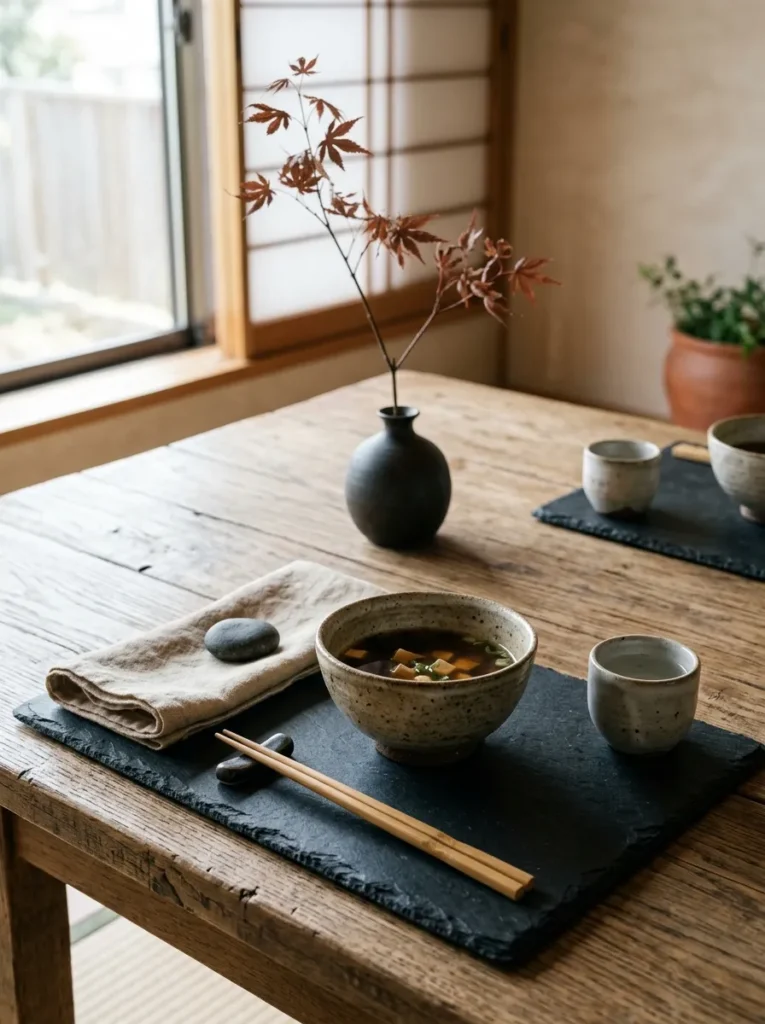
Vibe: Meditative and refined — the table setting that makes the act of sitting down to eat feel like a considered beginning rather than a reflex.
Why it works: The Japanese-inspired wabi-sabi table is the table decor idea that most completely inverts the abundance principle — rather than communicating care and intention through the quantity of beautiful objects, it communicates the same qualities through the restraint to select only objects of genuine material quality and to allow each object the space to be fully perceived. The single dried branch in an ikebana vase is the centerpiece that most powerfully expresses this inversion: one branch, in one vessel, with nothing competing for attention, communicates a level of design confidence and aesthetic maturity that an abundantly floral centerpiece can never achieve. The wabi-sabi aesthetic specifically values the beauty of natural imperfection — the ash glaze’s uneven surface, the river stone’s irregular form, the dried branch’s unpredictable extension — as the specific quality that makes these objects beautiful rather than as qualities to be overcome.
How to get it: Source hand-thrown ceramic bowls from a local ceramicist or specialist ceramic retailer — the ash glaze or tenmoku glaze that most authentically references Japanese ceramic tradition is the key visual element that establishes the Japanese aesthetic context of the place setting. River stones as napkin weights should be selected for smoothness and subtle color variation — spend time choosing stones with interesting natural markings rather than buying mass-produced decorative stones, as the individually chosen stone communicates the personal attention to detail that defines the wabi-sabi approach. The ikebana branch should be the single most visually resolved branch available — one branch with a clear directional line and interesting secondary branching, not a bundle of stems.
Shop the Look
| Product |
|---|
| Ash glaze ceramic bowl handmade |
| Narrow ikebana ceramic vase |
| Smooth river stone collection |
| Unbleached linen napkin set |
| Bamboo chopstick set |
9. Garden Party Table with Herbs and Edible Flowers
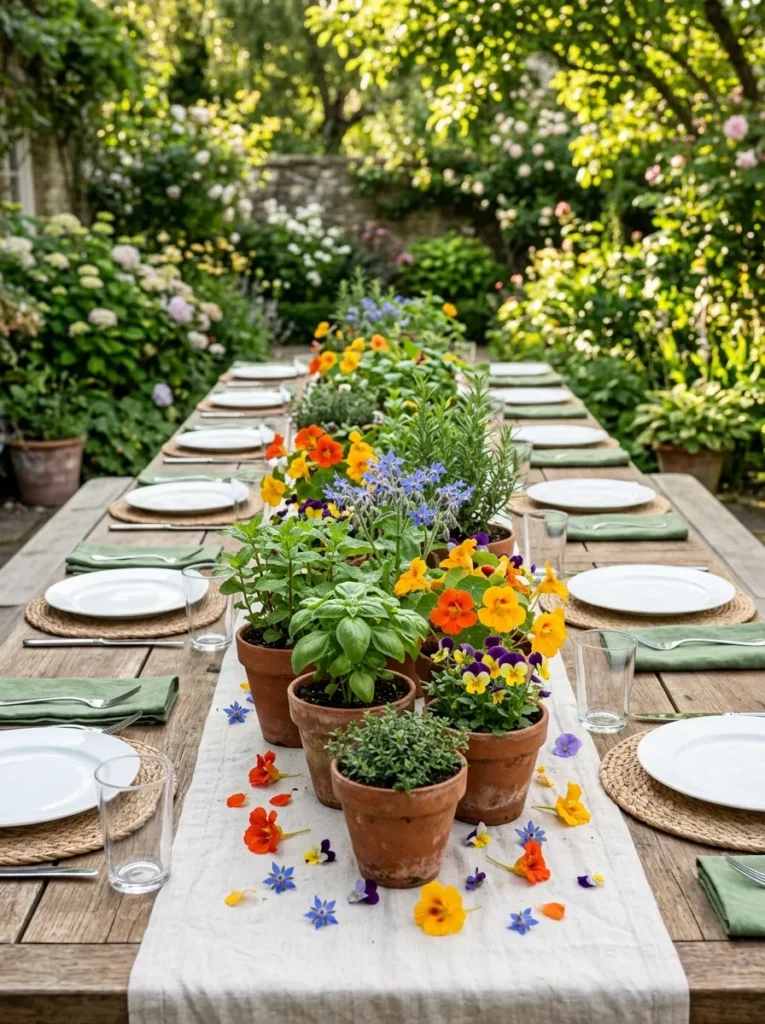
Vibe: Fresh and alive — the table centerpiece that is simultaneously the table’s most beautiful decoration and its most useful culinary resource.
Why it works: The garden party table with living herbs and edible flowers is the table decor idea that most completely collapses the distinction between decoration and function — the herbs and edible flowers that serve as the table’s centerpiece are simultaneously its most beautiful visual element and a directly usable culinary resource that guests can harvest and add to their plates or drinks throughout the meal. This double function communicates a specific kind of hosting philosophy — one that values genuine usefulness alongside aesthetic quality, and that treats the table as an environment of active engagement rather than a passive display. The living plants (still in their terracotta pots) are specifically more powerful than cut botanical arrangements for this application because their growing quality communicates vitality and abundance rather than the transience of a cut arrangement.
How to get it: Source the herb and edible flower pots from a garden center or farmers market the morning of the dinner — freshly purchased growing pots are in their best visual condition and will remain vital throughout the meal. Place the herb pots in terracotta saucers to prevent the table runner from becoming damp from drainage water. Brief guests that the herbs and edible flowers are available for use — many guests will not think to harvest from a potted herb unless it is explicitly suggested, and the offer itself contributes to the convivial, generous atmosphere of the garden party setting.
Shop the Look
| Product |
|---|
| Small terracotta herb pot set |
| Basil herb plant |
| Nasturtium edible flower plant |
| Linen outdoor table runner |
| White ceramic outdoor plate |
10. Intimate Dinner for Two with Candlelight and Single Stem Flowers
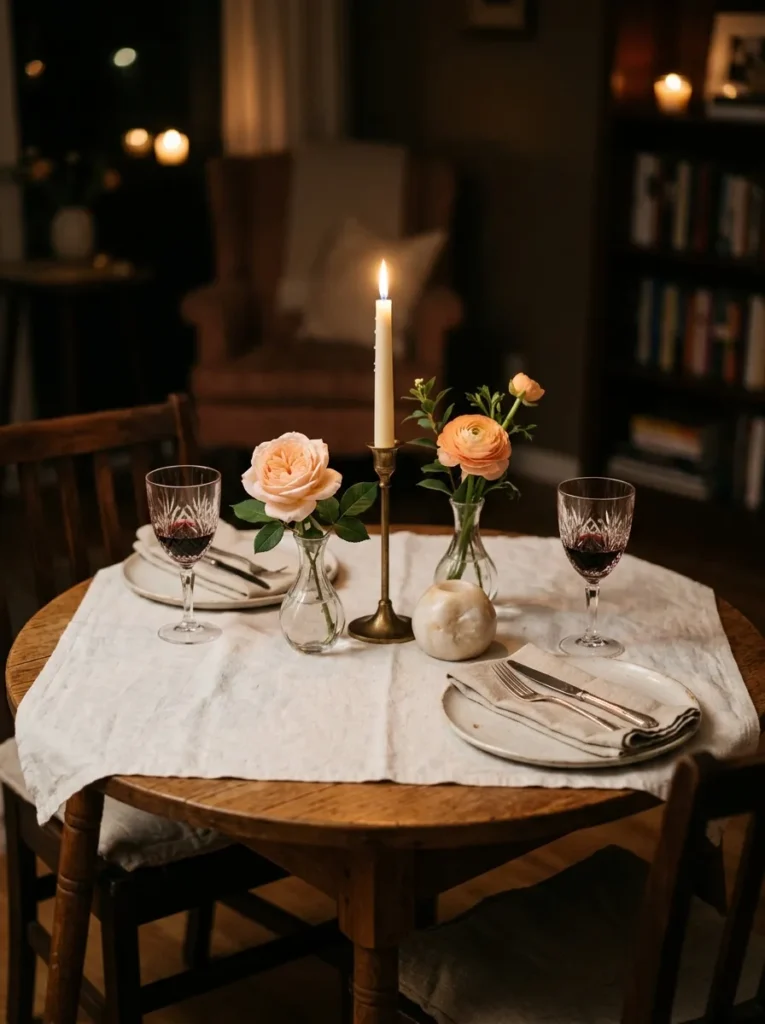
Vibe: Intimate and warm — the table for two that makes dinner at home feel more significant than dinner anywhere else.
Why it works: The intimate dinner for two table setting is the table decor idea that most directly applies the principle of restraint as the highest form of care — the decision to set only two places, with only the elements that serve those two people specifically, communicates a quality of attention and intention that a more elaborate setting cannot. The single stem rose in a slim bud vase is the floral choice that most precisely expresses this principle: one stem, chosen carefully, in a vessel sized for its singularity, reads as the opposite of abundance yet communicates more genuine care than an elaborate arrangement. The warm candlelight as the primary light source is the most important decision in the intimate dinner for two setting — candlelight at a small table creates a quality of enclosure and warmth that makes the two people at the table feel genuinely alone together even in a room that is not physically private.
How to get it: Use a single brass or silver taper candlestick at the exact center of the table — the single centered candlestick positions the candle flame as a shared light source equidistant from both settings, creating the specific quality of mutual illumination that two separate candlesticks on either side of the centerpiece cannot achieve. The bud vases should be positioned at the 10 and 2 o’clock positions relative to the central candle — close enough to the candle to be illuminated by it but not so close that they interrupt the candle’s visual primacy as the setting’s central element.
Shop the Look
| Product |
|---|
| Slim brass candlestick single |
| Slim bud vase pair |
| Single stem garden rose blush |
| Crystal wine glass pair |
| Marble small decorative object |
11. Festive Table with Gold, Greenery, and Taper Candles
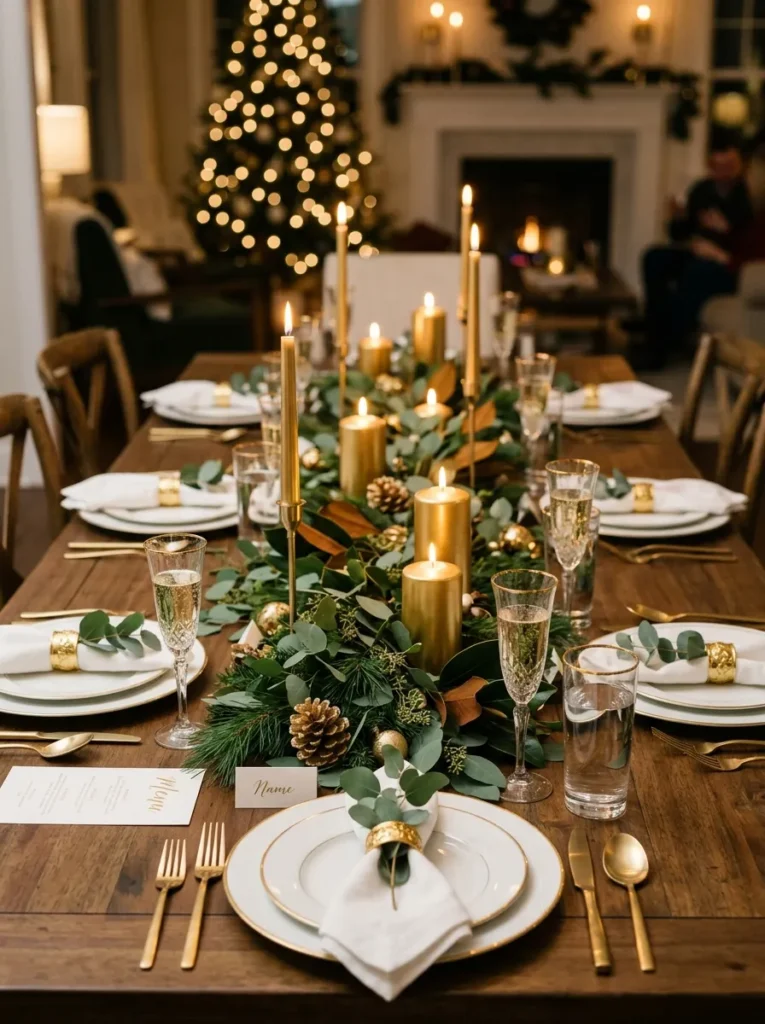
Vibe: Warm and festive — the celebration table that makes the occasion itself feel worthy of the setting before the first toast is raised.
Why it works: The festive table with gold, greenery, and taper candles is the table decor idea that most directly references the European feast tradition — the combination of evergreen botanicals (which have been used in winter celebrations across Northern Europe for millennia as symbols of life and continuity during the dark season) and warm gold candlelight creates the specific visual and atmospheric quality that humans recognize as festive at a near-instinctive cultural level. The deep forest green of the eucalyptus and pine against the warm gold of the candles and gilded accessories creates the most classic of color complements — a visual energy that reads as celebratory rather than merely decorative. The magnolia leaves in the greenery runner provide the structural, glossy-surface element that eucalyptus and pine cannot — their large, waxy leaves reflect the candlelight in a way that adds luminosity to the greenery composition.
How to get it: Build the greenery runner on the table directly rather than in a separate vessel — lay the eucalyptus branches, pine, and magnolia leaves directly on the tablecloth or runner in an overlapping arrangement, ensuring the cut stem ends are tucked under the following branch so no stem ends are visible. Spritz the fresh greenery lightly with water before laying to extend its freshness through the meal. Gold pillar candles should be placed on small gold or brass pillar holders that elevate them 20–30mm above the greenery surface to prevent fire risk from the botanical material.
Shop the Look
| Product |
|---|
| Fresh eucalyptus bunch |
| Gold pillar candle set |
| Gold-rimmed white ceramic plate |
| Gold napkin ring set |
| Gilded pinecone set |
12. Coastal Table with Shells, Driftwood, and Natural Linen
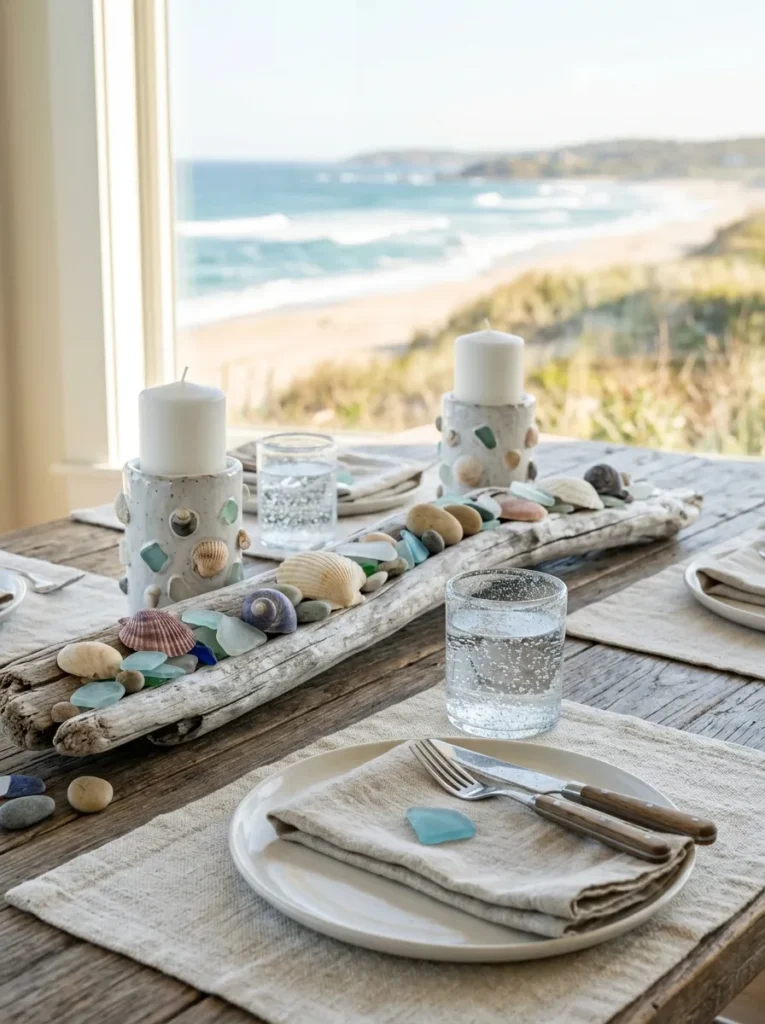
Vibe: Fresh and natural — the table that makes the ocean feel like it is just outside the window even when it is nowhere nearby.
Why it works: The coastal table with natural found materials is the table decor idea that most authentically references a specific natural environment through the use of genuine materials from that environment — shells, sea glass, driftwood, and smooth pebbles collected from an actual beach carry the specific material quality of having been shaped by the sea over time, which is a quality that manufactured coastal-themed decor cannot replicate regardless of its visual accuracy. Driftwood used as the centerpiece’s structural base rather than as a decorative accent is the compositional decision that most powerfully establishes the coastal material logic: the large driftwood piece serves as the table’s organizing element, onto which the smaller collected materials (shells, sea glass, pebbles) are composed as a curated beach find. This curatorial approach — the specific arrangement of genuinely collected materials — communicates the personal relationship with the coastal landscape that makes this table decor genuinely meaningful rather than merely thematic.
How to get it: Source the driftwood from a genuine beach collection — a piece approximately 400–600mm long with interesting natural form (gentle curves, texture variation, unexpected branching) is ideal as a centerpiece base. Allow collected shells and sea glass to dry completely before placing on the table — damp shells leave water marks on linen surfaces within minutes. Choose bubble glass tumblers (recycled glass with visible bubbles in the material) rather than standard clear glassware — the artisanal quality of bubble glass coordinates with the coastal found-material aesthetic more convincingly than machine-perfect glassware.
Shop the Look
| Product |
|---|
| Driftwood piece natural |
| Shell collection assorted |
| Sea glass piece set |
| Bleached linen placemat |
| Bubble glass tumbler set |
13. Everyday Table Setting with Flowers from the Garden
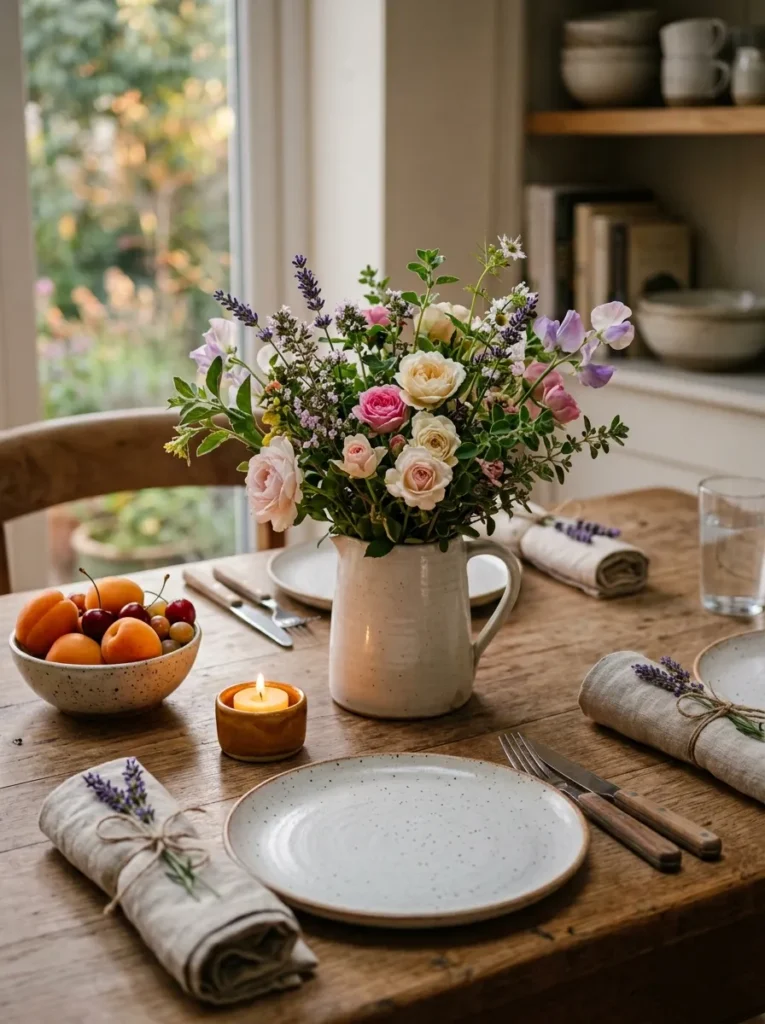
Vibe: Warm and everyday-lovely — the table that communicates that every meal at home is worth setting the table for, not just the special occasions.
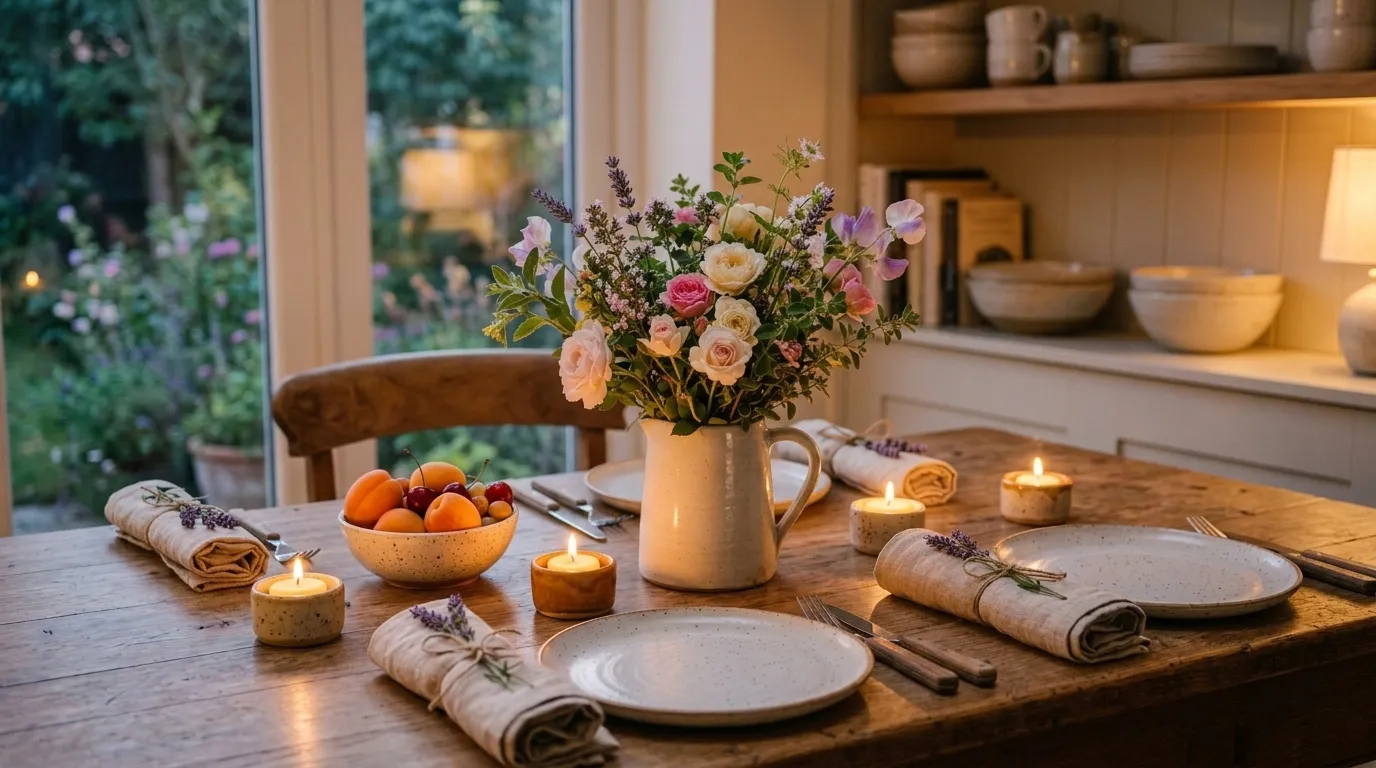
Why it works: The everyday table setting with garden flowers is the table decor idea that most powerfully makes the case for the design principle at the heart of this entire list — that the daily act of setting a table with some care and some beauty is one of the most consistently rewarding domestic practices available, producing a quality of daily life that accumulates into genuine wellbeing rather than waiting for special occasions to justify design attention. The garden flowers in a ceramic jug are the specific centerpiece choice that most accessibly achieves this daily table quality — they require no florist, no planning, and no expenditure beyond the fifteen minutes of cutting from whatever is blooming, and the result is always genuinely beautiful because garden flowers in season are always genuinely beautiful. The tea light candles in ceramic holders are the lighting decision that takes the everyday table from functional to atmospheric in a single action.
How to get it: Keep a ceramic jug or a small selection of bud vases in a consistent position in the kitchen so that the impulse to cut a few stems from the garden for the dinner table has an immediately available destination. The quality standard for an everyday garden flower table setting is not perfection — it is simply the evidence of care: three stems cut and placed in water in a ceramic jug, two tea lights lit, and a linen napkin beside each plate. These three actions, taking fifteen minutes in total, are the complete difference between a dinner table that communicates indifference and one that communicates care.
Quick Win: A set of six ceramic tea light holders ($15–25 from any homewares retailer) kept permanently in the kitchen and lit for every dinner — regardless of whether any other table decor effort is made — immediately transforms the quality of the daily dining experience at the absolute minimum investment of daily effort.
Shop the Look
| Product |
|---|
| Ceramic jug vase natural |
| Ceramic tea light holder set |
| Beeswax tea light candle pack |
| Natural linen napkin set |
| Seasonal fruit bowl ceramic |
How to Start Your Table Decor Practice
Your single first move is to identify the one table decor element that your table most consistently lacks and that would produce the highest daily improvement in its absence — and for most dining tables, that element is warm candlelight. The majority of dining tables that read as undecored are not lacking flowers or special textiles or designed centerpieces; they are lacking the warm, low-level ambient light of candles that transforms a functional eating surface into a designed environment. Before purchasing any florals, any new table linens, or any decorative objects for the table, place three beeswax tea light candles in any available holders at the center of your table, turn off the overhead lights, and observe the transformation for five minutes. This observation establishes the baseline quality that every other table decor decision builds on — and it demonstrates more convincingly than any mood board that the most impactful single table decor investment is not a beautiful centerpiece but a set of $12 beeswax tea lights and the discipline to light them every evening.
The most common table decor mistake is setting the table as a separate activity performed only for guests — reserving the beautiful napkins, the candlesticks, and the flowers for occasions that feel sufficiently important to warrant the effort, while eating daily at a functional surface that communicates the absence of that effort. The daily practice of setting the table with at least one beautiful element — whether that is a linen napkin, a single lit candle, or a bud vase with one stem from the garden — produces an entirely different quality of daily domestic life from the reserved-for-guests approach, because the quality of daily life is primarily determined by the quality of the daily, not by the quality of the occasional. The table decor ideas in this list are most valuable when they inform a daily practice, not when they provide a template for an annual celebration.
Three specific investments under $60 that create immediate table decor quality: (1) A set of six natural linen napkins ($35–55 from quality linen retailers) replaced on the table for every meal — the tactile quality of linen at the skin-level contact of napkin use is perceived at the closest possible range and communicates material care more immediately than any visual element at the table’s center. (2) A set of eight beeswax tea light candles ($12–20 from specialty candle retailers or health food stores) lit at the center of the table for every evening meal — beeswax tea lights provide a warmer, less acrid flame than standard paraffin tea lights, produce a natural honey scent that is barely perceptible but genuinely pleasant, and last approximately 4–6 hours each, making them the most cost-effective daily table lighting investment available. (3) One ceramic jug in a warm tone that lives on the kitchen counter specifically as the destination for any garden flowers, market stems, or foraged botanicals cut for the table — having a permanent, beautiful vessel ready for spontaneous cut flowers eliminates the friction of searching for a vase that makes the impulse more likely to be acted on.
Realistically, a complete celebration table setting — generous floral centerpiece, quality linen tablecloth and napkins, special occasion glassware, designed candlesticks, and coordinated ceramic tableware — costs $150–500 depending on the scale and the quality of individual elements. A focused three-element everyday table transformation — linen napkins, beeswax tea lights, and a ceramic jug for daily flowers — costs $60–90 and produces a dining experience that is genuinely, consistently more beautiful and more considered than the baseline of most domestic dining environments. Most households begin with the candles — the single element that produces the most dramatic transformation at the lowest cost with the least preparation — and build the table decor practice gradually from this established foundation of daily warm light.
Frequently Asked Questions About Table Decor
What is the most important element of a beautiful table setting?
Lighting is the most important single element of a beautiful table setting because it determines the quality of the sensory environment within which every other table decor element is experienced — the most beautiful flowers, the finest linens, and the most considered ceramics all read as significantly more beautiful in warm candlelight than under cool overhead lighting. The specific quality of candlelight (approximately 1800–2200K color temperature, the warmest light quality available in any domestic setting) creates a physiological response of relaxation, intimacy, and social warmth that no other light source can replicate, and this physiological response shapes the entire experience of eating at the table regardless of what other elements are present. A table with excellent lighting and modest everything else reads as more beautifully set than a table with excellent everything else and poor lighting.
How do I create a centerpiece that doesn’t block conversation?
The 200mm height rule is the most reliable guide for a conversation-compatible table centerpiece — keeping all centerpiece elements below 200mm in height ensures that no guest’s sightline across the table is blocked at the seated eye height of approximately 1200mm from the floor. The distributed approach (multiple small vessels along the central axis rather than one tall central arrangement) provides the most flexibility within this height constraint while allowing generous visual coverage along the table’s full length. The exception to the 200mm rule is the single tall element at the very center of a long table (six guests or more) — a tall centerpiece positioned at the precise geometric center of a very long table does not block sightlines between guests who are seated along the same side and is distant enough from guests at either end to remain above their sightlines.
What colors work best for table settings across different seasons?
The most effective seasonal color approach for table settings follows the natural color palette of each season rather than the conventional seasonal color assignments of commercial retail. Spring calls for the soft, dusty palette of early-season flowers — dusty blush, soft yellow, pale lavender, ivory white — rather than the bright primary colors that commercial spring palette tends toward. Summer calls for the saturated, abundant palette of high-season garden flowers — deep coral, warm yellow, intense green foliage — along with the natural materials of outdoor living (linen, rattan, garden ceramics). Autumn calls for the warm, earthy palette of the harvest season — terracotta, deep amber, burnt orange, deep burgundy, dried natural material — rather than the commercially themed pumpkin-orange and Halloween black. Winter calls for the deep, rich palette of candlelight, evergreen botanical, and warm metal — deep forest green, warm gold, aged brass, white — rather than the commercial red-and-green of conventional holiday tables.
How do I set a beautiful table on a very limited budget?
The three highest-impact, lowest-cost table decor practices are: lighting (beeswax tea lights at $0.50–1.50 each, lit for every evening meal), natural foliage from the garden or the immediate environment (a branch of whatever is interesting or beautiful in the outdoor environment costs nothing and is always seasonal), and linen napkins laundered and folded correctly (the quality of a well-pressed linen napkin at the skin-contact level communicates more material care than any decorative object on the table surface). These three practices together cost approximately $15–25 per month and produce a dining experience that is genuinely, significantly more beautiful than the absence of these practices. Beyond this baseline, farmers market seasonal flowers ($8–15 for a mixed bunch that can be divided among several small vessels) are the most cost-effective periodic table decor upgrade available.
What table textiles are most versatile for varied table decor occasions?
Natural linen in warm white or warm ivory is the most versatile table textile for any occasion or aesthetic context — it coordinates with every material palette, reads as appropriate for both everyday and celebratory occasions, improves visually with washing and aging (unlike synthetic fabrics that deteriorate with use), and provides the tactile quality of natural fiber that synthetic table textiles cannot replicate. A set of six warm white linen napkins purchased once will serve virtually every table decor occasion for a decade without appearing inappropriate for any setting. The tablecloth equivalent — a natural linen tablecloth in warm white — provides the neutral base on which any table decor idea can be built. Avoid synthetic linen-look fabrics, which provide the visual suggestion of linen without the tactile quality, the aging improvement, or the genuine naturalness that make real linen the most valuable table textile investment available.
Ready to Set Your Most Beautiful Table?
These 13 ideas span the full range of what a beautiful table can be — from a meadow floral arrangement running the full length of a celebratory dinner table to a single dried botanical arrangement in three ceramic vases that makes the table beautiful every day regardless of whether dinner is being served, from the dramatic opulence of a tall burgundy rose centerpiece with jewel-toned glassware to the everyday garden flower in a ceramic jug that makes Tuesday dinner worth sitting down for — so whether you are preparing a birthday celebration for twelve or setting the table for a Wednesday evening dinner for two, there is a genuinely achievable, genuinely beautiful table decor approach here for your specific occasion, your specific season, and the specific quality of daily domestic life you are working toward. The practice begins not with a special occasion but with today’s dinner — with the decision to light a candle, place one flower in a jar, and fold a linen napkin beside the plate before sitting down to a meal that is worth that simple, significant gesture. Today’s specific action: find one glass jar in your kitchen, fill it with water, cut one stem from whatever is blooming in your garden or whatever looks beautiful at the nearest market, place it at the center of your dinner table, and light one tea light beside it. Observe what that singular, fifteen-second action does to the quality of the room — and to the quality of the meal that follows. Save the ideas that matched your household’s specific aesthetic and your table’s specific occasions — those are the ones that will become the table decor practice that transforms daily eating into daily pleasure, and that makes every guest who sits at your table feel that someone genuinely wanted them there.