14 Inspiring Open Shelving Ideas for Kitchens
Open shelving in the kitchen is the practice of replacing upper cabinets with exposed shelves that display dishware, glassware, and cookware as part of the room’s everyday decor. This article gives you 14 specific, buildable ideas for bringing open shelving into your own kitchen. There’s a lightness open shelving brings to a room: walls that breathe instead of block, ceramics and glass catching the window light, a kitchen that feels curated rather than simply stocked. It borrows from both the exposed-brick, working-kitchen tradition of old European bistros and the current wave of minimalist Scandinavian kitchen design, which is exactly why it suits both rustic and modern homes alike. Here are 14 ideas worth saving — and stealing.
Why Open Shelving Works So Well
Open shelving draws from two traditions: the working bistro kitchens of old Europe, where exposed shelves kept everyday dishware within fast reach of the cook, and the pared-back Scandinavian kitchen movement that treats visible objects as part of the room’s design rather than clutter to hide. What makes open shelving distinct from simply removing cabinet doors is intentional styling — every item left visible is chosen because its shape, color, or material earns its place on display.
The material and color language favors warm oak or walnut shelf boards, paired with warm white or cream ceramics, stoneware in warm clay and sage tones, and glassware that catches light rather than blocking it. Brackets and hardware lean toward matte black or aged brass, kept slim so the shelf reads as a clean line rather than a bulky bracket-and-board structure.
This style is trending now because kitchen renovations increasingly favor lighter, more open layouts over heavy upper cabinetry, and Pinterest search data shows steady growth in “open shelving kitchen” as more homeowners look for a way to make a small or dark kitchen feel airier without a full remodel. The rise of curated, less-is-more dishware collections has also made open shelving more practical, since there’s simply less to hide.
Small kitchens benefit especially from open shelving, since removing bulky upper cabinets can make a tight room feel measurably larger and brighter. Prioritize one wall of shelving near the most-used prep zone before converting the entire kitchen’s storage.
Style at a Glance
| Element | Bistro Working Kitchen | Scandinavian Minimal |
|---|---|---|
| Philosophy | Functional, fast-reach | Curated, pared-back |
| Materials | Oak, ceramic, glass | Painted wood, stoneware |
| Color palette | Warm white, walnut, clay | Warm white, sage, oak |
14 Inspiring Open Shelving Ideas for Kitchens
1. Warm Oak Floating Shelf Trio
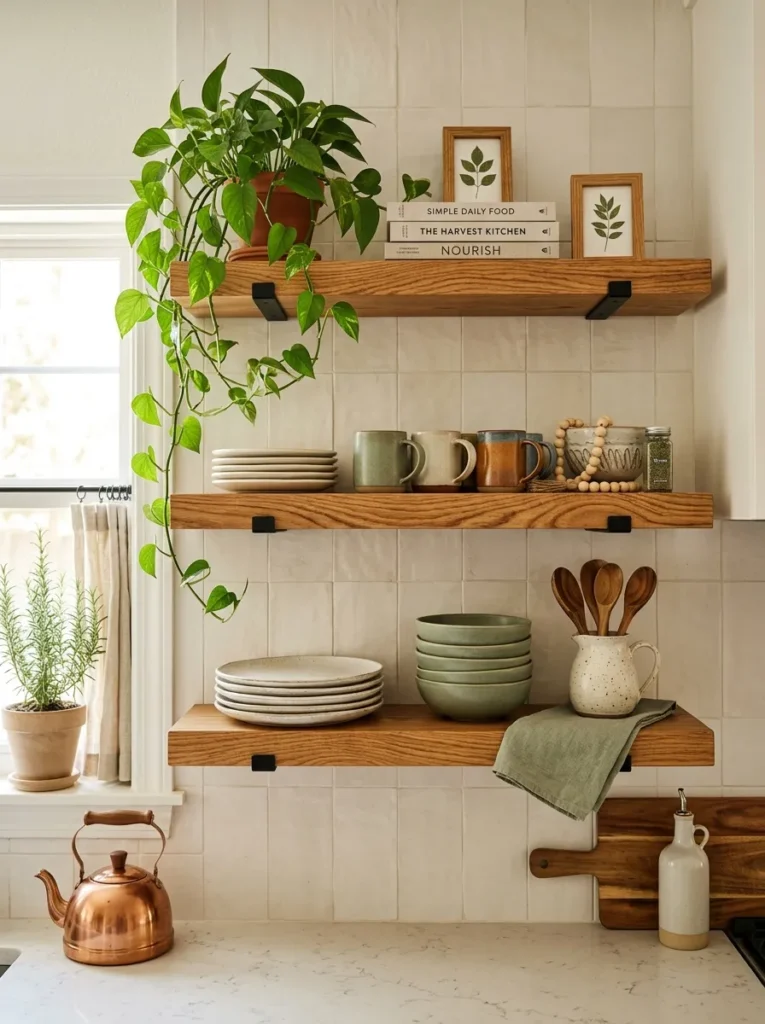
Vibe: Warm, like the wall itself became part of the kitchen’s daily rhythm.
Why it works: Stacking three shelves at even 10-inch intervals uses the design principle of rhythm and repetition, creating a clean vertical grid that reads as intentional rather than a single overloaded shelf trying to hold everything.
How to get it: Mount three oak shelves 10 inches apart above the counter, keeping the top shelf reserved for rarely used pieces and the bottom shelf for daily dishware so the most-reached items sit closest to hand.
Shop the Look
| Product |
|---|
| Warm oak floating shelf set of 3 |
| Matte black shelf bracket kit |
| Warm white ceramic dinnerware set |
| Small ceramic pitcher |
| Faux trailing pothos plant |
Also view: 13 IKEA MALM Dresser Hacks That Transform Any Room
2. Warm White Stacked Dish Display
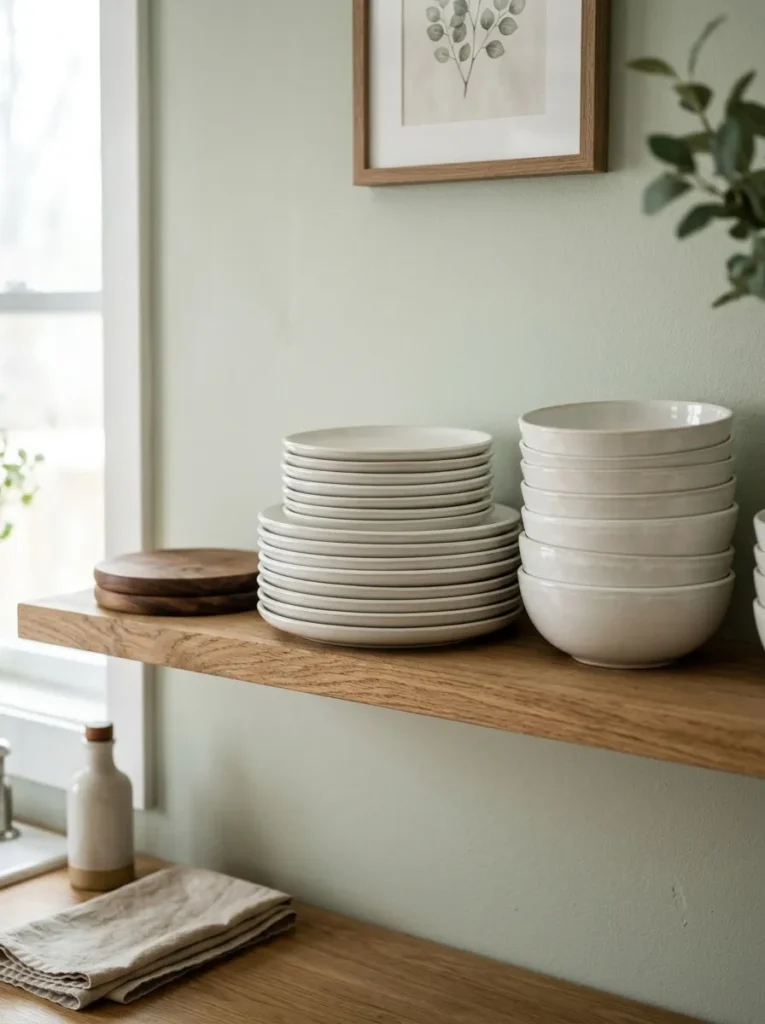
Vibe: Calm, like even the dishes agreed to a single quiet palette.
Why it works: Keeping every plate and bowl in the same warm white glaze uses color restraint as the organizing principle, so a shelf of mismatched shapes still reads as a cohesive collection rather than a jumble.
How to get it: Stack plates by size from largest to smallest, and choose bowls in the same warm white stoneware line so the entire display sits within one consistent tone rather than mixing patterns or finishes.
Quick Win: Swapping just your daily-use plates for a matching warm white set is the fastest way to unify an already-open shelf.
Shop the Look
| Product |
|---|
| Warm white stoneware dinner plate set |
| Warm white stoneware bowl set |
| Oak wood trivet small |
| Matte black shelf bracket pair |
| Oak wood shelf board |
Also view: 15 Indoor Plant Ideas Worth Saving for Every Home
3. Walnut and Brass Wine Glass Rail
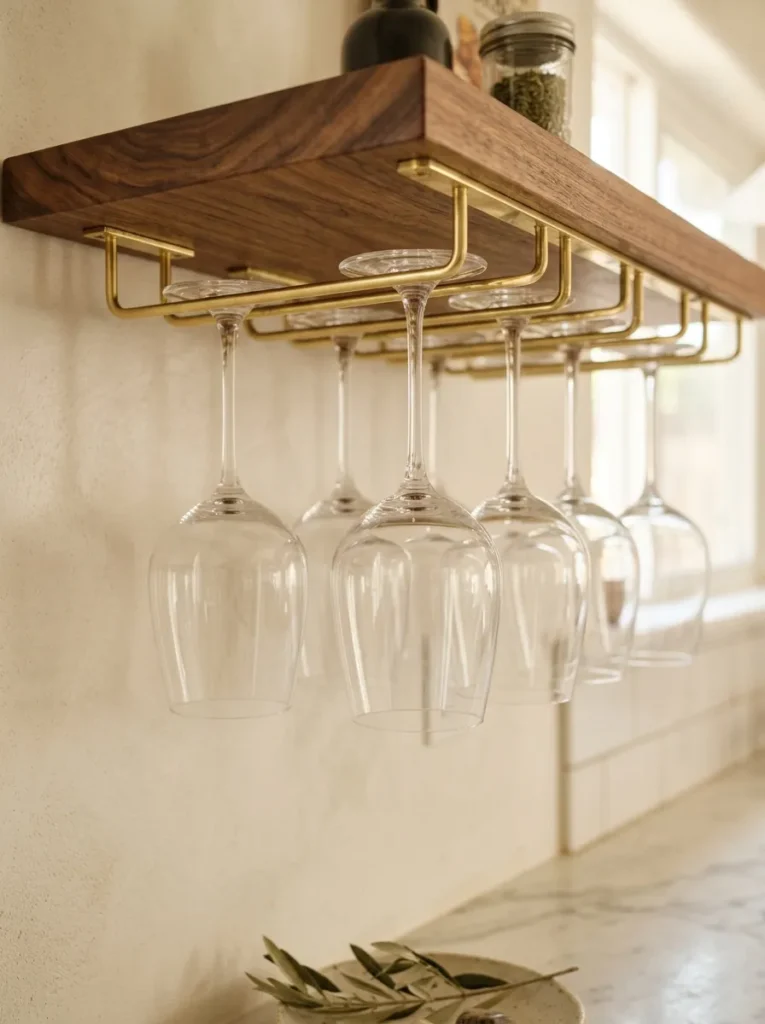
Vibe: Elegant, like the kitchen borrowed a little bit of restaurant polish.
Why it works: Hanging stemware upside down from a rail rather than standing glasses on the shelf surface uses vertical space more efficiently, a material and hardware choice that also keeps dust from settling inside the glass bowls.
How to get it: Mount a walnut shelf with a brass stemware rail fitted underneath, spacing the slots about 3 inches apart so each glass hangs freely without knocking against its neighbor.
Shop the Look
| Product |
|---|
| Walnut wood floating shelf with rail |
| Brass stemware rail hardware |
| Wine glass set clear |
| Matte black shelf bracket |
| Small ceramic coaster dish |
4. Small Kitchen Corner Shelf Wrap
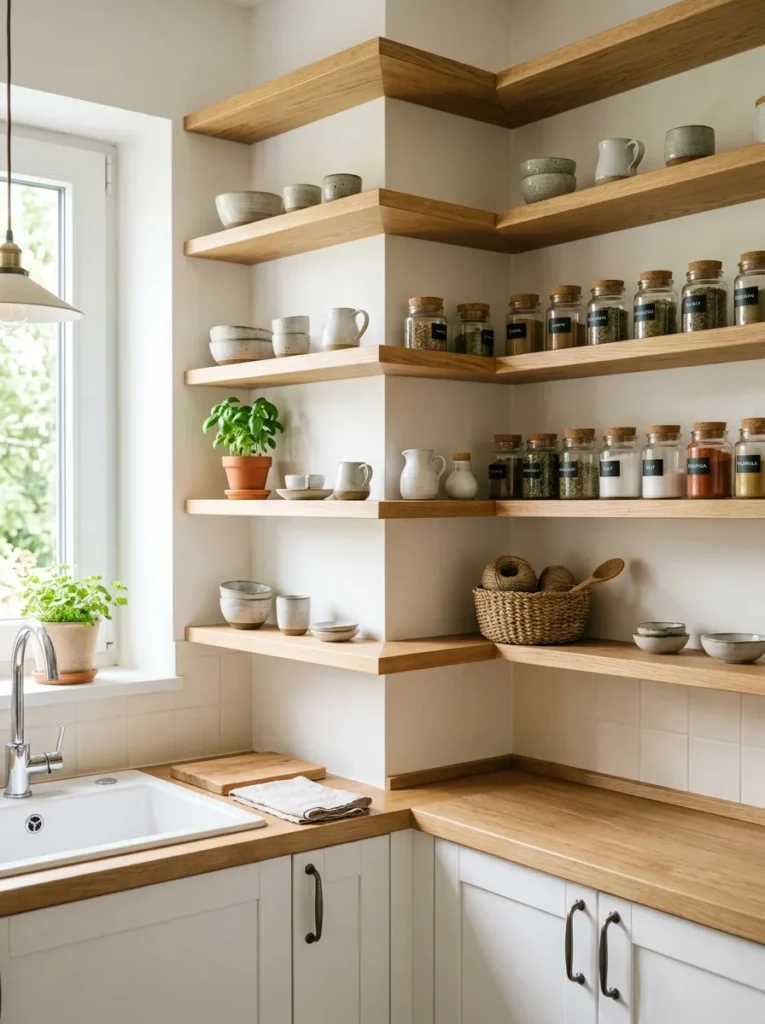
Vibe: Efficient, like the awkward corner finally found a real job.
Why it works: Wrapping the shelf around a corner rather than stopping at the wall edge uses negative space that’s typically wasted in small kitchens, an illusion technique that adds real storage capacity to a spot most layouts simply leave empty.
How to get it: Miter the shelf boards at a 45-degree corner joint so the oak grain continues visually around the bend, filling the corner section with smaller items like spice jars that fit the tighter depth.
Shop the Look
| Product |
|---|
| Oak wood corner shelf kit |
| Small glass spice jar set |
| Matte black corner bracket |
| Small woven storage basket |
| Canvas label sticker sheet |
5. Sage Green Painted Shelf Backdrop
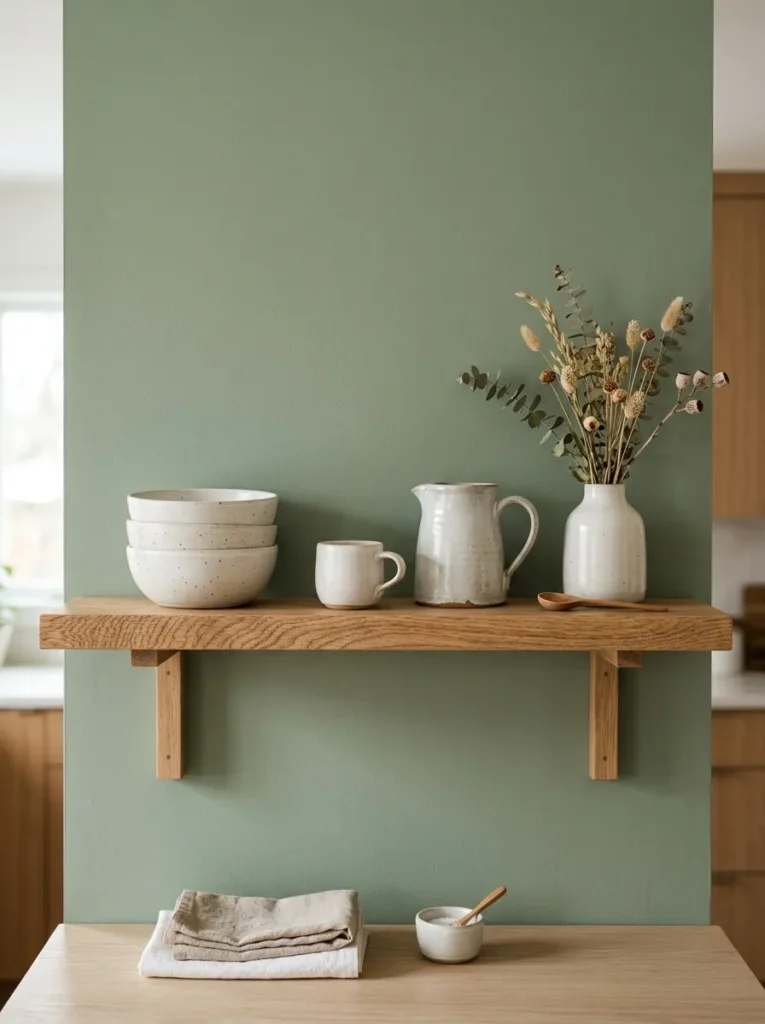
Vibe: Fresh, like the wall gave the dishware somewhere worth standing out against.
Why it works: Painting the wall behind the shelf in a muted sage rather than leaving it the same white as the rest of the kitchen uses value contrast, a color principle that makes the display pop without needing bold or busy dishware to do the work.
How to get it: Paint just the wall section directly behind the shelving in matte sage, keeping the surrounding kitchen walls in warm white so the color reads as a deliberate backdrop rather than a full room repaint.
Shop the Look
| Product |
|---|
| Matte sage interior paint sample |
| Oak wood floating shelf |
| Warm white ceramic mug set |
| Dried botanical stem bundle |
| Matte black shelf bracket |
6. Terracotta and Oak Material Mix Shelf
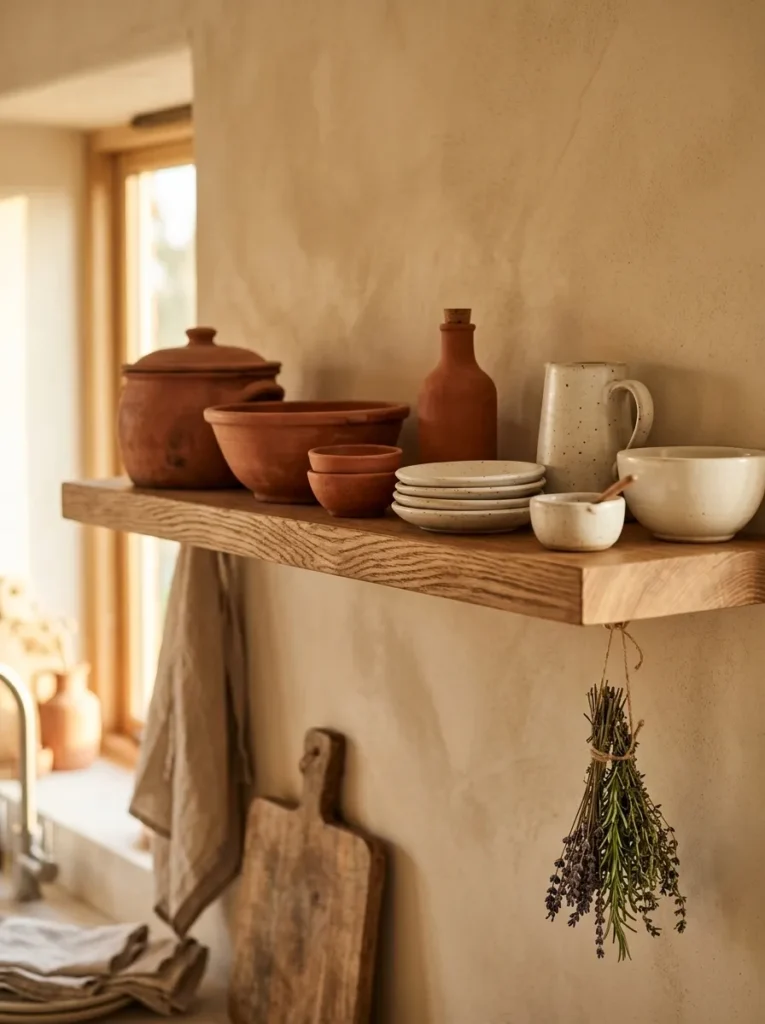
Vibe: Earthy, like the shelf pulled its palette straight from a farmhouse pantry.
Why it works: Mixing matte terracotta pieces with warm white ceramics on the same warm oak shelf uses tonal layering, a color principle that keeps the display visually rich without needing more than two core color families.
How to get it: Group terracotta pieces, like a pitcher or small bakeware, toward one end of the shelf and warm white pieces toward the other, letting the oak shelf itself act as the neutral thread tying both groups together.
Shop the Look
| Product |
|---|
| Oak wood floating shelf |
| Terracotta ceramic pitcher |
| Warm white ceramic bowl stack |
| Dried herb bundle small |
| Matte black shelf bracket |
7. Warm Puck Light Under-Shelf Glow
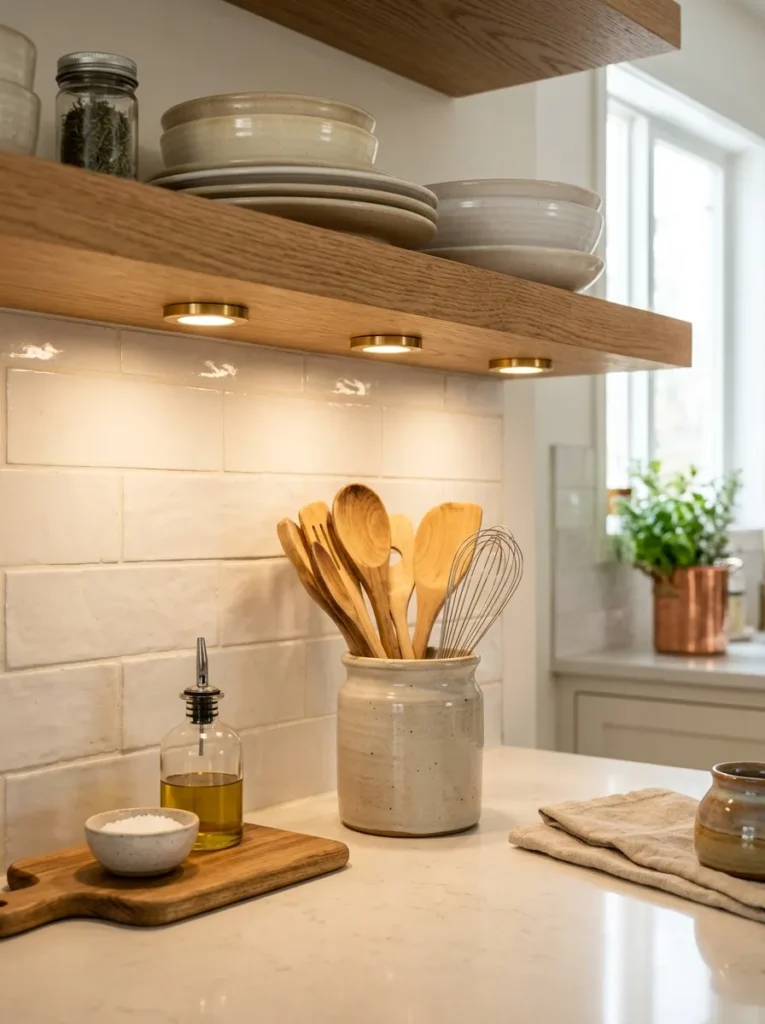
Vibe: Functional, like the counter below finally got proper task light.
Why it works: Recessing small puck lights under the shelf edge uses light behavior to illuminate the prep surface directly below, a lighting principle that solves the common under-cabinet lighting gap open shelving otherwise leaves behind.
How to get it: Install two to three battery-powered brass puck lights under each shelf’s front edge, spaced evenly so the countertop below receives even coverage without dark gaps between fixtures.
Quick Win: Battery puck lights need no wiring and can be repositioned in minutes if you rearrange the shelf later.
Shop the Look
| Product |
|---|
| Brass battery-powered puck light set |
| Oak wood floating shelf |
| Small ceramic utensil crock |
| Warm white LED puck bulb |
| Adhesive mounting strip kit |
8. Layout: Zoned Shelving by Cooking Task
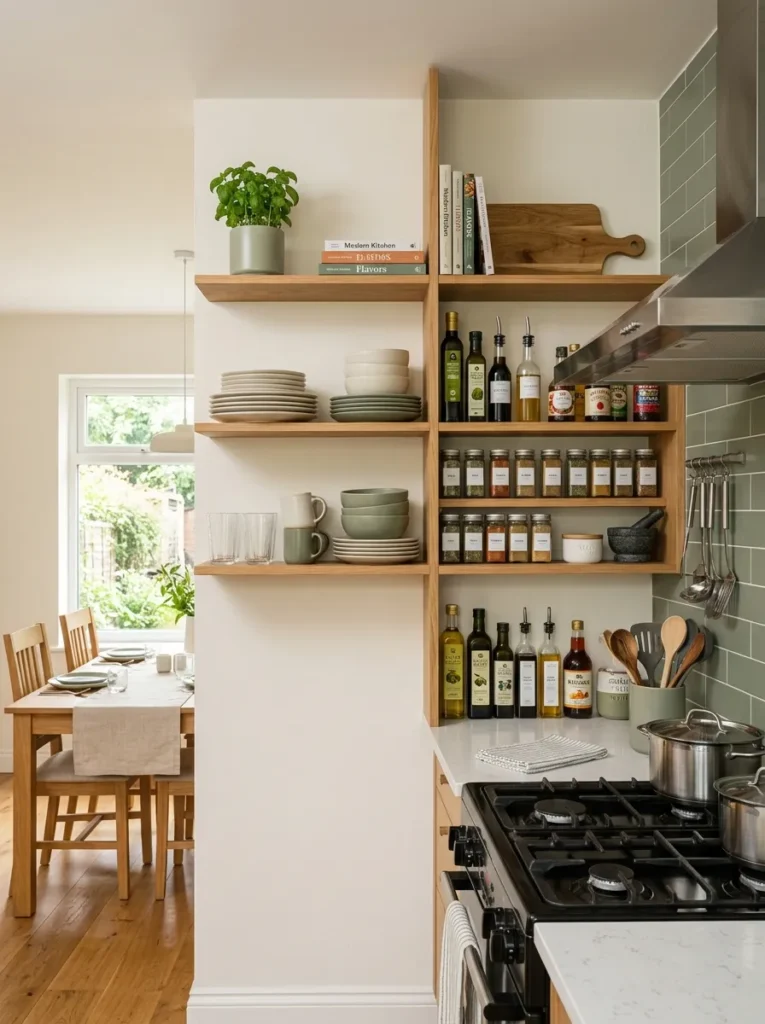
Vibe: Organized, like the shelves already understand how you cook.
Why it works: Assigning each shelf section to the task performed nearest to it, dishware by the table, oils by the stove, uses the layout principle of matching storage location to actual behavior, reducing the number of steps taken during a typical meal.
How to get it: Mount one shelf run near the dining area for plates and glassware, and a separate shorter run beside the stove for oils, spices, and frequently used cooking tools, keeping each zone visually distinct through its contents alone.
Shop the Look
| Product |
|---|
| Oak wood floating shelf set |
| Warm white dinnerware stack |
| Glass oil and vinegar cruet set |
| Small potted herb plant |
| Matte black shelf bracket kit |
9. Small Space Single Statement Shelf
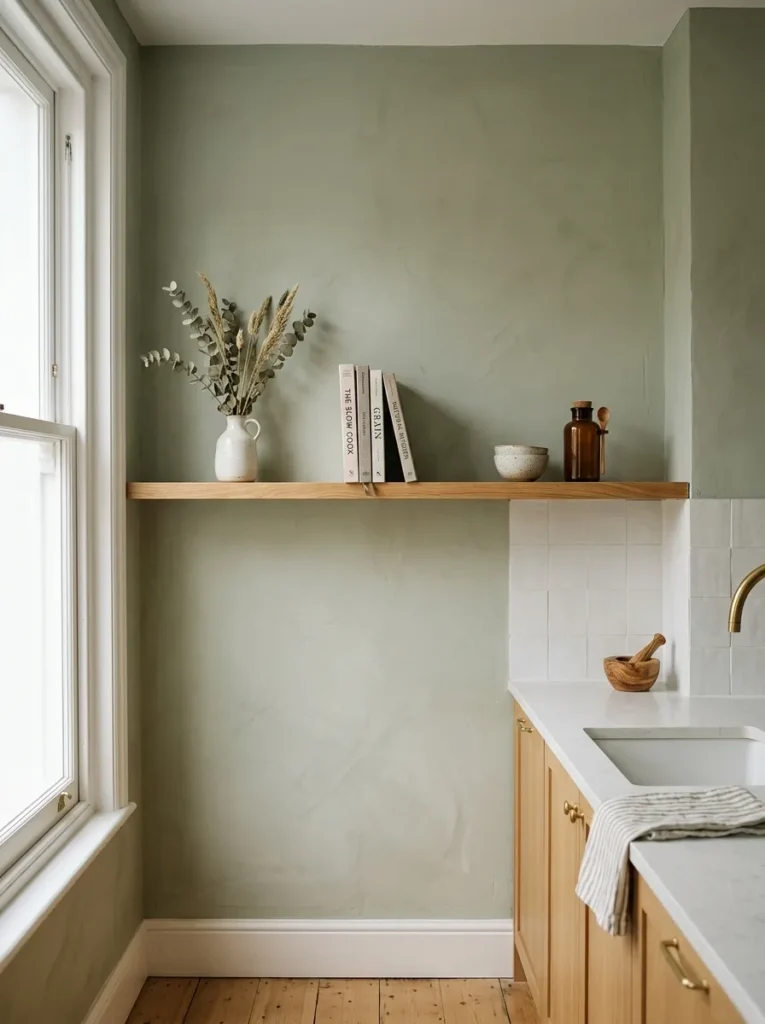
Vibe: Still, like one confident shelf said more than three cluttered ones could.
Why it works: In a genuinely small kitchen, a single long shelf styled sparingly avoids the visual weight multiple stacked shelves would add, a small-space technique where restraint itself becomes the design choice.
How to get it: Install one oak shelf spanning the full available wall width, and limit the styling to no more than five objects total so the negative space between them does as much visual work as the objects themselves.
Shop the Look
| Product |
|---|
| Long oak wood floating shelf |
| Small ceramic vase warm white |
| Matte black shelf bracket pair |
| Small wood cutting board display |
| Dried floral stem accent |
10. Woven Basket Dry Goods Shelf
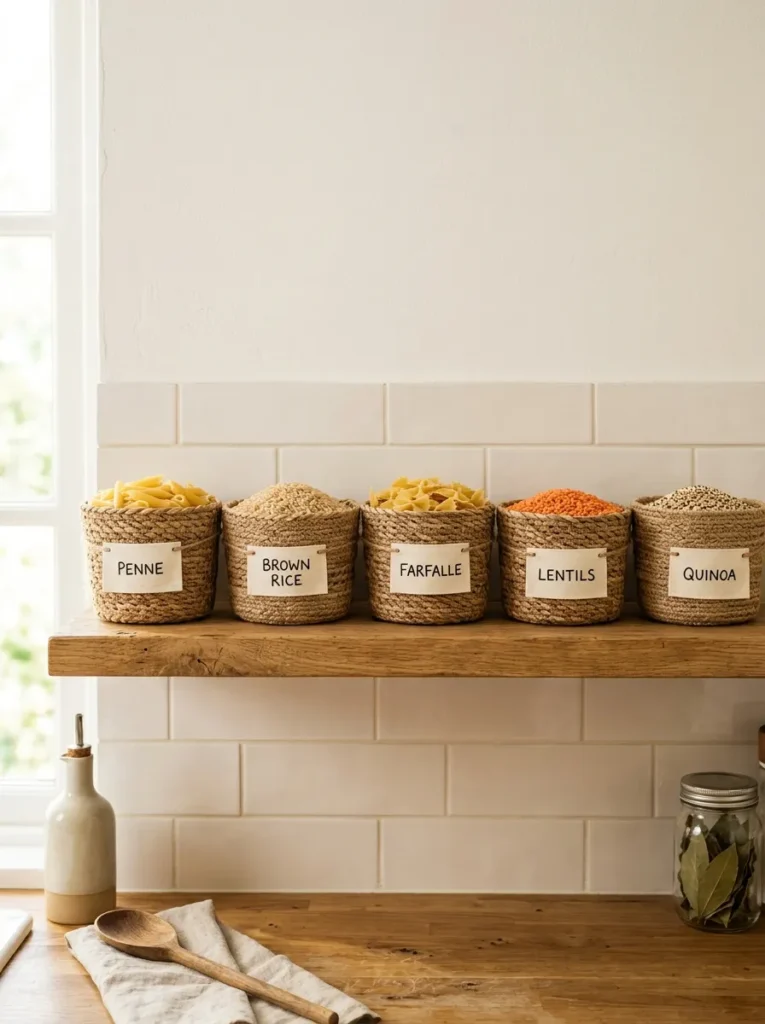
Vibe: Textural, like the pantry basics got promoted to decor.
Why it works: Using woven baskets to corral loose dry goods rather than leaving bags and boxes visible uses a material choice that keeps an open shelf from tipping into visual clutter, since the baskets standardize the shape of everything on display.
How to get it: Decant dry goods into clear jars or small canvas bags first, then group them inside matching woven baskets sized to the shelf depth, labeling each basket so contents stay identifiable without lifting the lid.
Shop the Look
| Product |
|---|
| Small woven seagrass basket set |
| Clear glass storage jar set |
| Canvas label tag set |
| Oak wood floating shelf |
| Small wood scoop |
11. Matte Black Shelf and Warm White Wall Contrast
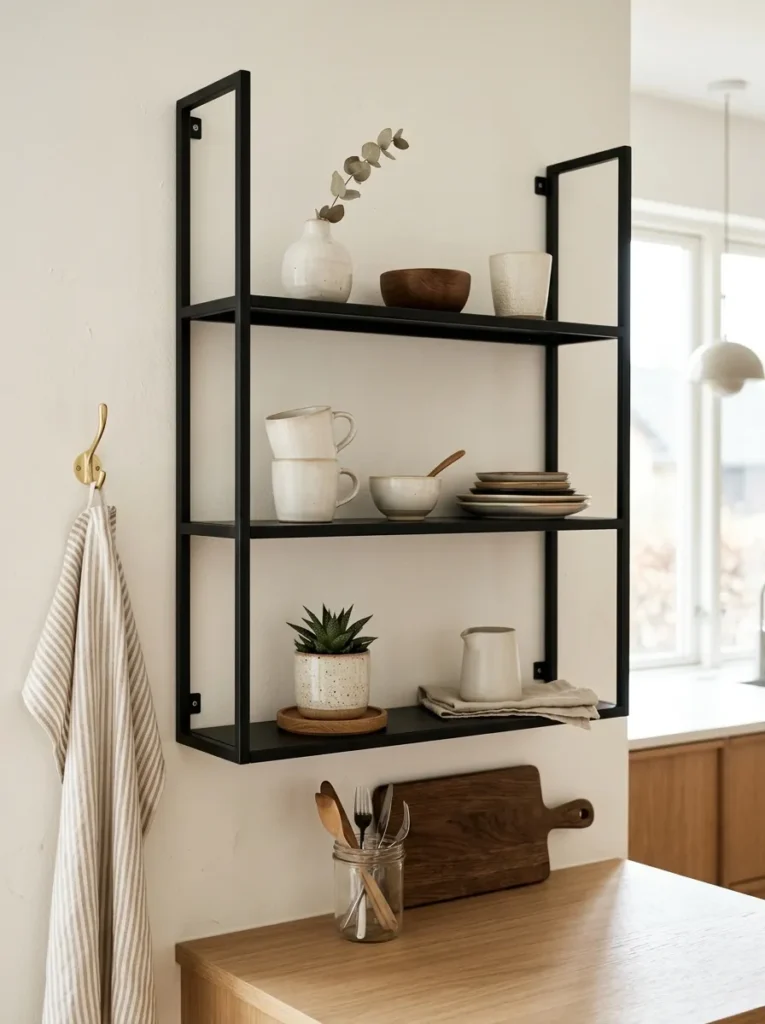
Vibe: Modern, like the shelf itself became the room’s graphic line.
Why it works: Swapping a wood shelf for matte black metal against a warm white wall uses maximum value contrast, a material principle that makes the shelf read as an architectural line rather than blending into the wall the way a lighter wood shelf might.
How to get it: Choose slim matte black steel shelf brackets and boards, keeping the styled objects minimal and light-toned so the contrast stays between the shelf and wall rather than getting lost among busy dishware.
Shop the Look
| Product |
|---|
| Matte black steel floating shelf |
| Warm white ceramic vase small |
| Small brass utensil hook |
| Warm white ceramic bowl pair |
| Wall anchor mounting kit |
12. Small Nook Cookbook Ledge Shelf
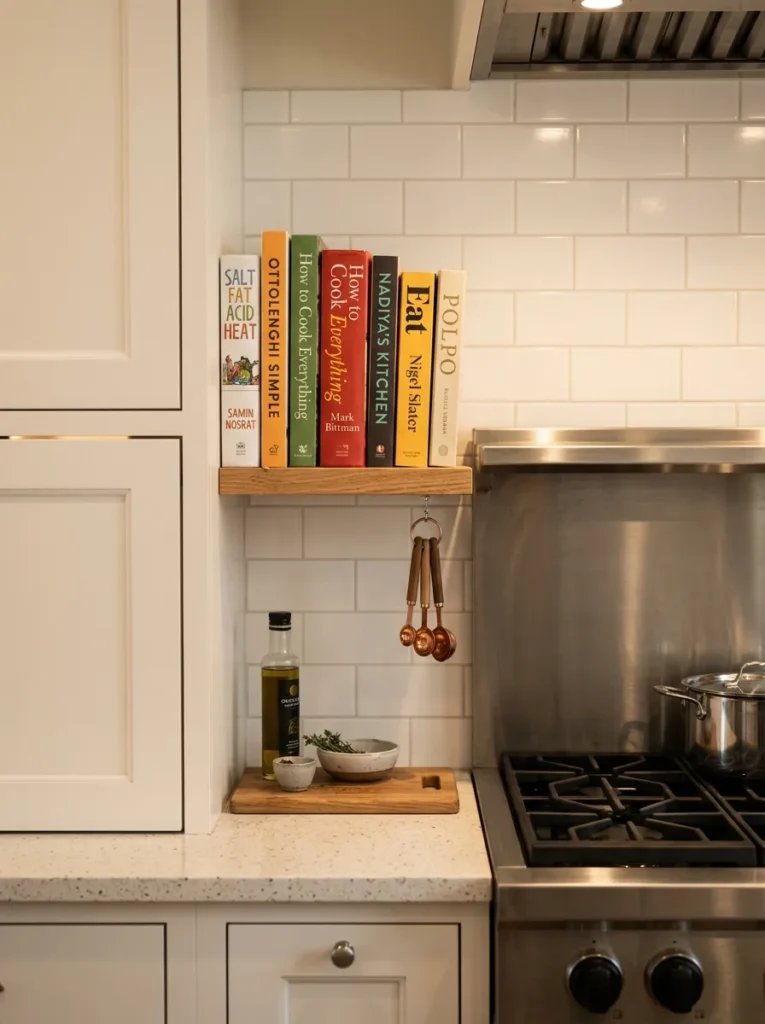
Vibe: Efficient, like the sliver of wall next to the stove finally earned its keep.
Why it works: A shallow ledge only needs a few inches of depth to hold books upright, an illusion technique that fits genuine storage into a gap too narrow for a standard shelf or cabinet.
How to get it: Mount a shallow oak ledge, no more than 4 inches deep, in any narrow wall gap near the cooking zone, standing three or four frequently used cookbooks upright rather than stacking them flat.
Quick Win: A standard picture ledge shelf from a home store works identically for this use without needing a custom cut.
Shop the Look
| Product |
|---|
| Shallow oak wood ledge shelf |
| Small brass bookend pair |
| Wall anchor mounting screws |
| Small measuring spoon set |
| Canvas recipe card box |
13. Layout Flow: Shelf Placement Clear of Traffic
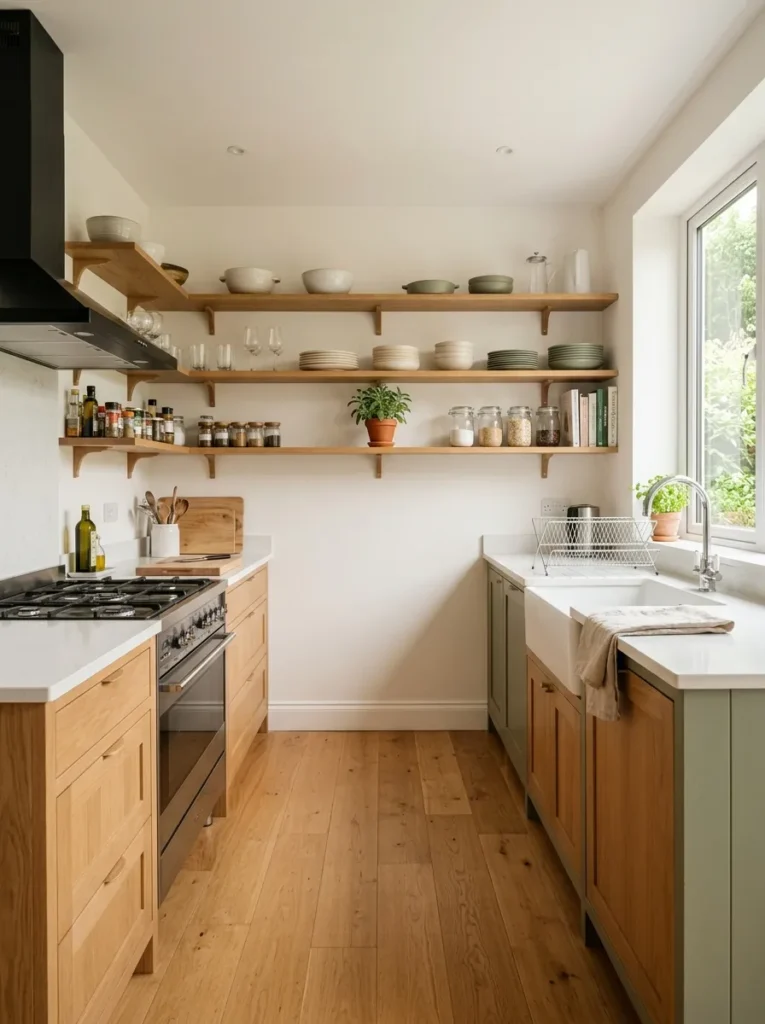
Vibe: Organized, like the kitchen was mapped out before a single shelf went up.
Why it works: Positioning shelving outside the direct path between the stove, sink, and fridge respects the kitchen work triangle, a layout principle that keeps the most efficient cooking route free of reaching or ducking around protruding shelves.
How to get it: Map your kitchen’s stove-sink-fridge triangle first, then install shelving only on walls outside that direct path, keeping at least 18 inches of clearance from any shelf edge to the nearest walking route.
Shop the Look
| Product |
|---|
| Oak wood floating shelf pair |
| Small potted herb plant |
| Warm white ceramic mug set |
| Matte black shelf bracket kit |
| Small wood cutting board |
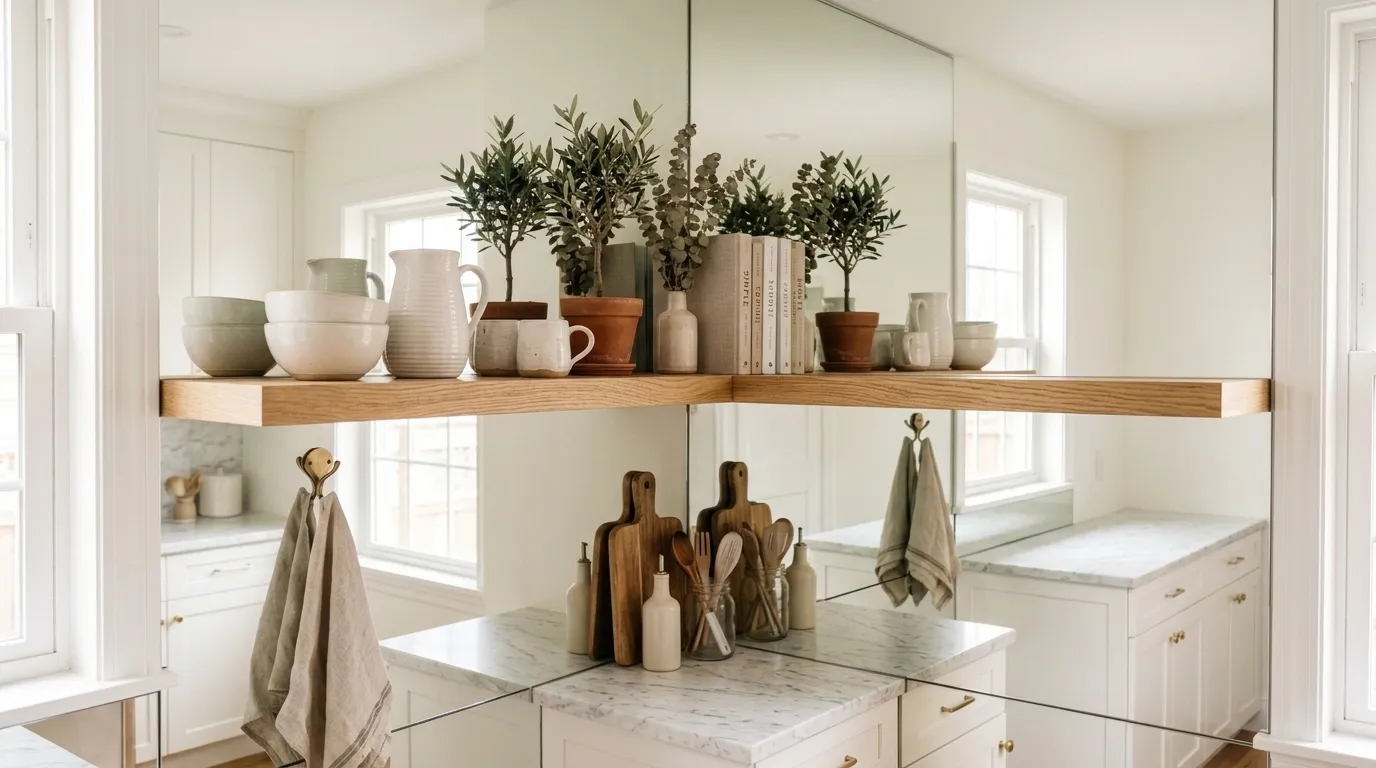
14. Small Space Illusion Mirrored Backsplash Shelf
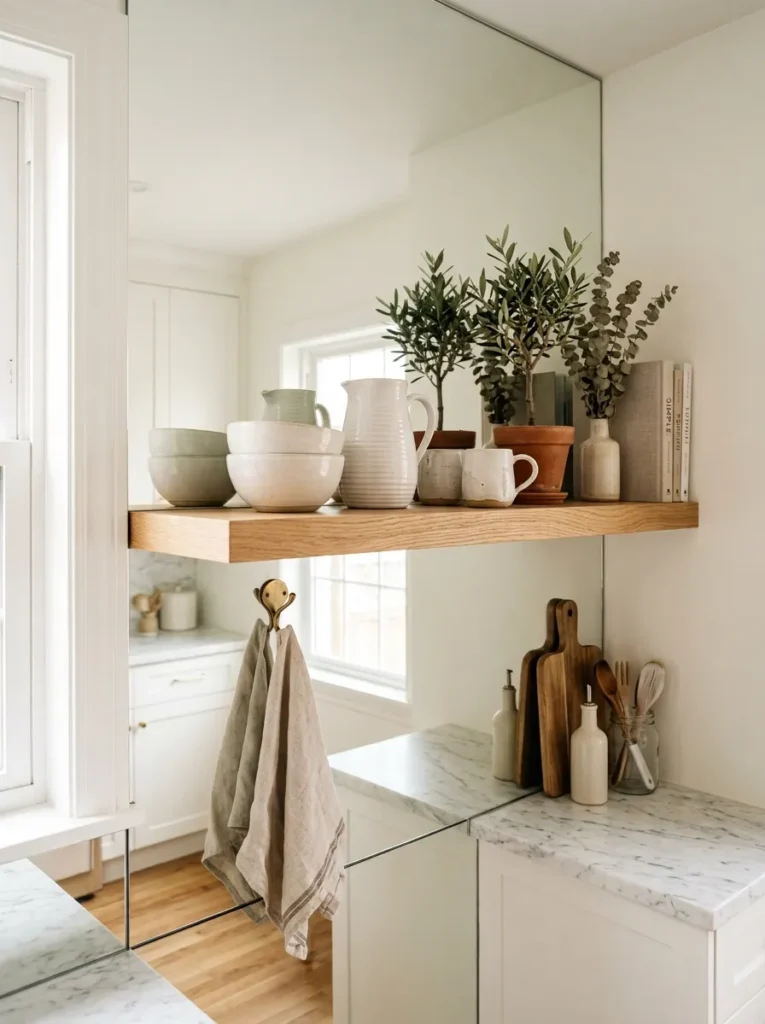
Vibe: Airy, like the small kitchen wall doubled its own depth.
Why it works: Mounting the shelf against a mirrored panel reflects both light and the styled objects themselves, an illusion technique that makes a narrow galley kitchen wall read as significantly deeper than it physically is.
How to get it: Install a mirrored backsplash panel behind a single oak shelf, keeping the styled objects to a light, uncluttered handful so the reflection reads as an extension of the display rather than a confusing double image.
Shop the Look
| Product |
|---|
| Mirrored backsplash panel kit |
| Oak wood floating shelf |
| Warm white ceramic pitcher |
| Small brass utensil hook |
| Mirror-safe mounting adhesive |
How to Start Your Open Shelving Transformation
Start with one wall, not the whole kitchen. Choose the single wall nearest your most-used prep zone and remove just the cabinets there first, since converting one section lets you live with the open display before committing your entire dish collection to full visibility.
The most common mistake is leaving mismatched, everyday clutter fully exposed the moment the cabinet doors come off. A shelf of random mugs and takeout containers reads as messy rather than styled; before removing any door, sort your dishware down to pieces in a consistent color or material family, and store anything mismatched elsewhere.
Three items under $50 that make an immediate difference: a single warm oak floating shelf with brackets, a small woven basket for dry goods, and a matching set of three warm white ceramic mugs to replace mismatched everyday cups.
A basic version — one shelf wall with curated dishware — is a weekend project costing $80 to $200. A full-kitchen conversion replacing all upper cabinets with shelving runs $600 to $2,000 and typically takes one to two weekends, plus additional time if any wall patching or painting is needed after cabinet removal.
Frequently Asked Questions About Open Kitchen Shelving
What are the pros and cons of open shelving compared to upper cabinets?
Open shelving makes a kitchen feel lighter and larger since it removes the visual bulk of cabinet doors, and it keeps daily-use items within faster reach. The trade-off is that shelved items collect dust and grease more easily than closed storage, and the display requires ongoing curation, since a poorly styled open shelf reads as cluttered in a way a closed cabinet never does.
What color and material choices work best for open kitchen shelves?
Warm oak or walnut shelf boards paired with warm white or sage-toned ceramics create the most flexible, timeless base, since these tones photograph well and rarely clash with existing cabinetry. Matte black metal shelving offers a more graphic, modern alternative when paired with a lighter wall color for contrast.
How much does it cost to convert a kitchen to open shelving?
A single-wall conversion with a curated dish collection runs $80 to $200. A full-kitchen replacement of all upper cabinets with shelving typically costs $600 to $2,000, with the price driven mainly by shelf material quality and any wall repair needed after removing the original cabinet boxes.
Is open shelving practical for a small kitchen, or does it work better in larger spaces?
Open shelving is often more practical in a small kitchen than a large one, since removing bulky upper cabinets makes a tight room feel measurably brighter and more spacious. A single long, sparsely styled shelf tends to work better in a small kitchen than several stacked, heavily decorated ones, since restraint keeps the space from feeling more crowded.
How do I keep open shelves from looking cluttered or collecting too much dust?
Limiting each shelf to items in a consistent color or material family keeps the display visually calm, and grouping loose dry goods into matching baskets or jars prevents the shelf from reading as a random collection. For dust, choosing pieces you use often enough to wash and restack regularly naturally keeps buildup to a minimum, since the biggest culprit is usually rarely touched decorative pieces left untouched for months.
Ready to Try Open Shelving in Your Kitchen?
Between oak shelf trios, zoned layouts, mirrored backsplashes, and warm puck lighting, these 14 ideas cover a full range of ways to bring open shelving into a kitchen of any size. Starting with just one wall near your prep zone is not a half-measure, it’s the smartest way to test the style before committing your whole dish collection to full display. Today, sort through your everyday dishware and set aside the pieces that share a consistent color or material family for that first shelf. Once it’s mounted and styled, the kitchen will feel lighter and more considered, the kind of room where morning coffee feels a little more like a small ritual than a routine. Save your favorite ideas now — especially the lighting tricks, since a well-lit shelf is what makes the whole display feel finished after dark.