14 Cozy Fabric Headboard Ideas for Dream Bedrooms
Cozy fabric headboard ideas transform the bedroom’s most prominent architectural feature — the wall surface behind the bed — using upholstered panels, padded frames, gathered fabric, button-tufted constructions, and wall-mounted textile installations to create the specific visual and tactile warmth that a bare wall, a wooden bedhead, or a metal frame cannot provide. This article gives you exactly 14 ideas spanning DIY builds, commercial upholstered options, renter-friendly non-permanent solutions, and statement-scale installations so every bedroom size, every budget, and every aesthetic finds a fabric headboard approach that genuinely transforms the sleep environment.
A fabric headboard done well creates the bedroom’s most significant single atmospheric change — the softness of upholstered material at the wall behind the bed signals comfort and enclosure in a way that hard architectural surfaces do not, and the color, texture, and pattern of the chosen fabric sets the room’s dominant aesthetic tone from the moment of entering. Here are 14 ideas worth implementing.
Why Cozy Fabric Headboard Ideas Work for Dream Bedrooms
The headboard occupies a specific and uniquely consequential position in the bedroom’s visual hierarchy: it is simultaneously the room’s primary focal point (the first surface the eye travels to on entering a bedroom), the most consistently experienced element of the sleep environment (visible throughout the pre-sleep period from any position on the bed), and the largest single surface of the bedroom whose treatment is entirely within the occupant’s design control (unlike walls, floors, windows, and doors, which are architectural givens). A fabric headboard therefore represents the highest-leverage single design decision available in any bedroom — its material, color, texture, and scale affect the room’s atmosphere more completely than any other addition or change of comparable investment.
The specific warmth of fabric versus other headboard materials comes from two distinct properties that upholstered surfaces share and that wood, metal, and painted wall surfaces do not. First, visual warmth: fabric surfaces absorb light rather than reflecting it, creating the matte, light-absorbing quality that the visual system associates with warmth, softness, and enclosure. A velvet headboard in forest green, a linen panel in warm oat, or a boucle upholstered frame in cream each produces a specifically different visual texture while sharing the fundamental light-absorbing quality that reads as warm. Second, tactile warmth: upholstered headboards that are used for sitting up in bed (reading, working, watching — all the activities that precede sleep in most modern bedrooms) provide a genuinely comfortable backrest that hard materials do not. The foam or polyester fill behind the fabric surface creates the cushioning that makes sitting up in bed against a headboard a comfortable extended posture rather than an uncomfortable one.
The DIY accessibility of fabric headboards specifically is the practical argument for the category — a plywood panel cut to the desired shape, covered with 5cm polyester foam and upholstery fabric, and fixed to the wall provides a result indistinguishable from commercial upholstered headboards at 20–30% of their cost. The principal skills required (measuring, cutting fabric, staple-gunning, and basic wall fixing) are achievable by any adult with basic practical ability and an afternoon’s commitment.
Style at a Glance
| Element | Headboard Function | Fabric Design Edge |
|---|---|---|
| Philosophy | The wall behind the bed is the bedroom’s focal point | Fabric creates warmth that hard materials cannot |
| Materials | Velvet, linen, boucle, cotton, textured weave | Foam, plywood, batting, staple gun, button needle |
| Scale Range | Simple panel to full wall-height installation |
14 Cozy Fabric Headboard Ideas for Dream Bedrooms
1. Classic Button-Tufted Linen Panel — The Foundational Upholstered Look
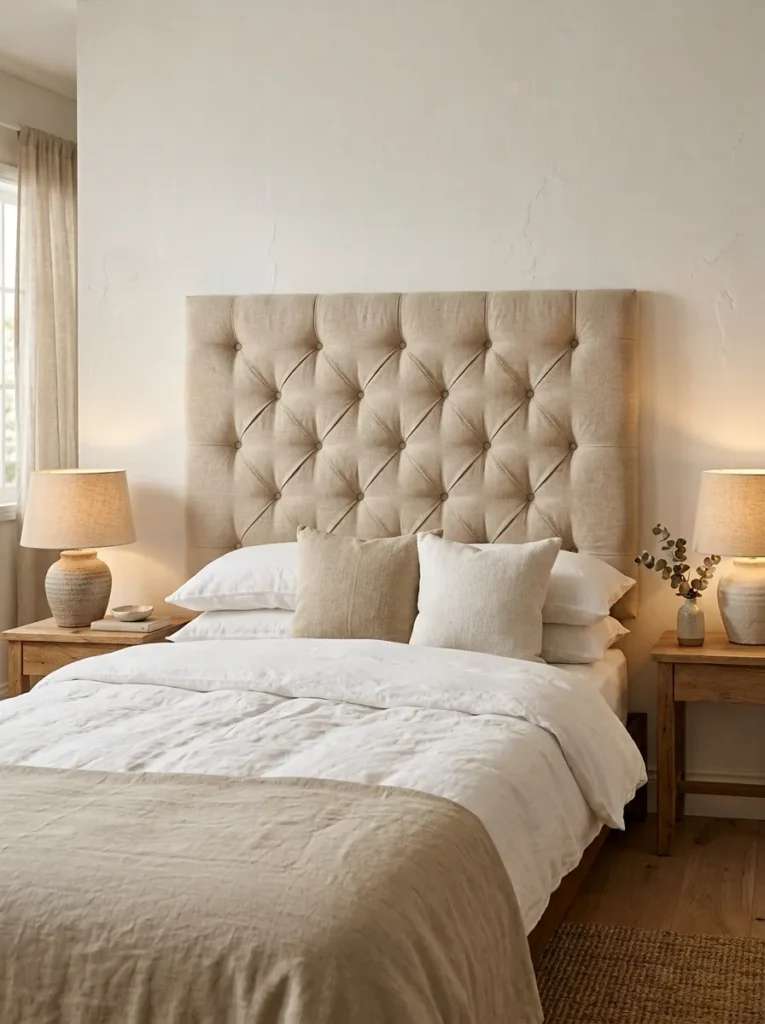
Vibe: The button-tufted linen headboard feels like the most resolved version of the traditional upholstered bedhead — the diamond tufting communicating craftsmanship and the natural linen communicating warmth simultaneously.
Why it works: A button-tufted linen panel applies the classic upholstery design principle — button tufting (where fabric is pulled through a padded panel and secured at regular intervals with fabric-covered buttons) is the oldest and most visually refined of all upholstery decorative techniques, producing the characteristic diamond or square grid of deep fabric folds that has defined luxury headboards and upholstery from the Victorian period to the contemporary interior. The fabric folds between each button create a surface with genuine three-dimensional depth — the shadows in each fold change with the light direction throughout the day, making the headboard a visually dynamic surface rather than a flat panel.
DIY construction: Cut a plywood sheet to the desired headboard dimensions. Cut 5cm high-density foam to match. Apply the foam to the plywood using spray adhesive. Cover with a layer of polyester batting (adds softness over the foam edge for comfort). Lay the linen fabric face-down, place the foam-and-plywood unit face-down on the fabric, pull the fabric to the plywood back and staple every 5cm around the perimeter. For tufting: drill small holes through the plywood and foam at each button position, thread upholstery twine through each hole from back to front using a long doll needle, loop through a covered button and back through the same hole, pulling firmly until the desired depth of tuft is achieved, then secure at the plywood back.
Budget: DIY: $80–180 in materials. Commercial equivalent: $300–800.
Quick Win: A simple rectangular linen panel without tufting (the same plywood, foam, and fabric construction minus the button drilling and threading) takes under two hours to complete and provides the upholstered headboard’s visual warmth at the simplest possible making effort.
Shop The Look
| Product |
|---|
| Oat linen upholstery fabric yard |
| High-density foam 5cm sheet |
| Plywood sheet headboard size |
| Fabric covered button kit set |
| Upholstery staple gun set |
Also view: 15 Indoor Plant Ideas Worth Saving for Every Home
2. Velvet Headboard — Deep Color, Rich Texture
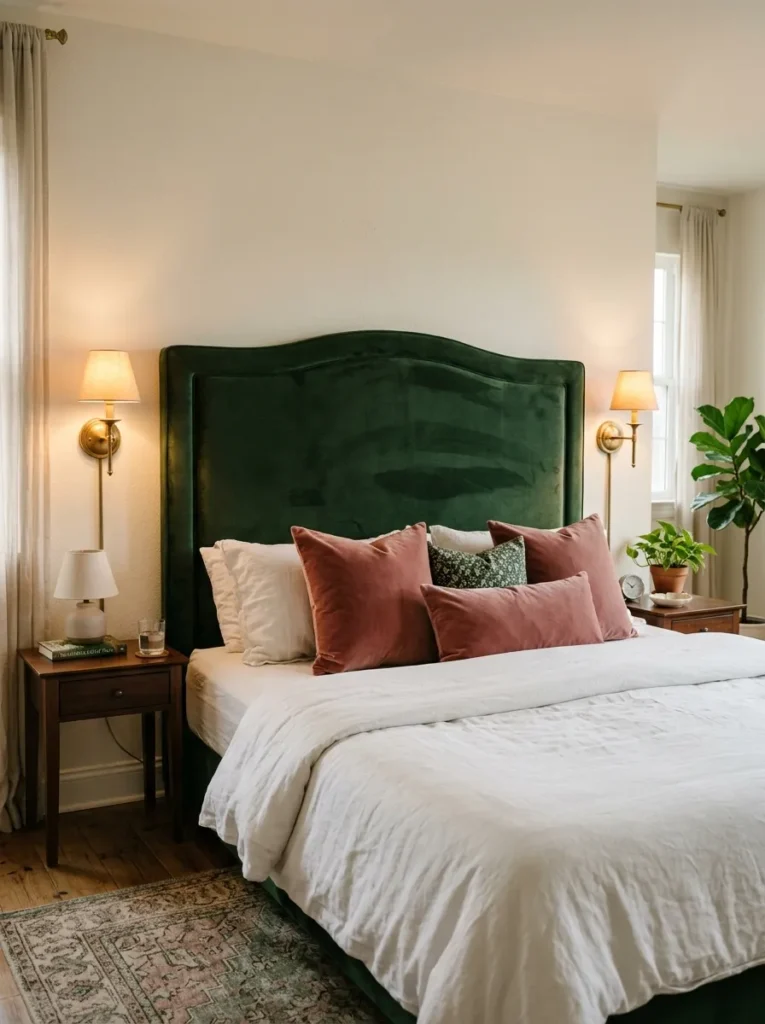
Vibe: The velvet headboard feels like the bedroom reached a decision about warmth and acted on it fully — the deep forest green and the pile’s directional sheen creating a chromatic depth that changes with the lamp angle.
Why it works: A deep color velvet headboard applies the chromatic enclosure principle — velvet’s pile structure creates a color depth unique to the material: the same fabric appears several shades lighter or darker depending on which direction the pile faces relative to the light source. This directional color variation means a velvet headboard is never a flat color but a living surface that shifts through a range of the chosen hue depending on light direction and viewing angle. Forest green is the most successful headboard color for the botanical reference and enveloping quality it creates — in a bedroom context, deep green reads as simultaneously restful (nature-referencing, calming) and rich (jewel-toned, considered).
Velvet fabric specification: Use upholstery-weight velvet (minimum 400gsm, with a Martindale rub count of 20,000+) rather than dress or curtain velvet, which lacks the structural integrity required for a headboard application. Velvet’s pile direction should run downward (from top of headboard toward bottom) for the most consistent appearance.
Shop The Look
| Product |
|---|
| Forest green upholstery velvet fabric |
| High-density foam 6cm upholstery |
| Plywood sheet headboard form |
| Upholstery staple gun |
| Brass wall sconce pair |
Also view: 13 IKEA MALM Dresser Hacks That Transform Any Room
3. Boucle Upholstered Headboard — Textured Warmth
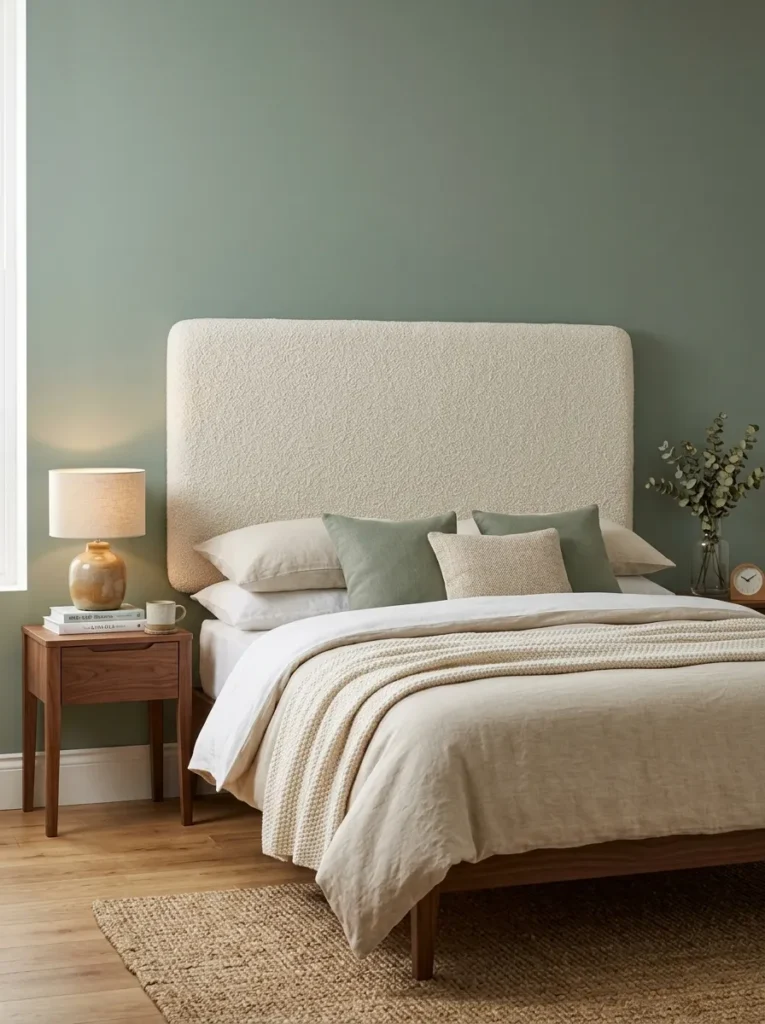
Vibe: The boucle headboard feels like the most tactile possible version of a warm bedroom surface — the looped yarn texture communicating softness even to a viewer who is not touching it.
Why it works: A boucle upholstered headboard applies the contemporary material warmth principle — boucle (a fabric woven from yarn with a looped, textured surface) has become the defining upholstery material of contemporary interior design because it simultaneously provides visual texture (the irregular loops create a surface with genuine depth and light variation), tactile warmth (the looped fiber is soft to the touch and perceived as warm), and material authenticity (the natural-looking surface reads as handmade even when machine-produced). Against a sage or warm neutral wall, the cream boucle headboard creates a layered material composition (the smooth painted wall behind the textured fabric surface) that provides visual richness through material contrast rather than color contrast.
Boucle fabric specification: Boucle for a headboard application should be upholstery-weight (minimum 350gsm) with a flat, tightly woven backing that provides dimensional stability when stapled around a form. Loosely woven boucle (specifically woven for decorative cushion use) may stretch unevenly when applied to a headboard frame. Test by pulling at the fabric edges — it should have minimal stretch in both directions.
Shop The Look
| Product |
|---|
| Cream boucle upholstery fabric |
| Plywood headboard frame |
| Polyester batting soft layer |
| Upholstery staple gun |
| Sage green wall paint matte |
4. Full-Wall Fabric Panel — Floor-to-Ceiling Statement
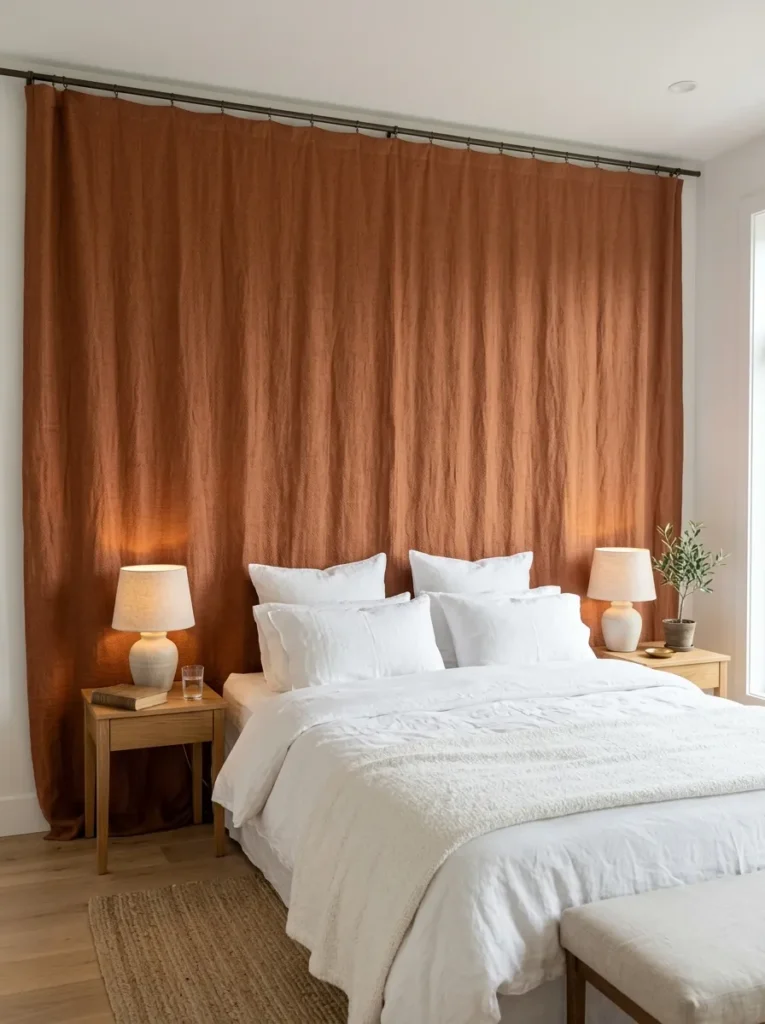
Vibe: The full-wall fabric panel feels like the bedroom’s most ambitious design gesture — the entire headboard wall becoming one fabric surface creates a room-within-a-room quality that cannot be replicated by a standard headboard.
Why it works: A floor-to-ceiling fabric panel applied to the full headboard wall applies the architectural textile principle — at full-wall scale, a fabric panel becomes a room-defining element rather than a decorative one, transforming the bedroom’s spatial character by replacing the hard, light-reflecting quality of a painted wall with the soft, light-absorbing quality of a large textile surface. The ceiling-height mounting (a simple wall-mounted rod within 5cm of the ceiling, with the fabric hanging from rod hooks or clip rings) creates the vertical dimension amplification effect of ceiling-height curtains — the eye registers the fabric as beginning at the ceiling and ending at the floor, making the room appear taller than it is.
Fabric requirement calculation: A full-wall panel for a 350cm wide wall requires fabric at that minimum width. For a single panel without seaming, this requires wide-width linen or textile (available in 150cm, 280cm, and occasionally 300cm widths from specialist fabric retailers). For a standard 150cm wide fabric, three joined panels (with seams positioned at approximately 120cm intervals) provide the full coverage, with the seams visible but acceptable as a designed element if the fabric panels are consistent in color and pattern.
Shop The Look
| Product |
|---|
| Wide linen terracotta fabric wall |
| Ceiling-height curtain rod simple |
| Curtain clip ring set rod |
| Wall bracket ceiling mount pair |
| Wide fabric join seam technique |
5. Renter-Friendly Hanging Fabric Headboard — No Drilling
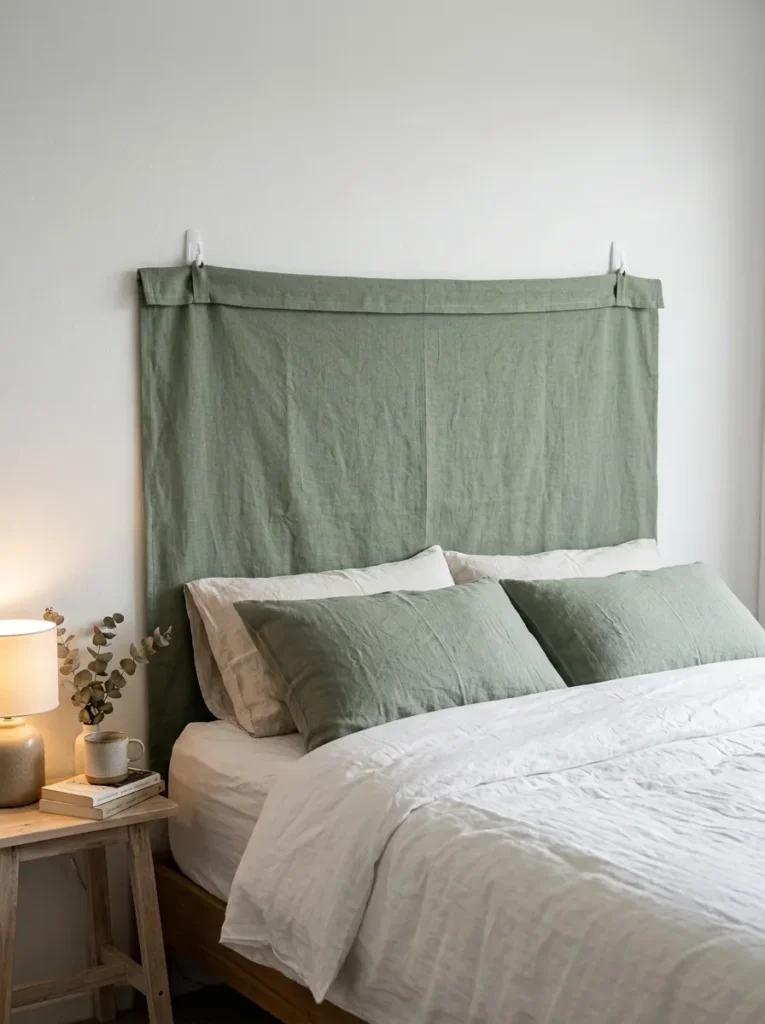
Vibe: The hanging fabric headboard feels like a rental bedroom that decided not to accept its limitations — the simple hanging fabric creating the headboard effect with zero wall damage and under twenty minutes of setup.
Why it works: A renter-friendly hanging fabric headboard applies the minimum viable headboard principle — the primary visual function of a headboard (creating a visually warm, defined zone at the wall behind the bed) can be achieved by any fabric panel that covers the correct wall area and hangs flat against the wall, regardless of whether it is permanently mounted. Two adhesive command hooks (rated for the fabric weight, which for a 140×80cm linen panel is typically under 500g — well within standard command hook capacity) hold the fabric panel’s top hem against the wall. The folded-hem technique (the fabric’s top edge folded 8–10cm to the back and pressed, creating a flat clean edge and a pocket through which the hooks engage) creates a clean mounting that reads as a designed installation rather than an improvised one.
Fabric selection: Heavy linen (180gsm+), cotton canvas (200gsm+), or denim provides the structural weight that allows the panel to hang flat and taut without distorting. Lighter fabrics tend to billow away from the wall or show irregular folds.
Shop The Look
| Product |
|---|
| Heavy linen fabric sage wide |
| Adhesive command hooks large |
| Iron press crease firm hem |
| White linen bedding simple |
| Hemming tape no-sew option |
6. Gathered Fabric Headboard — Romantic Softness
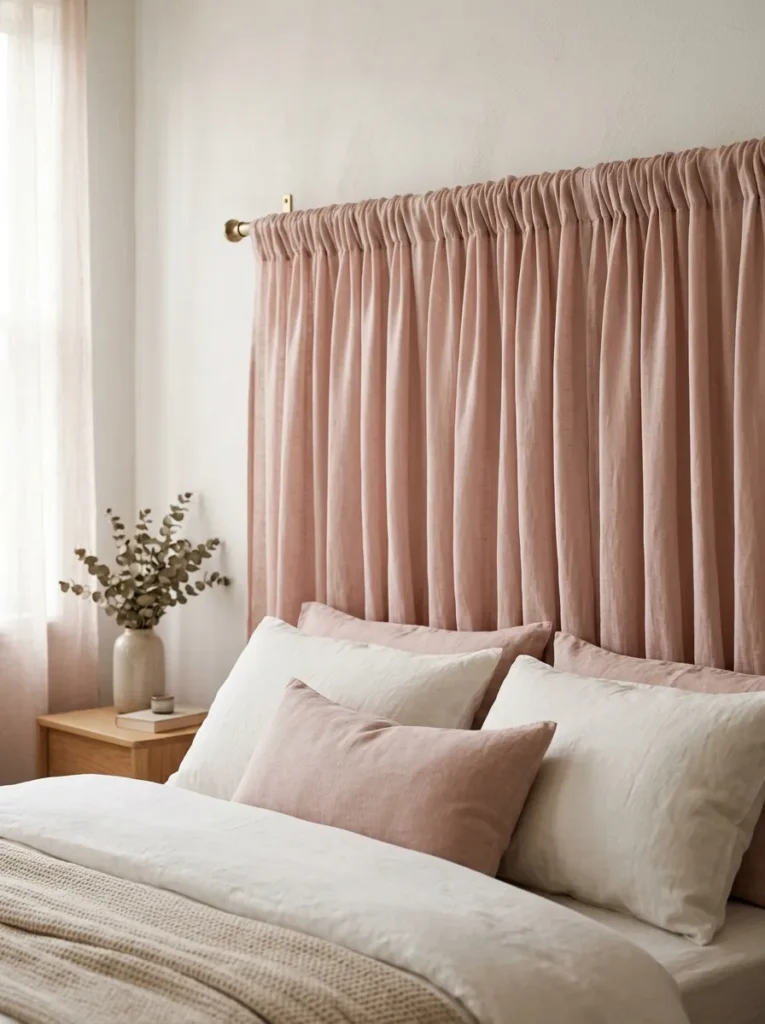
Vibe: The gathered fabric headboard feels like a curtain decided to become a headboard — the full gathered folds creating a softness that flat-panel headboards cannot achieve regardless of their fabric choice.
Why it works: A gathered fabric headboard applies the drapery-as-headboard principle — gathering fabric at double (or triple) the rod width onto a wall-mounted rod creates a headboard effect through the accumulated softness of the gathered folds rather than through a structured panel form. This gathered approach is specifically appropriate for bedroom aesthetics that value romantic softness over architectural precision — the gathered fabric’s quality of movement and light is inherently informal and soft in a way that a tailored flat panel is not. The rod mounting height (typically 20–30cm above the mattress level, allowing the gathered fabric to fall to mattress height at its lowest point) creates the visual zone of the headboard at the correct height behind the bed.
Technical note: Use a lightweight curtain rod (no heavier than required for the fabric weight) mounted on two brackets fixed into wall studs or masonry anchors rated for the combined fabric and rod weight. Clip rings or gathered heading tape provide the gathering mechanism on the rod.
Shop The Look
| Product |
|---|
| Dusty blush cotton voile fabric |
| Lightweight curtain rod 160cm |
| Curtain clip ring gathering set |
| Rod wall bracket pair |
| Lightweight linen gathered option |
7. Padded Headboard with Piped Edge — Tailored Luxury
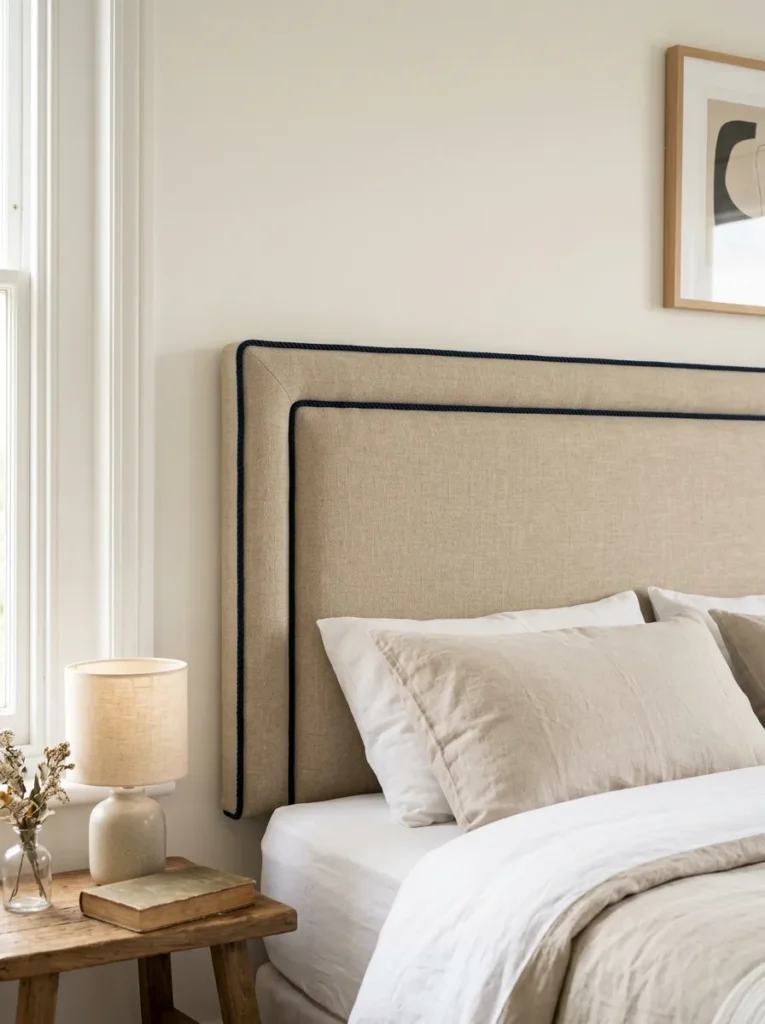
Vibe: The piped-edge headboard feels like the difference between a home-sewn garment and a tailored one — the continuous contrasting piping converting a simple panel into something that reads as genuinely crafted.
Why it works: A piped edge on an upholstered headboard applies the detail-as-quality-signal principle — professional upholstery consistently uses piping (a cord encased in a bias-cut fabric strip) at seams, edges, and boundaries to create a clean, precise line that the eye reads as evidence of craftsmanship. A contrasting piping color (dark navy, charcoal, or forest green against a neutral linen base fabric) creates a graphic definition of the headboard’s perimeter that makes the piece’s dimensions and form precisely legible while adding the visual interest of a two-color composition. The piping also serves a functional role — it reinforces the edge of the upholstered panel, making the headboard more durable and maintaining the clean edge definition over years of use.
Piping construction: Piping is made from a length of cotton cord (available in 3mm, 5mm, and 8mm diameters from haberdashery retailers) encased in a strip of bias-cut fabric. For a contrast piping effect, cut 4cm wide bias strips from the contrast fabric. Fold each strip over the cord and stitch close to the cord with a zipper foot. Attach the completed piping to the headboard fabric before applying the back panel, with the raw edges of the piping and the headboard fabric aligned and sewn together.
Shop The Look
| Product |
|---|
| Oat linen upholstery fabric |
| Contrast fabric navy charcoal piping |
| Cotton piping cord 5mm |
| Zipper sewing machine foot |
| Bias tape cutter fabric tool |
8. Arched Fabric Headboard — Contemporary Organic Form
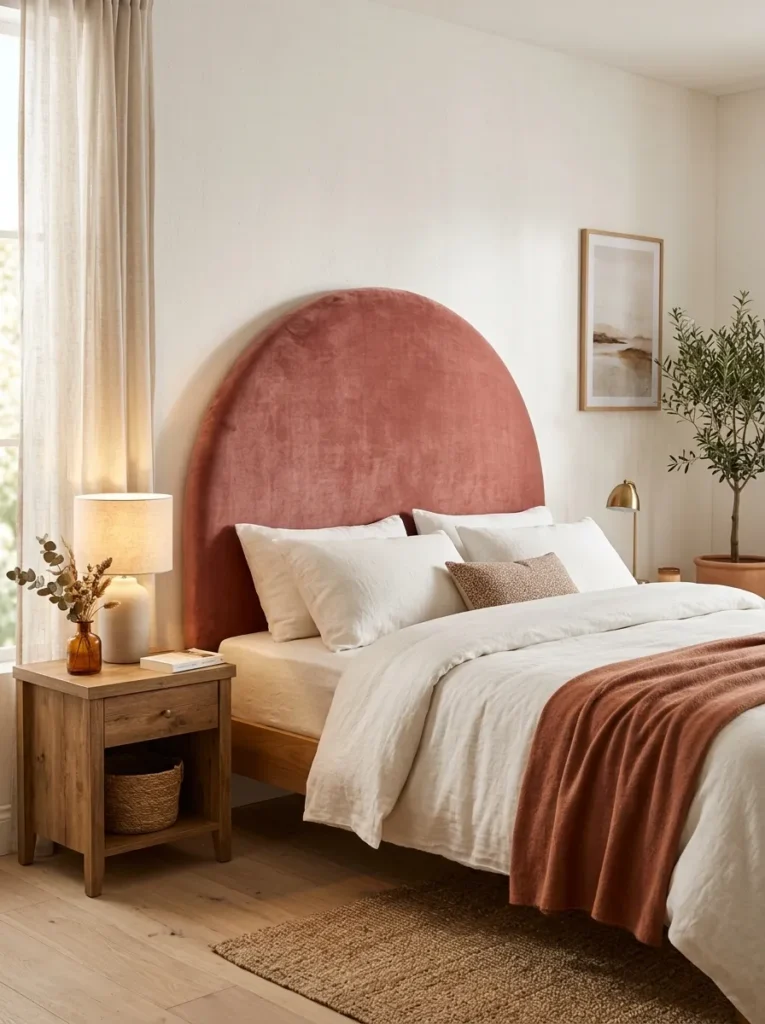
Vibe: The arched headboard feels like the bedroom found an architectural language it preferred — the arch form’s organic curve creating a visual warmth that the rectangular headboard’s sharp corners cannot produce.
Why it works: An arched fabric headboard applies the organic form design principle — the full arch (semi-circular top, straight sides) creates a headboard form that references the most ancient and most universally warm architectural form, the arch. In a bedroom context — where all other hard architectural elements (windows, doors, walls, ceiling) are rectangular — an arched headboard introduces the visual relief of a curved form that the eye finds naturally more comfortable than repeated right angles. The contemporary resurgence of the arched headboard (from approximately 2019 onward it became one of the most widely published bedroom design trends in premium interiors media) reflects a broader move toward organic form in contemporary interior design.
Arch construction: Cut the arch form from 18mm plywood using a jigsaw — for a full semi-circular arch at 120cm width, set a compass at 60cm radius and mark the arch on the plywood. Cut along the arc with a jigsaw. Apply foam and batting as for a standard rectangular headboard, trimming the foam and batting to follow the arch curve. Apply fabric, making relief cuts in the fabric at the arch’s outer curve (approximately every 3–4cm) to allow the fabric to fold around the curved edge without bunching.
Shop The Look
| Product |
|---|
| Terracotta upholstery velvet fabric |
| Plywood 18mm arch form cut |
| Jigsaw curved cutting tool |
| High density foam 5cm arch |
| Upholstery staple gun |
9. DIY Panel Headboard Grid — Multiple Panels Together
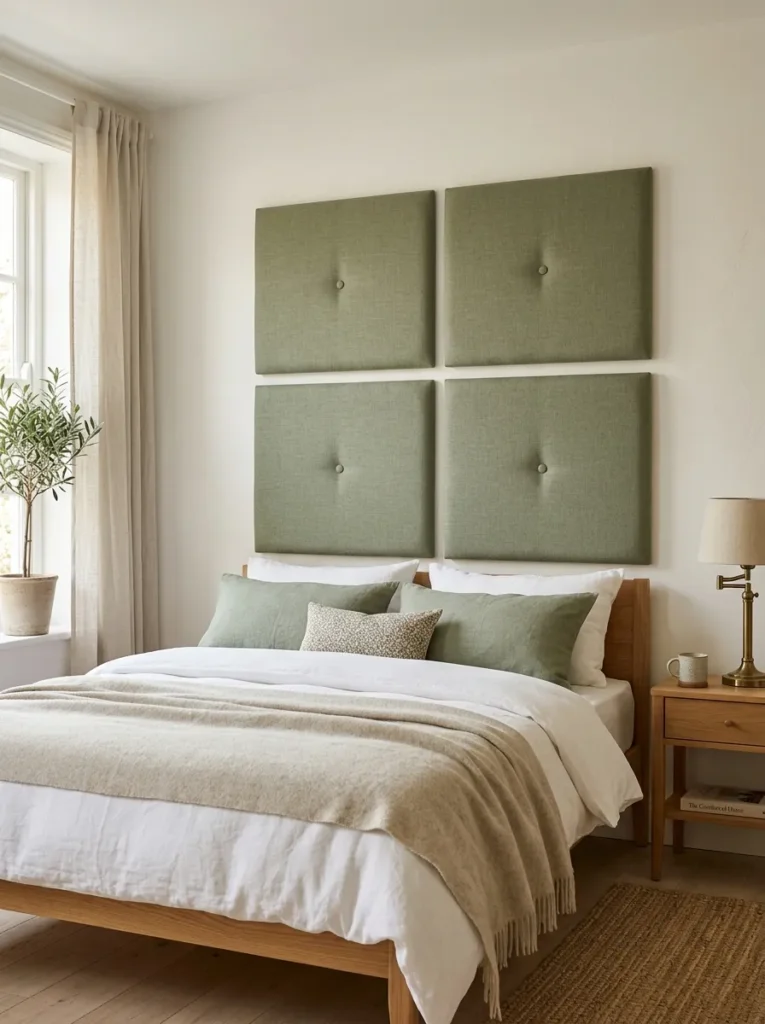
Vibe: The panel grid headboard feels like modular architecture applied to upholstery — the four individual panels and the gaps between them creating a geometric composition that reads as designed rather than simply padded.
Why it works: A multi-panel grid headboard applies the modular composition principle — rather than a single large upholstered panel, four (or six, or eight) smaller panels arranged in a grid create a headboard whose primary visual quality comes from the composition of the gaps between panels rather than from the individual panels themselves. The 3cm gap between each panel (painted or left as wall color) creates a grid line that makes the composition legible as a designed pattern — the grid of light-colored gaps against the fabric panels reads as a low-relief textile installation. The single center button on each individual panel (rather than a full tufting pattern across the whole composition) provides the visual detail that distinguishes the panels as upholstered objects rather than flat decorations.
Panel size and spacing: A two-by-two panel grid for a king bed should be designed at a total width of 140–160cm (to span the mattress width) and a total height of 100–130cm. For a two-by-three grid (two across, three tall), each panel is smaller, creating a more graphic composition. Keep the gap between panels consistent — 2–4cm provides the grid definition without making the gaps dominant.
Shop The Look
| Product |
|---|
| Sage linen upholstery fabric |
| Plywood panel form four cut |
| High density foam four panels |
| Covered button kit center |
| Foam adhesive spray panel |
10. Upholstered Wall — Full Bedroom Wall Fabric Treatment
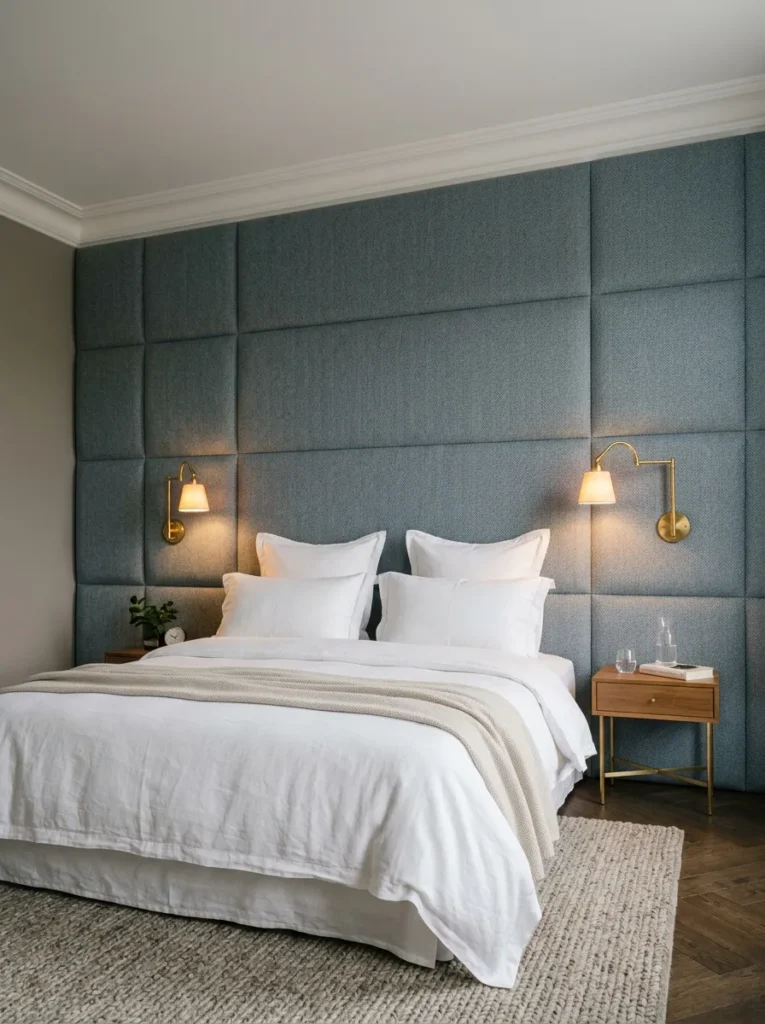
Vibe: The upholstered bedroom wall feels like the interior of a premium hotel suite — the floor-to-ceiling fabric enclosure creating the specific enveloping quality that the most expensive accommodation design achieves.
Why it works: A fully upholstered bedroom wall applies the total surface treatment principle — the most immersive application of upholstered fabric in a bedroom is the full wall treatment, where the entire headboard wall (floor to ceiling, full width) is padded and covered. This transforms the wall from a hard architectural surface into a soft enclosed surface, creating the den-like quality of enclosure that sleep research associates with faster sleep onset and reduced pre-sleep anxiety. Professionally, full wall upholstery is an installation technique used in premium hotel and residential projects — it involves fixing a framework of battens to the wall at regular intervals, applying foam or batting over the battens, and stretching the fabric over the entire surface secured at the perimeter.
DIY approach: For a renter-friendly or lower-commitment version: cover the full headboard wall with large panels of upholstery fabric using a grid of minimal damage adhesive hooks or a continuous fabric track system (available from theater and display supply companies) that holds the fabric flat against the wall surface without permanent fixing.
Shop The Look
| Product |
|---|
| Dusty blue herringbone upholstery |
| Wall batten framework timber |
| Foam or batting wall layer |
| Brass reading light wall pair |
| Upholstery track system rental |
11. Macramé or Woven Textile Headboard — Boho Warmth
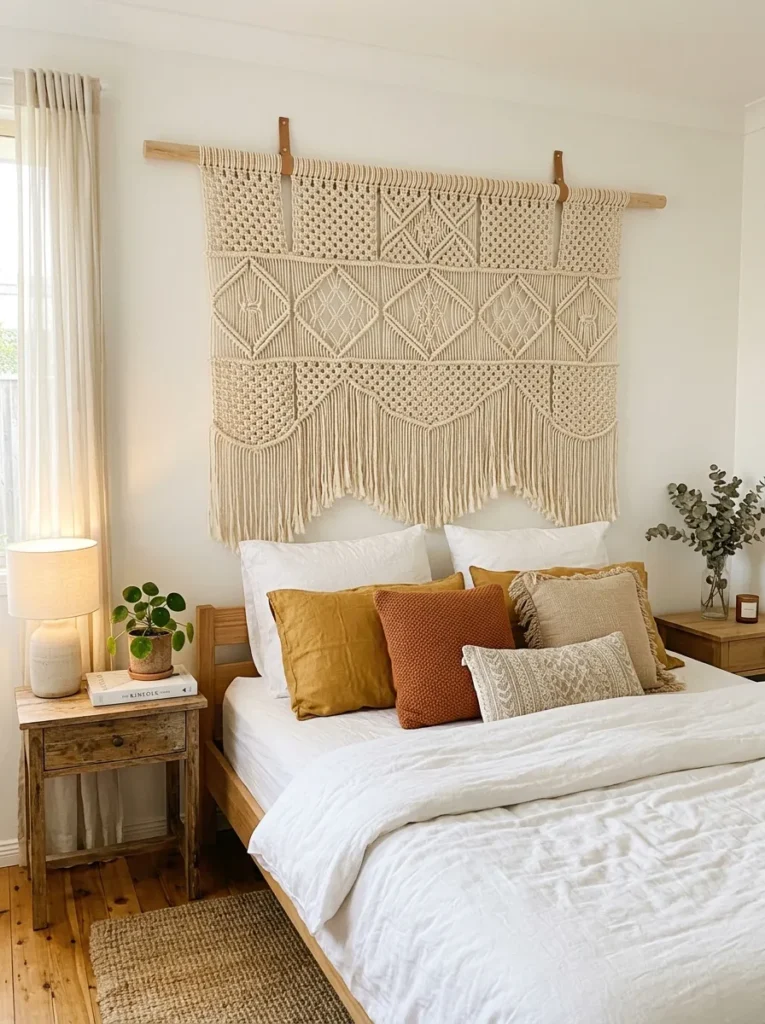
Vibe: The macramé headboard feels like the bedroom chose a craft tradition over an upholstery tradition and is completely confident in that choice — the knotted fiber creating warmth of a different material register than any woven fabric.
Why it works: A large macramé or woven textile piece used as a headboard applies the craft-as-architecture principle — a macramé wall hanging at headboard scale (wider than the bed and tall enough to occupy the visual space behind the pillows) functions identically to a fabric headboard in its atmospheric effect (creating a warm, textured zone at the wall behind the bed) while providing the specific visual warmth of knotted natural fiber rather than upholstered fabric. Macramé as a headboard material has the additional advantage of three-dimensional depth — the knots, the brushed fringe, and the shadows between cord elements create a surface with genuine relief that flat upholstery fabric cannot achieve.
Scale requirement: For a macramé headboard to function visually as a headboard (rather than as a wall decoration adjacent to the bed), it should be a minimum of 130–160cm wide (spanning the mattress width) and 80–100cm tall (occupying the visible wall from pillow height to approximately 50cm above the top of the pillows). A piece narrower or shorter than these dimensions reads as a wall hanging near the bed rather than as the bed’s headboard.
Shop The Look
| Product |
|---|
| Natural cotton cord 4mm macramé |
| Natural wood dowel 160cm |
| Stiff brush fringe combing |
| Wall hook heavy dowel mount |
| White linen bedding simple |
12. Fabric Headboard with Integrated Shelving — Functional Beauty
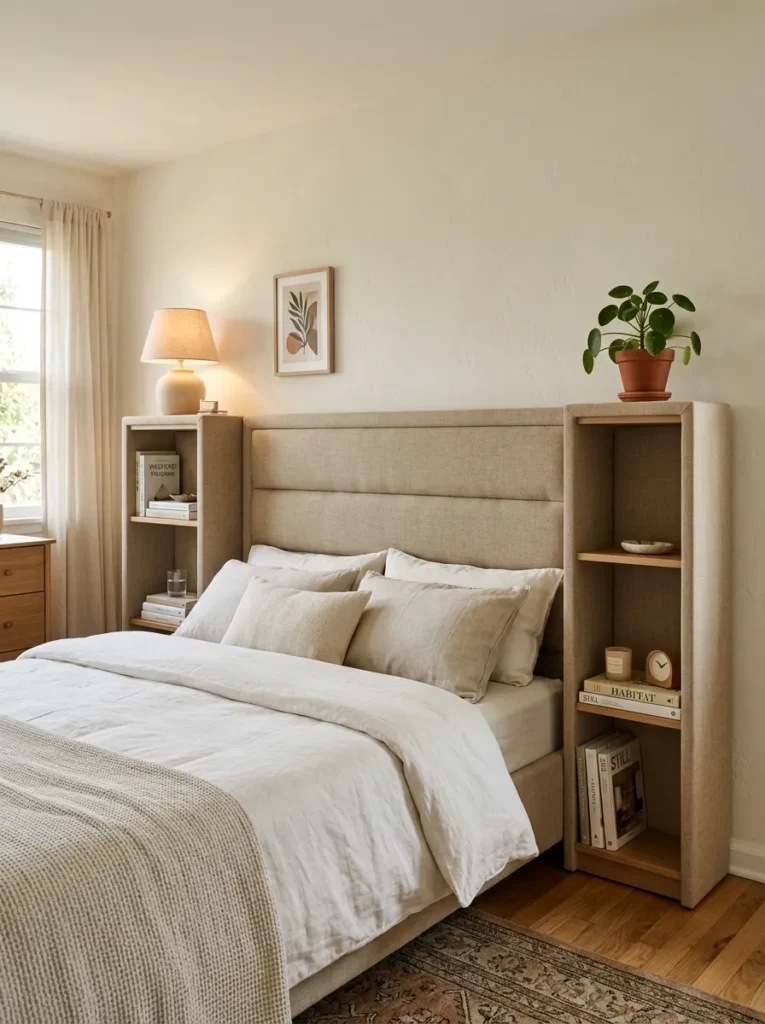
Vibe: The integrated headboard-shelf system feels like a bespoke piece commissioned for the specific room — the continuous fabric surface from one shelf side to the other converting three separate elements into one designed installation.
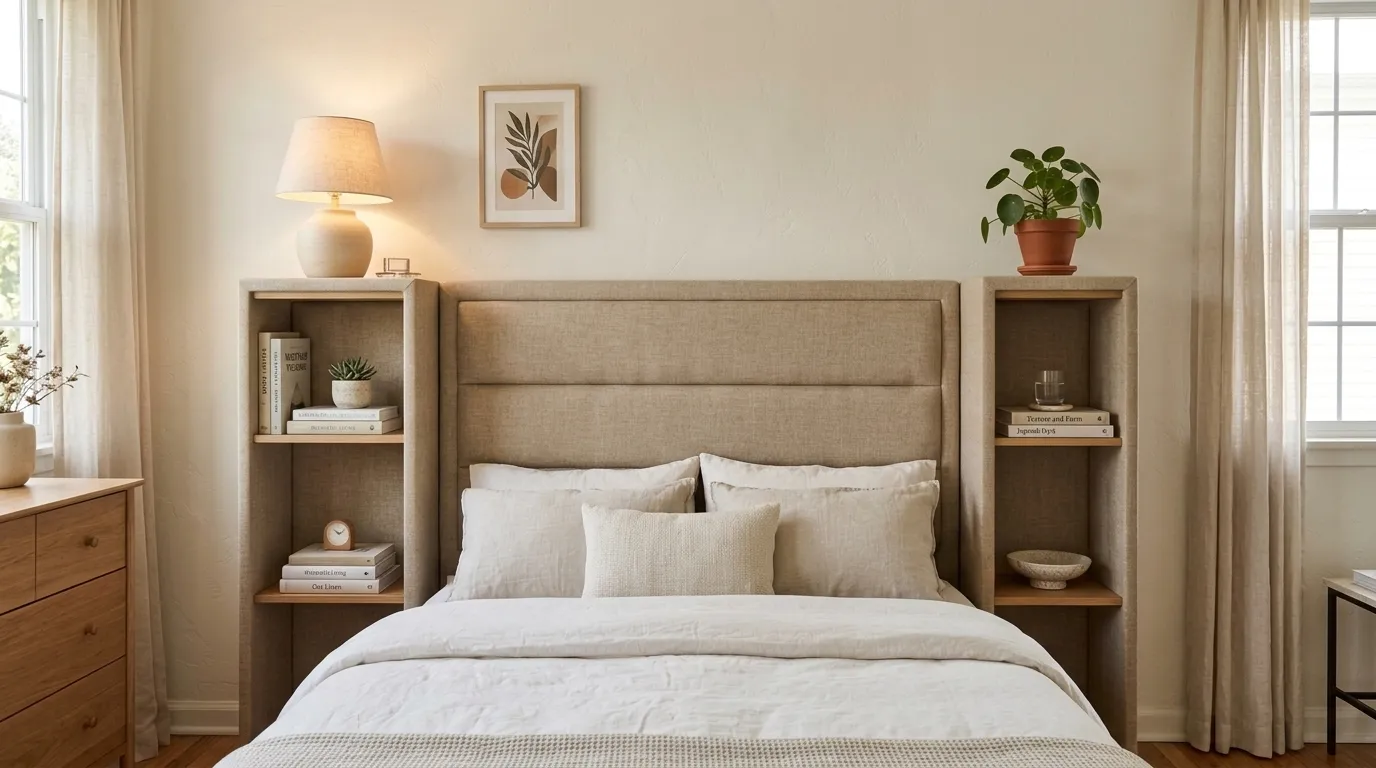
Why it works: A fabric headboard with integrated flanking shelves applies the unified furniture installation principle — individual pieces (headboard, bedside shelves) placed adjacently but separately read as coordinated furniture; the same pieces connected by a continuous fabric surface that covers all three elements identically read as a single bespoke installation. The continuous linen surface across the central headboard panel and the side shelf units’ faces converts what would be three separate objects into one composed headboard-and-storage system. This integration is particularly appropriate for small bedrooms where bedside tables cannot be positioned beside the bed due to space constraints — the flanking shelves provide the bedside function within the headboard’s footprint.
Construction: Build each shelf unit from 12mm MDF as simple rectangular boxes (20cm deep, the height of the headboard panel, and 30–40cm wide). Upholster the front face of each shelf unit in the same fabric as the central headboard panel. Mount the central headboard panel and the shelf units at the same height on the wall, with the shelf units immediately flanking the central panel. Leave the shelf top surfaces uncovered (the practical working surface) and the shelf interior uncovered (for visual access to the stored items).
Shop The Look
| Product |
|---|
| Oat linen upholstery fabric |
| MDF shelf unit 12mm construction |
| Foam and batting headboard panel |
| Ceramic bedside lamp pair |
| Staple gun upholstery |
13. Reclaimed Fabric Headboard — Antique or Vintage Textile
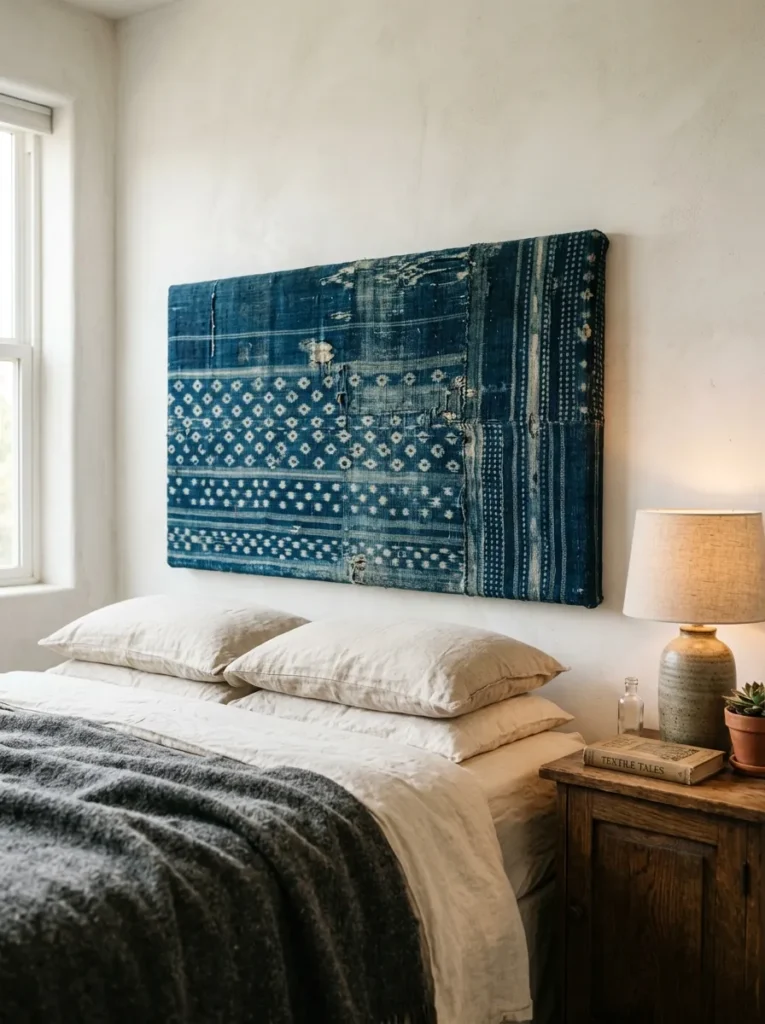
Vibe: The vintage textile headboard feels like the bedroom has been given something genuinely irreplaceable — the antique fabric’s specific history, wear, and patina creating a material quality that no new textile can replicate.
Why it works: A reclaimed vintage or antique textile used as a headboard fabric applies the historical material principle — the specific appeal of vintage and antique textiles (indigo-dyed Japanese fabrics, kilim fragments, antique ikat sections, vintage block prints) is their irreproducibility: each piece is the product of a specific maker, a specific dye batch, a specific period of use that has aged the fabric in ways that cannot be simulated. Using such a fabric for a headboard — the bedroom’s highest-visibility surface — gives the room a material presence of a genuinely different category than any new upholstery fabric provides. The simple rectangular headboard form (no tufting, no complex edge treatment, no structure that competes with the textile’s own content) allows the fabric’s pattern, color, and texture to be the headboard’s sole design statement.
Sourcing: Antique Japanese indigo fabric and vintage kilim pieces are available from vintage textile dealers online (Etsy has a substantial global supply of authentic vintage textiles), antique markets, and specialist textile dealers. A piece sufficient to cover a standard headboard (approximately 150×100cm) is typically available for $40–120 depending on the textile type and condition.
Shop The Look
| Product |
|---|
| Vintage kilim or ikat textile piece |
| Antique indigo fabric Japanese |
| Simple plywood headboard form |
| Thin foam 3cm backing |
| Headboard mounting hardware |
14. Oversized Upholstered Headboard — Floor-to-Ceiling Statement
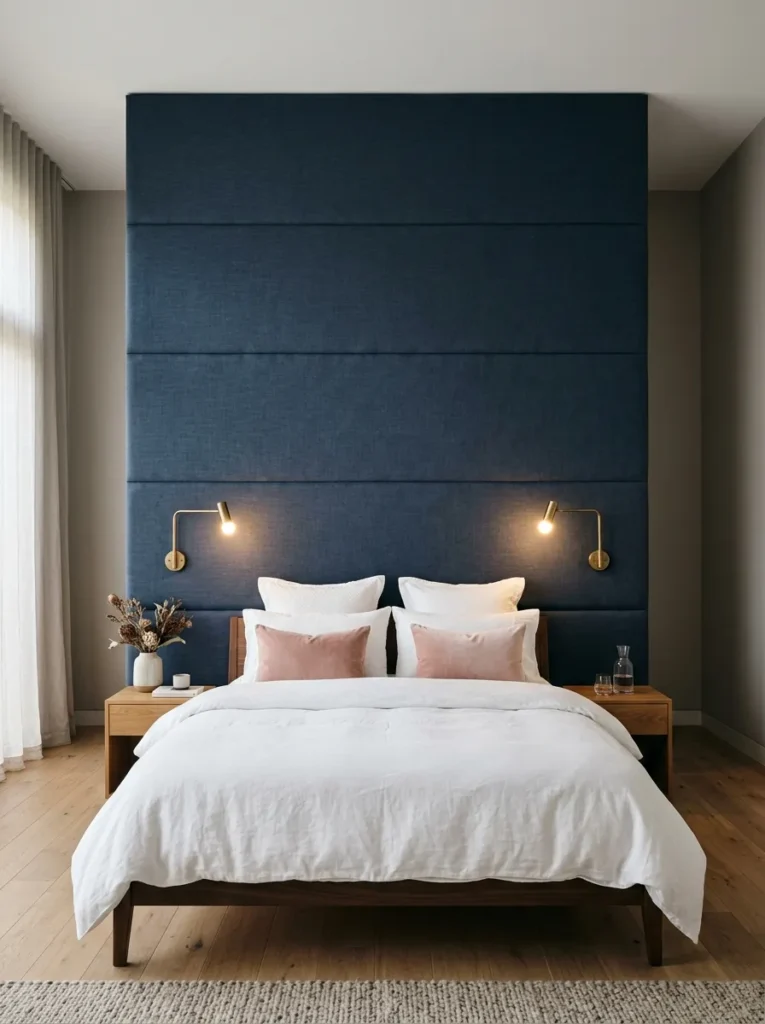
Vibe: The oversized floor-to-ceiling headboard feels like the most confident possible bedroom design gesture — the full room height and full-width scale making it simultaneously a headboard and a room-defining architectural feature.
Why it works: An oversized floor-to-ceiling upholstered headboard applies the architectural scale principle — by extending the upholstered panel to the full ceiling height (rather than the conventional 90–120cm headboard height), the headboard transitions from bedroom furniture to architectural wall treatment, fundamentally changing the room’s spatial character rather than simply providing a comfortable backrest. The floor-to-ceiling scale creates the enveloping quality of a full wall fabric treatment (Idea 10) while maintaining the defined, composed character of a headboard rather than the total surface treatment of a padded wall. The deep navy color at this scale provides maximum chromatic enclosure — the large area of deep color creates a dramatic, cave-like quality behind the bed that is simultaneously intimate and striking.
Construction note: A floor-to-ceiling panel at 210×240cm is significantly heavier than a standard headboard (the combined weight of plywood, foam, and fabric at this scale exceeds 30kg) and requires structural wall fixing — the mounting hardware must engage with multiple wall studs or a solid masonry wall. A standard plywood-and-foam construction at this scale is achievable but requires two people for installation. A lighter-weight alternative uses a timber batten frame (rather than solid plywood) as the structural element, reducing the total weight while maintaining the panel’s rigidity.
Shop The Look
| Product |
|---|
| Deep dusty navy linen upholstery |
| Timber batten frame large headboard |
| High density foam 5cm large |
| Structural wall fixing heavy kit |
| Wall-mounted reading light pair |
How to Start Your Fabric Headboard Project
The single best first move before beginning any fabric headboard project is spending thirty minutes making a scale drawing of the bedroom wall behind the bed — measuring the wall’s exact width, the bed’s exact width, the ceiling height, and the positions of any power points, light switches, or architectural features — and then drawing the proposed headboard at scale on this plan. This thirty-minute drawing exercise reveals three things that planning from memory or from published inspiration images cannot: the exact headboard width and height that will be proportionally appropriate for the specific bed and wall (the relationship between headboard width and bed width, and between headboard height and ceiling height, is the most important proportion decision in headboard design), the positions of any wall features that will need to be accommodated (a light switch at 130cm height, for example, rules out a floor-to-ceiling headboard at that position), and whether the intended headboard style will be visually proportional in the room’s specific spatial context.
The most common mistake in DIY fabric headboard construction is choosing a fabric based on its color and texture in-store or on screen without considering its structural suitability for upholstery application. The three structural properties that make a fabric appropriate for headboard use are: weave density (the fabric should be tightly woven enough to resist visible thread separation when pulled over the foam edge — open weaves like some linens and loose boucles can develop visible gaps at the stapled edges), stretch recovery (the fabric should have minimal stretch in both directions — a fabric that stretches significantly will develop soft spots and loose areas over the headboard’s surface after initial installation), and surface durability (the fabric surface will experience friction from pillows and hair — velvet, tight weave linen, and quality boucle all tolerate this friction; delicate prints, lightweight silks, and open-weave textiles wear prematurely).
Three specific items under $50 that enable the foundational DIY fabric headboard construction: a sheet of 18mm plywood cut to the headboard dimensions ($20–35 from a timber merchant or DIY retailer, most of which will cut to size for a small fee); a pneumatic or electric upholstery staple gun ($25–45, which provides the consistent staple driving force that a manual stapler cannot — the professional staple gun is the single investment that most improves DIY upholstery quality); and a roll of polyester batting ($8–15, which provides the soft comfort layer between the foam and the fabric that prevents the foam’s edge from reading through the fabric surface). These three items plus the chosen fabric and a sheet of 5cm foam (typically $25–40 for headboard quantities) provide the complete material kit for any of the padded panel headboard ideas in this list.
Frequently Asked Questions About Fabric Headboards
What fabric is best for a headboard?
The best fabrics for headboard applications share the structural properties of durability, low stretch, and dense weave. In order of recommended suitability: performance velvet (minimum 30,000 Martindale rub count — the soft pile surface and the tight woven backing make it the most comfortable and most visually refined headboard fabric); tight-weave linen (180gsm+ weight, the natural texture and matte finish coordinate well with most bedroom palettes and it wears well over time); boucle (minimum 350gsm, tight backing essential — provides the most fashionable contemporary texture quality); and cotton canvas or heavy cotton twill (the most affordable option, durable, and available in the widest color range). Avoid: lightweight silks and satins (slide off foam backing), open-weave loose fabrics (gaps appear at stapled edges), and heavily elasticized fabrics (lose tension over time).
How do you attach a DIY headboard to a wall?
The most reliable wall attachment methods for DIY fabric headboards depend on the headboard’s weight. For a standard plywood-and-foam headboard at standard sizes (up to approximately 120×100cm), two French cleat strips (a 45-degree angled timber batten fixed to the wall and a matching batten fixed to the headboard back — the two bevels interlock to hang the headboard) provide a secure, removable, and level mounting that distributes the load across the full headboard width. For larger or heavier headboards (floor-to-ceiling installations, large multi-panel compositions), additional fixings through the plywood into wall studs provide supplementary security. For renters or non-permanent installations, heavy-duty adhesive mounting strips (3M Command for lighter headboards) or a floor-standing timber leg system that holds the headboard upright without any wall contact provides a damage-free alternative.
How much fabric is needed for a headboard?
The fabric requirement depends on the headboard’s finished dimensions and the fabric’s width. As a general calculation: for a standard headboard (160cm wide, 100cm tall) using 150cm wide fabric, the minimum fabric length required is the headboard height plus 20cm for wrapping (for no pattern repeat). If the chosen fabric has a pattern repeat, add one full repeat length per panel to allow pattern matching. For a multi-panel composition or a floor-to-ceiling installation, calculate each panel’s fabric requirement separately and add 10% overage for matching. Bring the headboard dimensions (not just the mattress size) to the fabric shop when purchasing — the additional fabric required for wrapping around the edges and to the back is consistently underestimated.
Can a fabric headboard be cleaned?
The cleanability of a fabric headboard depends on the fabric type. Performance fabrics (Crypton, Aquaclean, and similar stain-resistant treated fabrics) can be cleaned with water and mild soap applied with a damp cloth, making them the most practical choice for households with children or pets. Velvet can be spot-cleaned with a damp cloth and a mild detergent, with particular care not to disturb the pile direction — blot rather than rub. Linen and cotton can be spot-cleaned similarly but may show water marks if incompletely dried — use a hairdryer on low heat after spot cleaning to prevent watermarks. Boucle requires careful treatment — the looped pile can catch on cleaning cloths, so use a soft brush or a velvet brush for surface debris rather than a cloth. For deeper cleaning, most fabric headboards can be professionally upholstery-cleaned in situ.
What height should a fabric headboard be?
Headboard height is determined by the relationship between the headboard, the mattress, and the ceiling. The minimum functional headboard height (providing a usable backrest for sitting up in bed) is 50cm above the top of the mattress — which in a standard bed (mattress top at approximately 55–65cm from the floor) places the top of the headboard at approximately 105–115cm from the floor. For visual comfort in a standard room with 240cm ceilings, a headboard height of 100–130cm above the mattress top (with the top of the headboard at 155–195cm from the floor) provides appropriate proportion without appearing either too small or overwhelmingly large. For statement-scale headboards (Ideas 4, 10, and 14), the headboard extends to ceiling height, which at 240cm requires a fabric panel of the full room height.
Ready to Upholster Your Dream Headboard?
These 14 ideas move through every dimension of what makes a fabric headboard genuinely cozy and genuinely beautiful — from the classical craftsmanship of diamond button-tufting in natural linen, to the contemporary material richness of deep velvet and boucle, to the architectural ambition of oversized floor-to-ceiling installations and fully upholstered bedroom walls, to the accessible pragmatism of a simple hanging linen panel that creates the headboard effect in a rental without drilling a single hole. Starting with the scale drawing — thirty minutes with a tape measure and a piece of graph paper — is the beginning that makes every subsequent material and construction decision purposeful rather than approximate. It establishes the specific dimensions that the specific bedroom requires, and from those dimensions all other decisions follow directly: how much fabric, what form, what height, what mounting. Order the fabric samples this week, cut the plywood this weekend, and let the staple gun and the chosen fabric together create the bedroom’s most significant single atmospheric change. When the headboard is mounted and the bedding is made and the lamps are lit and the room looks, for the first time, completely itself — that is the result that a fabric headboard produces and that no other single bedroom intervention matches.