16 Modern Succulent Planter Ideas for Stylish Spaces
A modern succulent planter is a purpose-designed or purpose-selected container that presents one or more succulent plants as a considered design object — using material, form, proportion, and placement to make the plant arrangement read as interior decor rather than a garden accessory placed indoors. This article gives you 16 genuinely creative, styled modern succulent planter ideas that work across every room and every aesthetic — from a minimalist Japandi shelf to a maximalist bohemian windowsill — making the most drought-tolerant plants available into the most visually intentional ones in your home.
Most succulent displays default to the terracotta pot and pebble combination that has defined the category for two decades. The homes and spaces in this list make a different choice: they treat the succulent planter as a design decision with the same seriousness as a ceramic lamp or a woven throw, selecting containers, arrangements, and placements that make the plants look genuinely exceptional rather than generically present. Here are 16 ideas worth saving — and planting.
Why Modern Succulent Planter Design Works So Well
The succulent as a design object has its roots in the desert botanical gardens of the American Southwest and the rockery traditions of European alpine garden design — both of which recognized that the architectural form of succulent plants (the geometric rosette of an echeveria, the sculptural column of a cereus cactus, the cascading geometry of a string of pearls) has an inherent visual quality that few other plant families match. These design traditions established the principle that succulents are not simply plants that happen to be decorative — they are plant-forms so architecturally resolved that their display deserves the same consideration as any other three-dimensional object in an interior space. The contemporary interior design community has recovered and amplified this principle: succulents now appear in the editorial photography of Architectural Digest, Dezeen, and Kinfolk not as background greenery but as foreground design objects, chosen with the same specificity as a ceramic vessel or a marble tray.
The materials that define a well-executed modern succulent planter are those that engage in a designed dialogue with the plant’s own visual language. Matte black ceramic creates maximum contrast with a pale green echeveria rosette, making the plant’s geometric form appear to float against the dark vessel. Rough-hewn concrete connects succulents to their natural rocky habitat while providing the contemporary brutalist material language that reads as considered in any modern interior. Pale natural oak and warm terracotta introduce warmth and organic texture that harmonizes with succulent plants’ earthy tones without competing with their sculptural forms. Antique brass and aged copper introduce metallic warmth that reads as deliberately curated. Each of these material choices creates a specific visual relationship with the plant that elevates both the container and its contents beyond their individual quality.
The trend reflects two intersecting cultural forces. The first is the ongoing growth of the indoor plant market, which accelerated dramatically during the 2020–2022 period and has maintained elevated levels since — the Global Houseplant Market Report projects the category to reach USD $22.4 billion by 2027. Within this market, succulents occupy a specific position as the most forgiving plant for busy or inexperienced plant owners (requiring watering only every 2–4 weeks), the most spatially versatile (thriving in everything from a 5cm diameter desk pot to a 60cm diameter statement planter), and the most architecturally resolved in their plant form. The second force is the broader shift in interior design toward objects that are simultaneously functional and beautiful — the houseplant as design object, not merely as living accessory.
Small apartments and compact spaces benefit disproportionately from succulent planters as design objects because succulents require no floor space, minimal maintenance, and deliver the visual richness of a living plant in whatever footprint their container occupies — from a 5cm wide shelf pot to a 25cm wide desk specimen. The same visual principle that makes succulents effective in large statement planters in a generous living room makes them equally effective in a small collection on a bathroom shelf in a studio apartment — the quality of the container and the precision of the arrangement determine the visual result, not the quantity of plants or the scale of the display.
Style at a Glance
| Element | Detail |
|---|---|
| Philosophy | The succulent planter is a design object first — the container, arrangement, and placement are design decisions with the same weight as any other object in the room |
| Key Materials | Matte black ceramic, rough concrete, pale natural oak, warm terracotta, aged brass, copper, handmade stoneware, volcanic stone |
| Color Palette | Matte black, warm concrete grey, dusty sage, pale terracotta, aged brass gold, natural timber warm, deep slate |
16 Modern Succulent Planter Ideas
1. Matte Black Geometric Ceramic Planter for Minimalist Shelves
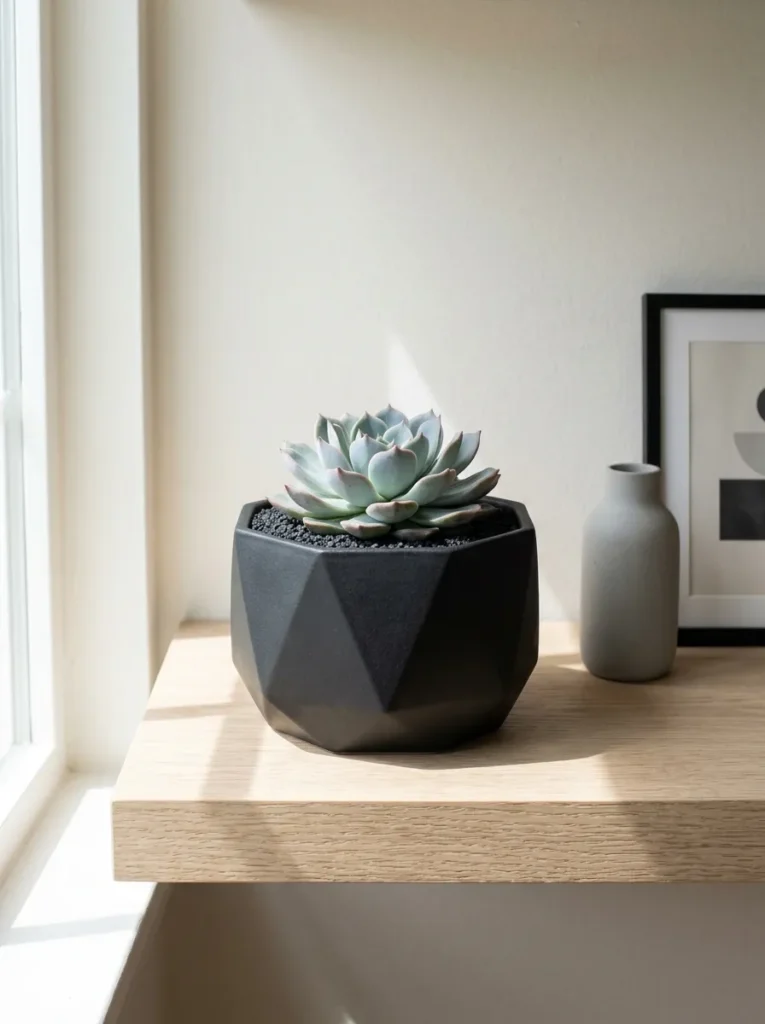
Vibe: Clean and minimal — the single plant arrangement that makes a shelf feel curated by someone who knows exactly what they are doing.
Why it works: The matte black geometric ceramic planter engages the most fundamental design principle in plant display — contrast. The dark, hard, geometric surface of a matte black octagonal or hexagonal vessel creates maximum visual contrast with the organic, soft, dusty blue-green rosette of an echeveria, making both the plant and the container appear more resolved and more intentional than either would in a neutral pairing. The geometric form adds a second layer of design intention: where a plain round pot reads as a generic vessel, an octagonal pot with defined facets reads as a considered object whose geometry references the mathematical precision already present in the succulent’s own leaf arrangement. The matte surface specifically is critical — a glossy black pot reads as commercial and decorative, while a matte black surface reads as architectural and considered.
How to get it: Echeveria ‘Dusty Rose’, Echeveria ‘Blue Atoll’, and Echeveria ‘Perle von Nürnberg’ are the three varieties with the most architecturally resolved rosette forms for a geometric matte black planter display. Top-dress with fine black basalt grit ($8–12 per 500g bag from specialist succulent suppliers) rather than standard pebbles — the fine-grain black grit creates a continuous dark surface between the plant base and the planter rim that reads as a professional finishing detail. Use a well-draining cactus and succulent mix with 50% added perlite to prevent the overwatering that kills more succulents than any other cause.
Quick Win: Fine black basalt grit top-dressing ($8–12 for a 500g bag) applied over the standard potting mix surface of any existing succulent planter — completely covering the soil surface to the plant’s base — immediately elevates the planter’s appearance from a plant in a pot to a curated display, regardless of the pot’s quality or the plant’s size.
Shop the Look
| Product |
|---|
| Matte black geometric ceramic planter |
| Echeveria rosette established plant |
| Black basalt grit top dressing |
| Cactus and succulent potting mix |
| Pale oak floating shelf bracket |
Also view: 14 IKEA KALLAX TV Unit Hacks for Modern Homes
2. Concrete Trough Planter with Mixed Succulent Arrangement
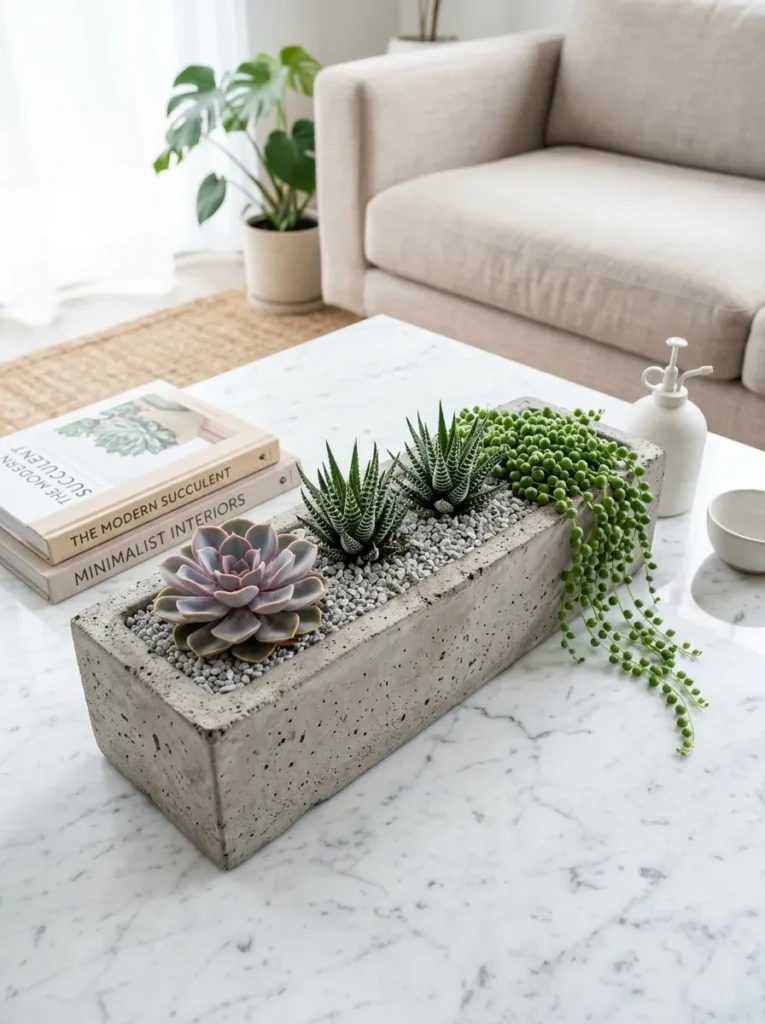
Vibe: Natural and architectural — the coffee table centerpiece that looks like a miniature landscape rather than a plant display.
Why it works: The concrete trough planter is the format that most effectively presents a mixed succulent arrangement as a composed landscape rather than a collection of individual plants — its elongated rectangular form creates a horizontal stage that the arrangement reads across from end to end, like a miniature garden scene rather than a pot of plants. The material connection between raw concrete and rocky desert habitat is direct and historically grounded: succulents evolved in environments of rocky, mineral-poor soil where the same grey-brown tones of concrete’s aggregate composition are the natural ground cover. This material coherence — the planter echoing the succulent’s natural habitat in color and texture — is the design principle that makes a concrete trough arrangement feel more complete and more natural than a ceramic pot arrangement of equivalent quality.
How to get it: The three-plant arrangement principle for a trough planter: one architectural upright (haworthia, aloe, or small agave), one rosette-form (echeveria or sempervivum), and one trailing or spreading form (string of pearls, sedum, or creeping thyme). This three-type selection creates a composed arrangement with height variation, form contrast, and directional interest that reads as designed rather than planted. Position the trailing element at one end of the trough rather than the center — a trailing plant cascading from the end of a trough creates directional movement in the composition that a centrally positioned trailing plant cannot achieve.
Shop the Look
| Product |
|---|
| Concrete rectangular trough planter |
| Haworthia fasciata established plant |
| String of pearls plant established |
| Fine grey gravel top dressing |
| Succulent trowel tool small |
Also view: 14 Handmade Gift Ideas That Feel Extra Special
3. Hanging Macrame Planter with Cascading Succulent
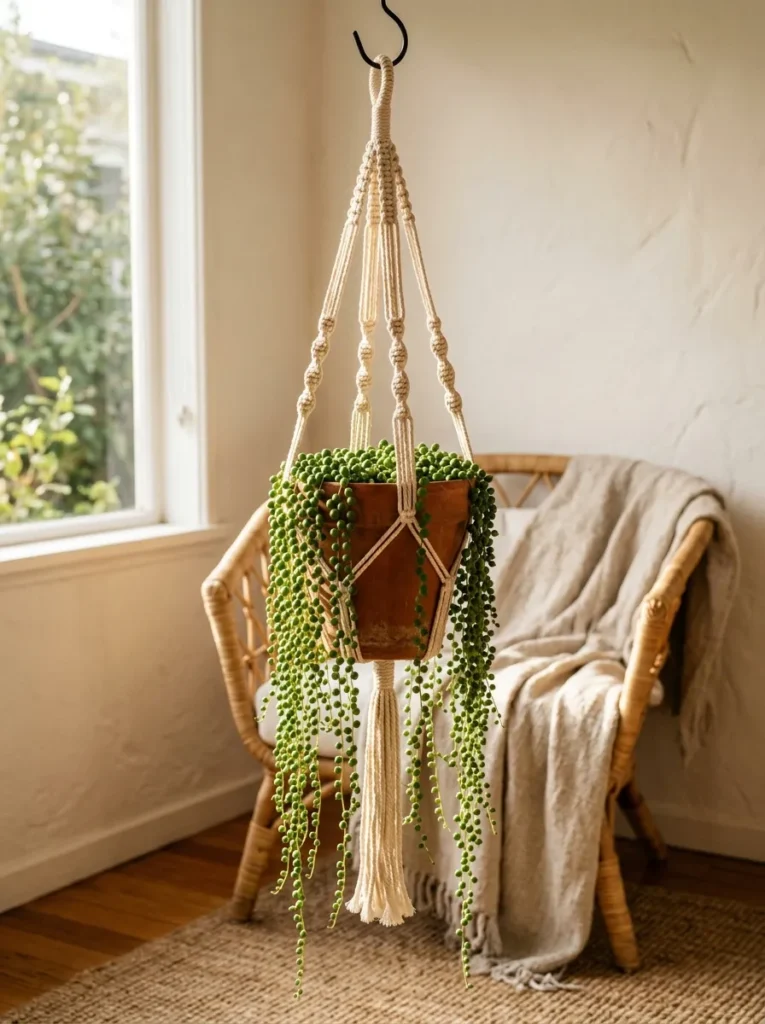
Vibe: Warm and textural — the hanging planter that makes a corner feel alive from floor to ceiling.
Why it works: The macrame hanging planter is the succulent display format that most completely uses the vertical plane — hanging a trailing succulent at 1.5–1.8 meters height allows the plant’s cascading habit to express itself fully as its primary visual feature, with the string of pearls or donkey’s tail beads forming a living curtain that would be impossible to achieve in any floor or shelf position. The macrame holder is the correct suspension format for this display because its natural cotton fiber and handknotted construction share the organic material character of the succulent and terracotta pairing — a wire or chain hanging planter would introduce an industrial tension that conflicts with the organic warmth of the plant and pot. String of pearls (Senecio rowleyanus) is the specific succulent variety that performs best in a hanging macrame display because its bead-like leaves have a sculptural quality that reads as jewelry when cascading through macrame knots.
How to get it: Install a ceiling hook rated for 3kg minimum — the combined weight of a mature string of pearls, a terracotta pot, soil, and the macrame holder can approach 2kg for a full plant. Position the hook in a location that receives bright indirect light rather than direct afternoon sun — string of pearls tolerates bright indirect light well but the combination of afternoon direct sun through a window and the insulating effect of the macrame holder can overheat the pot and stress the plant. Water string of pearls in a hanging macrame planter by removing the pot from the holder, watering thoroughly at a sink until water drains freely, and returning to the holder only after the pot has fully drained — water pooling in the macrame holder beneath the pot causes rot.
Shop the Look
| Product |
|---|
| Macrame hanging planter natural cotton |
| String of pearls plant established |
| Terracotta pot 15cm drainage |
| Ceiling hook rated 3kg |
| Cactus succulent potting mix |
4. Volcanic Stone Planter for a Japandi Shelf Display
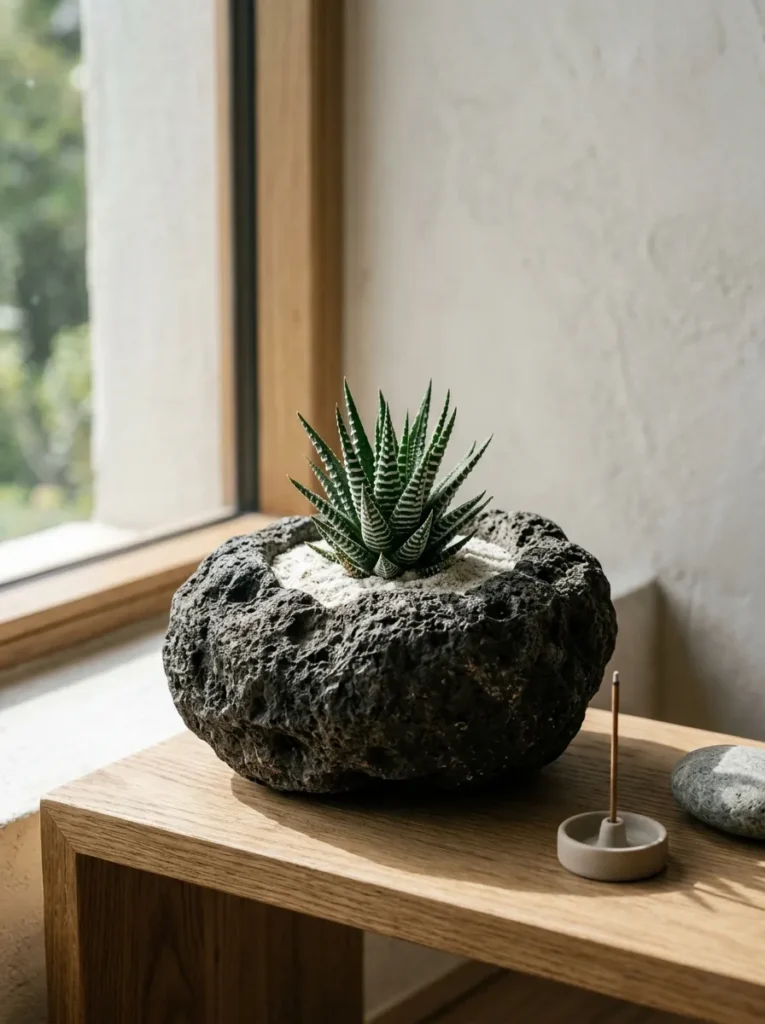
Vibe: Meditative and natural — a plant display that looks like it arrived from a Japanese garden rather than a garden centre.
Why it works: The volcanic stone planter is the succulent display object that most directly references the succulent’s natural rocky habitat while simultaneously connecting to the Japanese design tradition of using found and natural stone as a deliberate aesthetic choice — the tsukubai and suiseki traditions of Japanese garden design both place unworked or minimally worked stone as primary aesthetic objects rather than as structural materials. A haworthia planted in a hand-carved basalt hollow reads as a miniature landscape element — a plant growing from a rock face — that achieves the wabi-sabi quality of natural imperfection and material honesty that defines the Japandi aesthetic. The white sand top-dressing amplifies this landscape quality: it reads as the fine sediment of a dry riverbed, connecting the miniature plant arrangement to a larger natural context.
How to get it: Source carved volcanic stone planters from specialist Japanese garden suppliers, Indonesian craft importers, or online marketplaces where Balinese and Javanese stone carvers sell directly. Haworthia fasciata (‘Zebra Plant’) is the specific variety that most naturally suits a volcanic stone planter — its deep green and white striped leaves reference the color contrast of dark basalt and pale mineral veining that occurs naturally in volcanic stone. Use fine white horticultural sand ($8–12 per 2kg bag) as top-dressing rather than pebbles or grit — the fine sand reads as a continuation of the stone aesthetic at a smaller particle scale.
Shop the Look
| Product |
|---|
| Volcanic basalt carved stone planter |
| Haworthia fasciata zebra plant |
| Fine white horticultural sand |
| Low Japanese timber display shelf |
| Small ceramic incense holder |
5. Aged Brass Planter with Sculptural Cactus
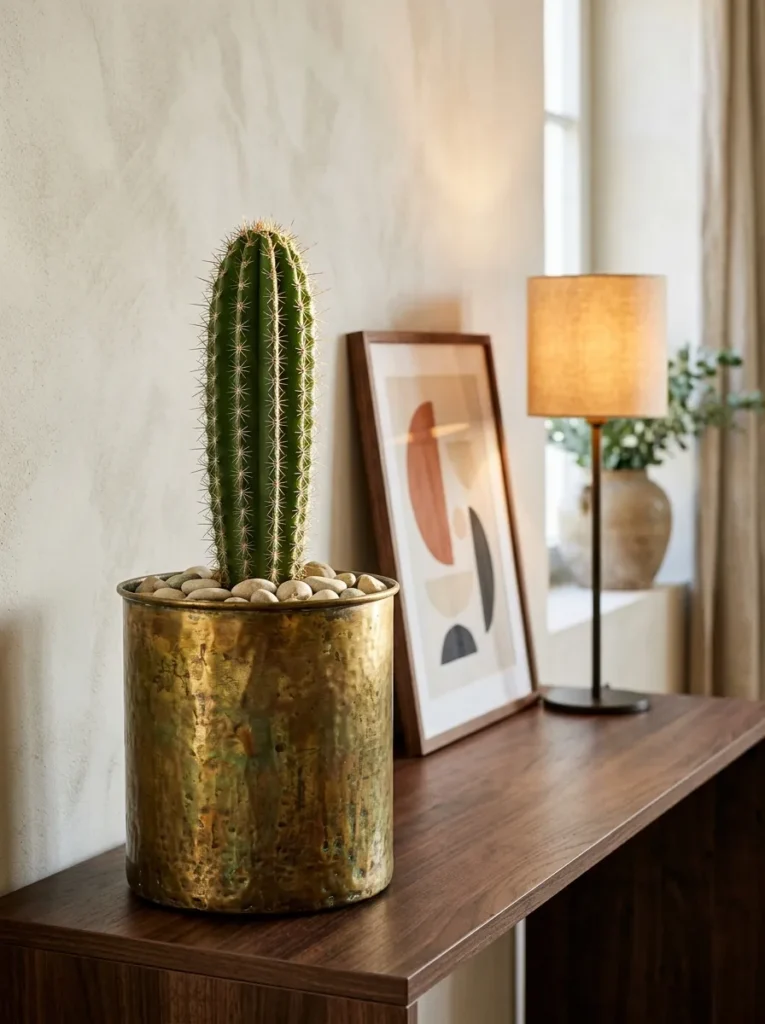
Vibe: Warm and sculptural — the statement plant arrangement that makes a console table feel like it was styled by a gallery.
Why it works: The aged brass planter paired with a column cactus is the succulent display that most powerfully creates a gallery-quality sculptural arrangement — the tall, spare vertical form of a column cactus rising from an aged brass cylinder references the kind of minimal, high-contrast object display that contemporary art galleries use for three-dimensional work. Aged brass specifically — rather than polished brass or gold — is the correct metal finish because its variable green-gold patina reads as authentic material history rather than decorative finish, connecting the planter to the geological time frame of the cactus’s own slow growth. The column cactus (cereus, trichocereus, or echinopsis species) is the correct plant for this format because its architectural vertical form creates a strong silhouette that reads clearly against the planter’s cylindrical body — a rosette-form succulent in a cylindrical tall pot would be visually overwhelmed by the container.
How to get it: Aged brass planters are available from specialist plant and homewares retailers including West Elm, CB2, and Anthropologie. The cactus height should be approximately 1.5–2 times the planter height — at this proportion, the cactus reads as architecturally scaled relative to its container rather than dwarfed by it or disproportionately dominant. Ensure the brass planter has drainage holes or is used as a cachepot (outer decorative container) with a plastic nursery pot inside — cacti require excellent drainage and die rapidly in containers without drainage.
Quick Win: Using a decorative aged brass planter as a cachepot — placing a standard plastic nursery pot inside it without removing the plant from its original growing medium — allows the use of any decorative container without drainage holes while maintaining the drainage conditions the cactus requires, and makes repotting as simple as lifting the nursery pot in and out.
Shop the Look
| Product |
|---|
| Aged brass cylindrical planter |
| Column cactus cereus established |
| Pale river stone top dressing |
| Dark walnut console table |
| Slim table lamp warm light |
6. Clustered Mini Planter Collection on a Windowsill
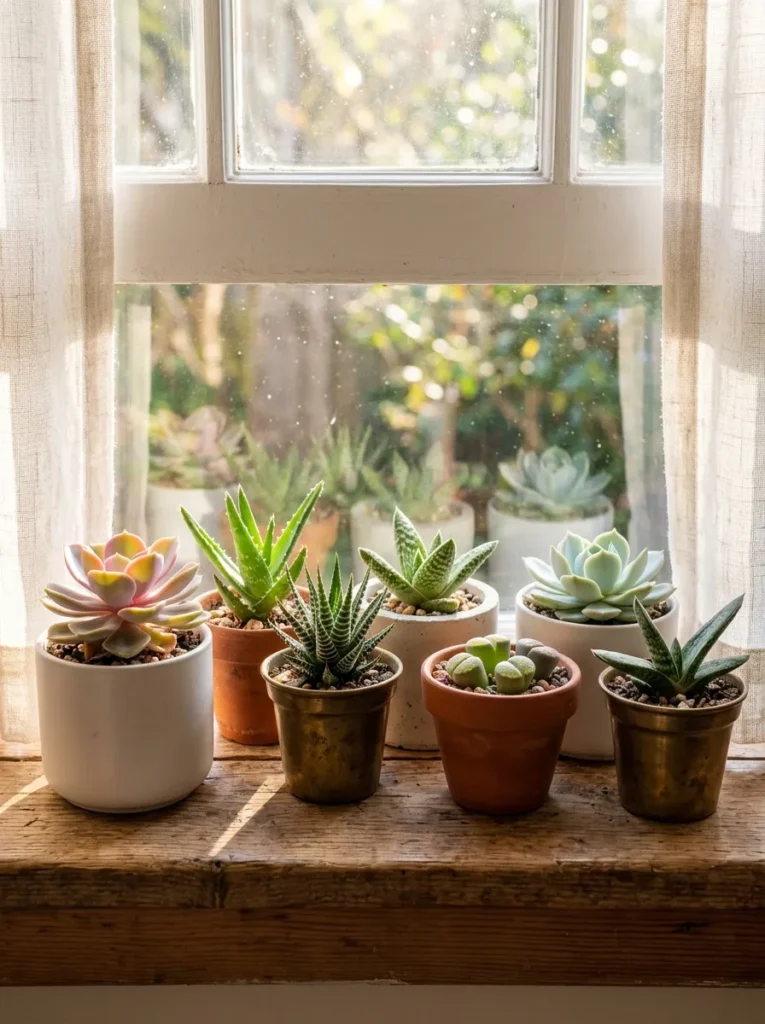
Vibe: Warm and abundant — the windowsill that makes every morning feel like a small botanical garden.
Why it works: The clustered mini planter collection on a windowsill is the succulent display strategy that delivers the highest visual richness per square centimeter of any arrangement in this list, because the visual abundance of multiple plant varieties and container forms creates a display that reads as a personal botanical collection rather than a decorating decision. The key design discipline for a windowsill cluster is container palette cohesion — the varied containers must share a tonal and material language (in this case, a palette of matte white, pale concrete, terracotta, and aged brass) that allows variety without visual chaos. The morning backlight through a south or east-facing window is the specific lighting condition that most dramatically reveals the translucent quality of succulent leaves — the thin-walled leaves of echeveria and haworthia glow from within when backlit, creating a display quality that no artificial light source can replicate.
How to get it: Build the windowsill collection gradually rather than purchasing all plants simultaneously — a collection that arrives in stages, with each plant selected based on the gaps in the existing arrangement, develops the character of a genuinely accumulated collection rather than an assembled display. The only organizational rule for the cluster arrangement: place the tallest plants at the back of the windowsill and the lowest at the front, creating a display that reads from below (the natural viewing angle from a standing position looking toward the window) rather than from above.
Shop the Look
| Product |
|---|
| Mini ceramic planter set mixed materials |
| Lithops living stone plant |
| Gasteria ox tongue plant small |
| Mini echeveria variety set |
| Small terracotta pot set drainage |
7. Handmade Stoneware Planter with Textured Surface
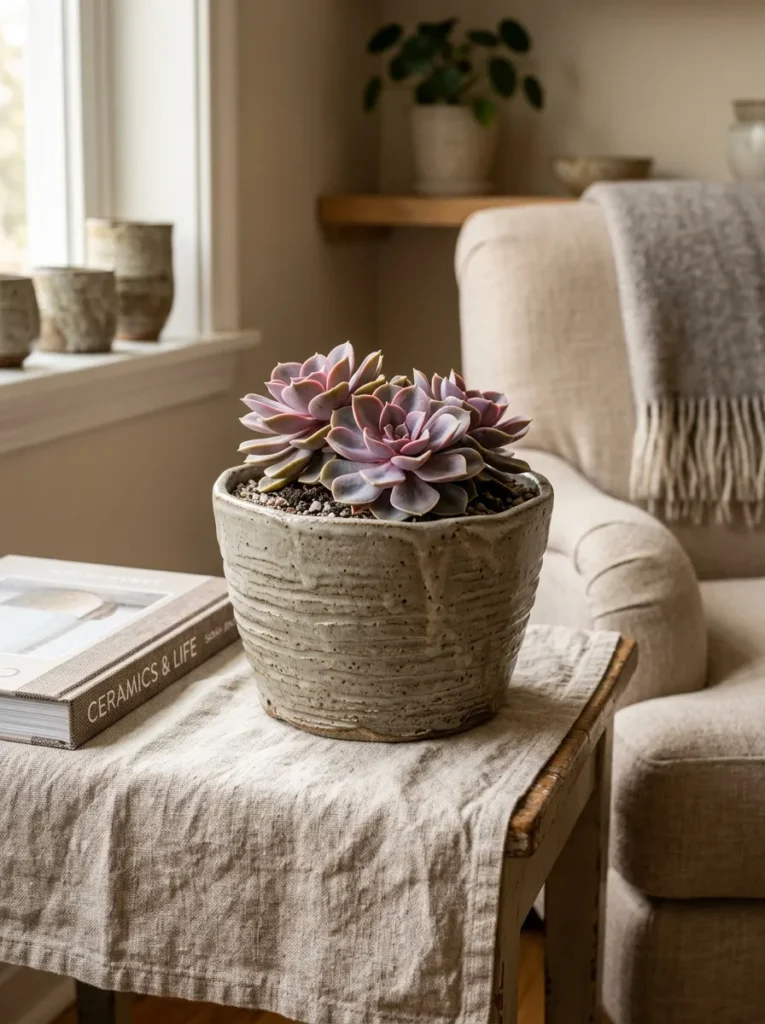
Vibe: Warm and artisanal — the plant pairing that makes a side table feel like it was curated by someone with genuinely good taste.
Why it works: The handmade stoneware planter is the succulent container that most completely embodies the design principle of material complementarity — the finger-textured exterior surface of a hand-thrown or hand-built stoneware vessel shares the organic imperfection and material authenticity of the succulent plant it holds, creating a pairing where both objects belong to the same aesthetic world rather than a designed container holding a natural object. The glaze color choice — warm putty, dusty sage, or pale blush — connects to the succulent’s own color palette rather than contrasting with it, producing a harmonized arrangement that reads as a single composed object rather than a plant in a pot. Echeveria ‘Perle von Nürnberg’ in its dusty pink-purple is the specific succulent that creates the most compelling pairing with a warm putty-grey stoneware glaze — the blush rosette against the grey stoneware references the same palette as a dried rose against aged linen.
How to get it: Source handmade stoneware planters from local pottery markets, Etsy ceramic makers, or small-batch studio ceramicists — the handmade quality is the functional requirement, and manufactured ceramics that simulate handmade texture do not achieve the same material authenticity. When purchasing a handmade stoneware planter, confirm that the glaze is food-safe (which also indicates it is watertight) and that a drainage hole is present or can be drilled before potting.
Shop the Look
| Product |
|---|
| Handmade stoneware planter grey glaze |
| Echeveria Perle von Nürnberg plant |
| Linen side table cover |
| Cactus succulent mix perlite blend |
| Cork drainage mat base |
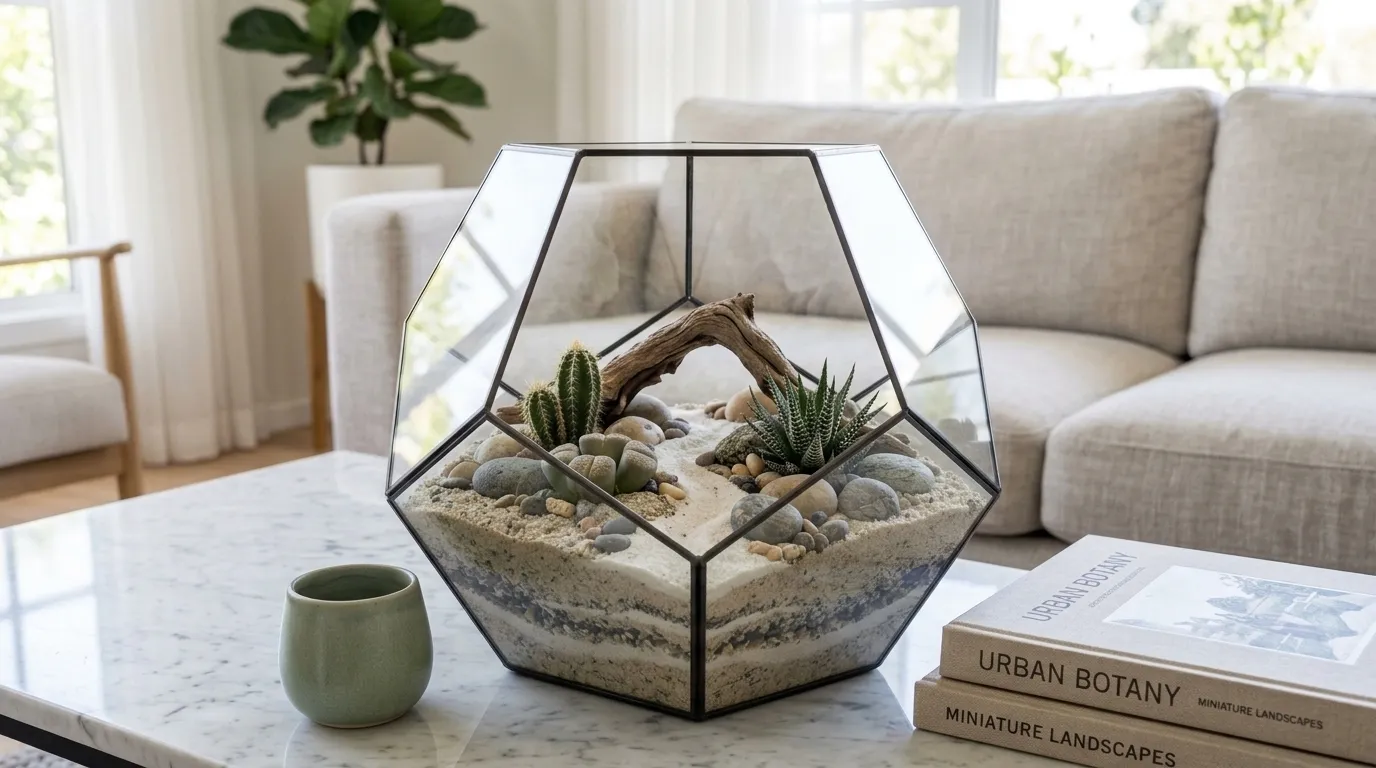
8. Terrarium Glass Vessel with Desert Landscape Scene
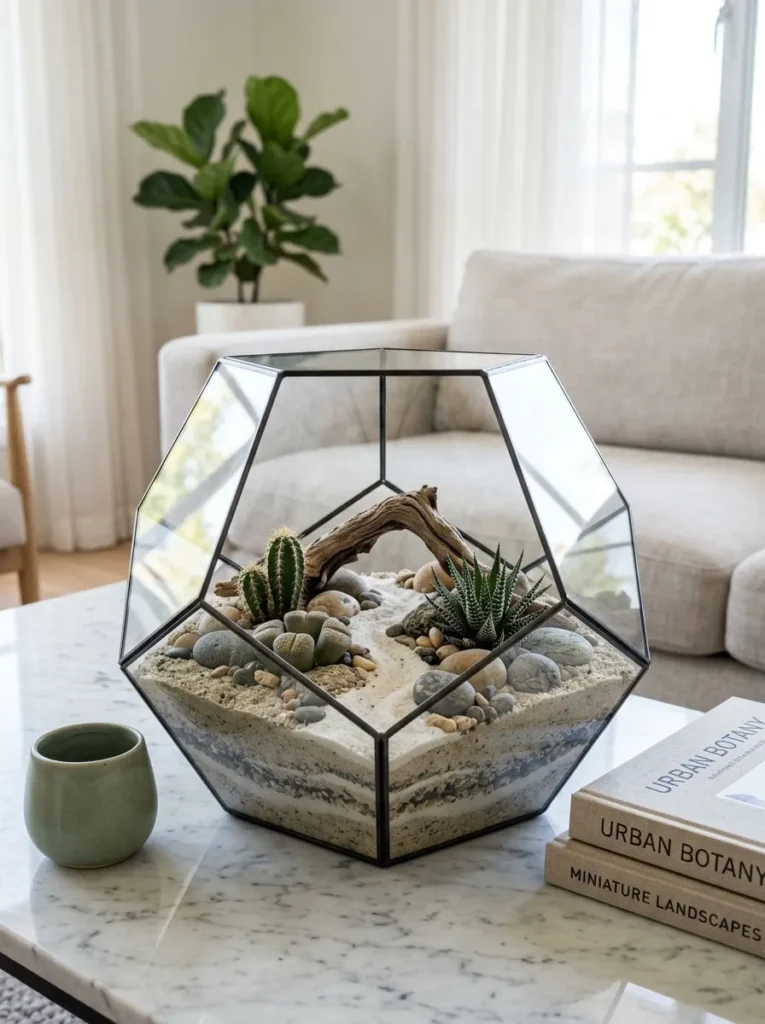
Vibe: Clean and landscape-like — a coffee table centerpiece that contains a complete desert scene within 30 centimeters.
Why it works: The geometric glass terrarium is the succulent display format that most completely achieves the miniature landscape effect — its transparent walls allow the full three-dimensional composition to be viewed from any angle, while the geometric glass panels (typically triangular or rectangular panels in a brass or black metal frame) create a visible architectural container that reads as an object in its own right. The desert landscape composition within the terrarium — layered sand, small rocks, driftwood, and selectively positioned plants at varied heights — applies the same design principles as full-scale landscape architecture: a ground plane, vertical elements at key positions, hardscape features as focal points, and visible circulation paths between plant groupings. Open-top terrariums (rather than closed, humid terrariums) are the correct format for succulents because they allow the air circulation and low humidity that succulents require — closed terrariums create the humid, stagnant air that causes succulent rot.
How to get it: Layer the terrarium base as follows: 20mm of pea gravel for drainage (succulents must never sit in standing water, and the gravel layer below the soil provides the drainage reservoir that a sealed glass base prevents), 40mm of cactus mix soil in which the plants are positioned, and a 10mm surface layer of fine river sand that covers the soil and creates the desert landscape surface visible through the glass. The sand layer should be raked into subtle valleys and ridges around the plant bases — this surface articulation is the detail that makes the terrarium read as a miniature landscape rather than plants in a glass box.
Shop the Look
| Product |
|---|
| Geometric glass terrarium open top |
| Pale river sand fine grain |
| Lithops living stone variety |
| Mini cactus assorted set |
| Small driftwood piece |
9. Stack of Graduated Concrete Sphere Planters
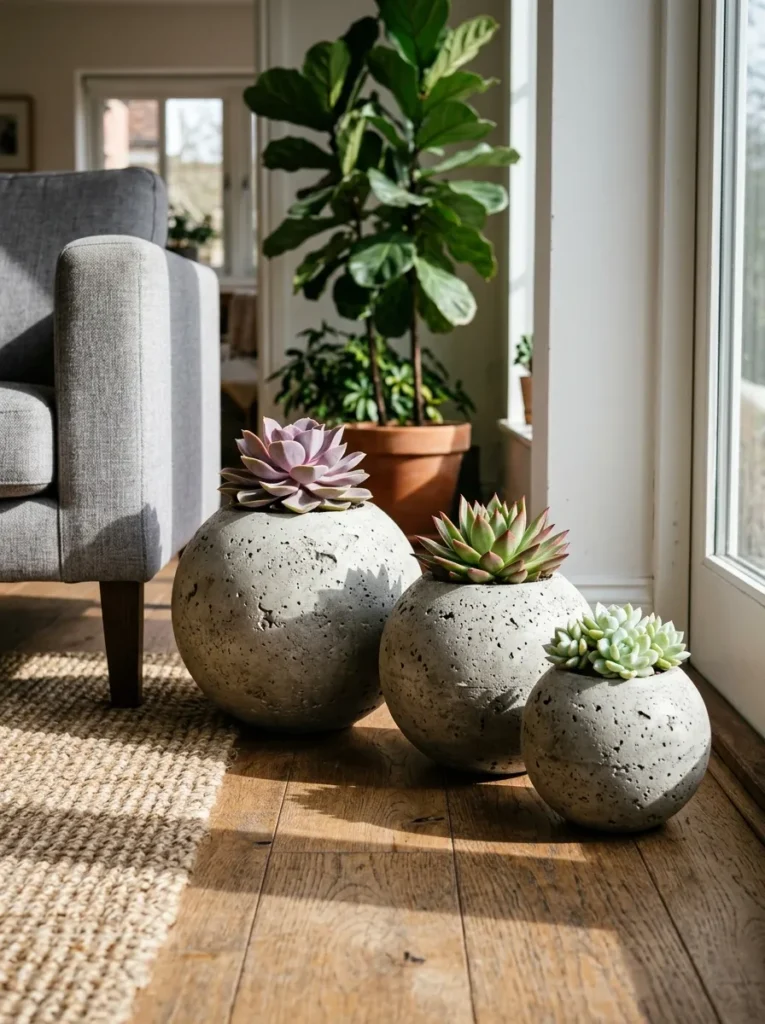
Vibe: Sculptural and bold — the floor display that makes succulents feel like gallery sculpture rather than indoor plants.
Why it works: Graduated concrete sphere planters arranged as a floor-level cluster is the succulent display that most powerfully creates a sculptural, gallery-quality composition at the scale of a room rather than a shelf — by bringing the plants to floor level and grouping three spheres in a diagonal cluster, the arrangement creates the same kind of three-dimensional object grouping that contemporary sculpture parks use to create spatial presence in a landscape. The sphere form is specifically effective for a floor display because it has no front or back — it reads equally from all angles and at all approach directions, which is the quality that allows a floor display to function as a room feature rather than a one-directional arrangement designed only for a specific viewing position. Concrete is the correct material for floor-level sphere planters because its weight and visual solidity reads as appropriate at the floor scale — a lightweight material at the same size would read as toy-like rather than sculptural.
How to get it: Concrete sphere planters in the graduated sizes required for this arrangement (25cm, 18cm, and 12cm diameter) are available from specialist concrete garden object suppliers and independent craft makers. Position the three spheres with the largest at the back, the medium in the middle-right, and the smallest in the front-left — this diagonal arrangement creates visual movement and depth that a symmetrical triangle or straight line arrangement cannot achieve.
Shop the Look
| Product |
|---|
| Concrete sphere planter large 25cm |
| Concrete sphere planter medium 18cm |
| Concrete sphere planter small 12cm |
| Echeveria variety three pack |
| Cactus mix soil bag |
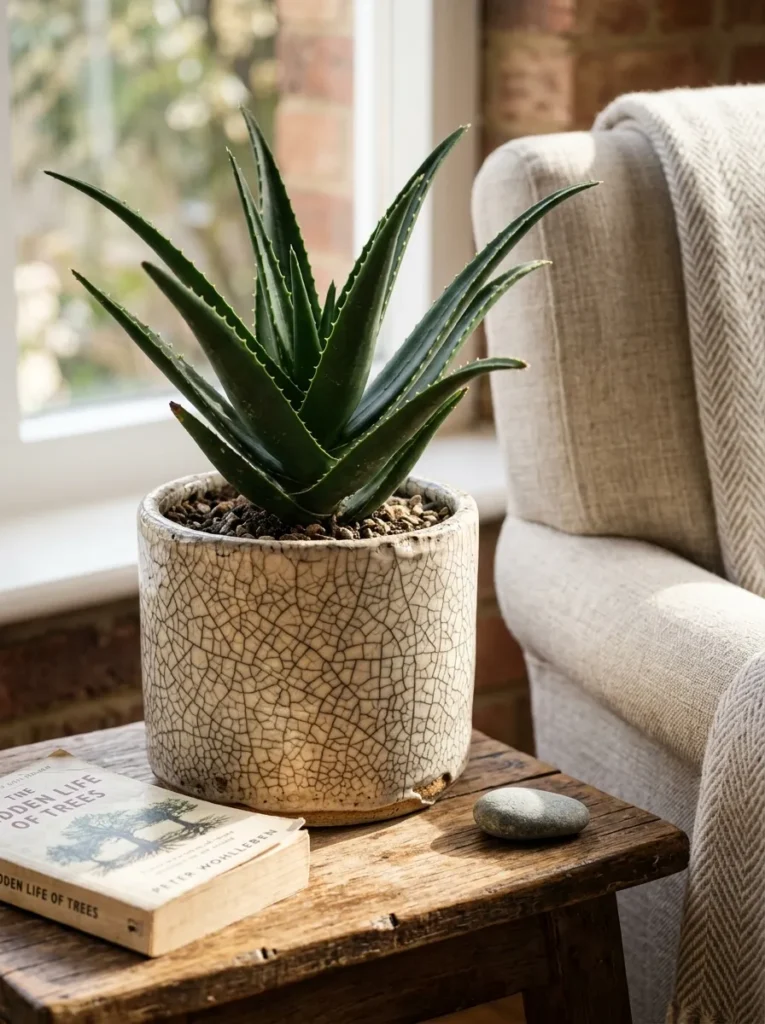
10. Wabi-Sabi Cracked Glaze Planter with Single Aloe
.
Vibe: Warm and imperfect — the plant that looks like it has been somewhere interesting and settled into its permanent home.
Why it works: The wabi-sabi crackle glaze planter is the succulent display that most directly applies the Japanese aesthetic philosophy of wabi-sabi — the beauty of imperfection, transience, and incompleteness — to the plant container. A deliberately crazed or crackled glaze surface reads as beautiful precisely because of its visible aging and imperfection: the network of fine cracks across the glaze surface records the thermal history of the clay, making the vessel a time document as well as a container. This material philosophy connects naturally to the succulent: aloe vera, with its thick dark green leaves and its history as both a healing plant and a botanical subject across millennia of human cultivation, is a plant with its own sense of time and permanence that the crackle glaze planter amplifies rather than contrasts with. The single aloe in a wabi-sabi vessel is the arrangement that most completely embodies the less-is-more principle — one mature plant, one distinctive container, one quality of morning light.
How to get it: Crackle glaze ceramic planters are produced by most studio ceramicists as a standard glaze technique — source from local pottery markets, studio ceramicist Etsy shops, or specialist ceramic retailers. Aloe vera ‘Barbadensis Miller’ is the standard variety with the most architectural dark green leaf form — avoid the smaller, more densely leaved varieties that lack the dramatic single-stem silhouette that makes the wabi-sabi single-plant arrangement work.
Shop the Look
| Product |
|---|
| Crackle glaze ceramic planter ivory |
| Aloe vera barbadensis mature plant |
| Weathered timber side table |
| Fine river sand top dressing |
| Smooth river stone decorative |
11. Copper Bowl Planter with Sempervivum Hen and Chicks
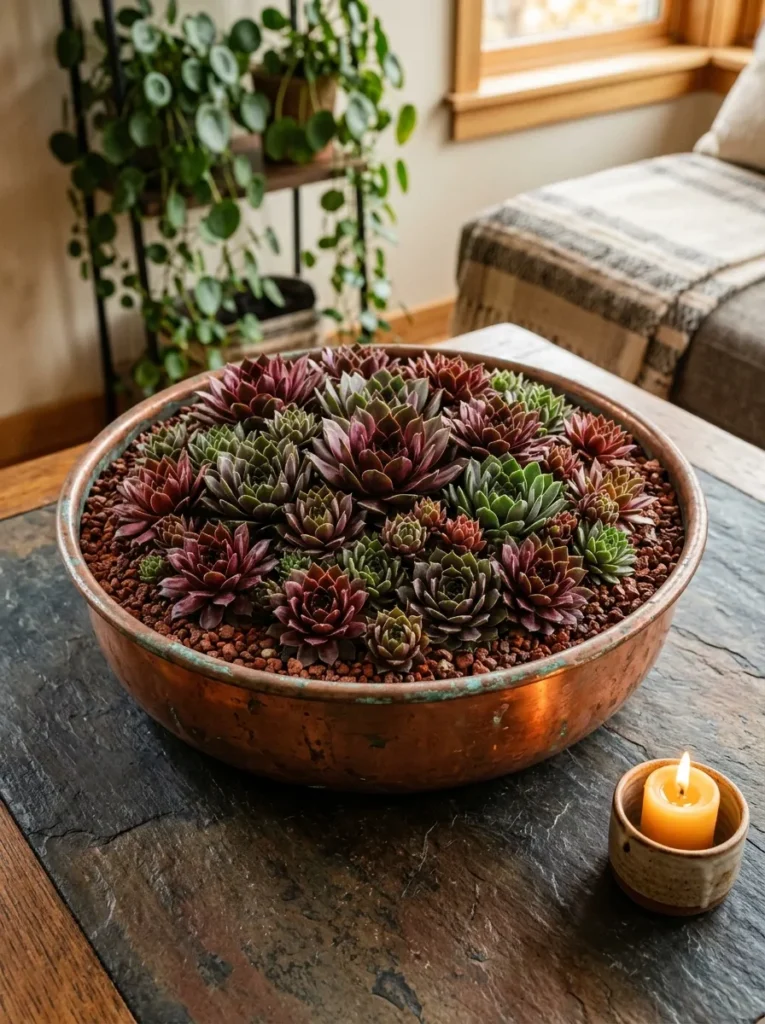
Vibe: Warm and abundant — the wide shallow bowl that makes sempervivum look like a harvest from the most beautiful garden.
Why it works: The wide shallow copper bowl densely planted with sempervivum hen and chicks is the succulent arrangement that most powerfully demonstrates the design principle of plant-as-texture — rather than presenting individual plants as sculptural specimens, the dense planting of multiple sempervivum rosettes in a shallow bowl creates a continuous textured surface that reads as a living material plane rather than individual plants. This texture effect is specific to sempervivum, which produces offsets (the “chicks”) that cluster tightly around the parent rosette, naturally creating a dense, interlocking rosette coverage that fills a shallow container completely without visible soil gaps. The copper bowl is the correct container for this planting because its warm oxidized tone coordinates with the red-green coloring of sempervivum varieties specifically — a cool grey or white planter would create a cool-warm color clash that works against the red tones in the plant.
How to get it: Purchase sempervivum in a mixed variety pack ($12–20 for 12 plants from most garden centres) and plant at maximum density — rosettes touching and offset growth filling gaps immediately, with fine red volcanic grit pressed between all plant bases. Sempervivum is frost-hardy and tolerates neglect better than most succulents — water monthly in summer and not at all in winter for maintenance-free performance in this arrangement.
💡 Quick Win: A single 12-plant mixed sempervivum pack ($12–20) planted at maximum density in a 25cm wide shallow bowl creates the full hen-and-chicks texture effect within a single planting session — the dense planting immediately reads as established and abundant rather than newly planted and sparse.
Shop the Look
| Product |
|---|
| Copper bowl wide shallow planter |
| Sempervivum mixed variety pack |
| Red volcanic grit top dressing |
| Dark slate coffee table tray |
| Small taper candle copper holder |
12. Wall-Mounted Vertical Succulent Frame
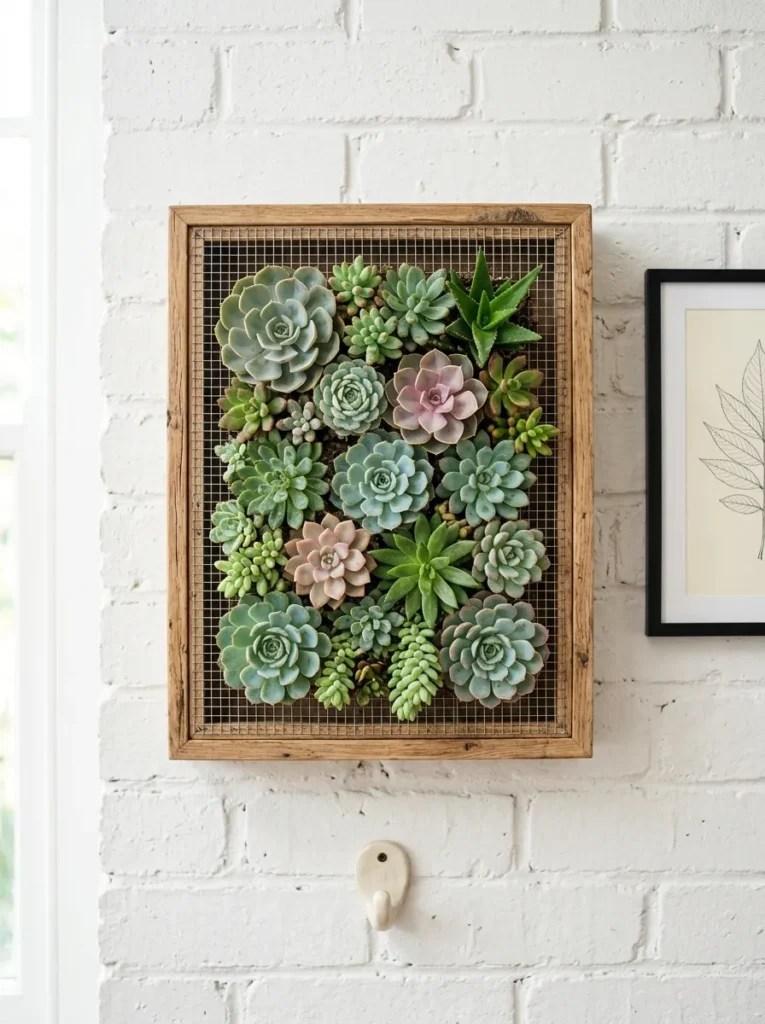
Vibe: Botanical and editorial — the wall piece that makes visitors ask where you bought it before they realize it is growing.
Why it works: The vertical succulent frame is the display format that most directly references the botanical illustration tradition — the succulent varieties arranged in a flat, picture-frame format echo the precise, taxonomic layouts of 18th and 19th-century botanical prints, transforming living plants into a wall-mounted display that reads as art. The wire mesh front of the shadow box frame holds each plant’s root ball in a small pocket of soil behind the mesh — the mesh apertures create a grid structure that imposes the same organizational discipline on the plant arrangement as a botanical illustration’s plate borders. Selecting succulent varieties for color composition across the frame — dark red-green varieties at the corners, pale blue-green in the center, pink-tipped varieties at the edges — makes the succulent frame read as a color-composed botanical artwork rather than a random collection of plants.
How to get it: Build the frame from 70mm × 20mm dressed pine, stapled together at the corners and lined with 6mm exterior plywood at the back. Staple a sheet of 25mm × 25mm galvanized wire mesh across the front face. Fill the interior with a cactus mix soil combined with coconut coir (which retains enough moisture for vertical planting while providing good drainage). Plant small succulent cuttings (not rooted plants — cuttings are easier to insert through the mesh) through the mesh apertures and into the soil behind. Lay the frame flat for 4–6 weeks while the cuttings root, then mount vertically.
Shop the Look
| Product |
|---|
| Timber shadow box frame 40x30cm |
| Galvanized wire mesh 25x25mm |
| Cactus mix and coconut coir blend |
| Succulent cutting mixed variety set |
| Wall mount picture hook heavy duty |
13. Industrial Pipe Shelf Planter System
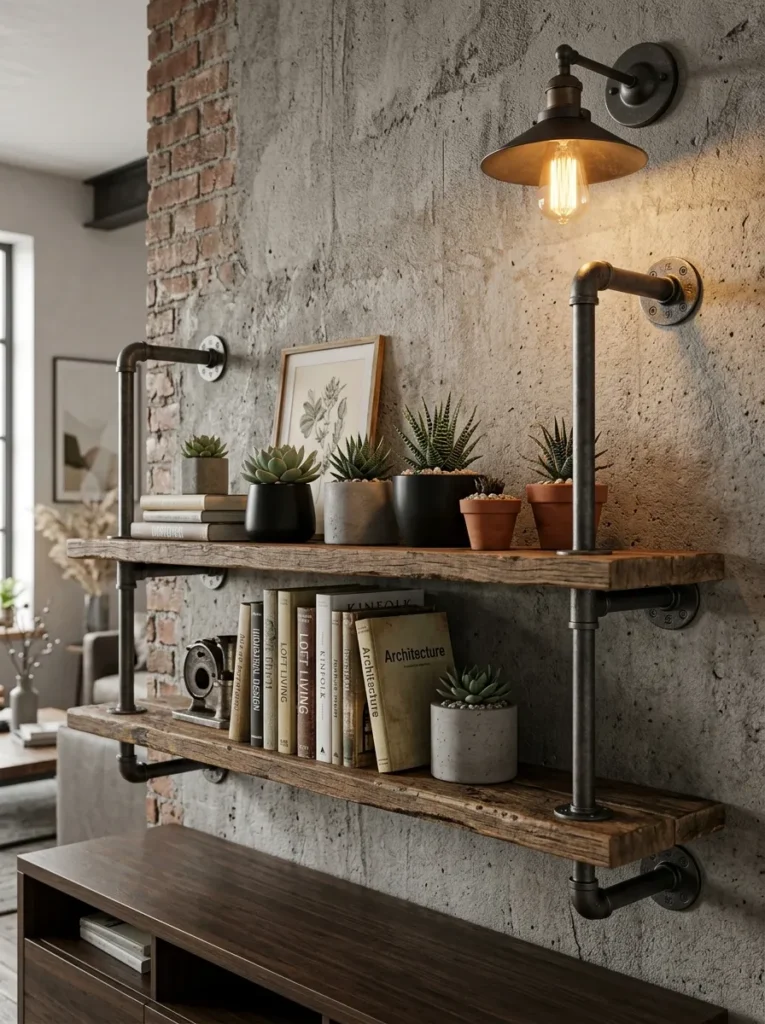
Vibe: Warm and industrial — the shelf system that makes succulents look at home in a converted warehouse.
Why it works: The industrial pipe shelf system integrates succulent planters into a display context where the shelf and its supporting structure are as much the design feature as the objects it holds — the raw steel pipe brackets, exposed fitting joints, and reclaimed timber shelf surface create an intentional aesthetic framework within which the succulent planters become components of a larger designed system rather than individual objects placed on a generic shelf. This integration principle — where the shelf system and its contents are conceived as a unified design rather than separately — produces a more resolved visual result than placing plants on a standard shelf, because the material language (raw steel, reclaimed timber, matte black ceramic) is consistent across the structure and the objects it holds. The succulent planters in this system are specifically selected in the matte black ceramic, concrete, and terracotta palette that coordinates with the industrial aesthetic — terracotta is the one warm natural material that prevents the palette from reading as cold and purely masculine.
How to get it: Standard industrial pipe shelf brackets using 20mm galvanized pipe fittings (floor flange, 90-degree elbow, and nipple section) are available as flat-pack kits from specialist homewares retailers and online suppliers at $40–80 per shelf bracket pair. The shelves are cut from reclaimed or rough-sawn timber boards at 200–250mm depth — the shallower depth of 200mm suits a shelf system where the visual focus is on the objects rather than the shelf’s storage capacity.
Shop the Look
| Product |
|---|
| Industrial pipe shelf bracket kit |
| Reclaimed timber shelf board |
| Wall mounted industrial pipe lamp |
| Mini concrete planter set |
| Mixed succulent planter assorted |
14. Upcycled Vintage Vessel Succulent Planter
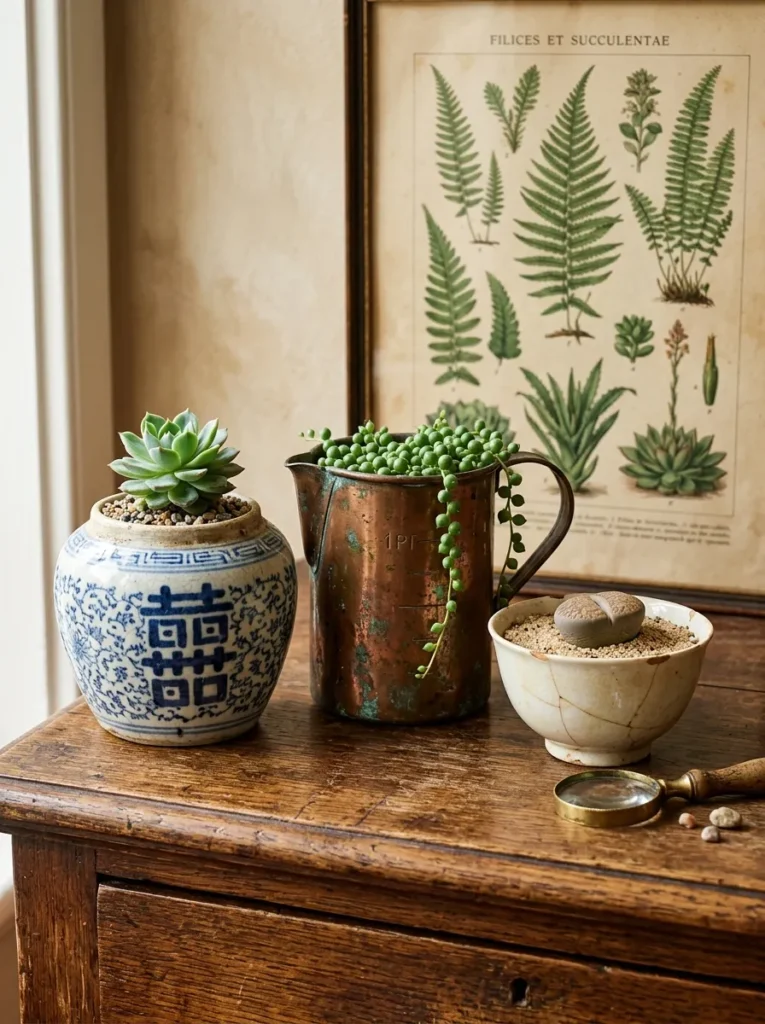
Vibe: Warm and collected — the plant display that looks like the best finds from three years of antique market Sundays.
Why it works: Upcycled vintage vessels as succulent planters is the display approach that delivers the highest personality-per-dollar ratio of any idea in this list — a collection of interesting old vessels found at antique markets, estate sales, and op-shops communicates personal history, aesthetic discernment, and a commitment to the found-and-repurposed over the purchased-new that is one of the most compelling design narratives available in interior styling. The succulent’s minimal watering requirements (every 2–4 weeks) make it uniquely suitable for vessels without drainage holes — the low watering frequency means the risk of overwatering and root rot is manageable by monitoring the soil moisture between waterings, which is not the case for thirstier plants that would quickly rot in a drainage-free vessel. Each vintage vessel is selected for its visual compatibility with the succulent species it will hold — the tall ginger jar for the compact echeveria, the wide-mouthed copper jug for the string of pearls that will cascade over its rim, the shallow tea bowl for the lithops that requires minimal soil depth.
How to get it: Add a drainage layer of 20mm pea gravel to any vessel without drainage holes before adding cactus mix soil — the gravel layer provides the drainage reservoir that prevents the soil layer above from becoming waterlogged. Water vintage-vessel succulents using the soak-and-dry method: add a small amount of water directly at the plant’s base (avoiding the vessel’s inner walls), allow to absorb completely before adding any additional water, and allow the soil to dry completely before watering again.
Shop the Look
| Product |
|---|
| Vintage ginger jar antique market |
| Copper measuring jug vintage |
| Cracked vintage porcelain bowl |
| Lithops living stone variety |
| Small pea gravel drainage layer |
15. Bathroom Shelf Succulent Display with Spa Styling
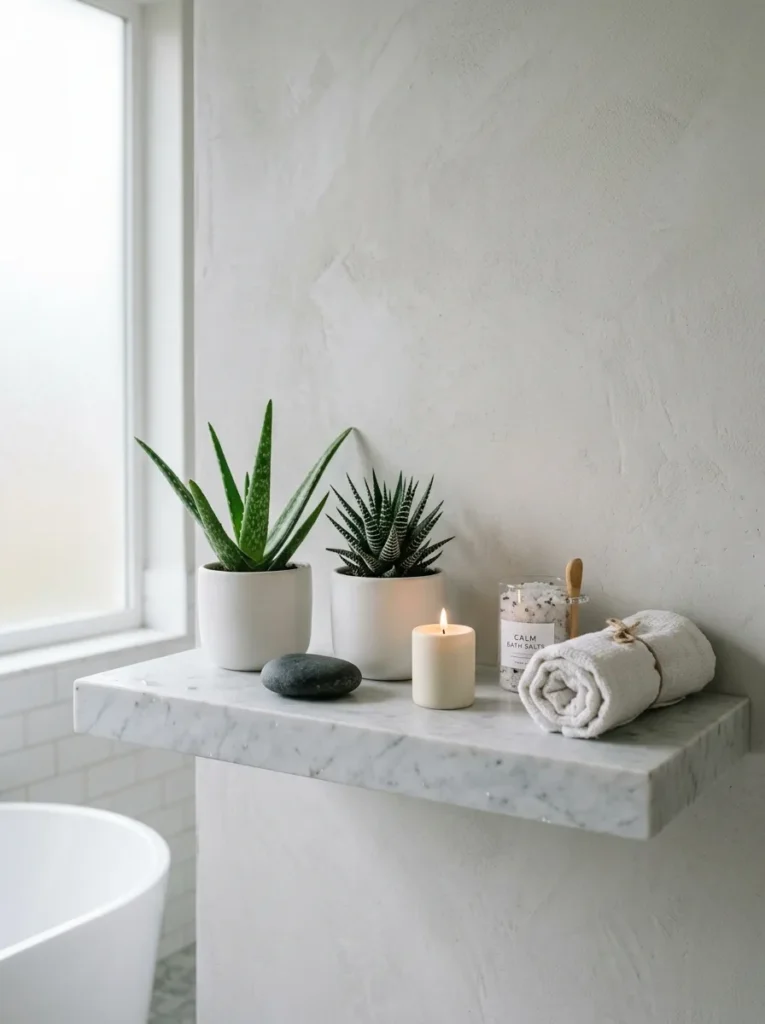
Vibe: Clean and spa-like — a bathroom shelf that makes the morning routine feel like it deserves a robe.
Why it works: The bathroom shelf succulent display is the succulent application that delivers the highest daily emotional impact because it places living plants in the room where the quality of the environment most directly affects the experiential quality of daily rituals — showering, skincare, morning preparation. Succulents are the only plant family that genuinely thrives in a bathroom with limited natural light and variable humidity (rather than simply tolerating it) because their water-storage physiology makes them indifferent to the high-humidity air that causes root problems for most houseplants, while their low-light tolerance allows them to perform adequately in a bathroom with a frosted window. The spa-styling of the shelf arrangement — combining succulents with a beeswax candle, bath salts, and a rolled linen cloth — situates the plants within a sensory ritual context that elevates the entire shelf from a storage surface to an experience zone.
How to get it: Aloe vera and haworthia are the two succulent genera most suited to bathroom environments: haworthia performs in low-light conditions and high humidity better than any other succulent genus, and aloe vera provides the additional functional benefit of a readily available topical gel for minor skin irritations. Use matte white ceramic planters exclusively for a bathroom shelf succulent display — in a room of white tiles, chrome fittings, and white towels, a matte white ceramic planter reads as an extension of the room’s material language rather than an introduced contrast element.
Quick Win: A single haworthia in a matte white ceramic planter placed on a bathroom shelf is the lowest-cost highest-impact bathroom improvement available — haworthia in particular requires watering only once every 3–4 weeks, makes no maintenance demands, tolerates the lowest light conditions of any succulent, and provides the living botanical quality that transforms a functional bathroom surface into a considered spa-like environment.
Shop the Look
| Product |
|---|
| Matte white ceramic planter small |
| Haworthia fasciata bathroom plant |
| Honed marble floating shelf |
| Beeswax candle ceramic holder |
| Rolled white linen cloth |
16. Statement Agave in an Oversized Textured Planter
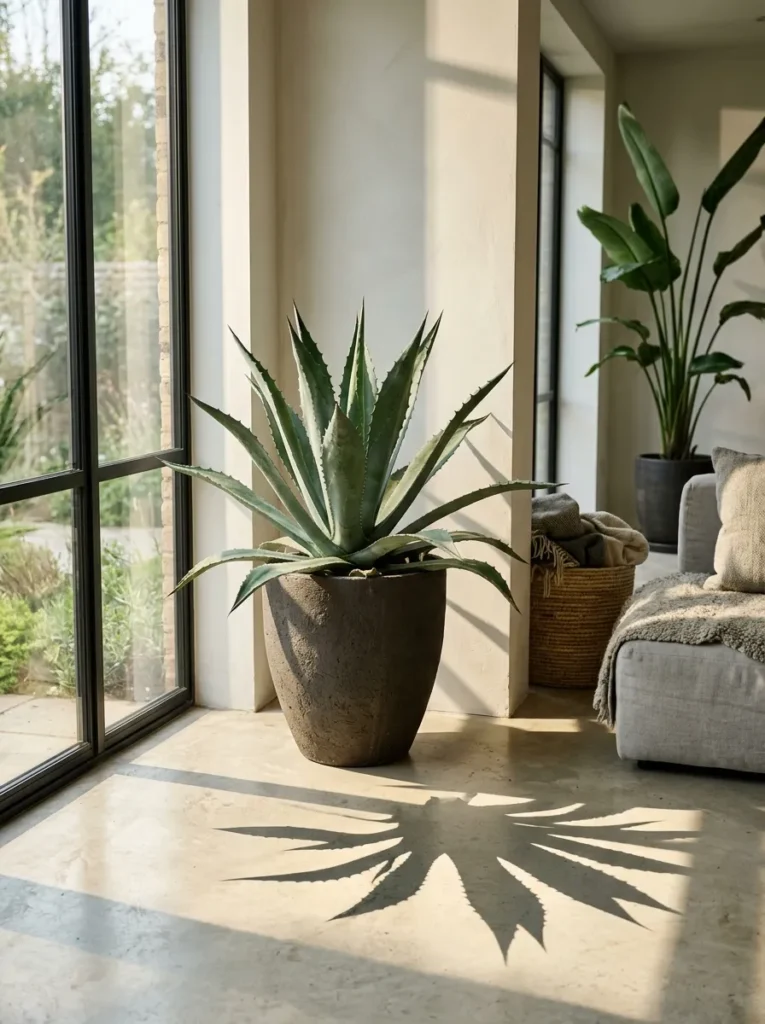
Vibe: Dramatic and architectural — the single plant arrangement that can anchor a full living room and make every other decorating decision easier.
Why it works: The statement agave in an oversized textured planter is the succulent display that most powerfully functions at the room scale rather than the shelf or table scale — its dramatic graphic shadow on floor and wall is the room-level design feature that makes this arrangement genuinely architectural rather than decorative. Agave species (agave attenuata for indoor use, agave americana for statement scale) have a leaf form that casts more graphic, design-quality shadows than almost any other plant species — the long, tapering leaves with their terminal spines produce shadow silhouettes of genuine abstract art quality on adjacent walls at the acute angles of morning and afternoon sunlight. The oversized textured planter at 35cm diameter is the proportional specification that allows the agave’s root system to develop the size required for a mature, dramatically leafed specimen, while the warm charcoal grey glaze grounds the blue-green agave leaf color without competing with it.
How to get it: Agave attenuata is the recommended indoor agave species because it lacks the terminal spine of most agave varieties — the spine at the leaf tip of agave americana is a genuine safety hazard in an indoor environment where people move close to the plant. Position in the strongest light position available in the room (the brightest corner, beside the largest window) — agave requires the highest light levels of any succulent in this list and will grow slowly and lose form in inadequate light. Water monthly in summer and every 6 weeks in winter — the oversized planter retains moisture for longer than a standard-sized container, reducing the watering frequency required.
Shop the Look
| Product |
|---|
| Agave attenuata mature plant large |
| Oversized ceramic planter charcoal 35cm |
| Cactus mix perlite blend large bag |
| Concrete pot saucer large |
| Pale concrete floor tile |
How to Start Your Modern Succulent Planter Collection
Your single first move is to choose your planter material palette before choosing a single plant or pot — decide whether your home’s aesthetic calls for a matte black and concrete palette (contemporary minimal), a warm terracotta and stoneware palette (organic and artisanal), a brass and aged metal palette (warm and collected), or a mixed vintage vessel palette (personal and accumulated). Every planter in your collection should belong to this palette, even if the container forms and sizes vary. The material palette is the organizing principle that transforms a random collection of potted plants into a designed display — without it, the arrangement reads as accumulated; with it, the arrangement reads as curated, regardless of how many or how few planters it includes.
The most common succulent planter mistake is purchasing a planter for its appearance before considering whether its drainage provision is adequate for the succulent species it will hold. Succulents die from overwatering more reliably and more rapidly than from any other cause, and overwatering is almost always caused by a planter without drainage rather than a watering-frequency error — even a monthly watering in a drainage-free container eventually produces root rot in the standing water that accumulates at the base. Every succulent planter must either have a drainage hole at the base, be used as a cachepot (decorative outer container) over a plastic nursery pot with drainage, or be set up with a drainage layer of pea gravel at minimum 20mm depth before the soil layer. This drainage requirement applies to every planter in this list — even the vintage vessel arrangement and the copper bowl.
Three specific purchases under $50 that create immediate succulent planter quality improvement: (1) Fine black basalt grit top-dressing ($8–12 per 500g bag) applied over the soil surface of every existing succulent planter immediately elevates the display quality from “plant in a pot” to “considered arrangement” by covering the soil surface with a clean, uniform mineral layer that reads as a professional finishing detail. (2) A 1-liter bag of perlite ($8–12) mixed at 50% with standard cactus mix creates the fast-draining medium that prevents the root rot that kills most indoor succulents — the perlite addition is the single most impactful cultural practice improvement available for succulent health. (3) A set of three matte black mini ceramic planters in graduated sizes ($15–30 from any homewares retailer) immediately creates the nucleus of a coordinated shelf display — three planters in the same material and color at different heights, each holding a different succulent variety, is the minimum composition that reads as a designed display rather than random shelf plants.
Realistically, a complete styled home succulent collection — six to eight plants in coordinated containers across three or four display zones (windowsill cluster, shelf specimen, bathroom display, coffee table centerpiece) — costs $150–350 in total for plants and containers sourced from a combination of specialist succulent suppliers, local nurseries, and homewares retailers. Individual statement arrangements — the oversized agave floor planter, the geometric glass terrarium, the vertical succulent frame — cost $60–200 each depending on the size and quality of the container specified. The lowest-cost high-impact entry point is the clustered windowsill mini planter collection — seven small planters in a coordinated palette with seven different succulent varieties costs $50–100 in total and creates the highest visual richness per dollar of any arrangement in this list.
Frequently Asked Questions About Modern Succulent Planters
What is the best planter material for indoor succulents?
Terracotta is the best planter material for succulent health because it is porous — it absorbs and evaporates soil moisture through its walls, which reduces the risk of overwatering and root rot that kills most indoor succulents. From a design perspective, however, contemporary terracotta competes with concrete, matte ceramic, and stoneware for the most visually considered material choice — each creates a different visual relationship with the plant and a different aesthetic register in the room. The practical compromise is to use terracotta as the inner growing pot (the nursery or growing vessel) inside a decorative cachepot of concrete, brass, or ceramic — this allows the soil conditions of terracotta drainage and porosity to benefit the plant’s health while the outer cachepot delivers the visual quality of any designed material choice.
What colors work best for succulent planters in a modern interior?
The three most versatile planter color choices for modern interiors are matte black (which creates maximum contrast with any succulent green and reads as contemporary in any design register), warm concrete grey (which references the succulent’s natural rocky habitat and reads as honest and natural), and warm terracotta (which coordinates with the earthy tones of most succulent varieties and introduces warmth to a palette that might otherwise read as cool). The least versatile planter colors are bright primary colors and stark white — bright colors compete with the plant’s own color rather than complementing it, and stark bright white creates an overlit, clinical quality that reads as commercial rather than designed. Aged and patinated finishes — aged brass, oxidized copper, crackle glaze ceramics — consistently outperform new and bright finishes in a modern interior context because their material history adds depth and character that new finishes cannot replicate.
How often do I water succulents in modern planters?
The correct watering frequency for indoor succulents varies by season and container material but is almost always lower than most plant owners practice — overwatering is the primary cause of succulent death in indoor environments. The general guideline is: water thoroughly (until water drains freely from the drainage holes) every 2–4 weeks in summer when the plant is in active growth, and every 4–6 weeks in winter when the plant is dormant. The correct test for whether to water is the soil moisture check — insert a finger 2–3cm into the soil at the planter edge: if the soil is completely dry at that depth, water thoroughly; if any moisture is detectable, wait another week and test again. In terracotta planters, the soil dries more quickly than in ceramic, concrete, or metal planters — adjust frequency accordingly. Never water on a fixed schedule regardless of soil moisture — always test first.
Can succulents survive in a bathroom with no window?
No — succulents require at minimum bright indirect light to survive long-term, and a bathroom with no window provides insufficient light for any succulent species regardless of the artificial lighting present. Standard indoor artificial lighting does not provide the light spectrum or intensity that succulents require for photosynthesis. A bathroom with a small frosted window that admits some natural light can support haworthia (the most low-light-tolerant succulent genus), and a bathroom with a clear window admitting direct or bright indirect natural light can support a wider range of succulent varieties. If a bathroom truly has no natural light, the only viable plant options are certain fern and moss species that genuinely tolerate low-light conditions — succulents are not among them.
What is the best succulent variety for beginners?
The three succulent varieties that most consistently succeed for beginners with no prior plant care experience are: Haworthia fasciata (Zebra Plant) — the most low-light and low-water tolerant of all common succulent varieties, requiring watering only every 3–4 weeks and performing in bathroom and office light conditions where other succulents struggle; Echeveria ‘Black Prince’ — a visually dramatic dark rosette-form succulent that is genuinely forgiving of irregular watering and thrives in bright indirect light; and Aloe vera — a multi-functional plant that tolerates wide variation in watering frequency, bright indirect light, and bathroom conditions while providing the added benefit of a readily available topical gel. All three are available at most garden centres and hardware store plant sections for $4–12 each in a 10cm nursery pot.
Ready to Create Your Modern Succulent Planter Collection?
These 16 ideas span the full range of what a modern succulent planter can be and do — from a single matte black geometric ceramic holding a perfect echeveria on a minimalist shelf, and a concrete trough landscape on a marble coffee table, to a volcanic stone carved planter on a Japandi display shelf, a copper bowl densely planted with hen and chicks, a living wall-mounted succulent frame, and a dramatic statement agave casting graphic shadows across a living room floor — so whether you are beginning with a single specimen on a bathroom shelf or building a complete whole-home succulent collection across every surface and zone, there is a genuinely achievable, genuinely designed starting point here for your space, your aesthetic, and your level of plant care commitment. The collection builds best when it begins with the material palette decision — not the plant choice, not the pot selection, but the two or three container materials that will define the visual language of every plant display in your home — because once that palette is established, every subsequent plant and container purchase becomes a clear decision rather than an open question. Today’s specific action: pick up a bag of fine black basalt grit top-dressing the next time you pass a garden centre or specialist succulent supplier, and apply it to the surface of every succulent you already own. That single material addition — covering the soil surface in a clean, uniform mineral layer to the plant’s base — will transform the visual quality of every plant you currently have before you spend a single dollar on a new container. Save the planter ideas that matched your home’s existing material palette and your most-used surfaces — those are the ones that will look most at home in your space and that will be genuinely admired by every person who visits it.