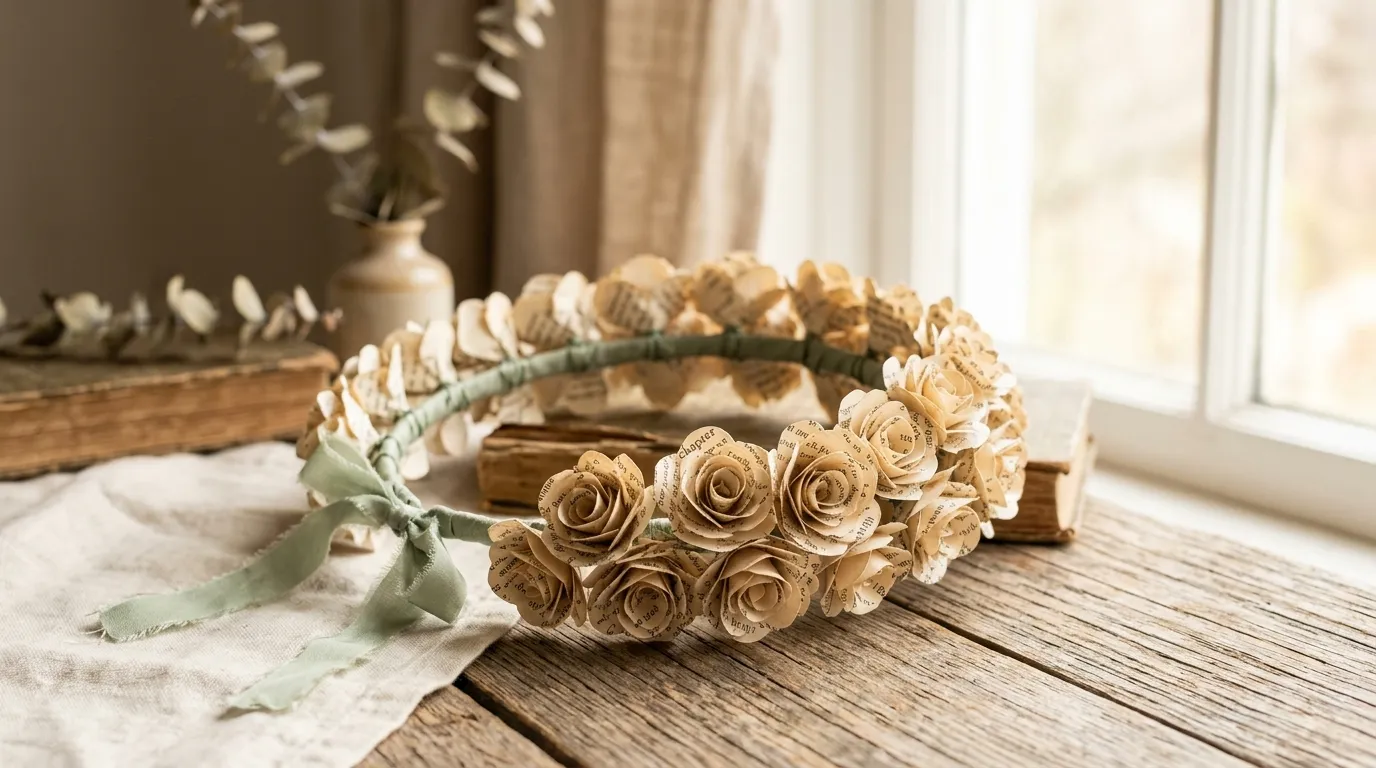
17 Book Page Craft Ideas for Creating Unique Paper Flowers
A book page paper flower is a dimensional bloom folded, rolled, or layered from the pages of an old or damaged book, turning free or near-free secondhand paper into lasting floral decor that never wilts. This article gives you 17 specific, buildable ideas for creating unique paper flowers entirely from book pages. There’s a particular charm to a book page flower: warm cream petals catching light the way real ones do, the faint ghost of old type running across a curled edge, a whole bouquet that costs nothing but the price of a damaged paperback and an afternoon. It borrows from both the vintage paper flower tradition that predates plastic florals entirely and the current wave of budget-conscious, textural home styling, which is exactly why these blooms work in wedding decor, everyday vases, and wall art alike. Here are 17 ideas worth saving — and stealing.
Why Book Page Paper Flowers Work So Well
Book page flower making draws from two traditions: the vintage paper flower craft that flourished long before silk or plastic florals were widely available, when book and newsprint pages were the cheapest material on hand, and the current wave of budget-conscious, textural home styling that treats free secondhand paper as a legitimate design resource. What makes book page flowers distinct from plain craft paper blooms is their built-in warmth — the cream tone, visible serif type, and soft aged texture of an old page reads as collected and romantic rather than simply recycled.
The material and color language centers entirely on the paper itself: warm cream and ivory tones, faded typeset text, and the natural give of a well-worn page, paired sparingly with wire, glue, and the occasional dab of dye for petal tips. Because the paper does so much visual work on its own, technique stays simple, rolling, layering, and cutting rather than anything requiring specialized floristry tools.
This style is trending now because secondhand books are genuinely cheap or free, thrift stores, library sales, and curbside giveaways all supply damaged copies that are perfect for cutting, and search interest in “book page flowers” and “paper flower tutorial” climbs steadily around wedding and home decor seasons. The style also holds up indefinitely once finished, unlike fresh flowers, which has helped it become a lasting decor category rather than a passing trend.
Small budgets and small projects both suit this style well, since a single damaged paperback provides enough pages for a full bouquet, a wreath, or a scattering of individual blooms. Prioritize sourcing one damaged, unsellable book, torn cover, missing pages, water damage, before starting any project, since that’s the cheapest and most guilt-free source material available.
Style at a Glance
| Element | Vintage Paper Flower Tradition | Budget Textural Styling |
|---|---|---|
| Philosophy | Romantic, hand-shaped | Resourceful, near-free |
| Materials | Old book pages, floral wire | Glue, dye, twine |
| Color palette | Warm cream, sepia, oak | Warm white, sage, oak |
17 Book Page Paper Flower Ideas
1. Classic Rolled Book Page Rose
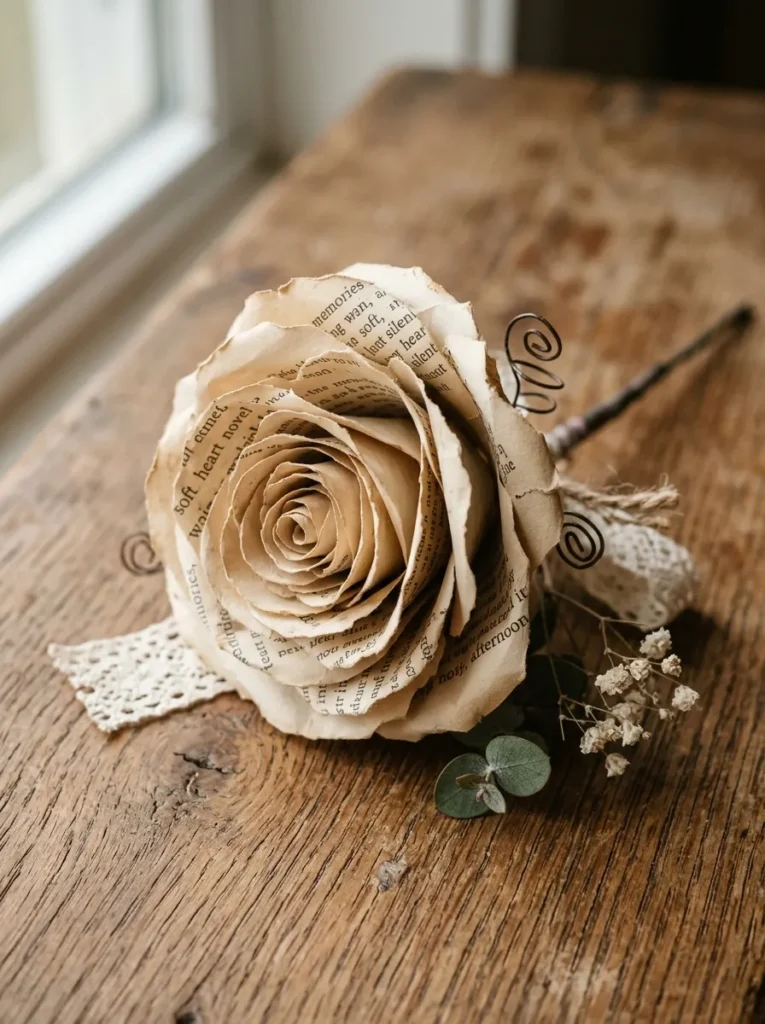
Vibe: Romantic, like an old novel’s pages curled themselves into a single perfect bloom.
Why it works: Cutting a page into a continuous spiral and rolling it from the outside in creates the classic rose silhouette using nothing but the paper’s own flexibility, a technique where one cut shape produces a fully dimensional flower.
How to get it: Cut a book page into a continuous spiral, starting from the outer edge, then roll the spiral tightly from the outer end inward, loosening the outer petals slightly once rolled and securing the base with hot glue.
Shop the Look
| Product |
|---|
| Secondhand damaged book |
| Hot glue gun and sticks |
| Floral wire stem |
| Fine-tip scissors |
| Small floral tape roll |
Also view: 19 Book Page Crafts Ideas for Decorating Your Home on a Budget
2. Layered Book Page Peony
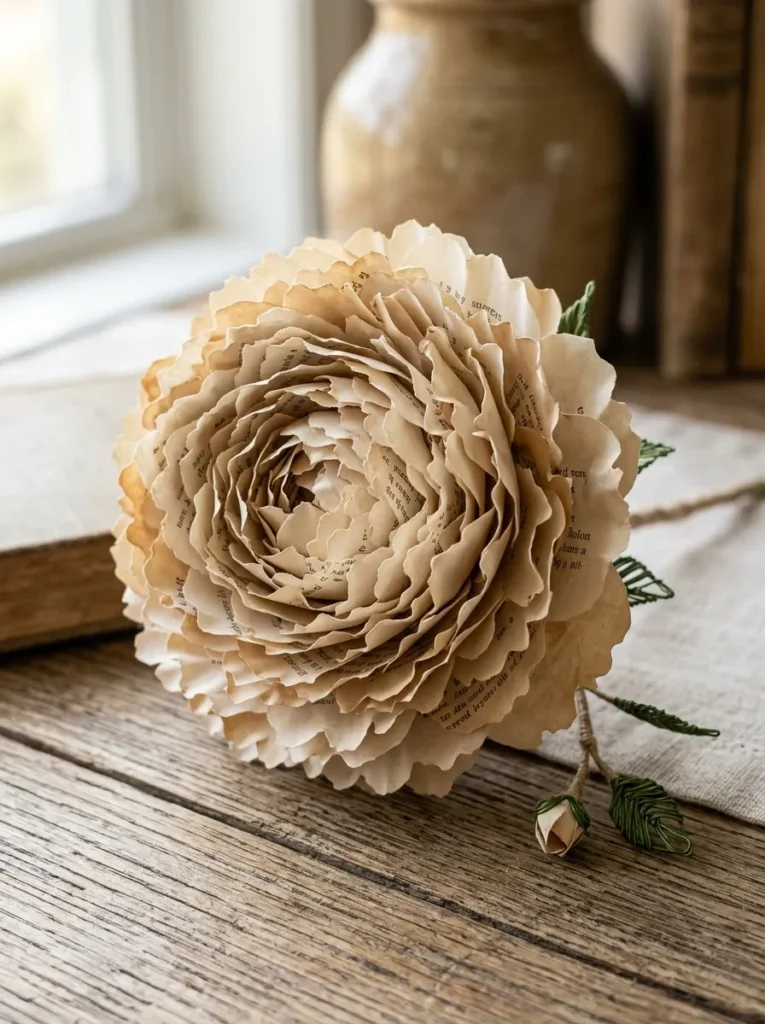
Vibe: Lush, like a whole handful of pages turned into one full, generous bloom.
Why it works: Stacking several layers of individually cut petals rather than one continuous spiral gives the peony its characteristically full, ruffled shape, a technique that trades simplicity for a noticeably more dramatic finished flower.
How to get it: Cut five to six rounded petal shapes per layer in graduating sizes, curl each petal edge gently around a pencil, and layer three to four rows together from largest to smallest, gluing each layer to a cardstock base before attaching a stem.
Shop the Look
| Product |
|---|
| Secondhand book pages |
| Round petal template set |
| Small cardstock base circles |
| Craft glue |
| Floral wire stem |
Also view: 15 Book Page Crafts Ideas for Beautiful DIY Wall Decor
3. Simple Five-Petal Book Page Daisy
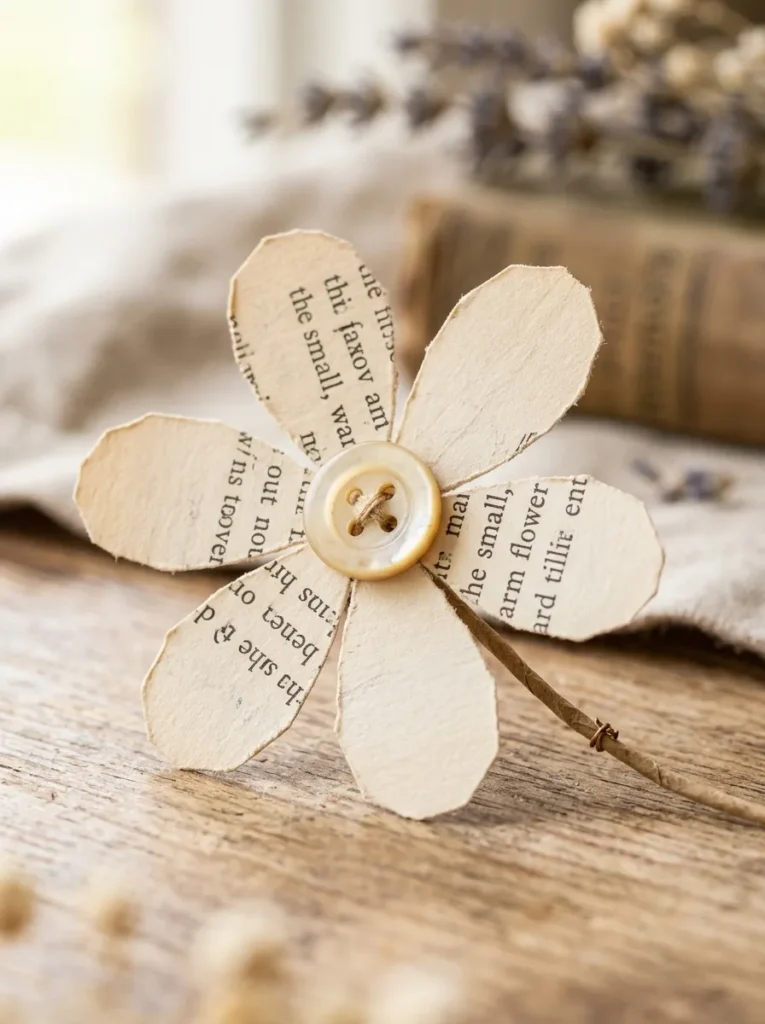
Vibe: Cheerful, like the simplest possible flower shape still managed to feel considered.
Why it works: A five-petal daisy shape requires only a single cut layer and a center accent, a beginner-friendly technique that produces a recognizable, charming flower with the least amount of folding or layering skill.
How to get it: Trace and cut a simple five-petal flower shape from a single book page, curl each petal tip slightly with your fingers, and glue a small button or paper circle to the center before attaching a wire stem from behind.
Quick Win: A flower-shaped cookie cutter works as an instant, precise template for this design.
Shop the Look
| Product |
|---|
| Secondhand book pages |
| Small button set |
| Flower-shaped template or cutter |
| Floral wire stem |
| Craft glue |
Also view: 17 Book Page Craft Ideas for Creating Unique Paper Flowers
4. Ombre-Dyed Book Page Ranunculus
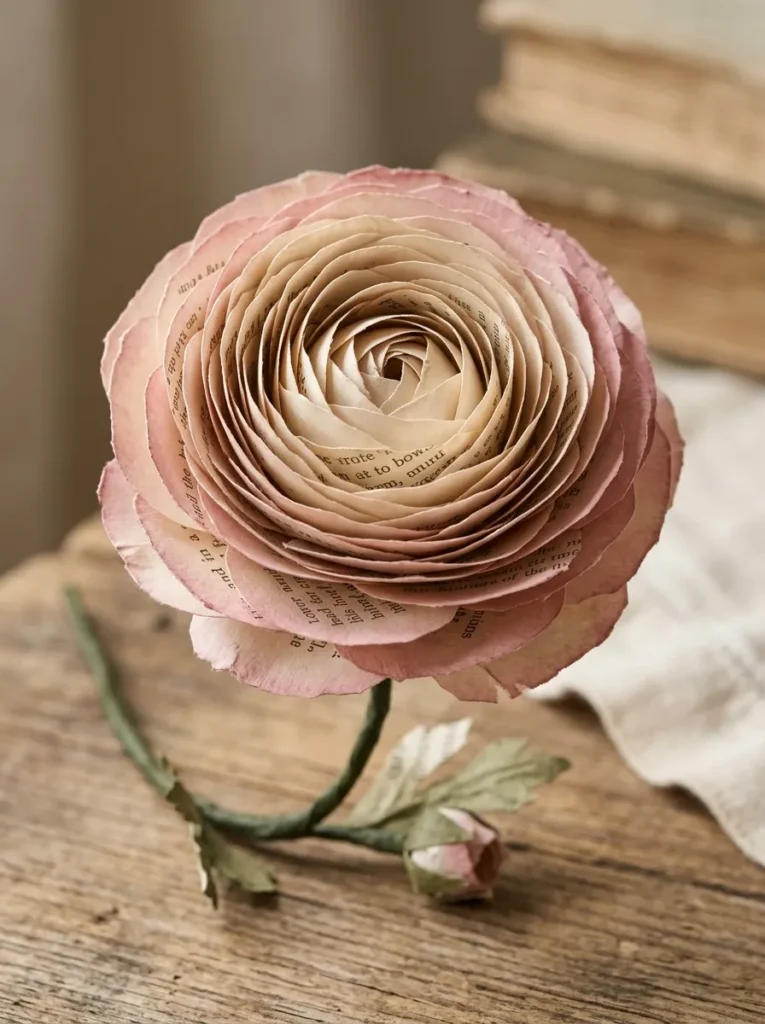
Vibe: Delicate, like the pages absorbed just a hint of color at the edges.
Why it works: Dipping only the outer petal edges into diluted fabric dye keeps the vintage text visible while adding a soft color gradient, a technique that introduces color without hiding the paper’s original character.
How to get it: Cut and layer many small rounded petals as with the peony method, but before assembly, dip just the outer edge of each petal into a shallow dish of diluted fabric dye, let dry fully, then layer and glue as usual.
Shop the Look
| Product |
|---|
| Secondhand book pages |
| Diluted fabric dye |
| Small shallow dye dish |
| Round petal template |
| Floral wire stem |
5. Small Space Miniature Book Page Buds
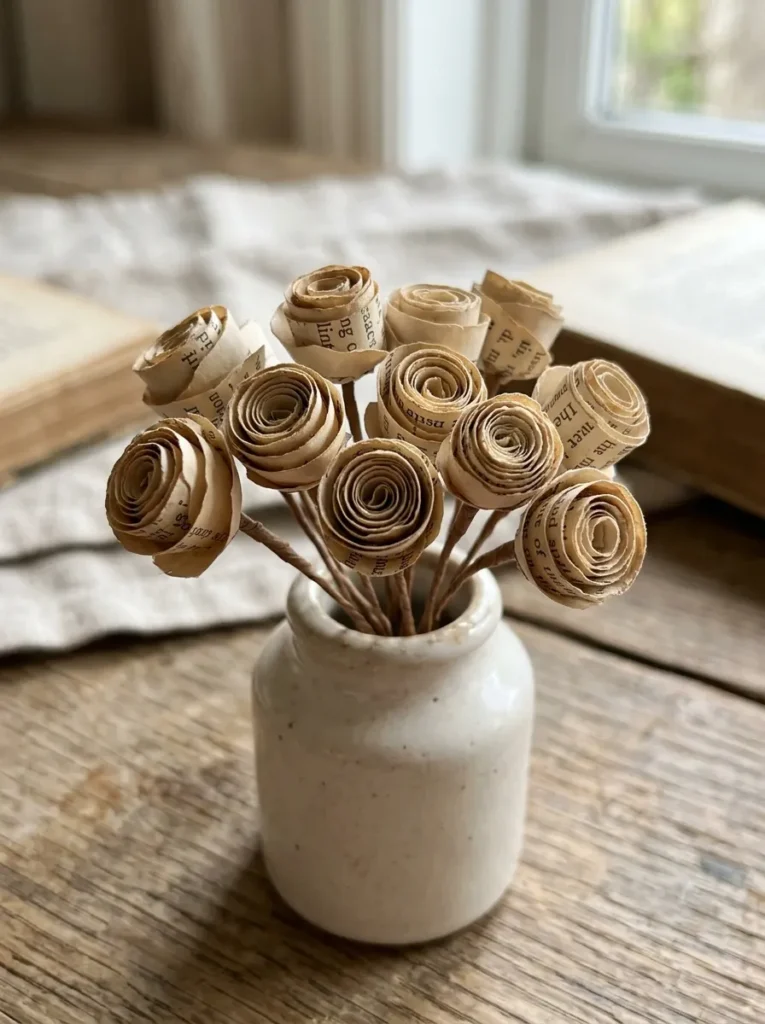
Vibe: Delicate, like a handful of tiny buds filled a small space with quiet detail.
Why it works: Scaling the classic rolled rose technique down to a miniature size uses very little paper per flower, a small-space technique that produces enough tiny buds from a single page to fill a whole cluster.
How to get it: Cut narrow spiral strips no more than an inch wide, roll tightly into small bud shapes without unfurling the outer petals, and attach several to thin floral wire stems for a clustered bouquet.
Shop the Look
| Product |
|---|
| Secondhand book pages |
| Thin floral wire |
| Craft glue |
| Fine-tip scissors |
| Small floral tape roll |
6. Sage and Cream Book Page Anemone
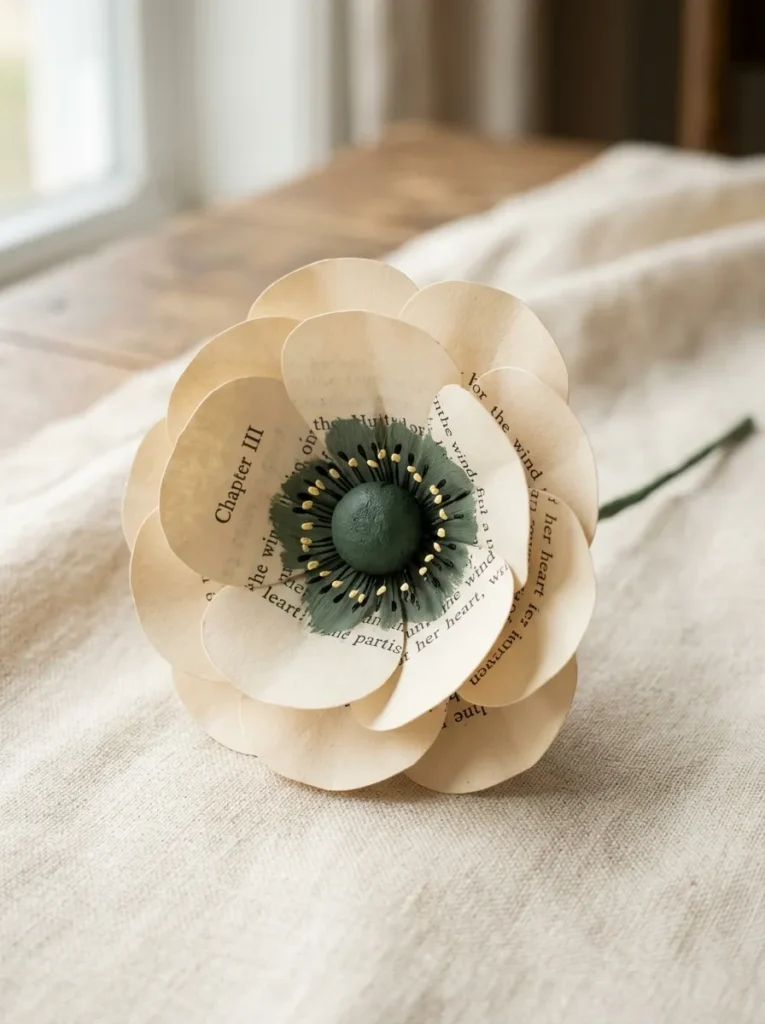
Vibe: Elegant, like one small painted detail gave the flower real personality.
Why it works: Anemones are recognized by their dark, contrasting center against pale petals, so painting just the center circle in sage or black uses minimal color to achieve a botanically specific, elegant look.
How to get it: Cut six to eight flat rounded petals and arrange them in a single layer around a small circle of cardstock painted dark sage or black at the center, gluing the petals flat rather than curled.
Shop the Look
| Product |
|---|
| Secondhand book pages |
| Sage or black acrylic paint |
| Small cardstock circle |
| Craft glue |
| Floral wire stem |
7. Warm Task Lighting Book Page Flower Lampshade Accent
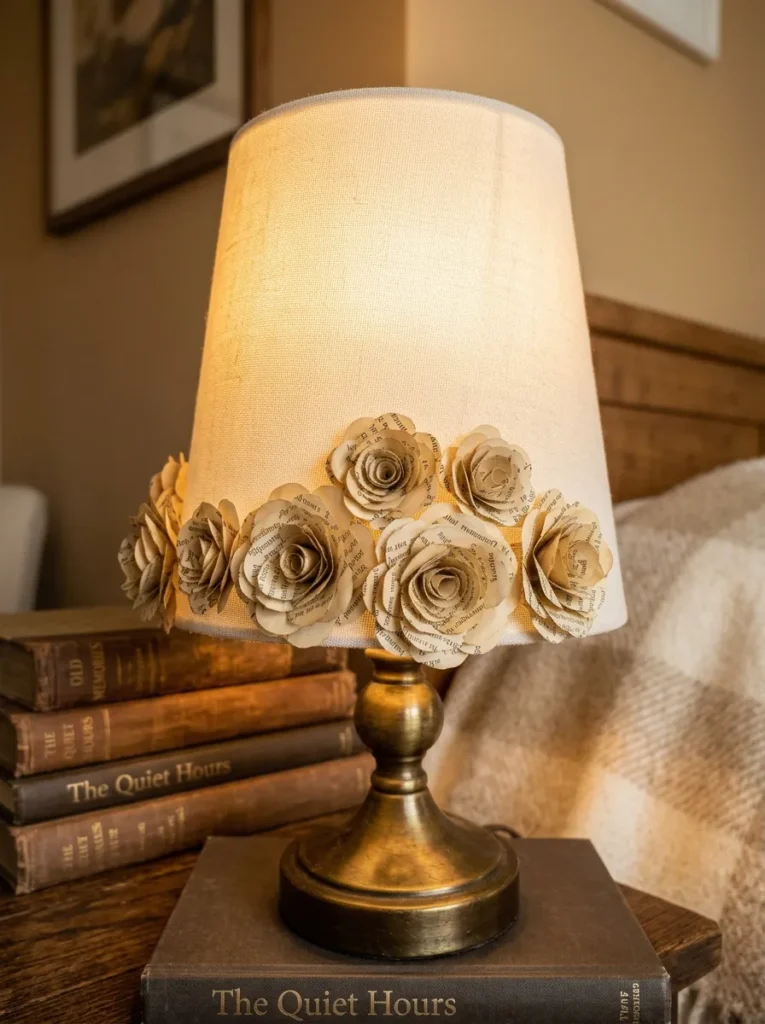
Vibe: Cozy, like a plain lamp quietly bloomed around its own base.
Why it works: Attaching flowers only around the shade’s bottom edge rather than covering the whole surface keeps the light diffusion unaffected while still adding dimensional texture that catches the warm glow from below.
How to get it: Glue three or four finished book page flowers evenly spaced around the bottom rim of a plain lampshade, keeping them clear of the bulb itself for safety.
Quick Win: Battery-operated lamps or LED bulbs eliminate any heat concern near the glued paper entirely.
Shop the Look
| Product |
|---|
| Plain lampshade |
| Finished book page flowers |
| Craft glue |
| Small brass lamp base |
| Warm white LED bulb |
8. Layout: Cascading Bouquet Mixing Flower Sizes
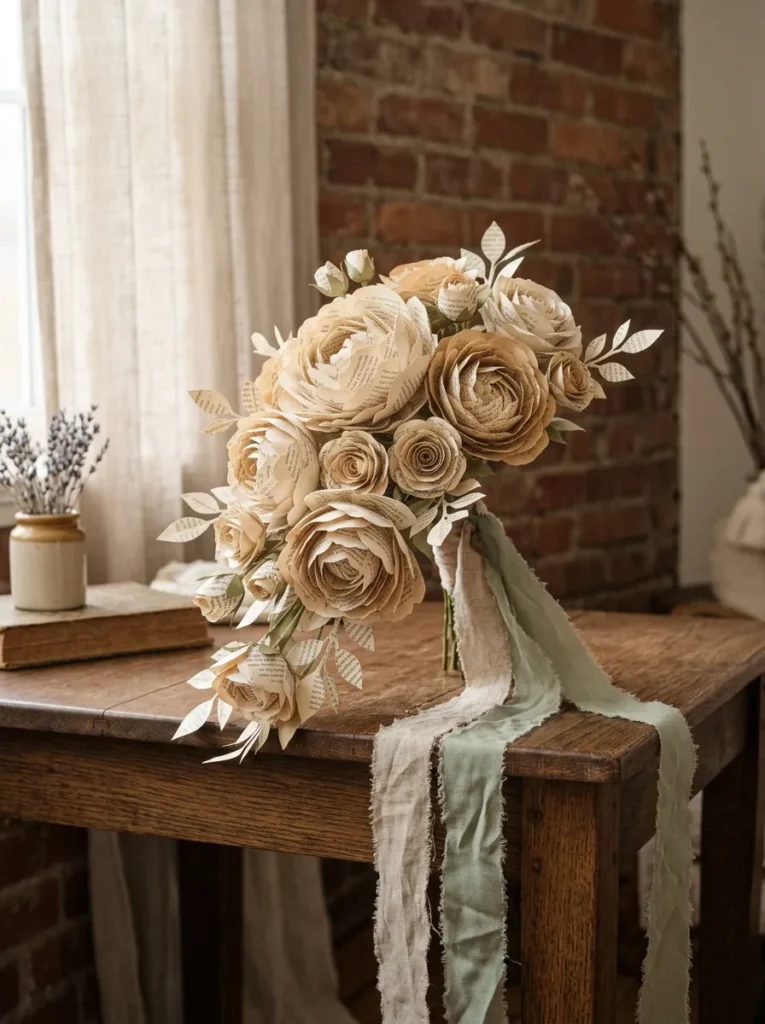
Vibe: Romantic, like a whole cascading bouquet came together from a single stack of old pages.
Why it works: Combining large, medium, and small flower sizes in one bouquet uses the layout principle of visual rhythm, letting the eye travel through the arrangement rather than landing on one flat, uniform cluster.
How to get it: Wire together two or three large peonies as the focal point, surround them with several medium roses, and fill the gaps with small rolled buds, trailing a length of ribbon down from the gathered base.
Shop the Look
| Product |
|---|
| Assorted finished book page flowers |
| Floral wire |
| Floral tape roll |
| Trailing ribbon |
| Fine-tip scissors |
9. Small Nook Book Page Flower Napkin Ring
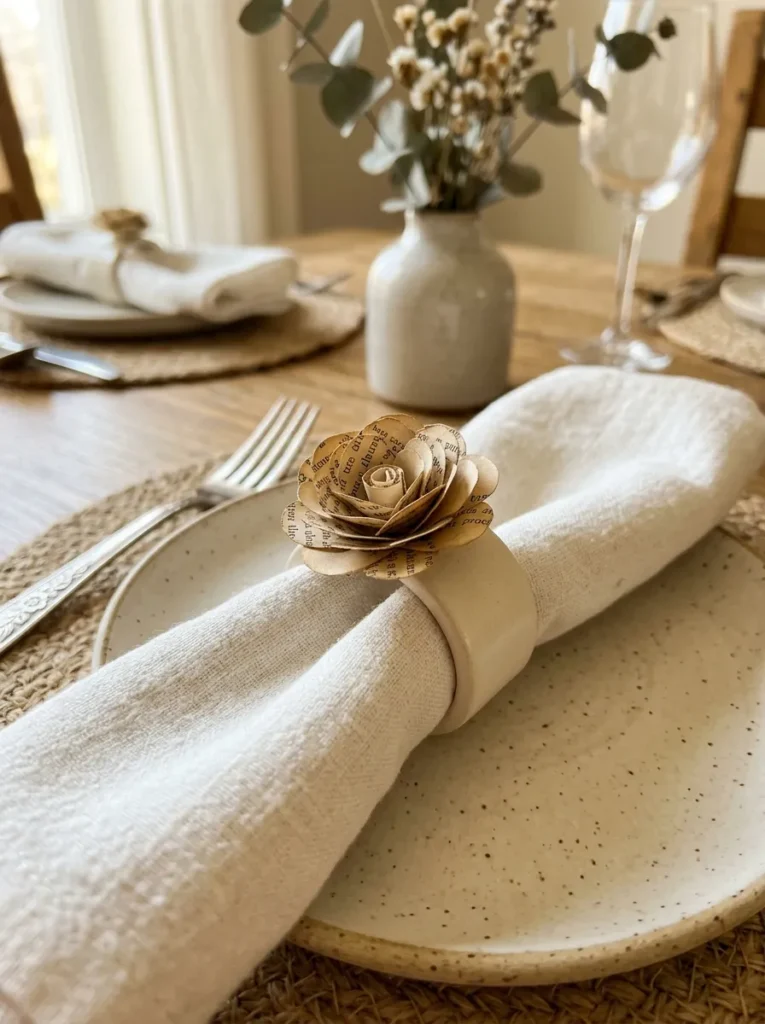
Vibe: Charming, like every place setting got its own tiny, considered detail.
Why it works: A single small flower glued to a plain napkin ring base uses minimal material per place setting, a small-space technique that dresses up an entire table without requiring a full centerpiece arrangement.
How to get it: Glue one small rolled book page flower onto a plain wood or metal napkin ring, positioning it slightly off-center so it doesn’t interfere with actually sliding the napkin through.
Shop the Look
| Product |
|---|
| Plain napkin ring set |
| Small book page flowers |
| Craft glue |
| Warm white linen napkin set |
| Fine-tip scissors |
10. Warm Oak and Book Page Flower Wall Hoop
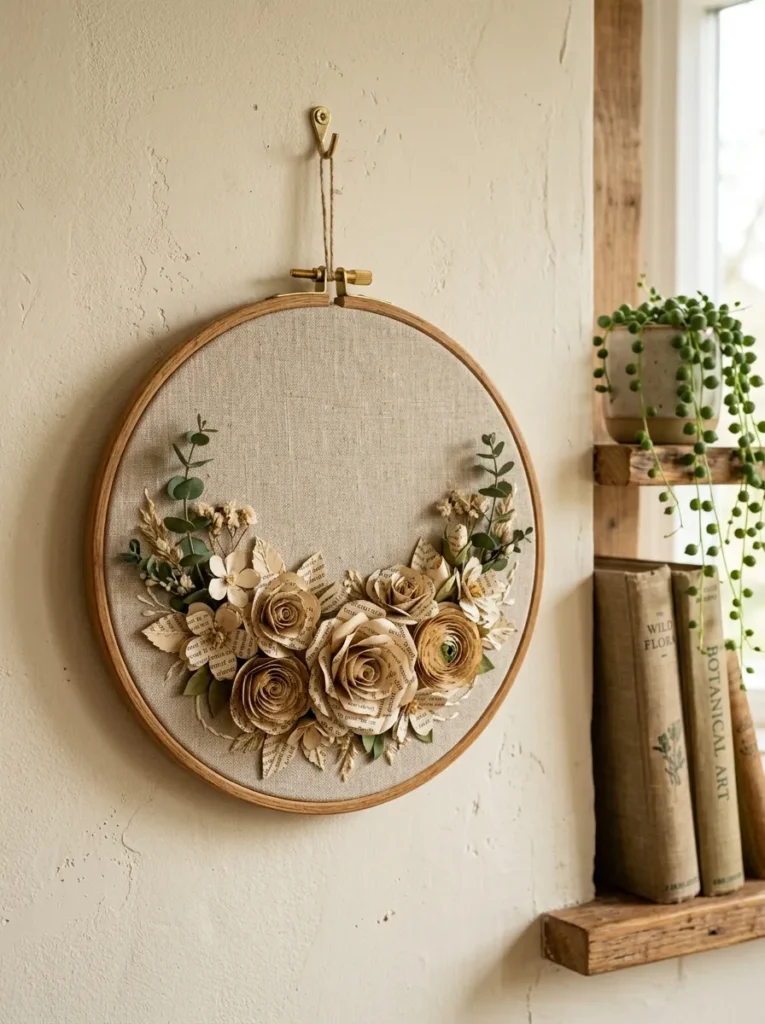
Vibe: Grounded, like a plain embroidery hoop became a genuine piece of wall art.
Why it works: Mounting flowers onto a wood hoop rather than a flat backing mixes a structural natural material with delicate paper, a texture contrast principle that gives the piece more dimension than a flat wall arrangement would.
How to get it: Glue a cluster of finished book page flowers along the bottom curve of a wood embroidery hoop, filling gaps with small faux greenery sprigs, and hang using the hoop’s existing hardware.
Shop the Look
| Product |
|---|
| Wood embroidery hoop |
| Assorted book page flowers |
| Craft glue |
| Small faux greenery sprig |
| Wall hanging hook |
11. Small Space Layout Flow Bud Vase Trio on a Windowsill
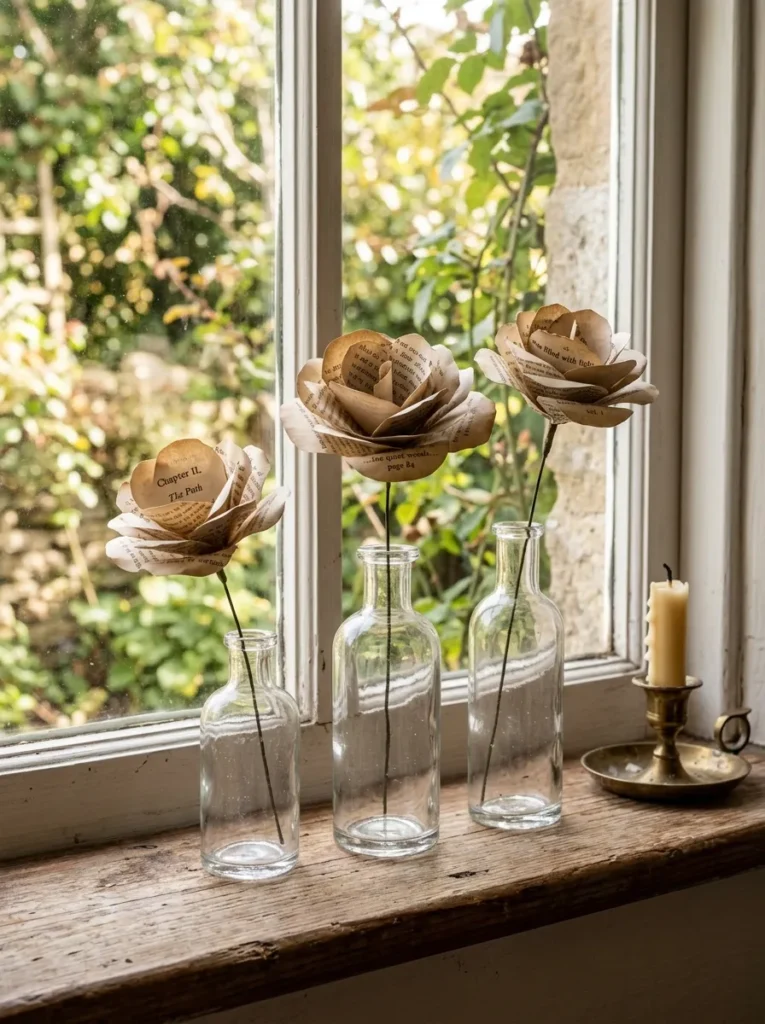
Vibe: Still, like a small windowsill quietly caught a whole season of paper blooms.
Why it works: Using three small vases at varying heights rather than one large arrangement uses a small-space technique that adds visual interest without requiring the counter space a larger vase would need.
How to get it: Place a single finished book page flower on a wire stem into each of three small glass bud vases of different heights, lining them along the windowsill for a staggered display.
Shop the Look
| Product |
|---|
| Small glass bud vase set |
| Assorted book page flowers on stems |
| Small brass candle holder |
| Small ceramic windowsill tray |
| Fine-tip scissors |
12. Sepia and Sage Book Page Boutonniere
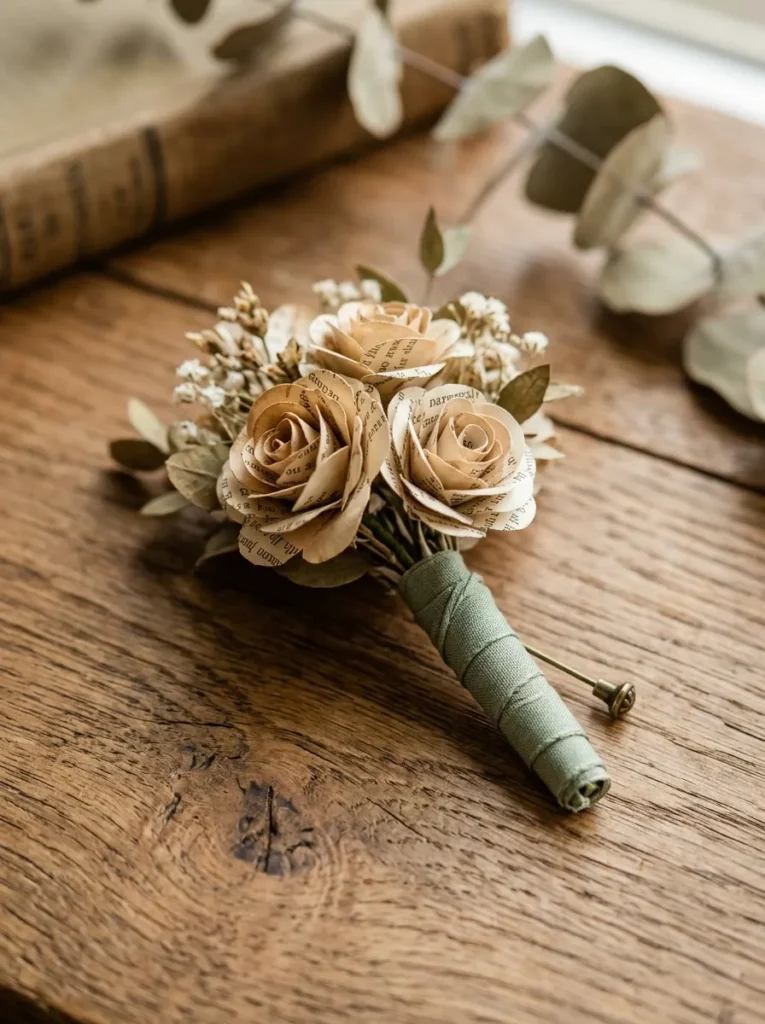
Vibe: Refined, like a tiny paper flower became something worth pinning on with real care.
Why it works: Scaling a single rolled or layered flower down to boutonniere size and wrapping the stem in ribbon gives the piece a finished, event-ready look using the same basic techniques as a full-size bloom.
How to get it: Assemble one small book page flower on a short wire stem, wrap the stem tightly in sage floral tape or ribbon, and finish with a corsage pin through the base.
Shop the Look
| Product |
|---|
| Small book page flower |
| Sage floral tape or ribbon |
| Corsage pin |
| Floral wire |
| Fine-tip scissors |
13. Small Nook Book Page Flower Gift Topper
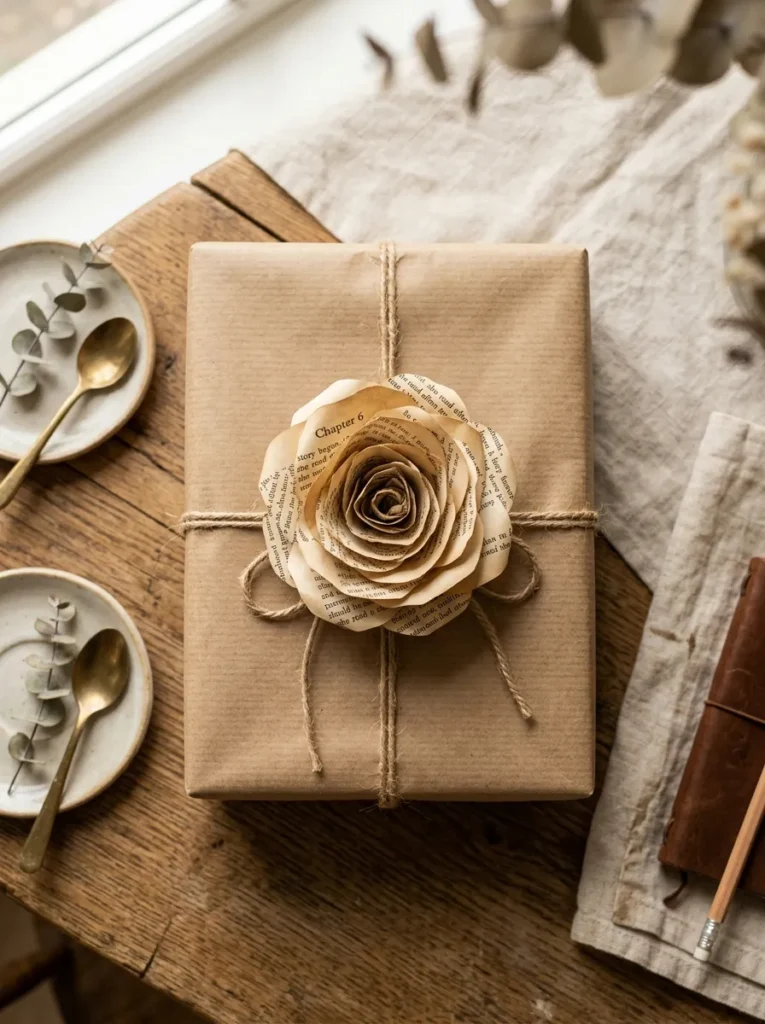
Vibe: Thoughtful, like a single paper flower replaced a bow and looked even better.
Why it works: Swapping a purchased ribbon bow for a single handmade flower turns the wrapping itself into a small gift-within-a-gift, a presentation technique where the topper can be kept long after the wrapping paper is discarded.
How to get it: Wrap a gift in plain kraft paper tied with twine, then glue or tuck a single finished book page flower under the twine knot as the topper.
Quick Win: The recipient can pin or display the flower separately once the gift is unwrapped, extending its life beyond the wrapping itself.
Shop the Look
| Product |
|---|
| Kraft wrapping paper roll |
| Kraft twine spool |
| Single book page flower |
| Craft glue |
| Fabric scissors |
14. Small Space Illusion Mirror-Backed Flower Display
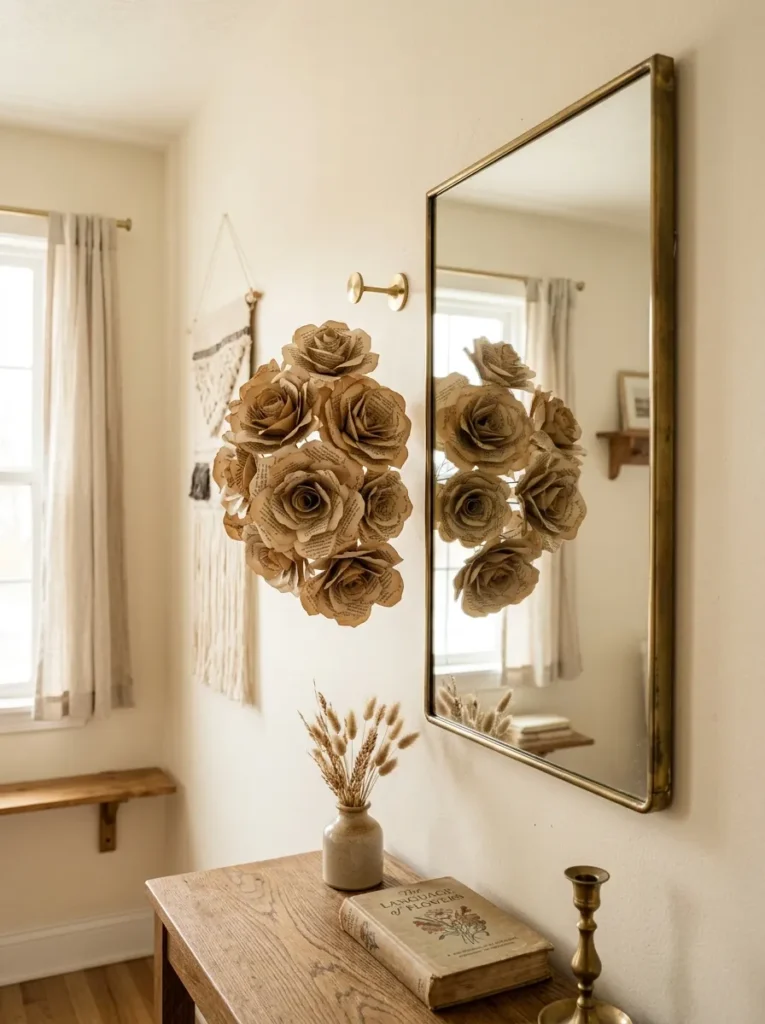
Vibe: Expansive, like a small cluster of paper flowers filled the whole wall twice over.
Why it works: Mounting the flower cluster directly beside a mirror reflects both the light and the paper texture back into the room, an illusion technique that makes a small, low-cost craft feel more substantial in a tight space.
How to get it: Mount a cluster of five or six finished flowers on the wall immediately beside an existing mirror, positioning them so the reflection doubles the visual density of the arrangement.
Shop the Look
| Product |
|---|
| Assorted book page flowers |
| Wall mirror existing or secondhand |
| Small brass mounting pins |
| Craft glue |
| Wall anchor kit |
15. Small Nook Book Page Flower Crown
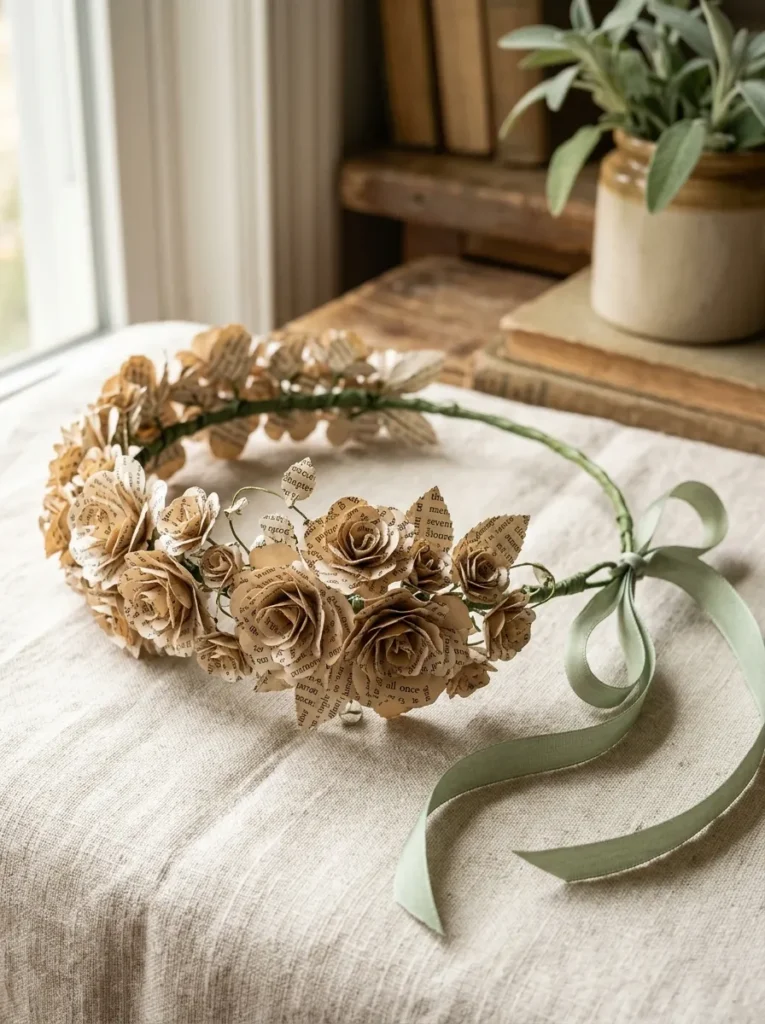
Vibe: Whimsical, like an old book quietly became something worth wearing for a day.
Why it works: Wiring several small flowers onto a bendable floral wire headband base uses the same basic construction as a bouquet stem, just curved into a wearable circle, making this an easy extension of skills already used elsewhere on this list.
How to get it: Wire five or six small book page flowers at intervals along a floral wire headband base, filling gaps with small faux greenery, and bend the finished piece to fit comfortably.
Shop the Look
| Product |
|---|
| Floral wire headband base |
| Assorted small book page flowers |
| Small faux greenery sprig |
| Floral tape |
| Fine-tip scissors |
16. Warm White and Sepia Book Page Flower Cake Topper
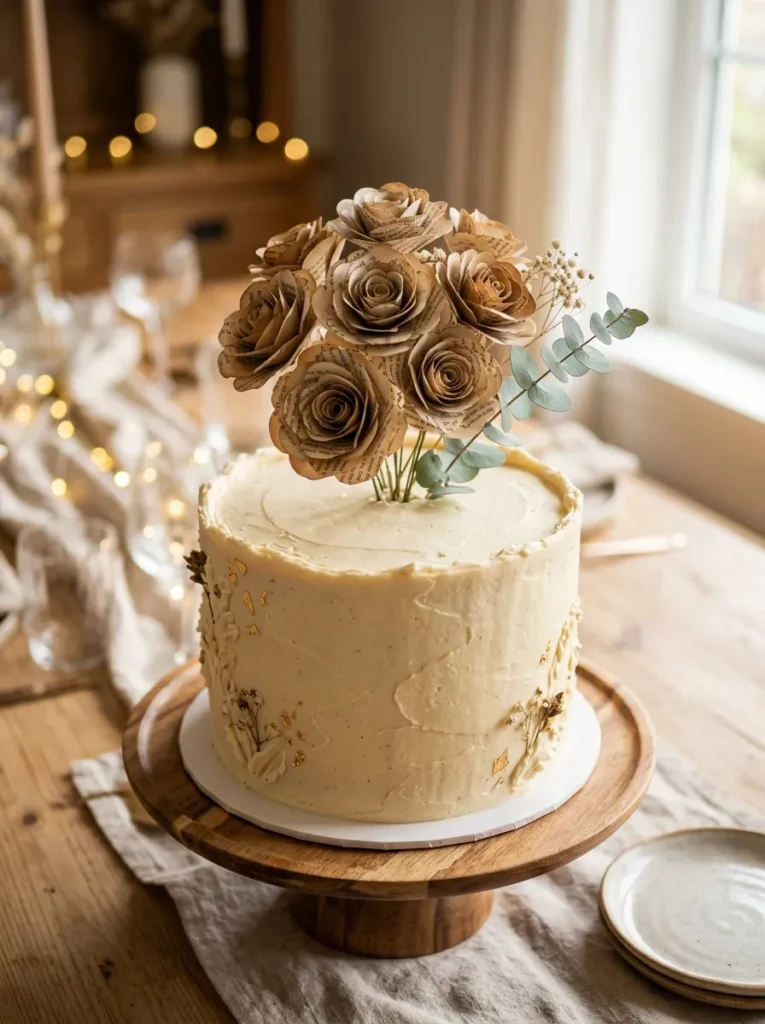
Vibe: Celebratory, like a favorite book quietly became part of the day’s cake.
Why it works: Book page flowers are entirely non-toxic to display near food when kept on food-safe picks and not touching the cake directly, making this a low-cost, reusable alternative to fresh floral cake toppers.
How to get it: Attach two or three small to medium book page flowers to food-safe floral picks, cluster them together with a bit of faux greenery, and insert directly into the top of a finished cake just before serving.
Quick Win: The finished topper can be lifted off and kept as a keepsake long after the cake is gone.
Shop the Look
| Product |
|---|
| Small to medium book page flowers |
| Food-safe floral picks |
| Small faux greenery sprig |
| Floral tape |
| Fine-tip scissors |
17. Small Space Illusion Book Page Flower Curtain Tieback
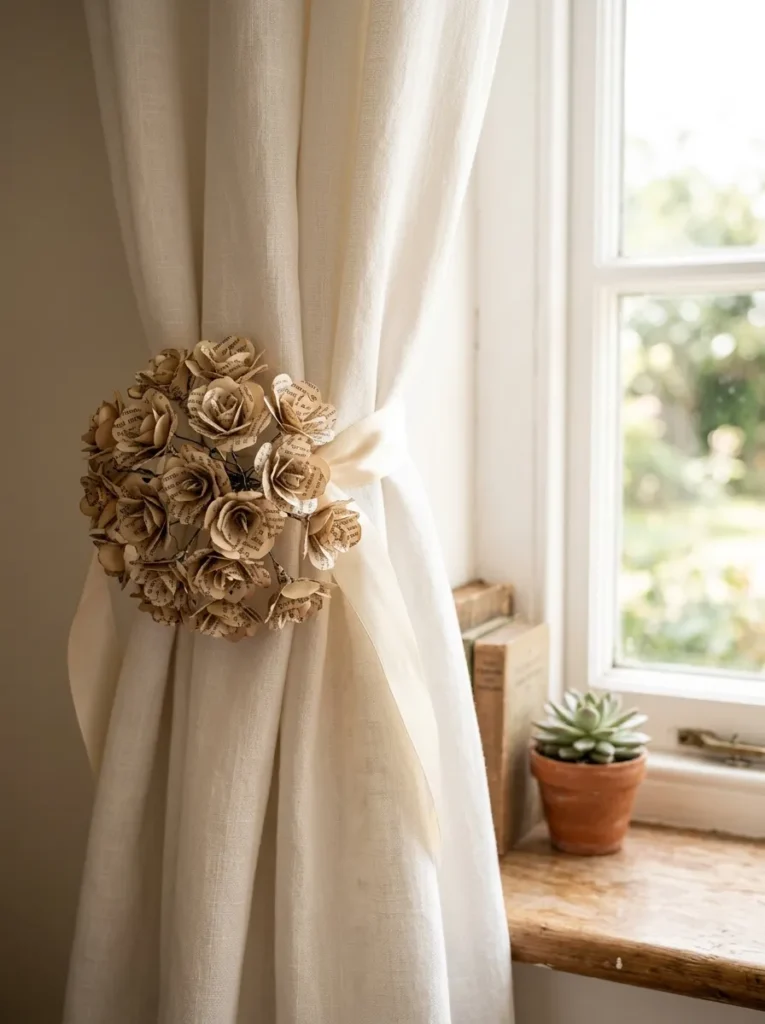
Vibe: Charming, like even the curtains got a small literary detail.
Why it works: Attaching a small flower cluster to a ribbon tieback uses a genuinely functional household object as the base for the craft, an illusion technique that gives the flowers a daily practical purpose rather than sitting purely as static decor.
How to get it: Wire two or three small book page flowers onto a length of ribbon sized to wrap around a curtain panel, securing the flowers at the center point so they sit forward once the tieback is wrapped and tied.
Shop the Look
| Product |
|---|
| Ribbon length for tieback |
| Small book page flowers |
| Floral wire |
| Craft glue |
| Small hook for wall mounting |
How to Start Your Book Page Paper Flower Project
Start with sourcing one damaged book, not buying new craft supplies. A torn-cover paperback or a water-stained hardcover from a thrift store, library sale, or curbside giveaway costs little to nothing and provides enough pages for a full bouquet or several smaller projects at once.
The most common mistake is cutting petals too rigidly precise, expecting them to look identical, which actually makes the finished flower look artificial. Real flowers have natural variation, so slightly uneven petal sizes and asymmetrical curling read as more realistic than perfectly matched shapes.
Three items under $50 that make an immediate difference: a spool of floral wire and floral tape that works across nearly every project on this list, a hot glue gun for secure petal assembly, and a set of round and petal-shaped templates or cutters for consistent shapes.
A basic version — one flower type made in a batch of five or six — is an afternoon project costing $5 to $15 in materials beyond the free or thrifted book itself. A fuller project like a full bouquet or a wall hoop arrangement runs $20 to $50 and typically takes a full afternoon, since layered flowers like peonies and ranunculus take longer to assemble than simple roses or daisies.
Frequently Asked Questions About Book Page Paper Flowers
What glue works best for assembling book page flowers?
Hot glue holds petal layers and stems securely within seconds, making it the best choice for anything with multiple layers like a peony or ranunculus, while craft glue works fine for simpler, flatter designs like the daisy where drying time isn’t as much of a concern. For any flower that will be handled often, like a boutonniere or gift topper, hot glue’s stronger hold is worth the slightly less precise application.
How do I keep book page flowers from looking flat or fake?
Curling petal edges around a pencil or the edge of a scissor blade before assembly adds the natural curve that flat, uncurled paper lacks, and varying petal sizes slightly within one flower mimics the imperfection of real blooms. Layering petals at slightly different angles rather than stacking them in a perfectly even circle also adds the dimensional randomness that makes a flower read as handmade rather than stamped from a machine.
How much does it cost to make a full bouquet of book page flowers?
A single flower type made in a batch of five or six costs $5 to $15 in materials beyond a free or thrifted book. A fuller cascading bouquet mixing several flower sizes and types typically runs $20 to $50, with floral wire, tape, and ribbon representing most of that cost since the paper itself is essentially free.
Will book page flowers hold up over time, or will they fall apart?
Paper flowers assembled with hot glue and stored away from high humidity or direct water contact hold their shape indefinitely, often lasting for years as a permanent decor piece rather than needing replacement like fresh flowers. Keeping finished pieces out of direct, intense sunlight also slows any further yellowing or fading of the paper beyond its original aged tone.
Can I use pages from a book with sentimental value, or should I stick to random secondhand books?
A sentimental book can be used if a few pages genuinely won’t be missed, like a duplicate copy or a book with only some salvageable sections, but it’s worth pausing before cutting up something irreplaceable. For a wedding bouquet specifically, some people intentionally choose pages from a meaningful book, a shared favorite novel, a book of poetry, to add a layer of personal significance to the finished flowers.
Ready to Make Your Own Book Page Paper Flowers?
Between rolled roses, layered peonies, ombre ranunculus, and flower crowns, these 17 ideas cover a full range of ways to turn old book pages into lasting, unique floral decor. Starting with just one damaged or thrifted book is not a small beginning, it’s the entire material budget for a full bouquet or several smaller projects at once, which is exactly what makes this craft so accessible regardless of skill level or budget. Today, check a local thrift store, library sale, or your own shelves for one book that’s already too damaged to read, and start with the simplest flower on this list, the rolled rose or the five-petal daisy, to build confidence before attempting a fuller peony or ranunculus. Once the first few blooms are finished, you’ll likely have enough pages left for an entire bouquet, wreath, or wall arrangement from that single book. Save your favorite ideas now — especially the layered techniques, since mastering the peony or ranunculus fold opens up nearly every other flower shape on this list.