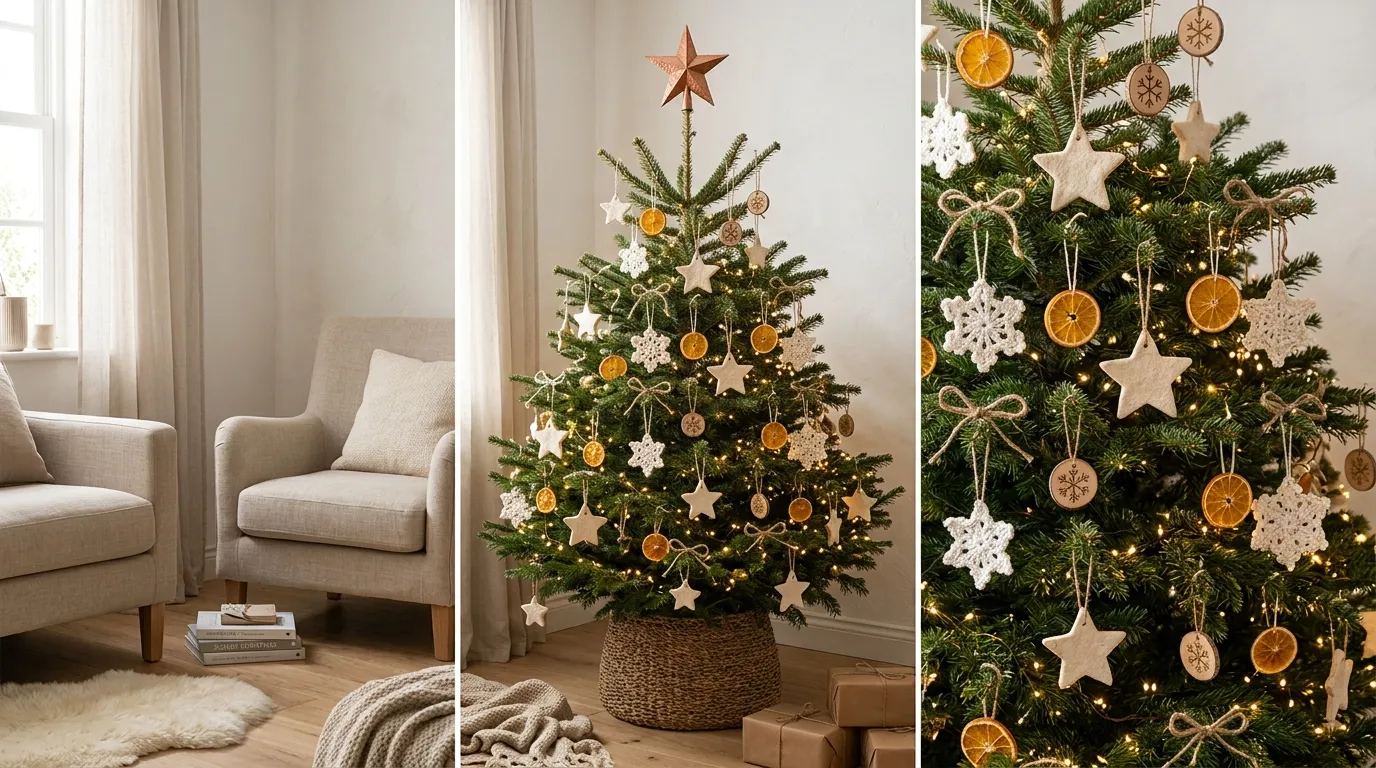
15 Beautiful Scandi Christmas Looks for Every Home
Beautiful Scandi Christmas looks for every home draw from the specific Nordic tradition of winter celebration that preceded and continues alongside commercial Christmas — a tradition rooted in the darkest months of the year in high-latitude countries where light is genuinely scarce, warmth is genuinely sought, and the domestic interior becomes the primary social and sensory environment for extended periods. The Scandi Christmas aesthetic emerges from this specific context: the candlelight that provides warmth when daylight hours are reduced to six or seven, the dried botanicals that preserve the summer landscape through the dark winter, the warm wool and sheepskin that provide the tactile warmth of genuinely cold climates, and the restrained, nature-referencing palette (warm white, deep forest green, warm red, birch silver, pine gold) that references the winter landscape outside the window. This article gives you exactly 15 ideas spanning every room and every scale of festive decoration so every home finds a Scandi Christmas approach that is genuine rather than themed, warm rather than commercial, and enduring rather than seasonal.
A beautiful Scandi Christmas is not about red and green in equal quantities, plastic reindeer, or the maximum quantity of decorations — it is about the specific quality of warmth that a considered, natural, candlelit interior provides in the shortest days of the year. Here are 15 ideas worth implementing.
Why Beautiful Scandi Christmas Looks Work for Every Home
The Scandi Christmas aesthetic has achieved global appeal precisely because it addresses a universal human experience — the specific desire for domestic warmth, light, and natural beauty during the dark months of the northern hemisphere winter — through a design vocabulary that is non-denominational, non-commercial, and non-trend-dependent in its material language. The traditions that constitute the Scandi Christmas aesthetic (the candlelit Advent wreath, the julnisse figures, the hanging star, the natural dried botanical garland, the white and red woven heart, the seven-branched Advent candelabra) each have centuries-long histories that pre-date commercial Christmas decoration by generations, making them among the most culturally authentic seasonal decorating traditions available in contemporary domestic design.
The specific design qualities that make the Scandi Christmas look simultaneously beautiful and achievable for every home are its material restraint (natural materials — dried botanicals, wool, unbleached cotton, beeswax, birch timber — rather than plastic, synthetic, or manufactured ornaments), its palette discipline (warm white, forest green, deep red, and warm neutral as the only colors present, rather than the full commercial Christmas color spectrum), its scale modesty (small groups of beautiful objects rather than complete coverage of every surface), and its sensory layering (the combination of candlelight, botanical scent, textural warmth, and the sound of a fire or a weather storm outside creating a complete sensory environment rather than merely a visual one).
Style at a Glance
| Element | Nordic Tradition | Modern Scandi Design Edge |
|---|---|---|
| Philosophy | Light against dark, warmth against cold, nature against winter | Restraint in quantity, richness in material quality |
| Materials | Beeswax, dried botanical, wool, linen, birch, pine | Warm white, forest green, deep red, warm neutral |
| Key Practices | Candlelight, Advent ritual, natural garland, botanical display |
15 Beautiful Scandi Christmas Looks for Every Home
1. The Advent Wreath — Four Candles, Four Sundays
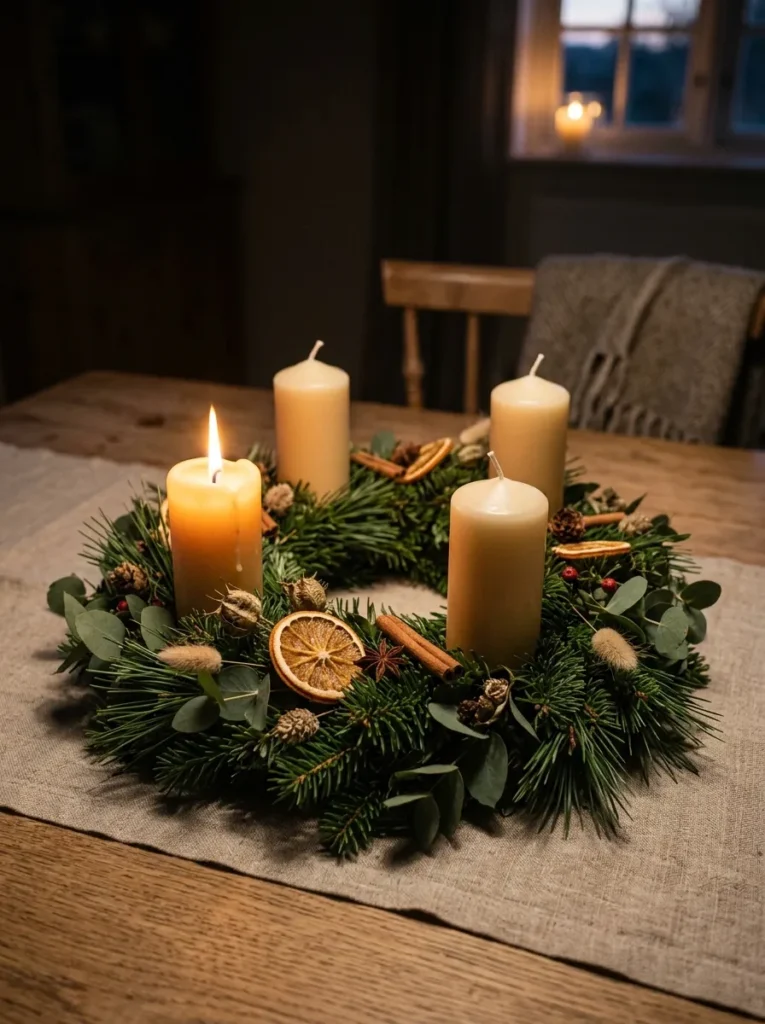
Vibe: The Advent wreath feels like the specific, counted anticipation of Christmas made into a physical object — one candle lit for each of the four Sundays before Christmas, the progressive accumulation of candlelight measuring the approach of the winter solstice.
Why it works: The traditional Nordic Advent wreath (Adventskrans in Danish and Norwegian, Adventskrans in Swedish) applies the ritual object principle — an object that is not merely decorative but that enacts a specific practice (lighting one additional candle each Sunday of Advent) gains the emotional weight of a genuine domestic ritual, creating anticipation and marking time in a way that static decorations cannot. The specific material composition (fresh pine and spruce for scent, eucalyptus for silver-green color contrast, beeswax candles for clean warm flame and natural honey fragrance, dried botanicals for texture variation) produces an arrangement whose natural materials age visibly and beautifully over the four weeks of Advent — the fresh greens slowly drying and becoming more fragrant, the beeswax candles developing their specific aged surface quality with each use.
Candle safety: An Advent wreath with lit candles must never be left unattended. Position the wreath so that the lit candles are at least 30cm from any overhanging material, and use candle holders that grip each pillar candle securely. The wreath should be fresh (not dried) when first assembled and misted lightly with water every two to three days to maintain the greens’ moisture and reduce fire risk.
Shop The Look
| Product |
|---|
| Fresh pine and spruce wreath base |
| Cream beeswax pillar candle set 4 |
| Dried orange slice decoration |
| Dried seed head wreath tucking |
| Natural linen cloth runner |
Also view: 13 Easter Craft Night Ideas Everyone Will Enjoy
2. The All-White Christmas Tree — The Scandi Forest
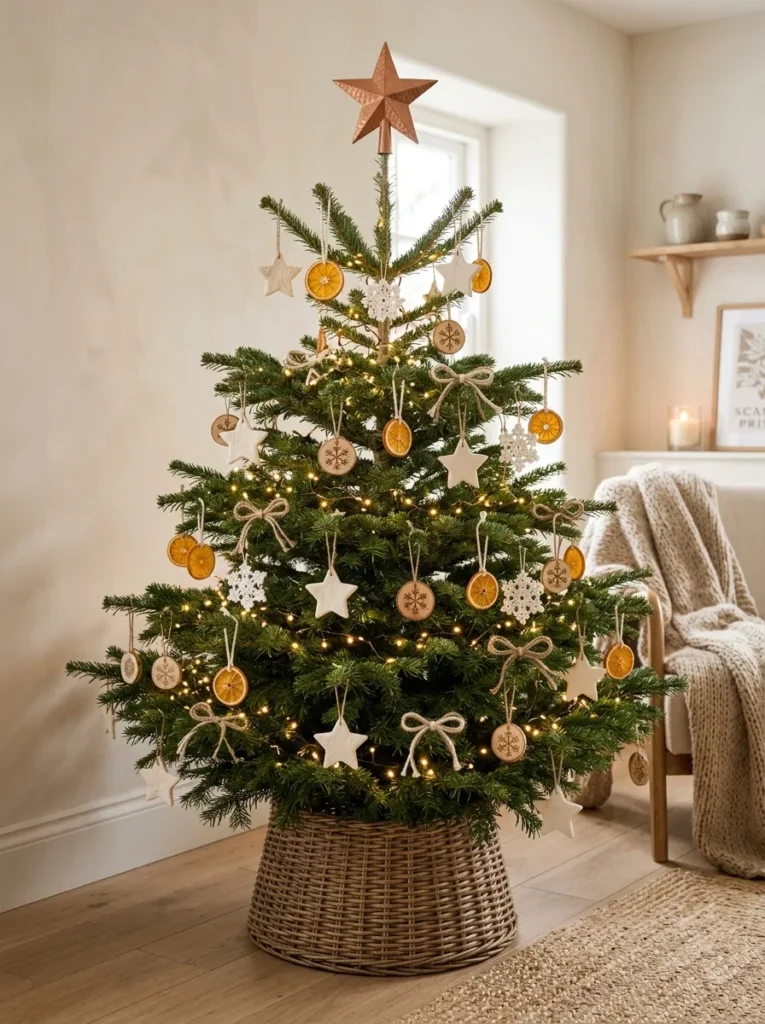
Vibe: The all-white and natural Christmas tree feels like a forest tree that decided to come inside wearing the winter landscape — the warm white lights and natural ornaments referencing snow, ice, and the specific beauty of a winter wood.
Why it works: An all-white and natural material Christmas tree applies the palette discipline principle — by restricting the tree’s decoration to warm white (lights, knitted ornaments, salt dough stars) and natural materials (dried orange, birch wood, jute, cotton), the tree reads as a coherent botanical installation rather than as an accumulation of unrelated ornaments. The Scandi Christmas tree’s specific characteristic is this chromatic restraint — where commercial Christmas tree decoration culture encourages variety and quantity, the Nordic tradition values unity and quality: fewer ornaments, each beautiful in itself, in a consistent material palette that reads as designed rather than assembled.
Handmade salt dough stars: Mix 2 cups flour, 1 cup salt, 3/4 cup warm water to a smooth dough. Roll to 5mm thickness, cut star shapes with a cookie cutter, pierce a hole for hanging, bake at 120°C for 2–3 hours until hard and dry. The natural cream color of the salt dough is the correct finish — no painting or varnishing required.
Quick Win: A string of warm copper wire LED lights ($8–15) threaded into an existing Christmas tree immediately shifts the tree’s aesthetic toward the Scandi palette, regardless of the existing ornaments’ style.
Shop The Look
| Product |
|---|
| Copper wire warm LED string lights |
| Salt dough star cookie cutter |
| Dried orange slice tree ornament |
| Birch wood disc snowflake routed |
| White knit snowflake ornament set |
3. The Julstjärna — The Swedish Advent Star
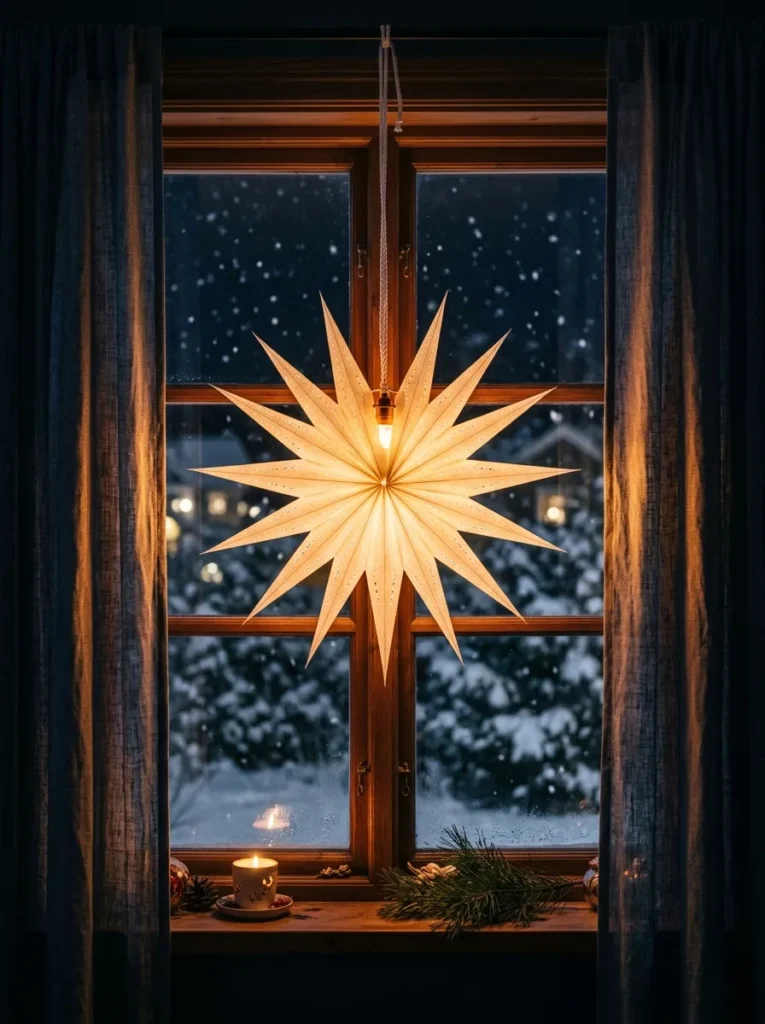
Vibe: The Advent star in the window feels like the Nordic tradition of lighting a beacon for travelers against the winter dark, domesticated to the size of a window — the warm amber glow of the star visible from both inside and outside the house communicating warmth and welcome.
Why it works: The Swedish Julstjärna (Christmas star, also called the Advent star or paper star) in a window applies the window-as-lantern principle — in Nordic winter culture, illuminated windows are a traditional form of social signaling: the lit window communicates warmth, welcome, and human habitation against the winter darkness. The Advent star transforms the window from a transparent boundary between the warm interior and the cold exterior into a designed light installation that creates a specific visual experience from both sides simultaneously — the household within sees the warm star shape backlit against the dark sky, and the street outside sees the warm amber glow of the star as a beacon of domestic warmth. This dual audience quality makes the Advent star the most specifically Nordic of all Christmas decorations and the most appropriate for a window position.
Star sourcing: Traditional Scandinavian Advent stars (genuine 24-pointed parchment stars) are available from Scandinavian import retailers, online Nordic gift stores, and specialist Christmas decoration suppliers. IKEA produces an affordable version (the STRÅLA star). DIY paper stars can be made from white tissue paper using template-guided folding.
Shop The Look
| Product |
|---|
| Swedish paper Advent star 50cm |
| IKEA STRÅLA star alternative |
| Warm amber LED e14 bulb small |
| White hanging cord star mount |
| Star mounting hook window |
4. Hygge Candle Cluster — The Gathered Light
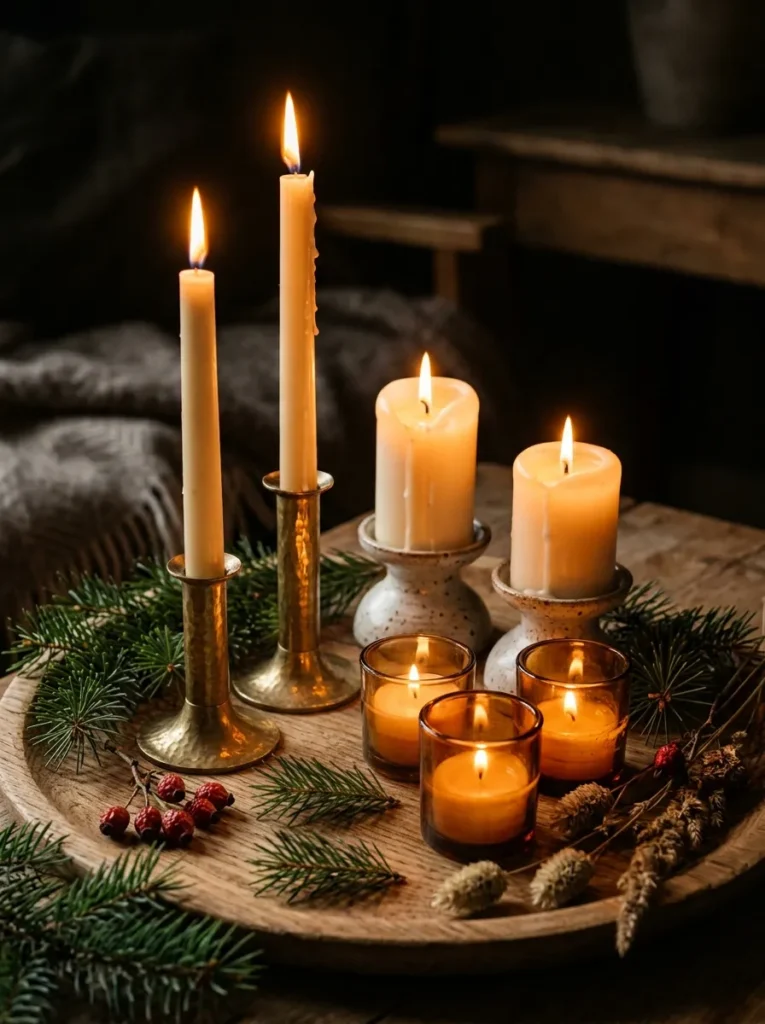
Vibe: The candle cluster feels like seven small fires gathered on a tray — the accumulated warmth of multiple candle flames creating the specific quality of gathered domestic light that the Nordic tradition considers the primary form of winter decoration.
Why it works: A gathered candle cluster applies the light accumulation principle — the Danish concept of hygge (the specific quality of cozy, convivial warmth produced by gathered candlelight, close companions, and warm materials) identifies candlelight as the primary sensory element of the hyggelig experience. A single candle produces warmth; seven candles on a tray produce the specific quality of gathered warmth that corresponds to the pre-electric Nordic winter interior’s primary light source. The specific assembly (tall tapers for height, medium pillars for visual mass, small votives for sparkle and foreground interest) creates a composed grouping with height variation that reads as a designed light installation rather than a casual collection.
Candle material: Beeswax candles are specified for the Scandi Christmas aesthetic for three reasons: their warm amber flame color (warmer and more golden than paraffin), their natural honey fragrance (a gentle, botanically authentic scent that coordinates with the dried botanical elements of the broader Christmas decoration), and their significantly longer burn time per unit of wax. All seven candles in a cream or warm white beeswax specification maintain the restrained Scandi palette.
Shop The Look
| Product |
|---|
| Cream beeswax taper candle pair |
| Cream beeswax pillar candle pair |
| Small votive glass holder set 3 |
| Hammered brass candlestick pair |
| Natural oak tray candle display |
5. Natural Pine Garland — The Staircase or Mantel Treatment
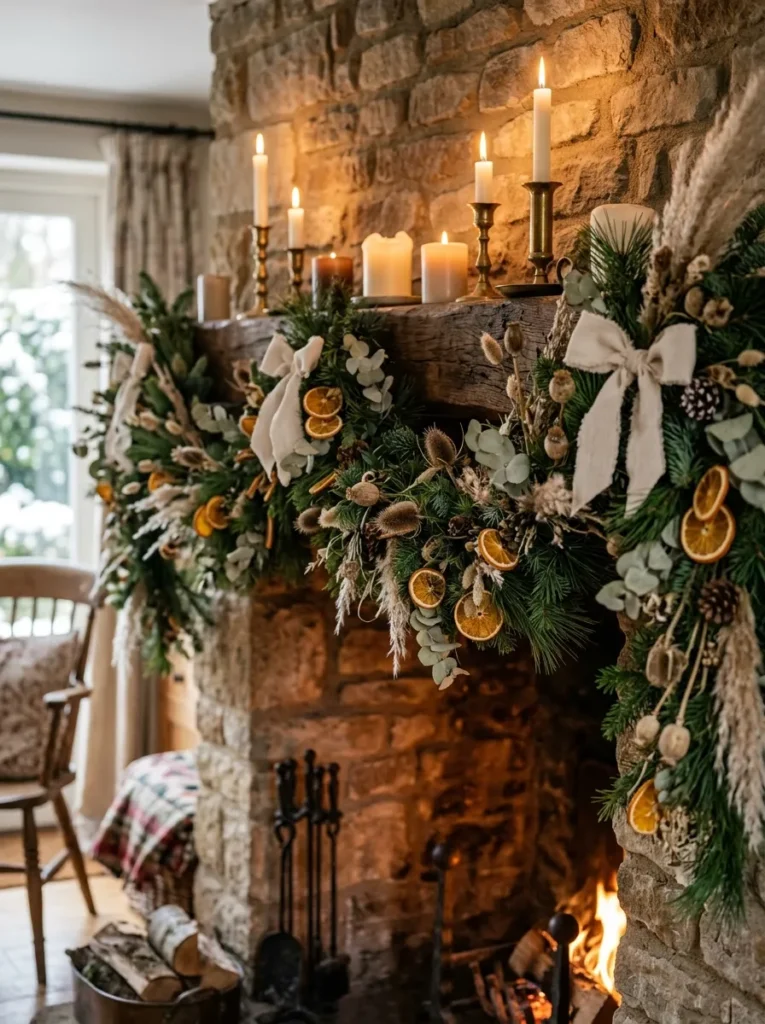
Vibe: The natural pine garland feels like a section of winter forest installed in the house — the varied pine species, the dried botanicals, and the natural cotton ribbon creating a garland whose beauty is entirely the beauty of natural materials in a considered arrangement.
Why it works: A purely botanical Christmas garland (no tinsel, no manufactured ornaments, no artificial materials) applies the natural material exclusivity principle — the Scandi Christmas garland is distinguished from commercial Christmas decoration by what it excludes as much as what it includes. By restricting the garland’s materials to genuinely natural elements (fresh pine, dried eucalyptus, dried seed heads, dried orange, cotton ribbon), the arrangement reads as a composed botanical installation with the authority of genuine natural materials rather than as a decorated manufactured product. The varied textures of the natural elements — the rough pine needle, the smooth dried eucalyptus, the papery dried orange, the soft pampas tip — create a surface of genuine tactile and visual richness that manufactured ornaments cannot replicate.
Garland freshness: A fresh pine garland in a warm indoor environment will remain fragrant and visually fresh for approximately 10–14 days. Mist lightly with water every two to three days to extend freshness. The scent of warming fresh pine is one of the most specific and most evocative of all Scandi Christmas sensory experiences.
Shop The Look
| Product |
|---|
| Fresh pine garland 180cm |
| Dried pampas tips garland |
| Dried eucalyptus garland addition |
| Dried orange slice garland |
| Natural cotton ribbon white |
6. The Julbock — The Swedish Straw Goat
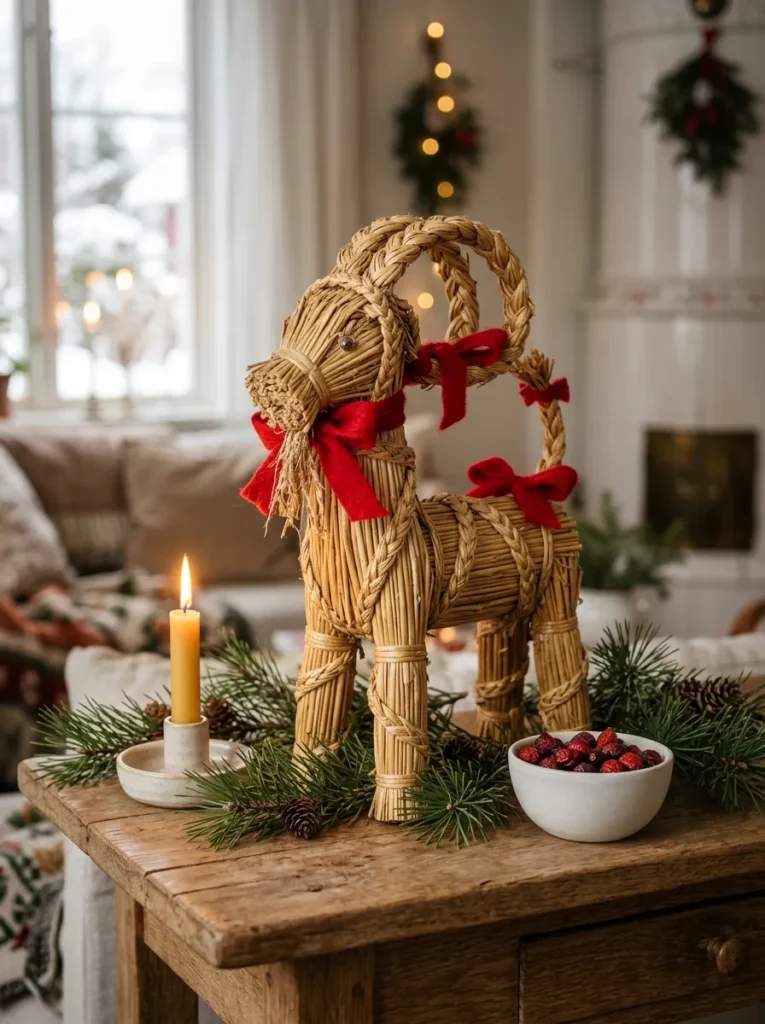
Vibe: The straw Julbock feels like a piece of genuine folk craft that has been on Swedish Christmas tables for longer than anyone’s grandparents can remember — the woven rye straw and the red bow creating an object whose material simplicity and cultural depth are the same quality.
Why it works: The Swedish Julbock (Yule goat) applies the folk object cultural depth principle — the straw goat is one of the oldest surviving pagan Nordic winter symbols (originating in the Norse tradition of Thor’s goats and the Germanic Yule traditions predating Christianity), giving it a cultural depth that manufactured Christmas ornaments do not possess. A genuine straw Julbock purchased from a Swedish craft supplier or a Scandinavian import retailer is a piece of genuine folk craft — hand-woven from natural rye straw, bound with natural cord, decorated with a simple red bow — that carries the specific warmth of genuine handcraft tradition. The object’s material modesty (straw, which is the humblest of agricultural by-products) and its functional simplicity (it is purely a decorative cultural symbol, not an ornament holder or a light) make it a genuinely Scandi object in the most specific sense.
Shop The Look
| Product |
|---|
| Traditional Swedish straw Julbock |
| Natural rye straw goat large |
| Red wool ribbon bow Julbock |
| Small fresh pine sprig display |
| White ceramic bowl rosehips |
7. The Woven Heart Basket — Julehjerter
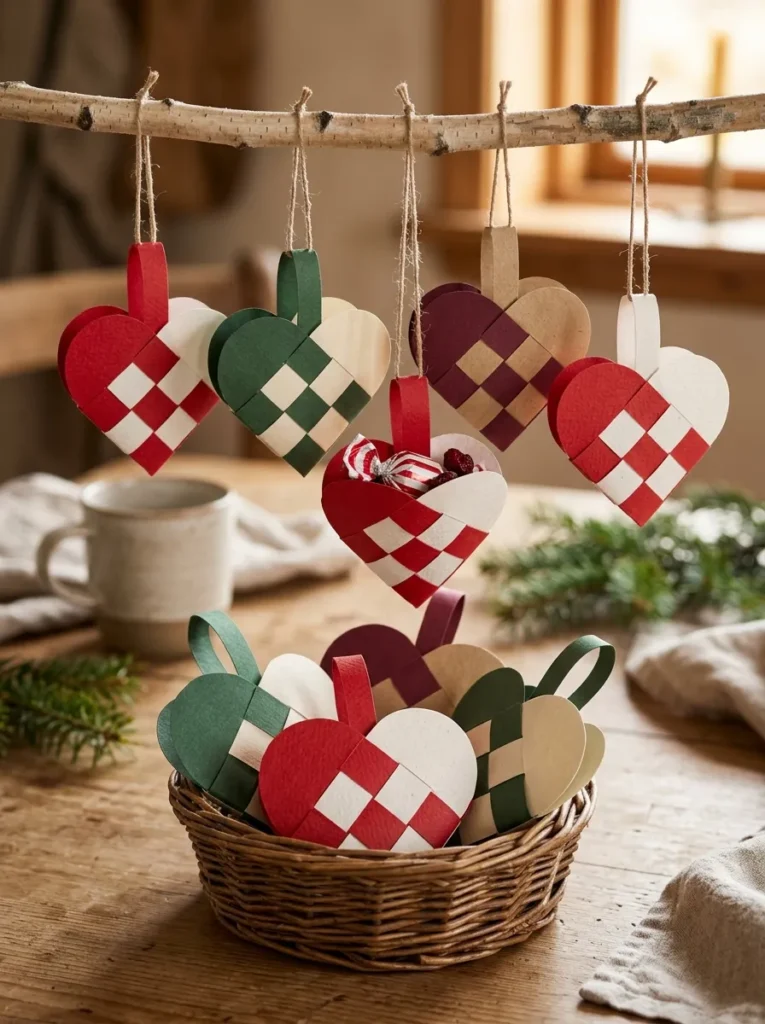
Vibe: The woven heart baskets feel like the most delightful possible version of paper-folding — the interlocked woven structure creating a functional small basket from two flat strips of paper that somehow makes the simplest mathematical principle feel like a small miracle.
Why it works: The Danish woven heart basket (Julehjerter) applies the folk craft tradition principle — invented or popularized by Hans Christian Andersen in the 19th century (who made them as Christmas gifts), the woven paper heart is the most characteristically Danish of all Christmas craft traditions, appearing on Christmas trees, as table decorations, and as gift presentations throughout Denmark from early December. The weaving technique (two U-shaped strips of paper or card, one slipped through the other in an alternating over-under pattern that creates a small basket when the two strips are pulled apart) is achievable in under five minutes by anyone who has seen it done once, making it the most accessible of all Scandi Christmas craft traditions.
Making: Cut two rectangular strips of red and white paper (or any two contrasting colors) approximately 6×12cm each. Fold each strip in half to create a 6×6cm U-shape. Make two vertical cuts through both layers of each U-shape, creating three strips. Weave the three strips of one U through the three strips of the other U in alternating over-under pattern. Glue or staple a small loop handle at the top.
Shop The Look
| Product |
|---|
| Red craft card heart weaving |
| White card heart weaving |
| Forest green card alternative |
| Heart basket template print |
| Small candy filling hearts |
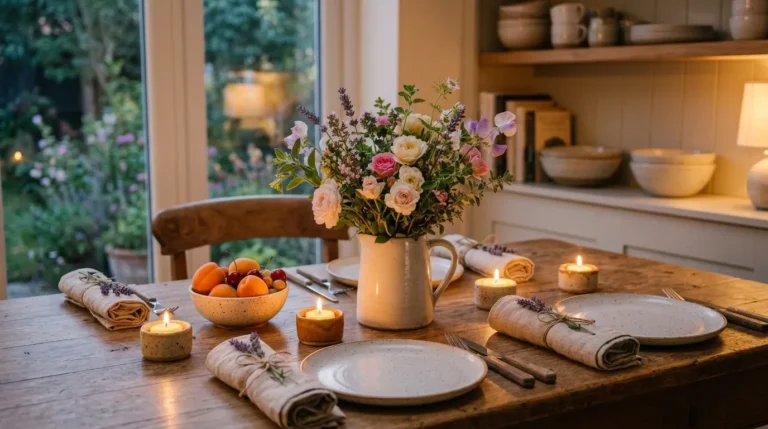
8. The Nordic Table Setting — Christmas Eve Dinner
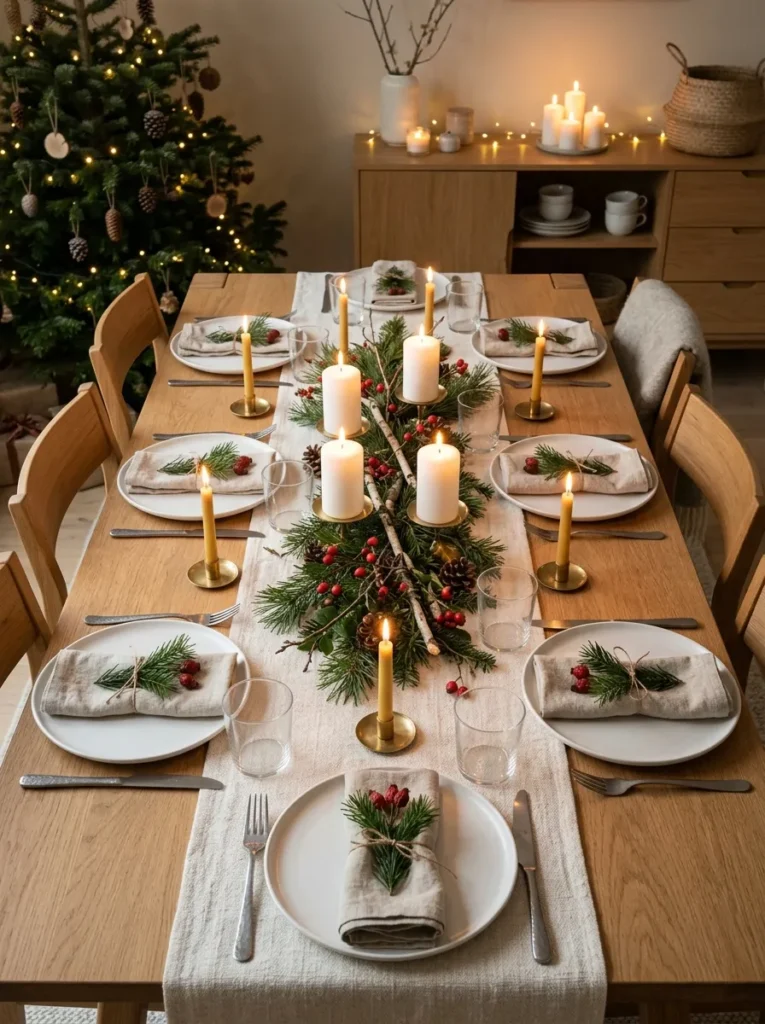
Vibe: The Nordic Christmas table setting feels like a celebration that trusts entirely in the beauty of simple, honest materials — the white ceramic, the natural linen, and the candlelight at each place creating a table of genuine warmth without a single piece of commercial Christmas decoration.
Why it works: A Scandi Christmas table setting applies the material quality over decorative quantity principle — the Nordic Christmas table tradition (particularly the Danish julaften and the Swedish julafton) prioritizes genuine material quality (white ceramic, natural linen, hammered metal, clear glass) over decorative variety, producing a table whose beauty is the beauty of the materials themselves rather than of applied decoration. The individual beeswax taper at each place setting is the most specifically Scandinavian of the table elements — lighting a small candle for each dinner guest is a Nordic hospitality tradition that communicates the specific warmth of having prepared a light for each person individually.
The napkin sprig: A fresh pine sprig and a cluster of dried rosehips tied around a natural linen napkin with a small length of natural cotton twine is the Scandi Christmas table’s most charming individual detail — it is botanical, fragrant, seasonal, and can be achieved at the cost of a pine branch from the garden and a handful of rosehips from a garden hedge.
Shop The Look
| Product |
|---|
| Natural linen table runner white |
| White ceramic plate set simple |
| Natural linen napkin set |
| Hammered brass taper holder set |
| Beeswax taper candle set 12 |
9. The Nisse — The Little Scandinavian House Elf
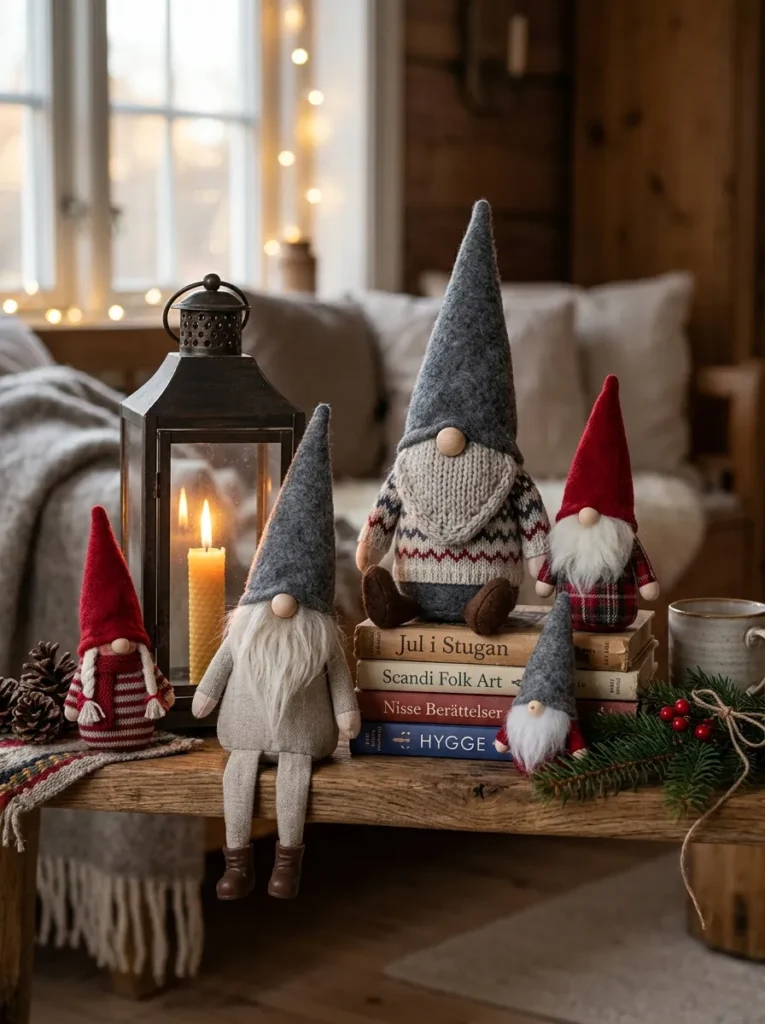
Vibe: The nisse collection feels like the house’s own supernatural warmth has taken on small felt forms — the traditional Scandinavian house spirits gathered in a shelf composition that reads as folk art of genuine cultural warmth.
Why it works: The Scandinavian nisse (called tomte in Swedish, nisse in Danish and Norwegian) applies the cultural mythology object principle — the nisse is the ancient Nordic household spirit who protects the home and its animals if treated with respect (traditionally with a bowl of porridge left on Christmas Eve) and who causes mischief if neglected. The contemporary representation of the nisse as a small felt-and-fabric figure with a large pointed hat is a 19th-century artistic formalization of a much older folk tradition, and artisan-made nisse figures (from Scandinavian craft suppliers or independent makers on Etsy) carry the warmth of this tradition in a tangible, displayable object. A composed group of three to five nisse figures in varied sizes creates a folk art installation that reads as a genuine cultural reference rather than as a commercial Santa Claus variant.
Shop The Look
| Product |
|---|
| Handmade Scandinavian nisse figure |
| Artisan tomte Swedish figure |
| Gray felt pointed hat nisse |
| Nisse figure set varied sizes |
| Small pine cone shelf display |
10. The Birch Branch Decoration — Minimal Winter Botanical
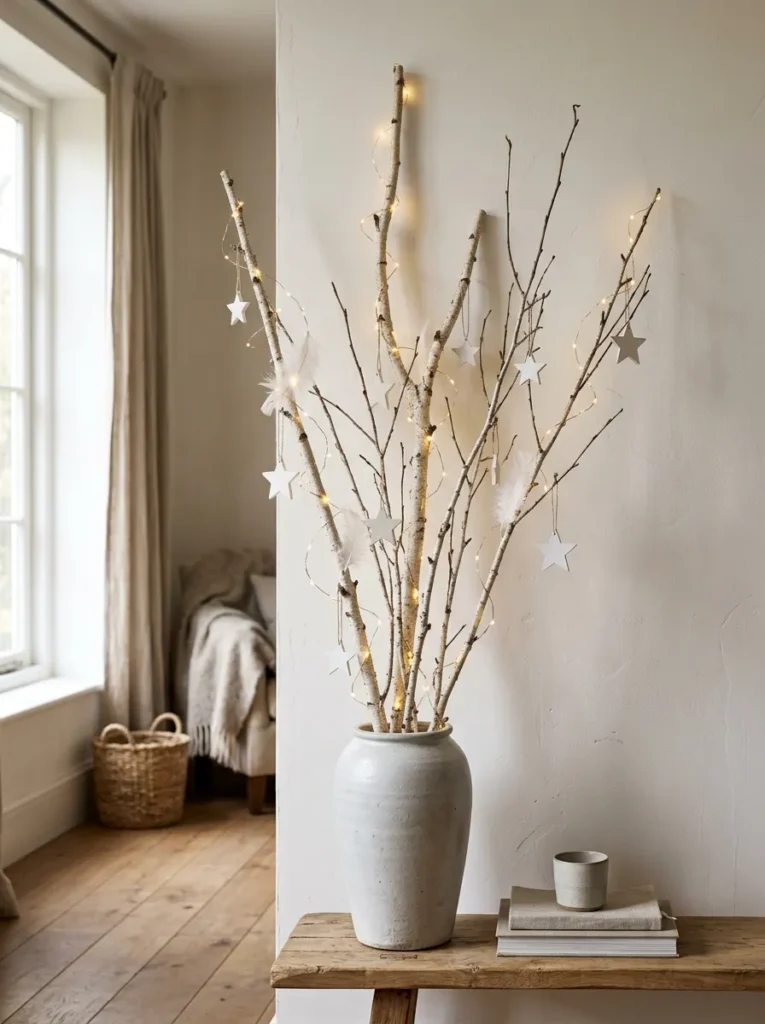
Vibe: The birch branch arrangement feels like a piece of the winter forest that agreed to stand indoors and be beautiful in a different way — the silver bark, the minimal ornaments, and the copper wire lights creating a winter botanical installation of genuine restraint and genuine beauty.
Why it works: Silver birch branches arranged in a large vessel apply the winter botanical tree alternative principle — for households that prefer a non-traditional Christmas tree (due to space constraints, design preference, or a desire for a more minimal aesthetic), silver birch branches provide the vertical botanical presence of a Christmas tree in a more restrained, more sculptural form that reads as genuinely Scandinavian. Silver birch (Betula pendula) is the tree most closely associated with the Nordic landscape — its white-silver bark and delicate branch structure are the specific botanical signature of the Scandinavian boreal forest, making birch branches the most culturally authentic natural material available for a Scandi Christmas decoration.
Branch sourcing: Silver birch branches are available from florists and garden centres as dried decorative branches, from garden pruning (where a garden birch is seasonally pruned in late autumn or early winter), or from woodland areas where fallen or pruned branches are available. Use branches with as much white-silver bark visible as possible — the bark’s color is the decoration’s primary aesthetic element.
Shop The Look
| Product |
|---|
| Silver birch branches dried set |
| Large concrete vessel tall 40cm |
| Small white star ornament set |
| Copper wire warm LED string |
| White feather natural decoratio |
11. The Danish Red and White Palette — The Classic Christmas Dining Room
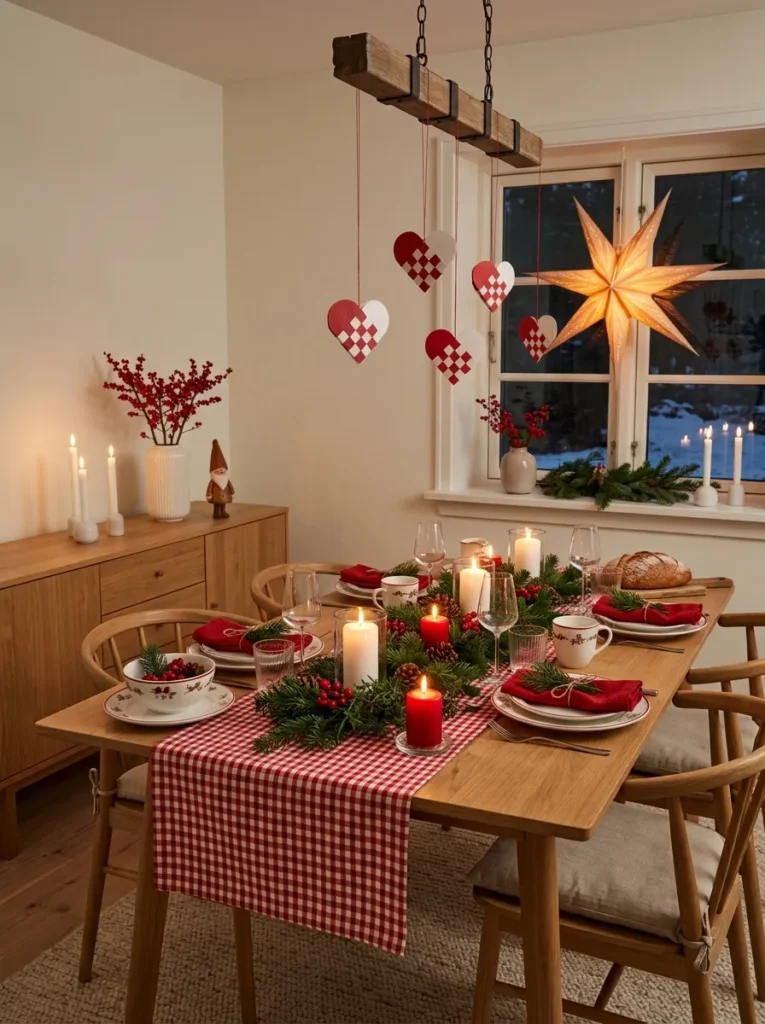
Vibe: The red and white Danish dining room feels like Christmas in Denmark and nowhere else — the specific red and white palette, the woven hearts, and the pine garland creating a room that references an entire cultural tradition.
Why it works: The classic Danish red and white Christmas palette applies the traditional color system principle — the Danish Christmas color palette (rødt og hvidt, red and white) is one of the most culturally specific and most visually coherent traditional Christmas color systems, derived from the Danish national flag (Dannebrog, a white cross on red ground) and from the folk craft traditions that use red and white as primary decorative colors (the woven Julehjerter, the painted wooden ornaments, the red-and-white textile traditions). Applied consistently across a dining room (red gingham runner, white ceramic, red berries, red and white woven hearts, Advent star, red pillar candle beside white pillar candle), this palette creates a room that reads as a complete, culturally specific Christmas environment rather than as a generic seasonal decoration.
Shop The Look
| Product |
|---|
| Red gingham linen table runner |
| White ceramic Christmas plate |
| Red berry branch cluster |
| Red gingham check napkin set |
| Danish Advent star window |
12. The Scandi Bedroom at Christmas — Quiet Festivity
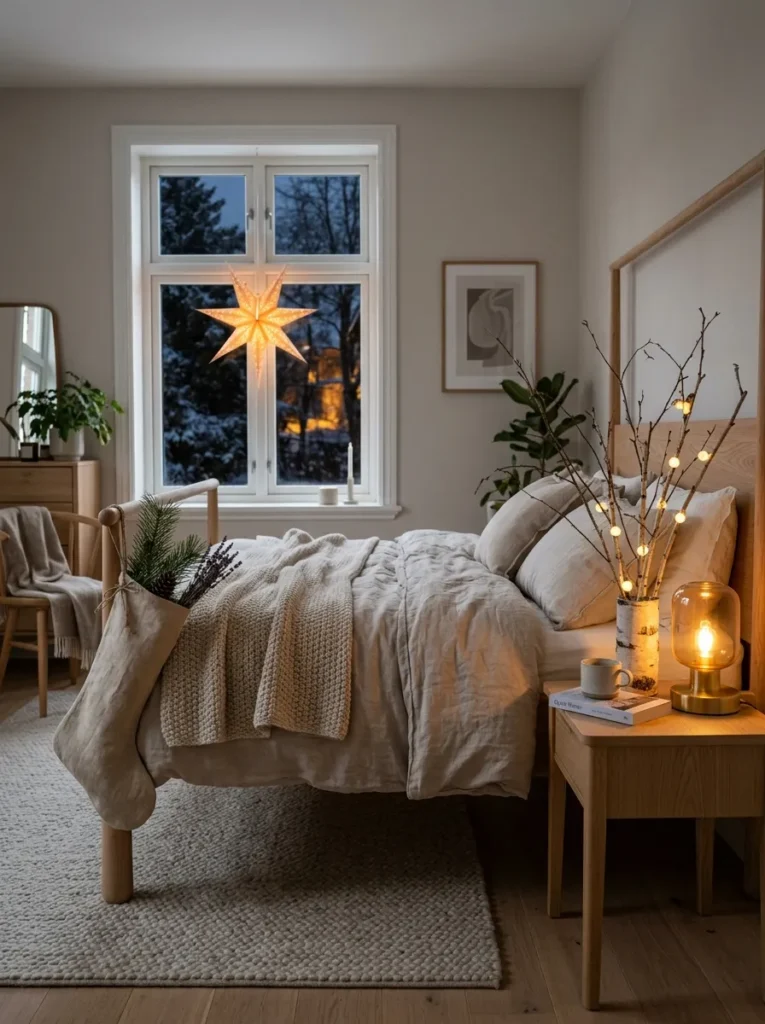
Vibe: The Scandi Christmas bedroom feels like Christmas came quietly to the room that needs quiet most — the three restrained festive additions providing seasonal warmth without converting the bedroom’s essential calm into a decorated space.
Why it works: A minimally decorated bedroom at Christmas applies the room-appropriate festivity principle — the bedroom’s primary function (sleep and rest) is served by an environment of calm and low visual complexity, and covering it with Christmas decoration disrupts this function regardless of the decoration’s aesthetic quality. The Scandi Christmas tradition’s comfort with restraint — its understanding that three beautiful, specific objects are more festive than twenty generic ones — makes it specifically appropriate for bedroom decoration: the small birch branch with its warm LED lights, the simple linen stocking with its pine sprig, and the glowing Advent star in the window provide seasonal warmth through sensory quality (warm light, natural botanical scent, the star’s amber glow) rather than through visual quantity.
The linen stocking: A simple handmade linen stocking (cut from unbleached linen, two identical pieces seam-stitched on the outside and turned right side in) is the most Scandi of all Christmas stocking formats — the natural material, the simple construction, and the absence of decoration are exactly the qualities that the Nordic folk craft tradition values in its functional objects.
Shop The Look
| Product |
|---|
| Small silver birch branch bedroom |
| Natural linen stocking unbleached |
| Small Advent star bedroom window |
| Dried lavender stocking tucking |
| Pine sprig fresh stocking display |
13. The Scandi Wreath — The Natural Door Welcome
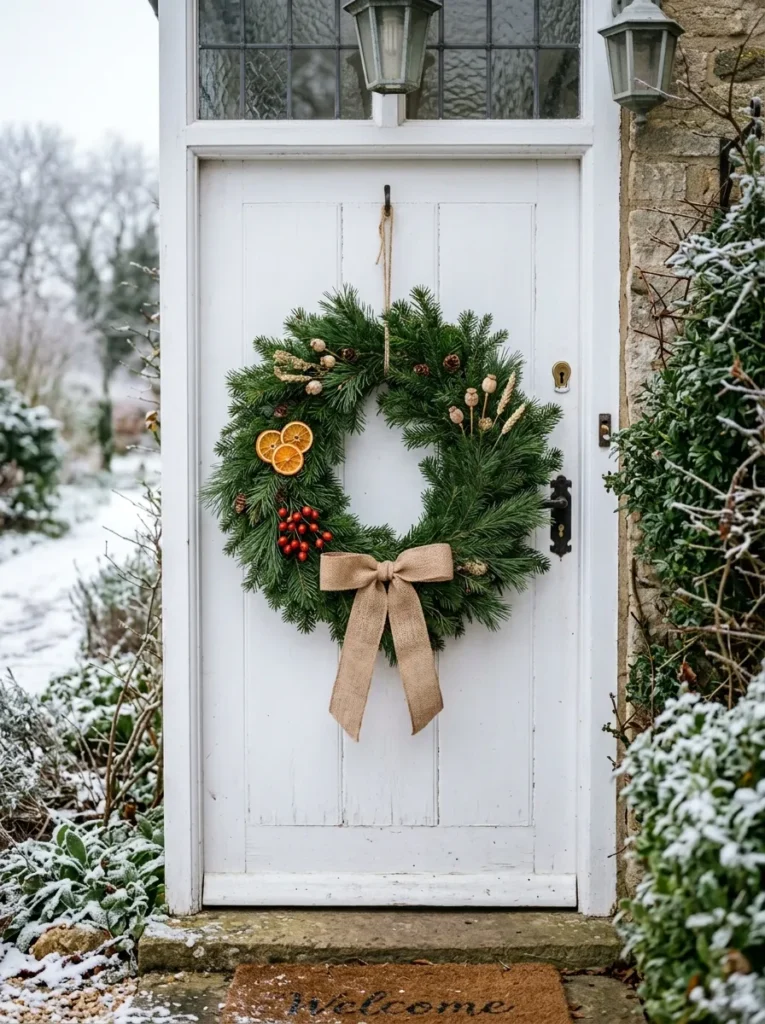
Vibe: The natural Scandi door wreath feels like the most direct possible welcome to a home that celebrates with genuine natural materials — the fresh pine, the dried botanicals, and the simple linen bow creating a wreath that reads as specifically and deliberately chosen rather than generically festive.
Why it works: A natural botanical Christmas wreath with no manufactured decoration applies the material exclusivity door welcome principle — the front door wreath is the first Christmas decoration that any visitor experiences, and its material quality communicates the home’s entire decorative approach in a single glance. A wreath composed exclusively of natural materials (fresh pine, dried botanicals, natural ribbon) read as specifically Scandi in its restraint and specifically beautiful in its material honesty — the absence of the commercial decoration (the plastic berries, the artificial ribbon, the pre-wired ornaments) is the quality that most immediately distinguishes it from generic Christmas door decoration.
Wreath freshness: Mount the wreath on a door that is protected from direct rain if possible — rain accelerates the fresh pine’s drying and reduces the wreath’s lifespan. In exposed positions, a naturally dried botanical wreath (using preserved eucalyptus, dried seed heads, and no fresh material) lasts the full Christmas season without wilting.
Shop The Look
| Product |
|---|
| Fresh pine spruce wreath base 40cm |
| Natural cotton hessian ribbon wide |
| Dried orange slice wreath wire |
| Dried rosehip cluster wreath |
| Wreath hanging hook door |
14. The Scandi Kitchen at Christmas — Baking and Botanical
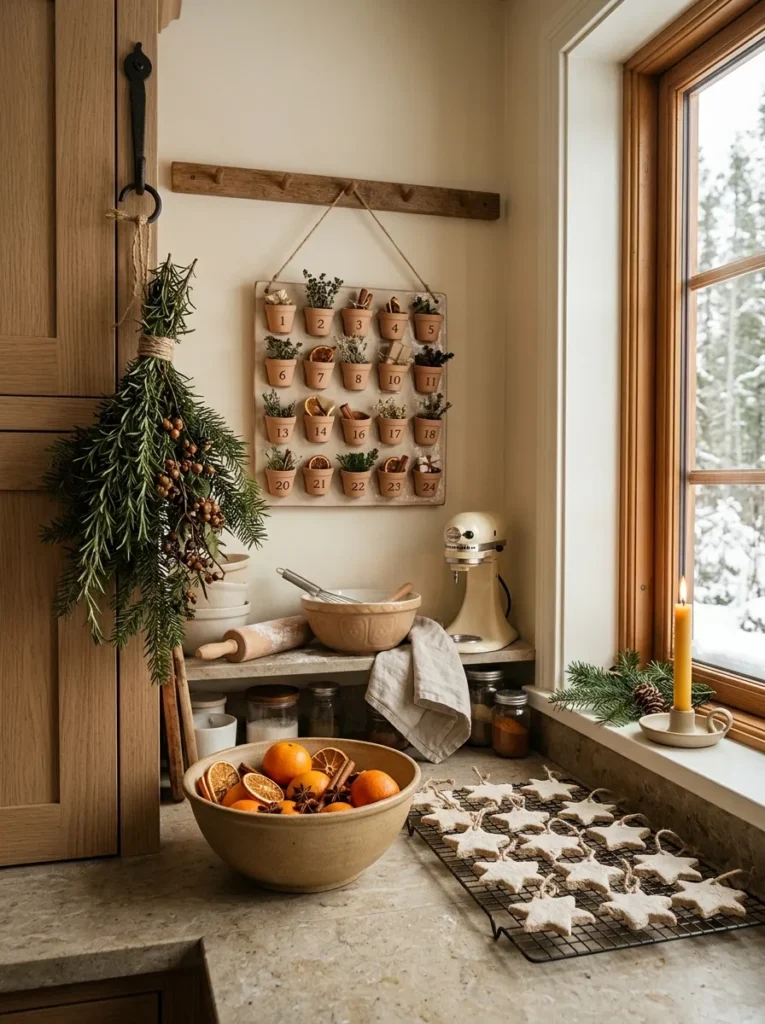
Vibe: The Scandi Christmas kitchen feels like a kitchen whose Christmas decoration is indistinguishable from its cooking preparation — the clementines, the cinnamon sticks, and the salt dough stars are simultaneously decoration and ingredients, the kitchen and the celebration genuinely the same thing.
Why it works: A Scandi Christmas kitchen applies the cooking-as-decoration principle — the kitchen is the one room in the house where the most authentically Scandinavian Christmas decoration is also the preparation for genuinely Scandi Christmas food. The clementines (used in julpunch, in decoration, and eaten throughout December), the cinnamon sticks (a primary spice in Swedish pepparkakor and Danish æbleskiver), the dried rosemary (used in Nordic Christmas baking), and the salt dough stars (made from the same ingredients as Christmas cookies) are objects that reference the Nordic Christmas food tradition in their natural form before they appear in any decorated capacity. This identity between kitchen preparation and kitchen decoration is specifically and genuinely Scandi — the kitchen is treated as the home’s primary Christmas space because the Nordic Christmas is primarily a food-centered celebration.
Shop The Look
| Product |
|---|
| Dried rosemary bundle Christmas |
| Stoneware bowl clementines large |
| Cinnamon stick bundle kitchen |
| Ceramic advent calendar 24 pots |
| Salt dough star ornament kit |
15. The Scandi Living Room Christmas — The Complete Warm Environment
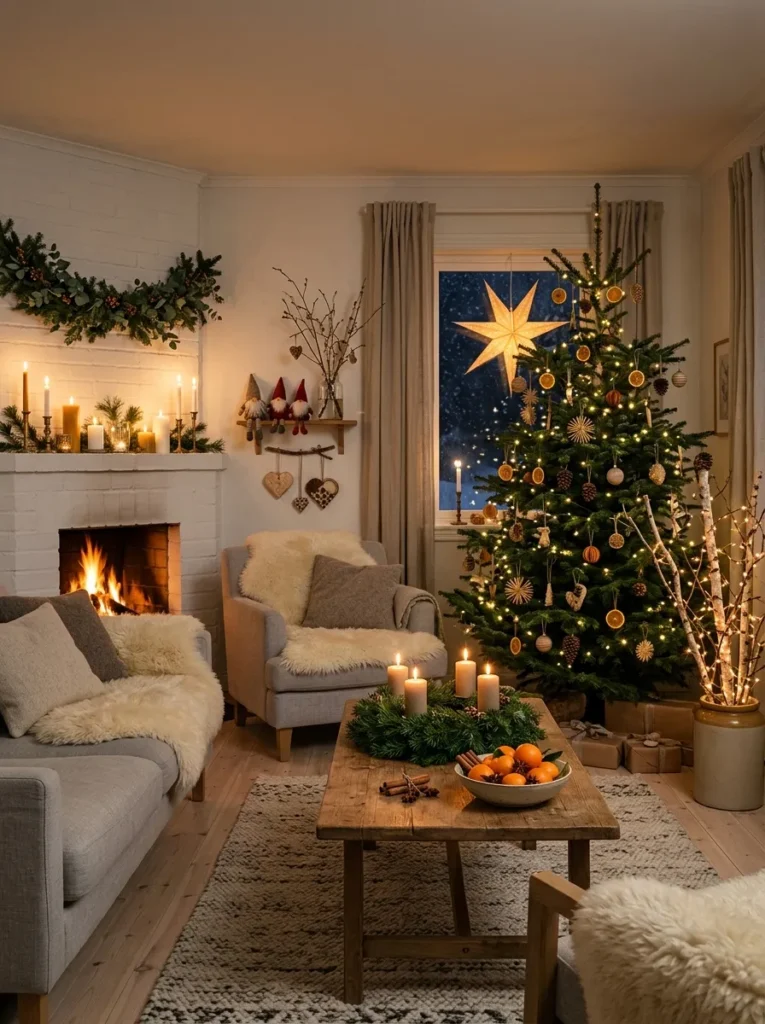
Vibe: The complete Scandi Christmas living room feels like the entire Nordic winter tradition gathered into one warm room — every element from this list present in a composed, warm, completely natural environment that reads as the most considered and most genuine Christmas decoration possible.
Why it works: A complete Scandi Christmas living room where all elements are present simultaneously applies the cumulative atmospheric principle — each individual element in the Scandi Christmas tradition (the Advent wreath, the birch branches, the nisse, the woven hearts, the candle cluster, the sheepskin throws, the natural garland) contributes a specific sensory and visual quality; when all elements are present together in a considered, composed arrangement, their cumulative effect produces the complete Scandi Christmas atmosphere that no individual element achieves alone. The specific quality of this complete environment is its sensory layering: warm candlelight from multiple sources (the Advent wreath, the candle cluster, the individual tapers), botanical fragrance from the fresh pine and the beeswax, tactile warmth from the sheepskin and the heavy wool throws, and visual warmth from the consistent warm-white-and-natural palette that reads as a single, complete design decision across the full room.
The editing principle: Even with this abundance of Scandi Christmas elements, the room reads as calm rather than cluttered because every element is in the warm-white-and-natural palette — there are no competing colors, no purchased commercial decoration, and no element that is not made from a natural material. The editing principle that makes the complete Scandi Christmas work is not restraint in quantity but restraint in material and palette — the room can have fifteen different types of natural decoration and still read as calm because they all speak the same material language.
Shop The Look
| Product |
|---|
| Sheepskin throw natural cream |
| Heavy wool throw warm natural |
| Clementines bowl seasonal |
| Cinnamon sticks bowl accent |
| All Scandi Christmas elements list |
How to Start Your Scandi Christmas This Year
The single most important first move for creating a genuinely beautiful Scandi Christmas in any home is conducting a five-minute material editing exercise — going through every piece of existing Christmas decoration and sorting it into two groups: natural material (pine, beeswax, dried botanical, natural cotton, linen, unbleached wool, wood, stone, straw, ceramics in neutral glazes) and manufactured or synthetic material (plastic ornaments, synthetic ribbon, tinsel, battery-operated plastic lights, commercial Santa and reindeer figures, flashing multi-color LED products). The natural material group becomes the foundation of the Scandi Christmas decoration; the manufactured and synthetic group can be stored, donated, or simply set aside for this year. This editing exercise, which costs nothing and takes five minutes, typically reveals that the household already possesses several genuinely Scandi Christmas elements — ceramic candleholders, natural linen, sheepskin throws, simple white pillar candles, small wooden ornaments — that have been obscured by the visual noise of the accumulated commercial decoration around them.
The most common mistake in attempting a Scandi Christmas look is adding Scandi-aesthetic items to an existing commercial Christmas decoration rather than replacing the commercial elements with the natural ones. A silver birch branch arrangement beside a plastic Santa, an Advent wreath beside a collection of commercial ornaments, and beeswax candles beside an LED reindeer do not produce a Scandi Christmas — the natural elements are overwhelmed by the visual noise of the commercial ones. The Scandi Christmas aesthetic requires the removal of the commercial decoration as much as the addition of the natural.
Three specific investments under $80 that immediately transform any home’s Christmas decoration toward the Scandi aesthetic: a set of four cream beeswax pillar candles ($20–35 for four pillar candles in the 8–12cm height, providing the primary light source of the Scandi Christmas’s candle-centered celebration); a bundle of fresh pine branches or a fresh pine garland ($15–30, providing the botanical scent and natural green that is the Scandi Christmas’s most fundamental natural material); and a traditional Swedish paper Advent star for a window ($10–20 from a Scandinavian import retailer, providing the Nordic candlelight-in-window tradition in its most authentic form). These three investments combined for under $80 provide the candlelight, the botanical, and the window star — the three most fundamentally Scandi Christmas elements — from which the complete look of this list can be built through the December weeks.
Frequently Asked Questions About Scandi Christmas Decoration
What is the essential difference between a Scandi Christmas look and a general Christmas look?
The essential difference is in the relationship to natural materials and the discipline of the palette. A general or commercial Christmas look accepts synthetic materials (plastic, metallic mylar, acrylic) alongside natural ones, and accepts the full commercial Christmas color spectrum (red, green, gold, silver, blue, white) simultaneously. The Scandi Christmas look uses exclusively natural materials (fresh botanical, dried botanical, beeswax, natural fiber, natural wood, natural stone, handmade ceramic) and maintains a disciplined palette of warm white, forest green, deep red, and warm neutral — never all simultaneously, but always in a considered selection that reads as a unified color system. The commercial Christmas look asks “what more can I add?” The Scandi Christmas look asks “what is necessary and what is not?”
How do you maintain Scandi Christmas decoration on a small budget?
The Scandi Christmas tradition is specifically one of the most accessible to maintain on a small budget because its most characteristic elements — fresh pine branches (from garden pruning or fallen branches in parks and forests), beeswax candles (which are more expensive per candle than paraffin but burn significantly longer, making the cost-per-burning-hour comparable), dried botanicals (from the summer garden, dried and stored through autumn), and handmade folk craft objects (salt dough stars, woven hearts, knitted snowflakes) — are available at low or zero cost through garden collection and domestic making. The most expensive elements of the Scandi Christmas (a large traditional Advent star, a genuine straw Julbock, artisan nisse figures) are purchase-once objects that are stored and reused for decades rather than replaced annually. The overall cost-per-year of a Scandi Christmas is typically lower than a commercial Christmas decoration maintained annually because the natural elements are refreshed from garden and kitchen materials rather than purchased from seasonal decoration retailers.
Which plants and botanicals are safe to use in a Scandi Christmas decoration if you have pets?
The Scandi Christmas botanical palette includes several elements that are safe for pets and several that require care. Non-toxic for dogs and cats: dried eucalyptus (safe), dried orange slices (safe), dried lavender (safe in small quantities), dried chamomile (safe), dried rosehips (safe), birch branches (safe). Require caution or positioning out of reach: fresh pine and spruce (mildly irritating if needles are ingested in quantity — position the Christmas tree and pine garlands out of reach of dogs and cats), beeswax candles (non-toxic in material but a fire hazard if knocked over by a pet — use stable holders and position away from pet access). Avoid: holly berries (toxic to dogs and cats), mistletoe (toxic), some dried seed heads that contain toxic compounds (verify individual species against the ASPCA database before use).
How long does fresh pine decoration last indoors?
Fresh pine branches and fresh pine wreaths and garlands typically last 10–14 days in a warm indoor environment before the needles begin to dry and drop. The lifespan can be extended by: misting the fresh pine with water every two to three days (keeping the foliage surface moisture higher), positioning fresh pine decoration away from direct heat sources (radiators, fireplaces, sunny windows), and keeping cut ends in water where possible (for individual branches in vessels, changing the water every three to four days significantly extends the branch’s freshness). After the fresh pine has dried (typically 14–21 days after cutting), it becomes a dried botanical element that continues to provide fragrance and visual interest for the remainder of the Christmas season, though the green color fades to a soft gray-green.
What is the correct Scandi Christmas candle protocol?
Candles are the primary light source of the Scandi Christmas, and their specific use is governed by both cultural tradition and practical safety. The cultural protocol: light candles at the beginning of each evening spent in the Christmas-decorated room, never leave them burning unattended, and extinguish them when the household goes to bed. The Scandi Christmas is specifically a celebration of gathered candlelight — the candles are lit when people are present in the room to experience them, not as a background element. The safety protocol: use candles in stable, non-tip holders rated for the candle’s specific diameter; maintain minimum 30cm clearance between lit candles and any flammable material (fresh pine, dried botanical, fabric); never use candles near children or pets without direct supervision; and keep a small container of water accessible in any room where multiple candles are lit. The beeswax candle drips less than paraffin and has a harder wax, making it slightly safer for general use.
Ready to Welcome a Scandi Christmas?
These 15 ideas move through every dimension of what makes a Scandi Christmas genuinely beautiful and genuinely warm — from the ritual accumulation of four Advent Sundays marked by the wreath’s candlelight, through the folk art warmth of the woven hearts, the straw Julbock, and the nisse gathered on their shelf, to the botanical simplicity of the natural wreath, the birch branch arrangement, and the fresh pine garland, to the complete sensory environment of a living room where candlelight, botanical fragrance, sheepskin warmth, and natural material visual unity create the specific quality of Nordic winter warmth that no commercial Christmas decoration can produce. Starting with the material editing exercise — five minutes sorting existing decoration into natural and manufactured, setting aside the manufactured, and working with the natural — is the beginning that creates the clarity from which every subsequent Scandi Christmas addition makes sense and finds its place. Add the beeswax candles this week. Hang the Advent star in the window this weekend. Cut a branch of fresh pine from the garden next week and stand it in a vessel beside the Advent wreath. Let the Christmas build slowly, one natural element at a time, through the four weeks of Advent — exactly as the Nordic tradition intends