15 Bathroom Wall Panel Ideas for Small Bathrooms
Bathroom wall panels are moisture-resistant cladding systems — typically PVC, MDF, wood composite, or stone-effect sheets — installed directly over walls to replace or cover traditional tiling. This article gives you exactly 15 bathroom wall panel ideas for small bathrooms, covering everything from color and material choices to layout tricks that make compact spaces feel twice their size.
There’s something quietly transformative about a panelled bathroom wall. It’s the difference between a room that merely functions and one that feels considered — where texture catches the morning light, where grout lines disappear, and where even the smallest bathroom begins to feel like a retreat. These spaces don’t need square footage to feel elevated. They need intention. Here are 15 ideas worth saving — and stealing.
Why Bathroom Wall Panels Work So Well in Small Bathrooms
Bathroom wall panels have moved well beyond their utilitarian origins. Once associated with dated shower enclosures, modern wall panelling systems now draw from Scandinavian minimalism, spa design, and even traditional British joinery to create bathrooms that feel genuinely designed rather than simply fitted. The shift happened quietly but deliberately — as homeowners began treating bathrooms as rooms worthy of the same design attention as living spaces.
The core materials that define this trend include high-gloss acrylic in warm white and soft sage, woodgrain PVC in unfinished oak and warm walnut tones, stone-effect panels in warm greige and smoky slate, and tongue-and-groove MDF primed in matte Farrow & Ball shades like Elephant’s Breath or Pointing. Grout-free surfaces mean colour reads consistently across the wall — no visual interruption, no contrast lines breaking up the space.
The timing of this trend connects directly to a post-pandemic rethinking of home spaces. Bathroom renovation searches surged from 2021 onward, and panelling emerged as a cost-effective alternative to full retiling — relevant to a generation increasingly conscious of both budget and sustainability. Panels also produce significantly less construction waste than tile removal and replacement.
For small bathrooms specifically, wall panels are genuinely one of the best design decisions you can make. Their seamless, grout-free surfaces reduce visual clutter; their reflective finishes bounce light; and their vertical or horizontal orientation can be used deliberately to manipulate perceived height and width. The one honest limitation: heavily textured stone-effect panels can visually compress a narrow bathroom — save those for a single feature wall only.
Style at a Glance
| Element | Trait 1 | Trait 2 |
|---|---|---|
| Philosophy | Seamless, spa-like simplicity | Practical elegance over decoration |
| Materials | PVC, acrylic, MDF, stone composite | Tongue-and-groove, shiplap, slab profile |
| Color Palette | Warm white, soft sage, smoky slate | Warm walnut, greige, matte charcoal |
1. Warm White Shiplap Panels Floor to Ceiling
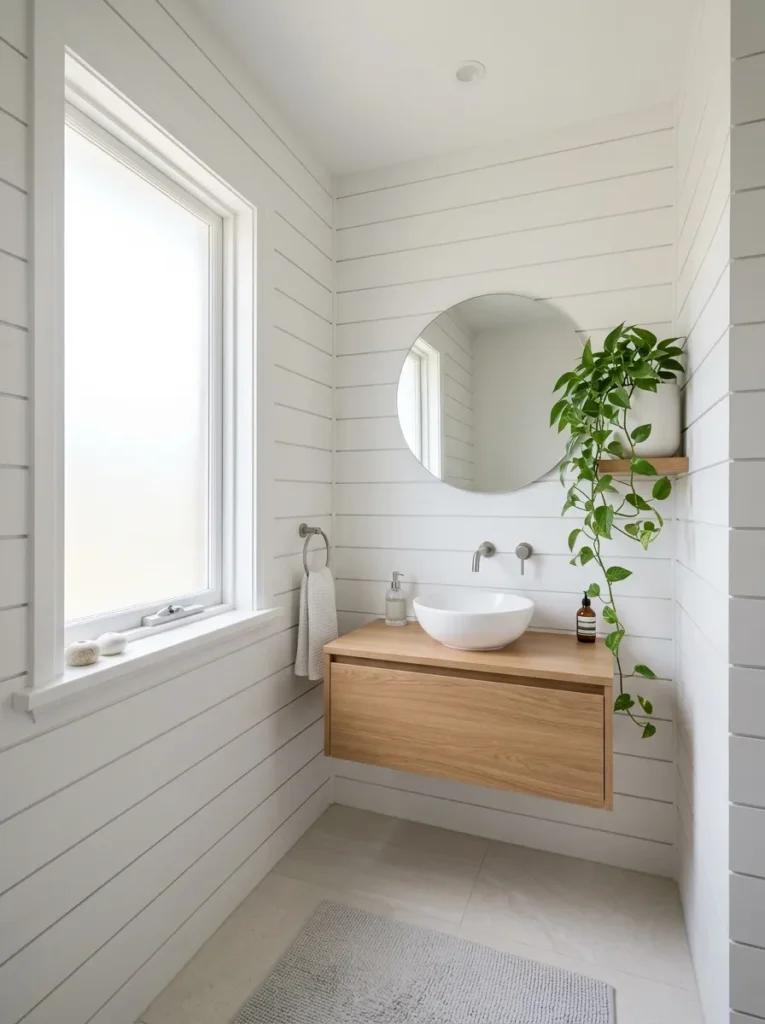
Vibe: Still and quietly expansive — like a deep exhale built into the walls.
Why it works: Continuous vertical coverage eliminates the stop-start visual noise of grout lines, allowing the eye to travel smoothly up the full height of the room. In a small bathroom, this uninterrupted surface creates the impression of height even in a standard 2.4m ceiling. The horizontal shiplap profile reinforces width simultaneously — a rare dual illusion that single-colour tile simply cannot achieve.
How to get it: Install white PVC shiplap panel sheets (available in 2.4m × 1.2m boards) using waterproof adhesive and snap the tongue-and-groove edges flush. For the warmest result, choose warm white rather than cool white — paint codes like Dulux Natural Hessian White or Farrow & Ball Pointing read as crisp without the clinical edge.
Quick Win: A single roll of white peel-and-stick shiplap wallpaper (waterproof, £18–£30) on one wall immediately previews the look before you commit to full installation.
Shop the Look
| Product |
|---|
| White PVC shiplap bathroom wall panel 2.4m waterproof |
| Ceramic vessel sink basin white round |
| Frameless round bathroom mirror 60cm |
| Matte white ceramic planter pot medium |
| Brushed chrome bathroom towel ring wall mount |
Also view: 14 Blue Bathroom Ideas for a Fresh Coastal Look
2. Sage Green Slab Panel Feature Wall
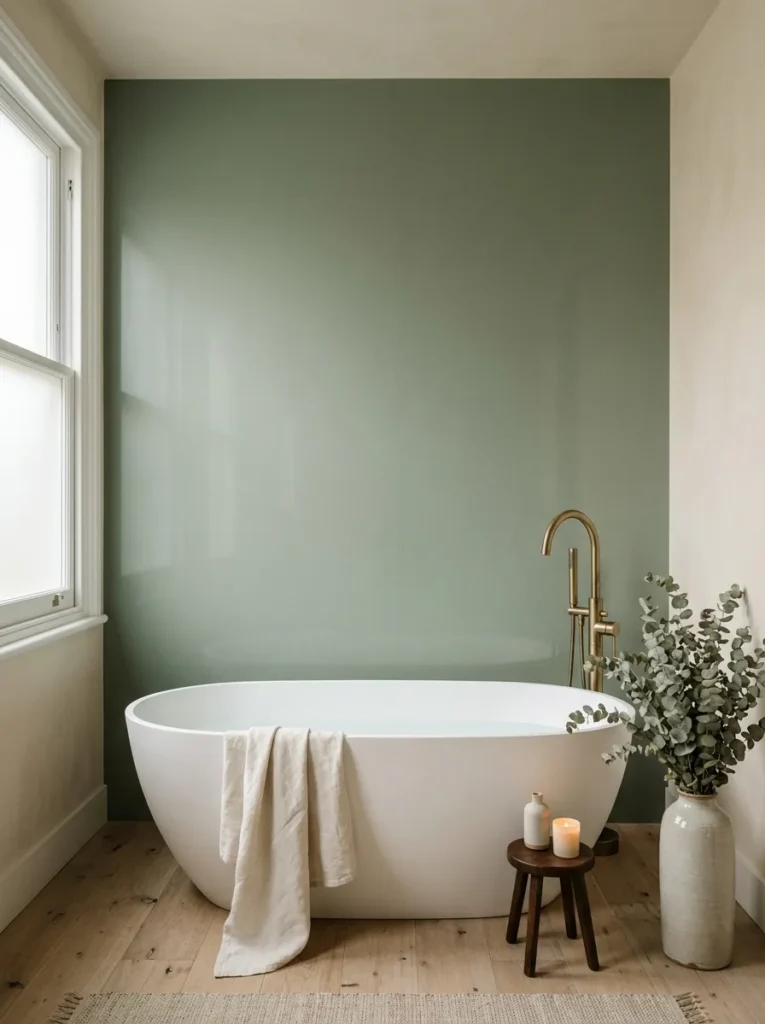
Vibe: Hushed and botanical — the colour of a greenhouse on a grey morning.
Why it works: A single large-format slab panel in dusty sage functions as a painted artwork behind the bath, giving the wall compositional weight without visual complexity. The seamless sheet — no grout, no joins, no pattern repeat — allows the colour itself to do the work. Sage sits in the warm-neutral family, so it recedes slightly rather than advancing toward you, which preserves the perceived depth of a compact bathroom.
How to get it: Choose a large-format acrylic slab panel in a matte or semi-gloss sage finish. Apply to one wall only in a small bathroom — limiting the colour to a feature wall avoids the closing-in effect that can happen when saturated tones wrap all four walls.
Shop the Look
| Product |
|---|
| Sage green acrylic bathroom wall panel large format |
| Brushed brass bath filler tap freestanding |
| Cream waffle weave bath towel set |
| Dried eucalyptus stems bundle tall |
| Matte black floor vase tall ceramic |
3. Woodgrain PVC Panels for a Spa-Like Warmth
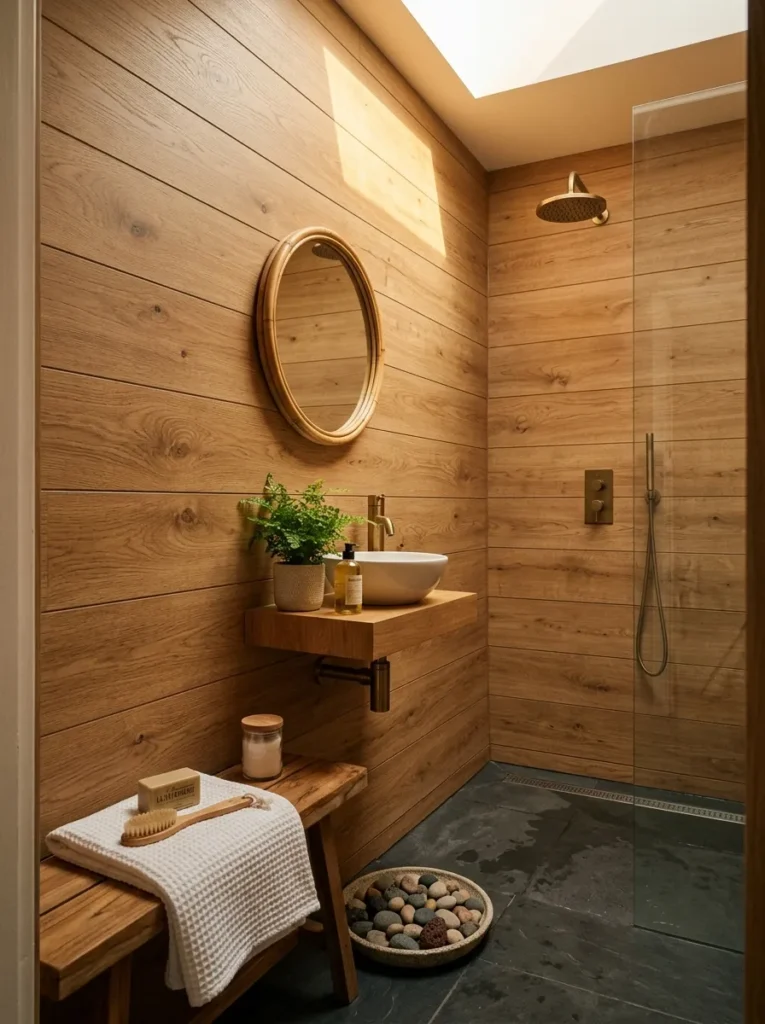
Vibe: Sun-warmed and deeply calm — the texture of a Scandinavian sauna in miniature.
Why it works: Woodgrain PVC panels introduce the visual warmth of natural timber without any of the moisture vulnerability that makes real wood impractical in bathrooms. The grain direction matters enormously: horizontal grain elongates the wall, making a narrow bathroom feel wider; vertical grain draws the eye upward. This is applied texture theory — using the directional quality of pattern to redirect spatial perception.
How to get it: Source woodgrain PVC panels in warm oak or walnut tone from panelling suppliers. Run horizontal for maximum width illusion. Pair with brushed brass or matte black fittings — chrome can feel too cool against wood tones and breaks the warmth.
Quick Win: A teak bath shelf that spans between tub walls (£25–£45) immediately introduces real wood texture as a complement, reinforcing the natural material story without full panel installation.
Shop the Look
| Product |
|---|
| Oak woodgrain PVC bathroom wall panel waterproof |
| Teak wood bathtub caddy shelf expandable |
| Bamboo framed round mirror bathroom |
| Brushed brass towel bar wall mount |
| River stone pebble bath mat natural |
4. Vertical Tongue-and-Groove for Perceived Height
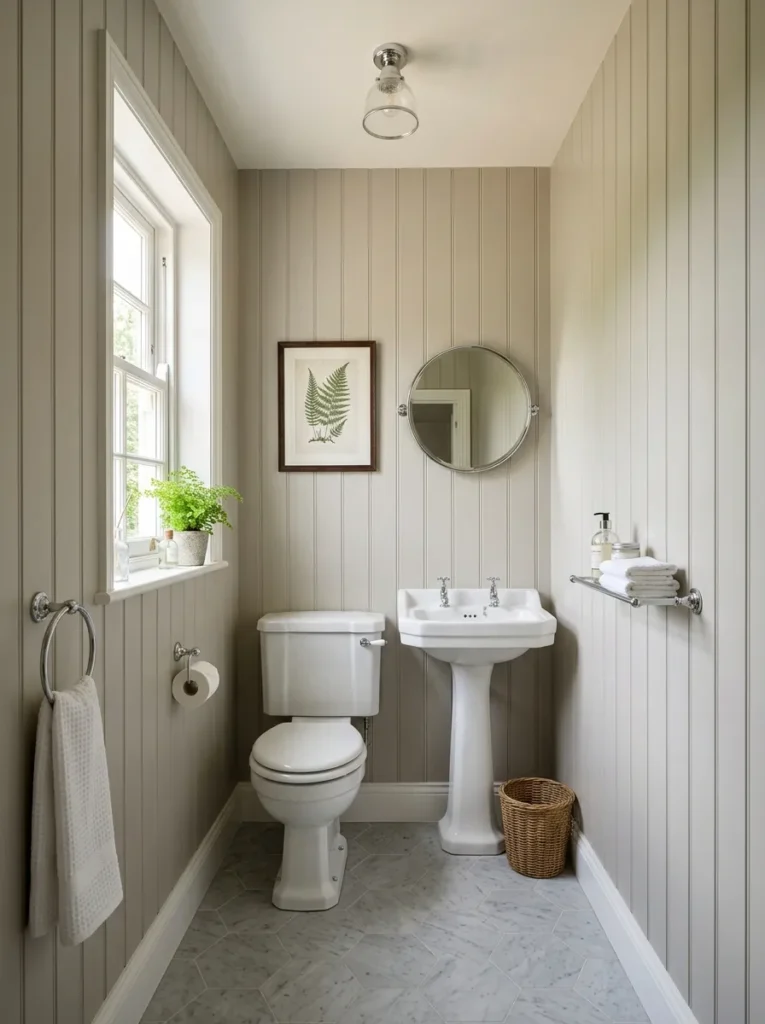
Vibe: Ordered and quietly classical — like a Victorian bathroom reimagined with restraint.
Why it works: Vertical lines are one of the most reliable tools in small-space design — the eye follows the board upward and then continues past it, creating the perception of a taller ceiling. Tongue-and-groove MDF in a full floor-to-ceiling run eliminates the visual horizon line that dado-height panelling creates, which is critical in a small bathroom where every horizontal break reduces perceived height.
How to get it: Install pre-primed MDF tongue-and-groove sheets vertically and paint in Farrow & Ball Elephant’s Breath (No. 229) or Dulux equivalent warm greige. Use a brush rather than roller to keep paint out of the groove reveals — the shadow line is what creates the architectural definition.
Shop the Look
| Product |
|---|
| Primed MDF tongue and groove wall panel sheet |
| Farrow and Ball Elephant’s Breath paint tester |
| Oval pedestal ceramic basin sink |
| Chrome bathroom light bar mirror light |
| Framed botanical print bathroom wall art |
5. Dark Slate-Effect Panels for Moody Drama
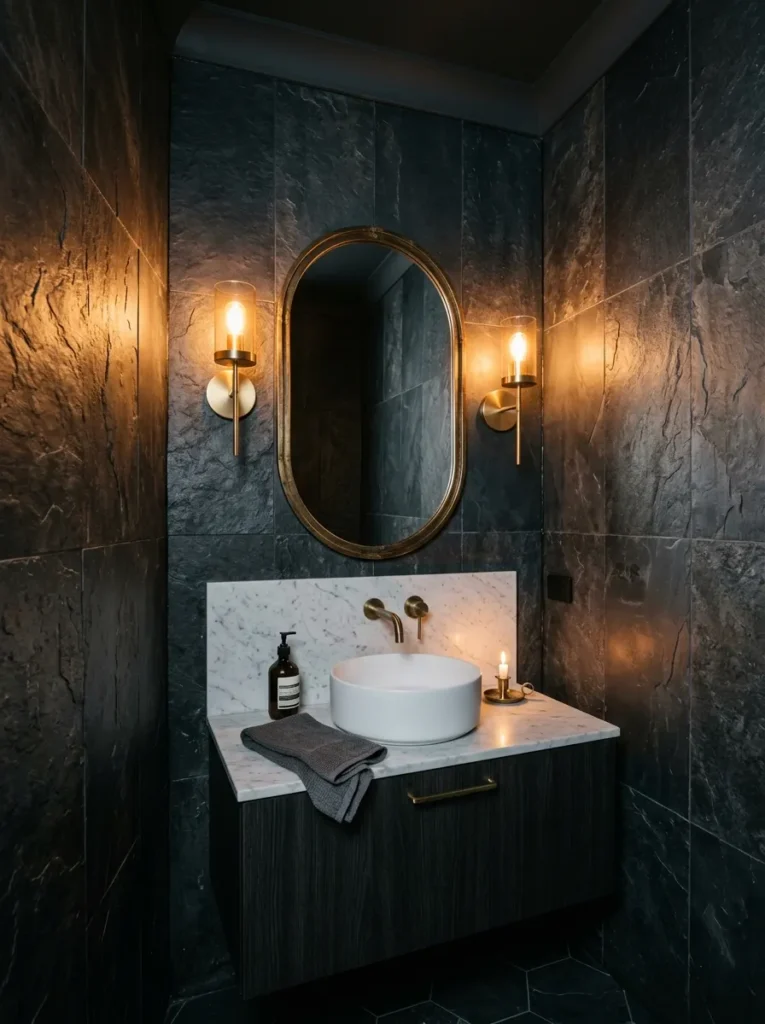
Vibe: Raw and atmospheric — a space that feels like it was carved rather than built.
Why it works: Dark panels work in small bathrooms when used intentionally rather than reluctantly. The key design principle is contrast: a dark panelled wall recedes, making the room feel larger in depth rather than width. Paired with warm, close-range lighting (sconces at eye level rather than overhead), the dark surface creates intimacy rather than claustrophobia. This is the principle of deliberate enclosure — using darkness to define, not diminish.
How to get it: Reserve dark slate-effect panels for a single feature wall, ideally behind a mirror or vanity unit where you control the lighting closest to it. Choose panels with natural tonal variation rather than flat dark finishes — the subtle surface movement mimics genuine stone and avoids the flat, plastic look.
Quick Win: Swap a standard bathroom light for two brushed gold wall sconces at mirror height (£20–£35 each) before you even touch the walls — the warm uplighting immediately makes any dark surface read as intentional rather than gloomy.
Shop the Look
| Product |
|---|
| Charcoal slate effect bathroom wall panel waterproof |
| Brushed gold bathroom wall sconce light pair |
| Oval antique brass framed bathroom mirror |
| White marble effect basin sink vessel |
| Matte black bathroom soap dispenser set |
6. Half-Height Panelling with Contrasting Paint Above
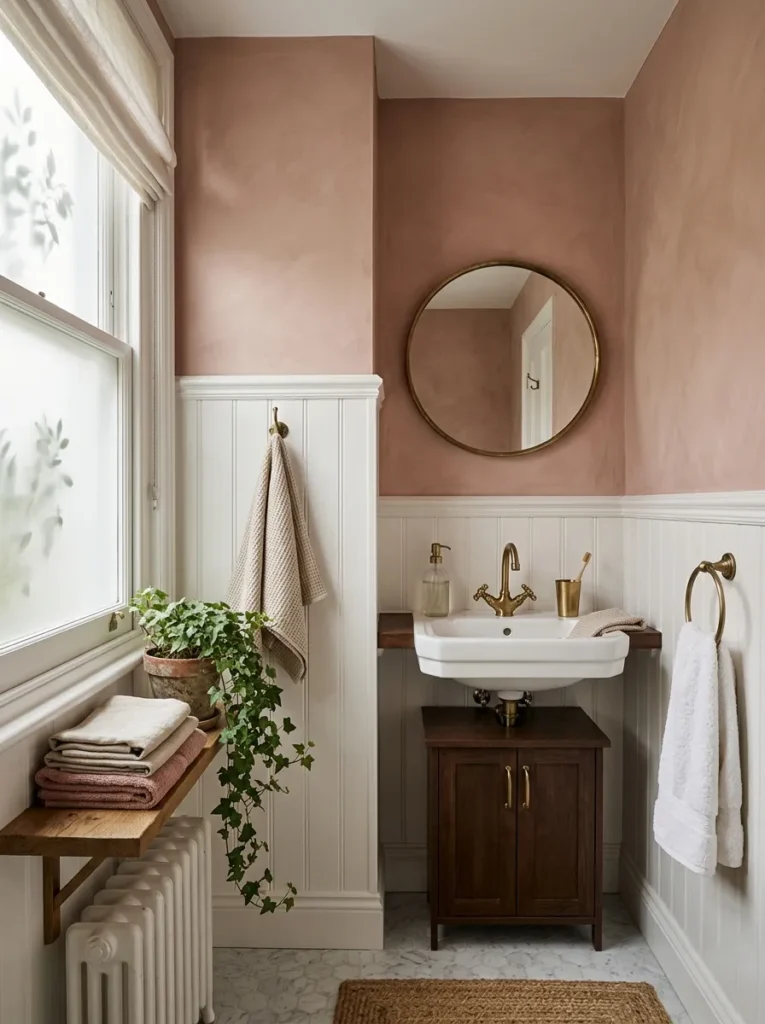
Vibe: Layered and lived-in — the warmth of a room that’s been loved slowly.
Why it works: Two-zone walls use a classic principle of interior architecture: dividing the vertical plane creates proportion, framing the human body rather than the room’s dimensions. The lower panelled zone adds tactile weight and visual grounding, while the contrasting paint above draws the eye upward. This technique also allows you to introduce colour confidently in a small bathroom — the panel zone contains the visual “risk” and prevents colour from overwhelming the space.
How to get it: Set the panel rail at 90–100cm from floor level (this aligns with standard dado height and visually extends the room proportions). Paint the upper zone in a muted, plaster-toned pink such as Little Greene’s Dorchester Pink or Dulux Vintage Blush — these shades have enough grey in them to read as sophisticated rather than sweet.
Shop the Look
| Product |
|---|
| White beadboard PVC dado panel kit bathroom |
| Dusty rose plaster paint interior matte finish |
| Aged brass cup hook rail bathroom |
| Stacked linen hand towel set cream |
| Terracotta plant pot small bathroom indoor |
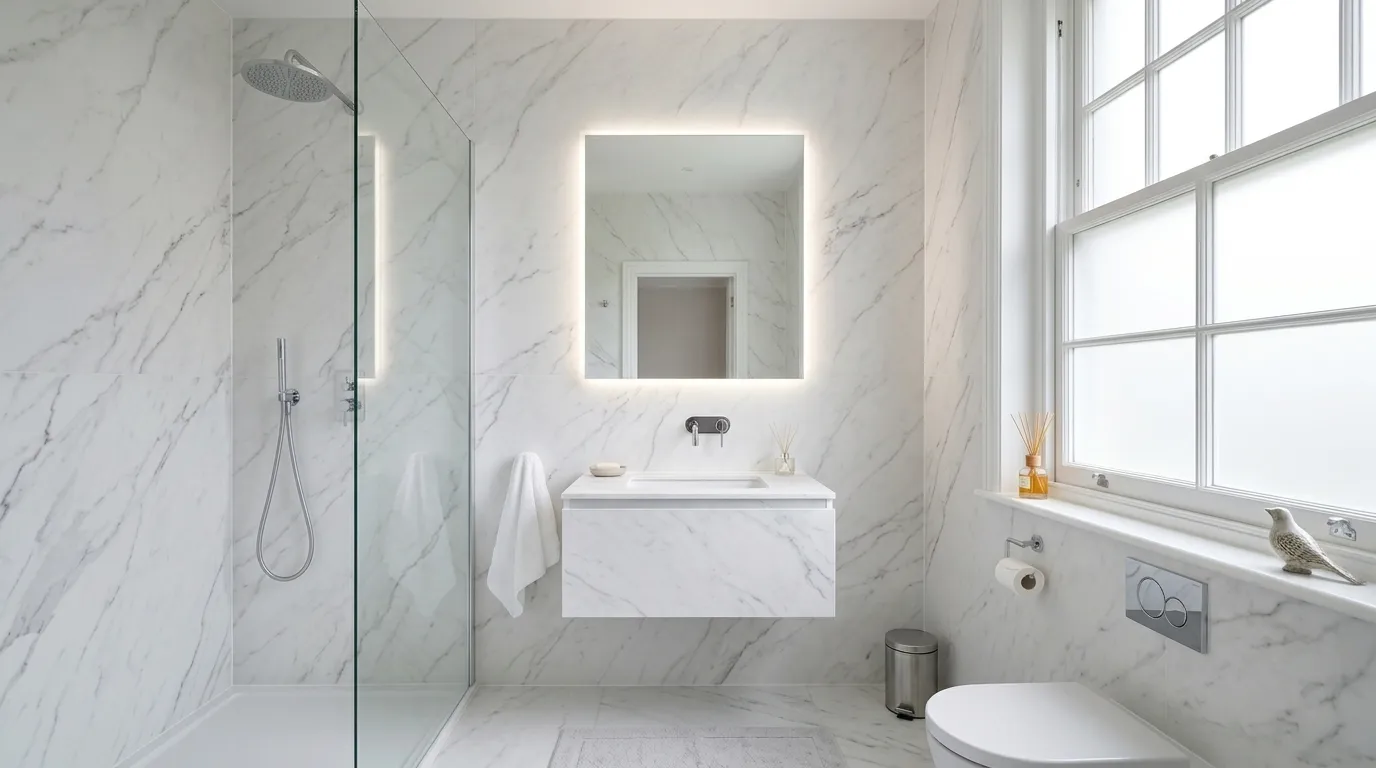
7. Marble-Effect Panels for Luxury Without the Budget
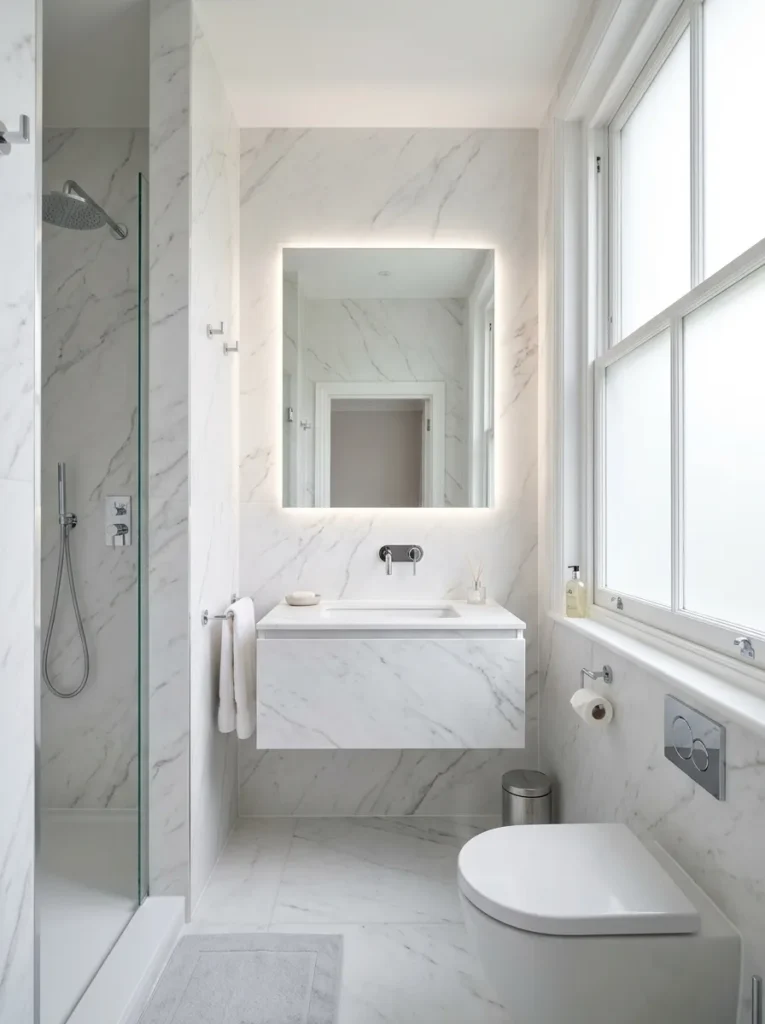
Vibe: Luminous and quietly aspirational — the look of a hotel suite without the nightly rate.
Why it works: White marble-effect panels exploit the light-reflective quality of acrylic surfaces: they bounce natural light back into the room, optically enlarging the space. The subtle grey veining adds visual movement — enough to prevent the wall from reading as flat, without the complexity that would make a small bathroom feel busy. Seamless panel joins mean the veining pattern can run continuously, reinforcing the impression of a single slab of genuine stone.
How to get it: Choose panels with large-scale veining patterns rather than busy small-scale ones — fine, scattered veining reads as noise in a small space, while bold, directional veining reads as intentional. Align panel joins so the vein direction is continuous across the seam.
Quick Win: A marble-effect contact paper roll (£12–£20) applied to the back panel of an open shelf or niche is an instant luxury accent that costs almost nothing and takes under an hour.
Shop the Look
| Product |
|---|
| Calacatta marble effect acrylic bathroom wall panel |
| LED backlit bathroom mirror rectangle |
| Wall hung chrome bathroom mixer tap |
| Undermount ceramic bathroom basin white |
| White gloss floating bathroom vanity unit |
8. Fluted Ribbed Panels for Texture and Shadow Play
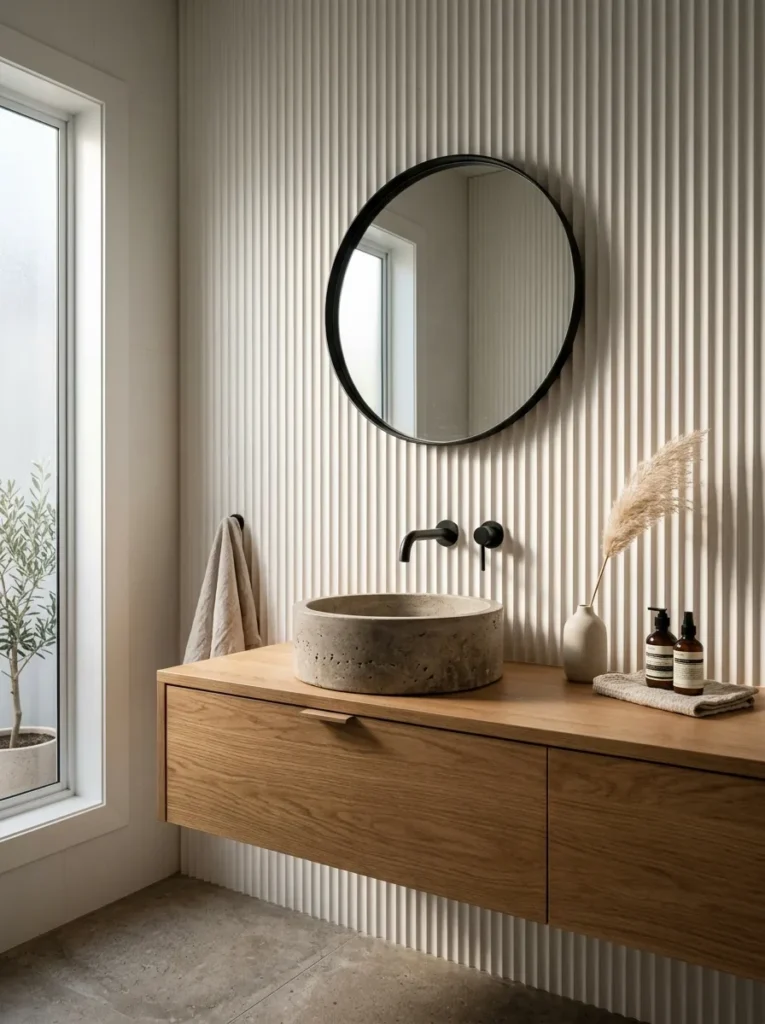
Vibe: Tactile and unhurried — a wall you actually want to reach out and touch.
Why it works: Fluted panels introduce depth without volume — the ribbed profile is measured in millimetres, but the shadow lines it creates give a bathroom wall genuine three-dimensionality. This matters in small bathrooms because visual interest that comes from light behaviour rather than pattern scale doesn’t visually crowd the space. The rule is simple: texture that reacts to light expands; pattern that competes with fixtures clutters.
How to get it: Fluted PVC panels are now widely available as shower wall panels. Install on a single feature wall behind the basin or bath rather than all walls. The ribbing direction should be vertical — it reads more architecturally and avoids the visual “fence” effect of horizontal ribbing in a confined space.
Shop the Look
| Product |
|---|
| Fluted ribbed PVC bathroom wall panel white |
| Concrete look round bathroom basin sink |
| Solid oak bathroom vanity unit wall hung |
| Matte black basin mixer tap |
| Slim glass bud vase set of 3 |
9. Full Shower Enclosure Panelling in Graphite Grey
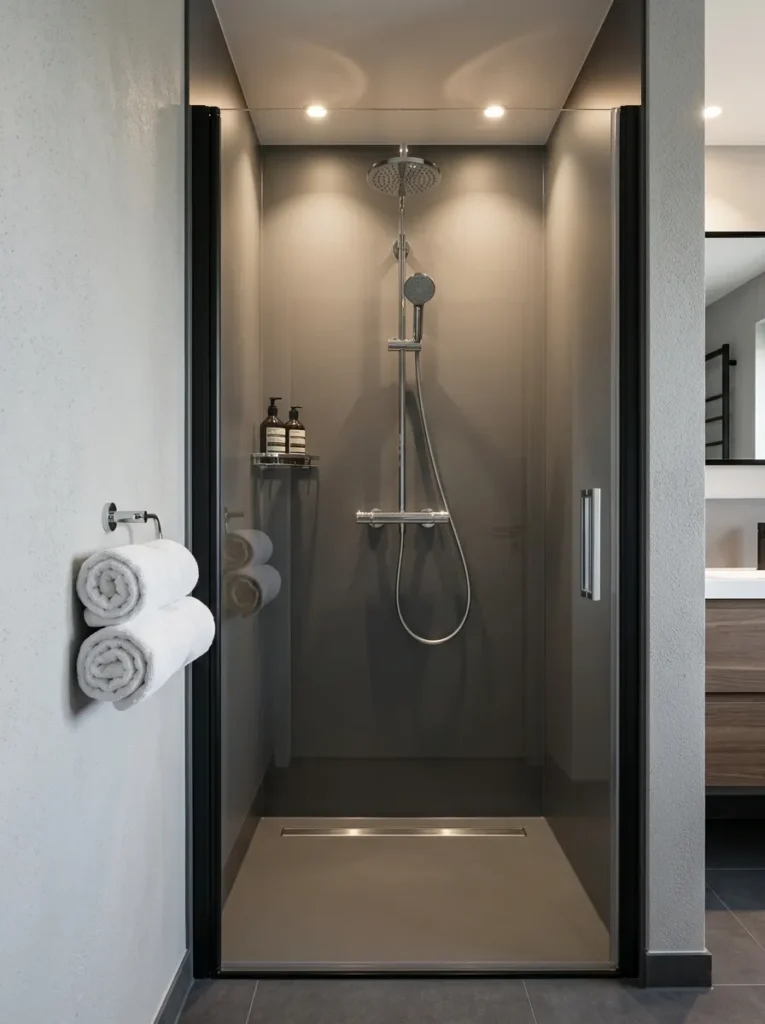
Vibe: Grounded and decisive — a shower that means business.
Why it works: A fully panelled shower enclosure eliminates the single biggest maintenance problem in bathrooms: mould in grout lines. Graphite grey panels provide a neutral base that reads as masculine and modern without requiring pattern or texture — the matte finish absorbs light rather than reflecting it, which creates a sense of solidity and quiet. In a small bathroom, containing the dark colour within the shower zone is the key — it defines the wet area without making the wider room feel heavy.
How to get it: Use waterproof thermoplastic shower wall panels rated for wet rooms. A thickness of 10mm gives sufficient rigidity without requiring battening in most shower enclosures. Seal panel joins with a colour-matched silicone rather than standard white — invisible joins are what separates a professional installation from a DIY one.
Quick Win: Replace cracked or discoloured grout in your existing shower with grout paint in the same shade as your tiles (£8–£15 a pot) while you plan a full panel installation — it instantly resets the visual cleanliness of the space.
Shop the Look
| Product |
|---|
| Graphite grey thermoplastic shower wall panel 10mm |
| Chrome rainfall shower head ceiling mount |
| Chrome corner shower caddy shelf stainless |
| Clear glass hinged shower door 800mm |
| Chrome heated towel rail small |
10. Pale Blue Panels for Coastal Calm
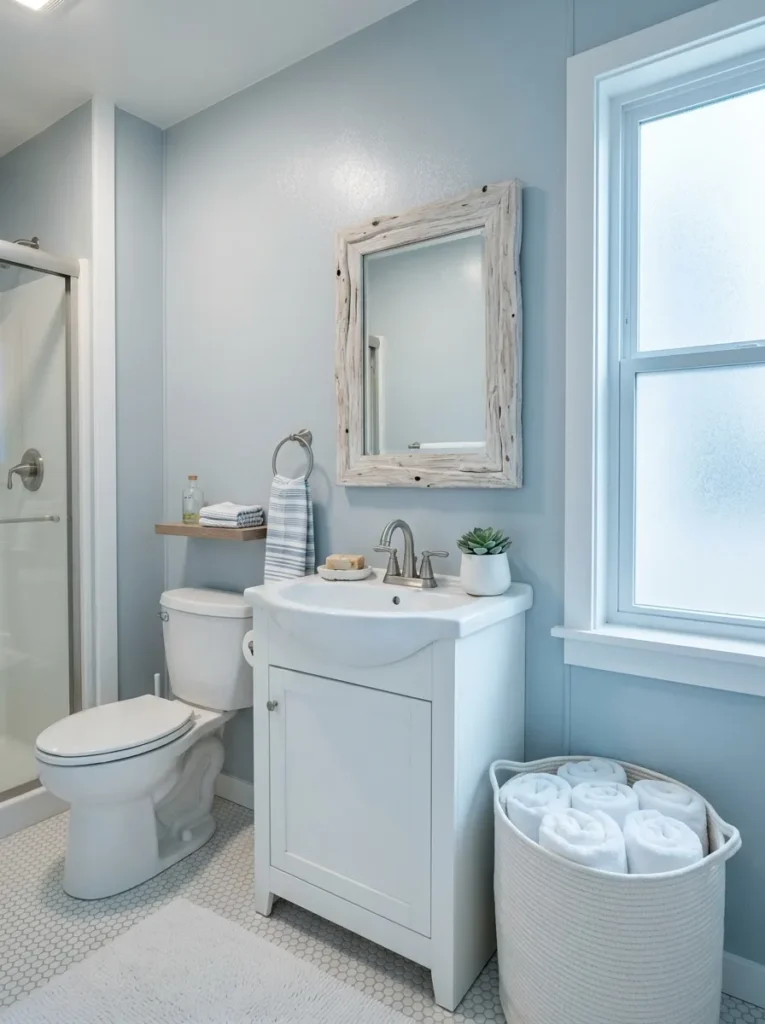
Vibe: Airy and salt-rinsed — the feeling of a window open to the sea.
Why it works: Pale blue sits in the cool-light family of colours, which makes it optically recede — creating the impression that walls are slightly further away than they are. This is one of the most useful spatial illusions available in a small bathroom. The specific tone matters: blue-grey rather than pure sky blue retains softness while avoiding the nursery-room association that pure pale blue can carry. Grey undertones keep it sophisticated at any size.
How to get it: Source smooth acrylic or PVC panels in blue-grey tones — look for descriptions like “duck egg,” “muted teal,” or “soft Atlantic.” Pair with white fittings and natural textures (rope, driftwood, linen) to anchor the coastal reference without it tipping into themed kitsch.
Shop the Look
| Product |
|---|
| Pale blue grey smooth bathroom wall panel acrylic |
| Whitewashed driftwood round bathroom mirror |
| White rope storage basket bathroom medium |
| White ceramic bathroom soap dish |
| Small succulent set with white ceramic pots |
11. Mixed-Width Vertical Panel Layout
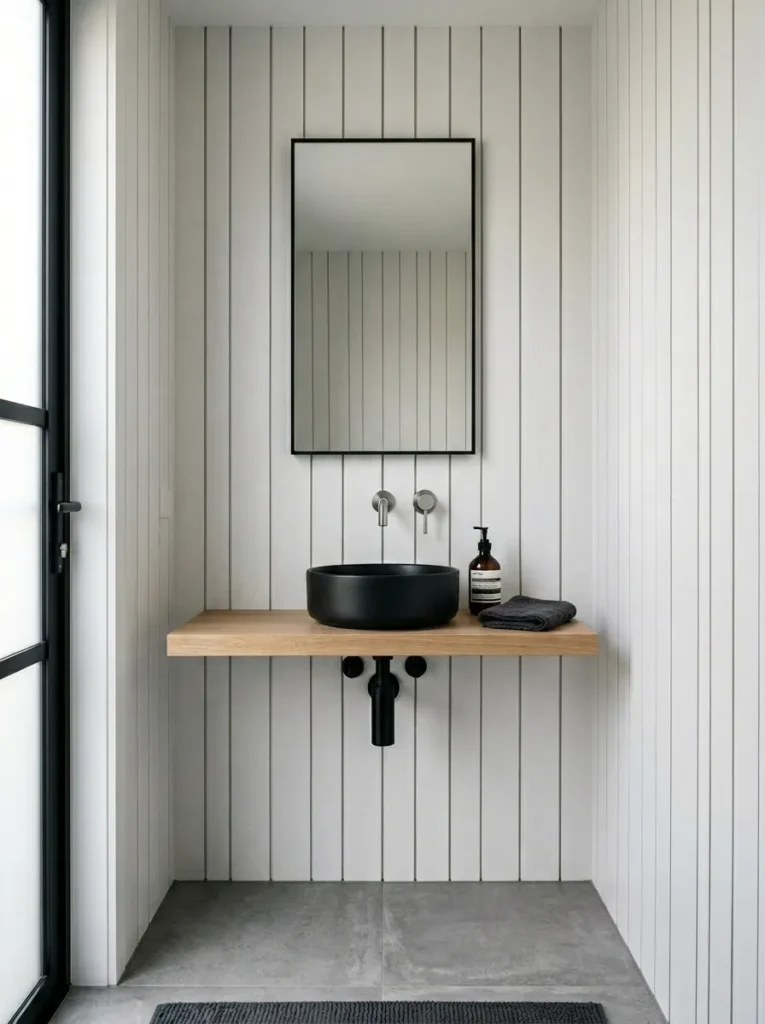
Vibe: Considered and quietly architectural — the kind of detail that makes visitors ask who designed the room.
Why it works: Alternating wide and narrow panel widths creates a rhythm that moves the eye vertically without the monotony of uniformly-spaced boards. The principle is musical: varying the beat makes you more aware of the rhythm, not less. This technique also disguises the repetitive quality that simple panelling can develop over large wall areas — critical in a small bathroom where the walls are close enough that any visual repetition is amplified.
How to get it: Plan the layout on paper before cutting. A typical sequence might be 15cm / 8cm / 15cm / 8cm — or for a less regular feel, 20cm / 10cm / 15cm / 8cm. Cut MDF strips yourself from sheet material or source pre-cut panelling kits that include mixed widths. Sand, prime, and paint with a matte eggshell for the cleanest finish.
Quick Win: A panelling effect can be faked entirely with strips of 3mm-thick MDF moulding applied directly over existing painted walls — no demolition, no re-skimming, under £40 for an average bathroom wall.
Shop the Look
| Product |
|---|
| MDF wall panel moulding strip set mixed width |
| White matte eggshell bathroom paint 2.5L |
| Floating oak bathroom shelf 60cm wall mounted |
| Matte black rectangular bathroom mirror |
| Brushed nickel wall mounted basin tap |
12. Panels with Integrated Niche Shelving
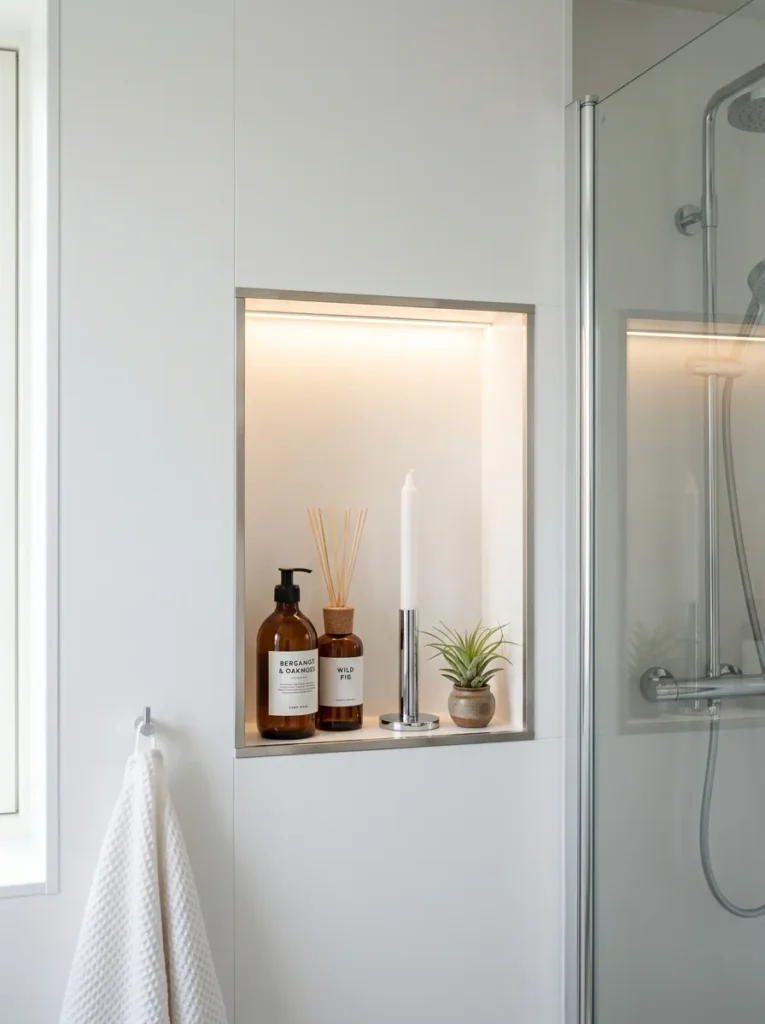
Vibe: Serene and organised — function elevated to the level of design.
Why it works: Recessed niches eliminate the need for surface shelving, which is one of the key layout gains in a small bathroom — every item that moves off a shelf or countertop returns floor and counter space to the room. The integration of LED strip lighting inside the niche turns functional storage into a focal point, shifting the visual weight of the wall from a flat surface to an illuminated display. This is the design principle of activated negative space — the cavity becomes more interesting than the wall around it.
How to get it: Plan niche position before panelling — the niche should fall between wall studs (typically 400–600mm apart). Standard niche dimensions are 30cm wide × 20cm tall × 10cm deep. Line niche interior with matching panel or a contrasting material — brushed brass sheet is striking and practical.
Shop the Look
| Product |
|---|
| LED recessed niche shelf bathroom chrome trim |
| Amber glass bathroom accessory bottle set |
| Small air plant tillandsia set of 3 |
| Chrome taper candle holder bathroom |
| White matte ceramic tray small bathroom |
13. Two-Tone Panel Layout: Dark Base, Light Upper
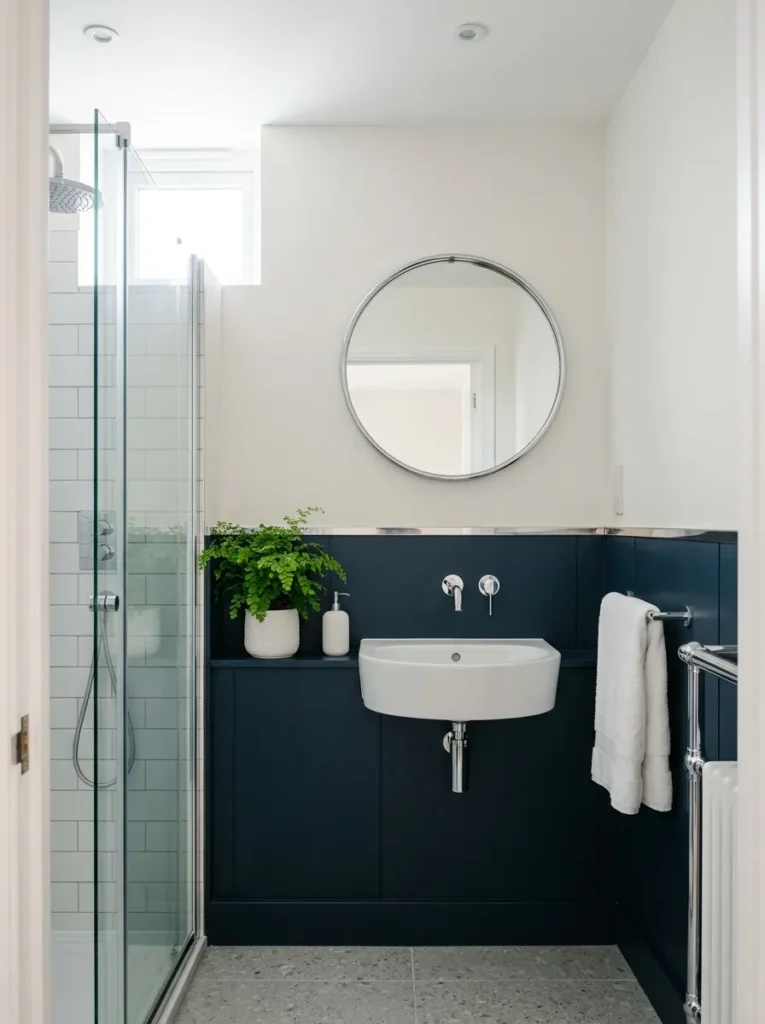
Vibe: Bold without being heavy — the confidence of colour used with precision.
Why it works: A dark lower zone and light upper zone mirrors the visual logic of the natural world — ground is heavier, sky is lighter — which creates an intuitively comfortable spatial experience. In a small bathroom, keeping dark colour below the waist line (80–90cm) grounds the space visually without closing it in. The light upper zone keeps the ceiling reading as high and airy. This technique is more sophisticated than either all-dark or all-light treatment because it controls the distribution of visual weight.
How to get it: Choose two complementary panels in the same product range so that thickness, finish, and profile are identical — the only difference should be colour. Use a chrome or brushed brass trim strip at the colour change line to create a deliberate join rather than an accidental-looking edge.
Quick Win: Try the two-tone paint test first (£5–£10 in tester pots) — mask a horizontal line at 90cm and paint below in the darker tone for 48 hours before committing to panels. The painted version tells you immediately whether the proportion feels right in your specific room.
Shop the Look
| Product |
|---|
| Navy blue smooth bathroom wall panel PVC |
| Chrome panel trim strip bathroom wall 2.4m |
| Wall mounted chrome bathroom basin tap |
| Small potted fern plant bathroom indoor |
| White ceramic pump soap dispenser |
14. Mirror-Backed Panel Columns for Light Amplification
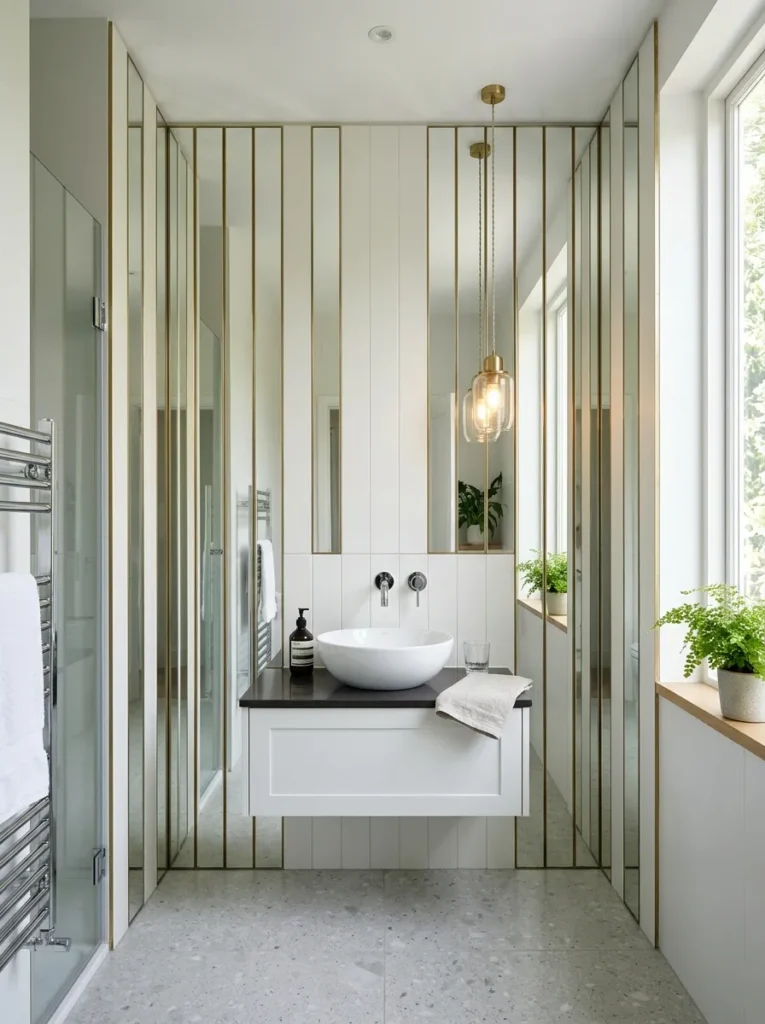
Vibe: Luminous and spatially generous — a room that gives back more light than it receives.
Why it works: Alternating mirror and solid panel columns create a rhythm of reflection that multiplies natural light exponentially — each mirror column captures light from a different angle and returns it to the room. The vertical format of the mirror strips enhances the height illusion while the reflections visually dissolve the wall, making the room feel less bounded. This is applied from the principle of doubling: every reflective surface in a small bathroom is effectively making the room do twice the work.
How to get it: Use mirror-cut strips 15–20cm wide mounted flush between panel sections. Source from glass suppliers who will cut to exact length — specify 4mm mirror glass with safety backing. Adhere with mirror adhesive pads rather than silicone to avoid silver edge damage.
Shop the Look
| Product |
|---|
| Mirror adhesive pads bathroom glass mounting |
| White gloss bathroom wall panel slab PVC |
| Chrome wall mounted bathroom pendant light |
| White floating bathroom vanity unit 60cm |
| Chrome bathroom accessories set 5 piece |
15. Natural Stone-Effect Panels in Warm Travertine
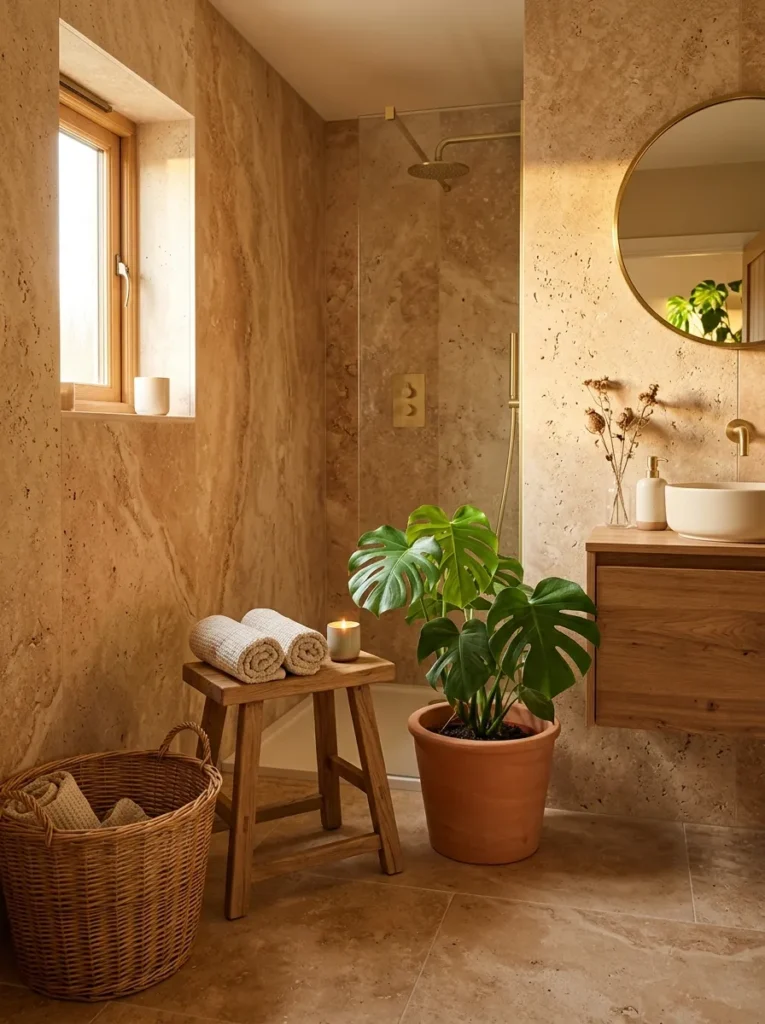
Vibe: Warm and earthen — the quiet luxury of a Roman bath in a three-metre room.
Why it works: Travertine-effect panels are one of the most effective ways to bring biophilic warmth into a small bathroom without the cost or weight of real stone. The key design principle is temperature — warm beige with terracotta undertones reads as welcoming and human-scaled, where cool stone tones (marble, slate) can feel clinical at small scale. A single wall in travertine-effect creates a sense of material richness that elevates the entire room’s perceived quality.
How to get it: Choose travertine-effect panels with realistic surface variation — subtle pitting and tonal shift across the face. Avoid perfectly uniform patterns, which immediately read as synthetic. Large format (1.2m × 2.4m) with minimal joins maximises the stone illusion. Pair with warm wood, rattan, and terracotta accessories to reinforce the natural material palette.
💡 Quick Win: A travertine-effect adhesive tile peel-and-stick sheet (£15–£25 per pack) applied to the inside of a bathroom niche or the back wall of a recessed cabinet gives the stone effect as an accent without committing to full-wall installation.
Shop the Look
| Product |
|---|
| Travertine effect PVC bathroom wall panel large format |
| Rattan storage basket bathroom small |
| Terracotta ceramic plant pot bathroom medium |
| Wooden bathroom stool teak small |
| Cream waffle weave hand towel set |
How to Start Your Bathroom Wall Panel Transformation
Your single first move: Choose your main panel wall before you buy anything else. In a small bathroom, this is almost always the wall directly opposite the door — the wall your eye lands on first when you enter. Getting this wall right anchors everything else in the room, from fixture choices to accessory styling. One confident feature wall reads as designed intent; panelling all four walls at once risks a visual overload that makes a small bathroom feel like a cladding showroom.
The most common mistake: Choosing panels that are too cool in tone. Beginners often default to bright white or cool grey panels because they seem “safe” — but cool tones in a small bathroom with limited natural light can make the space feel stark and slightly clinical. The fix is to check the panel’s undertone against natural light in the room at multiple times of day. Warm white panels (with a yellow or pink undertone) will read as ivory in strong light but as cosy and inviting in lower light — which is what you want.
Three specific items under £50 for immediate impact: A white shiplap peel-and-stick wallpaper panel for a test wall (£18–£28, most DIY retailers); a set of white primed MDF moulding strips to fake a panelled effect over existing paint (£15–£35 from timber merchants); and a single tube of colour-matched silicone sealant to refresh existing panel or tile joins in aged bathrooms (£8–£12, any hardware store).
Realistic expectations: A single feature wall panel installation is a half-day project for a competent DIYer, or 2–4 hours for a professional. A full bathroom panel replacement (four walls) runs 1–2 days professionally. Budget for a starter feature-wall approach at £150–£400 including materials; a full small bathroom refurb using panels instead of tiles at £800–£2,500 depending on panel quality and labour.
Frequently Asked Questions About Bathroom Wall Panel Ideas for Small Bathrooms
What is the difference between bathroom wall panels and tiles?
Bathroom wall panels are large-format sheets of PVC, acrylic, or composite material installed directly over walls, whereas tiles are small individual ceramic or porcelain units grouted in place. The core practical difference is grout: tiles require ongoing grout maintenance and are vulnerable to mould in the grout lines, while panels are completely seamless and require only wiping down. Panels are also faster to install — a full bathroom wall in panels typically takes a few hours versus a day or more for tiling — and generally cost less in labour.
What colour wall panels make a small bathroom look bigger?
Pale, warm-toned panels consistently outperform both very dark and very bright white options for making small bathrooms feel larger. Specifically, warm white, soft greige (grey-beige), and pale blue-grey tones reflect light without the harshness of cool white, and they recede optically from the viewer. Avoid very high-gloss finishes in cool shades — they create a mirror-like reflection that draws attention to the wall’s proximity rather than pushing it back. A semi-matte finish in a warm pale tone is the most reliably space-expanding choice.
How much do bathroom wall panels cost compared to tiles?
Supply-only, bathroom wall panels range from approximately £15–£80 per square metre depending on material and finish — PVC panels sit at the lower end, acrylic slab panels at the higher end. Standard ceramic tiles range from £10–£60 per square metre for supply only. The installation cost difference is more significant: panel installation runs roughly £30–£60 per hour in labour, versus £50–£100 per square metre for professional tiling. For a small bathroom of 4–6m² of wall coverage, total installed panel cost typically runs £600–£1,800 versus £800–£2,500 for fully tiled walls.
Can bathroom wall panels be used in a shower or wet room?
Yes — but only if you choose panels specifically rated for wet room or shower use. Look for panels marked as waterproof (not just water-resistant) with a minimum thickness of 8–10mm and a C2 or D4 adhesive rating for the adhesive used at joins. The critical installation detail is the silicone seal at every join, corner, and edge — a missed or failed seal is where water infiltrates and causes damage. Quality thermoplastic and acrylic panels certified for wet rooms are genuinely as watertight as tiles when correctly installed.
Which bathroom wall panel type is best for a rented property?
For renters, peel-and-stick waterproof wall panel systems are the most practical option — they adhere to existing wall surfaces without adhesive or fixings and can be removed without damage to the underlying surface. Look for vinyl panels with a textured finish (smooth peel-and-stick panels show every wall imperfection underneath). These systems are available from £15–£40 per panel, cover approximately 0.5–0.75m² per panel, and genuinely transform a bathroom without affecting any deposit. The visual quality has improved significantly over recent years — current products photograph well and are convincing in person.
Ready to Create Your Dream Bathroom with Wall Panels?
From the colour ideas that use warm sage and pale blue-grey to expand and calm, to the material ideas that bring woodgrain warmth and travertine richness, to the layout techniques that manipulate height and light through panel direction and proportion — these 15 bathroom wall panel ideas for small bathrooms offer a genuinely wide range of starting points. Transformation in a small bathroom rarely happens all at once, and starting with a single feature wall is not a compromise — it’s the right approach, because one confident wall tells you more about what works in your specific space than any amount of planning. Today, identify which wall you see first when you walk into your bathroom — that’s your starting point, and it costs nothing to stand in the doorway and decide. When the panels are up and the room is right, a small bathroom stops feeling like a limitation and starts feeling like a considered decision. Save the ideas that made you stop scrolling — and come back to the ones that keep pulling you back, because those are almost always the right ones for your space.