14 Chic Modern Farmhouse Kitchen Inspirations
Chic modern farmhouse kitchen inspirations draw from the specific design intersection where the warmth and material honesty of traditional farmhouse kitchens — the raw timber, the stone, the worn patina of genuinely used surfaces — meets the restraint and functional precision of contemporary kitchen design, producing kitchens that feel simultaneously rooted and current, warm and disciplined, gathered and edited. This article gives you exactly 14 inspirations spanning cabinetry, hardware, surface materials, lighting, storage, and the specific material and finish decisions that distinguish a genuinely chic modern farmhouse kitchen from one that reads as either too rustic or too contemporary to achieve the specific warmth of the hybrid approach.
A chic modern farmhouse kitchen is not a farmhouse kitchen with cleaner lines, nor a modern kitchen with a butler’s sink — it is a genuinely resolved hybrid where every material decision has been made in service of the specific quality of warm, functional, materially honest beauty that the best farmhouse kitchens have always achieved and that contemporary kitchen design, at its best, can amplify rather than compromise. Here are 14 inspirations worth building.
Why Chic Modern Farmhouse Kitchen Inspirations Work
The enduring appeal of the farmhouse kitchen aesthetic draws from deeply rooted psychological responses to specific material qualities that environmental aesthetics research has documented across multiple studies: the preference for natural materials over manufactured ones (wood over laminate, stone over synthetic composite, ceramic over plastic), the preference for material surfaces with visible history (the worn edge of a timber worktop, the variation in handmade tile glaze, the patina of aged brass) over surfaces with no trace of their making or use, and the preference for spaces that communicate genuine function over spaces whose appearance is primarily decorative.
These psychological preferences align precisely with the farmhouse kitchen’s material tradition — the solid timber cabinetry, the stone or ceramic worktop, the range cooker, the butler’s sink, the open shelf displaying well-used vessels — and the contemporary design discipline’s contribution to this tradition is the editing and proportioning that prevents the farmhouse kitchen from reading as a rural museum piece. The chic modern farmhouse kitchen achieves this balance through specific design decisions: using contemporary cabinet proportions (handleless or minimal hardware, clean door profiles) with traditional surface materials (timber, stone, ceramic), combining modern appliance integration with traditional fixture specification (the range cooker, the butler’s sink, the ceiling rack), and calibrating the material palette to the warm-neutral register that the farmhouse tradition provides but the contemporary lens selects for.
Style at a Glance
| Element | Farmhouse Tradition | Modern Chic Edge |
|---|---|---|
| Philosophy | Material honesty, functional warmth | Edited, proportioned, contemporary in discipline |
| Materials | Timber, stone, ceramic, aged brass | Linen white, warm sage, deep charcoal, warm natural |
| Key Fixtures | Butler’s sink, range cooker, ceiling rack | Handleless cabinetry, integrated appliances, stone slab |
14 Chic Modern Farmhouse Kitchen Inspirations
1. Shaker Cabinet in Linen White — The Refined Foundation
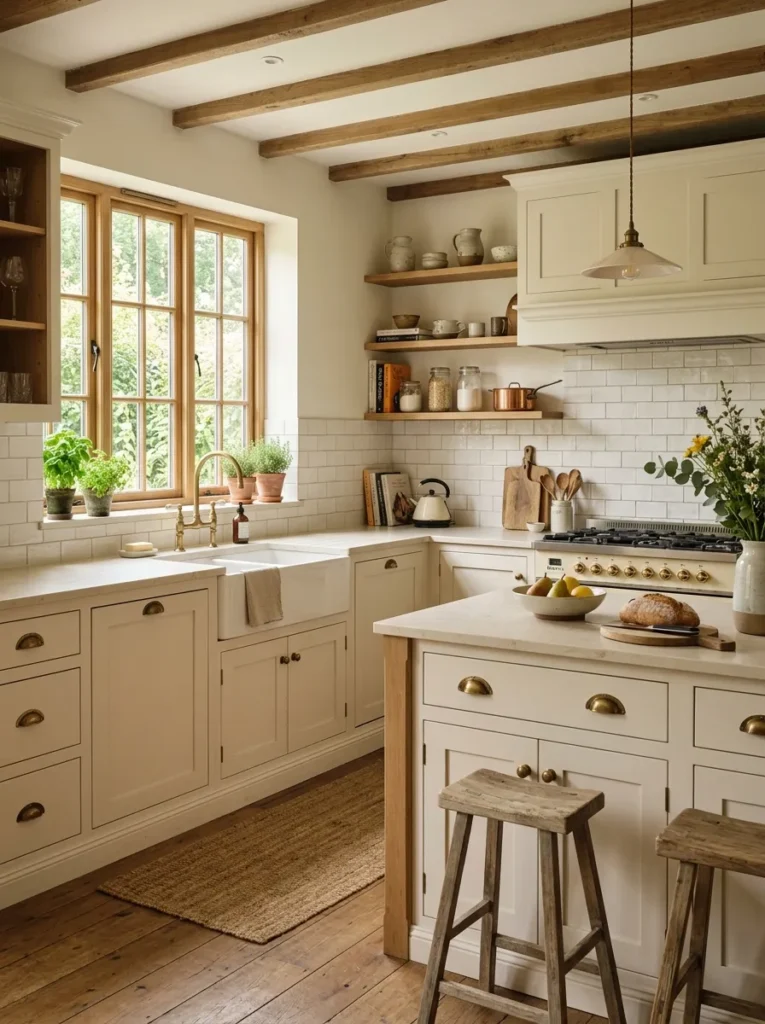
Vibe: The linen white Shaker kitchen feels like every good kitchen decision distilled to its most essential form — the warm white, the brass, and the butler’s sink creating a kitchen that reads as timelessly considered rather than momentarily fashionable.
Why it works: Linen white Shaker cabinetry with aged brass hardware applies the farmhouse foundation principle — the Shaker cabinet door (a flat center panel within a profiled frame rail) is the simplest, most architecturally resolved cabinet door profile available, and in linen white it provides the warm neutral ground against which all other kitchen material decisions can be made without competing with each other. The aged brass hardware (cup pulls on base cabinets, knobs on upper cabinets) provides the warm metallic accent that the linen white cabinet cannot provide — the aged brass’s specific warm gold-brown tone coordinates with the linen white’s warm undertone in a way that polished brass, chrome, or nickel cannot.
The in-frame distinction: In-frame cabinetry (where the cabinet doors sit within a solid timber face frame rather than overlapping the carcass front) reads as a specifically higher quality than face-overlay cabinetry because the face frame is visible at the door edges, communicating genuine timber construction rather than veneer or foil over particleboard carcass. The shadow line between the door and the face frame creates the architectural definition that makes in-frame Shaker cabinetry read as furniture rather than fitted units.
Quick Win: Replacing existing cabinet hardware with aged brass cup pulls and knobs ($3–8 per pull, $15–40 total for a standard kitchen) converts any white Shaker kitchen toward the chic modern farmhouse aesthetic at the lowest possible investment — the hardware change is more immediately visible than almost any other single kitchen alteration.
Shop The Look
| Product |
|---|
| Shaker cabinet door linen white |
| Aged brass cup pull set |
| Aged brass knob set |
| Warm white quartz worktop |
| Fireclay butler sink double |
Also view: 15 Dreamy Luxe Bedroom Ideas for Elegant Living
2. Warm Sage Green Lower Cabinets — The Two-Tone Kitchen
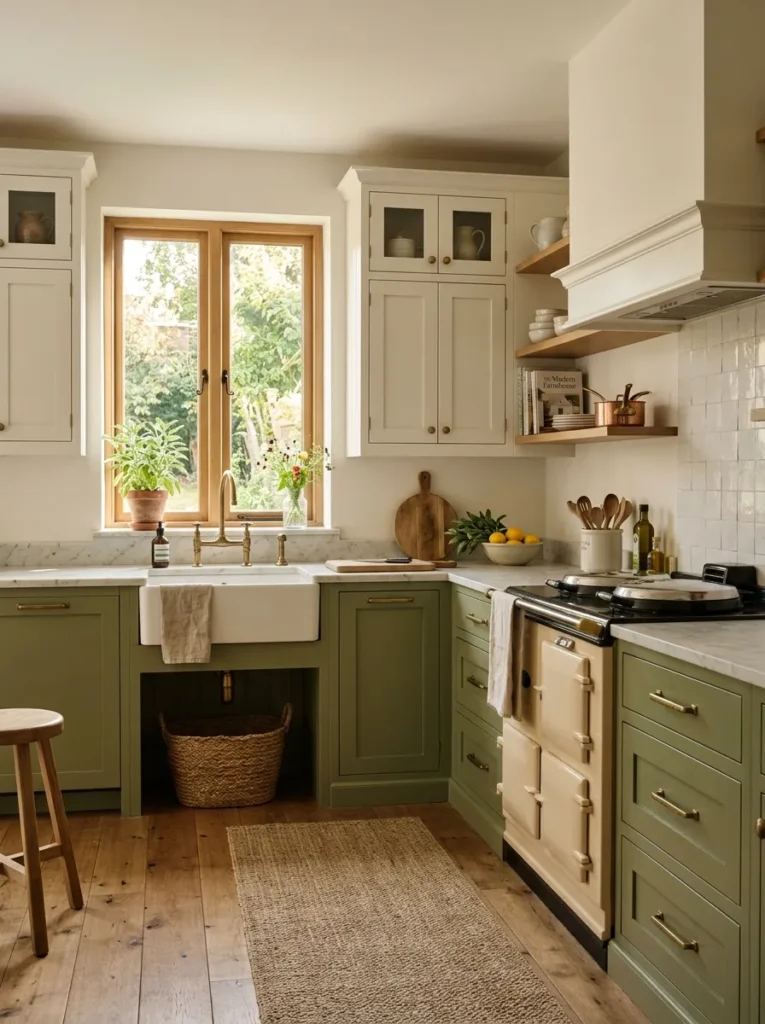
Vibe: The two-tone sage and white kitchen feels like a decision made with complete confidence in the specific quality of that specific green — the sage lower cabinets creating the botanical reference that makes the kitchen feel rooted in the natural world.
Why it works: A two-tone kitchen with sage green lower cabinets and white upper cabinets applies the visual grounding principle — dividing the kitchen’s cabinetry at worktop height between a deeper color below and a lighter color above creates the same compositional effect as a dado in a room: the lower zone appears visually heavier and more grounded, anchoring the kitchen’s spatial composition, while the upper zone appears lighter and more open, preventing the room from feeling enclosed. The specific color choice of warm sage (not the desaturated cool sage of some contemporary palettes, but the warm yellow-green sage that references the actual herb) coordinates with the natural material palette of the chic modern farmhouse kitchen — timber, stone, dried botanical, aged brass — more completely than any other color family.
Hardware distinction: Bar handles on the lower cabinets (which are used most frequently and whose horizontal pull direction suits a bar handle’s ergonomics) and simple knobs on the upper cabinets (which are used less frequently and whose upward pull direction suits a knob’s fingertip engagement) is the hardware assignment that most authentically references the traditional farmhouse kitchen’s cabinet hardware arrangement.
Shop The Look
| Product |
|---|
| Sage green cabinet paint warm |
| Off-white upper cabinet |
| Honed marble worktop |
| Aged brass bar handle set |
| Aged brass knob set upper |
3. Integrated Range Cooker — The Kitchen’s Heart
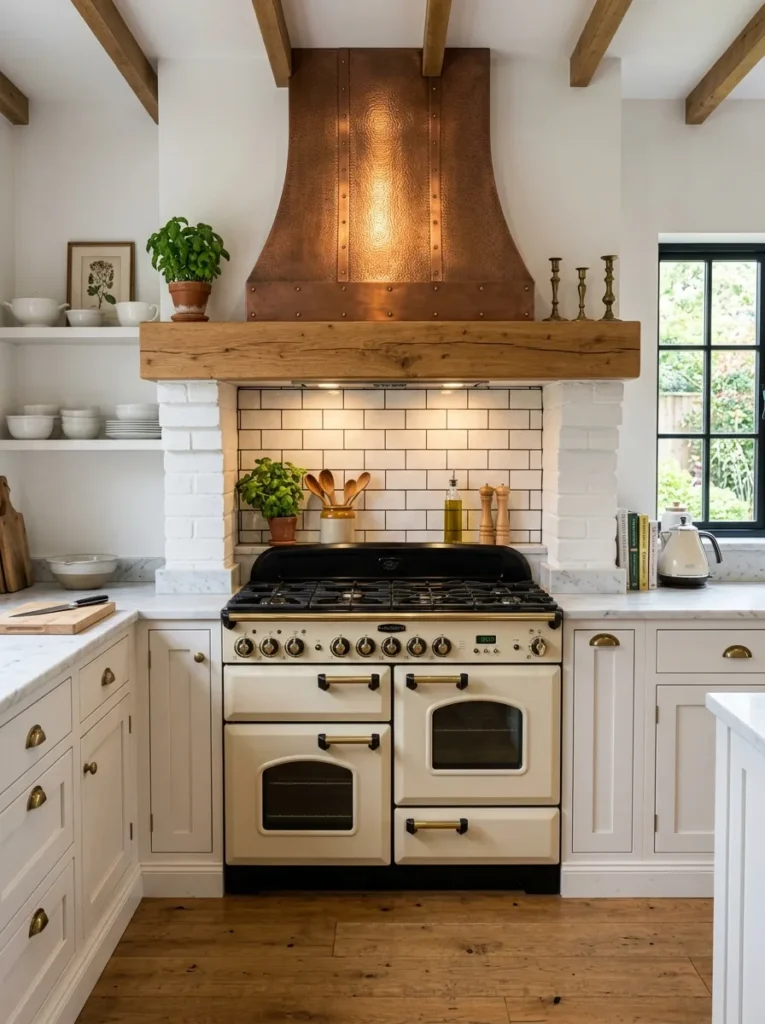
Vibe: The range-centered kitchen feels like the kitchen is organized around its most important decision rather than its most convenient one — the range cooker as architectural focal point communicating that this is a kitchen that takes cooking seriously.
Why it works: A professional-style range cooker with a timber or stone mantel surround applies the kitchen focal architecture principle — the range cooker at the kitchen’s center is the contemporary equivalent of the open fireplace in the farmhouse kitchen’s historical precedent: the heat source, the point of gathering, the element around which the room’s layout is organized. The mantel surround (a natural oak shelf supported by simple brackets or a stone surround that frames the range) converts the cooker from an appliance positioned against a wall into an architectural installation with the visual authority of a fireplace — the surround provides the frame that separates the range from the surrounding cabinetry and elevates it to a designed focal element.
Range cooker selection: A 100cm range in cream (Rangemaster Excel, Falcon 1000, or equivalent) in the chic modern farmhouse kitchen provides the generous cooking capacity (typically five or six burners plus two or three ovens) that a farmhouse kitchen’s cooking use requires. The cream or linen white specification coordinates with the Shaker cabinet’s linen white, creating continuity between the range and the cabinet palette.
Shop The Look
| Product |
|---|
| 100cm cream range cooker |
| Natural oak mantel shelf above range |
| Copper range hood extractor |
| Cast iron pan rest accessories |
| Stone or oak range surround |
4. Butler’s Sink on Timber Base — The Heritage Detail
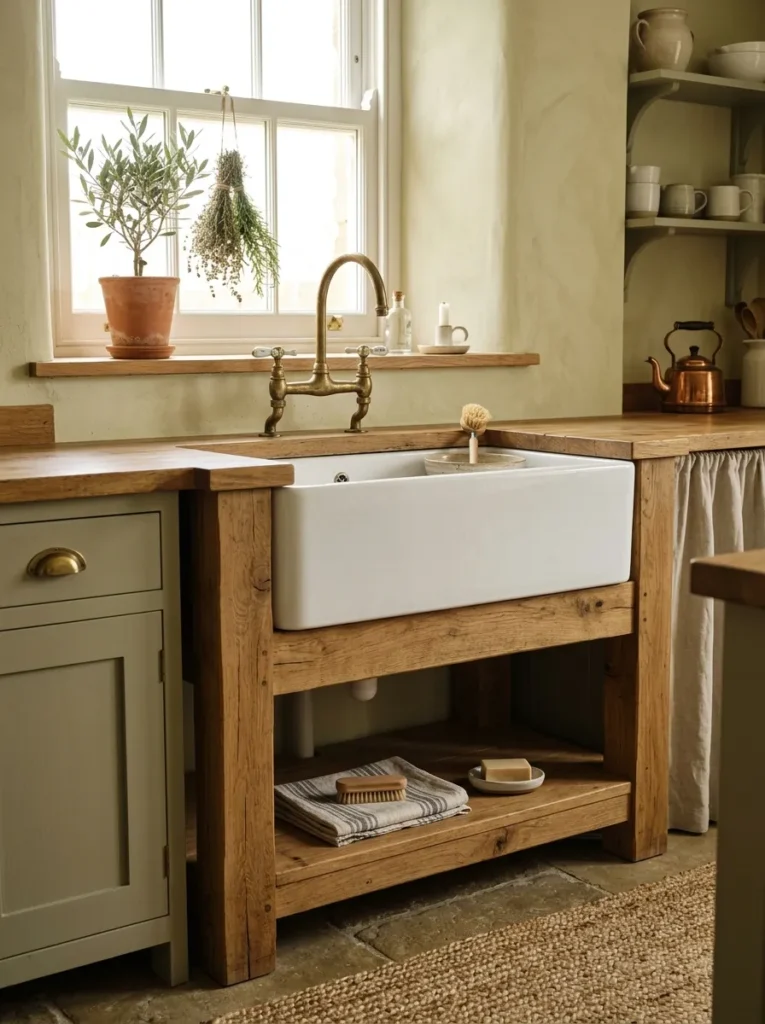
Vibe: The butler’s sink on a timber base feels like kitchen furniture that a craftsman made rather than a unit that a factory fitted — the exposed timber base and the apron front creating the specific honesty of genuinely functional freestanding furniture.
Why it works: A butler’s sink on an open timber base applies the furniture-in-kitchen principle — the most authentic farmhouse kitchen detail is the presence of furniture (freestanding pieces with exposed construction) within a fitted kitchen environment. The solid timber open base beneath the butler’s sink is the detail that most effectively introduces this furniture quality: the absence of a door reveals the timber shelf and the structural framework, communicating solid construction and functional honesty in a way that a cabinet door conceals. The fireclay butler’s sink specifically (the deep, thick-walled ceramic basin that maintains water temperature and resists staining) is the farmhouse kitchen’s most historically specific fixture and its presence in a chic modern kitchen is the single most effective farmhouse reference available.
Timber base specification: Solid oak or pine at 40mm thickness for the visible surfaces (the front stile, the shelf), constructed using mortise and tenon or dowel joinery (no pocket screws in visible faces), oiled with a food-safe hard wax oil that can be re-oiled annually as the timber develops its patina through use.
Shop The Look
| Product |
|---|
| Fireclay butler sink double bowl |
| Solid oak base unit open |
| Aged brass bridge tap kitchen |
| Food-safe hard wax oil timber |
| Dried herb kitchen window |
5. Exposed Ceiling Rack — The Overhead Storage Statement
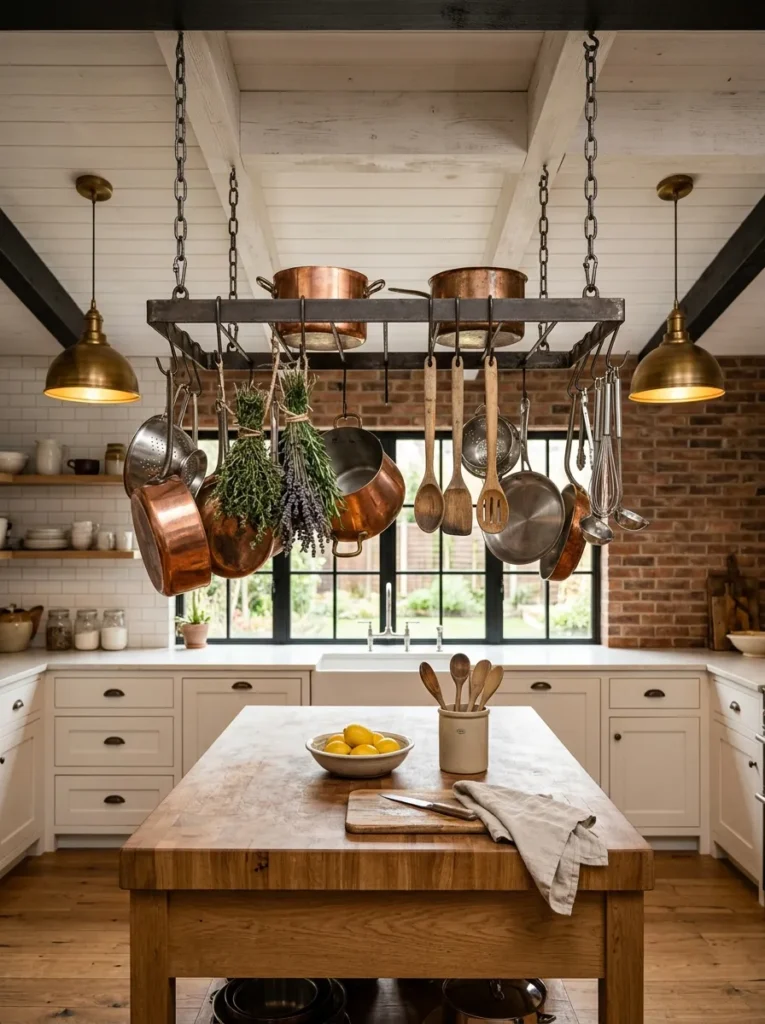
Vibe: The ceiling pot rack feels like the kitchen that is not afraid to show what it is used for — the hanging copper and the dried herbs converting the ceiling plane into the kitchen’s most authentically functional display.
Why it works: An exposed ceiling pot rack above the kitchen island applies the functional display principle — in the chic modern farmhouse kitchen, the best decoration is the material evidence of genuine cooking use: the collection of copper pots in varied sizes, the dried herb bundles from the garden, the wooden utensils worn smooth with use. The ceiling rack makes this material evidence visible from every position in the kitchen, converting storage from a hidden function into a displayed one that communicates the kitchen’s genuine cooking purpose. The rack’s position above the island (the kitchen’s primary preparation surface) is also functionally optimal — pots and pans hang within immediate reach of the cooking zone without occupying counter or cabinet space.
Ceiling fixing: The rack’s four suspension chains must be fixed into ceiling joists or structural elements — not plasterboard alone, which cannot safely support the rack’s weight plus the combined weight of cookware (a fully loaded rack can weigh 20–40kg). Use a stud finder to locate joists, fix a 6×60mm lag bolt into each joist, and hang the chain from the lag bolt eye. The chain length should be adjusted so the lowest hanging pot clears the kitchen island’s worktop surface by a minimum of 30cm.
Shop The Look
| Product |
|---|
| Iron pot rack ceiling hung |
| Aged brass pot rack alternative |
| Copper pot set varied sizes |
| S-hook set rack hanging |
| Dried herb bundle kitchen |
6. Open Shelf Display — Edited and Beautiful
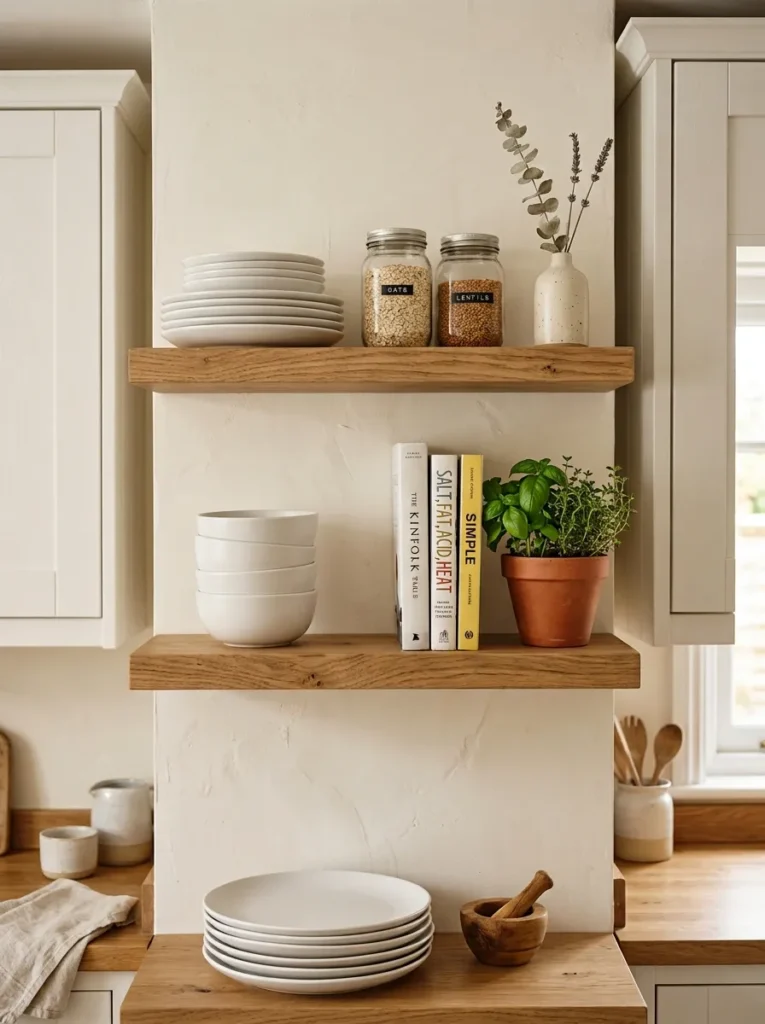
Vibe: The open shelf display feels like kitchen organisation that became art — the edited composition of the ceramics, the cookbooks, and the botanical creating a shelf that rewards looking at as much as using.
Why it works: Edited open shelving in a farmhouse kitchen applies the curated display principle — open shelves in a kitchen must satisfy two simultaneous requirements: genuinely functional (the items on the shelves must be actually used, not decorative facsimiles of kitchen objects) and genuinely beautiful (the arrangement of functional objects must constitute a composed visual display). The specific items on this shelf (stacked white ceramics, cookbooks, herb pot, dry goods jars, dried botanical) are all functional items arranged in a composed still life — the white ceramics provide a color-consistent set, the cookbooks provide height and spine variation, the botanical provides the organic element, and the generous negative space between object groups prevents the shelf from reading as accumulated storage rather than curated display.
The shelf specification: Solid oak at 30cm depth and 3cm thickness (not 2cm, which appears proportionally thin for a kitchen shelf and can deflect under the weight of stacked ceramics) provides the visual weight and material quality that the kitchen’s hardworking material palette requires. Fix using concealed steel brackets (the bracket fits inside a routed slot in the shelf’s underside, screwing to the wall within the slot and invisible from the front) rather than visible brackets.
Shop The Look
| Product |
|---|
| Solid oak floating shelf 30cm |
| Concealed shelf bracket steel |
| White ceramic bowl set matching |
| White ceramic plate set matching |
| Glass storage jar set dry goods |
7. Warm Marble Worktop — The Premium Surface Decision
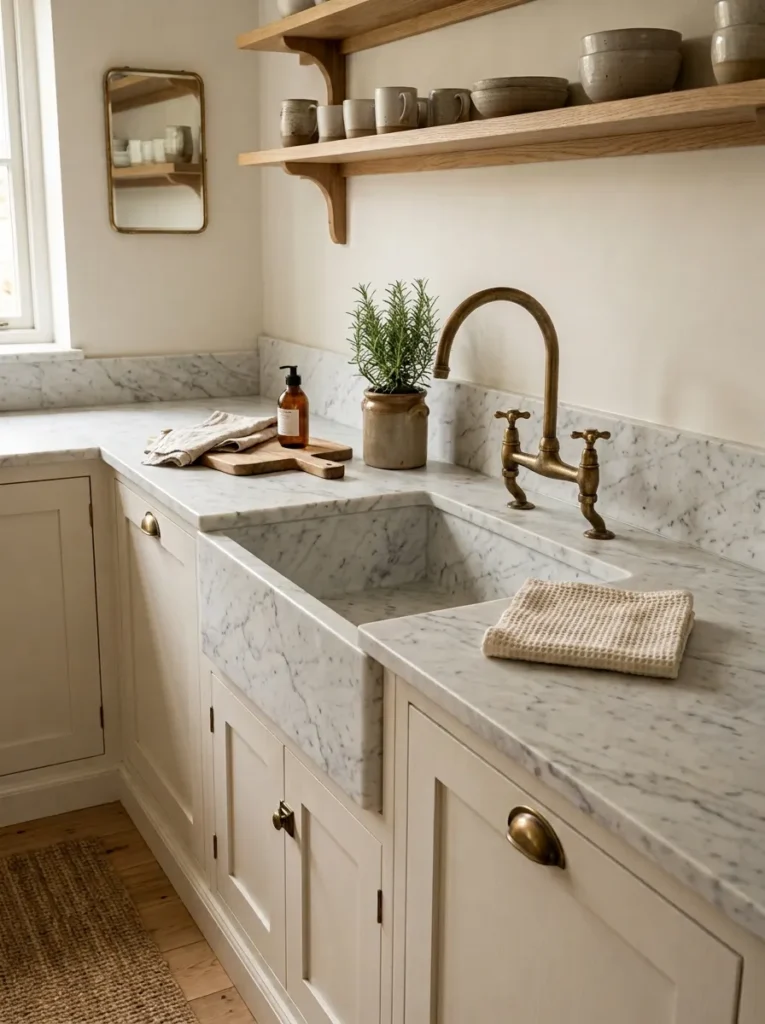
Vibe: The marble worktop kitchen feels like the surface was chosen by someone who understood that a kitchen worktop is touched fifty times a day and should be worth touching — the warm marble’s specific tactile quality and material depth creating a working surface of genuine sensory pleasure.
Why it works: A warm marble worktop in a chic modern farmhouse kitchen applies the premium functional surface principle — the kitchen worktop is the most-touched and most-used horizontal surface in the home, and the material quality of the worktop is experienced physically (its temperature, its weight, its specific smooth-but-slightly-textured surface when honed) as much as visually. Honed marble (a matte finish rather than the polished finish’s high sheen) provides the specific surface quality most compatible with a farmhouse kitchen’s aesthetic — the matte surface absorbs light rather than reflecting it, creating the warm, calm quality that polished marble’s reflectivity cannot achieve.
Practical considerations: Marble is porous and etches (loses its surface polish or texture when in contact with acids such as lemon juice, vinegar, and wine). In a honed finish, etching is significantly less visible than in a polished finish — the matte surface is already non-uniform, so the slight texture change from acid contact is imperceptible. Seal with a penetrating stone sealer every six to twelve months and clean with a pH-neutral stone cleaner. The characteristic that marble acquires as it ages (the slight patina of use) is, in the farmhouse kitchen context, a genuine aesthetic benefit — the marble develops a lived-in quality that enhances rather than diminishes its beauty.
Shop The Look
| Product |
|---|
| Honed Carrara marble slab |
| Honed Calacatta marble alternative |
| Penetrating stone sealer marble |
| pH-neutral stone cleaner |
| Undermount butler sink compatible |
8. Handmade Tile Splashback — Artisan Surface
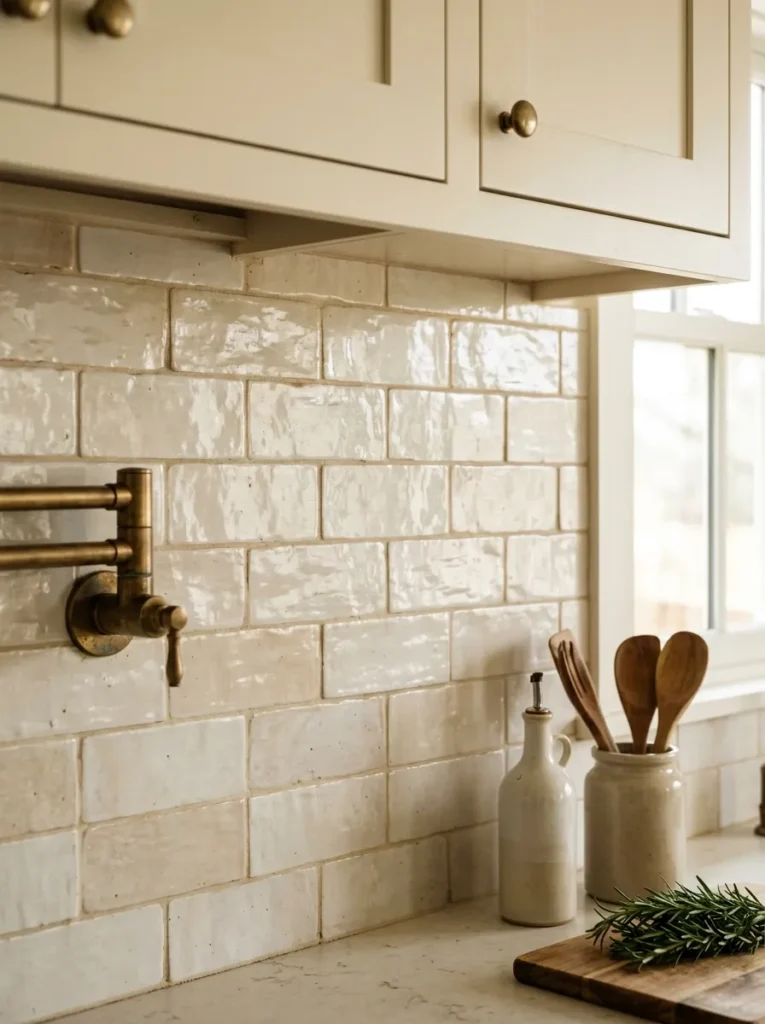
Vibe: The handmade tile splashback feels like the kitchen wall was finished by a craftsperson rather than installed by a contractor — the glaze variation and the slight dimensional irregularity of handmade ceramic creating a surface of genuine material depth.
Why it works: A handmade ceramic tile splashback applies the artisanal surface material principle — handmade tiles (individually formed by hand or in small batches using traditional press or roller techniques) produce a tile with subtle variations in thickness, surface texture, and glaze color that commercial machine-pressed tiles cannot replicate. These variations — which the ceramic tradition considers characteristics rather than defects — create a tile surface that reads as warm, human-made, and materially alive in the way that perfectly uniform commercial tile cannot. In a chic modern farmhouse kitchen, the handmade tile is the single splashback choice that most directly references the farmhouse kitchen’s tradition of genuine craft while being equally appropriate in a contemporary kitchen context.
Sourcing: Handmade ceramic tiles are available from independent studio ceramicists, from specialist tile companies such as Fired Earth, Clé Tile, and Heath Ceramics, and from artisan tile suppliers in the UK, France, Spain, and Portugal where handmade ceramic tile production has a centuries-long tradition. Expect to pay $15–60 per square metre more than equivalent commercial tiles — the material quality and visual difference justifies the premium in a kitchen where the splashback is a primary visual element.
Shop The Look
| Product |
|---|
| Handmade ceramic subway tile cream |
| Warm putty grout splashback |
| Handmade tile artisan source |
| Tile adhesive handmade compatible |
| Grout float set application |
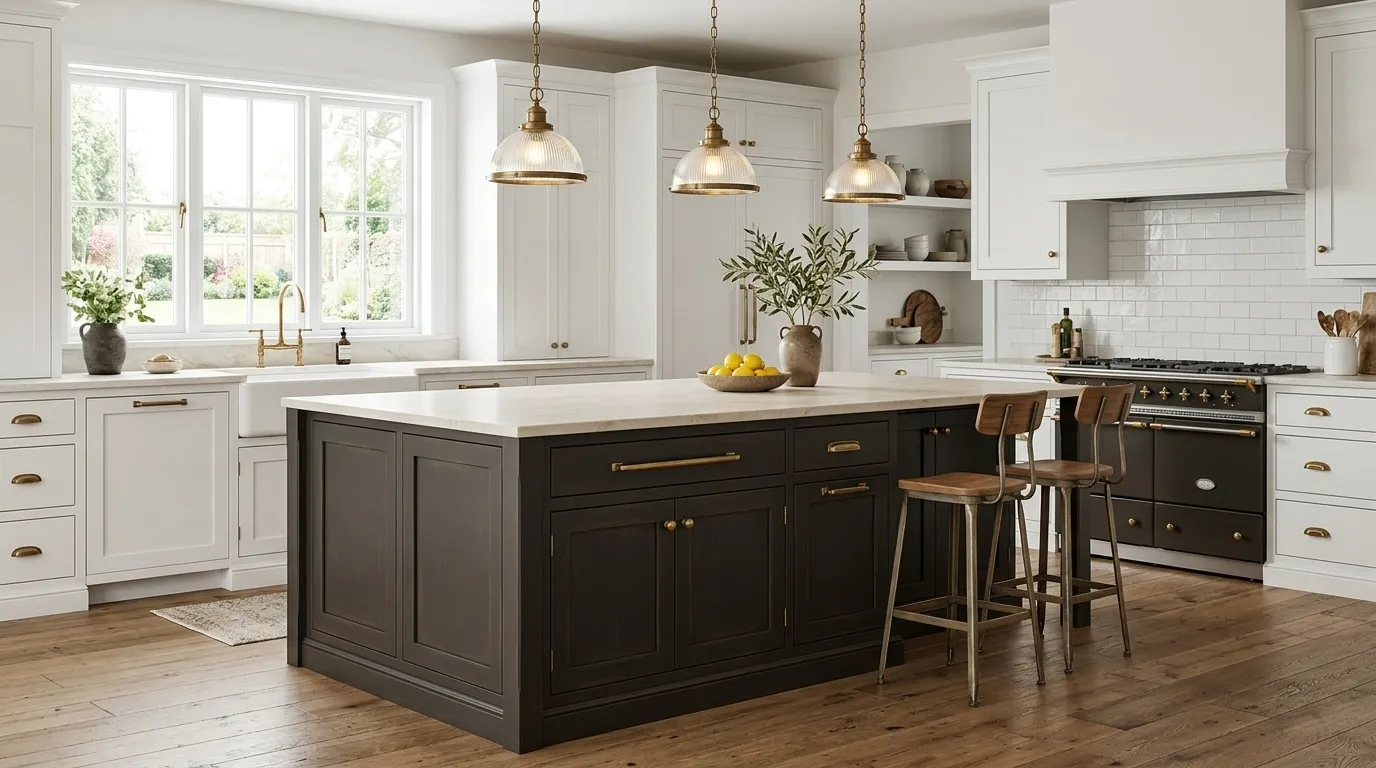
9. Deep Charcoal Island — The Contrasting Anchor
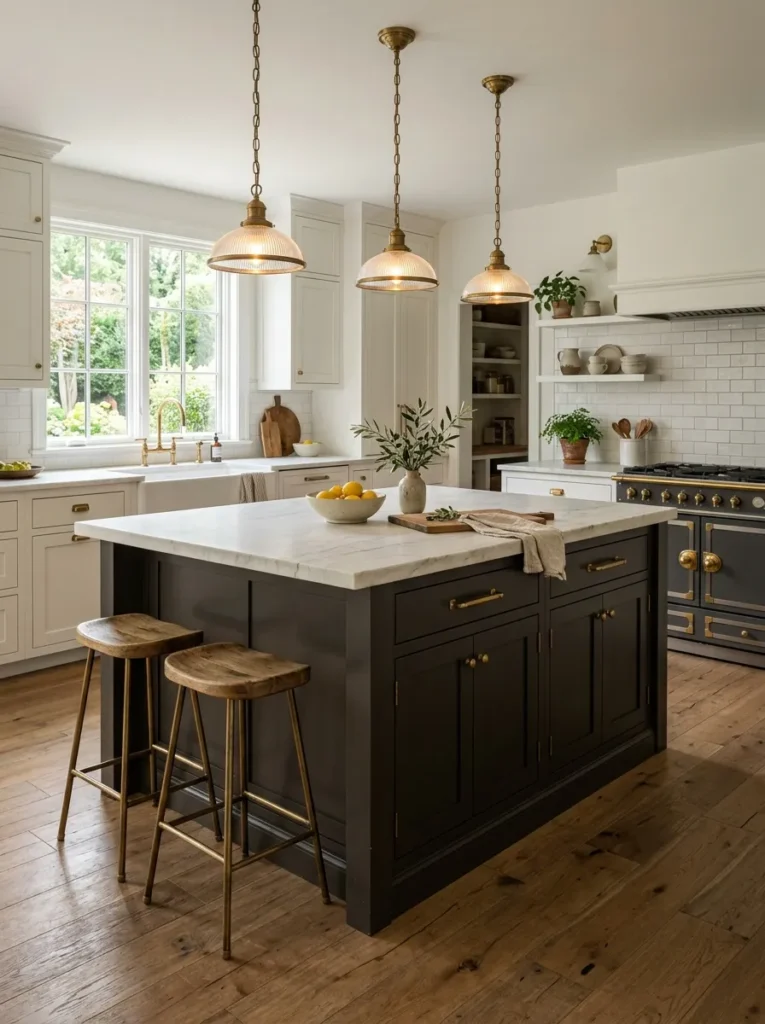
Vibe: The charcoal island feels like the kitchen found its own center of gravity — the deep dark island creating the visual anchor that grounds the kitchen’s entire spatial composition and makes the surrounding white cabinetry appear cleaner and brighter by contrast.
Why it works: A deep charcoal kitchen island within a white or linen white perimeter kitchen applies the chromatic anchor principle — a kitchen where all cabinetry is the same color (all white, all sage, all charcoal) lacks the visual depth variation that makes a kitchen’s spatial composition interesting and resolved. A charcoal island within a white perimeter kitchen creates maximum value contrast at the kitchen’s center, producing the specific compositional tension that makes both the dark island and the white cabinetry appear more resolved — the dark appears richer against the white, the white appears cleaner against the dark. The warm undertone of the charcoal (a slight brown-warm component rather than cool blue-black) maintains the kitchen’s warm palette rather than introducing a cool industrial note.
Worktop contrast: The warm white marble or honed limestone worktop on the charcoal island provides the specific light surface that creates maximum contrast with the dark cabinet and reflects light downward from the pendant above — the island worktop becomes the kitchen’s most luminous horizontal surface when the pendants are on.
Shop The Look
| Product |
|---|
| Deep charcoal kitchen island paint |
| Warm white marble island worktop |
| Aged brass bar handle island set |
| Aged brass pendant light set |
| Island pendant adjustable height |
10. Timber Ceiling Beams — The Structural Character Element
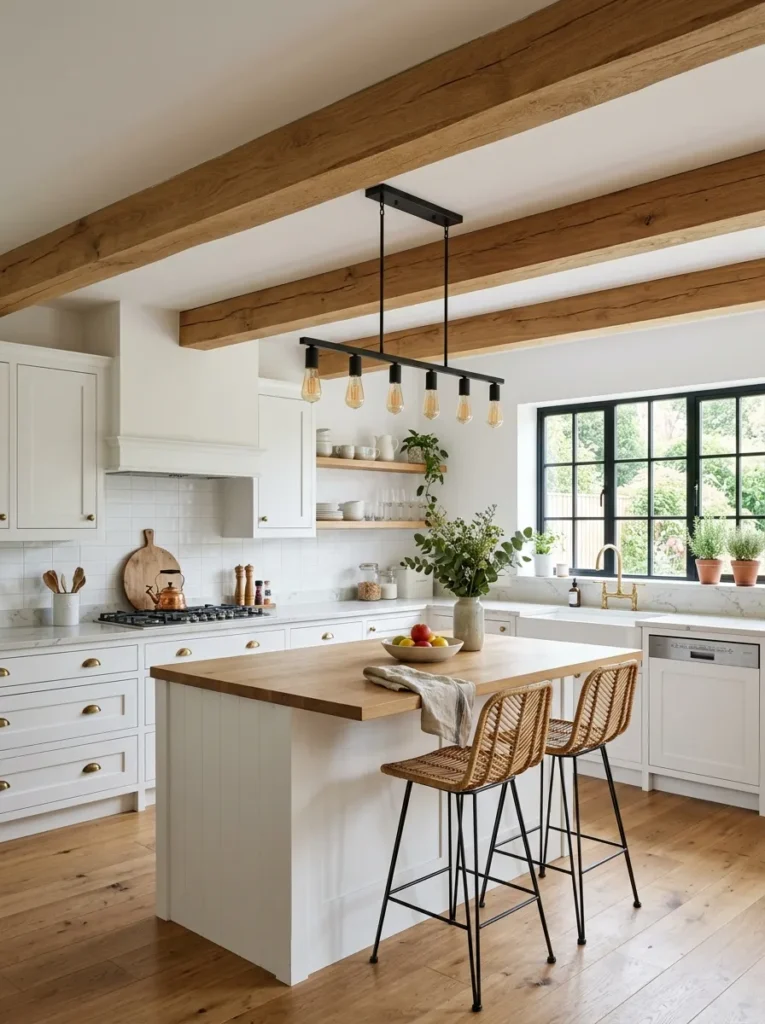
Vibe: The beamed kitchen feels like the structure of the original building was revealed and the kitchen was built within it — the ceiling beams adding the vertical warmth dimension that no amount of cabinetry or surface material can introduce at ceiling level.
Why it works: Exposed ceiling beams in a modern farmhouse kitchen apply the structural character principle — ceiling beams are the one element that is visible from every position in the kitchen, experienced above the worktop while cooking, above the island while preparing food, above the table while dining. Their presence introduces the warm natural timber material into the kitchen’s ceiling plane — the only surface at which timber can appear as a structural element rather than as applied decoration. The chic modern farmhouse kitchen uses beams in their structurally honest form (flat undersides, simple rectangular section, no carving or artificial distressing) rather than in the decorative heavy-beam aesthetic of some rustic interiors — the structural honesty of the beam’s form is as important as its material warmth.
New build specification: In new build or renovation kitchens without existing beams, steel section beams (RSJs) clad in timber boarding can be used to create the visual equivalent of structural timber beams, or new engineered timber beams can be specified for genuine structural use where the floor structure above permits their installation.
Shop The Look
| Product |
|---|
| Exposed oak ceiling beam |
| Natural pine beam alternative |
| Black iron bar ceiling light |
| Edison bulb set bar light |
| Beam mounting bracket structural |
11. Warm Brass Sink Tap — The Hardware Statement
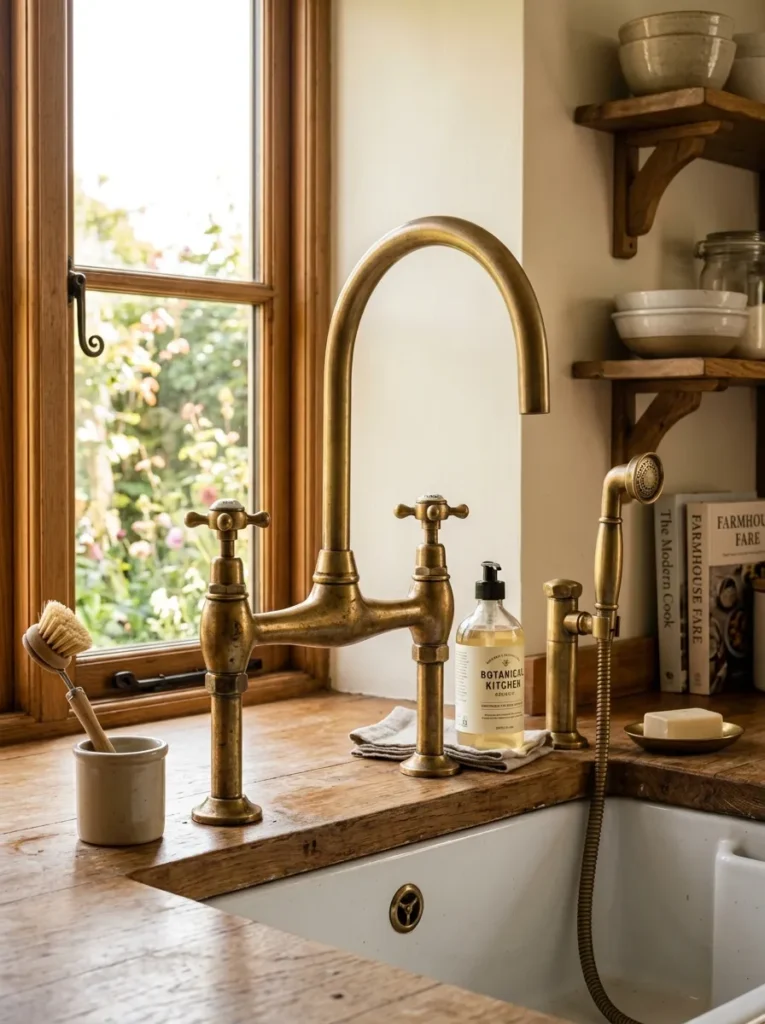
Vibe: The aged brass bridge tap feels like a kitchen fitting with genuine historical consciousness — the bridge tap form’s reference to Victorian kitchen plumbing creating a fixture that reads as both historically informed and unambiguously contemporary in its material quality.
Why it works: A tall aged brass bridge tap above a butler’s sink applies the statement hardware principle — the kitchen tap is the most-handled piece of hardware in the kitchen, contacted hundreds of times daily, and its material quality is experienced through every interaction. An aged brass bridge tap — tall, with two separate valve controls and a visible horizontal bridge connecting them — is both more physically generous (the tall neck allows easy filling of large pots) and more architecturally specific (the bridge form has a clear historical reference) than any contemporary mono tap. The unlacquered aged brass finish (which patinates naturally over time, developing the warm dark accents at high-contact points that signal genuine material quality) specifically suits the chic modern farmhouse kitchen’s material philosophy of honest materials that improve with use.
Unlacquered brass maintenance: Unlacquered brass taps develop a natural patina through use — the areas touched most frequently develop darker accents while the less-touched surfaces retain a brighter tone. This patination is the authentic aging of genuine brass and is considered an aesthetic benefit in the farmhouse kitchen context. To clean, use a mild brass polish occasionally if a more uniform finish is preferred, or allow the patination to develop naturally.
Shop The Look
| Product |
|---|
| Aged brass bridge mixer tap tall |
| Unlacquered brass finish tap |
| Matching brass rinse hose |
| Bridge tap valve set |
| Tap installation template |
12. Painted Brick or Tile Feature Wall — The Rustic Texture
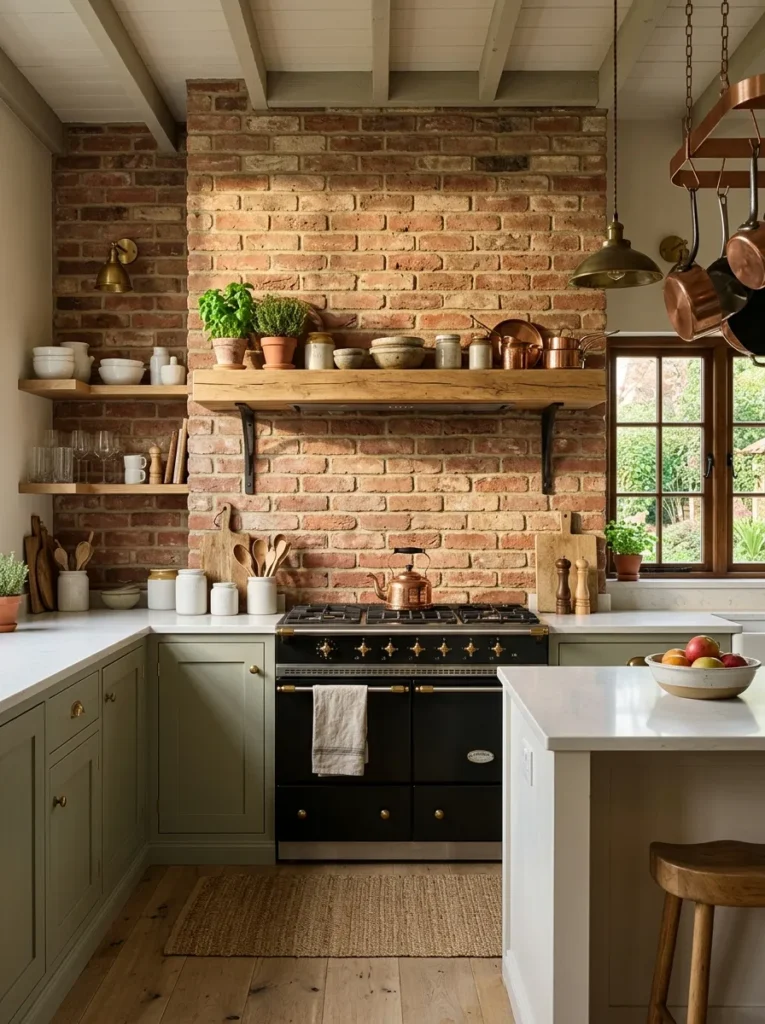
Vibe: The exposed brick kitchen wall feels like the original building material was revealed and the kitchen was grateful for it — the brick’s texture and warmth providing the material depth that every other kitchen surface is smooth and cannot provide.
Why it works: An exposed or limewashed brick feature wall in a farmhouse kitchen applies the original material revelation principle — brick is the material of the original farmhouse (or city terraced house, or warehouse, or Victorian kitchen) that was hidden behind plasterboard and paint in mid-20th century renovations and whose re-revelation in contemporary renovations provides instant material authenticity. The brick’s specific qualities — the warmth of its red-buff or cream clay color, the texture of its stretcher bond surface and mortar joints, the slight color variation from brick to brick — create a wall with genuine material depth and historical resonance that no manufactured material can replicate. The limewash treatment (a thin coat of diluted lime plaster or specialist limewash paint applied over the brick, rubbing the high points of the brick faces and settling into the mortar joint depths) is the specific finish that converts a potentially too-rustic exposed brick into a sophisticated chic farmhouse element.
Shop The Look
| Product |
|---|
| Limewash paint white over brick |
| Lime wash application brush wide |
| Exposed brick seal natural finish |
| Simple timber shelf bracket set |
| Exposed brick mortar joint rake |
13. Kitchen Island Seating — The Social Heart
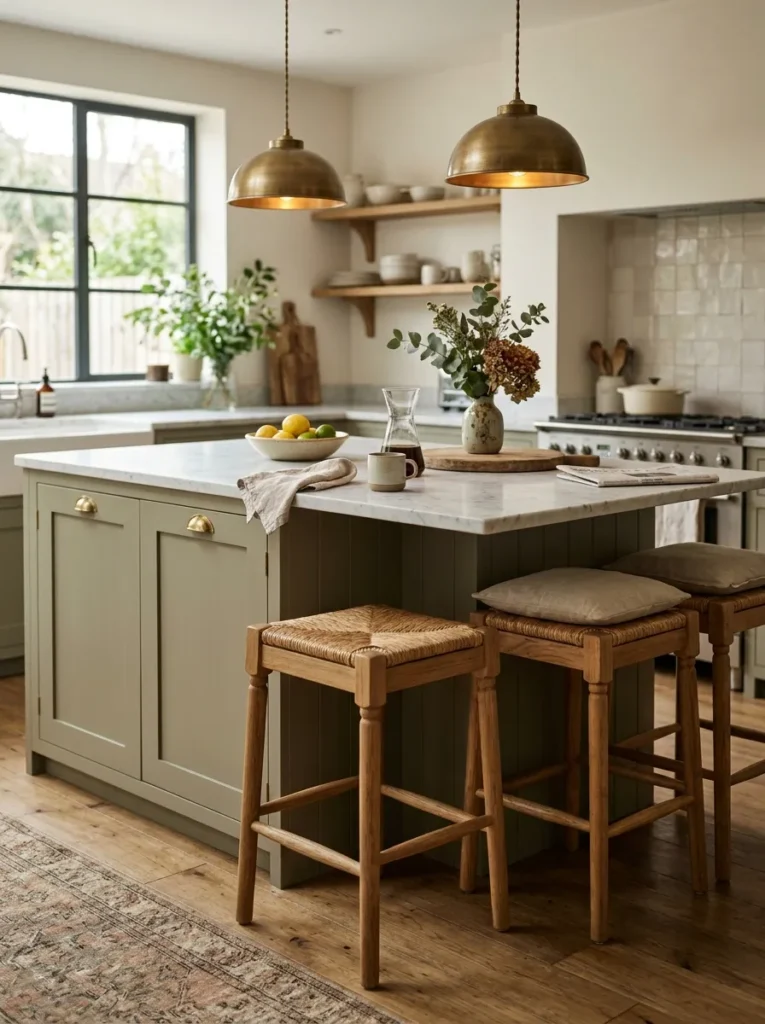
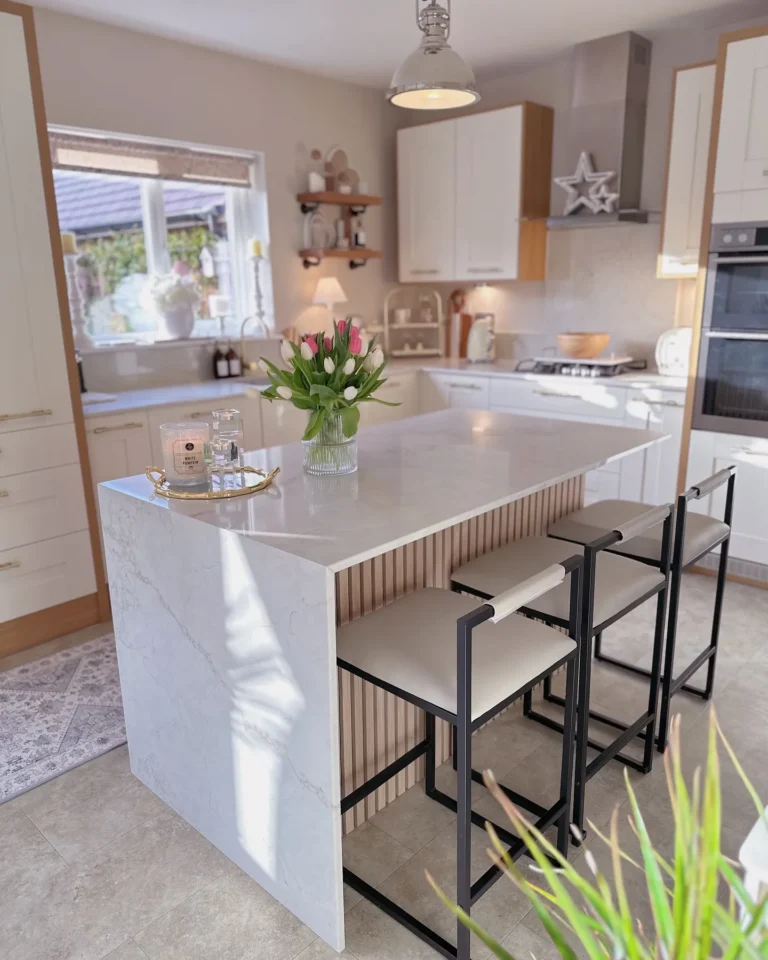
Vibe: The island seating kitchen feels like the kitchen finally admitted that the best conversations happen at the island rather than the dining table — the integrated breakfast bar making the kitchen the genuine social center of the home.
Why it works: An island with a seating overhang and natural material barstools applies the social kitchen design principle — the kitchen island with seating creates the specific social geography of the best kitchens: the cook is separated from the guests by the island’s width but connected to them by eye contact and conversation, allowing genuine participation in preparation and cooking by everyone in the room. The barstool material choice is the specific decision that most determines whether the kitchen island seating reads as chic modern farmhouse or as commercial contract — natural solid timber (oak or pine in a simple turned or bentwood form), woven rattan or cane, and aged-finish metal stools in simple ladder-back or cross-back forms all read as farmhouse-appropriate; chrome or powder-coat steel restaurant stools read as commercial.
Shop The Look
| Product |
|---|
| Solid oak barstool turned leg |
| Rattan barstool natural woven |
| Bentwood barstool classic form |
| Island overhang worktop extension |
| Aged brass pendant bar seating |
14. Dried Botanical Kitchen Display — Living Decoration
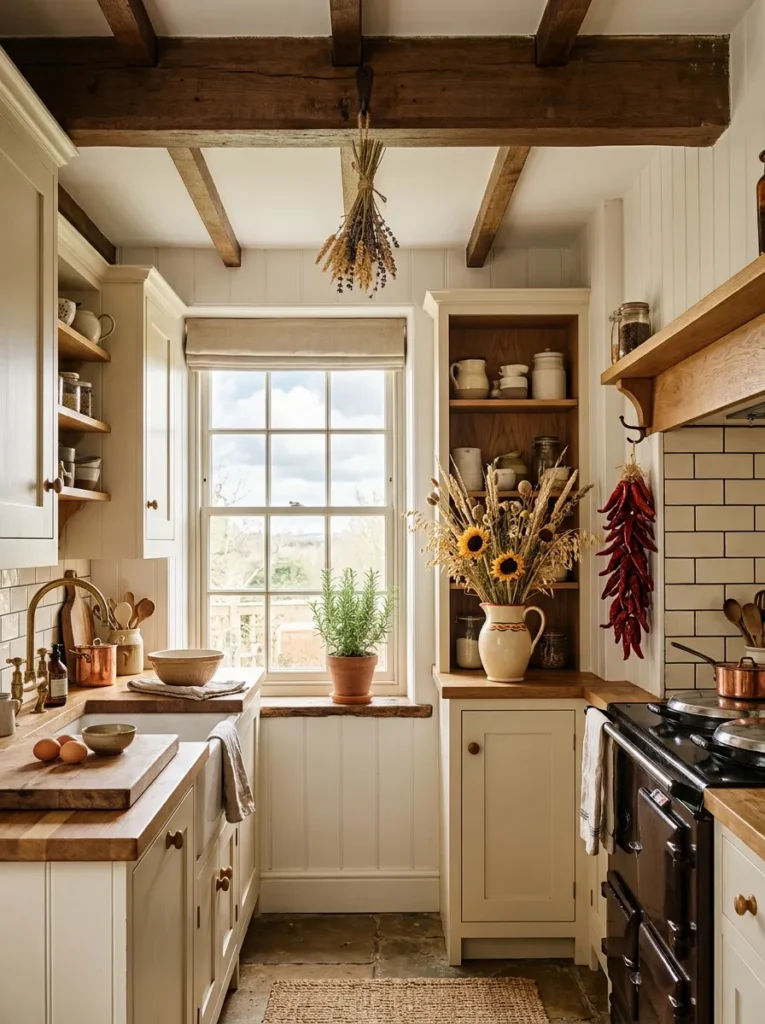
Vibe: The botanical kitchen feels like a kitchen that has been cooking all summer and preserved the season on its walls — the dried lavender, the chile string, and the wheat sheaf creating decoration that reads as the evidence of genuine seasonal living.
Why it works: Dried botanical displays throughout a farmhouse kitchen apply the genuine decoration principle — in a chic modern farmhouse kitchen, the most appropriate decoration is not objects purchased for the purpose of decorating but the material evidence of genuine kitchen and garden use: the dried herbs from last summer’s garden, the chile peppers from the autumn harvest, the wheat bundle from the field margin, the lavender from the garden border. These botanical elements provide the specific decoration quality of the farmhouse kitchen at its best — warmth, scent, natural material texture, and the cultural reference of genuine food culture rather than generic kitchen decoration. The multiple position approach (hanging, windowsill, shelf, range-side) distributes the botanical presence throughout the kitchen rather than concentrating it in a single display.
Maintaining the display: Dried botanicals in a kitchen environment need refreshing annually — the natural color fades over time in the kitchen’s humidity and warmth, and the aromatics (lavender, dried herbs) gradually lose their fragrance. Replace or supplement the dried displays with fresh bundles from the summer garden each autumn to maintain both the visual quality and the fragrance that makes dried botanical kitchen decoration genuinely sensory rather than merely visual.
Shop The Look
| Product |
|---|
| Dried lavender bunch large |
| Dried wheat stem bundle |
| Jute twine bundle tie |
| Dried chile string kitchen |
| Ceramic pitcher display vessel |
How to Start Your Chic Modern Farmhouse Kitchen
The single most important first move before beginning any farmhouse kitchen renovation is identifying which specific element of the farmhouse kitchen aesthetic most strongly reflects the household’s genuine cooking and domestic life — and starting with that element rather than with the cabinet door profile. A household that genuinely cooks should start with the range cooker and the butler’s sink (the two fixtures whose presence most fundamentally defines a farmhouse kitchen’s function and character) and build the cabinetry and surface decisions around them. A household that genuinely gathers should start with the island and its seating arrangement. A household that genuinely grows and harvests should start with the open shelving and the botanical display positions. The farmhouse kitchen that begins with genuine functional priorities reads as authentic; the one that begins with aesthetic surface choices and then adds the functional elements reads as styled.
The most common mistake in chic modern farmhouse kitchen design is allowing the “modern” discipline to so thoroughly edit the “farmhouse” warmth that the resulting kitchen reads as contemporary with farmhouse accessories rather than as a genuinely hybrid design. The specific elements that most reliably prevent this failure are: the butler’s sink (which no contemporary design convention can improve upon), the range cooker (whose specific form and scale creates the kitchen’s architectural focal point regardless of what surrounds it), and the open shelf with genuine everyday-use objects (which provides the honest functional display that purely fitted kitchen cabinetry conceals). These three elements together establish the farmhouse character that the chic modern design discipline then refines, proportions, and calibrates rather than eliminating.
Three specific investments under $150 that immediately move any kitchen toward the chic modern farmhouse aesthetic: replacing all existing cabinet hardware with aged brass cup pulls and knobs ($30–80 for a complete kitchen set, the single most impactful low-cost kitchen change available); adding one bundle of dried botanicals (dried lavender, dried wheat, or dried herbs, tied with jute twine and hung from a ceiling hook — $10–25 from a dried flower supplier, providing the farmhouse decoration element at essentially zero design effort); and replacing a section of upper cabinetry with one or two solid timber floating shelves ($30–70 for the timber and concealed brackets, open shelving providing the honest display quality that closed upper cabinets suppress). These three investments combined for under $150 address the hardware warmth, the botanical element, and the open display quality — three of the most immediately visible farmhouse kitchen qualities.
Frequently Asked Questions About Chic Modern Farmhouse Kitchens
What is the difference between a traditional farmhouse kitchen and a chic modern farmhouse kitchen?
A traditional farmhouse kitchen is characterized by historical material references used without contemporary editing — heavy timber beams, rough stone floors, unfitted furniture arranged in a functional rather than designed order, and the accumulated material evidence of decades of use with no concern for aesthetic composition. A chic modern farmhouse kitchen uses the same material vocabulary (timber, stone, ceramic, aged brass) but applies a contemporary design discipline to its arrangement — clean cabinet profiles, resolved proportion, edited color palette, considered lighting, and the deliberate juxtaposition of traditional materials with contemporary function. The chic modern farmhouse kitchen is designed; the traditional farmhouse kitchen accrues. Both have genuine appeal, but they serve different design intentions: the traditional kitchen communicates history, and the chic modern kitchen communicates both material warmth and design intelligence simultaneously.
What colors work best for a chic modern farmhouse kitchen?
The chic modern farmhouse kitchen’s color palette is defined by warm neutrals and warm nature-tones — colors that reference the agricultural and natural landscape without being literally botanical or literally earthy. The most consistently successful farmhouse kitchen colors are: linen white (a warm white with barely visible cream warmth, suitable for all cabinetry), warm sage (a muted warm green with yellow-green undertone, suitable for lower cabinets or an island), warm charcoal (a dark color with brown warmth rather than cool blue-black, suitable for an island or a single cabinet run), warm mushroom or warm putty (a warm gray-beige, suitable for cabinetry in a kitchen where sage would be too assertively colored), and deep warm navy (a blue with sufficient warmth to avoid reading as cool, suitable for a bold island or lower cabinet specification). Colors to avoid: cool gray (reads as 2010s contemporary rather than timeless farmhouse), pure white (too cool, too clean for the farmhouse warmth), and high-saturation primaries (too assertive for the farmhouse’s material-led aesthetic).
Are open shelves practical in a farmhouse kitchen?
Open shelves are practical in a farmhouse kitchen when they contain items that are used daily and when the kitchen environment has sufficient air circulation to prevent dust and grease accumulation. The items best suited to open shelf display in a kitchen are: white or neutral ceramic plates and bowls (which are used daily, look beautiful stacked, and can be quickly rinsed if dusty), cookbooks (not frequently enough used to require enclosed storage, attractive as a decorative element), glass storage jars (visible contents make them functional as daily pantry items while providing visual interest), and ceramic vessels used as utensil holders (the utensil-in-a-ceramic-vessel format is both more functional and more visually interesting than a dedicated utensil holder). Items poorly suited to open shelf display are: small miscellaneous gadgets and accessories (which create visual clutter), rarely used items (which accumulate dust), and anything in non-neutral colors that conflicts with the overall palette.
How do you keep a farmhouse kitchen feeling modern rather than rustic?
The key to maintaining the modern quality within a farmhouse kitchen is editing the rustic elements so that each appears by deliberate choice rather than by default. Specifically: use exposed timber beams only if they are genuinely structural or genuinely beautiful in their natural form (not decorative applied beams in stained pine); use exposed brick only if it is genuinely warm and high-quality (not reconstituted brick slips); keep the cabinet profiles clean (Shaker panel with minimal molding depth rather than complex Victorian profile); maintain the hardware finish consistency (all aged brass, not mixed periods); and use dried botanicals as edited, composed displays rather than as accumulated decorative elements. The farmhouse kitchen reads as chic and modern when each rustic element has been chosen and positioned with care; it reads as simply rustic when the elements accumulate without editing.
What flooring works best in a chic modern farmhouse kitchen?
The flooring materials that most consistently produce a chic modern farmhouse kitchen result are: large-format porcelain tiles in a warm stone effect (the simplicity of the large format combined with the warmth of a stone reference creates a floor that reads as contemporary and farmhouse simultaneously), genuine stone tiles in a warm cream or warm gray limestone or sandstone (honed finish, aged edge if appropriate to the kitchen’s aesthetic), and wide-plank solid oak or engineered oak in a natural or lightly oiled finish (the width of the board — minimum 150mm, preferably 200mm or wider — is important: narrow-board timber reads as traditional parquet rather than farmhouse plank). Avoid: small-format terracotta or Victorian-pattern encaustic tiles (too historically specific), highly polished porcelain (too commercial), and vinyl or luxury vinyl tile flooring in wood or stone effects (the manufactured quality is consistently discernible at close range in a kitchen where floor level is frequently experienced).
Ready to Design Your Chic Modern Farmhouse Kitchen?
These 14 inspirations move through every dimension of what makes a farmhouse kitchen genuinely chic and genuinely modern — from the refined warmth of linen white Shaker cabinetry with aged brass hardware, through the botanical honesty of ceiling pot racks and dried lavender bundles, the premium material quality of warm marble worktops and handmade ceramic tile, the architectural character of exposed beams and painted brick walls, to the social generosity of an island with natural timber barstool seating. Starting with the functional anchors — the range cooker, the butler’s sink, the island seating — before making any surface or color decision is the beginning that grounds the farmhouse character in genuine function rather than in aesthetic styling. Identify what the household genuinely uses the kitchen for, specify the fixtures that serve those uses most completely, and build the cabinetry, surface, and hardware decisions outward from those functional anchors. When the kitchen is complete — the aged brass bridge tap above the fireclay sink, the dried lavender above the window, the marble worktop catching the afternoon light, the range cooker at the room’s center — it will read as a kitchen that was designed from the inside out rather than from the style references inward, and that specific quality is what distinguishes genuinely chic from merely fashionable.